
Depth of Knowledge and the Cognitive Rigor Matrix


- Slides: 10
Depth of Knowledge and the Cognitive Rigor Matrix 1
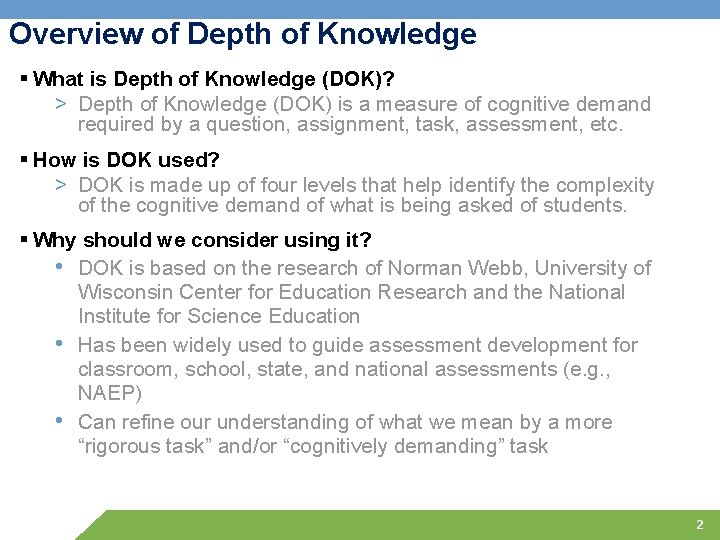
Overview of Depth of Knowledge § What is Depth of Knowledge (DOK)? > Depth of Knowledge (DOK) is a measure of cognitive demand required by a question, assignment, task, assessment, etc. § How is DOK used? > DOK is made up of four levels that help identify the complexity of the cognitive demand of what is being asked of students. § Why should we consider using it? • DOK is based on the research of Norman Webb, University of Wisconsin Center for Education Research and the National Institute for Science Education • Has been widely used to guide assessment development for classroom, school, state, and national assessments (e. g. , NAEP) • Can refine our understanding of what we mean by a more “rigorous task” and/or “cognitively demanding” task 2
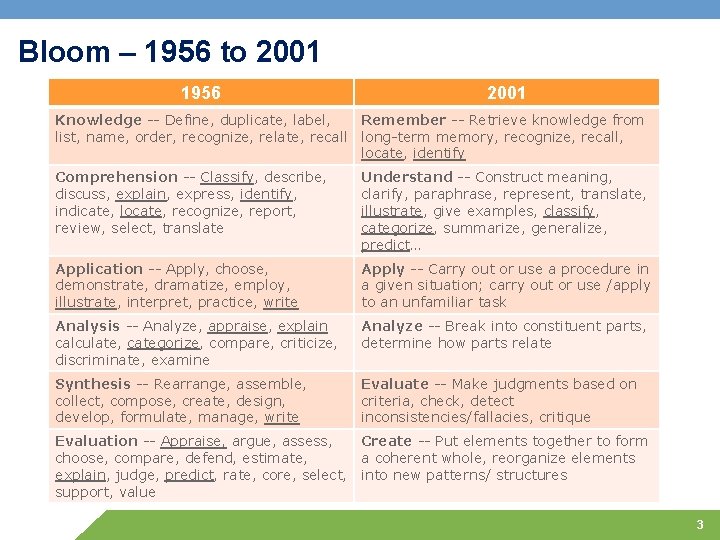
Bloom – 1956 to 2001 1956 2001 Knowledge -- Define, duplicate, label, Remember -- Retrieve knowledge from list, name, order, recognize, relate, recall long-term memory, recognize, recall, locate, identify Comprehension -- Classify, describe, discuss, explain, express, identify, indicate, locate, recognize, report, review, select, translate Understand -- Construct meaning, clarify, paraphrase, represent, translate, illustrate, give examples, classify, categorize, summarize, generalize, predict… Application -- Apply, choose, demonstrate, dramatize, employ, illustrate, interpret, practice, write Apply -- Carry out or use a procedure in a given situation; carry out or use /apply to an unfamiliar task Analysis -- Analyze, appraise, explain calculate, categorize, compare, criticize, discriminate, examine Analyze -- Break into constituent parts, determine how parts relate Synthesis -- Rearrange, assemble, collect, compose, create, design, develop, formulate, manage, write Evaluate -- Make judgments based on criteria, check, detect inconsistencies/fallacies, critique Evaluation -- Appraise, argue, assess, Create -- Put elements together to form choose, compare, defend, estimate, a coherent whole, reorganize elements explain, judge, predict, rate, core, select, into new patterns/ structures support, value 3
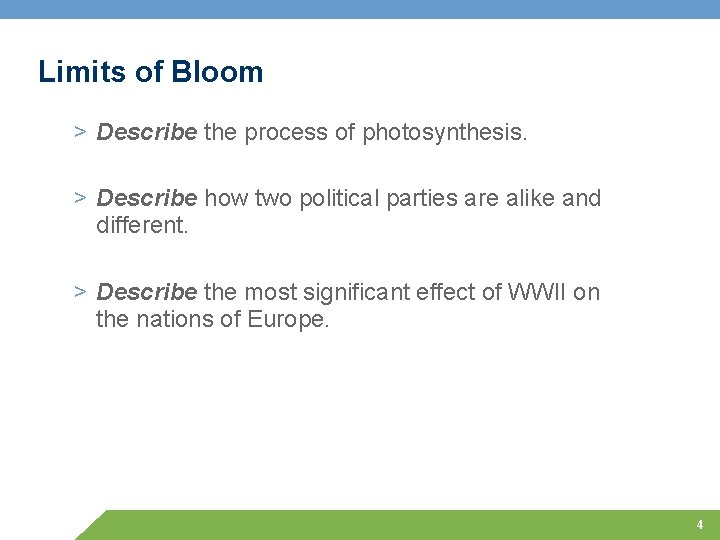
Limits of Bloom > Describe the process of photosynthesis. > Describe how two political parties are alike and different. > Describe the most significant effect of WWII on the nations of Europe. 4
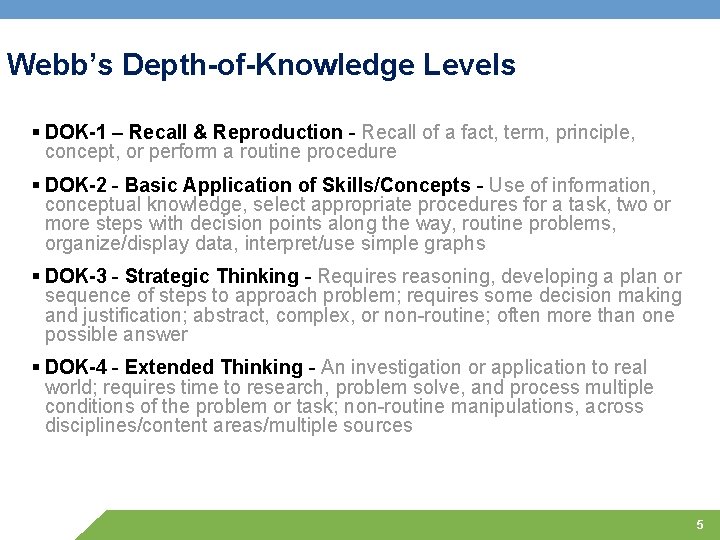
Webb’s Depth-of-Knowledge Levels § DOK-1 – Recall & Reproduction - Recall of a fact, term, principle, concept, or perform a routine procedure § DOK-2 - Basic Application of Skills/Concepts - Use of information, conceptual knowledge, select appropriate procedures for a task, two or more steps with decision points along the way, routine problems, organize/display data, interpret/use simple graphs § DOK-3 - Strategic Thinking - Requires reasoning, developing a plan or sequence of steps to approach problem; requires some decision making and justification; abstract, complex, or non-routine; often more than one possible answer § DOK-4 - Extended Thinking - An investigation or application to real world; requires time to research, problem solve, and process multiple conditions of the problem or task; non-routine manipulations, across disciplines/content areas/multiple sources 5
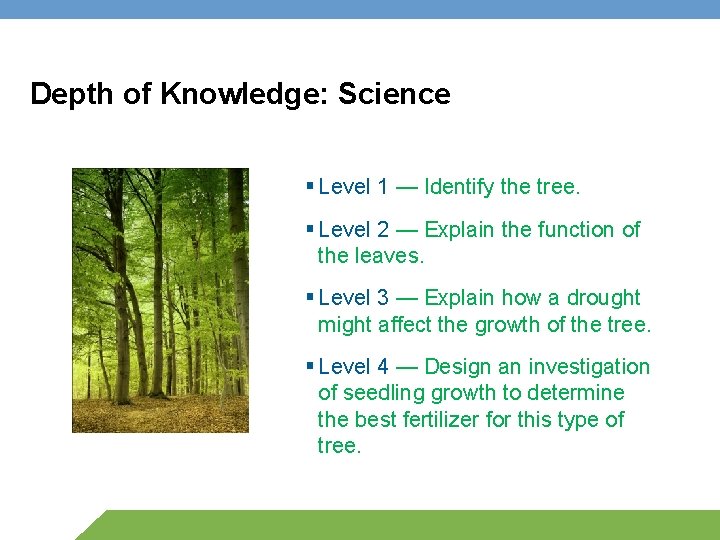
Depth of Knowledge: Science § Level 1 — Identify the tree. § Level 2 — Explain the function of the leaves. § Level 3 — Explain how a drought might affect the growth of the tree. § Level 4 — Design an investigation of seedling growth to determine the best fertilizer for this type of tree.
Depth of Knowledge: ELA § Level 1 — Identify the main characters in this story. § Level 2 — Which of the following best describes the main characters’ feelings about each other? § Level 3 — Why do the main characters conflict? § Level 4 — Interview your friends to compare how they deal with problems with other people.
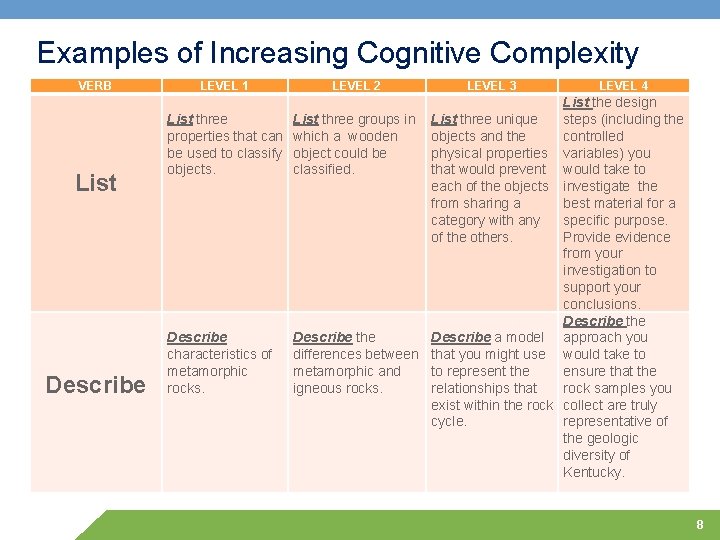
Examples of Increasing Cognitive Complexity VERB List Describe LEVEL 1 LEVEL 2 LEVEL 3 LEVEL 4 List the design List three groups in List three unique steps (including the properties that can which a wooden objects and the controlled be used to classify object could be physical properties variables) you objects. classified. that would prevent would take to each of the objects investigate the from sharing a best material for a category with any specific purpose. of the others. Provide evidence from your investigation to support your conclusions. Describe the Describe a model approach you characteristics of differences between that you might use would take to metamorphic and to represent the ensure that the rocks. igneous rocks. relationships that rock samples you exist within the rock collect are truly cycle. representative of the geologic diversity of Kentucky. 8
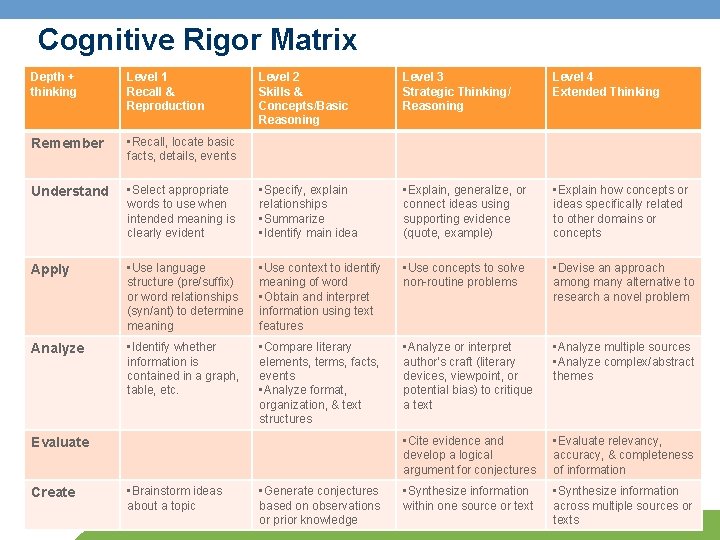
Cognitive Rigor Matrix Depth + thinking Level 1 Recall & Reproduction Level 2 Skills & Concepts/Basic Reasoning Level 3 Strategic Thinking/ Reasoning Level 4 Extended Thinking Remember • Recall, locate basic facts, details, events Understand • Select appropriate words to use when intended meaning is clearly evident • Specify, explain relationships • Summarize • Identify main idea • Explain, generalize, or connect ideas using supporting evidence (quote, example) • Explain how concepts or ideas specifically related to other domains or concepts Apply • Use language structure (pre/suffix) or word relationships (syn/ant) to determine meaning • Use context to identify meaning of word • Obtain and interpret information using text features • Use concepts to solve non-routine problems • Devise an approach among many alternative to research a novel problem Analyze • Identify whether information is contained in a graph, table, etc. • Compare literary elements, terms, facts, events • Analyze format, organization, & text structures • Analyze or interpret author’s craft (literary devices, viewpoint, or potential bias) to critique a text • Analyze multiple sources • Analyze complex/abstract themes • Cite evidence and develop a logical argument for conjectures • Evaluate relevancy, accuracy, & completeness of information • Synthesize information within one source or text • Synthesize information across multiple sources or texts 9 Evaluate Create • Brainstorm ideas about a topic • Generate conjectures based on observations or prior knowledge
Weaving DOK into our current units of study and curriculum maps can help schools transition to the CCSS… College & Career Trajectory K O D 4 1 f. S it o n U y tud S f it o Un y tud it Un K DO 4 1 - it Un y tud it Un tu f. S it o S of o y tud S f S of K O D 4 1 - dy Un September Curriculum June