
DEPT OF FM TOXICOLOGY Rights Duties of Doctors




- Slides: 23
DEPT: OF FM& TOXICOLOGY
Rights &Duties of Doctors and Patients Dr. salini Chandran BHMS; PGDMLS
Rights of a RMP To practice medicine u To choose a patient u To dispense medicines u To possess and supply dangerous drugs u To add descriptions etc to name u To recovery of fees u For appointment in local and public hospitals u To issue medical certificates u To give evidence as an expert u
Duties of a RMP u Duty to exercise proper skill and care u Duties with regard to attendance and examination u Duty to furnish proper and suitable medicine u Duty to give instructions u Duty to control and warn u Duty to third parties u Duty to inform patient of risks u Duty with regard to poisons
u Duty to notify certain diseases u Duty with regard to consultation
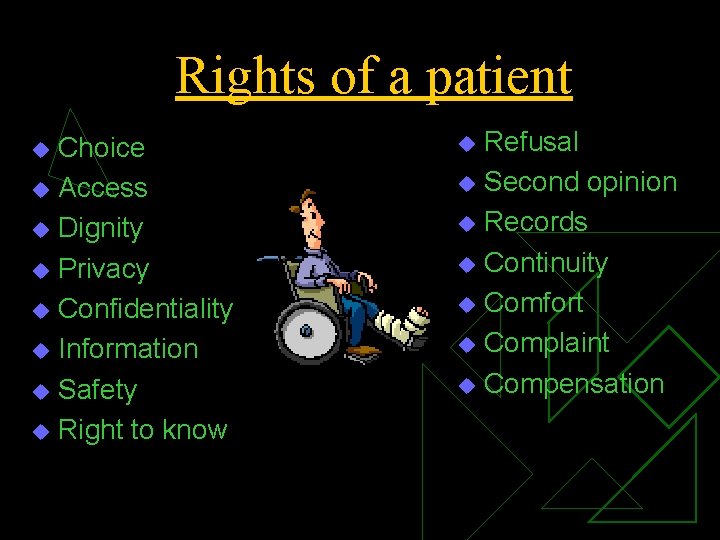
Rights of a patient Choice u Access u Dignity u Privacy u Confidentiality u Information u Safety u Right to know u Refusal u Second opinion u Records u Continuity u Comfort u Complaint u Compensation u
Doctor can refuse to treat a patient in: u Beyond his practicing hours u Not belonging to his speciality u Illnesses beyond the competence and qualifications of the doctor or beyond the facilities available in his setup /institution u Doctor is unwell or family member is ill u Doctor is having important social function in the family u Doctor has consumed alcohol u Patient has been defaulting payment
u Patient or his/her relatives are non-cooperative violent or abusive u Malingerer u Patient refuses to give consent or accept risk u Patient rejecting low cost remedies in favour of high- cost alternatives u At night on grounds of security if the patient is not brought to him u An unaccompanied minor patient or female patient u Any new patient if he is not the only doctor
PROFESSIONAL SECRECY It is an implied term of contract between the doctor and his patient The doctor is obliged to keep secret , all that he comes to know concerning the patient in course of his professional work Disclosure is failure of trust and confidence Doctor can be sued if harm results
PRIVILAGED COMMUNICATION u. A statement made bonafide upon any subject matter by a doctor to the concerned authority , due to his duty to protect the interests of the community or the state u Should be made only to the party who has direct interest in itor in reference of which he has a duty
Examples of privilaged communication Infectious diseases u Servants and employees u Venereal diseases u Self- interest u Patient’s own interest u Suspected crime u Negligence suits u Courts of law u
Medical Records u It is necessary for a GP to maintain Medical Records of the patient examined on outdoor basis or indoor basis u Mandatory u May be called upon for later evidence in court
u. The Medical Record is the’who ‘‘what ‘ ‘when’ ‘where’ ‘why’ of the patient care in the hospital u. Only documentary evidence of the care and treatment in the hospital‘
CONTENTS u Particulars of the patient u Date and time of arrival andexamination in hospital u Date and time of admission and discharge from hospital u The complaints of the patient u Relevant past history u Relevant family history u Relevant personal history
u Lab examinations and other investigations u Details of examinations done and their findings u Treatment given u Duly completed consent forms for all procedures and operations done u Prognosis u In case of consultation with another doctorhis opinion and reports
u In case of discharge from hospital-the condition at the time of discharge u Details of information to police –in medicolegal cases u In case of death-cause , time and date of death u Name and signature of the doctor
Property Rights u The medical records and X’ray plates are the property of the hospital u The patient buys the expertise and the treatment rather than the records u All records are kept in the hospital for the benefit of the patient, , doctor and hospital u Patient does not own his records, though he has a legal right to use the information contained therein
Patient’s Rights Usually the patient is given a copy of the investigation Reports, treatment advised and the discharge summary u Patient has right to know what is in his records and is entitled to a copy of his hospital records on discharge, on payment of cost of reproduction u In cases of death his next of kin can have the hospital records u Therapeutic discretion can be used u
u. The records cannot be used by the hospital for publication without the patient’s consent
Govt: and other agencies u Many a times a request is received from Govt: & other agencies like LIC to supply information about a patient u As per law , they are NOT entitled to this information without the written consent of the patient and the hospital must not comply with such requests u Information about the name, age , sex, dates of admission and discharge can be given as they are not confidential
Disposal of Medical Records u NON MLC– u OPD records have to be retained for minimum 3 yrs u IPD -- records have to be retained for minimum 5 yrs u MLC u There is no specified time limit so they should be retained