
Depression and Cardiovascular Disease The correlation between mind
Depression and Cardiovascular Disease: The correlation between mind and body Jessica Fordham, DNP, APRN, FNP-C, PMHNP student University of Alabama at Birmingham
Objective �Discuss the prevalence, risk factors, economic burdens, comorbidities and correlation between depression and cardiovascular disease. �Define and discuss theoretical underpinnings of depression �Define and describe Depression according to the DSM 5 criteria, symptoms, and evidence-based treatment recommendation �Discuss evidence-based risk reduction and prevention methods to reduce depression and cardiovascular disease �Provide a detailed description of the role of the psychiatric nurse practitioner along with screening tools, community resources, and supportive care instructions to foster at risk individuals.
Background �Depression affects the entire body �Depression heighten the risk of heart disease �Depression is about twice as likely to occur in people with heart disease compared with the general population �Between 31 -45% of patients with coronary artery disease (CAD), including those with unstable angina, or Myocardial infarction (MI), suffer from clinically significant depressive symptoms
Depression in the United States �Major Depression is the most common psychiatric Disorder in America �Estimated 1 out of 10 Americans ages 18 and older suffers from Depression �Depressive episodes are higher among adult females (8. 5%) compared to males(4. 8%). �There is an increase prevalence of a major depressive episode among individuals aged 18 -25 (10. 9%)
Common Comorbid Mental Disorders with Depression in Cardiac Patients �Anxiety symptoms and formal anxiety disorders are strongly associated with depression in a variety of cardiac populations. �According to Huffman, Celano, Beach, Motiwala, and Januzzi (2013), Anxiety Disorder (GAD) has been concomitantly present in Major Depressive Disorder (MDD) among 38% of patients with CAD and Acute Coronary Syndrome (ACS) in a large outpatient study. �PTSD commonly seen in CABG patients and those who receive ICD �PTSD may stem from the cardiac event necessitating ICD placement or from firing of the device itself.
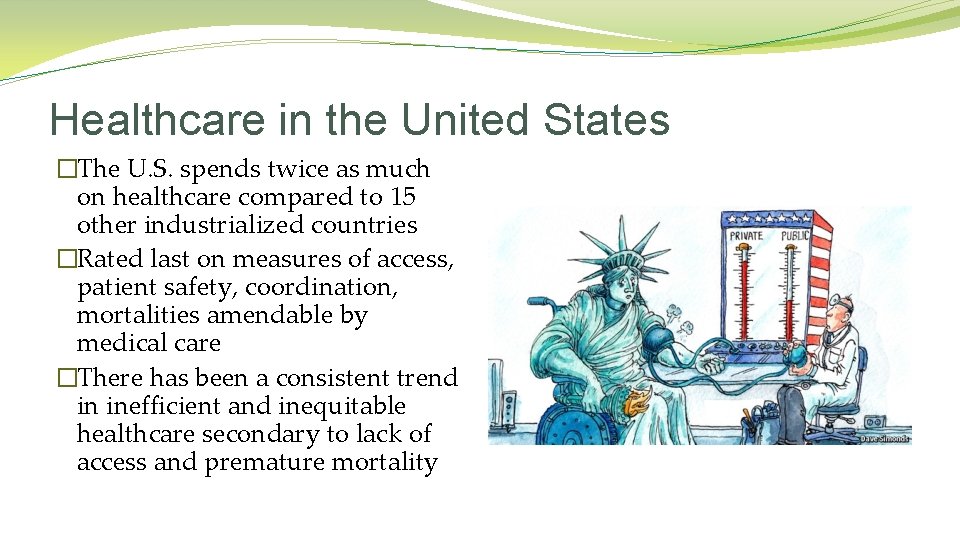
Healthcare in the United States �The U. S. spends twice as much on healthcare compared to 15 other industrialized countries �Rated last on measures of access, patient safety, coordination, mortalities amendable by medical care �There has been a consistent trend in inefficient and inequitable healthcare secondary to lack of access and premature mortality
Economic Burden of Depression and Cardiovascular Disease in America �Depression results in almost $400 million disability days per year �In 2010, suicide-related cost associated with individuals with MDD was $9. 7 billion �Cost associated with workplace absentism resulting from MDD was $78. 7 billion in 2010 �Direct cost incurred by individuals with MDD was $98. 9 billion in 2010 �In 2016, Cardiovascular disease (CVD) cost America $555 billion �Direct cost associated with CVD was $318 billion �Indirect cost of CVD is estimated to be around $237 billion �It’s projected by 2035 the cost of CVD will increase to $1. 1 trillion.
Correlation Between Depression and Heart Disease �Depression increase production of stress hormone �Depression increase glucose level and cortisol levels which induces inflammation �Low-grade inflammation contributes to the clogging of arteries and the rupture of cholesterol-filled plaque �Increase cell fragments known as platelets to clump and form clots in the blood stream �These phenomenon are linked to the development of CAD, unstable angina, heart failure and heart attack
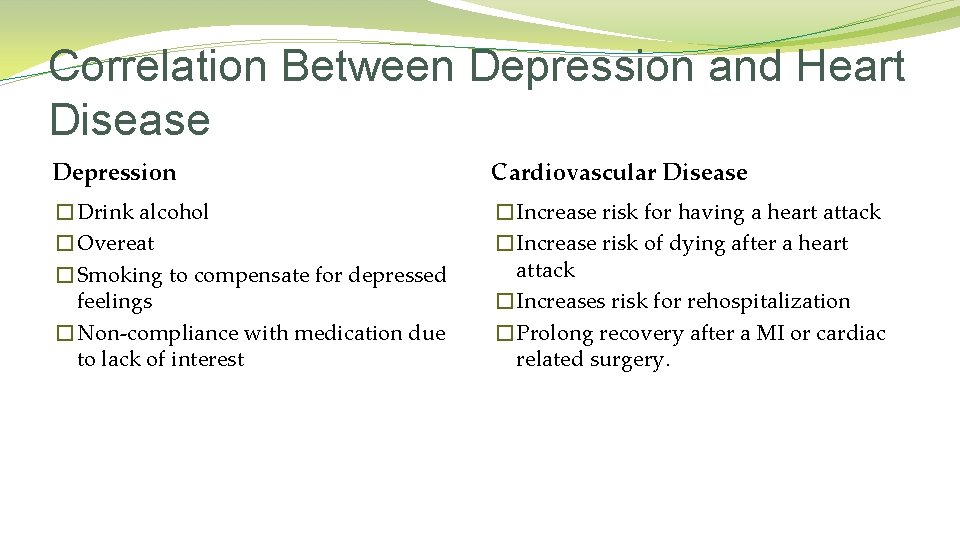
Correlation Between Depression and Heart Disease Depression Cardiovascular Disease �Drink alcohol �Overeat �Smoking to compensate for depressed feelings �Non-compliance with medication due to lack of interest �Increase risk for having a heart attack �Increase risk of dying after a heart attack �Increases risk for rehospitalization �Prolong recovery after a MI or cardiac related surgery.
Theory and Science of Depression �Seligman’s (1972) learned helplessness theory of depression was a notable study which depicted how repeated exposure to uncontrollable and aversive environmental stimuli lead to individuals being depressed. �Abramason et. Al (1978) reformulated theory of learned helplessness and articulated it as the hopelessness theory of depression �One of the first depictions of a depressive syndrome was noted in the Old Testament story of King Saul.
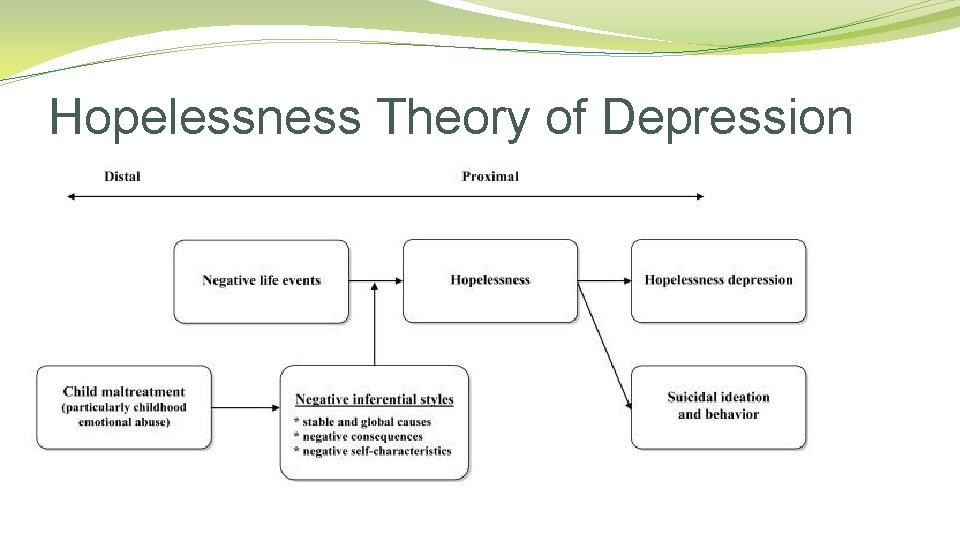
Hopelessness Theory of Depression
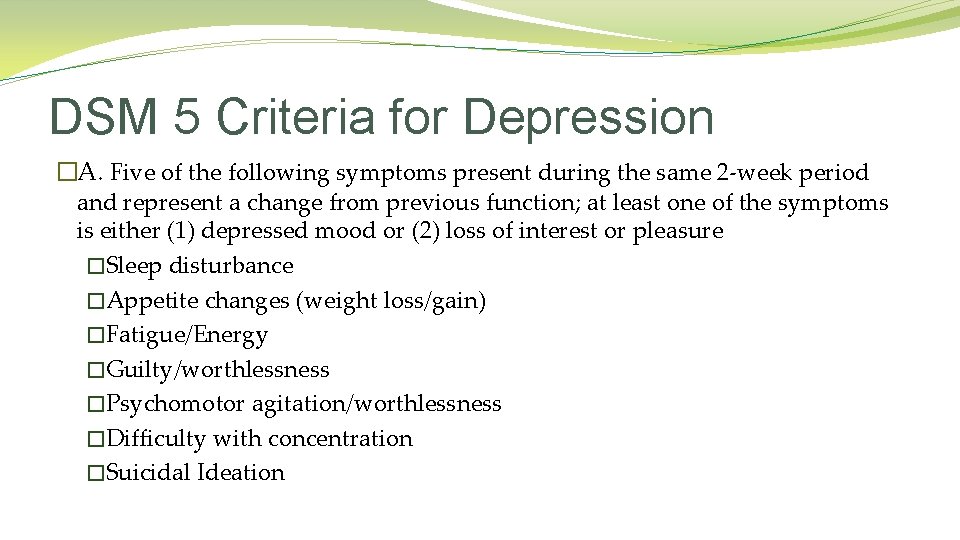
DSM 5 Criteria for Depression �A. Five of the following symptoms present during the same 2 -week period and represent a change from previous function; at least one of the symptoms is either (1) depressed mood or (2) loss of interest or pleasure �Sleep disturbance �Appetite changes (weight loss/gain) �Fatigue/Energy �Guilty/worthlessness �Psychomotor agitation/worthlessness �Difficulty with concentration �Suicidal Ideation
Signs of Depression �Feelings of sadness that doesn’t resolve �Irritableness �Difficulty focusing and making decisions �Difficulty falling or staying asleep/sleeping to much �Weight loss (loss of appetite) or gain (comfort eating) due to changes in appetite �Lose interest in previous enjoyed activities including sex �Self hate, guilt, and worthlessness �Thoughts of death and suicide
Depression Treatment �Based on the severity of the symptoms, co-occurring disorder and psychosocial stressor, environmental factors, and patient preference �The main two types of treatment �Therapy �pharmacologic �First-line pharmacologic treatment is a Serotonin reuptake inhibiotor (SSRI) *Antidepressant* �Psychotherapy �Cognitive behavioral therapy
Steps to Reduce Depression and Cardiovascular Disease �Exercise �Routine exercise; Cardiac patients can join a cardiac rehabilitation program; �Be proactive �Be compliant with medication and treatment regimen. Adhere to positive activities �Stress reduction �Listen to music, yoga, and relaxation technique �Seek social support �Seek refuge with a person you trust and discuss fears and feelings �Notify healthcare provider for the following �Hear voices, cry often without cause, or symptoms affect work, family, and life for 2 weeks, or suicidal thoughts or ideation
Prevention is the Key �Choose Healthy Habits �Exercise: Improves mood and overall quality of health � Improves cardiovascular healthy; Increase cardiac perfusion �Healthy dietary choices � Choose foods from all 4 foods groups � Portion control (reduce calories) � Cut back on fats, sugars, �Smoking cessation �Practice coping strategies and reduce unnecessary stressors � Identify causes of stressor and address them � Breathing, relaxation, and meditation techniques � Yoga
Long-term Effects Depression Cardiovascular disease �Inflammation associated with elevated depressive symptoms or MDD is associated with CVD and CVD mortality �Individuals with CVD, depression is often chronic and recurrent �American Heart Association (AHA) (2014) listed depression as a risk factor for poor prognosis after heart attack �Risk of death in heart attack survivors with depression is three times that of those without depression
How Can I Help? Nurse Practitioner Community Support Volunteer �Assess and diagnose mental health illnesses �Develop and implement treatment plans for individuals and families with psychiatric disorders �Identify risk factors of psychiatric disorders �Policy development, quality improvement, practice evaluation, and healthcare reform �Healthcare facilitators �Exercise, Encouragement �Inspire individuals to be active in their health �Discuss and help with techniques to reduce stress �Social Support �Early identification and Screening
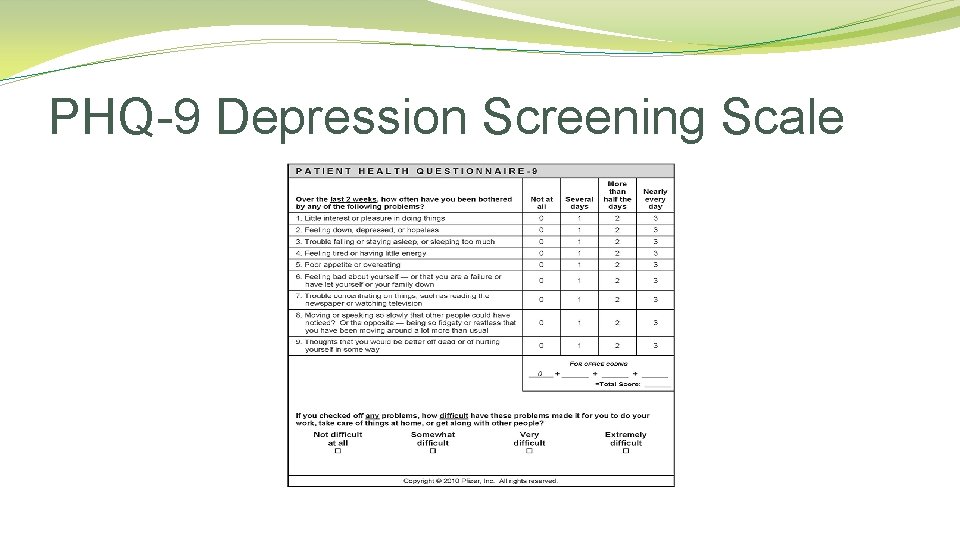
PHQ-9 Depression Screening Scale
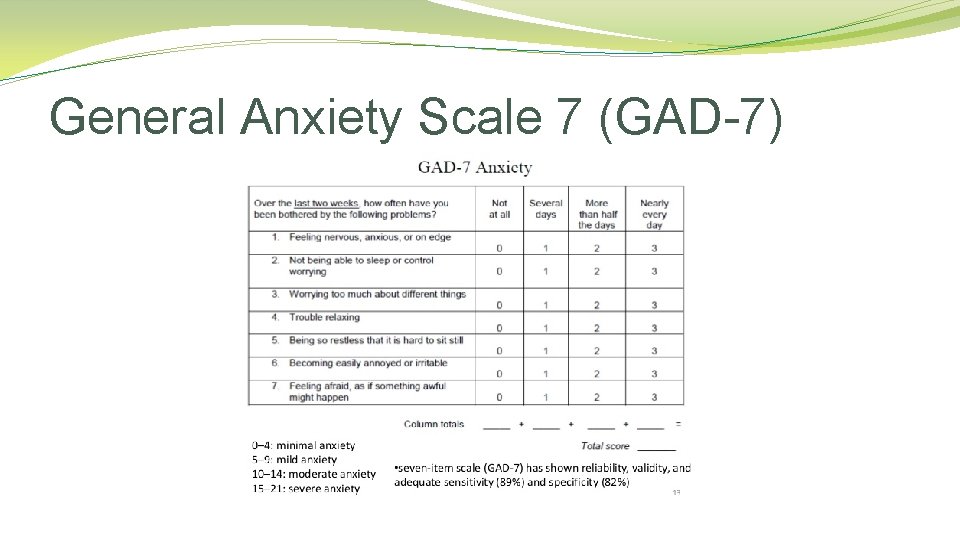
General Anxiety Scale 7 (GAD-7)
Community Resources �Hinds Behavioral Health Services �Regional Community Mental Health Center �Outpatient psychiatry and Drug/Alcohol Rehabilitation/Crisis �Mobile Crisis 601 -955 -6381 Facility 601 -321 -2400
Summary �Depression affects the entire body �Depression is about twice as likely to occur in people with heart disease compared with the general population �Individuals with CVD, depression is often chronic and recurrent �Risk of death in heart attack survivors with depression is three times that of those without depression �Choosing healthy habits decreases risk factors for developing both depression and cardiovascular disease �Early identification and Screening for depression improve cardiovascular health outcomes and prognosis

Questions
Reference � American Heart Association. (2017). Cardiovascular Disease: a costly burden for america projection through 2035. Retrieved from https: //healthmetrics. heart. org/wp-content/uploads/2017/10/Cardiovascular-Disease-A-Costly-Burden. pdf � American Heart Association. (n. d. ). How does depression affect the heart? Retrieved from http: //www. heart. org/HEARTORG/Healthy. Living/Stress. Management/How. Does. Stress. Affect. You/How-does-depression-affect-theheart_UCM_460263_Article. jsp#. W 0 go. Cad. Ki. M 8 � American Psychiatric Association. (2010). Practice guideline for the treatment of patients with major depressive disorder. Retrieved from http: //psychiatryonline. org/pb/assets/raw/sitewide/practice_guidelines/mdd. pdf � Depression and heart disease: A two-way street. (2016). Harvard heart Letter, 27(4), 5. Retrieved from http: //web. a. ebscohost. com. ezproxy 3. lhl. uab. edu/ehost/pdfviewer? vid=8&sid=93 ad 1 f 4 f-f 97 d-4 c 61 -89 d 651 e 2 a 6890%40 sessionmgr 4007 � Greenberg, P. E. , Fournier, A. , Sisitsky, T. , Pike, C. T. , & Kessler, R. C. (2015). The econcomic burden of adults with major depressive disorder in the United States (2005 -2010). Journal of Clinical Psychiatry, 76(2), 155 -162. https: //doi. org/10. 4088/jcp. 14 m 09298 � Huffman, J. C. , Celano, C. M. , Beach, S. R. , & Motiwala, S. R. (2013). Depression and Cardiac Disease: Epidemiology, Mechanisms, and Diagnosis. Cardiovascular, Psychiatry, and Neurology, 2013(695925), 1 -14. � Liu, R. T. , Kleiman, E. M. , Nestor, B. A. , & Cheek, S. M. (2015). The hopelessness theory of depression: a quarter century in review. Clinical psychology, 22(4), 345 -365. https: //doi. org/10. 1111/cpsp. 12125 � National Institute of Mental Health. (2017). Major Depression. Retrieved from https: //www. nimh. nih. gov/health/statistics/majordepression. shtml � National Library of Medicine. (n. d. ). Heart disease and depression. Retrieved from https: //medlineplus. gov/ency/patientinstructions/000790. htm
- Slides: 24