
Deposition of polymer thin films by PVD process
Deposition of polymer thin films by PVD process Olivia Lehtimäki 9. 3. 2016
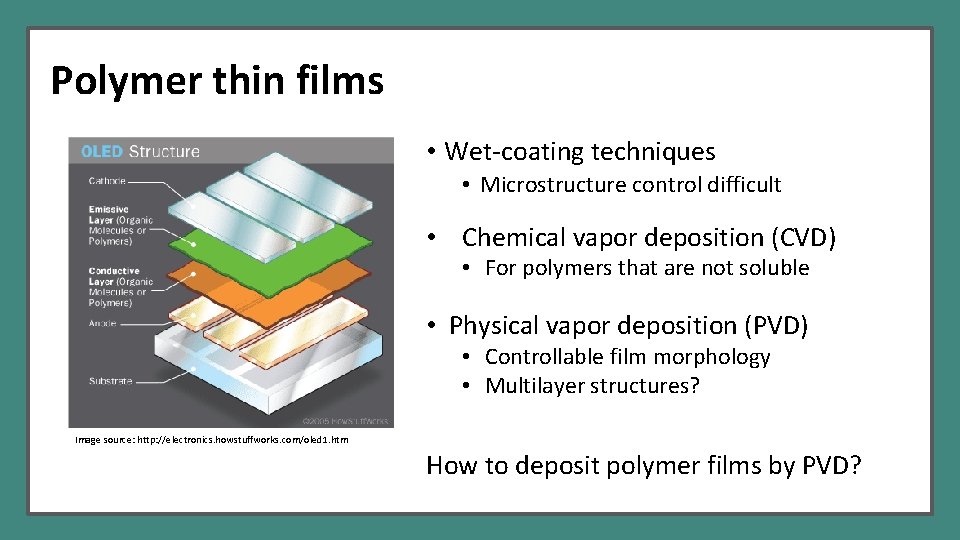
Polymer thin films • Wet-coating techniques • Microstructure control difficult • Chemical vapor deposition (CVD) • For polymers that are not soluble • Physical vapor deposition (PVD) • Controllable film morphology • Multilayer structures? Image source: http: //electronics. howstuffworks. com/oled 1. htm How to deposit polymer films by PVD?
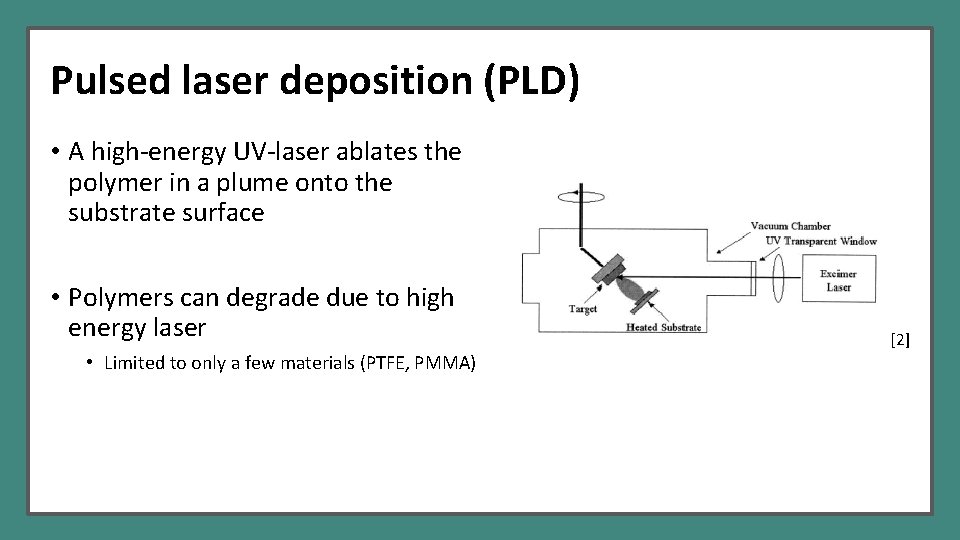
Pulsed laser deposition (PLD) • A high-energy UV-laser ablates the polymer in a plume onto the substrate surface • Polymers can degrade due to high energy laser • Limited to only a few materials (PTFE, PMMA) [2]
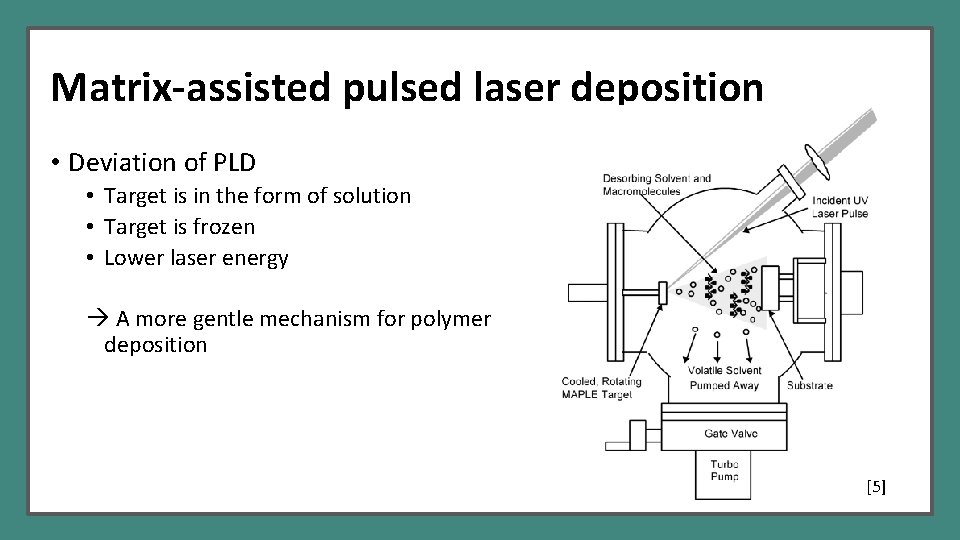
Matrix-assisted pulsed laser deposition • Deviation of PLD • Target is in the form of solution • Target is frozen • Lower laser energy A more gentle mechanism for polymer deposition [5]
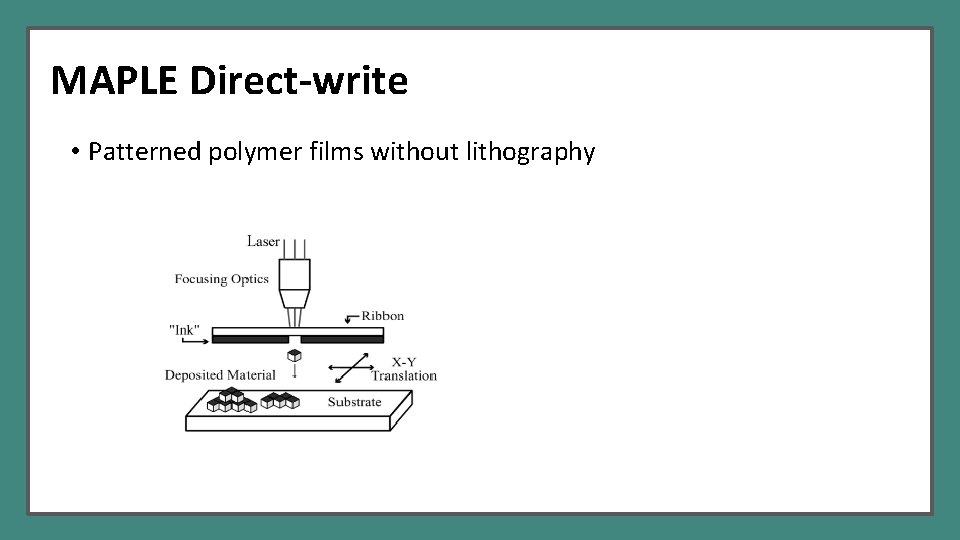
MAPLE Direct-write • Patterned polymer films without lithography

INFORMATION SLIDES
Introduction • Polymer thin films are important for optoelectronics, sensors and photovoltaics • Traditional wet-coating techniques cannot produce films with controlled morphology • These methods include spin-casting, ink-jet printing, drop-casting, spraying, Langmuir-Blodgett deposition • CVD can be used for polymers that are insoluble in common solvents • Specific reaction requirements needed to produce wanted polymers • Methods need to be developed as the applications for organic thin films grow PVD [1], [2], [3]
Pulsed laser deposition (PLD) • Limited to only a few materials • Polymer decomposition due to high energy • Succesful for depositing addition polymers (PTFE, PMMA) • A high-energy UV-laser ablates the polymer in a plume onto the substrate surface • Target holder is rotated • The film thickness control arises from the pulsed nature of the laser • The theory of PLD reactions for polymers • The UV laser converts the polymer to monomers and oligomers • These recombine on the substrate surface • The final film may not be chemically identical to the target material [2], [3], [4]
Matrix assisted pulsed laser evaporation • A deviation of pulsed laser deposition (PLD) • Same principle, difference in target and laser fluence • The target material is solution which is frozen by liquid nitrogen • Low concentration solution, highly volatile solvent • Target holder is cryogenically cooled to keep the target frozen • The polymer molecules evaporate with the solvent in a plume • A pulsed laser source ablates the target • The energy of the laser can be lower than for PLD as only the solvent needs to be evaporated • The solution absorbs most of the energy and therefore protects the fragile polymer molecules • Volatile solvent does not stick onto the substrate surface pumped away [5]
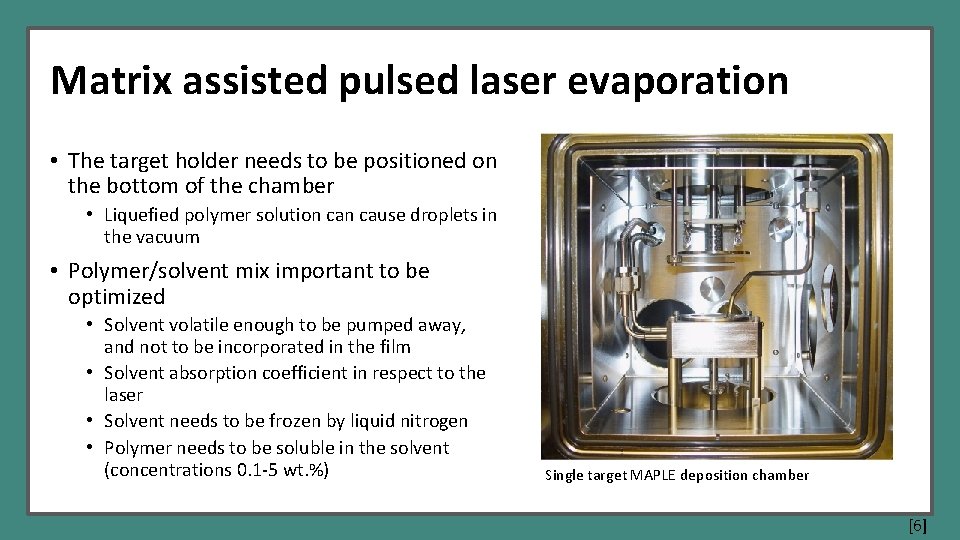
Matrix assisted pulsed laser evaporation • The target holder needs to be positioned on the bottom of the chamber • Liquefied polymer solution cause droplets in the vacuum • Polymer/solvent mix important to be optimized • Solvent volatile enough to be pumped away, and not to be incorporated in the film • Solvent absorption coefficient in respect to the laser • Solvent needs to be frozen by liquid nitrogen • Polymer needs to be soluble in the solvent (concentrations 0. 1 -5 wt. %) Single target MAPLE deposition chamber [6]
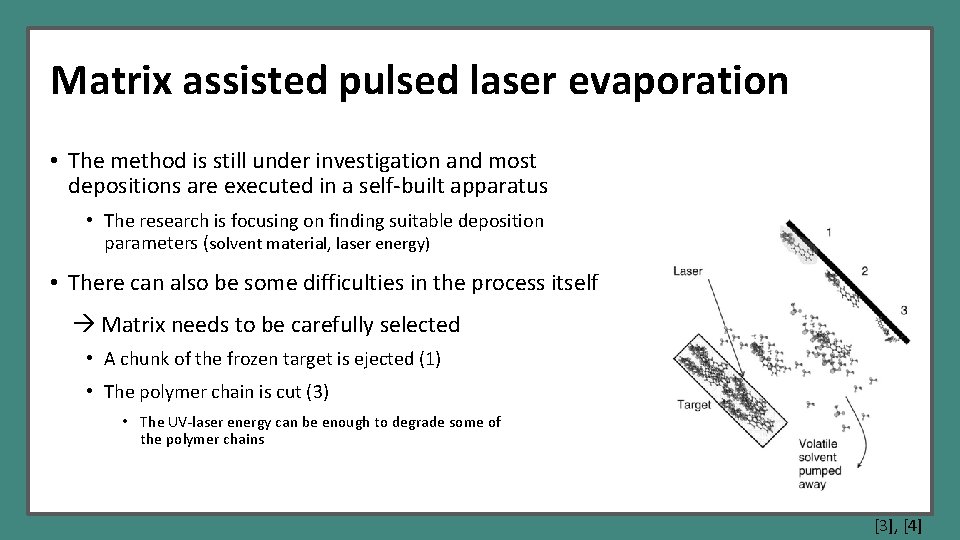
Matrix assisted pulsed laser evaporation • The method is still under investigation and most depositions are executed in a self-built apparatus • The research is focusing on finding suitable deposition parameters (solvent material, laser energy) • There can also be some difficulties in the process itself Matrix needs to be carefully selected • A chunk of the frozen target is ejected (1) • The polymer chain is cut (3) • The UV-laser energy can be enough to degrade some of the polymer chains [3], [4]
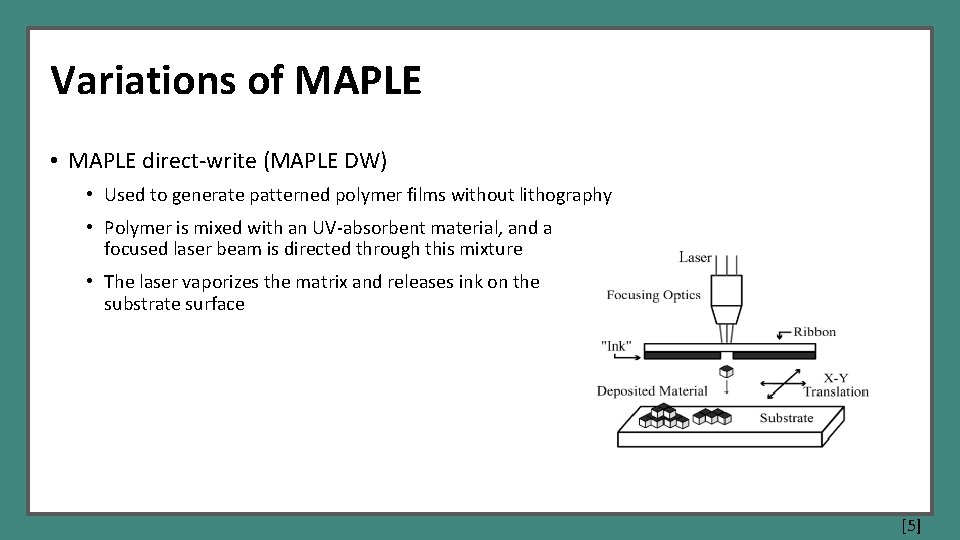
Variations of MAPLE • MAPLE direct-write (MAPLE DW) • Used to generate patterned polymer films without lithography • Polymer is mixed with an UV-absorbent material, and a focused laser beam is directed through this mixture • The laser vaporizes the matrix and releases ink on the substrate surface [5]
References 1. R. Pate et. al. , RIR-MAPLE deposition of conjugated polymers for application to optoelectronic devices, Applied Physics A 105 (2011) 555 -563 2. D. B. Chrisey et. al. , Laser Deposition of Polymer and Biomaterial Films, Chemical Reviews 103 (2003) 553 -576 3. K. B. Shepard, R. D. Priestley, MAPLE Deposition of Macromolecules, Macromolecular Chemistry and Physics 214 (2013) 862 -872 4. R. Eason, Pulsed Laser Deposition of Thin Films: Applications-Led Growth of Functional Materials, Wiley 2006, pp. 36 -41 5. A. Piqué et. al. , Laser processing of polymer thin films for chemical sensor applications, Surface and Coatings Technology 163 -164 (2003) 293 -299 6. J. A. Greer, Design challenges for matrix assisted pulsed laser evaporation and infrared laser evaporation equipment, Applied Physics A 105 (2011) 661 -667
- Slides: 13