
Deposition Notes and Stream Life History Notes Fill

- Slides: 13
Deposition Notes and Stream Life History Notes Fill in the Blanks of Your Part 3 Note Packet for Unit 4.
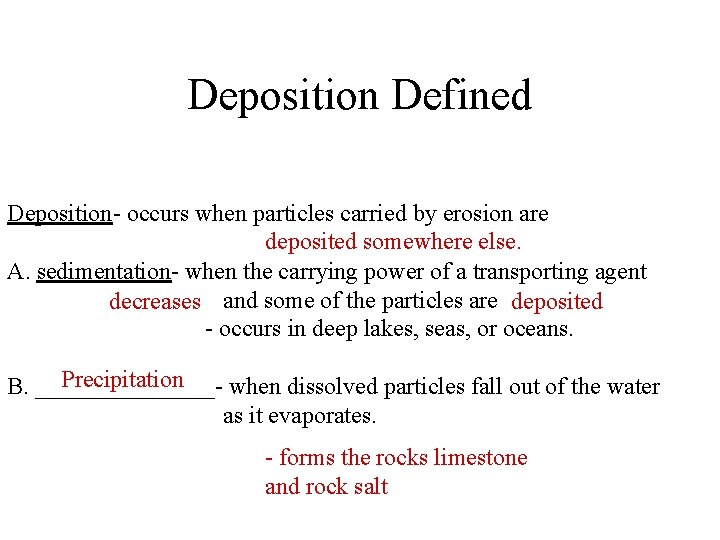
Deposition Defined Deposition- occurs when particles carried by erosion are deposited somewhere else. A. sedimentation- when the carrying power of a transporting agent decreases and some of the particles are deposited - occurs in deep lakes, seas, or oceans. Precipitation B. ________- when dissolved particles fall out of the water as it evaporates. - forms the rocks limestone and rock salt
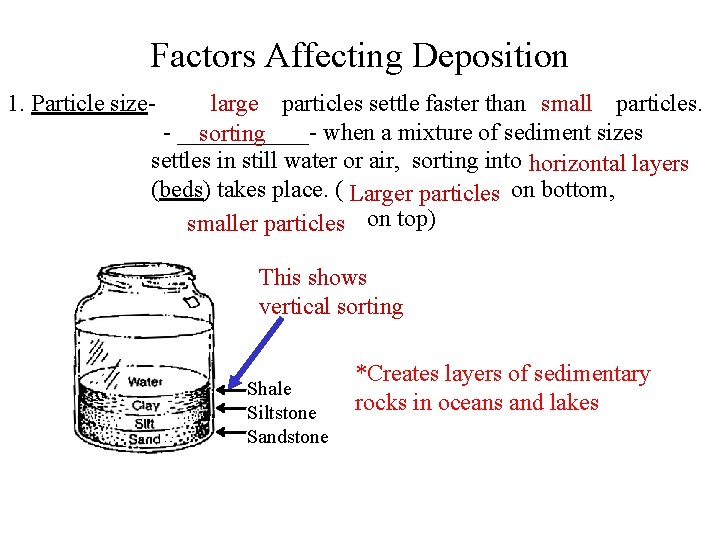
Factors Affecting Deposition 1. Particle size- particles settle faster than particles. large small - ______- when a mixture of sediment sizes sorting settles in still water or air, sorting into horizontal layers (beds) takes place. ( Larger particles on bottom, smaller particles on top) This shows vertical sorting Shale Siltstone Sandstone *Creates layers of sedimentary rocks in oceans and lakes
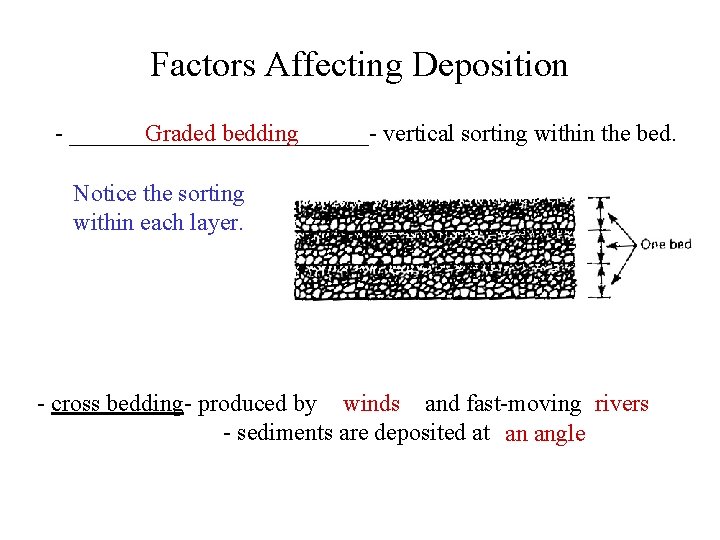
Factors Affecting Deposition - _____________- vertical sorting within the bed. Graded bedding Notice the sorting within each layer. - cross bedding- produced by and fast-moving winds rivers - sediments are deposited at an angle
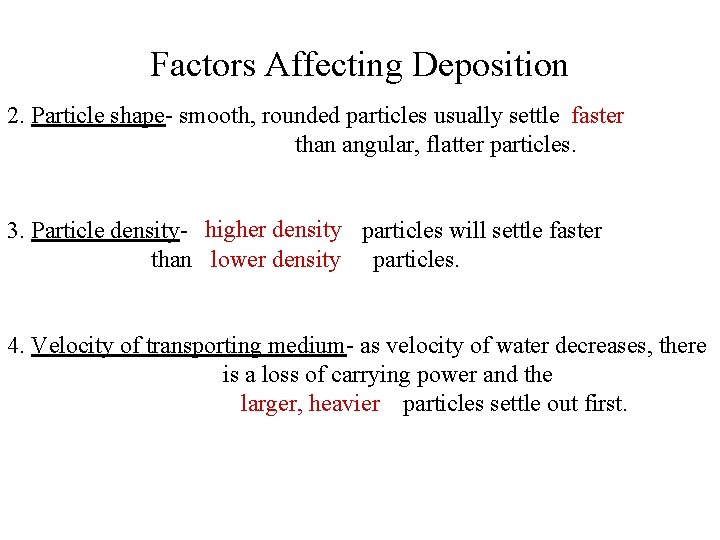
Factors Affecting Deposition faster 2. Particle shape- smooth, rounded particles usually settle than angular, flatter particles. higher density 3. Particle density- particles will settle faster than lower density particles. 4. Velocity of transporting medium- as velocity of water decreases, there is a loss of carrying power and the particles settle out first. larger, heavier
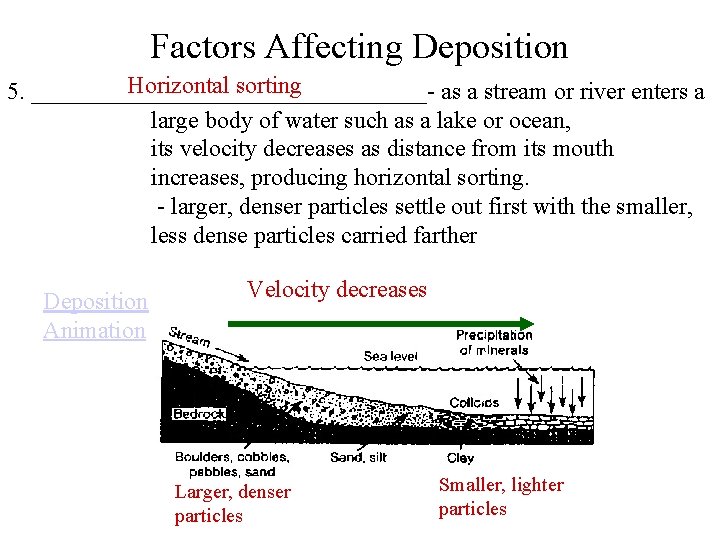
Factors Affecting Deposition Horizontal sorting 5. _________________- as a stream or river enters a large body of water such as a lake or ocean, its velocity decreases as distance from its mouth increases, producing horizontal sorting. - larger, denser particles settle out first with the smaller, less dense particles carried farther Deposition Animation Velocity decreases Larger, denser particles Smaller, lighter particles
Factors Affecting Deposition 6. Particle velocity- particles in solution move at the velocity of the stream as do many of the colloidal particles. - suspended particles move slower than the stream. - largest and densest move slowest. 7. Glacial deposition -__ ____- unsorted (all mixed together) rock material glacial till deposited directly by glaciers. outwash - _______- rock material deposited by the meltwater of a glacier. - can show horizontal sorting. erratics - _______- large boulders deposited by glaciers
Erosional-Depositional System source - ______- where the river begins. - river has its greatest potential energy - ______- where the river ends. mouth - as the river flows toward its mouth the potential energy decreases steep - erosion- dominant when the slope is and the velocity of the river is fast - source. (usually found here) gentle slow - deposition- dominant when the slope is and the velocity is - mouth. (usually found here) - the outside of a meander (curve) experiences while the erosion inside of a meander experiences deposition
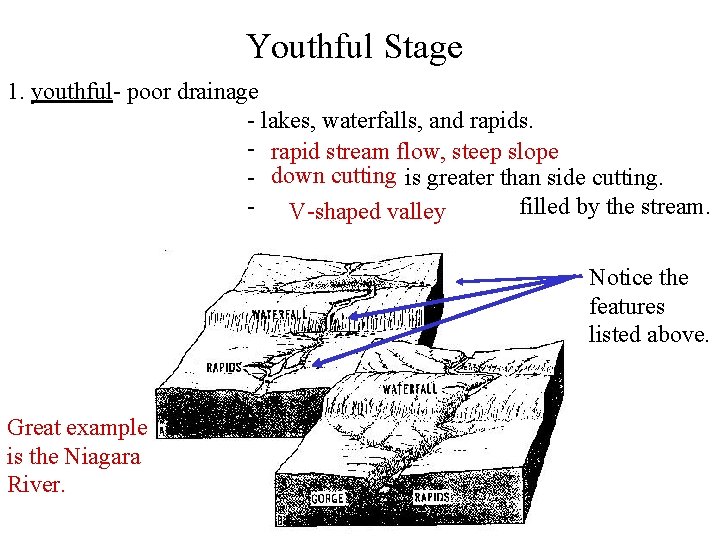
Youthful Stage 1. youthful- poor drainage - lakes, waterfalls, and rapids. - rapid stream flow, steep slope down cutting - is greater than side cutting. - filled by the stream. V-shaped valley Notice the features listed above. Great example is the Niagara River.
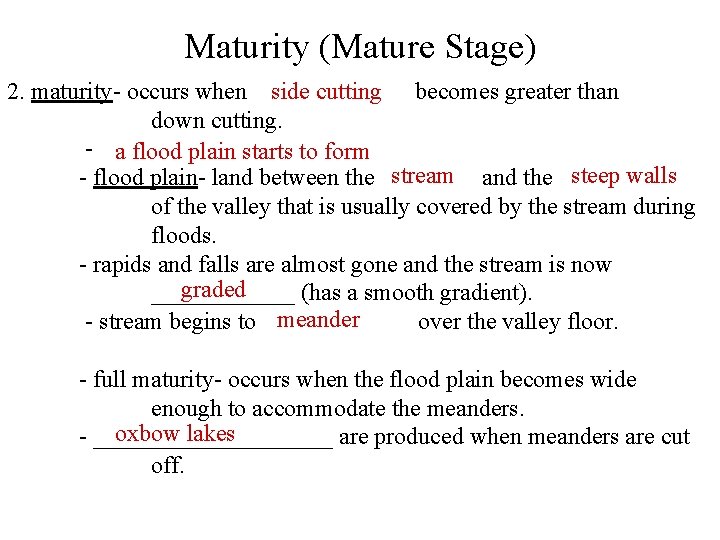
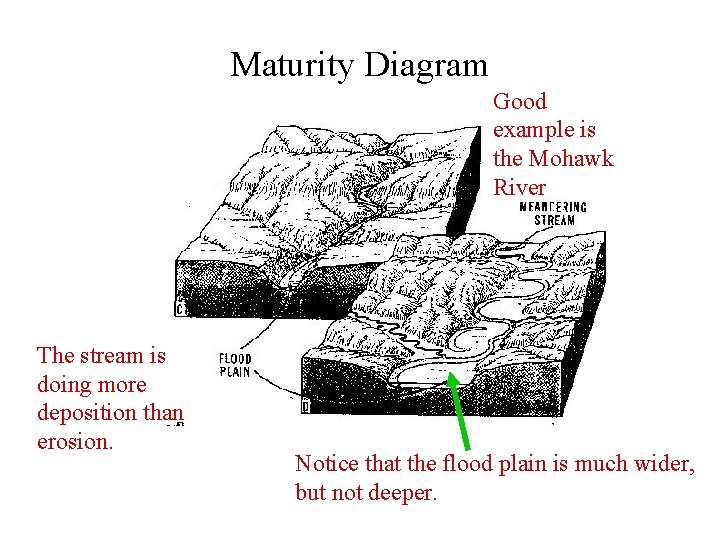
Maturity (Mature Stage) side cutting 2. maturity- occurs when becomes greater than down cutting. - a flood plain starts to form stream steep walls - flood plain- land between the and the of the valley that is usually covered by the stream during floods. - rapids and falls are almost gone and the stream is now graded ______ (has a smooth gradient). meander - stream begins to over the valley floor. - full maturity- occurs when the flood plain becomes wide enough to accommodate the meanders. oxbow lakes - __________ are produced when meanders are cut off.
Maturity Diagram Good example is the Mohawk River The stream is doing more deposition than erosion. Notice that the flood plain is much wider, but not deeper.
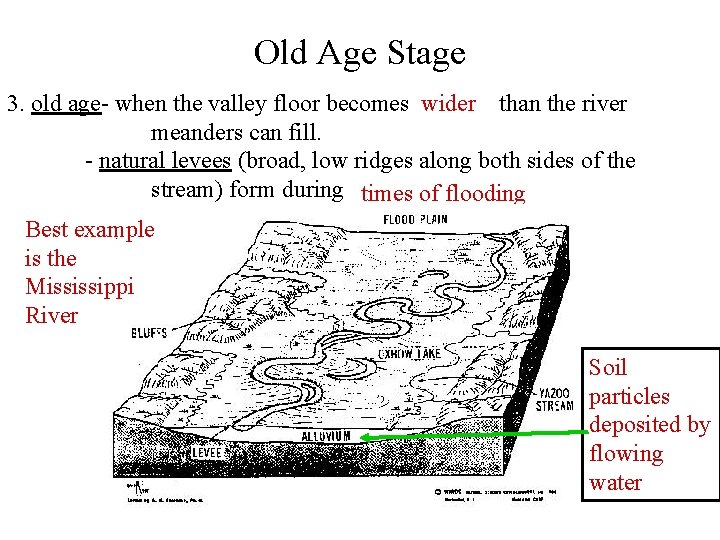
Old Age Stage 3. old age- when the valley floor becomes than the river wider meanders can fill. - natural levees (broad, low ridges along both sides of the stream) form during times of flooding Best example is the Mississippi River Soil particles deposited by flowing water
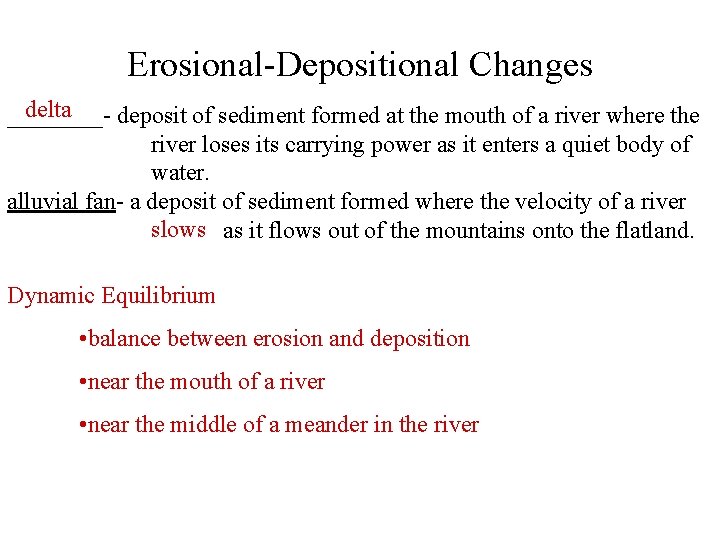
Erosional-Depositional Changes delta ____- deposit of sediment formed at the mouth of a river where the river loses its carrying power as it enters a quiet body of water. alluvial fan- a deposit of sediment formed where the velocity of a river slows as it flows out of the mountains onto the flatland. Dynamic Equilibrium • balance between erosion and deposition • near the mouth of a river • near the middle of a meander in the river