
Deposit Return Where do we stand Clarissa Morawski


- Slides: 25
Deposit Return: Where do we stand ? Clarissa Morawski February 7, 2019
Who we are: Brussels based not for profit association 4 founders from Industry, ENGO and Government. Reloop is founded on the principal of working on issues which have broad support from governments, industry and ENGOs and in line with transitioning to a circular economy. The transition to a circular economy depends on the development of policy drivers that keep resources within the economy.
Working for 1. Mandated Minimum recycled content in products and packaging 2. Increased market share of reusable consumer, transport and industrial packaging 3. A new recycling calculation which excludes all contamination & losses after sorting until final recycling 4. Introduction of deposit return systems for beverage containers 5. Increased collection and sorting system
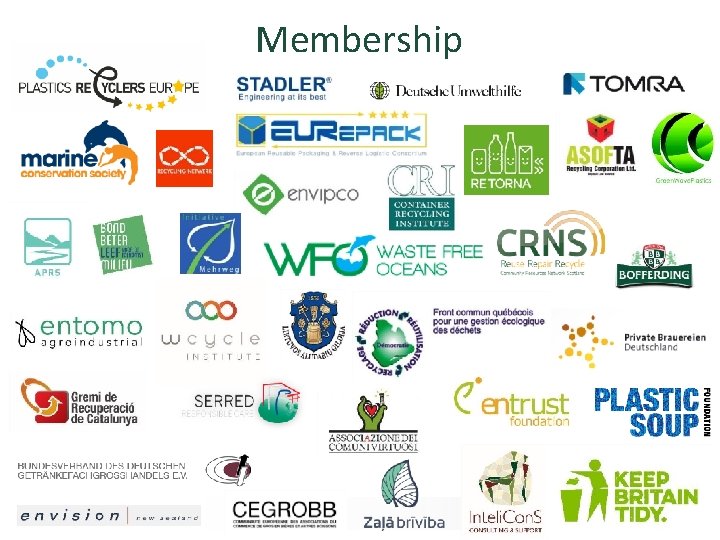
Membership
5 Trend Considerations 1. Rising share of financial obligation for producers with greater EPR minimum requirements and litter clean up costs. Per tonne costs of separate collection systems will rise with new costs for away from home collection. 2. Increasing need for access to post consumer resin to meet national recycled content mandates. 25% recycled plastic by 2025, and 30% by 2030. (By member state)
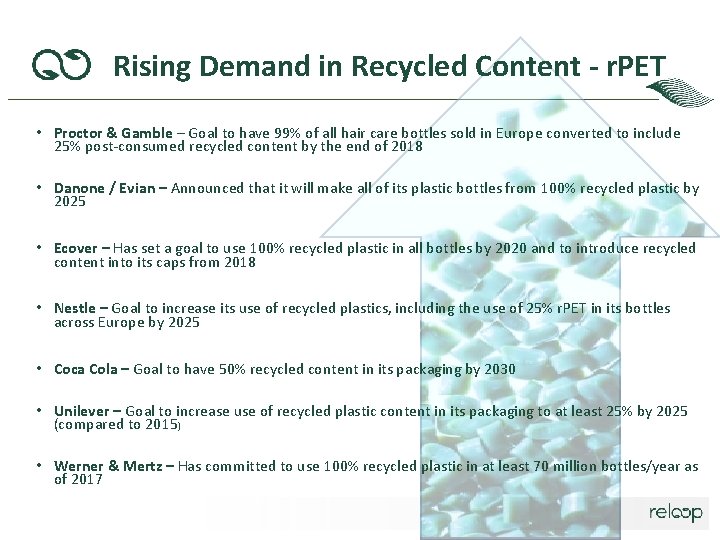
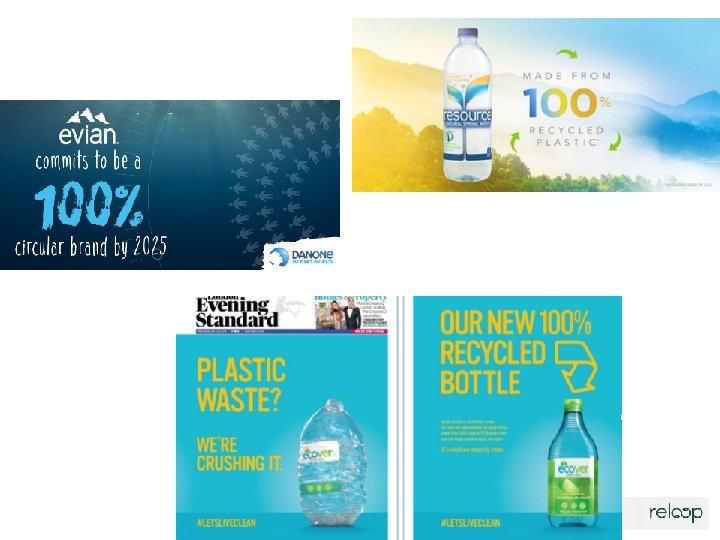
Rising Demand in Recycled Content - r. PET • Proctor & Gamble – Goal to have 99% of all hair care bottles sold in Europe converted to include 25% post consumed recycled content by the end of 2018 • Danone / Evian – Announced that it will make all of its plastic bottles from 100% recycled plastic by 2025 • Ecover – Has set a goal to use 100% recycled plastic in all bottles by 2020 and to introduce recycled content into its caps from 2018 • Nestle – Goal to increase its use of recycled plastics, including the use of 25% r. PET in its bottles across Europe by 2025 • Coca Cola – Goal to have 50% recycled content in its packaging by 2030 • Unilever – Goal to increase use of recycled plastic content in its packaging to at least 25% by 2025 (compared to 2015) • Werner & Mertz – Has committed to use 100% recycled plastic in at least 70 million bottles/year as of 2017
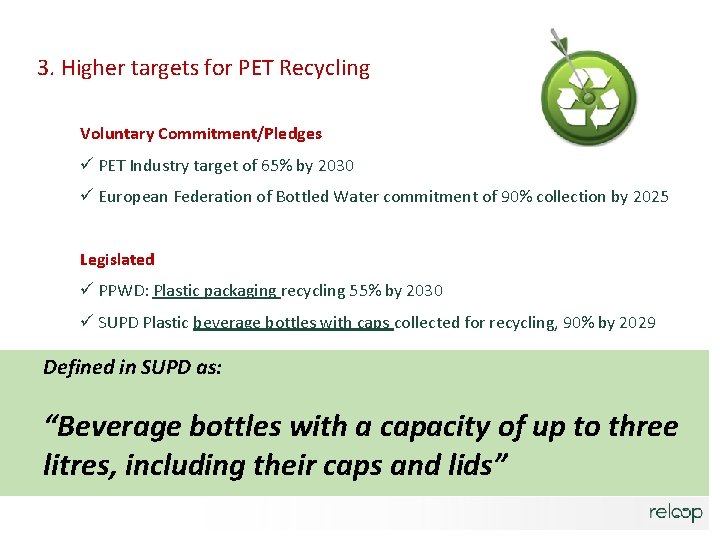
3. Higher targets for PET Recycling Voluntary Commitment/Pledges ü PET Industry target of 65% by 2030 ü European Federation of Bottled Water commitment of 90% collection by 2025 Legislated ü PPWD: Plastic packaging recycling 55% by 2030 ü SUPD Plastic beverage bottles with caps collected for recycling, 90% by 2029 Defined in SUPD as: “Beverage bottles with a capacity of up to three litres, including their caps and lids”
4. New recycling calculation method to net out contaminants in collection and new rules on reporting weight of packaging waste generated. (by spring 2019). New methodology for calculation and verification of “collection for recycling” target for in SUPD. (by spring 2020).
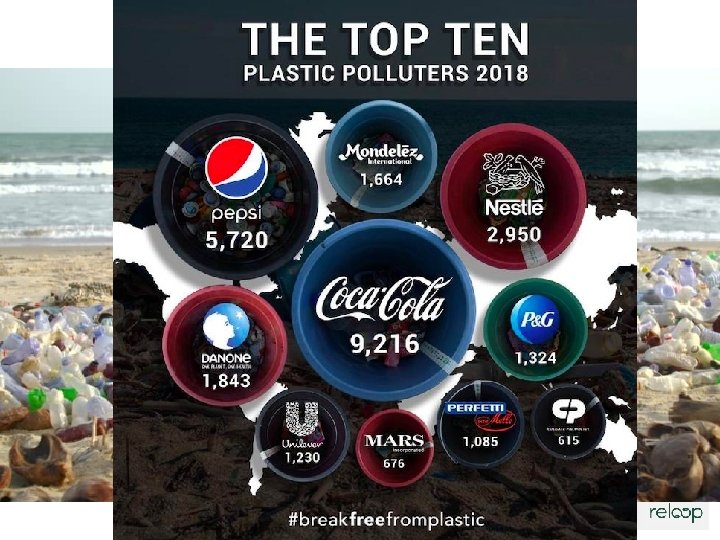
5. More pressure around plastics in the marine environment and litter
DRS Update
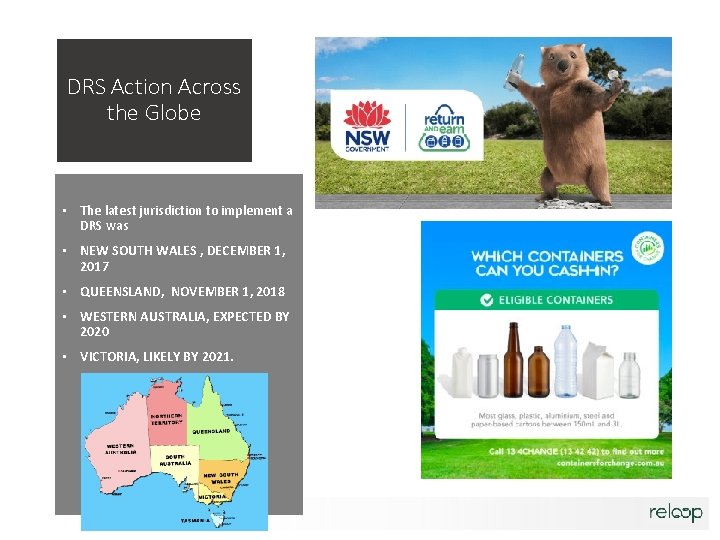
DRS Action Across the Globe • The latest jurisdiction to implement a DRS was • NEW SOUTH WALES , DECEMBER 1, 2017 • QUEENSLAND, NOVEMBER 1, 2018 • WESTERN AUSTRALIA, EXPECTED BY 2020 • VICTORIA, LIKELY BY 2021.
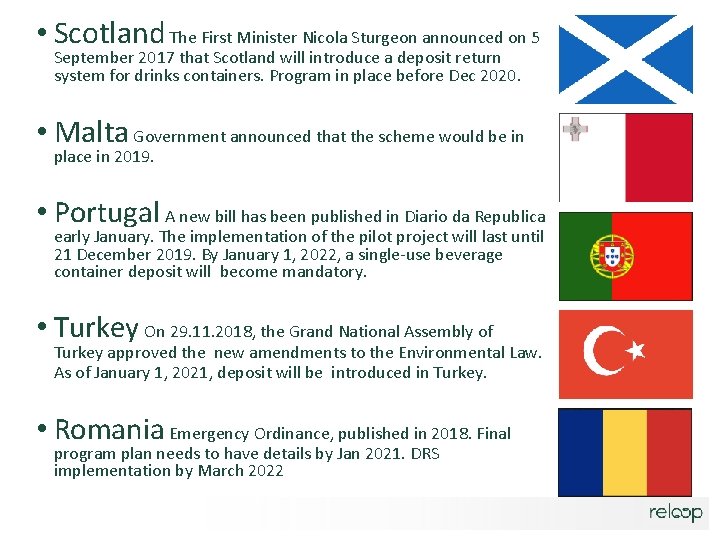
• Scotland The First Minister Nicola Sturgeon announced on 5 September 2017 that Scotland will introduce a deposit return system for drinks containers. Program in place before Dec 2020. • Malta Government announced that the scheme would be in place in 2019. • Portugal A new bill has been published in Diario da Republica early January. The implementation of the pilot project will last until 21 December 2019. By January 1, 2022, a single use beverage container deposit will become mandatory. • Turkey On 29. 11. 2018, the Grand National Assembly of Turkey approved the new amendments to the Environmental Law. As of January 1, 2021, deposit will be introduced in Turkey. • Romania Emergency Ordinance, published in 2018. Final program plan needs to have details by Jan 2021. DRS implementation by March 2022
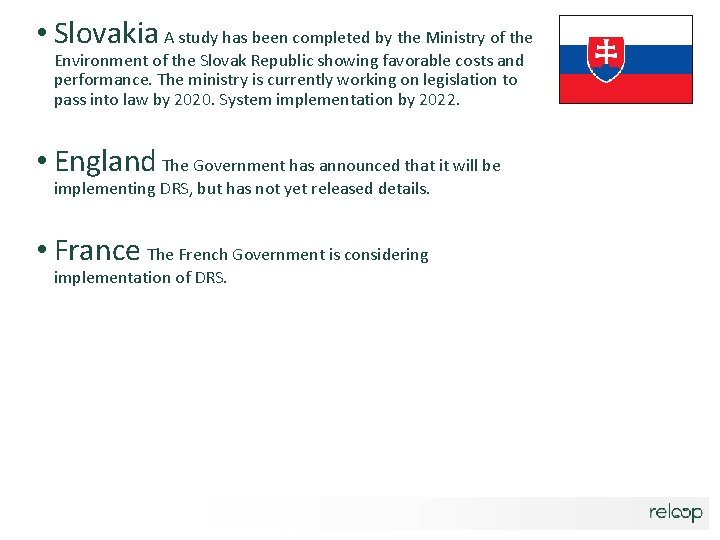
• Slovakia A study has been completed by the Ministry of the Environment of the Slovak Republic showing favorable costs and performance. The ministry is currently working on legislation to pass into law by 2020. System implementation by 2022. • England The Government has announced that it will be implementing DRS, but has not yet released details. • France The French Government is considering implementation of DRS.
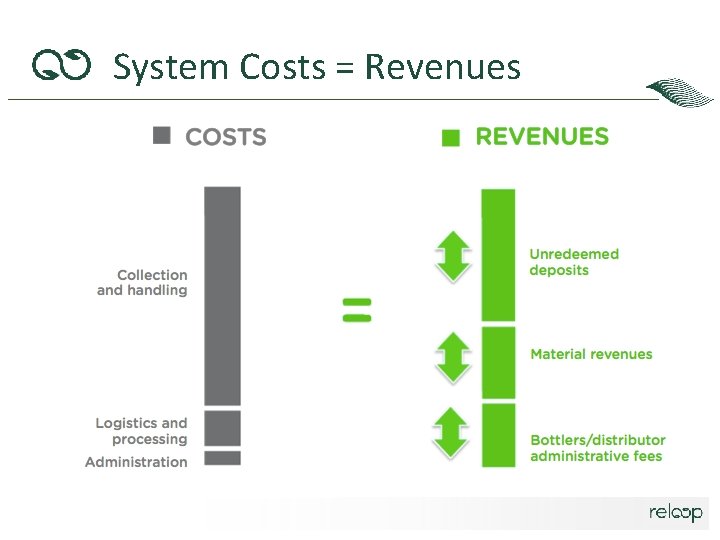
System Costs = Revenues
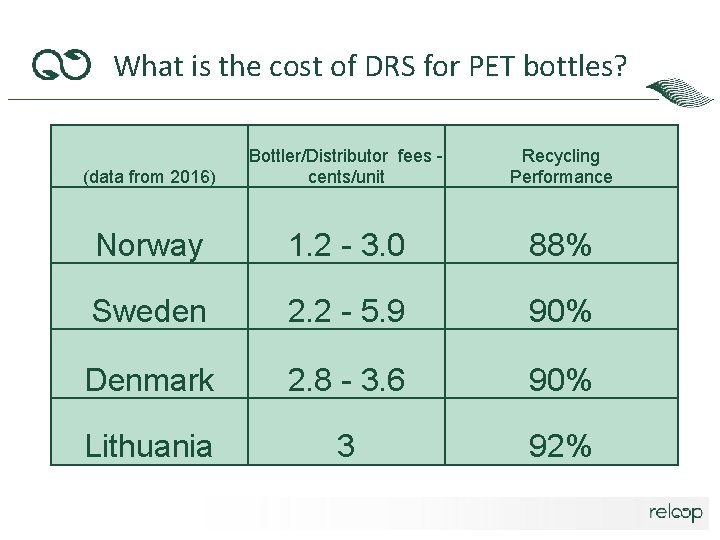
What is the cost of DRS for PET bottles? (data from 2016) Bottler/Distributor fees cents/unit Recycling Performance Norway 1. 2 - 3. 0 88% Sweden 2. 2 - 5. 9 90% Denmark 2. 8 - 3. 6 90% Lithuania 3 92%
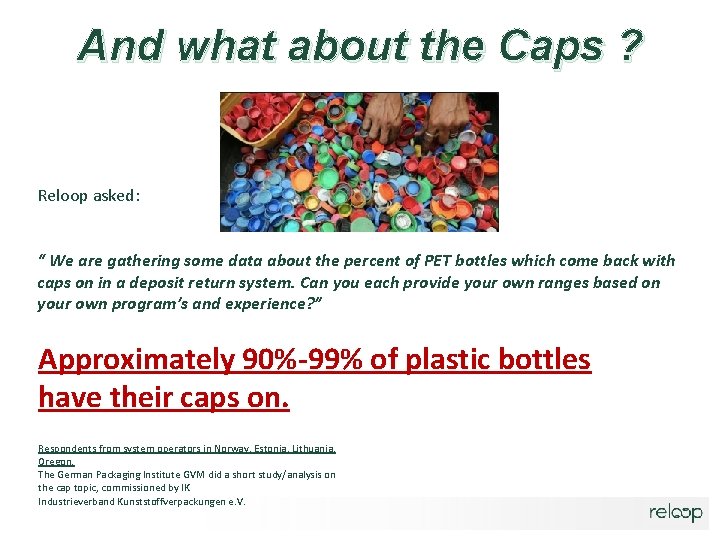
And what about the Caps ? Reloop asked: “ We are gathering some data about the percent of PET bottles which come back with caps on in a deposit return system. Can you each provide your own ranges based on your own program’s and experience? ” Approximately 90%-99% of plastic bottles have their caps on. Respondents from system operators in Norway, Estonia, Lithuania, Oregon. The German Packaging Institute GVM did a short study/analysis on the cap topic, commissioned by IK Industrieverband Kunststoffverpackungen e. V.
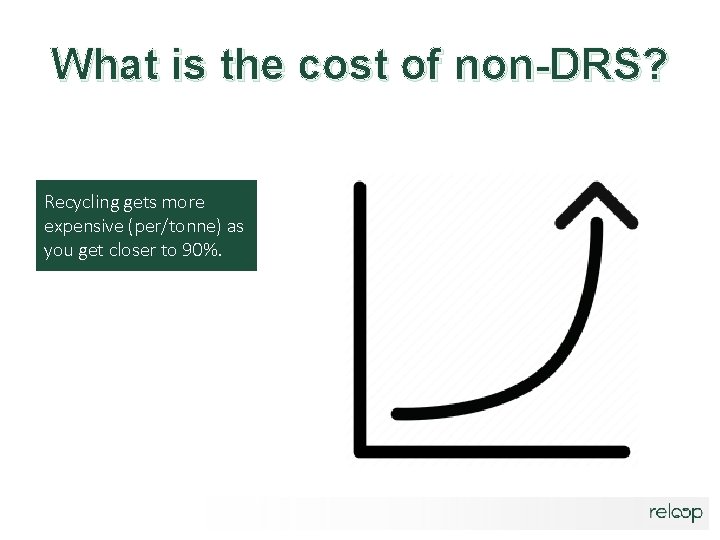
What is the cost of non-DRS? Recycling gets more expensive (per/tonne) as you get closer to 90%.
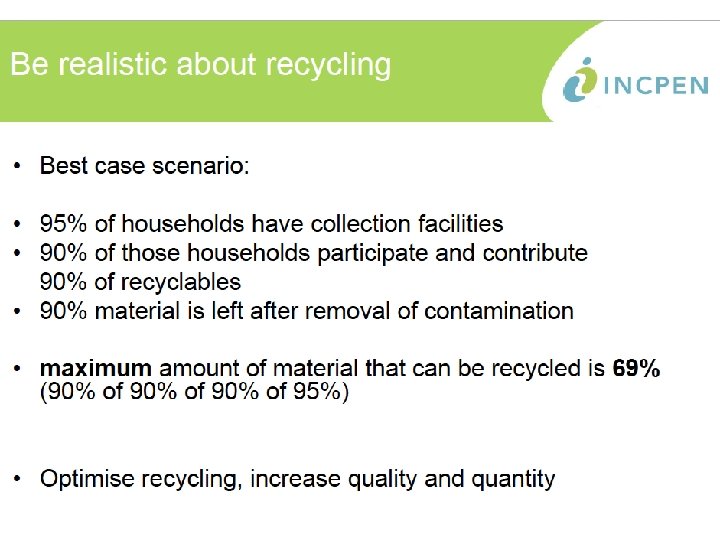
Can a 90% collection for recycling target be achieved without DRS?
https: //www. cmconsultinginc. com/wp content/uploads/2017/02/RR ACCESS Feb 2017. pdf
Mechanisms which decide about success or failure of such systems? ü Deposit level must be high enough to incentivize collection. ü Centrally reported sales data by size and material type. ü Convenient collection points / no extra trips minimal extra time to redeem containers. ü Modern data management system (Bar code recognition / on site compaction). ü Compatibility with Green Dot System producers. Many case studies of jurisdictions which offer both comprehensive deposit return in addition to separate collection of recyclables (paper and containers).
THANK YOU! twitter@reloop_platform www. reloopplatform. eu