
DEPONENT VERBS Lets look first at a Latin
DEPONENT VERBS
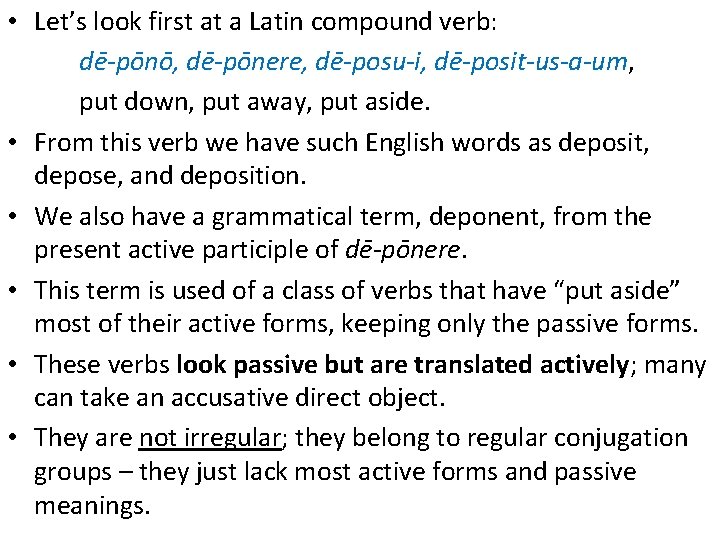
• Let’s look first at a Latin compound verb: dē-pōnō, dē-pōnere, dē-posu-i, dē-posit-us-a-um, put down, put away, put aside. • From this verb we have such English words as deposit, depose, and deposition. • We also have a grammatical term, deponent, from the present active participle of dē-pōnere. • This term is used of a class of verbs that have “put aside” most of their active forms, keeping only the passive forms. • These verbs look passive but are translated actively; many can take an accusative direct object. • They are not irregular; they belong to regular conjugation groups – they just lack most active forms and passive meanings.

• Now let’s quickly review passive forms: • In present-system tenses (present, imperfect, future), the passive personal endings are -r -mur -ris (-re) -mini -tur -ntur • The perfect-system tenses (perfect, pluperfect, future perfect) use the 4 th principal part, in agreement with the subject in gender and number, plus the present, imperfect, or future forms of the verb esse: perfect: 4 th p. p. + sum, est, sumus, estis, sunt pluperfect: 4 th p. p. + eram, eras, erat, eramus, eratis, erant fut. perfect: 4 th p. p. + ero, eris, erit, erimus, eritis, erunt - or their subjunctive equivalents.
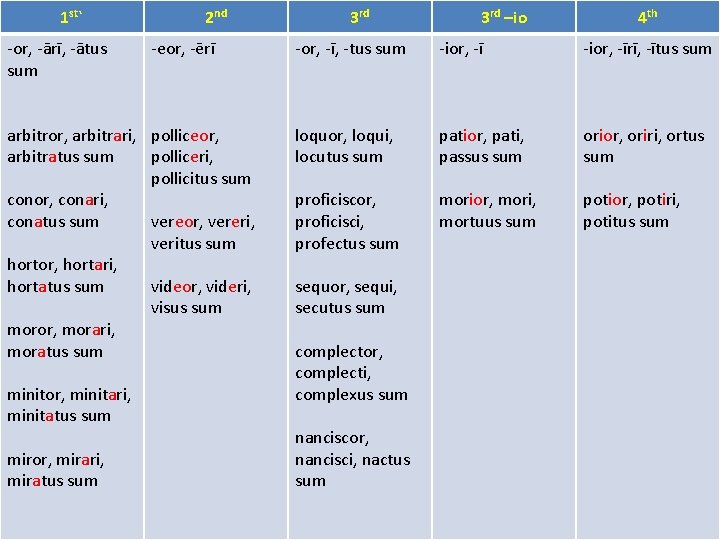
1 st` -or, -ārī, -ātus sum 2 nd -eor, -ērī arbitror, arbitrari, polliceor, arbitratus sum polliceri, pollicitus sum conor, conari, conatus sum vereor, vereri, veritus sum hortor, hortari, hortatus sum videor, videri, visus sum moror, morari, moratus sum minitor, minitari, minitatus sum miror, mirari, miratus sum 3 rd –io 4 th -or, -ī, -tus sum -ior, -īrī, -ītus sum loquor, loqui, locutus sum patior, pati, passus sum orior, oriri, ortus sum proficiscor, proficisci, profectus sum morior, mori, mortuus sum potior, potiri, potitus sum sequor, sequi, secutus sum complector, complecti, complexus sum nanciscor, nancisci, nactus sum

The PUFF-V deponents: all take ablative object: potior, potiri, potitus sum: get possession of, own utor, uti, usus sum: use, enjoy fruor, frui, fructus sum: enjoy fungor, fungi, functus sum: perform, carry out vescor, vesci: feed on, eat The SEMI-DEPONENT verbs: active-form in present-system tenses, deponent-form in perfect-system tenses: gaudeo, gaudēre, gavisus sum: rejoice, be glad audeo, audēre, ausus sum: dare (+ infin. ) soleo, solēre, solitus sum: be accustomed to (+ infin. )
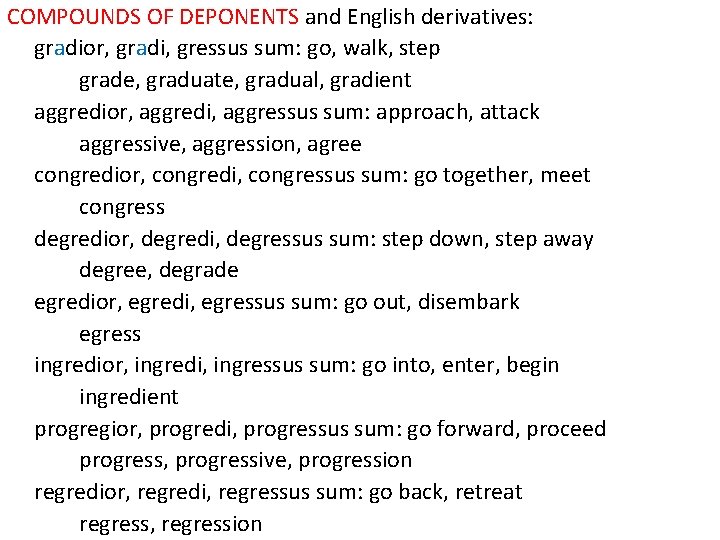
COMPOUNDS OF DEPONENTS and English derivatives: gradior, gradi, gressus sum: go, walk, step grade, graduate, gradual, gradient aggredior, aggredi, aggressus sum: approach, attack aggressive, aggression, agree congredior, congredi, congressus sum: go together, meet congress degredior, degredi, degressus sum: step down, step away degree, degrade egredior, egredi, egressus sum: go out, disembark egress ingredior, ingredi, ingressus sum: go into, enter, begin ingredient progregior, progredi, progressus sum: go forward, proceed progress, progressive, progression regredior, regredi, regressus sum: go back, retreat regress, regression
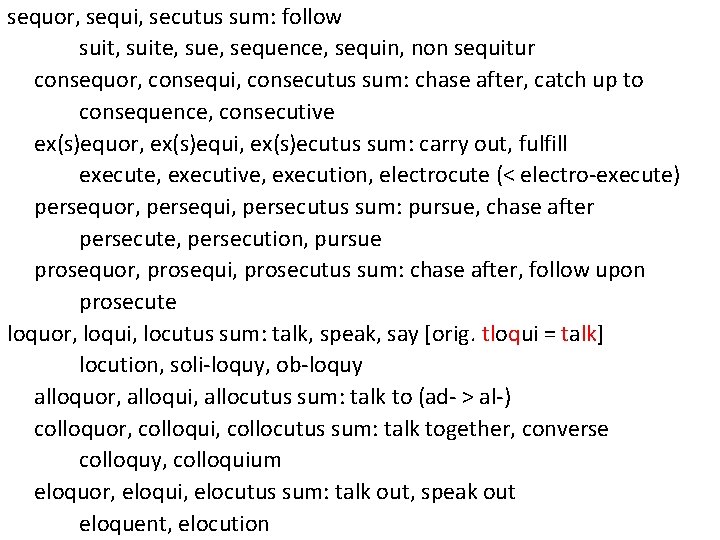
sequor, sequi, secutus sum: follow suit, suite, sue, sequence, sequin, non sequitur consequor, consequi, consecutus sum: chase after, catch up to consequence, consecutive ex(s)equor, ex(s)equi, ex(s)ecutus sum: carry out, fulfill execute, executive, execution, electrocute (< electro-execute) persequor, persequi, persecutus sum: pursue, chase after persecute, persecution, pursue prosequor, prosequi, prosecutus sum: chase after, follow upon prosecute loquor, loqui, locutus sum: talk, speak, say [orig. tloqui = talk] locution, soli-loquy, ob-loquy alloquor, alloqui, allocutus sum: talk to (ad- > al-) colloquor, colloqui, collocutus sum: talk together, converse colloquy, colloquium eloquor, eloqui, elocutus sum: talk out, speak out eloquent, elocution
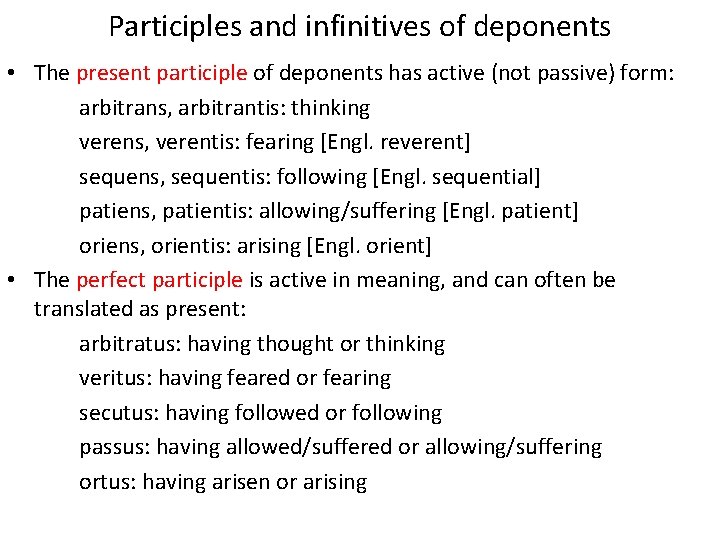
Participles and infinitives of deponents • The present participle of deponents has active (not passive) form: arbitrans, arbitrantis: thinking verens, verentis: fearing [Engl. reverent] sequens, sequentis: following [Engl. sequential] patiens, patientis: allowing/suffering [Engl. patient] oriens, orientis: arising [Engl. orient] • The perfect participle is active in meaning, and can often be translated as present: arbitratus: having thought or thinking veritus: having feared or fearing secutus: having followed or following passus: having allowed/suffered or allowing/suffering ortus: having arisen or arising

• The future participle is active in both form and meaning: arbitraturus: about to think, intending to think veriturus: about to fear, going to fear secuturus: about to follow, intending to follow passurus: about to suffer/allow oriturus: soon to arise, about to arise • Deponent infinitives are passive in form but active in meaning: present perfect future 1 st arbitrari arbitratus esse arbitraturus esse 2 nd vereri veritus esse veriturus esse 3 rd sequi secutus esse secuturus esse 3 rd -io pati passus esse passurus esse 4 th oriri ortus esse oriturus esse
- Slides: 9