
Deponent Verbs Chapter 37 Ecce Romani look passive
Deponent Verbs Chapter 37 Ecce Romani
look passive active meaning deponent verbs

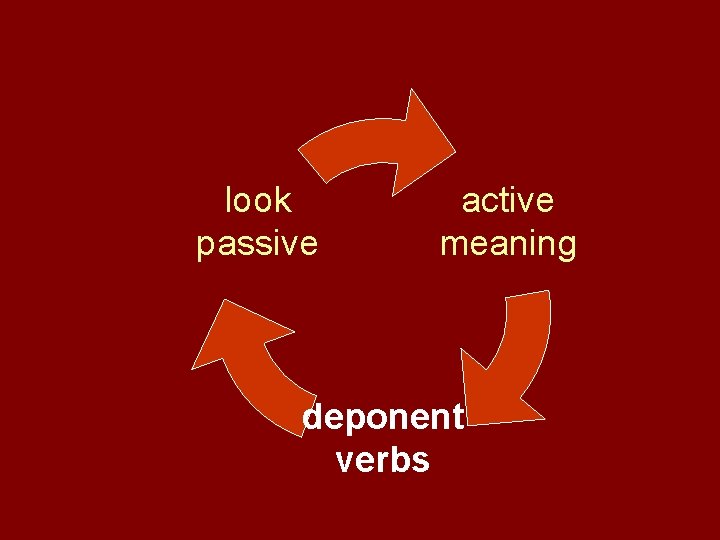
Definition • A deponent verb has passive forms but active meanings • Deponent verbs occur in each conjugation • Deponents have only three principal parts: – 1 st person singular present (e. g. , cōnor) – Present infinitive (e. g. , cōnārī) – 1 st person singular perfect (e. g. , cōnātus sum)
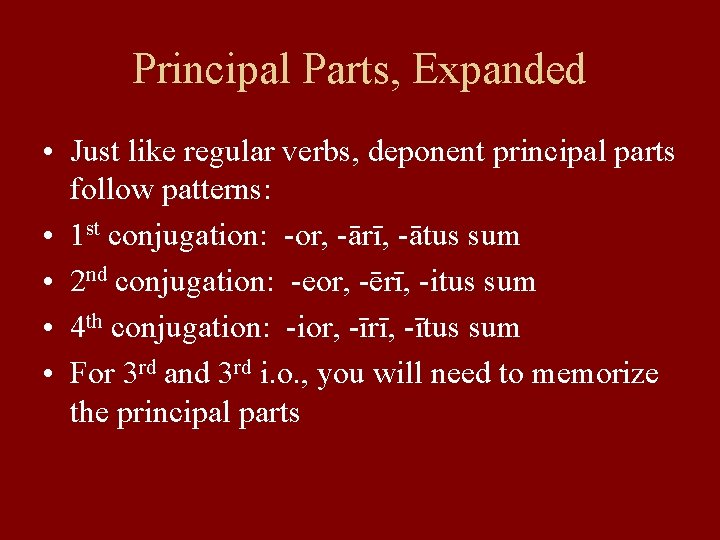
Principal Parts, Expanded • Just like regular verbs, deponent principal parts follow patterns: • 1 st conjugation: -or, -ārī, -ātus sum • 2 nd conjugation: -eor, -ērī, -itus sum • 4 th conjugation: -ior, -īrī, -ītus sum • For 3 rd and 3 rd i. o. , you will need to memorize the principal parts
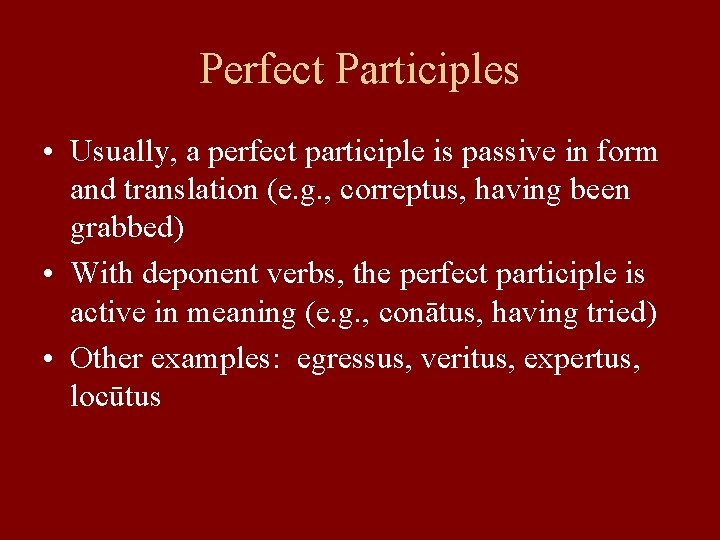
Perfect Participles • Usually, a perfect participle is passive in form and translation (e. g. , correptus, having been grabbed) • With deponent verbs, the perfect participle is active in meaning (e. g. , conātus, having tried) • Other examples: egressus, veritus, expertus, locūtus
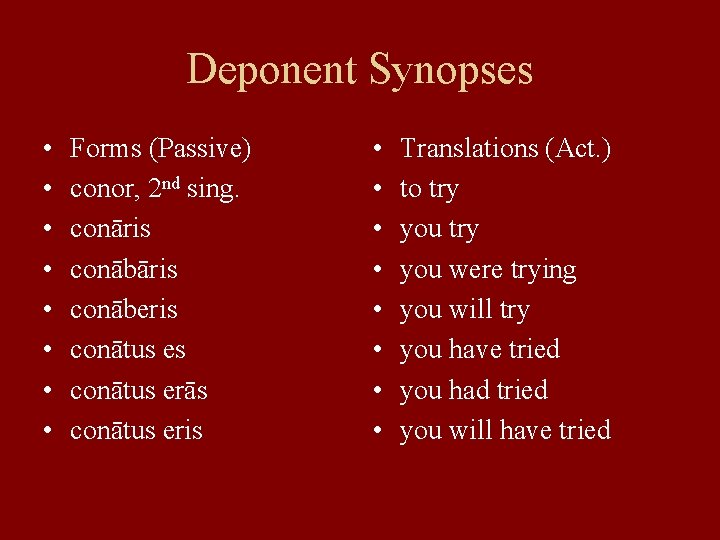
Deponent Synopses • • Forms (Passive) conor, 2 nd sing. conāris conāberis conātus erās conātus eris • • Translations (Act. ) to try you were trying you will try you have tried you had tried you will have tried
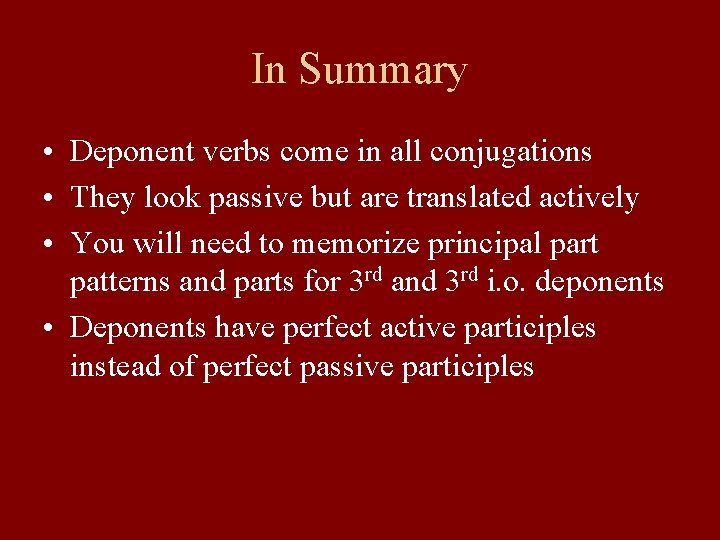
In Summary • Deponent verbs come in all conjugations • They look passive but are translated actively • You will need to memorize principal part patterns and parts for 3 rd and 3 rd i. o. deponents • Deponents have perfect active participles instead of perfect passive participles
- Slides: 7