
Deployment of Sys ML in Tools and Architectures
- Slides: 19
Deployment of Sys. ML in Tools and Architectures: an Industry Perspective Rick Steiner Raytheon IDS, San Diego fsteiner@raytheon. com
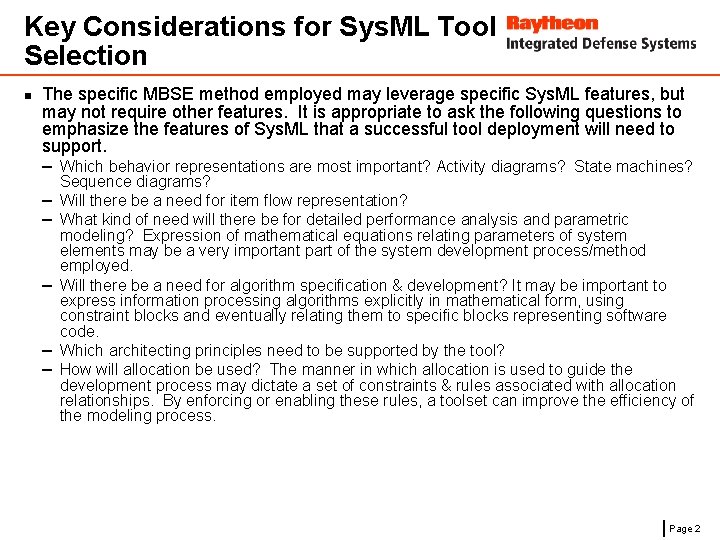
Key Considerations for Sys. ML Tool Selection n The specific MBSE method employed may leverage specific Sys. ML features, but may not require other features. It is appropriate to ask the following questions to emphasize the features of Sys. ML that a successful tool deployment will need to support. – Which behavior representations are most important? Activity diagrams? State machines? – – – Sequence diagrams? Will there be a need for item flow representation? What kind of need will there be for detailed performance analysis and parametric modeling? Expression of mathematical equations relating parameters of system elements may be a very important part of the system development process/method employed. Will there be a need for algorithm specification & development? It may be important to express information processing algorithms explicitly in mathematical form, using constraint blocks and eventually relating them to specific blocks representing software code. Which architecting principles need to be supported by the tool? How will allocation be used? The manner in which allocation is used to guide the development process may dictate a set of constraints & rules associated with allocation relationships. By enforcing or enabling these rules, a toolset can improve the efficiency of the modeling process. Page 2
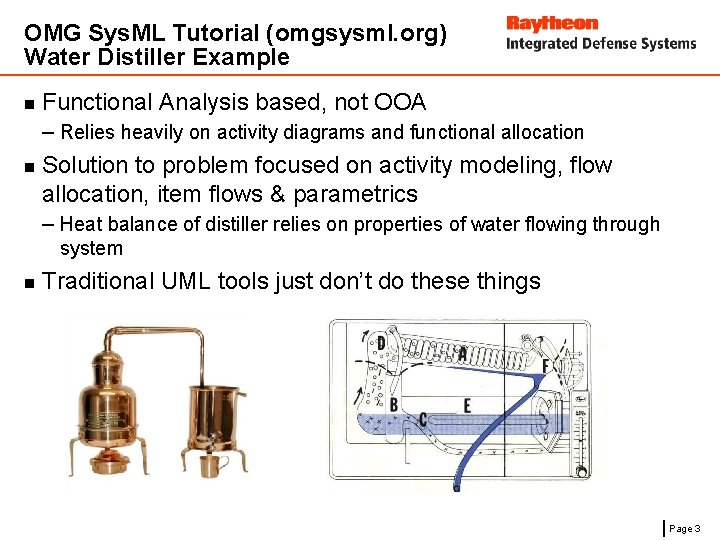
OMG Sys. ML Tutorial (omgsysml. org) Water Distiller Example n Functional Analysis based, not OOA – Relies heavily on activity diagrams and functional allocation n Solution to problem focused on activity modeling, flow allocation, item flows & parametrics – Heat balance of distiller relies on properties of water flowing through system n Traditional UML tools just don’t do these things Page 3
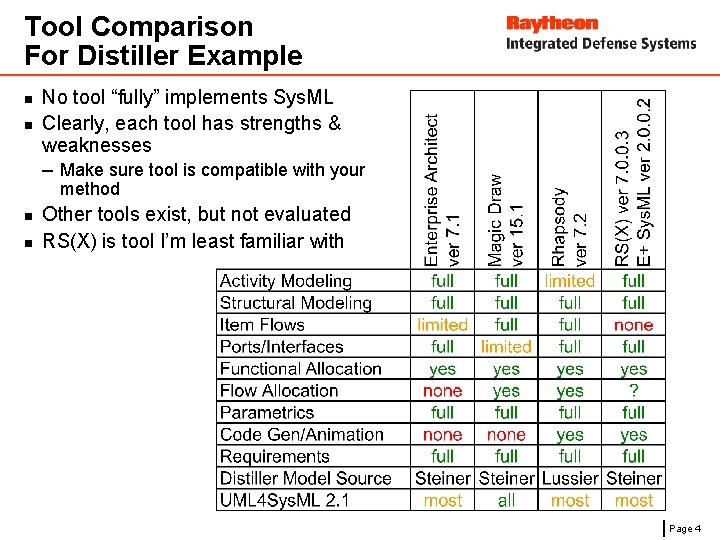
Tool Comparison For Distiller Example n n No tool “fully” implements Sys. ML Clearly, each tool has strengths & weaknesses – Make sure tool is compatible with your method n n Other tools exist, but not evaluated RS(X) is tool I’m least familiar with Page 4
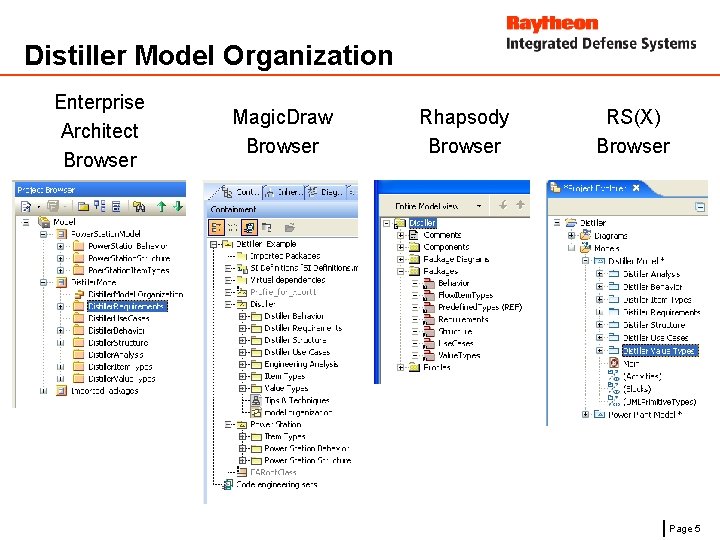
Distiller Model Organization Enterprise Architect Browser Magic. Draw Browser Rhapsody Browser RS(X) Browser Page 5
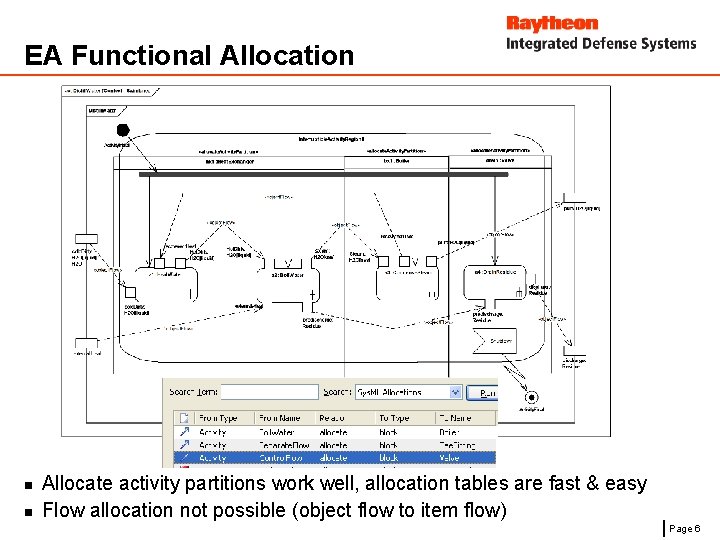
EA Functional Allocation n n Allocate activity partitions work well, allocation tables are fast & easy Flow allocation not possible (object flow to item flow) Page 6
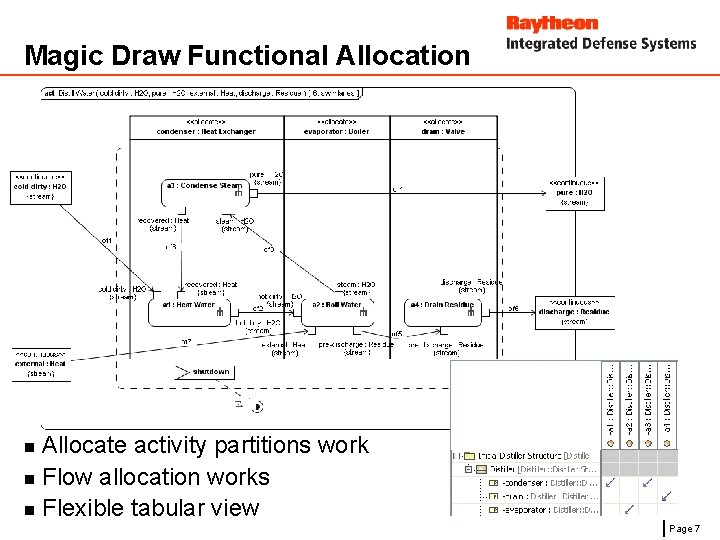
Magic Draw Functional Allocation Allocate activity partitions work n Flow allocation works n Flexible tabular view n Page 7
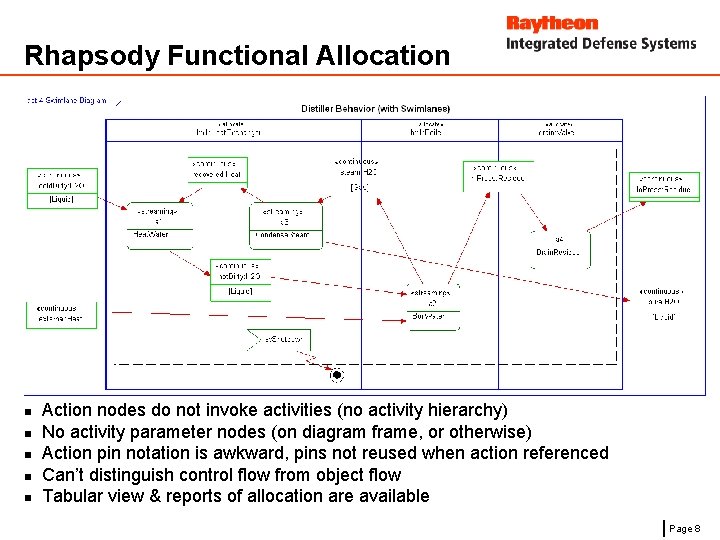
Rhapsody Functional Allocation n n Action nodes do not invoke activities (no activity hierarchy) No activity parameter nodes (on diagram frame, or otherwise) Action pin notation is awkward, pins not reused when action referenced Can’t distinguish control flow from object flow Tabular view & reports of allocation are available Page 8
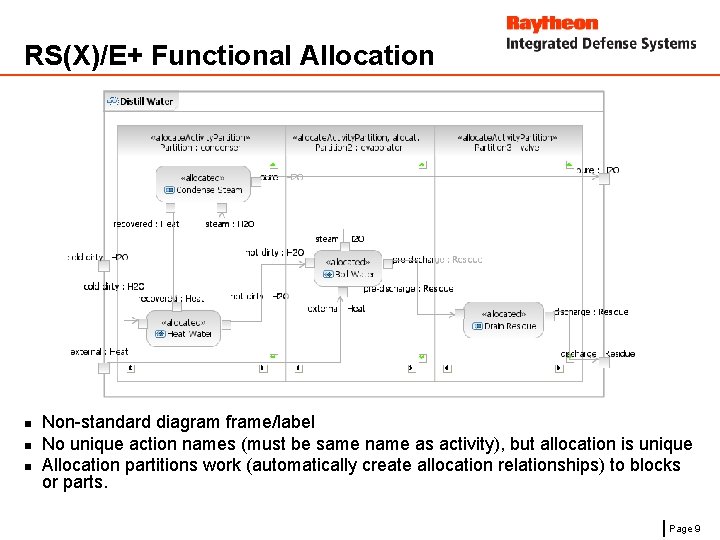
RS(X)/E+ Functional Allocation n Non-standard diagram frame/label No unique action names (must be same name as activity), but allocation is unique Allocation partitions work (automatically create allocation relationships) to blocks or parts. Page 9
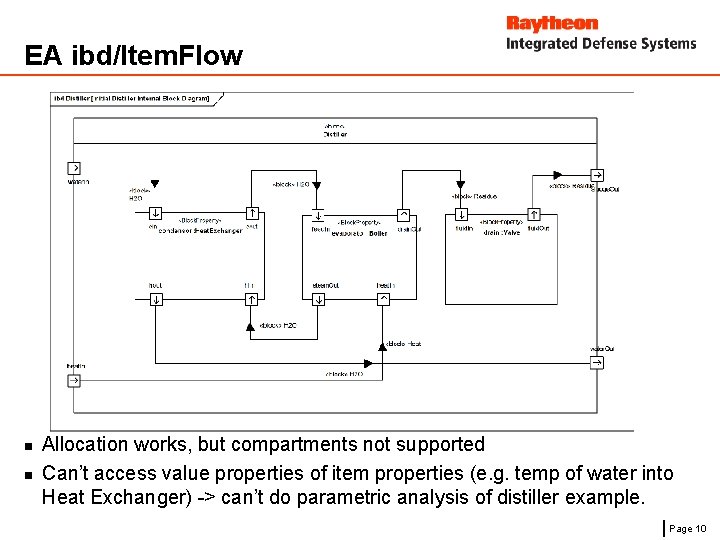
EA ibd/Item. Flow n n Allocation works, but compartments not supported Can’t access value properties of item properties (e. g. temp of water into Heat Exchanger) -> can’t do parametric analysis of distiller example. Page 10
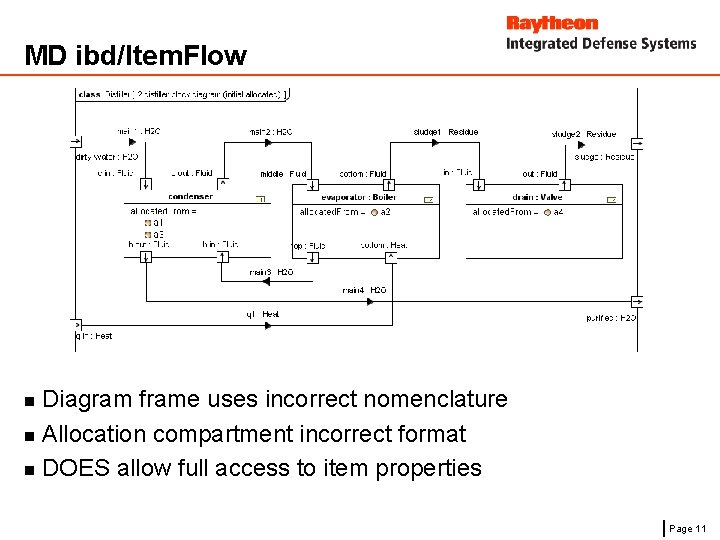
MD ibd/Item. Flow Diagram frame uses incorrect nomenclature n Allocation compartment incorrect format n DOES allow full access to item properties n Page 11
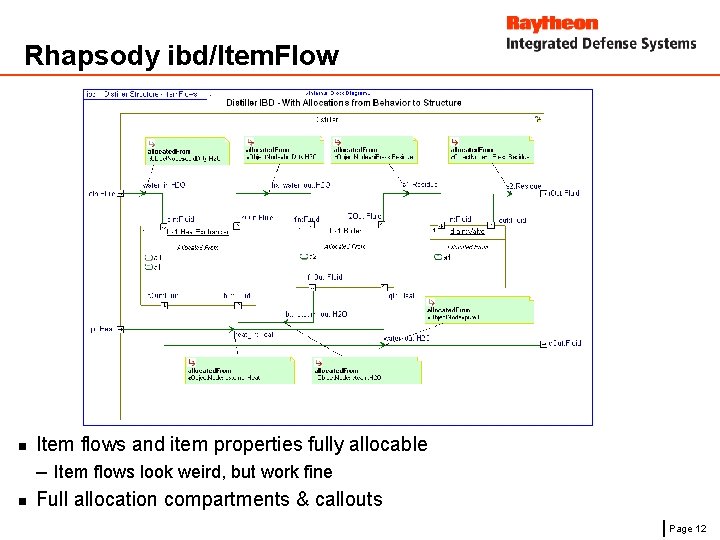
Rhapsody ibd/Item. Flow n n Item flows and item properties fully allocable – Item flows look weird, but work fine Full allocation compartments & callouts Page 12
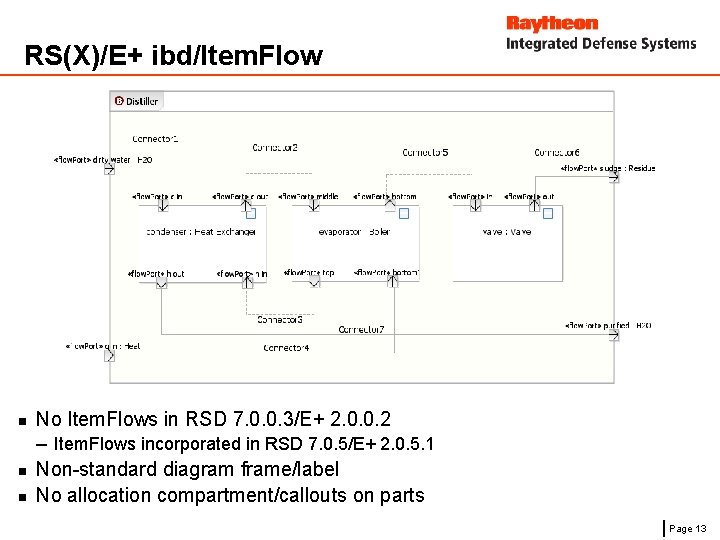
RS(X)/E+ ibd/Item. Flow n n n No Item. Flows in RSD 7. 0. 0. 3/E+ 2. 0. 0. 2 – Item. Flows incorporated in RSD 7. 0. 5/E+ 2. 0. 5. 1 Non-standard diagram frame/label No allocation compartment/callouts on parts Page 13
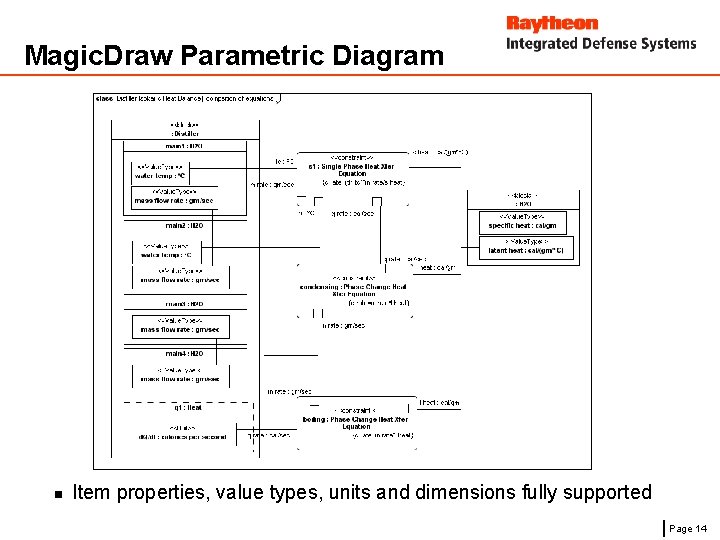
Magic. Draw Parametric Diagram n Item properties, value types, units and dimensions fully supported Page 14
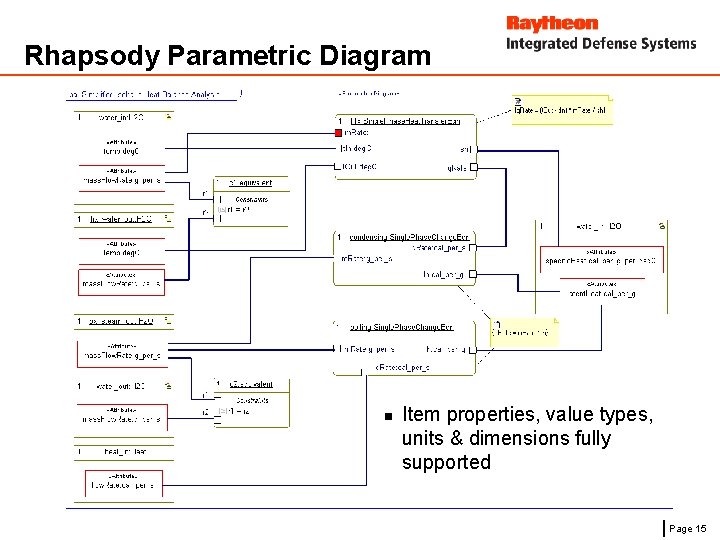
Rhapsody Parametric Diagram n Item properties, value types, units & dimensions fully supported Page 15
EA & RS(X)/E+ Parametrics Both support units, dimensions, value types, constraint blocks, and parametric diagrams n Neither support value properties of item properties on item flows n – Item Flows incorporated in RSD 7. 0. 5/E+ 2. 0. 5. 1 Page 16
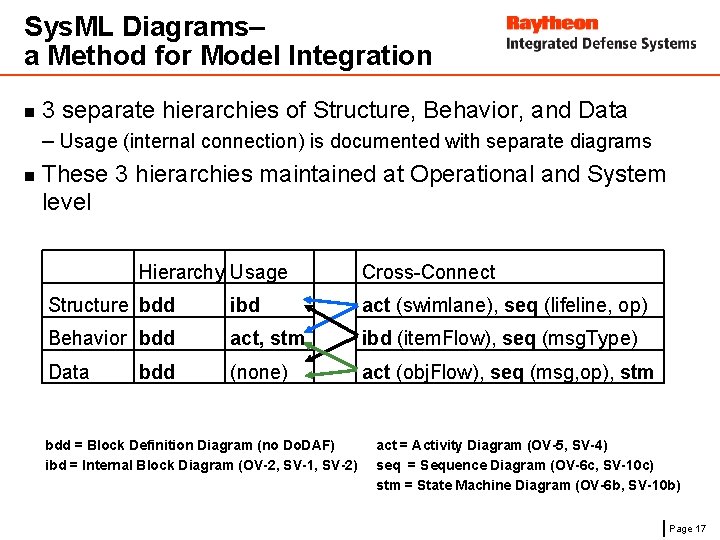
Sys. ML Diagrams– a Method for Model Integration n 3 separate hierarchies of Structure, Behavior, and Data – Usage (internal connection) is documented with separate diagrams n These 3 hierarchies maintained at Operational and System level Hierarchy Usage Cross-Connect Structure bdd ibd act (swimlane), seq (lifeline, op) Behavior bdd act, stm ibd (item. Flow), seq (msg. Type) Data (none) act (obj. Flow), seq (msg, op), stm bdd = Block Definition Diagram (no Do. DAF) ibd = Internal Block Diagram (OV-2, SV-1, SV-2) act = Activity Diagram (OV-5, SV-4) seq = Sequence Diagram (OV-6 c, SV-10 c) stm = State Machine Diagram (OV-6 b, SV-10 b) Page 17
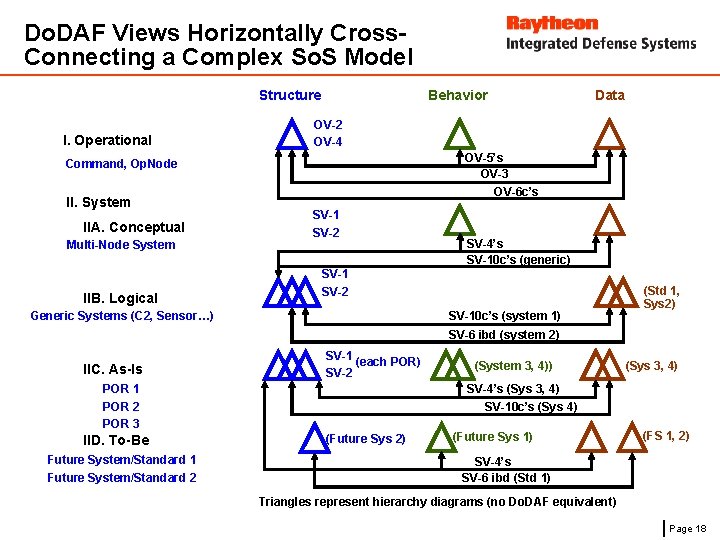
Do. DAF Views Horizontally Cross. Connecting a Complex So. S Model Structure I. Operational Behavior OV-2 OV-4 OV-5’s OV-3 OV-6 c’s Command, Op. Node II. System IIA. Conceptual Multi-Node System IIB. Logical Data SV-1 SV-2 SV-4’s SV-10 c’s (generic) SV-1 SV-2 Generic Systems (C 2, Sensor…) SV-10 c’s (system 1) (Std 1, Sys 2) SV-6 ibd (system 2) IIC. As-Is SV-1 (each POR) SV-2 Future System/Standard 1 Future System/Standard 2 (Sys 3, 4) SV-4’s (Sys 3, 4) SV-10 c’s (Sys 4) POR 1 POR 2 POR 3 IID. To-Be (System 3, 4)) (Future Sys 2) (Future Sys 1) (FS 1, 2) SV-4’s SV-6 ibd (Std 1) Triangles represent hierarchy diagrams (no Do. DAF equivalent) Page 18
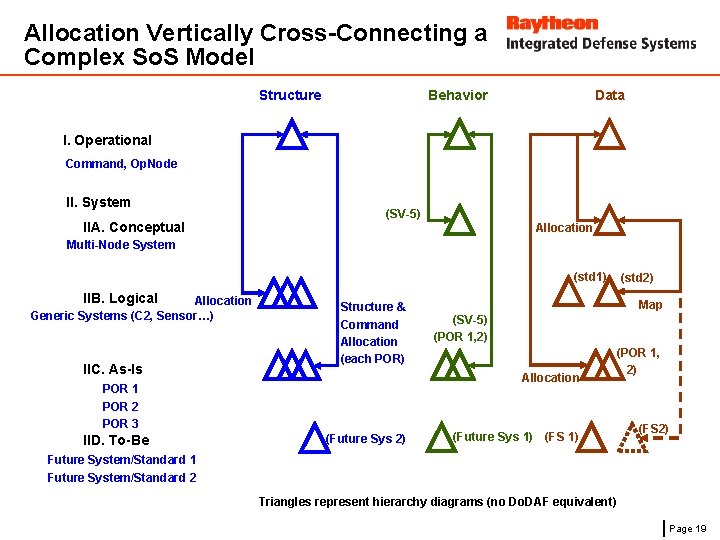
Allocation Vertically Cross-Connecting a Complex So. S Model Structure Behavior Data I. Operational Command, Op. Node II. System IIA. Conceptual (SV-5) Allocation Multi-Node System (std 1) IIB. Logical Allocation Generic Systems (C 2, Sensor…) IIC. As-Is Structure & Command Allocation (each POR) IID. To-Be Map (SV-5) (POR 1, 2) Allocation POR 1 POR 2 POR 3 (Future Sys 2) (std 2) (Future Sys 1) (FS 1) (POR 1, 2) (FS 2) Future System/Standard 1 Future System/Standard 2 Triangles represent hierarchy diagrams (no Do. DAF equivalent) Page 19