
Deployment of SAR and GMTI Signal Processing on
- Slides: 27
Deployment of SAR and GMTI Signal Processing on a Boeing 707 Aircraft using p. Matlab and a Bladed Linux Cluster Jeremy Kepner, Tim Currie, Hahn Kim, Bipin Mathew, Andrew Mc. Cabe, Michael Moore, Dan Rabinkin, Albert Reuther, Andrew Rhoades, Lou Tella and Nadya Travinin September 28, 2004 This work is sponsored by the Department of the Air Force under Air Force contract F 19628 -00 -C-002. Opinions, interpretations, conclusions and recommendations are those of the author and are not necessarily endorsed by the United States Government. MIT Lincoln Laboratory Slide-1 Quicklook
Outline • Introduction • System • Software • Results • Summary Slide-2 Quicklook • • Li. MIT Technical Challenge p. Matlab “Quick. Look” Concept MIT Lincoln Laboratory
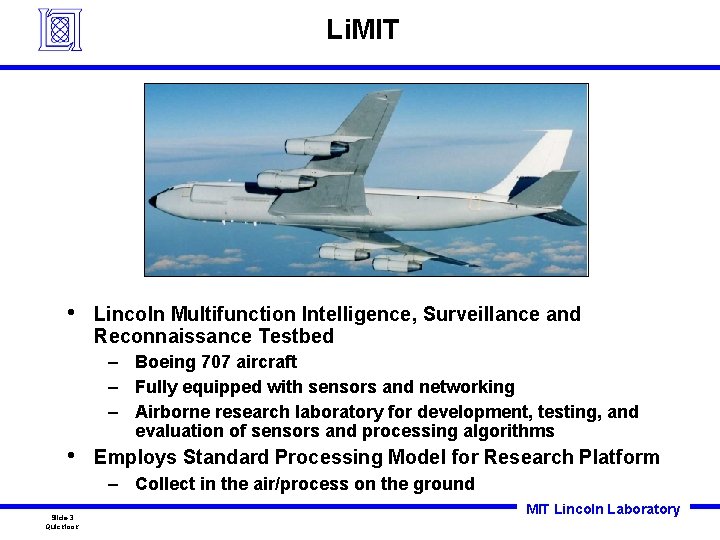
Li. MIT • Lincoln Multifunction Intelligence, Surveillance and Reconnaissance Testbed – Boeing 707 aircraft – Fully equipped with sensors and networking – Airborne research laboratory for development, testing, and evaluation of sensors and processing algorithms • Employs Standard Processing Model for Research Platform – Collect in the air/process on the ground Slide-3 Quicklook MIT Lincoln Laboratory
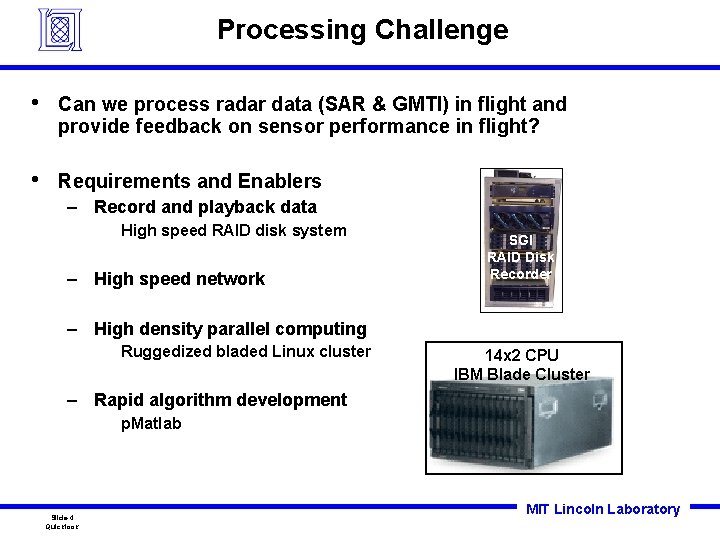
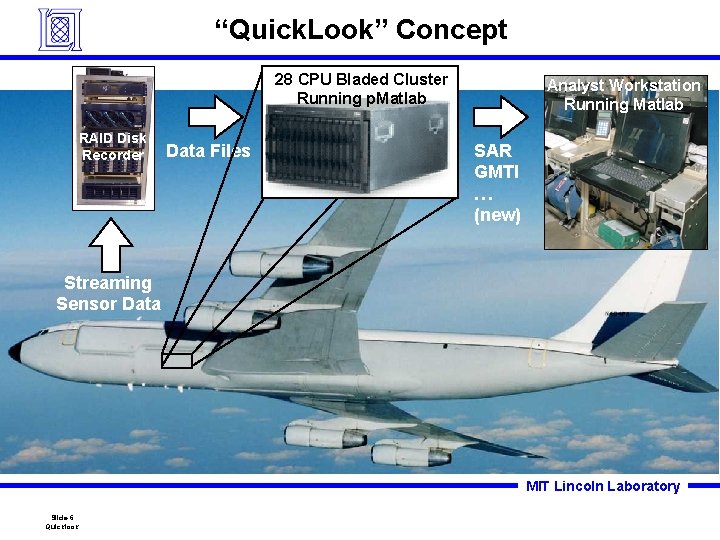
Processing Challenge • Can we process radar data (SAR & GMTI) in flight and provide feedback on sensor performance in flight? • Requirements and Enablers – Record and playback data High speed RAID disk system – High speed network SGI RAID Disk Recorder – High density parallel computing Ruggedized bladed Linux cluster 14 x 2 CPU IBM Blade Cluster – Rapid algorithm development p. Matlab Slide-4 Quicklook MIT Lincoln Laboratory
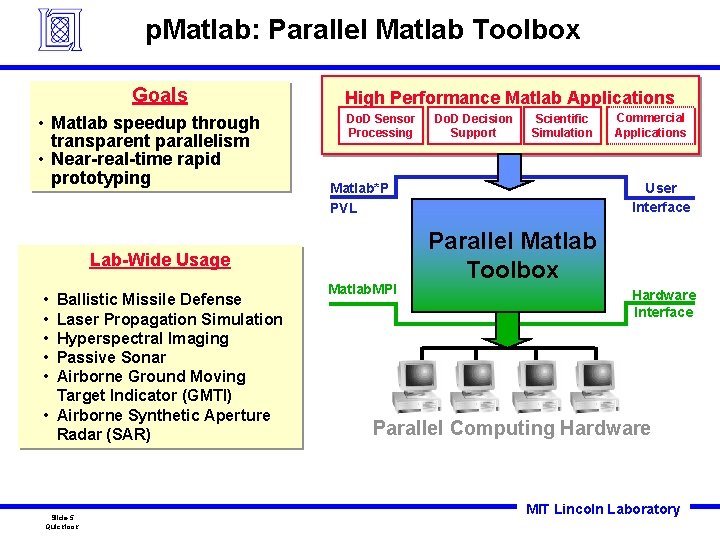
p. Matlab: Parallel Matlab Toolbox Goals • Matlab speedup through transparent parallelism • Near-real-time rapid prototyping High Performance Matlab Applications Do. D Sensor Processing Ballistic Missile Defense Laser Propagation Simulation Hyperspectral Imaging Passive Sonar Airborne Ground Moving Target Indicator (GMTI) • Airborne Synthetic Aperture Radar (SAR) Slide-5 Quicklook Scientific Simulation Matlab*P PVL Lab-Wide Usage • • • Do. D Decision Support Matlab. MPI Commercial Applications User Interface Parallel Matlab Toolbox Hardware Interface Parallel Computing Hardware MIT Lincoln Laboratory
“Quick. Look” Concept 28 CPU Bladed Cluster Running p. Matlab RAID Disk Recorder Data Files Analyst Workstation Running Matlab SAR GMTI … (new) Streaming Sensor Data MIT Lincoln Laboratory Slide-6 Quicklook
Outline • Introduction • System • Software • Results • Summary Slide-7 Quicklook • Con. Ops • Ruggedization • Integration MIT Lincoln Laboratory
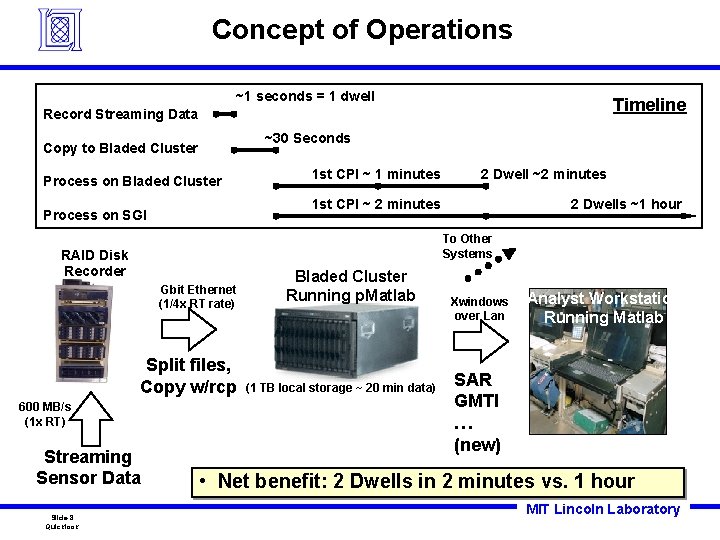
Concept of Operations ~1 seconds = 1 dwell Timeline Record Streaming Data ~30 Seconds Copy to Bladed Cluster Process on Bladed Cluster 2 Dwell ~2 minutes 1 st CPI ~ 2 minutes Process on SGI 2 Dwells ~1 hour To Other Systems RAID Disk Recorder Gbit Ethernet (1/4 x RT rate) Split files, Copy w/rcp 600 MB/s (1 x RT) Streaming Sensor Data Slide-8 Quicklook 1 st CPI ~ 1 minutes Bladed Cluster Running p. Matlab (1 TB local storage ~ 20 min data) Xwindows over Lan Analyst Workstation Running Matlab SAR GMTI … (new) • Net benefit: 2 Dwells in 2 minutes vs. 1 hour MIT Lincoln Laboratory
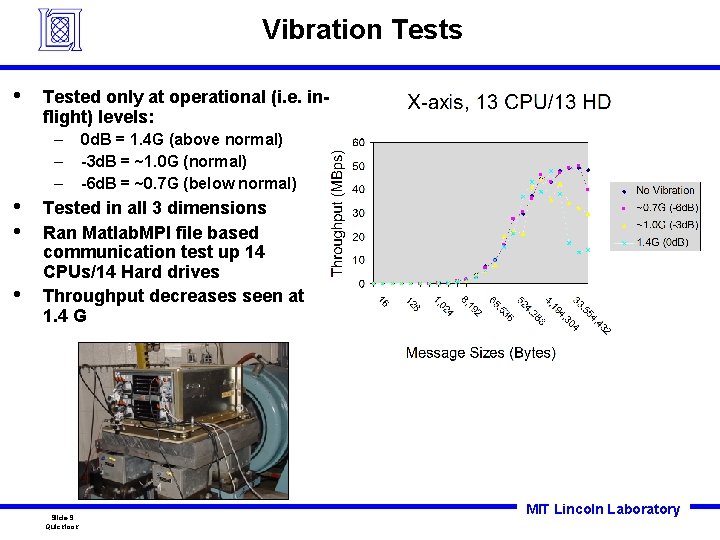
Vibration Tests • Tested only at operational (i. e. inflight) levels: – – – • • • 0 d. B = 1. 4 G (above normal) -3 d. B = ~1. 0 G (normal) -6 d. B = ~0. 7 G (below normal) Tested in all 3 dimensions Ran Matlab. MPI file based communication test up 14 CPUs/14 Hard drives Throughput decreases seen at 1. 4 G Slide-9 Quicklook MIT Lincoln Laboratory
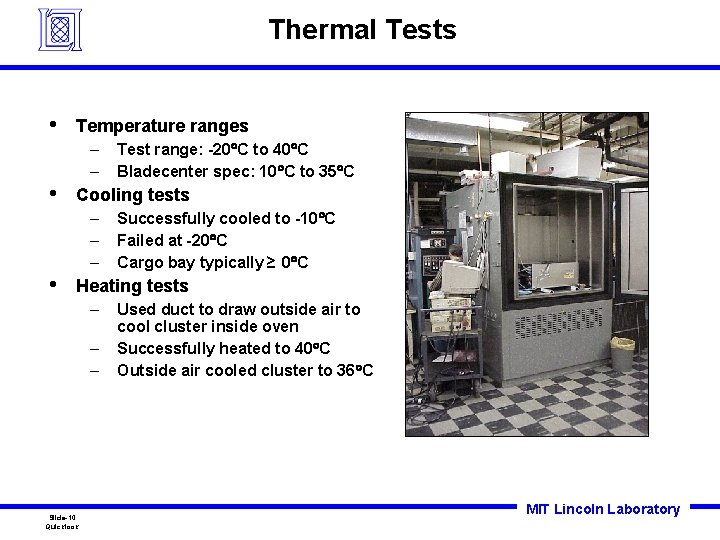
Thermal Tests • Temperature ranges – – • Cooling tests – – – • Test range: -20 C to 40 C Bladecenter spec: 10 C to 35 C Successfully cooled to -10 C Failed at -20 C Cargo bay typically ≥ 0 C Heating tests – – – Slide-10 Quicklook Used duct to draw outside air to cool cluster inside oven Successfully heated to 40 C Outside air cooled cluster to 36 C MIT Lincoln Laboratory
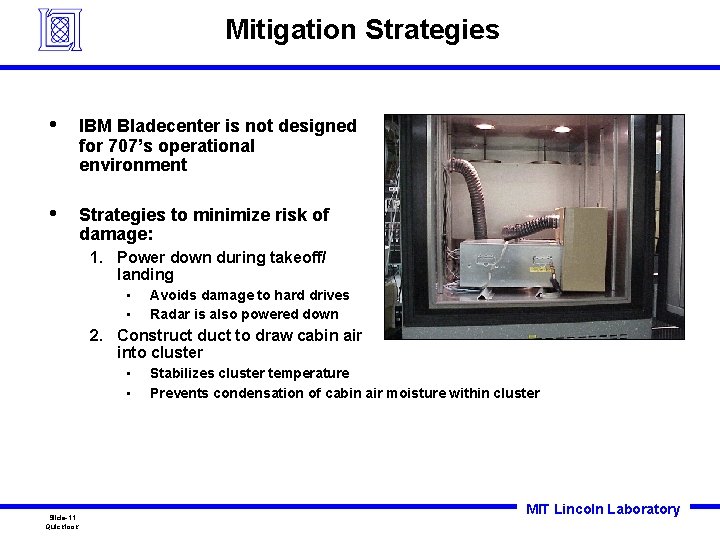
Mitigation Strategies • IBM Bladecenter is not designed for 707’s operational environment • Strategies to minimize risk of damage: 1. Power down during takeoff/ landing • • Avoids damage to hard drives Radar is also powered down 2. Construct duct to draw cabin air into cluster • • Slide-11 Quicklook Stabilizes cluster temperature Prevents condensation of cabin air moisture within cluster MIT Lincoln Laboratory
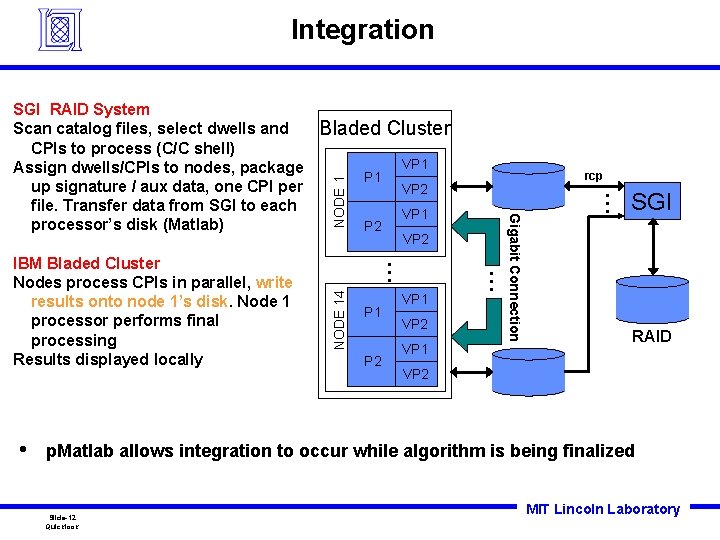
Integration • P 2 VP 1 VP 2 VP 1 … rcp … P 1 … NODE 14 IBM Bladed Cluster Nodes process CPIs in parallel, write results onto node 1’s disk. Node 1 processor performs final processing Results displayed locally Bladed Cluster Gigabit Connection SGI RAID System Scan catalog files, select dwells and CPIs to process (C/C shell) Assign dwells/CPIs to nodes, package up signature / aux data, one CPI per file. Transfer data from SGI to each processor’s disk (Matlab) SGI RAID VP 2 p. Matlab allows integration to occur while algorithm is being finalized Slide-12 Quicklook MIT Lincoln Laboratory
Outline • Introduction • Hardware • Software • Results • Summary Slide-13 Quicklook • p. Matlab architecture • GMTI • SAR MIT Lincoln Laboratory
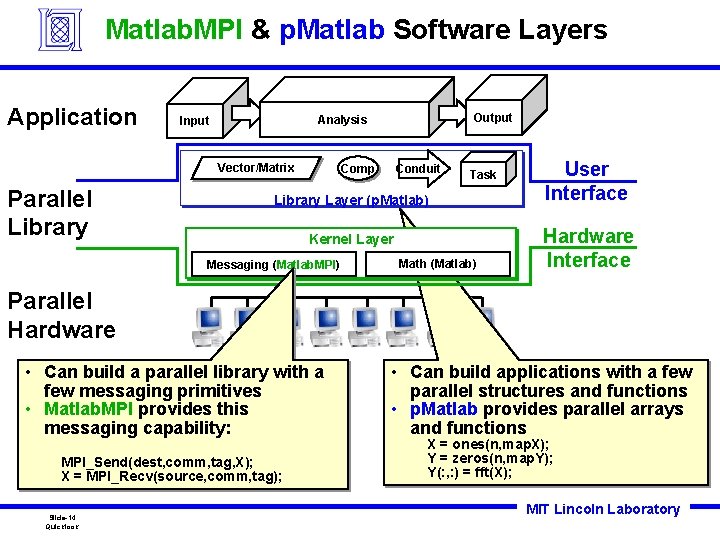
Matlab. MPI & p. Matlab Software Layers Application Vector/Matrix Parallel Library Output Analysis Input Comp Conduit Task Library Layer (p. Matlab) Kernel Layer Messaging (Matlab. MPI) Math (Matlab) User Interface Hardware Interface Parallel Hardware • Can build a parallel library with a few messaging primitives • Matlab. MPI provides this messaging capability: MPI_Send(dest, comm, tag, X); X = MPI_Recv(source, comm, tag); Slide-14 Quicklook • Can build applications with a few parallel structures and functions • p. Matlab provides parallel arrays and functions X = ones(n, map. X); Y = zeros(n, map. Y); Y(: , : ) = fft(X); MIT Lincoln Laboratory
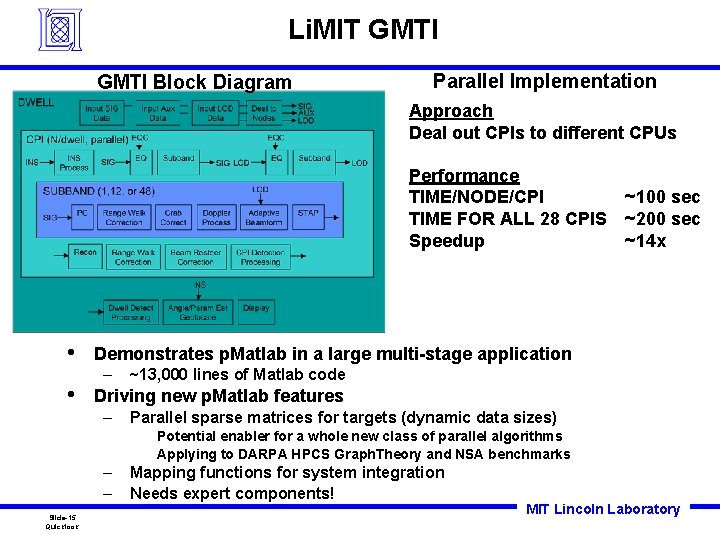
Li. MIT GMTI Block Diagram Parallel Implementation Approach Deal out CPIs to different CPUs Performance TIME/NODE/CPI TIME FOR ALL 28 CPIS Speedup • • ~100 sec ~200 sec ~14 x Demonstrates p. Matlab in a large multi-stage application – ~13, 000 lines of Matlab code Driving new p. Matlab features – Parallel sparse matrices for targets (dynamic data sizes) Potential enabler for a whole new class of parallel algorithms Applying to DARPA HPCS Graph. Theory and NSA benchmarks – – Slide-15 Quicklook Mapping functions for system integration Needs expert components! MIT Lincoln Laboratory
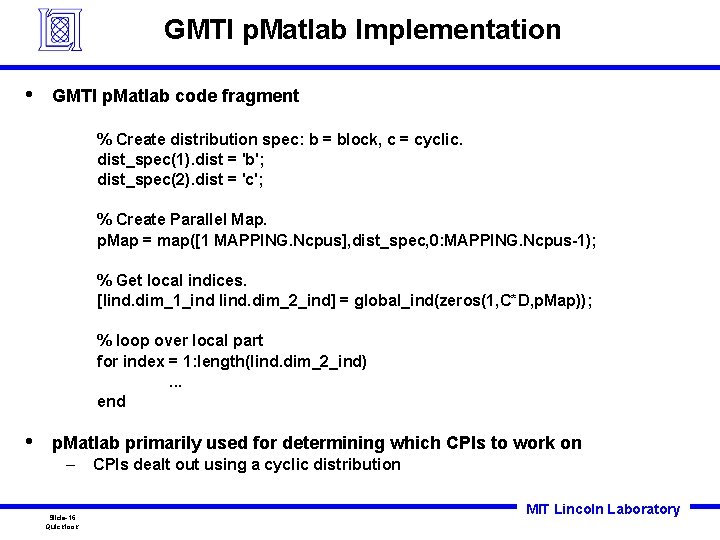
GMTI p. Matlab Implementation • GMTI p. Matlab code fragment % Create distribution spec: b = block, c = cyclic. dist_spec(1). dist = 'b'; dist_spec(2). dist = 'c'; % Create Parallel Map. p. Map = map([1 MAPPING. Ncpus], dist_spec, 0: MAPPING. Ncpus-1); % Get local indices. [lind. dim_1_ind lind. dim_2_ind] = global_ind(zeros(1, C*D, p. Map)); % loop over local part for index = 1: length(lind. dim_2_ind). . . end • p. Matlab primarily used for determining which CPIs to work on – Slide-16 Quicklook CPIs dealt out using a cyclic distribution MIT Lincoln Laboratory
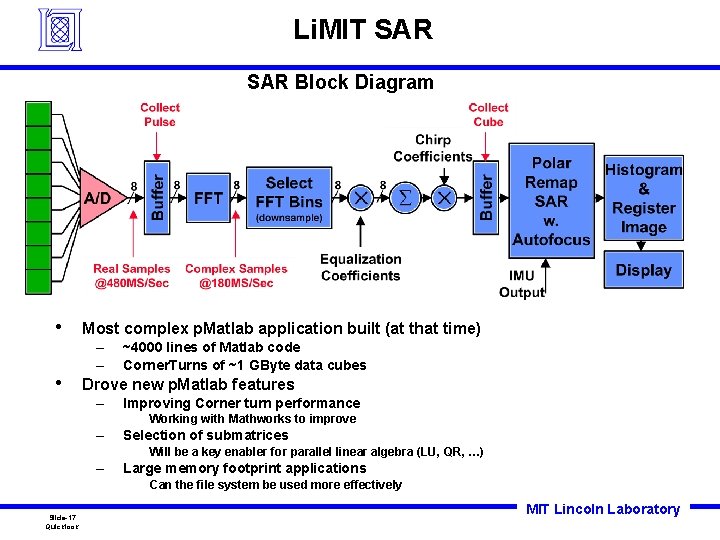
Li. MIT SAR Block Diagram • • Most complex p. Matlab application built (at that time) – – ~4000 lines of Matlab code Corner. Turns of ~1 GByte data cubes Drove new p. Matlab features – Improving Corner turn performance Working with Mathworks to improve – Selection of submatrices Will be a key enabler for parallel linear algebra (LU, QR, …) – Large memory footprint applications Can the file system be used more effectively Slide-17 Quicklook MIT Lincoln Laboratory
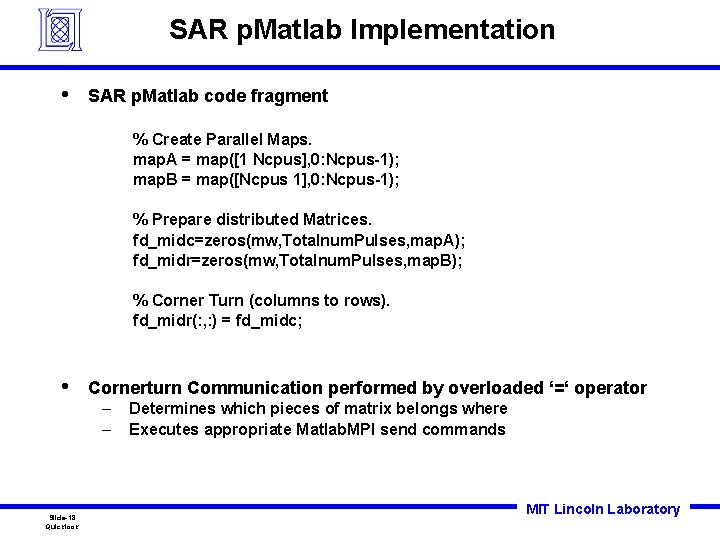
SAR p. Matlab Implementation • SAR p. Matlab code fragment % Create Parallel Maps. map. A = map([1 Ncpus], 0: Ncpus-1); map. B = map([Ncpus 1], 0: Ncpus-1); % Prepare distributed Matrices. fd_midc=zeros(mw, Totalnum. Pulses, map. A); fd_midr=zeros(mw, Totalnum. Pulses, map. B); % Corner Turn (columns to rows). fd_midr(: , : ) = fd_midc; • Cornerturn Communication performed by overloaded ‘=‘ operator – – Slide-18 Quicklook Determines which pieces of matrix belongs where Executes appropriate Matlab. MPI send commands MIT Lincoln Laboratory
Outline • Introduction • Implementation • Results • Summary Slide-19 Quicklook • Scaling Results • Mission Results • Future Work MIT Lincoln Laboratory
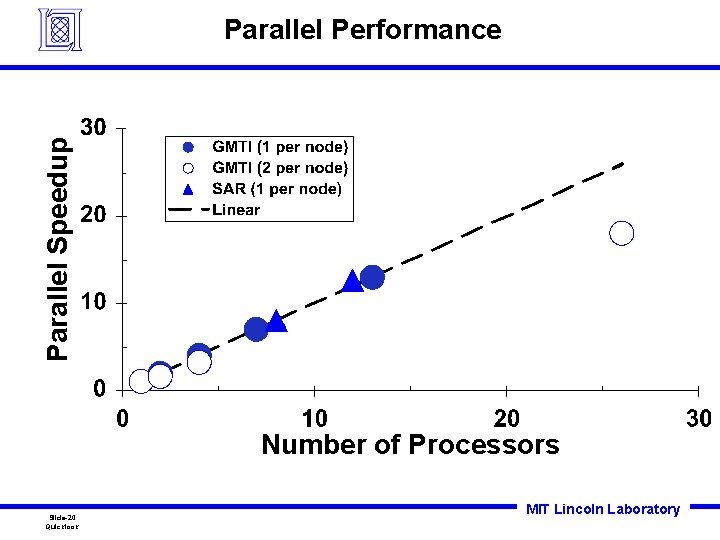
Parallel Speedup Parallel Performance Number of Processors Slide-20 Quicklook MIT Lincoln Laboratory
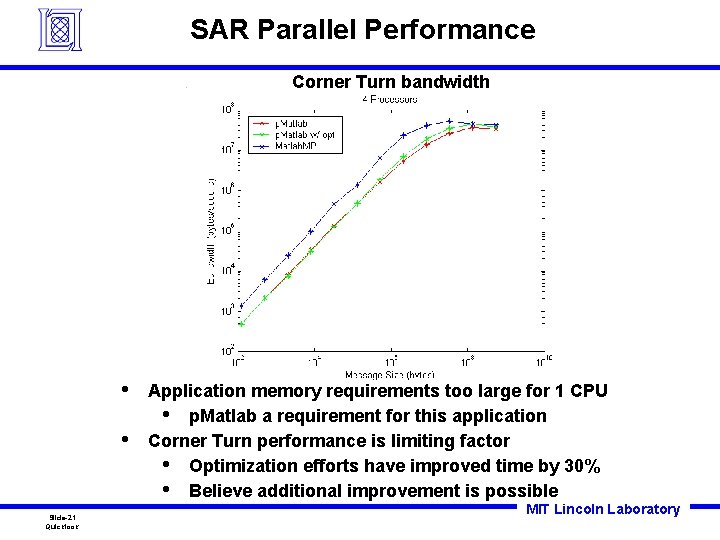
SAR Parallel Performance Corner Turn bandwidth • • Slide-21 Quicklook Application memory requirements too large for 1 CPU • p. Matlab a requirement for this application Corner Turn performance is limiting factor • Optimization efforts have improved time by 30% • Believe additional improvement is possible MIT Lincoln Laboratory
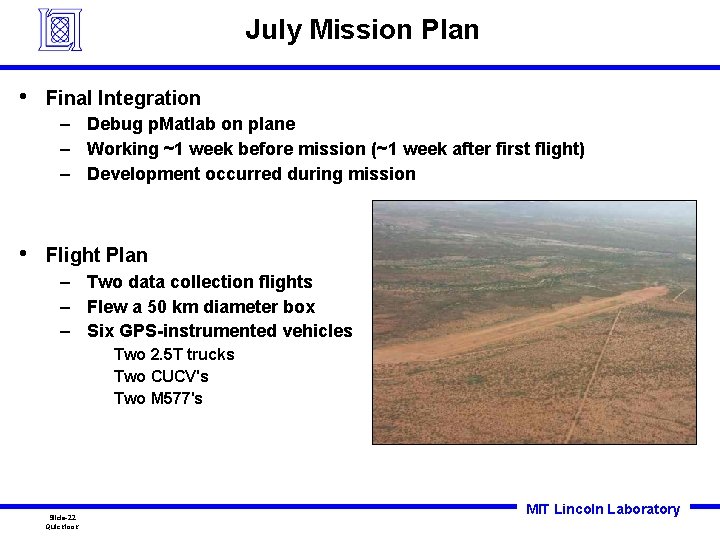
July Mission Plan • Final Integration – Debug p. Matlab on plane – Working ~1 week before mission (~1 week after first flight) – Development occurred during mission • Flight Plan – Two data collection flights – Flew a 50 km diameter box – Six GPS-instrumented vehicles Two 2. 5 T trucks Two CUCV's Two M 577's Slide-22 Quicklook MIT Lincoln Laboratory
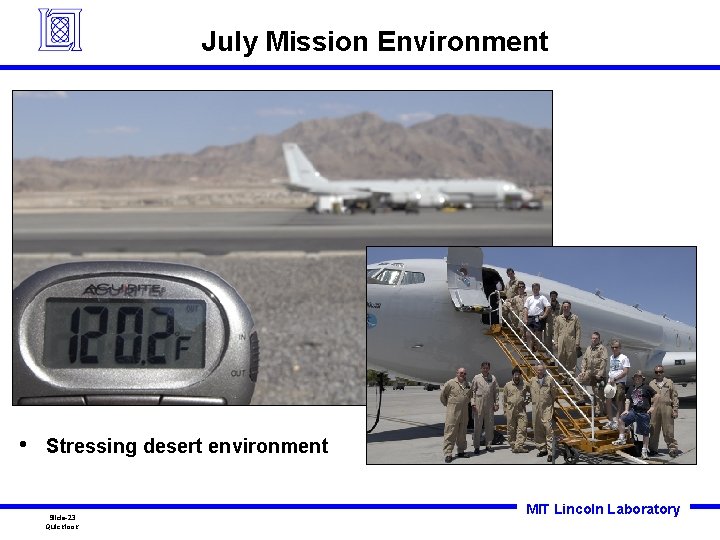
July Mission Environment • Stressing desert environment Slide-23 Quicklook MIT Lincoln Laboratory
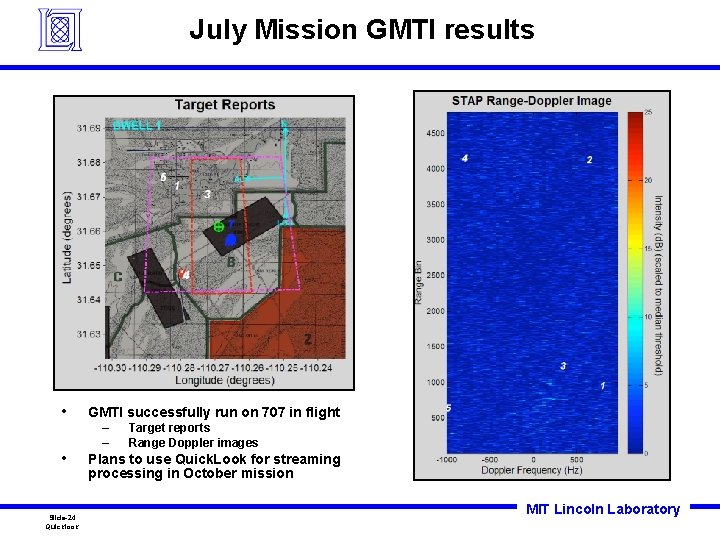
July Mission GMTI results • • Slide-24 Quicklook GMTI successfully run on 707 in flight – – Target reports Range Doppler images Plans to use Quick. Look for streaming processing in October mission MIT Lincoln Laboratory
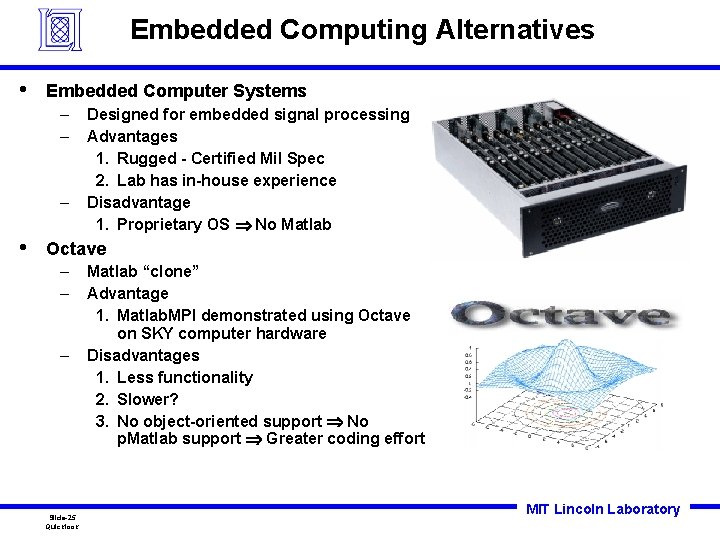
Embedded Computing Alternatives • Embedded Computer Systems – – – • Designed for embedded signal processing Advantages 1. Rugged - Certified Mil Spec 2. Lab has in-house experience Disadvantage 1. Proprietary OS No Matlab Octave – – – Slide-25 Quicklook Matlab “clone” Advantage 1. Matlab. MPI demonstrated using Octave on SKY computer hardware Disadvantages 1. Less functionality 2. Slower? 3. No object-oriented support No p. Matlab support Greater coding effort MIT Lincoln Laboratory
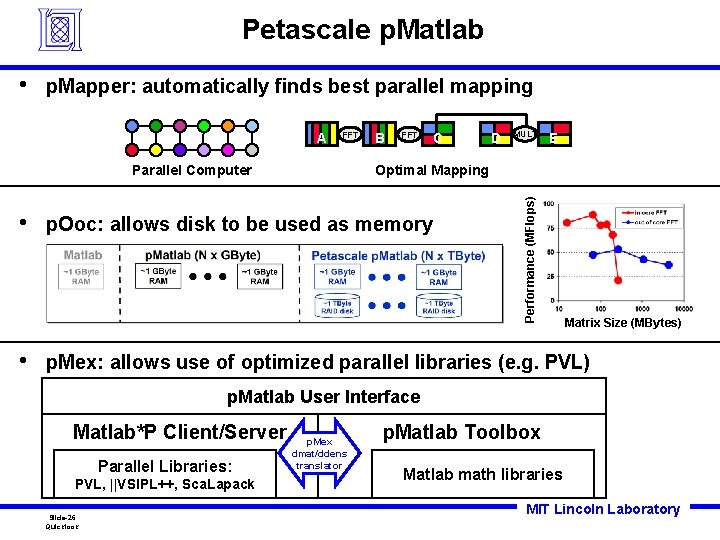
Petascale p. Matlab p. Mapper: automatically finds best parallel mapping A FFT Parallel Computer • • B FFT C D MULT E Optimal Mapping p. Ooc: allows disk to be used as memory Performance (MFlops) • Matrix Size (MBytes) p. Mex: allows use of optimized parallel libraries (e. g. PVL) p. Matlab User Interface Matlab*P Client/Server Parallel Libraries: PVL, ||VSIPL++, Sca. Lapack Slide-26 Quicklook p. Mex dmat/ddens translator p. Matlab Toolbox Matlab math libraries MIT Lincoln Laboratory
Summary • Airborne research platforms typically collect and process data later • p. Matlab, bladed clusters and high speed disks enable parallel processing in the air – Reduces execution time from hours to minutes – Uses rapid prototyping environment required for research • Successfully demonstrated in Li. MIT Boeing 707 – First ever in flight use of bladed clusters or parallel Matlab • Planned for continued use – Real Time streaming of GMTI to other assets • Drives new requirements for p. Matlab – Expert mapping – Parallel Out-of-Core – pmex Slide-27 Quicklook MIT Lincoln Laboratory