
Deploying the Optimal BWA Architecture May 2000 PTP
Deploying the Optimal BWA Architecture May 2000 PTP vs. PTMP Broadband Wireless World Forum 2001 Rami Hadar Executive Vice President Marketing & Business Development
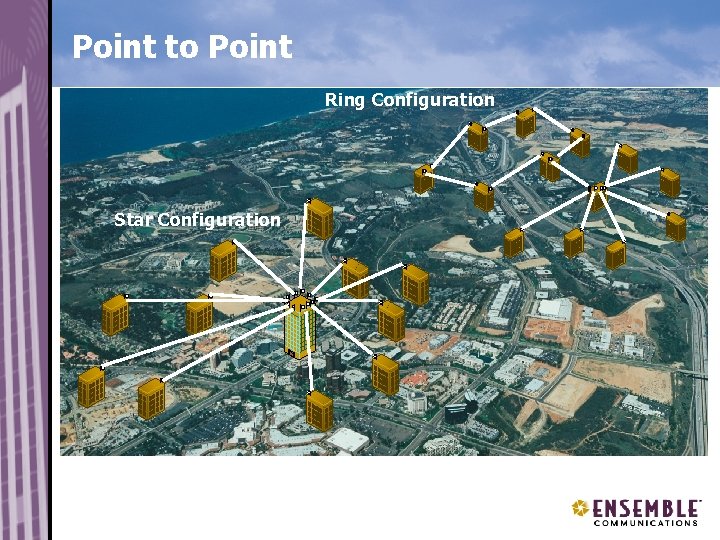
Point to Point Ring Configuration Star Configuration
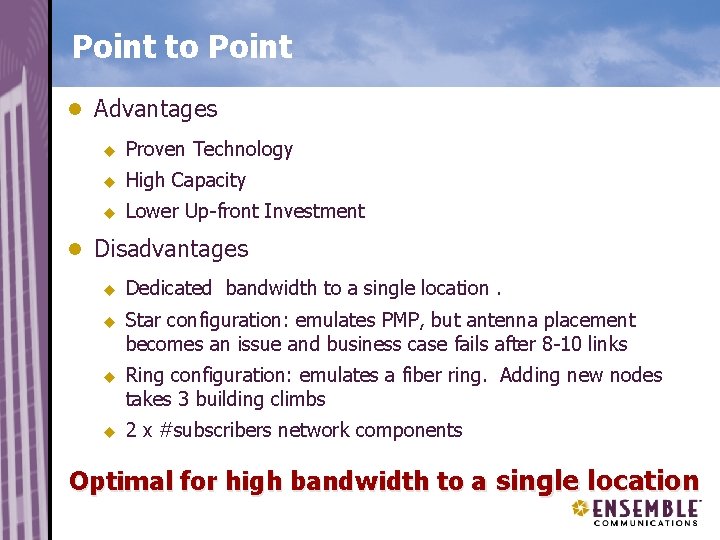
Point to Point n n Advantages u Proven Technology u High Capacity u Lower Up-front Investment Disadvantages u u Dedicated bandwidth to a single location. Star configuration: emulates PMP, but antenna placement becomes an issue and business case fails after 8 -10 links Ring configuration: emulates a fiber ring. Adding new nodes takes 3 building climbs 2 x #subscribers network components Optimal for high bandwidth to a single location
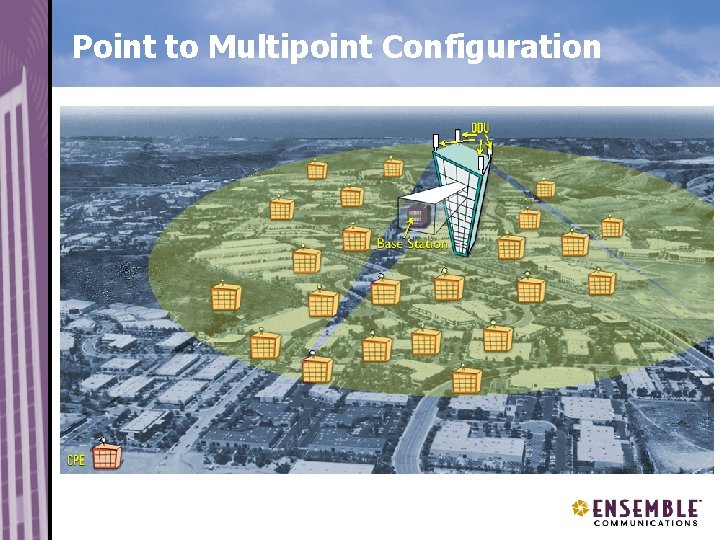
Point to Multipoint Configuration
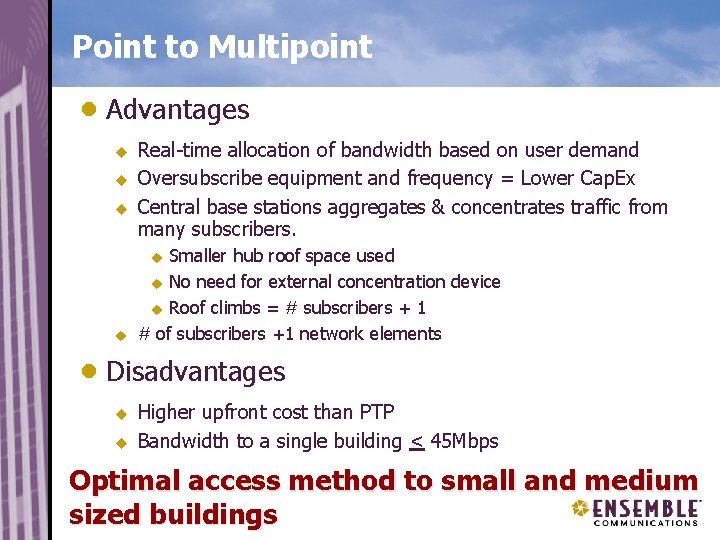
Point to Multipoint n Advantages u u u Real-time allocation of bandwidth based on user demand Oversubscribe equipment and frequency = Lower Cap. Ex Central base stations aggregates & concentrates traffic from many subscribers. Smaller hub roof space used u No need for external concentration device u Roof climbs = # subscribers + 1 # of subscribers +1 network elements u u n Disadvantages u u Higher upfront cost than PTP Bandwidth to a single building < 45 Mbps Optimal access method to small and medium sized buildings
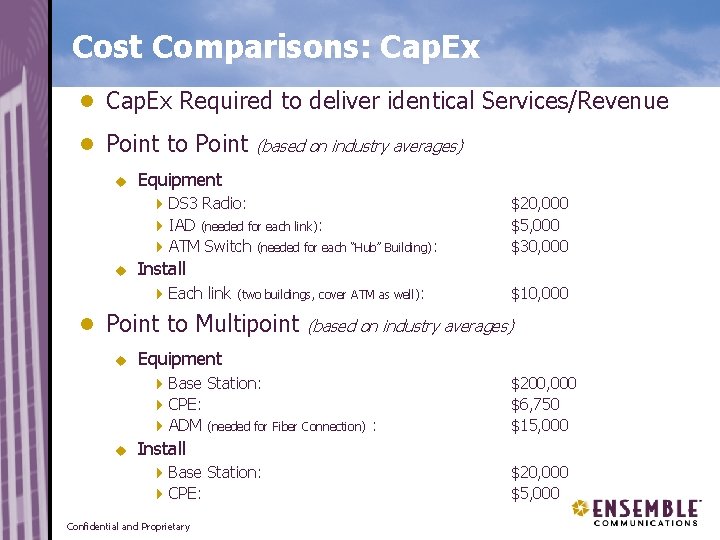
Cost Comparisons: Cap. Ex n Cap. Ex Required to deliver identical Services/Revenue n Point to Point u (based on industry averages) Equipment 4 DS 3 Radio: 4 IAD (needed for each link) : 4 ATM Switch (needed for each “Hub” Building) : u Install 4 Each link n (two buildings, cover ATM as well) : Point to Multipoint u $10, 000 (based on industry averages) Equipment 4 Base Station: 4 CPE: 4 ADM (needed for Fiber Connection) : u $20, 000 $5, 000 $30, 000 $200, 000 $6, 750 $15, 000 Install 4 Base Station: 4 CPE: Confidential and Proprietary $20, 000 $5, 000
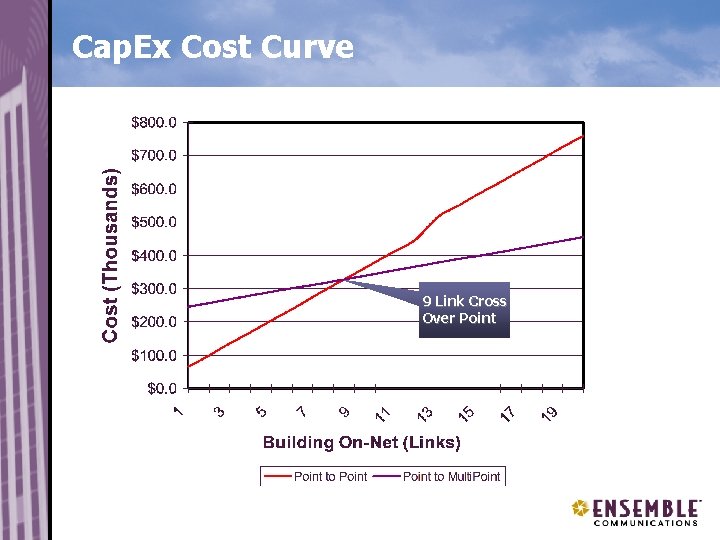
Cap. Ex Cost Curve 9 Link Cross Over Point
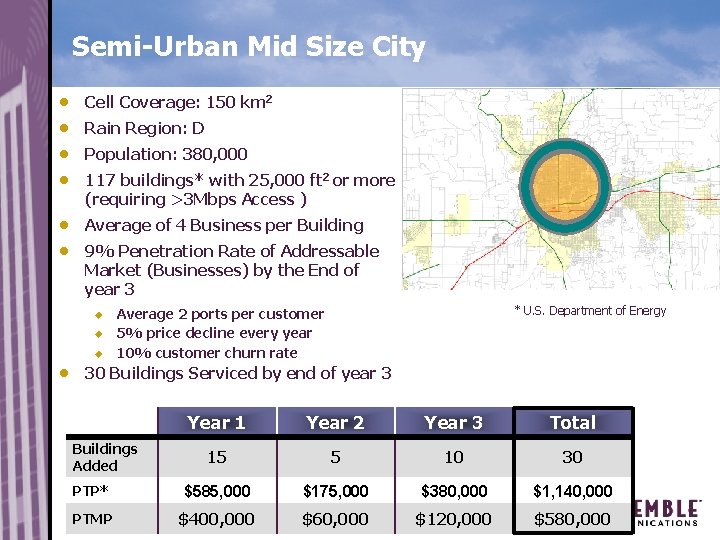
Semi-Urban Mid Size City n Cell Coverage: 150 km 2 n Rain Region: D n Population: 380, 000 n 117 buildings* with 25, 000 ft 2 or more (requiring >3 Mbps Access ) n Average of 4 Business per Building n 9% Penetration Rate of Addressable Market (Businesses) by the End of year 3 u u u n * U. S. Department of Energy Average 2 ports per customer 5% price decline every year 10% customer churn rate 30 Buildings Serviced by end of year 3 Year 1 Year 2 Year 3 Total 15 5 10 30 PTP* $585, 000 $175, 000 $380, 000 $1, 140, 000 PTMP $400, 000 $60, 000 $120, 000 $580, 000 Buildings Added Confidential and Proprietary
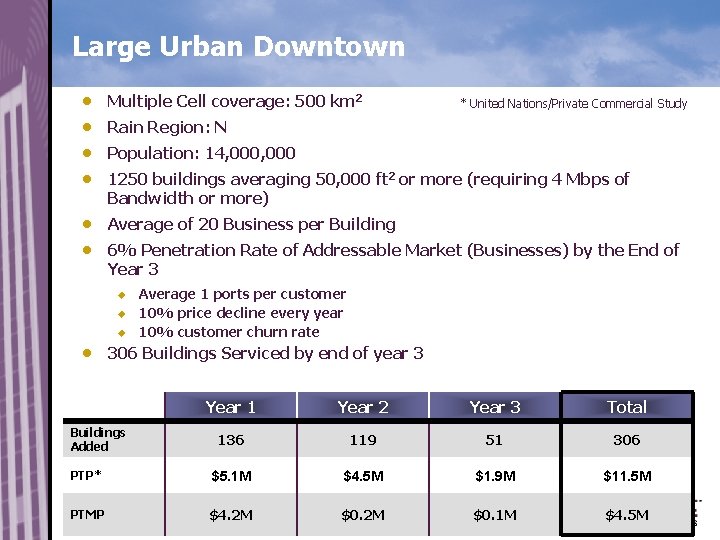
Large Urban Downtown n Multiple Cell coverage: 500 km 2 n Rain Region: N n Population: 14, 000 n 1250 buildings averaging 50, 000 ft 2 or more (requiring 4 Mbps of Bandwidth or more) n Average of 20 Business per Building n 6% Penetration Rate of Addressable Market (Businesses) by the End of Year 3 u u u n * United Nations/Private Commercial Study Average 1 ports per customer 10% price decline every year 10% customer churn rate 306 Buildings Serviced by end of year 3 Year 1 Year 2 Year 3 Total 136 119 51 306 PTP* $5. 1 M $4. 5 M $1. 9 M $11. 5 M PTMP $4. 2 M $0. 1 M $4. 5 M Buildings Added Confidential and Proprietary
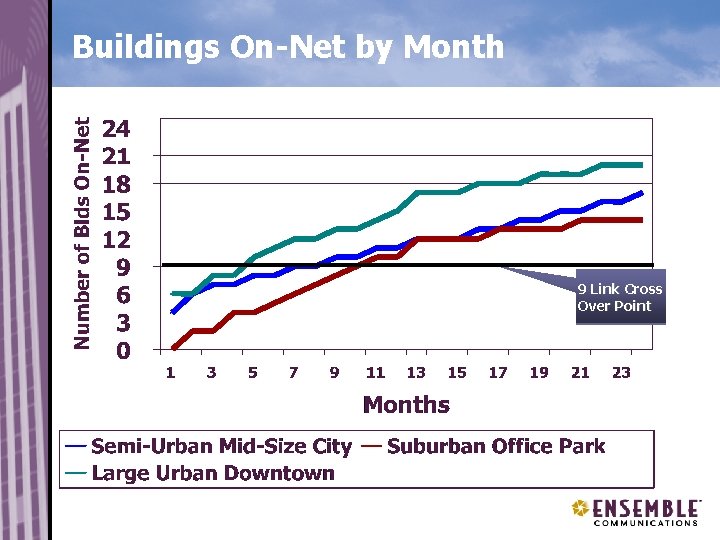
Buildings On-Net by Month 9 Link Cross Over Point
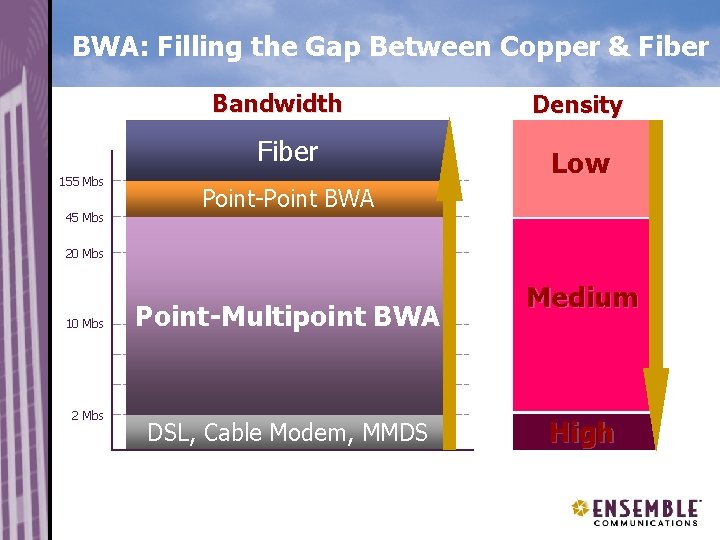
BWA: Filling the Gap Between Copper & Fiber Bandwidth Fiber 155 Mbs 45 Mbs Density Low Point-Point BWA 20 Mbs 10 Mbs 2 Mbs Point-Multipoint BWA DSL, Cable Modem, MMDS Medium High
- Slides: 11