
Deploying Neural Network Architectures using Py Torch Nabila
Deploying Neural Network Architectures using Py. Torch Nabila Shawki Neural Engineering Data Consortium Temple University
Outline • Machine Learning/Deep Learning Pipeline • A Brief Introduction to Py. Torch • Data Preparation • Model Design and Training • Decoding • Hyperparameter Tuning • Evaluation N. Shawki et al. : Neural Network Tutorials April 23, 2021 2
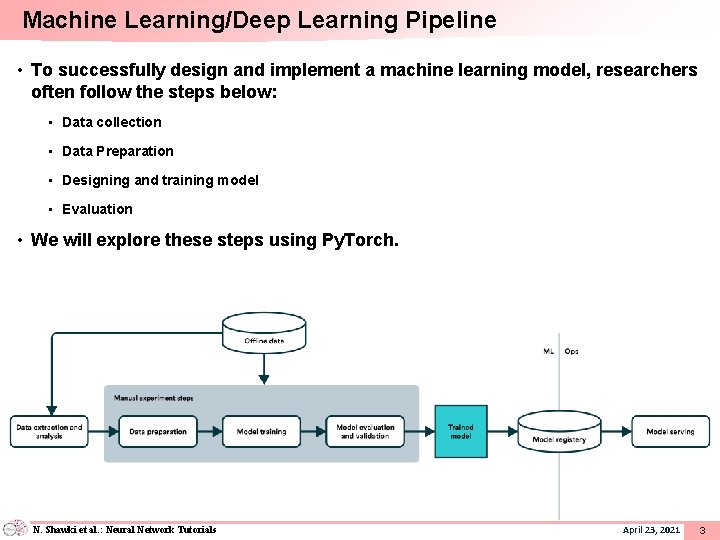
Machine Learning/Deep Learning Pipeline • To successfully design and implement a machine learning model, researchers often follow the steps below: • Data collection • Data Preparation • Designing and training model • Evaluation • We will explore these steps using Py. Torch. N. Shawki et al. : Neural Network Tutorials April 23, 2021 3
A Brief Introduction to Py. Torch • Py. Torch is a machine and deep learning library by Facebook’s AI Research Lab (FAIR). • Py. Torch has gained popularity among the research community as it is easy to develop and debug machine learning models in Py. Torch. • Nowadays, all state-of-the-art models and more available in Py. Torch and easy to integrate with any pipeline. • With proper seeding, Py. Torch can generate reproducible models. • Like Tensorflow, a machine learning library by Google, Py. Torch works with tensors which can be thought of as matrices with higher dimensions. These are equivalent to ndarrays in Num. Py. • There are other deep learning framework available. For example, MATLAB can be used to design and train models. • Keras is a high-level API library that uses Tensor. Flow as backend and suitable for beginners. It is straightforward to build and test models using Keras. However, it can be difficult to debug in Keras. N. Shawki et al. : Neural Network Tutorials April 23, 2021 4
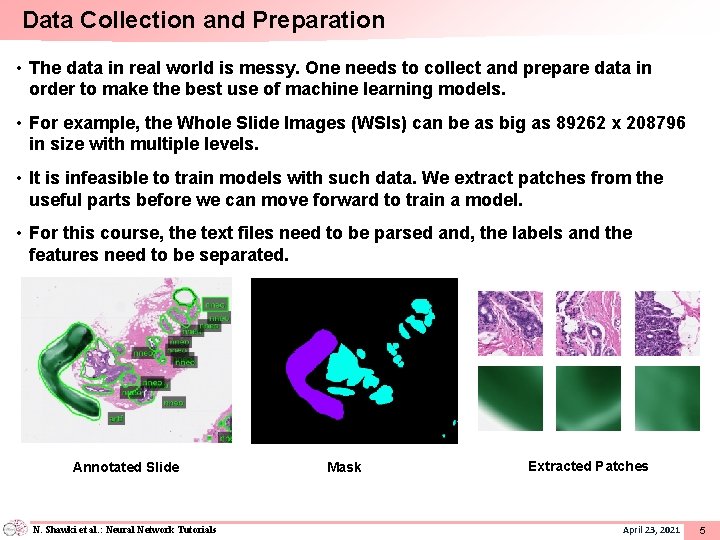
Data Collection and Preparation • The data in real world is messy. One needs to collect and prepare data in order to make the best use of machine learning models. • For example, the Whole Slide Images (WSIs) can be as big as 89262 x 208796 in size with multiple levels. • It is infeasible to train models with such data. We extract patches from the useful parts before we can move forward to train a model. • For this course, the text files need to be parsed and, the labels and the features need to be separated. Annotated Slide N. Shawki et al. : Neural Network Tutorials Mask Extracted Patches April 23, 2021 5
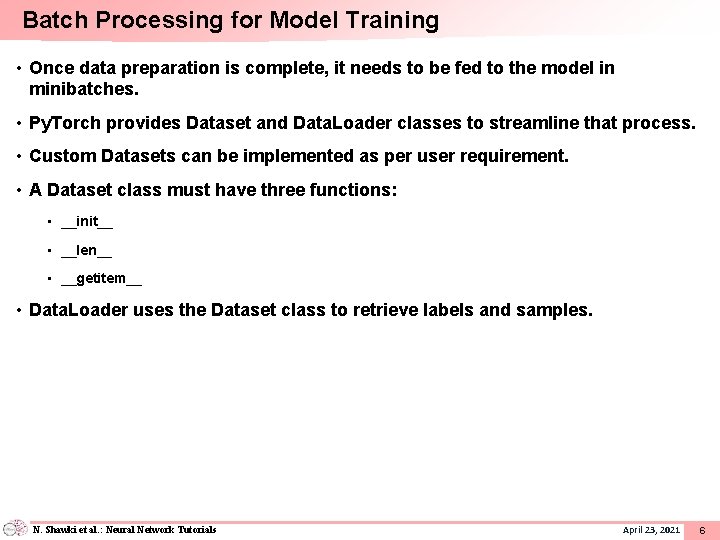
Batch Processing for Model Training • Once data preparation is complete, it needs to be fed to the model in minibatches. • Py. Torch provides Dataset and Data. Loader classes to streamline that process. • Custom Datasets can be implemented as per user requirement. • A Dataset class must have three functions: • __init__ • __len__ • __getitem__ • Data. Loader uses the Dataset class to retrieve labels and samples. N. Shawki et al. : Neural Network Tutorials April 23, 2021 6
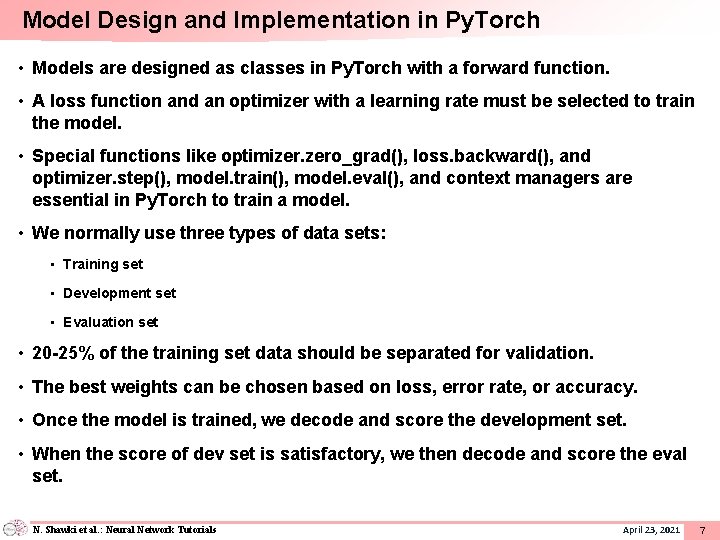
Model Design and Implementation in Py. Torch • Models are designed as classes in Py. Torch with a forward function. • A loss function and an optimizer with a learning rate must be selected to train the model. • Special functions like optimizer. zero_grad(), loss. backward(), and optimizer. step(), model. train(), model. eval(), and context managers are essential in Py. Torch to train a model. • We normally use three types of data sets: • Training set • Development set • Evaluation set • 20 -25% of the training set data should be separated for validation. • The best weights can be chosen based on loss, error rate, or accuracy. • Once the model is trained, we decode and score the development set. • When the score of dev set is satisfactory, we then decode and score the eval set. N. Shawki et al. : Neural Network Tutorials April 23, 2021 7
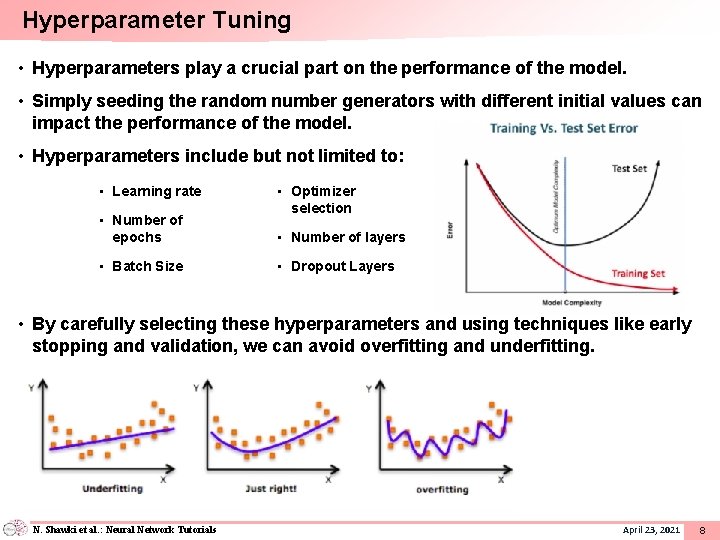
Hyperparameter Tuning • Hyperparameters play a crucial part on the performance of the model. • Simply seeding the random number generators with different initial values can impact the performance of the model. • Hyperparameters include but not limited to: • Learning rate • Number of epochs • Batch Size • Optimizer selection • Number of layers • Dropout Layers • By carefully selecting these hyperparameters and using techniques like early stopping and validation, we can avoid overfitting and underfitting. N. Shawki et al. : Neural Network Tutorials April 23, 2021 8
- Slides: 8