
Deploying Interactive Remote Labs Using the i Lab
Deploying Interactive Remote Labs Using the i. Lab Shared Architecture James Hardison, MIT - CECI Frontiers in Education, October 22 - 25, 2008
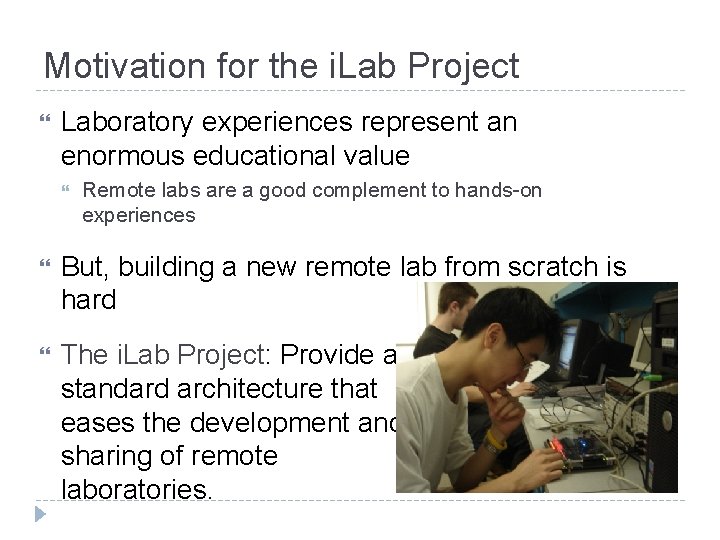
Motivation for the i. Lab Project Laboratory experiences represent an enormous educational value Remote labs are a good complement to hands-on experiences But, building a new remote lab from scratch is hard The i. Lab Project: Provide a standard architecture that eases the development and sharing of remote laboratories.

A Brief History of the i. Lab Project 1998: First Individual Labs Developed 2004: i. Lab Shared Architecture (ISA), Compliant Batched Labs Released 2007: Support for Interactive Experiments Added to ISA Adoption of ISA increasing worldwide ►
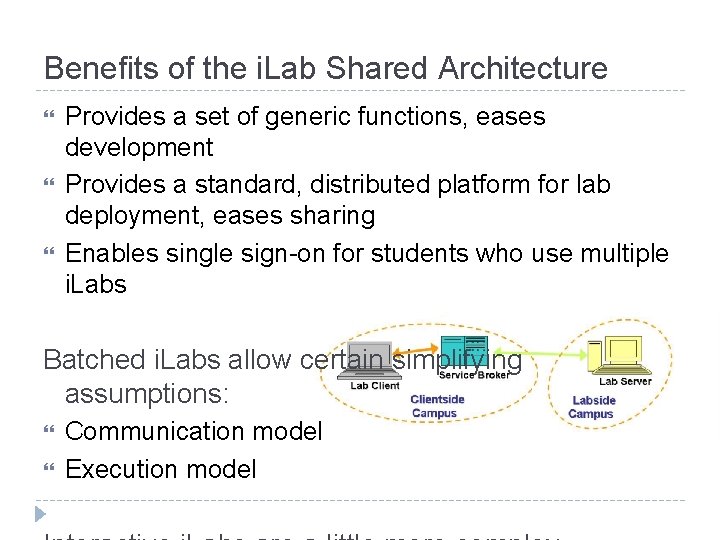
Benefits of the i. Lab Shared Architecture Provides a set of generic functions, eases development Provides a standard, distributed platform for lab deployment, eases sharing Enables single sign-on for students who use multiple i. Labs Batched i. Labs allow certain simplifying assumptions: Communication model Execution model

Supporting Interactive Experiments Interactive experiments, by their nature… …require real-time control. Direct client to lab server connection needed (possibly high-bandwidth, possibly proprietary) …are performed in human-time. Longer periods of single user control A revision to the i. Lab Shared Architecture was necessary to provide services for interactive experiments.
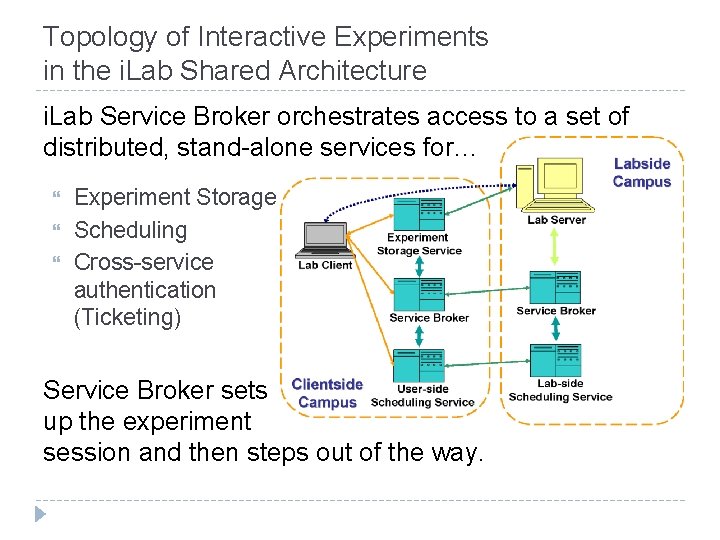
Topology of Interactive Experiments in the i. Lab Shared Architecture i. Lab Service Broker orchestrates access to a set of distributed, stand-alone services for… Experiment Storage Scheduling Cross-service authentication (Ticketing) Service Broker sets up the experiment session and then steps out of the way.

The Experiment Storage Service (ESS) A generic stand-alone service responsible storing student experiment information Lab configurations, input parameters, results Service Brokers, Lab Servers and Clients all interface to an ESS Service Broker responsible for record management Clients & Lab Servers contribute to the record A single ESS may service many i. Lab installations
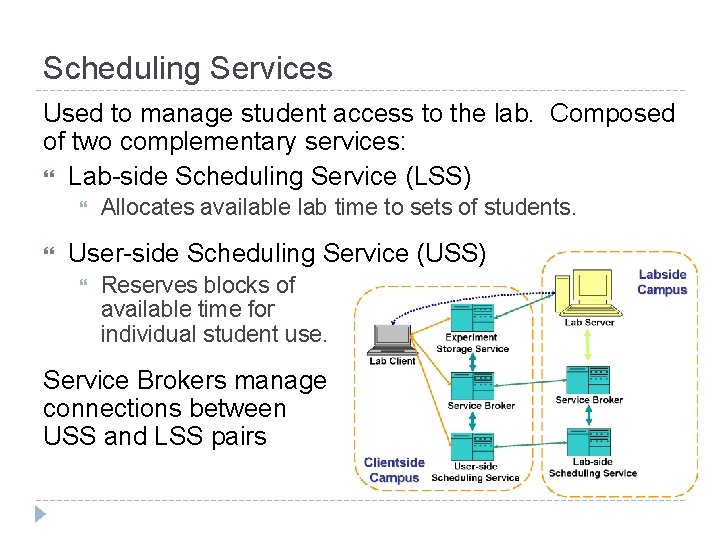
Scheduling Services Used to manage student access to the lab. Composed of two complementary services: Lab-side Scheduling Service (LSS) Allocates available lab time to sets of students. User-side Scheduling Service (USS) Reserves blocks of available time for individual student use. Service Brokers manage connections between USS and LSS pairs
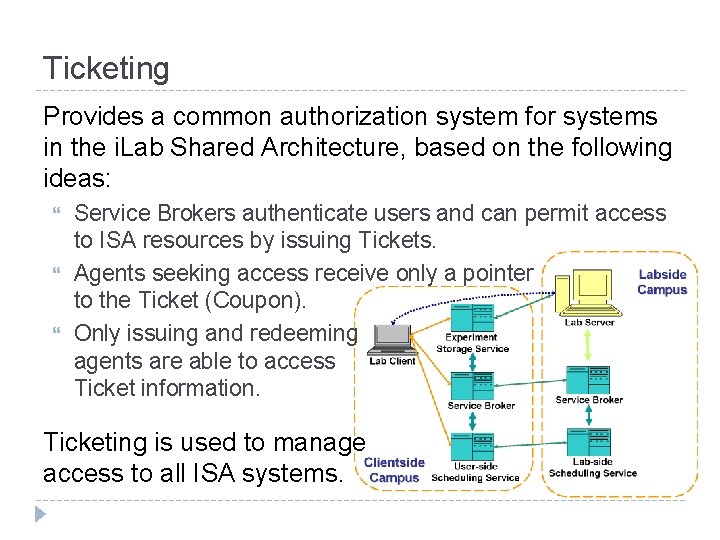
Ticketing Provides a common authorization system for systems in the i. Lab Shared Architecture, based on the following ideas: Service Brokers authenticate users and can permit access to ISA resources by issuing Tickets. Agents seeking access receive only a pointer to the Ticket (Coupon). Only issuing and redeeming agents are able to access Ticket information. Ticketing is used to manage access to all ISA systems.
Developing Interactive Labs for the ISA By design, few technical constraints are placed on lab development Lab. VIEW Integrated Interactive Lab Server (LVIILS) Labs can have drastically different requirements One size does not fit all Provides a toolkit for building a Lab. VIEW based lab using the ISA Enables Lab. VIEW VIs to take full advantage of ISA services Existing VI can be converted to an i. Lab in a matter of hours Development on other platforms follows similar path to that of the LVIILS
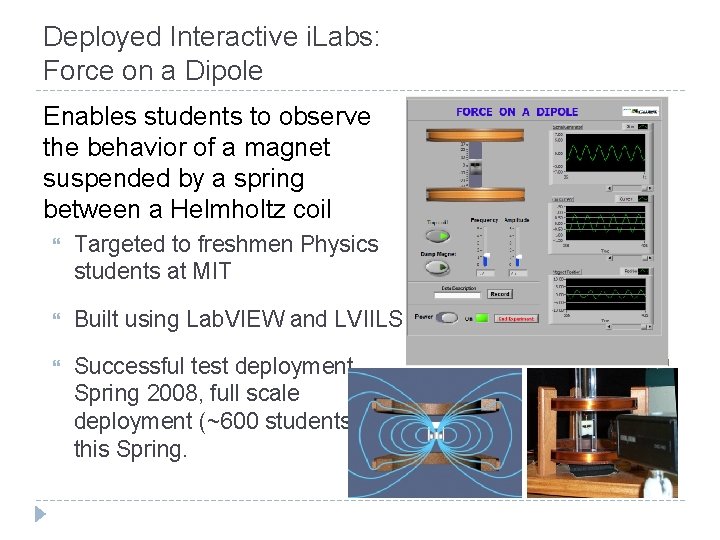
Deployed Interactive i. Labs: Force on a Dipole Enables students to observe the behavior of a magnet suspended by a spring between a Helmholtz coil Targeted to freshmen Physics students at MIT Built using Lab. VIEW and LVIILS Successful test deployment Spring 2008, full scale deployment (~600 students) this Spring.
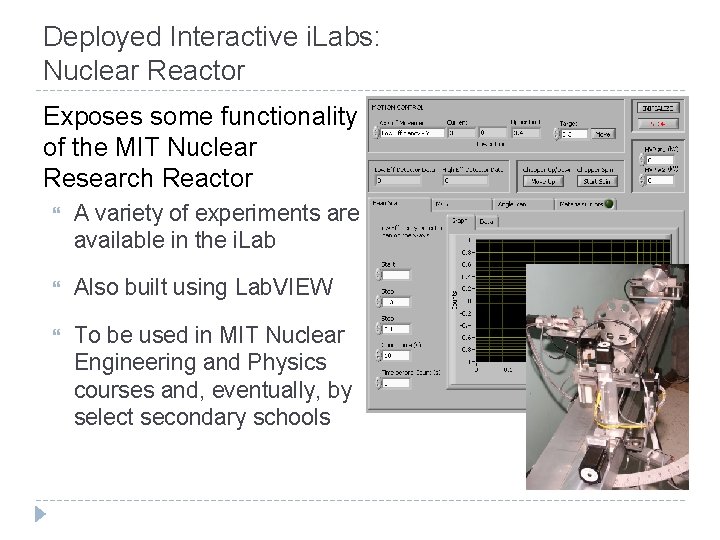
Deployed Interactive i. Labs: Nuclear Reactor Exposes some functionality of the MIT Nuclear Research Reactor A variety of experiments are available in the i. Lab Also built using Lab. VIEW To be used in MIT Nuclear Engineering and Physics courses and, eventually, by select secondary schools
Ongoing Work and Conclusions What we’re working on now: Develop a unified architecture that will support both Batched and Interactive i. Labs (recently completed). Further refine services for Interactive i. Labs on the ISA Support development of Interactive i. Labs at Project partner institutions. In conclusion… The i. Lab Project has developed a platform to support the development and deployment of Interactive remote laboratories. A toolkit has been developed to enable the rapid development of Lab. VIEW based experiments. This work will drastically increase the number of i. Labs available to students. For more information, see http: //ilab. mit. edu/wiki
- Slides: 13