
Dependent Verification Audits What Why How When The


- Slides: 17
Dependent Verification Audits What? Why? How? When? The Keys to Executing a Successful Audit HR. com Webinar December 12, 2012 Michael Gaudette Dependent Specialists, Inc mgaudette@dependentspecialists. com 800 -DSI-7175 ext 300
Agenda I. Audits Defined II. What’s the Big Deal with Audits? III. Considerations of whether to do an audit IV. How to do an audit V. Best Practices & Avoidable Mistakes VI. Q&A
What is a Dependent Audit? • A systematic check of the legitimacy of dependents claimed by employees in the benefits pool of employer-sponsored health plans. • Various types and methods of audits covered today. • One of the fastest growing tools adopted by companies to combat increasing health care costs.
What’s the Big Deal with Dependent Audits? Factors • Increasing health care costs • Rampant fraud in dependent population • Employee benefits are becoming an entitlement, but not for dependents • Significant savings potential • Employee education and appreciation
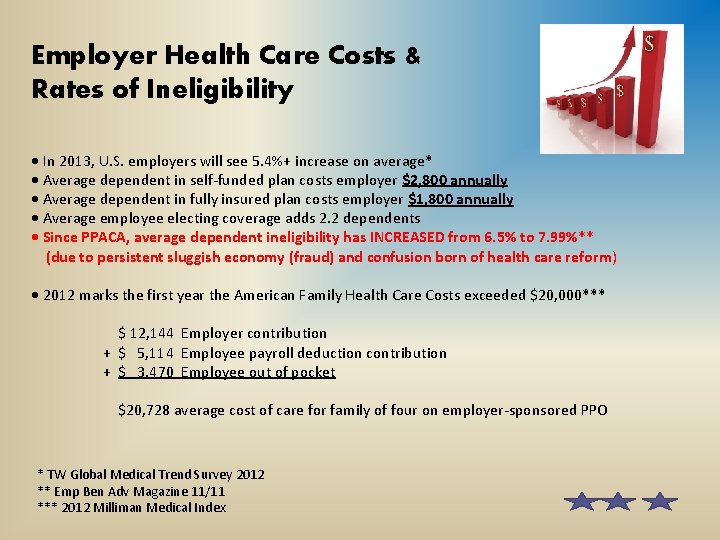
Employer Health Care Costs & Rates of Ineligibility • In 2013, U. S. employers will see 5. 4%+ increase on average* • Average dependent in self-funded plan costs employer $2, 800 annually • Average dependent in fully insured plan costs employer $1, 800 annually • Average employee electing coverage adds 2. 2 dependents • Since PPACA, average dependent ineligibility has INCREASED from 6. 5% to 7. 99%** (due to persistent sluggish economy (fraud) and confusion born of health care reform) • 2012 marks the first year the American Family Health Care Costs exceeded $20, 000*** $ 12, 144 Employer contribution + $ 5, 114 Employee payroll deduction contribution + $ 3, 470 Employee out of pocket $20, 728 average cost of care for family of four on employer-sponsored PPO * TW Global Medical Trend Survey 2012 ** Emp Ben Adv Magazine 11/11 *** 2012 Milliman Medical Index
What’s the Big Deal with Dependent Audits (cont’d) • Reminds employees that insurance for dependents is a benefit of employment, not an entitlement • Employees recognize being treated fairly and equally to keep costs as low as possible for all employees • Ensure ERISA Compliance • Exclusive benefits, prudent man, Plan Doc compliance • Sarbanes-Oxley Compliance And the #1 reason…. $AVING$
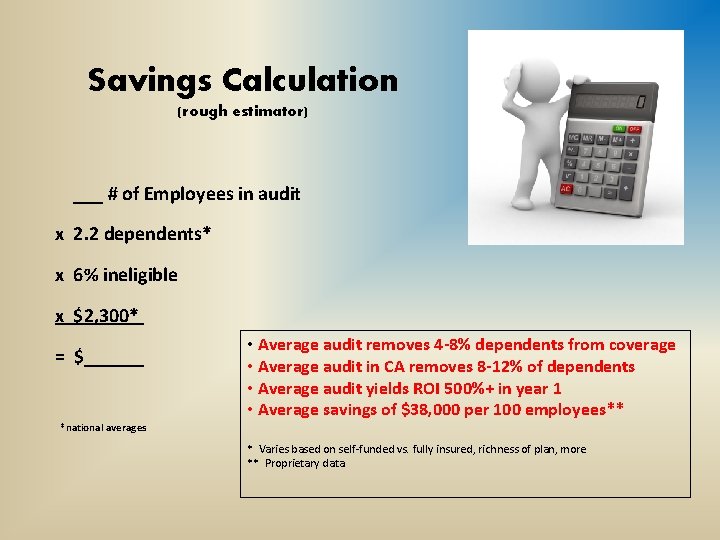
Savings Calculation (rough estimator) ___ # of Employees in audit x 2. 2 dependents* x 6% ineligible x $2, 300* = $______ • Average audit removes 4 -8% dependents from coverage • Average audit in CA removes 8 -12% of dependents • Average audit yields ROI 500%+ in year 1 • Average savings of $38, 000 per 100 employees** *national averages * Varies based on self-funded vs. fully insured, richness of plan, more ** Proprietary data
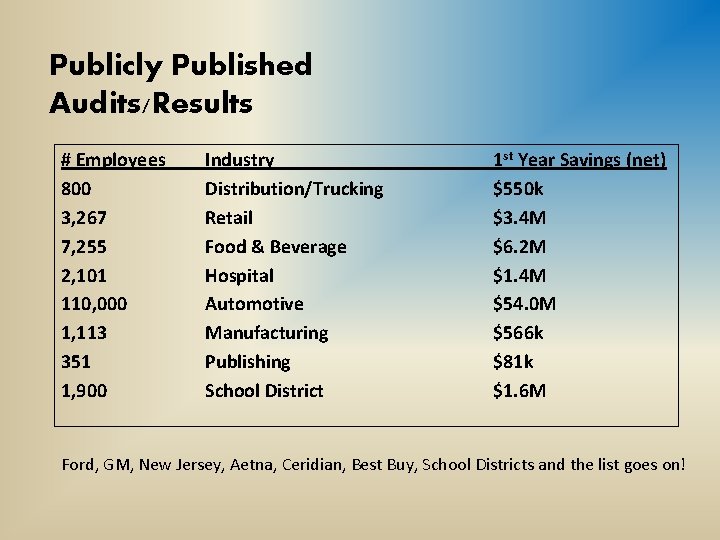
Publicly Published Audits/Results # Employees 800 3, 267 7, 255 2, 101 110, 000 1, 113 351 1, 900 Industry Distribution/Trucking Retail Food & Beverage Hospital Automotive Manufacturing Publishing School District 1 st Year Savings (net) $550 k $3. 4 M $6. 2 M $1. 4 M $54. 0 M $566 k $81 k $1. 6 M Ford, GM, New Jersey, Aetna, Ceridian, Best Buy, School Districts and the list goes on!
Considerations – Should we Audit? Factors • Employer size • Timing • Type of Audit • Employee population • In-house or Outsource • Resources and Funding
Dependent Audit Considerations Employer Size: Most groups are 250+ employees and self funded, but value can be found at all sizes and in fully insured groups. Timing: 1) Audits should never be conducted in conjunction with Open Enrollment. Employees have a hard enough time remembering to enroll for benefits, they don’t need an additional responsibility. 2) Best times are Feb-July for January 1 renewals, and 3 months before Open Enrollment for everyone else. 3) Allows time for audit, appeals, removals and clean census before OE begins Rescission: Rare due to Health Care Reform requirements, excellent webinar in HR. com directory focused on this subject – May 2012
Considerations (cont’d) Type of Audit: • Comprehensive – no risk of discrimination • Amnesty – free removal, no questions asked • Sampling – departmental, random, can be risky • Periodic - every few years • Ongoing – monthly maintenance • Working Spouse – the next generation of audits Employee Population: • Heavy Union? • Heavy English-as-a-Second-Language? • White collar/blue collar In-House or Outsource: • Issue of resources: time and money Funding/Fees of Outsourcing: • Contingent, per-head removed, flat fee, implementation fees, admin fees, etc.
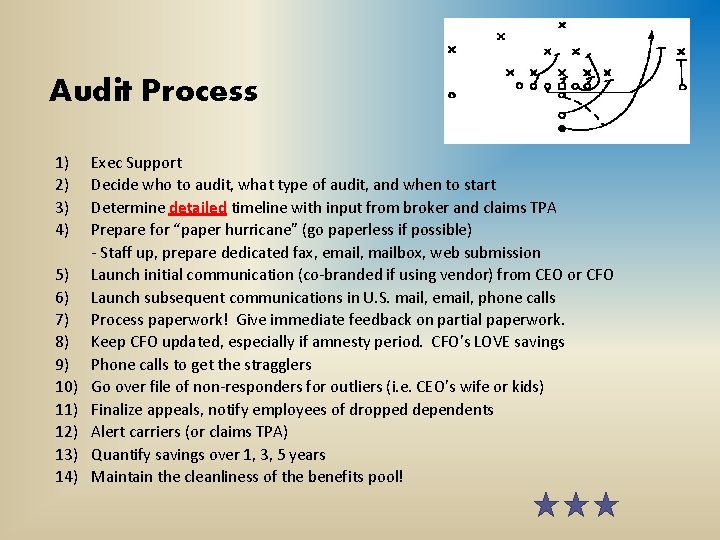
Audit Process 1) 2) 3) 4) 5) 6) 7) 8) 9) 10) 11) 12) 13) 14) Exec Support Decide who to audit, what type of audit, and when to start Determine detailed timeline with input from broker and claims TPA Prepare for “paper hurricane” (go paperless if possible) - Staff up, prepare dedicated fax, email, mailbox, web submission Launch initial communication (co-branded if using vendor) from CEO or CFO Launch subsequent communications in U. S. mail, email, phone calls Process paperwork! Give immediate feedback on partial paperwork. Keep CFO updated, especially if amnesty period. CFO’s LOVE savings Phone calls to get the stragglers Go over file of non-responders for outliers (i. e. CEO’s wife or kids) Finalize appeals, notify employees of dropped dependents Alert carriers (or claims TPA) Quantify savings over 1, 3, 5 years Maintain the cleanliness of the benefits pool!
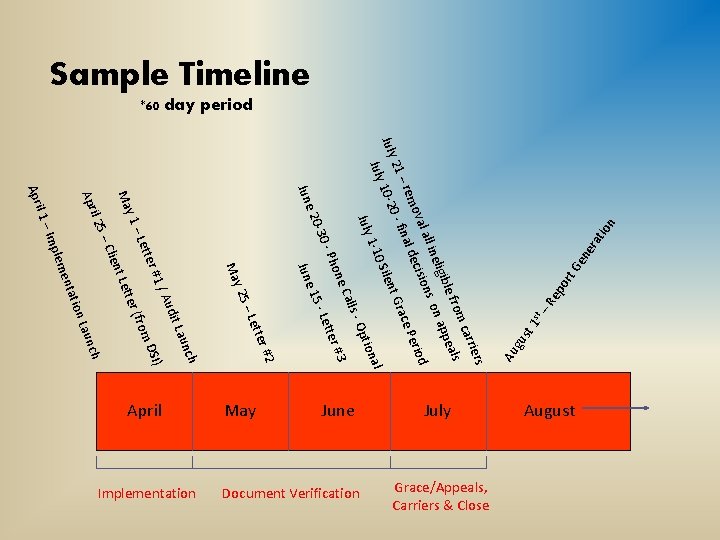
iona 1 st – st Opt gu rt po Re ati o Ge ne r 0 Si ls - #3 n s rier car om als e fr ppe gibl on a neli all i isions d val erio mo dec ce P – re - final Gra 21 0 2 lent 10 l July 1 -1 July Cal one tter - Le e 15 Jun - Ph -30 e 20 Jun ch SI) nch m D n Lau r #2 ette – L y 25 Ma dit / Au (fro tter t Le #1 tter – Le y 1 Ma lien – C Lau tion enta lem Imp il 25 Apr il 1 – Apr Grace/Appeals, Carriers & Close Document Verification Implementation August April May June July Au Sample Timeline *60 day period
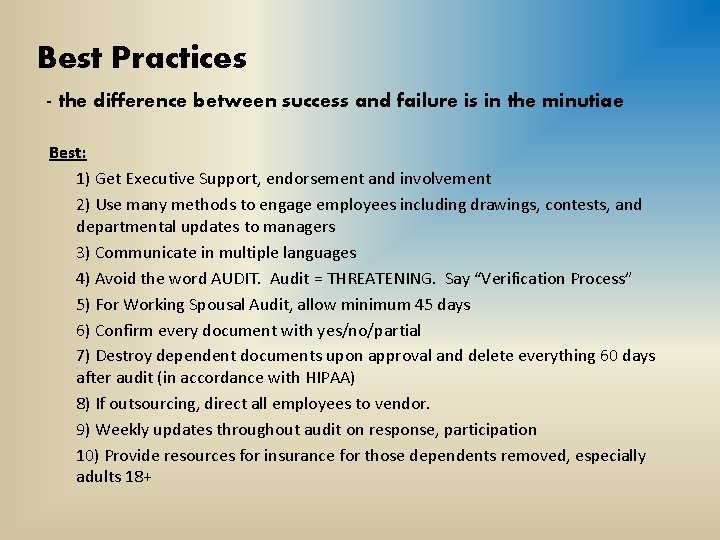
Best Practices - the difference between success and failure is in the minutiae Best: 1) Get Executive Support, endorsement and involvement 2) Use many methods to engage employees including drawings, contests, and departmental updates to managers 3) Communicate in multiple languages 4) Avoid the word AUDIT. Audit = THREATENING. Say “Verification Process” 5) For Working Spousal Audit, allow minimum 45 days 6) Confirm every document with yes/no/partial 7) Destroy dependent documents upon approval and delete everything 60 days after audit (in accordance with HIPAA) 8) If outsourcing, direct all employees to vendor. 9) Weekly updates throughout audit on response, participation 10) Provide resources for insurance for those dependents removed, especially adults 18+
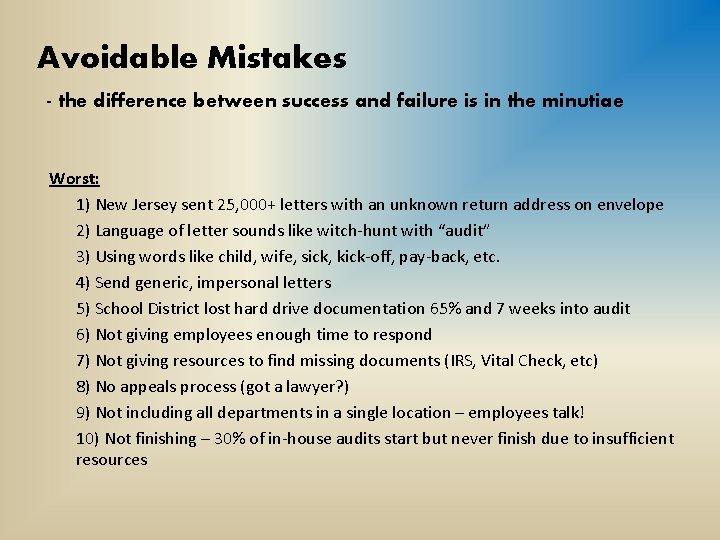
Avoidable Mistakes - the difference between success and failure is in the minutiae Worst: 1) New Jersey sent 25, 000+ letters with an unknown return address on envelope 2) Language of letter sounds like witch-hunt with “audit” 3) Using words like child, wife, sick, kick-off, pay-back, etc. 4) Send generic, impersonal letters 5) School District lost hard drive documentation 65% and 7 weeks into audit 6) Not giving employees enough time to respond 7) Not giving resources to find missing documents (IRS, Vital Check, etc) 8) No appeals process (got a lawyer? ) 9) Not including all departments in a single location – employees talk! 10) Not finishing – 30% of in-house audits start but never finish due to insufficient resources
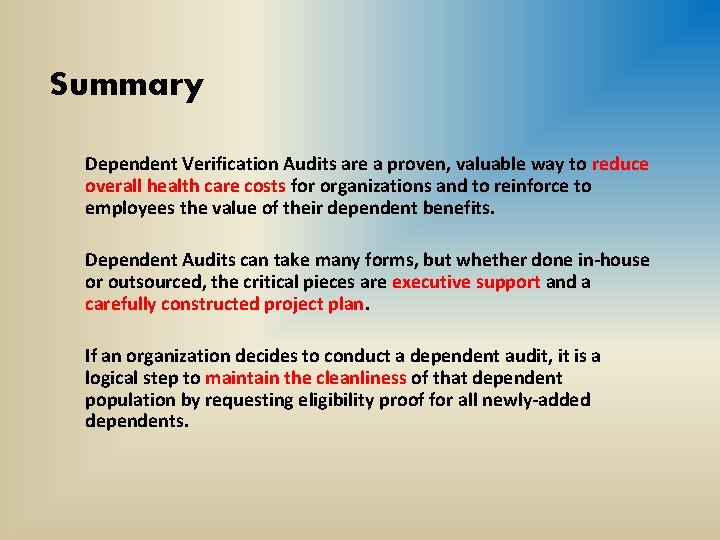
Summary Dependent Verification Audits are a proven, valuable way to reduce overall health care costs for organizations and to reinforce to employees the value of their dependent benefits. Dependent Audits can take many forms, but whether done in-house or outsourced, the critical pieces are executive support and a carefully constructed project plan. If an organization decides to conduct a dependent audit, it is a logical step to maintain the cleanliness of that dependent population by requesting eligibility proof for all newly-added dependents.
Questions? Decision and ROI Tree? Michael Gaudette mgaudette@dependentspecialists. com P: 800 -DSI-7175 ext 300 PO Box 80133 Rancho Santa Margarita, CA 92688 Sensitive Solutions l Real Savings