
Dependent Variable Discrete o 2 values binomial o
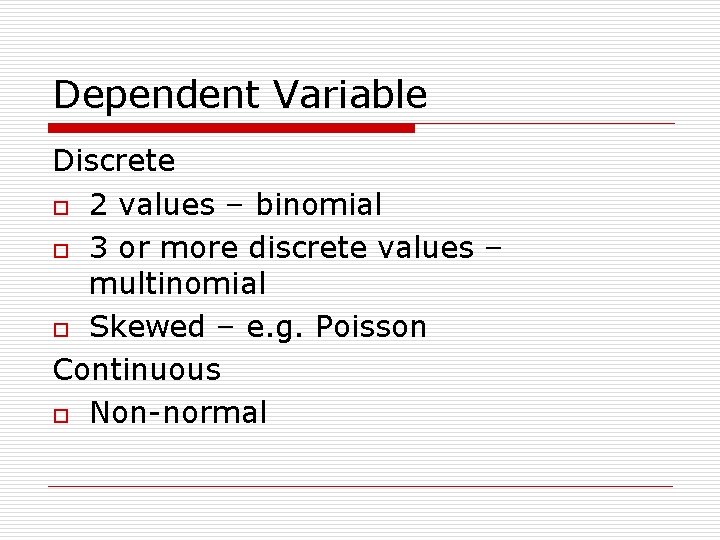
Dependent Variable Discrete o 2 values – binomial o 3 or more discrete values – multinomial o Skewed – e. g. Poisson Continuous o Non-normal
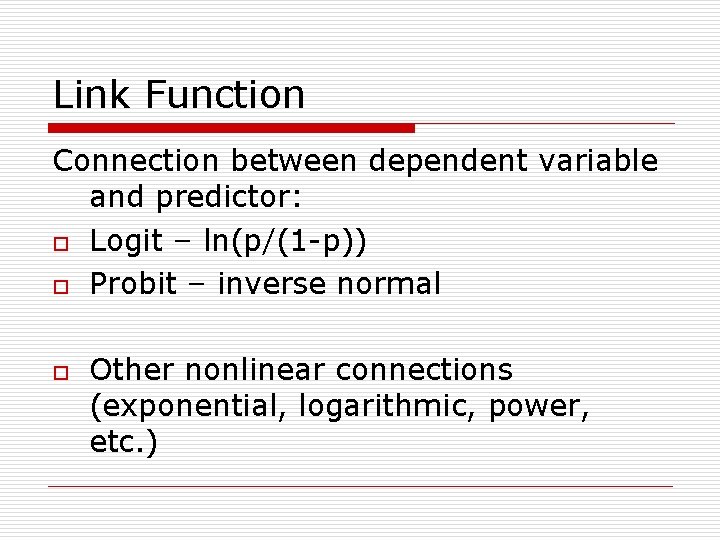
Link Function Connection between dependent variable and predictor: o Logit – ln(p/(1 -p)) o Probit – inverse normal o Other nonlinear connections (exponential, logarithmic, power, etc. )
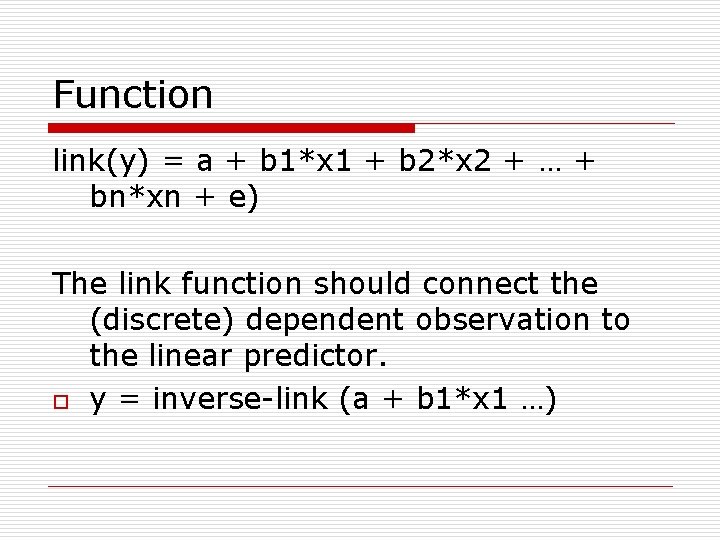
Function link(y) = a + b 1*x 1 + b 2*x 2 + … + bn*xn + e) The link function should connect the (discrete) dependent observation to the linear predictor. o y = inverse-link (a + b 1*x 1 …)
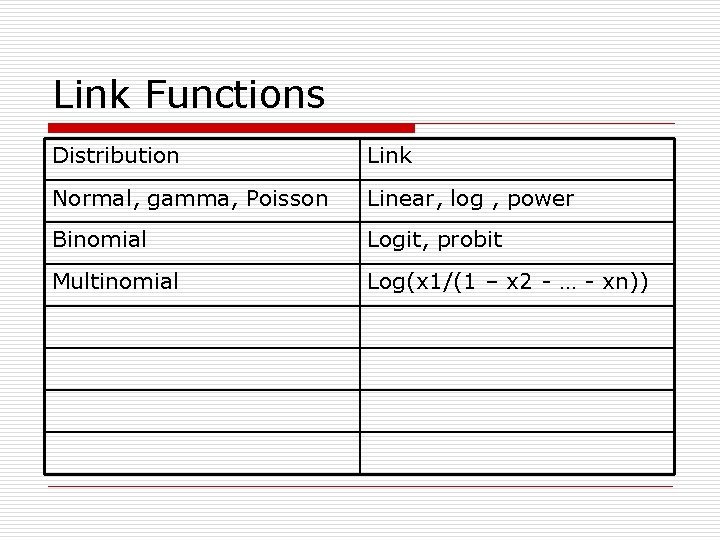
Link Functions Distribution Link Normal, gamma, Poisson Linear, log , power Binomial Logit, probit Multinomial Log(x 1/(1 – x 2 - … - xn))
Solution o Requires numeric solution (rather than algebraic for traditional GLM)
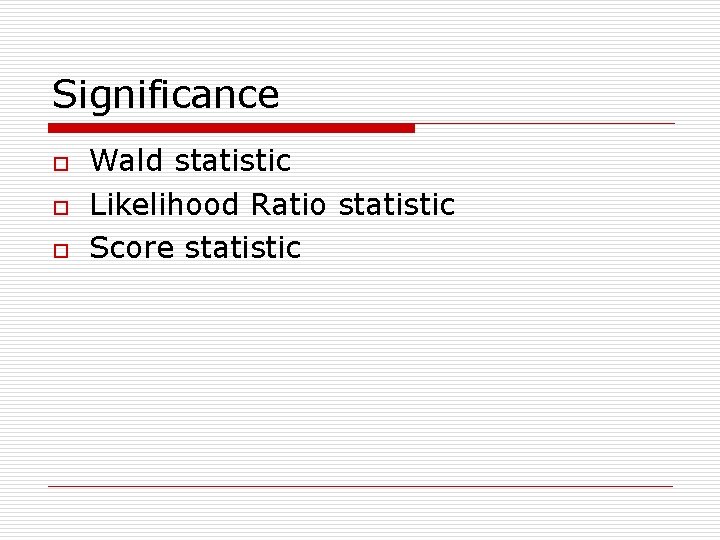
Significance o o o Wald statistic Likelihood Ratio statistic Score statistic
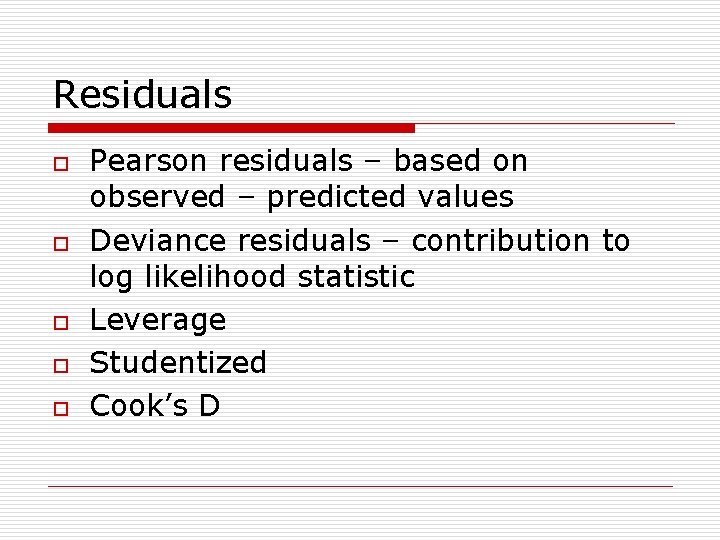
Residuals o o o Pearson residuals – based on observed – predicted values Deviance residuals – contribution to log likelihood statistic Leverage Studentized Cook’s D
Models o o ANOVA Regression ANCOVA More complex linear models
SAS o o o PROC GENMOD: procedure call CLASS: categorical (ANOVA) variables MODEL: dependent= independent
MODEL o o Model= dependent Model = events/trials = (ratio of events divided by number of trials for summarized binomial responses)
Model Options o o o CORR, COVB: parameter correlations or covariances DIST= lists the assumed distribution of the dependent variable (see SAS docs) LINK= specifies the link function. SAS will pick a default for a DIST if you don’t Type 1 (sequential), Type 3 (partial), Wald statistics P (predicted estimates) R (residuals)
- Slides: 12