
DEPENDENCE A OF SATELLITE OCEAN COLOR DATA PRODUCTS

- Slides: 2
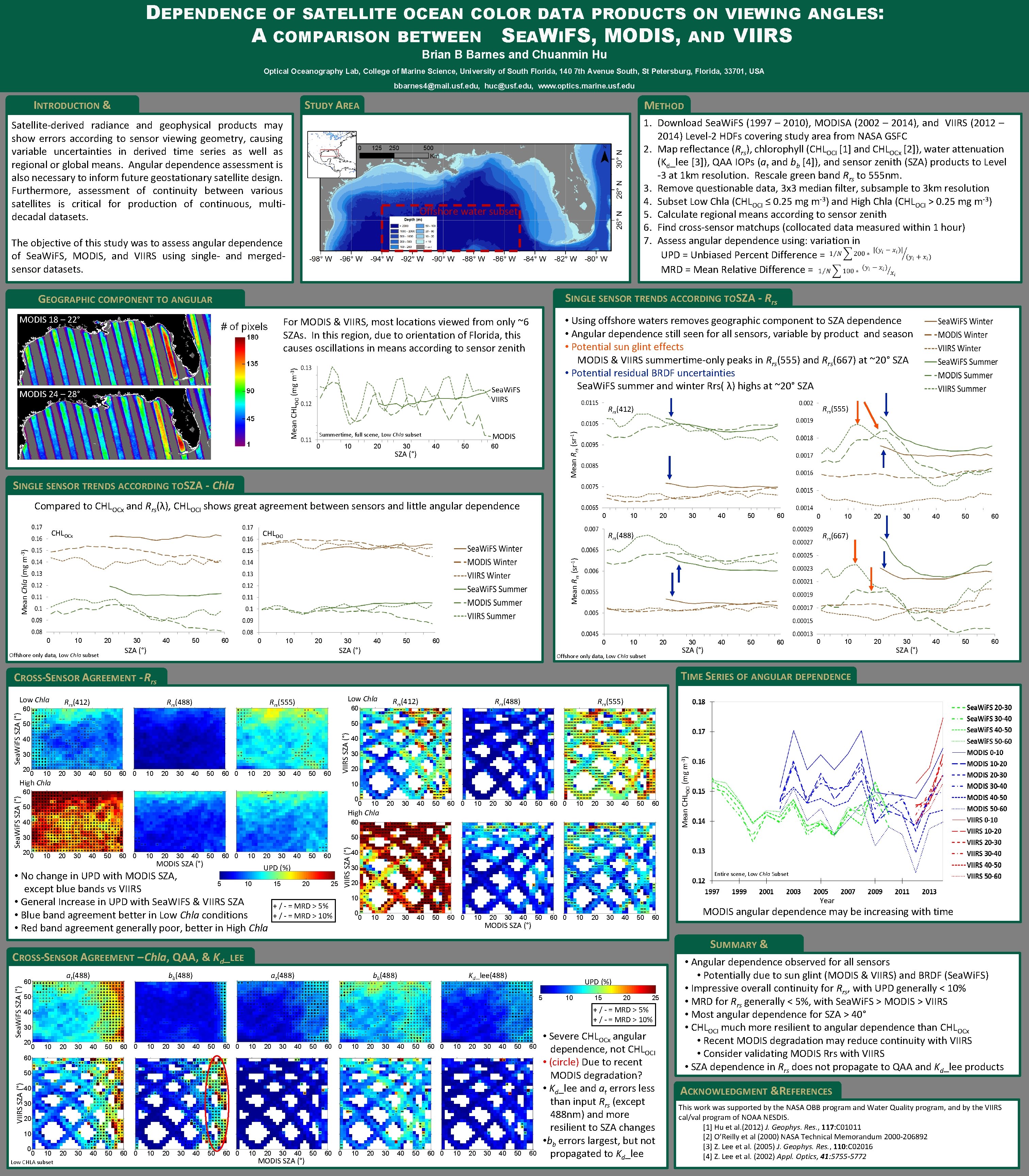
DEPENDENCE A OF SATELLITE OCEAN COLOR DATA PRODUCTS ON VIEWING ANGLES: SEAWIFS, MODIS, COMPARISON BETWEEN AND Brian B Barnes and Chuanmin Hu VIIRS Optical Oceanography Lab, College of Marine Science, University of South Florida, 140 7 th Avenue South, St Petersburg, Florida, 33701, USA bbarnes 4@mail. usf. edu, huc@usf. edu, www. optics. marine. usf. edu INTRODUCTION & O BJECTIVE Satellite-derived radiance and geophysical products may STUDY AREA METHOD show errors according to sensor viewing geometry, causing variable uncertainties in derived time series as well as regional or global means. Angular dependence assessment is also necessary to inform future geostationary satellite design. Furthermore, assessment of continuity between various satellites is critical for production of continuous, multidecadal datasets. S 1. Download Sea. Wi. FS (1997 – 2010), MODISA (2002 – 2014), and VIIRS (2012 – 2014) Level-2 HDFs covering study area from NASA GSFC 2. Map reflectance (Rrs), chlorophyll (CHLOCI [1] and CHLOCx [2]), water attenuation (Kd_lee [3]), QAA IOPs (at and bb [4]), and sensor zenith (SZA) products to Level -3 at 1 km resolution. Rescale green band Rrs to 555 nm. 3. Remove questionable data, 3 x 3 median filter, subsample to 3 km resolution 4. Subset Low Chla (CHLOCI ≤ 0. 25 mg m-3) and High Chla (CHLOCI > 0. 25 mg m-3) 5. Calculate regional means according to sensor zenith 6. Find cross-sensor matchups (collocated data measured within 1 hour) 7. Assess angular dependence using: variation in UPD = Unbiased Percent Difference = MRD = Mean Relative Difference = Offshore water subset The objective of this study was to assess angular dependence of Sea. Wi. FS, MODIS, and VIIRS usingle- and mergedsensor datasets. SINGLE SENSOR TRENDS ACCORDING TOSZA - Rrs GEOGRAPHIC COMPONENT TO ANGULAR DEPENDENCE • Using offshore waters removes geographic component to SZA dependence • Angular dependence still seen for all sensors, variable by product and season • Potential sun glint effects MODIS & VIIRS summertime-only peaks in Rrs(555) and Rrs(667) at ~20° SZA • Potential residual BRDF uncertainties Sea. Wi. FS summer and winter Rrs( λ) highs at ~20° SZA For MODIS & VIIRS, most locations viewed from only ~6 SZAs. In this region, due to orientation of Florida, this causes oscillations in means according to sensor zenith Mean CHLOCI (mg m-3) MODIS 24 – 28° Sea. Wi. FS VIIRS MODIS 18 R –(412) 22° Rrs(555) rs Summertime, full scene, Low Chla subset 0 20 10 30 MODIS 50 40 SZA (°) Mean Rrs (sr-1) MODIS 18 – 22° 60 MODIS 24 – 28° SINGLE SENSOR TRENDS ACCORDING TOSZA - Chla Compared to CHLOCx and Rrs(λ), CHLOCI shows great agreement between sensors and little angular dependence CHLOCx 0 CHLOCI 20 10 Low Chla 60 0 10 20 30 40 50 60 30 50 40 60 0 20 10 30 SZA (°) 50 40 60 0 SZA (°) 20 10 Offshore only data, Low Chla subset Rrs(412) Rrs(488) Low Chla Rrs(555) Rrs(412) 60 10 20 30 40 50 60 0 10 20 30 50 40 60 VIIRS SZA (°) 30 High Chla Rrs(488) 0 10 20 30 40 50 60 SZA (°) 40 30 20 10 0 0 50 10 20 30 40 50 60 0 10 20 30 50 40 60 0 10 20 30 40 50 60 High Chla 60 30 50 10 20 30 40 50 60 0 10 20 30 40 MODIS SZA (°) 50 60 0 10 20 30 50 40 40 60 UPD (%) • No change in UPD with MODIS SZA, 5 10 except blue bands vs VIIRS • General Increase in UPD with Sea. WIFS & VIIRS SZA • Blue band agreement better in Low Chla conditions • Red band agreement generally poor, better in High Chla VIIRS SZA (°) 40 30 15 20 25 + / - = MRD > 5% + / - = MRD > 10% Entire scene, Low Chla Subset 20 10 0 0 Year 10 20 30 40 50 60 0 10 20 30 40 MODIS SZA (°) 50 60 0 10 20 30 40 50 60 at(488) bb(488) Kd_lee(488) UPD (%) 50 5 10 15 20 25 + / - = MRD > 5% + / - = MRD > 10% 40 30 10 20 30 40 50 60 0 10 20 30 40 50 60 60 VIIRS SZA (°) 50 40 30 20 10 10 Low CHLA subset 20 30 40 50 60 0 10 20 30 40 50 60 0 MODIS angular dependence may be increasing with time SUMMARY & CONCLUSIONS • Angular dependence observed for all sensors CROSS-SENSOR AGREEMENT – Chla, QAA, & Kd_LEE 0 0 60 Rrs(555) 60 20 0 50 50 40 20 0 SZA (°) 40 TIME SERIES OF ANGULAR DEPENDENCE 50 0 30 Mean CHLOCI (mg m-3) Sea. Wi. FS SZA (°) 60 Rrs(667) CROSS-SENSOR AGREEMENT - Rrs Sea. Wi. FS SZA (°) 50 Mean Rrs (sr-1) 20 10 Offshore only data, Low Chla subset Sea. Wi. FS SZA (°) 40 Rrs(488) Mean Chla (mg m-3) 0 20 30 10 20 30 40 MODIS SZA (°) 50 60 0 10 20 30 40 50 60 • Severe CHLOCx angular dependence, not CHLOCI • (circle) Due to recent MODIS degradation? • Kd_lee and at errors less than input Rrs (except 488 nm) and more resilient to SZA changes • bb errors largest, but not propagated to Kd_lee • Potentially due to sun glint (MODIS & VIIRS) and BRDF (Sea. Wi. FS) • Impressive overall continuity for Rrs, with UPD generally < 10% • MRD for Rrs generally < 5%, with Sea. Wi. FS > MODIS > VIIRS • Most angular dependence for SZA > 40° • CHLOCI much more resilient to angular dependence than CHLOCx • Recent MODIS degradation may reduce continuity with VIIRS • Consider validating MODIS Rrs with VIIRS • SZA dependence in Rrs does not propagate to QAA and Kd_lee products ACKNOWLEDGMENT &REFERENCES This work was supported by the NASA OBB program and Water Quality program, and by the VIIRS cal/val program of NOAA NESDIS. [1] Hu et al. (2012) J. Geophys. Res. , 117: C 01011 [2] O’Reilly et al (2000) NASA Technical Memorandum 2000 -206892 [3] Z. Lee et al. (2005) J. Geophys. Res. , 110: C 02016 [4] Z. Lee et al. (2002) Appl. Optics, 41: 5755 -5772