
Departmentation and Organization Structure Chapter 6 Departmentation Process

- Slides: 16
Departmentation and Organization Structure Chapter 6
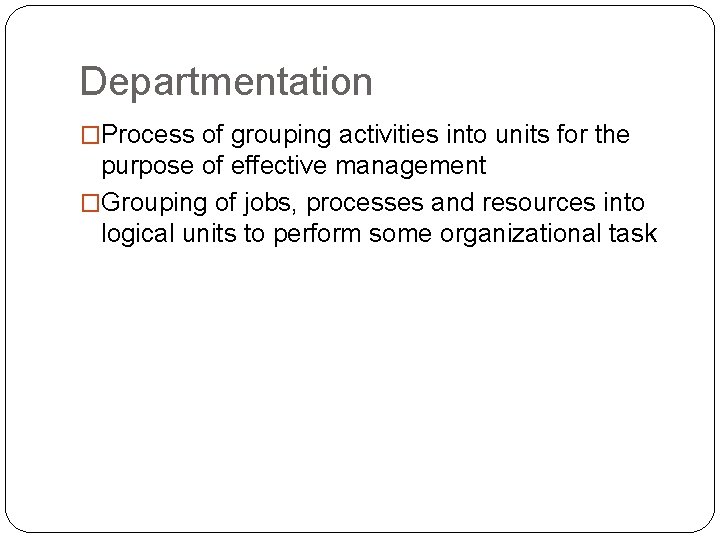
Departmentation �Process of grouping activities into units for the purpose of effective management �Grouping of jobs, processes and resources into logical units to perform some organizational task
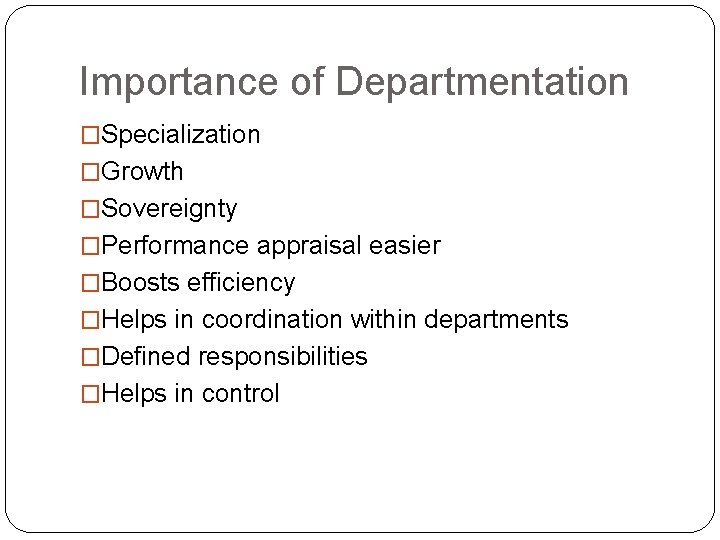
Importance of Departmentation �Specialization �Growth �Sovereignty �Performance appraisal easier �Boosts efficiency �Helps in coordination within departments �Defined responsibilities �Helps in control
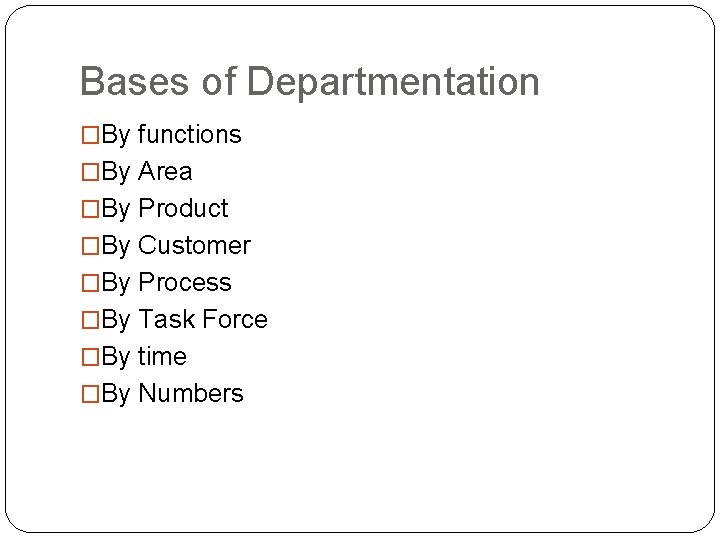
Bases of Departmentation �By functions �By Area �By Product �By Customer �By Process �By Task Force �By time �By Numbers
Organization as a structure Network of relationships among individuals and positions in the organization Relationships between positions on one hand jobs on the other
Types of Organizational Structures �Line Organization �Functional Organization �Line and Staff Organization �Matrix Organization �Formal and Informal Organization
Line Organization �Simplest and oldest form �Also called scalar or military type Organisation �Direct flow of authority �Unity of Command �Clear responsibility �Suitable to small Organisations �Lack of specialisation �Easy coordination �Better relationships �Quick decision making
Functional Organization �Introduced by Taylor �Each function managed by a functional expert �Each functional expert may serve the other functional experts also �Encourages specialization �Reduced pressure �Optimum use of resources �Higher efficiency �Lack of unity of command �Expensive
Line and Staff Organization �Combination of activities of line executives and staff experts �Line executives-decision makers, staff-advisors or planners �Line executives implement plans, staff engage in research and planning �Need for staff due to growth of organizations, technological developments and uncertainties �Suitable for large organizations �Conflicts between line and staff possible �Expensive
Conflicts between line and staff Complaints of line against staff � Grabbing compliments � Unfamiliar with actual work � Interference � Superiority complex � Excessive paper work � Easy access to management Complaints of staff against Line � Last minute advice � Irresponsible � Lack clarity � Shift responsibility � Reluctant to accept new ideas � Lack respect
Matrix Organization �Uses two or more co-existing structures-functional and project �Hybrid structure �In functional organization , the manager has absolute responsibility for the project and the resources required, in matrix organization the project manager shares resources with the rest of the organization. � Problem of unity of command �Suitable for multi projects organizations
Formal and Informal Organization �Formal: �Two or more persons consciously coordinated towards a common objective �Informal: �A network of personal, and social relations not established or required by the formal organization but arising spontaneously as people associate with each other (through grapevine)
Features of Formal Organization �Specific Duties and responsibilities �Well defined goals �Clear superior- subordinate relationships �System of Authority and Coordination �Set of rules and regulations
Features of Informal Organization �No specific goals �No established superior subordinate relationships �No system of authority or coordination �Communication through grapevine �Develops social and personal ties
Differences between Formal and Informal Organizations �Authority �Flow of Communication �Creation �Stability �Importance of Rules
Thank You