
Departmentalization by simple numbers Definition group people who
Departmentalization by simple numbers • Definition: group people who are to perform same duties under the supervision of a manager
Advantages: • useful when it is the number of people that is critical to finish a task Disadvantages: • Low specialization • Low efficiency
Departmentalization by time • Group people based on time
Advantages • Extended services • Suitable when certain processes can’t be interrupted or certain expensive equipment can be used more than 8 hours a day Disadvantages: • Lacks supervision during the night shift • Fatigue • Affects coordination and communication among different shifts
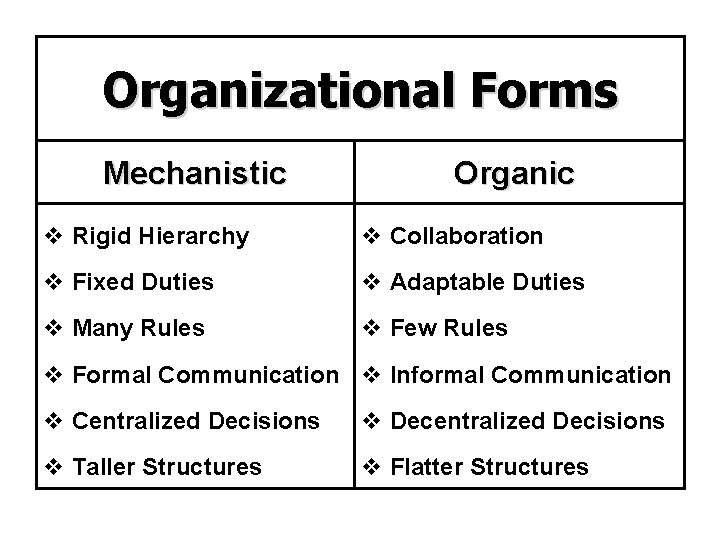
Organizational Forms Mechanistic Organic v Rigid Hierarchy v Collaboration v Fixed Duties v Adaptable Duties v Many Rules v Few Rules v Formal Communication v Informal Communication v Centralized Decisions v Decentralized Decisions v Taller Structures v Flatter Structures

Simple structure • Characteristics: – – – – A low degree of departmentalization Wide span of control Centralized authority Little formalization A flat structure Inexpensive to maintain the structure A clear accountability Popular in small business owned and managed by same person – Risky as the organization grows
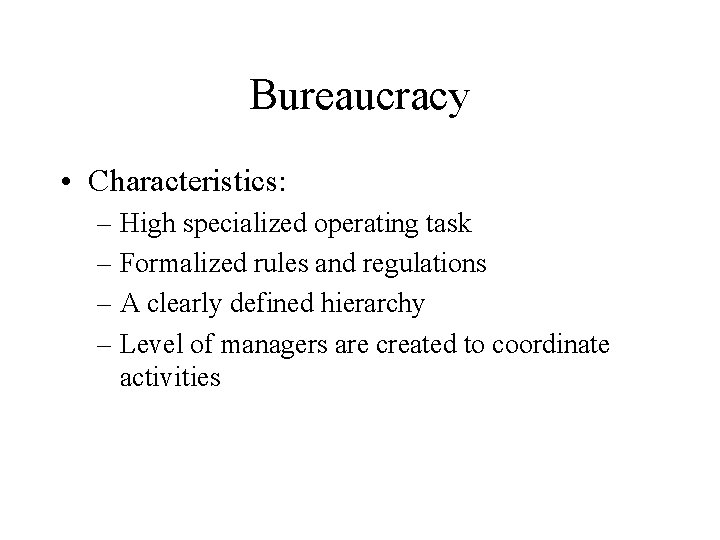
Bureaucracy • Characteristics: – High specialized operating task – Formalized rules and regulations – A clearly defined hierarchy – Level of managers are created to coordinate activities
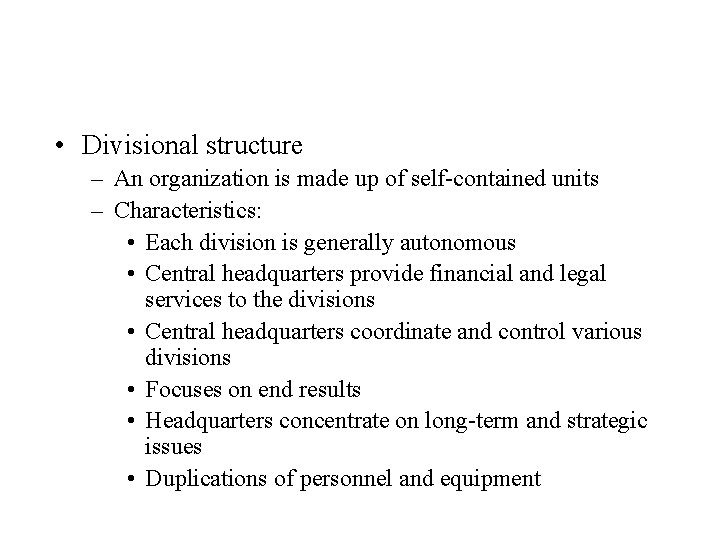
• Divisional structure – An organization is made up of self-contained units – Characteristics: • Each division is generally autonomous • Central headquarters provide financial and legal services to the divisions • Central headquarters coordinate and control various divisions • Focuses on end results • Headquarters concentrate on long-term and strategic issues • Duplications of personnel and equipment
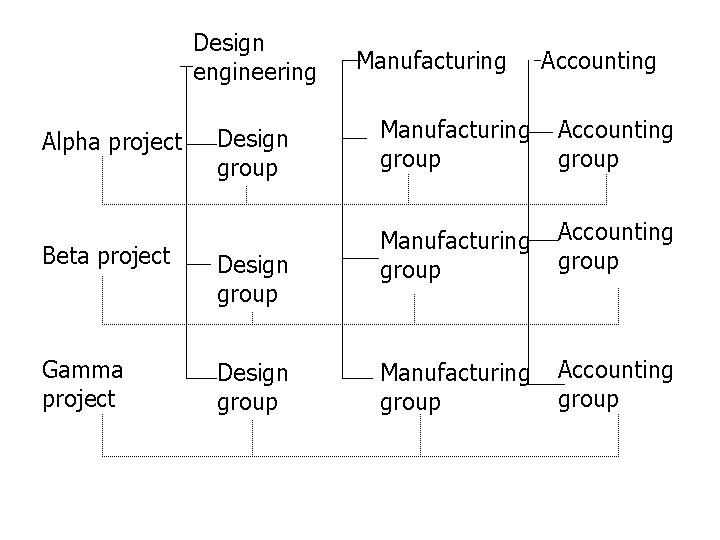
Design engineering Alpha project Design group Beta project Design group Gamma project Design group Manufacturing Accounting Manufacturing group Accounting group
Matrix organization • Definition: assign people from functional departments to work on one or more projects led by a project manager
Advantages • Is oriented toward end results • Professional identification is maintained • Pinpoints product-profit responsibility • Cross-functional coordination Disadvantages: • Conflict in organization authority exists • Possibility of disunity of command exists • Requires managers effective in human relations
Team-based structure Definition: the entire organization consists of work groups or team that perform the organization’s work Characteristics: 1. No rigid chain of command 2. Team member has authority to make decisions
Advantages: • Is flexible • Empower workers • Encourages cooperation • Oriented toward end results Disadvantages: • Lack of responsibility • Central control may be difficult • Requires managers effective in human relations
The Boundaryless Organization • An organization that is not defined or limited by boundaries or categories imposed by traditional structures • Characteristics: – Minimize the chain of command – Replaces departments with empowered team – Participative decision-making – Coordination among occupational specialties
• Functional structure – An organization in which similar and related occupational specialties are grouped together – Characteristics: • • • Work specialization Minimizes duplication of personnel and equipment Follows principle of occupational specializing Simplifies training Furnishes means of tight control at top
Factors that affect structure • Organizational factors – Strategy (structure should fit organizational strategy) • Growth strategy • Stability strategy • Retrenchment strategy – Size and age Larger organizations tended to be more specialized and standardized, and formalized but less centralized than smaller organizations – Culture (i. e. , a system of shared meaning within an organization that determines, to a large degree, how employees act) • Strong culture substitute for the rules and regulations that formally guide employees
• Environmental factors – Technology (i. e. , the sequence of physical techniques, knowledge, and equipment used to turn organization inputs into outputs) • Define organizational structure • Define new roles (e. g. , CIOs) – Economic situation • Strong/weak economy • Dynamic/static economy – Social/political situation
Building an effective organization design • • • Align with organizational goals Make clear individual roles Make clear sub-goals and policies Be flexible Make staff work effective – Make line listen staff – Keep staff informed • Recognize the importance of informal organization and grapevine
Evaluating effective organizational structure • • Effective two-way communication Align with organizational goals Clarify authority and responsibility Respond to environmental changes promptly
Why do we need organizational design? • Achieve goals • Make the best use of people’s experiences, knowledge, skills, and expertise, etc. • Provide a smooth communication channel • Reduce uncertainty • Encourage cooperation
- Slides: 20