
Department of Veterans Affairs Whistleblower Rights and Protection
Department of Veterans Affairs Whistleblower Rights and Protection & Prohibited Personnel Practices Managers and Supervisors Roles and Responsibilities Adapted from materials prepared by the U. S. Office of Special Counsel (OSC)
2 Learning Objectives 11/22/2020 After reviewing this training you will be able to: 1. Explain why Merit Systems Principles, Prohibited Personnel Practices, and whistleblower disclosures are important to the Department of Veterans Affairs (VA). 2. Recognize the nine Merit Systems Principles and thirteen Prohibited Personnel Practices. 3. Distinguish between a protected disclosure and whistleblower retaliation complaint. 4. Explain the process for making a protected disclosure and filing a whistleblower retaliation complaint. 5. Explain the roles and responsibilities of the Merit Systems Protection Board (MSPB), the Office of Special Counsel (OSC), and the Equal Employment Opportunity Commission (EEOC). 6. Summarize your roles and responsibilities in proactively preventing Prohibited Personnel Practices and whistleblower retaliation. 7. Summarize the avenues of redress and resources available to VA employees for addressing whistleblower retaliation and making whistleblower disclosures.
3 11/22/2020 Merit System Principles
4 Merit System Principles 11/22/2020 • Merit System Principles are the corporate values that guide the Federal Human Capital Management System and provide the foundational underpinnings directing how we manage and leader our employees. • These nine Merit System Principles provide guidance on how managers and supervisors should manage our workforce, how human resources staff should provide advisory and consulting services, and what should be at the core of every human resources decision. • Merit System Principles are part of the Civil Service Reform Act of 1978, and can be found at 5 U. S. C. § 2301(b).
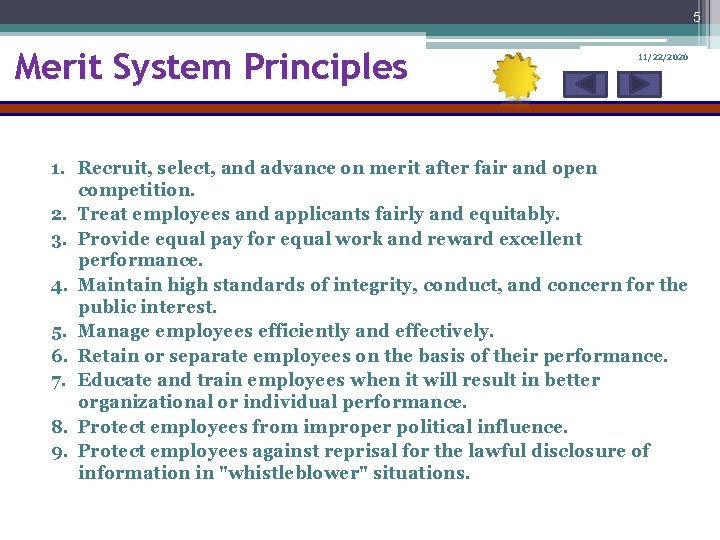
5 Merit System Principles 11/22/2020 1. Recruit, select, and advance on merit after fair and open competition. 2. Treat employees and applicants fairly and equitably. 3. Provide equal pay for equal work and reward excellent performance. 4. Maintain high standards of integrity, conduct, and concern for the public interest. 5. Manage employees efficiently and effectively. 6. Retain or separate employees on the basis of their performance. 7. Educate and train employees when it will result in better organizational or individual performance. 8. Protect employees from improper political influence. 9. Protect employees against reprisal for the lawful disclosure of information in "whistleblower" situations.
6 11/22/2020 Prohibited Personnel Practices
7 Prohibited Personnel Practices (PPP) • Prohibited Personnel Practices (PPP) are actions that a Federal employee with personnel action authority MAY NOT TAKE. A 11/22/2020 employee with personnel action authority MAY NOT TAKE. A Federal employee has personnel action authority if they can: (a) take; (b) direct others to take; (c) recommend; or • • (d) approve any personnel action. People with personnel action authority – managers and supervisors – are charged with avoiding Prohibited Personnel Practices. Committing a PPP is cause for disciplinary action (e. g. , suspension, demotion, removal, debarment from Federal employment). Managers and supervisors must take corrective action and provide relief (e. g. , restoring the employee back to his or her position) to employees who are victims of PPPs. Thirteen Prohibited Personnel Practices (PPP) are defined by law at 5 U. S. C. § 2302(b).
8 Prohibited Personnel Practices (PPP) 11/22/2020 1. Discriminate for or against any employee/applicant. 2. Solicit or consider improper employment recommendations. 3. Coerce an employee's political activity. 4. Deceive or willfully obstruct a person's right to compete for employment. 5. Influence any person to withdraw from competition for a position. 6. Give unauthorized preference or improper advantage. 7. Employ, promote, or provide an employment benefit to a relative. 8. Retaliate against a whistleblower, whether an employee or applicant. 9. Retaliate against employees or applicants for exercising their lawful rights. 10. Unlawfully discriminate for conduct unrelated to work performance. 11. Knowingly violate veterans' preference requirements. 12. Violate any law, rule, or regulation which implements or directly concerns the merit principles. 13. Implement or enforce a nondisclosure agreement or policy lacking notification of whistleblower rights.
9 PPP 1 - Discrimination 11/22/2020 A Federal employee authorized to take, direct others to take, recommend, or approve any personnel action may not: discriminate for or against an employee or applicant based on race, color, religion, sex (including pregnancy and gender identity), national origin, age, handicapping condition, genetic information, marital status, or political affiliation. EXAMPLE: Susan is married to Louis. One evening, Louis comes by to pick up Susan from work. Joe, Susan ’s supervisor, meets Louis in the parking lot and finds that Louis is loud and obnoxious. Joe, concerned with Susan ’s judgment in her choice of partner, reassigns Susan to a different position at the same pay. Joe has committed a PPP.
10 PPP 2 - Improper employment recommendations 11/22/2020 A Federal employee authorized to take, direct others to take, recommend, or approve any personnel action may not: solicit or consider employment recommendations based on factors other than personal knowledge or records of job-related abilities or characteristics. EXAMPLE: The Selecting Official hires Francis based on Senator Smith’s recommendation. Senator Smith provides Francis a recommendation based only on the fact that Francis is a constituent of Senator Smith. The selecting official has committed a PPP.
11 PPP 3 - Coerce political activity 11/22/2020 A Federal employee authorized to take, direct others to take, recommend, or approve any personnel action may not: coerce the political activity of any person. EXAMPLE: The Shift Supervisor takes away significant job duties and responsibilities from Marley because Marley will not make a contribution to the Shift Supervisor’s favorite candidate. The Shift Supervisor has committed a PPP.
12 PPP 4 - Obstruct competition for employment 11/22/2020 A Federal employee authorized to take, direct others to take, recommend, or approve any personnel action may not: deceive or willfully obstruct anyone from competing for employment EXAMPLE: Ariel, a Supervisor located at the Network Support Office, directs that no vacancy announcements be released to the Network Budget Office where Alex works because Ariel does not want Alex to get a new job. Ariel has committed a PPP.
13 PPP 5 - Influence withdrawal from competition 11/22/2020 A Federal employee authorized to take, direct others to take, recommend, or approve any personnel action may not: influence anyone to withdraw from competition for any position so as to improve or injure the employment prospects of any other person. EXAMPLE: Gina is hiring a management analyst for a position that does not require travel. Scott applies for the position and is interviewed. Gina knows that Scott does not like to travel. Even though the position does not require travel, Gina tells Scott in the interview that he would be traveling 80% of the time if he is selected for this position. Scott is unhappy with the travel but does not withdraw from the competition. Gina has committed a PPP.
14 PPP 6 - Unauthorized preference or advantage 11/22/2020 A Federal employee authorized to take, direct others to take, recommend, or approve any personnel action may not: give an unauthorized preference or advantage to anyone so as to improve or injure the employment prospects of any particular employee or applicant. EXAMPLE: Olivia wants to select her friend Ralph for a program analyst position in her office located in Miami. Olivia is worried that too many qualified candidates will apply for the position in Miami, which may prevent her selection of Ralph. Consequently, Olivia announces the vacancy in Tampa. Ralph, who lives in Miami, applies and is selected for the position in Tampa. As soon as Ralph is selected, the position is reassigned to Miami. Olivia has committed a PPP.
15 PPP 7 - Nepotism 11/22/2020 A Federal employee authorized to take, direct others to take, recommend, or approve any personnel action may not: engage in nepotism (i. e. , hire, promote, provide an employment benefit, or advocate for the hiring, promotion, or provision of employment benefits to relatives). EXAMPLE: The Supply Manager asks the Supply Supervisor overseeing the evening shift to hire his stepson. The Supply manager has committed a PPP.
16 PPP 8 – Retaliate against a whistleblower 11/22/2020 A Federal employee authorized to take, direct others to take, recommend, or approve any personnel action may not: (a) take; (b) fail to take; (c) threaten to take; or (d) threaten to fail to take a personnel action against an employee or applicant for disclosing information which the employee or applicant reasonably believes evidences: a violation of any law, rule or regulation; (a) gross mismanagement; (b) a gross waste of funds; (c) an abuse of authority; (d) a substantial and specific danger to public health or safety; or (e) censorship related to scientific research, analysis, or technical information. More information about whistleblower retaliation can be found later in this training. EXAMPLE: The Cemetery Director informs her staff that she will reassign any employee for reporting problems at the Cemetery to Senator Martin. The Cemetery Director has committed a PPP.
17 PPP 9 - Retaliation for exercising lawful rights 11/22/2020 A Federal employee authorized to take, direct others to take, recommend, or approve any personnel action may not: (a) take; (b) fail to take; (c) threaten to take; or (d) threaten to fail to take a personnel action against an employee or applicant for: (a) exercising an appeal, complaint, or grievance right of the employee, regardless of whether such an appeal, complaint or grievance right pertains to whistleblower retaliation; (b) testifying for or assisting another in exercising such a right; (c) cooperating with or disclosing information to the Inspector General or the Special Counsel; or (d) refusing to obey an order that would require the individual to violate a law. EXAMPLE: Dr. Shah is Dr. Neal’s second-level supervisor. Dr. Neal is researching the causes of Veteran suicide for the VA. Dr. Shah learns that Dr. Neal filed a complaint with VA’s Office of Inspector General (VAOIG). A few days later, Dr. Shah contacts Dr. Martinez, Dr. Neal’s supervisor, and informs her of Dr. Neal’s complaint to VAOIG. Dr. Shah and Dr. Martinez both agree that they cannot trust Dr. Neal because he went to VAOIG. On the same day, Dr. Martinez emails Dr. Shah to inform him that Dr. Neal often seems depressed and for that reason she believes that Dr. Neal should not lead the research project. Dr. Shah sends an email agreeing with Dr. Martinez ’s decision. Dr. Neal is removed from the research project and transferred to a new research project. Dr. Shah and Dr. Martinez have both committed a PPP.
18 PPP 10 – Discrimination for conduct unrelated to work performance 11/22/2020 A Federal employee authorized to take, direct others to take, recommend, or approve any personnel action may not: discriminate on the basis of conduct unrelated to work performance. EXAMPLE: The Associate Director refuses to promote Stevie because Stevie is a outspoken member of the Tea Party and attends Tea Party events on the weekends. The Associate Director has committed a PPP.
19 PPP 11 – Knowingly violate veterans’ preference requirements 11/22/2020 A Federal employee authorized to take, direct others to take, recommend, or approve any personnel action may not: (a) knowingly take or fail to take; (b) recommend; or (c) approve a personnel action if the taking or failure to take such action would violate a veterans’ preference requirement. EXAMPLE: The OI&T Supervisor learns the candidate she wants to hire is being blocked by several candidates ranked high on the certificate because of veterans’ preference. The OI&T Supervisor cancels the vacancy announcement to avoid selecting candidates with veterans’ preference. The OI&T Supervisor committed a PPP.
20 PPP 12 - Violate any Law, Rule, or Regulation 11/22/2020 A Federal employee authorized to take, direct others to take, recommend, or approve any personnel action may not: take or fail to take a personnel action, if taking or failing to take action would violate any law, rule or regulation implementing or directly concerning merit system principles at 5 U. S. C. § 2301. EXAMPLE: Dr. Marcos, a prominent VA physician, writes a letter to the editor of a local newspaper criticizing the affirmative action plan at her medical center and its impact on patient care. Dr. Marcos does not sign the letter using her job title and she indicates in the letter that her views represent her personal opinion. Malik, the Medical Center Director, terminates Dr. Marcos’ appointment because he believes Dr. Marcos’ letter is unfairly critical of the medical center. Malik has committed a PPP because he took a personnel action (termination) in violation of a law (first amendment right to free speech on a matter of public concern) that implements a merit system principle (treat employees and applicants fairly and equitably).
21 PPP 13 – Nondisclosure agreements without certain language 11/22/2020 A Federal employee authorized to take, direct others to take, recommend, or approve any personnel action may not: implement or enforce any nondisclosure policy, form, or agreement, if such policy, form, or agreement does not contain the following statement: "These provisions are consistent with and do not supersede, conflict with, or otherwise alter the employee obligations, rights, or liabilities created by existing statute or Executive order relating to (1) classified information, (2) communications to Congress, (3) the reporting to an Inspector General of a violation of any law, rule, or regulation, or mismanagement, a gross waste of funds, an abuse of authority, or a substantial and specific danger to public health or safety, or (4) any other whistleblower protection. The definitions, requirements, obligations, rights, sanctions, and liabilities created by controlling Executive orders and statutory provisions are incorporated into this agreement and are controlling. ”
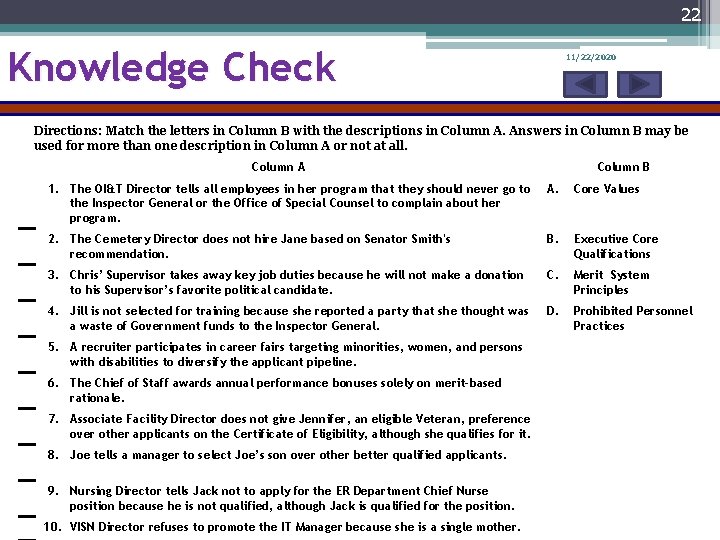
22 Knowledge Check 11/22/2020 Directions: Match the letters in Column B with the descriptions in Column A. Answers in Column B may be used for more than one description in Column A or not at all. Column A Column B 1. The OI&T Director tells all employees in her program that they should never go to the Inspector General or the Office of Special Counsel to complain about her program. A. Core Values 2. The Cemetery Director does not hire Jane based on Senator Smith's recommendation. B. Executive Core Qualifications 3. Chris’ Supervisor takes away key job duties because he will not make a donation to his Supervisor’s favorite political candidate. C. Merit System Principles 4. Jill is not selected for training because she reported a party that she thought was a waste of Government funds to the Inspector General. D. Prohibited Personnel Practices 5. A recruiter participates in career fairs targeting minorities, women, and persons with disabilities to diversify the applicant pipeline. 6. The Chief of Staff awards annual performance bonuses solely on merit-based rationale. 7. Associate Facility Director does not give Jennifer, an eligible Veteran, preference over other applicants on the Certificate of Eligibility, although she qualifies for it. 8. Joe tells a manager to select Joe’s son over other better qualified applicants. 9. Nursing Director tells Jack not to apply for the ER Department Chief Nurse position because he is not qualified, although Jack is qualified for the position. 10. VISN Director refuses to promote the IT Manager because she is a single mother.

23 Knowledge Check Answers 11/22/2020 Directions: Match the letters in Column B with the descriptions in Column A. Answers in Column B may be used for more than one description in Column A or not at all. Column A Column B D 1. The OI&T Director tells all employees in her program that they should never go to A. Core Values D 2. The Cemetery Director does not hire Jane based on Senator Smith's B. Executive Core Qualifications D 3. Chris’ Supervisor takes away key job duties because he will not make a donation C. Merit System Principles D 4. Jill is not selected for training because she reported a gross waste of funds to D. Prohibited Personnel Practices the Inspector General or the Office of Special Counsel to complain about her program. recommendation. to his Supervisor’s favorite political candidate. VAOIG. C 5. A recruiter participates in career fairs targeting minorities, women, and persons with disabilities to diversify the applicant pipeline. C 6. The Chief of Staff awards annual performance bonuses solely on merit-based rationale. D 7. Associate Facility Director does not give Jennifer, an eligible Veteran, preference over other applicants on the Certificate of Eligibility, although she qualifies for it. D 8. Joe tells a manager to select Joe’s son over other better qualified applicants. D 9. Nursing Director tells Jack not to apply for the ER Department Chief Nurse position because he is not qualified, although Jack is qualified for the position. D 10. VISN Director refuses to promote the IT Manager because she is a single mother.
24 11/22/2020 Whistleblower Retaliation and Protected Disclosures
25 Whistleblower retaliation and protected disclosures • • • 11/22/2020 Whistleblower disclosures are crucial in helping to expose fraud, waste, abuse, mismanagement, and threats or harm to public health and safety across the Federal government. Whistleblowers disclosures save billions of dollars and even human lives. Retaliating against a whistleblower is a Prohibited Personnel Practice (PPP). Whistleblower retaliation is cause for disciplinary action (e. g. , suspension, demotion, removal, debarment from Federal employment). Victims of whistleblower retaliation are also entitled to corrective action and relief (e. g. , restoring the employee back to his or her position).
26 Protected disclosures 11/22/2020 n Protected disclosures are defined as disclosing information which the whistleblower reasonably believes evidences: 1. a violation of law, rule, or regulation; 2. gross mismanagement; 3. gross waste of funds; 4. an abuse of authority; 5. a substantial and specific danger to public health or safety; or 6. Censorship related to scientific research, analysis or technical information. n Determining what is a protected disclosure: n The information disclosed does not have to be accurate to be protected. n No requirement that a whistleblower go through his or her chain of command. n Whistleblower’s personal motivation does not negate reasonable belief. n Employee or applicant is protected if an employer mistakenly believes the employee or applicant is a whistleblower.
Whistleblower retaliation 27 11/22/2020 n Whistleblower Retaliation: A Federal employee authorized to take, direct others to take, recommend or approve any personnel action MAY NOT take, fail to take, or threaten to take any personnel action against an employee because of a protected disclosure. EXAMPLE: A supervisor directs the geographic reassignment of an employee because the employee reported safety violations to senior agency officials. n Personnel actions that may constitute retaliation include (but are not limited to) reassignment, suspension, termination, adverse pay decisions, or a change in duties, responsibilities or working conditions, such as suspending an employee’s ability to telework.
28 Whistleblower retaliation complaints 11/22/2020 • Elements of a whistleblower retaliation complaint: An employee filing a whistleblower retaliation complaint must show that: 1) he or she engaged in an activity that he or she reasonably believed to be a protected disclosure; 2) the employer knew about the protected disclosure and the identity of the employee making the disclosure; 3) the employer took, failed to take (e. g. , such as in the case of a promotion), threatened to take, or influenced an official to take a personnel action against the employee; and 4) the protected disclosure was a contributing factor in the personnel action. • If all these elements are met, the agency then would have to show by clear and convincing evidence that it would have taken the same action without the disclosure. Clear and convincing evidence factors include the: 1) strength of the evidence in support of the personnel action; 2) existence and strength of a motive to retaliate; and 3) Treatment of similar employees who are not whistleblowers.
29 Knowledge Check 11/22/2020 Directions: Match the letters in Column B with the descriptions in Column A. Answers in Column B may be used for more than one description in Column A or not at all. Column A Column B 1. A disclosure of wrongdoing which the employee reasonably believes evidences a violation of law, rule, or regulation; gross mismanagement; or abuse of authority. A. Equal employment opportunity complaint 2. A disclosure of wrongdoing which the employee reasonably believes evidences a substantial and specific danger to public health or safety. B. Merit System Principles 3. An action filed with the Office of Special Counsel in response to an alleged Prohibited Personnel Practice. C. Prohibited Personnel Practices 4. Personnel action taken against a VA employee in response to contacting a member of Congress about patient safety. D. Office of Special Counsel Complaint 5. An unlawful personnel action such as retaliation or discrimination that may be disclosed to the Office of Special Counsel (OSC). E. Whistleblower Disclosure 6. Any personnel action against a VA employee because the employee filed a Whistleblower Disclosure with the Office of Special Counsel (OSC). F. Whistleblower Retaliation 7. Core corporate values that guide the Federal Human Capital Management System. 8. Personnel action taken against a VA employee in response to filing a claim of gross mismanagement with the Office of Special Counsel (OSC). 9. Those things a Federal employee with personnel action authority MAY NOT DO. 10. Treating VA employees and applicants for employment fairly and equitably.
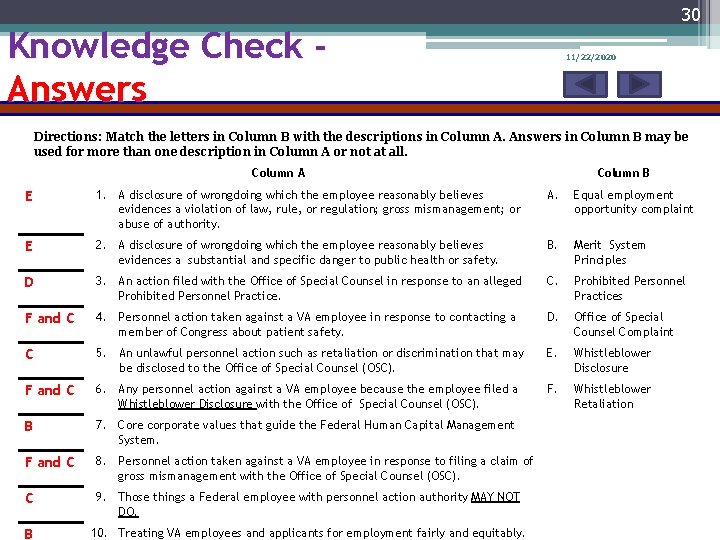
30 Knowledge Check Answers 11/22/2020 Directions: Match the letters in Column B with the descriptions in Column A. Answers in Column B may be used for more than one description in Column A or not at all. Column A Column B E 1. A disclosure of wrongdoing which the employee reasonably believes evidences a violation of law, rule, or regulation; gross mismanagement; or abuse of authority. A. Equal employment opportunity complaint E 2. A disclosure of wrongdoing which the employee reasonably believes evidences a substantial and specific danger to public health or safety. B. Merit System Principles D 3. An action filed with the Office of Special Counsel in response to an alleged Prohibited Personnel Practice. C. Prohibited Personnel Practices F and C 4. Personnel action taken against a VA employee in response to contacting a member of Congress about patient safety. D. Office of Special Counsel Complaint C 5. An unlawful personnel action such as retaliation or discrimination that may be disclosed to the Office of Special Counsel (OSC). E. Whistleblower Disclosure F and C 6. Any personnel action against a VA employee because the employee filed a Whistleblower Disclosure with the Office of Special Counsel (OSC). F. Whistleblower Retaliation B 7. Core corporate values that guide the Federal Human Capital Management System. F and C 8. Personnel action taken against a VA employee in response to filing a claim of gross mismanagement with the Office of Special Counsel (OSC). C 9. Those things a Federal employee with personnel action authority MAY NOT DO. B 10. Treating VA employees and applicants for employment fairly and equitably.
31 11/22/2020 Agencies and groups that protect and enforce employee rights
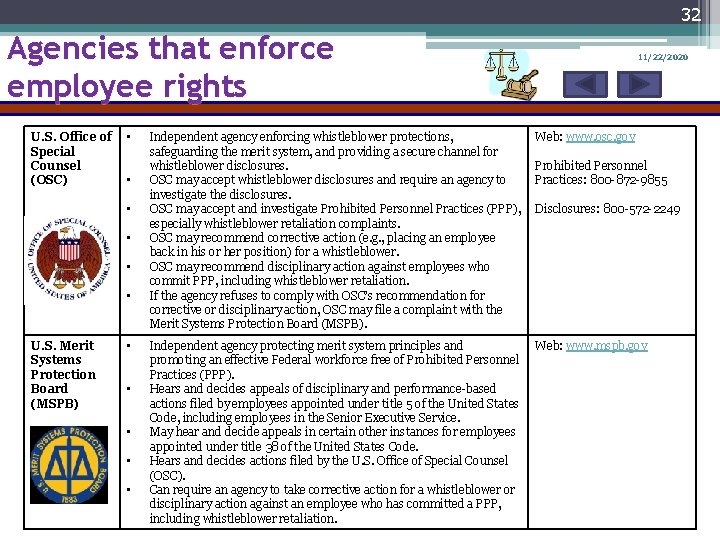
32 Agencies that enforce employee rights U. S. Office of Special Counsel (OSC) • • • U. S. Merit Systems Protection Board (MSPB) • • • 11/22/2020 Independent agency enforcing whistleblower protections, safeguarding the merit system, and providing a secure channel for whistleblower disclosures. OSC may accept whistleblower disclosures and require an agency to investigate the disclosures. OSC may accept and investigate Prohibited Personnel Practices (PPP), especially whistleblower retaliation complaints. OSC may recommend corrective action (e. g. , placing an employee back in his or her position) for a whistleblower. OSC may recommend disciplinary action against employees who commit PPP, including whistleblower retaliation. If the agency refuses to comply with OSC’s recommendation for corrective or disciplinary action, OSC may file a complaint with the Merit Systems Protection Board (MSPB). Web: www. osc. gov Independent agency protecting merit system principles and promoting an effective Federal workforce free of Prohibited Personnel Practices (PPP). Hears and decides appeals of disciplinary and performance-based actions filed by employees appointed under title 5 of the United States Code, including employees in the Senior Executive Service. May hear and decide appeals in certain other instances for employees appointed under title 38 of the United States Code. Hears and decides actions filed by the U. S. Office of Special Counsel (OSC). Can require an agency to take corrective action for a whistleblower or disciplinary action against an employee who has committed a PPP, including whistleblower retaliation. Web: www. mspb. gov Prohibited Personnel Practices: 800 -872 -9855 Disclosures: 800 -572 -2249
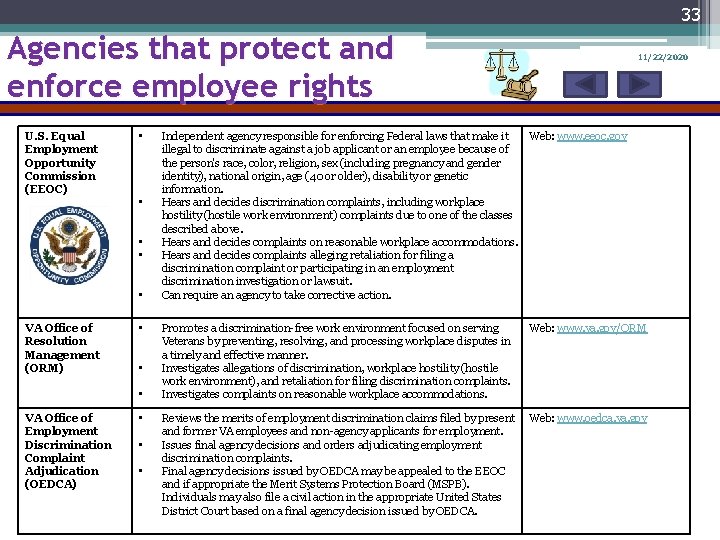
33 Agencies that protect and enforce employee rights U. S. Equal Employment Opportunity Commission (EEOC) • • • VA Office of Resolution Management (ORM) • • • VA Office of Employment Discrimination Complaint Adjudication (OEDCA) • • • 11/22/2020 Independent agency responsible for enforcing Federal laws that make it illegal to discriminate against a job applicant or an employee because of the person's race, color, religion, sex (including pregnancy and gender identity), national origin, age (40 or older), disability or genetic information. Hears and decides discrimination complaints, including workplace hostility (hostile work environment) complaints due to one of the classes described above. Hears and decides complaints on reasonable workplace accommodations. Hears and decides complaints alleging retaliation for filing a discrimination complaint or participating in an employment discrimination investigation or lawsuit. Can require an agency to take corrective action. Web: www. eeoc. gov Promotes a discrimination-free work environment focused on serving Veterans by preventing, resolving, and processing workplace disputes in a timely and effective manner. Investigates allegations of discrimination, workplace hostility (hostile work environment), and retaliation for filing discrimination complaints. Investigates complaints on reasonable workplace accommodations. Web: www. va. gov/ORM Reviews the merits of employment discrimination claims filed by present and former VA employees and non-agency applicants for employment. Issues final agency decisions and orders adjudicating employment discrimination complaints. Final agency decisions issued by OEDCA may be appealed to the EEOC and if appropriate the Merit Systems Protection Board (MSPB). Individuals may also file a civil action in the appropriate United States District Court based on a final agency decision issued by OEDCA. Web: www. oedca. va. gov
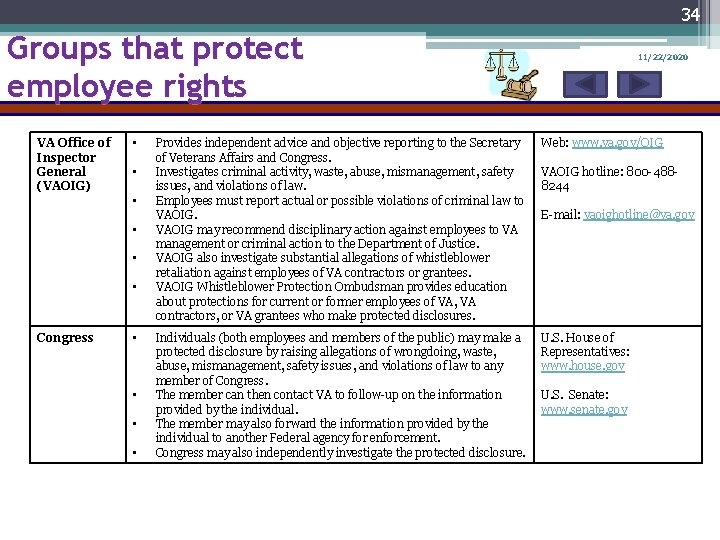
34 Groups that protect employee rights VA Office of Inspector General (VAOIG) • • • Congress • • 11/22/2020 Provides independent advice and objective reporting to the Secretary of Veterans Affairs and Congress. Investigates criminal activity, waste, abuse, mismanagement, safety issues, and violations of law. Employees must report actual or possible violations of criminal law to VAOIG may recommend disciplinary action against employees to VA management or criminal action to the Department of Justice. VAOIG also investigate substantial allegations of whistleblower retaliation against employees of VA contractors or grantees. VAOIG Whistleblower Protection Ombudsman provides education about protections for current or former employees of VA, VA contractors, or VA grantees who make protected disclosures. Web: www. va. gov/OIG Individuals (both employees and members of the public) may make a protected disclosure by raising allegations of wrongdoing, waste, abuse, mismanagement, safety issues, and violations of law to any member of Congress. The member can then contact VA to follow-up on the information provided by the individual. The member may also forward the information provided by the individual to another Federal agency for enforcement. Congress may also independently investigate the protected disclosure. U. S. House of Representatives: www. house. gov VAOIG hotline: 800 -4888244 E-mail: vaoighotline@va. gov U. S. Senate: www. senate. gov
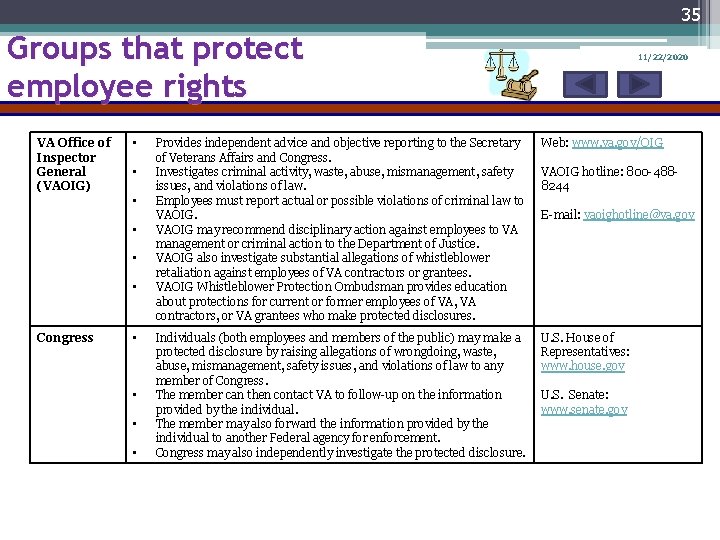
35 Groups that protect employee rights VA Office of Inspector General (VAOIG) • • • Congress • • 11/22/2020 Provides independent advice and objective reporting to the Secretary of Veterans Affairs and Congress. Investigates criminal activity, waste, abuse, mismanagement, safety issues, and violations of law. Employees must report actual or possible violations of criminal law to VAOIG may recommend disciplinary action against employees to VA management or criminal action to the Department of Justice. VAOIG also investigate substantial allegations of whistleblower retaliation against employees of VA contractors or grantees. VAOIG Whistleblower Protection Ombudsman provides education about protections for current or former employees of VA, VA contractors, or VA grantees who make protected disclosures. Web: www. va. gov/OIG Individuals (both employees and members of the public) may make a protected disclosure by raising allegations of wrongdoing, waste, abuse, mismanagement, safety issues, and violations of law to any member of Congress. The member can then contact VA to follow-up on the information provided by the individual. The member may also forward the information provided by the individual to another Federal agency for enforcement. Congress may also independently investigate the protected disclosure. U. S. House of Representatives: www. house. gov VAOIG hotline: 800 -4888244 E-mail: vaoighotline@va. gov U. S. Senate: www. senate. gov
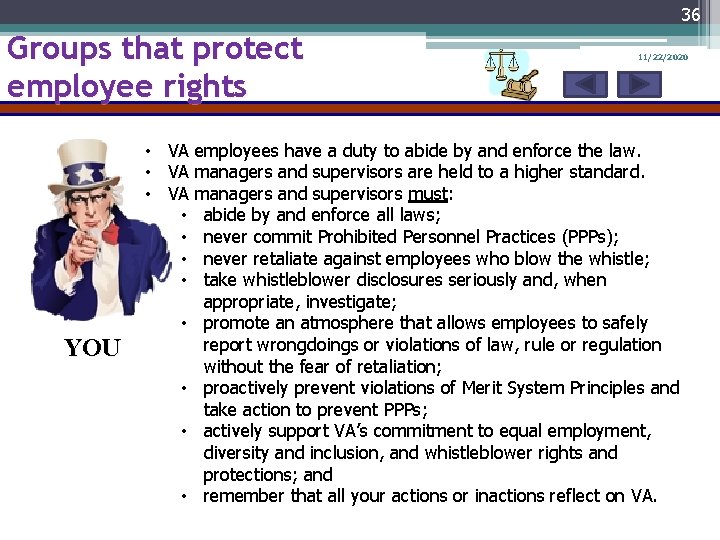
36 Groups that protect employee rights YOU 11/22/2020 • VA employees have a duty to abide by and enforce the law. • VA managers and supervisors are held to a higher standard. • VA managers and supervisors must: • abide by and enforce all laws; • never commit Prohibited Personnel Practices (PPPs); • never retaliate against employees who blow the whistle; • take whistleblower disclosures seriously and, when appropriate, investigate; • promote an atmosphere that allows employees to safely report wrongdoings or violations of law, rule or regulation without the fear of retaliation; • proactively prevent violations of Merit System Principles and take action to prevent PPPs; • actively support VA’s commitment to equal employment, diversity and inclusion, and whistleblower rights and protections; and • remember that all your actions or inactions reflect on VA.
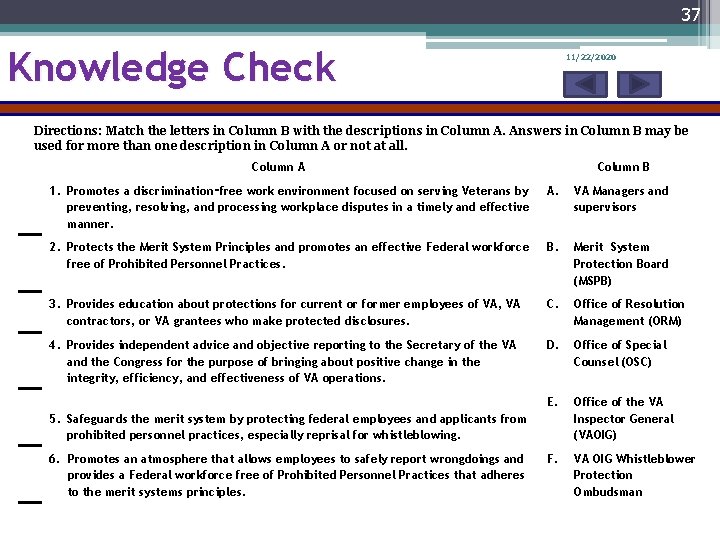
37 Knowledge Check 11/22/2020 Directions: Match the letters in Column B with the descriptions in Column A. Answers in Column B may be used for more than one description in Column A or not at all. Column A Column B 1. Promotes a discrimination‑free work environment focused on serving Veterans by preventing, resolving, and processing workplace disputes in a timely and effective manner. A. VA Managers and supervisors 2. Protects the Merit System Principles and promotes an effective Federal workforce free of Prohibited Personnel Practices. B. Merit System Protection Board (MSPB) 3. Provides education about protections for current or former employees of VA, VA contractors, or VA grantees who make protected disclosures. C. Office of Resolution Management (ORM) 4. Provides independent advice and objective reporting to the Secretary of the VA and the Congress for the purpose of bringing about positive change in the integrity, efficiency, and effectiveness of VA operations. D. Office of Special Counsel (OSC) E. Office of the VA Inspector General (VAOIG) F. VA OIG Whistleblower Protection Ombudsman 5. Safeguards the merit system by protecting federal employees and applicants from prohibited personnel practices, especially reprisal for whistleblowing. 6. Promotes an atmosphere that allows employees to safely report wrongdoings and provides a Federal workforce free of Prohibited Personnel Practices that adheres to the merit systems principles.
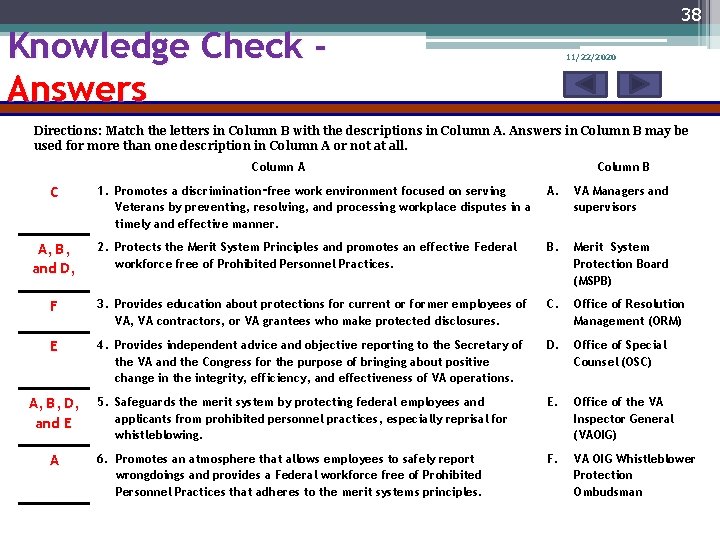
38 Knowledge Check Answers 11/22/2020 Directions: Match the letters in Column B with the descriptions in Column A. Answers in Column B may be used for more than one description in Column A or not at all. Column A Column B 1. Promotes a discrimination‑free work environment focused on serving Veterans by preventing, resolving, and processing workplace disputes in a timely and effective manner. A. VA Managers and supervisors 2. Protects the Merit System Principles and promotes an effective Federal workforce free of Prohibited Personnel Practices. B. Merit System Protection Board (MSPB) F 3. Provides education about protections for current or former employees of VA, VA contractors, or VA grantees who make protected disclosures. C. Office of Resolution Management (ORM) E 4. Provides independent advice and objective reporting to the Secretary of the VA and the Congress for the purpose of bringing about positive change in the integrity, efficiency, and effectiveness of VA operations. D. Office of Special Counsel (OSC) 5. Safeguards the merit system by protecting federal employees and applicants from prohibited personnel practices, especially reprisal for whistleblowing. E. Office of the VA Inspector General (VAOIG) 6. Promotes an atmosphere that allows employees to safely report wrongdoings and provides a Federal workforce free of Prohibited Personnel Practices that adheres to the merit systems principles. F. VA OIG Whistleblower Protection Ombudsman C A, B, and D, A, B, D, and E A
39 11/22/2020 Tips for managers and supervisors
40 General tips 11/22/2020 n Periodically remind your employees that they have an obligation to disclose any wrongdoing (mismanagement, waste of funds, abuse of authority, or substantial and specific danger to public health or safety) or violation of law and provide them with information on ways in which they can report the information (e. g. , VAOIG, OSC, Congress). n If an employee reports wrongdoing or a violation of law, rule, or regulation to you, don’t ignore the information. Instead, review the information and investigate the matter. You should also notify a senior executive (an employee in the Senior Executive Service (SES) or an SES-equivalent employee) about the information. n If the information pertains to a possible or actual criminal violation, you must report it to VAOIG. n If the information directly or indirectly pertains to you or bias may be perceived by a reasonable person, do not directly investigate the matter. Instead , inform your supervisor or a senior executive in a higher level position about the information so that he or she can investigate or assign someone to investigate the matter. n Periodically reiterate your commitment to whistleblower rights and protections to your employees. Ensure that staff understand that you will not retaliate or allow anyone else to retaliate against them for making a protected disclosure.
41 Some more tips 11/22/2020 • Never take employee allegations personally. Remember, an allegation is not a fact unless proven. • Be measured in your speech and actions. Remember, negligent or imprudent actions can create an appearance of a violation, which may lead to complaints and investigations. For example, broadcasting your favorite job candidate before a job has been advertised. • Deal with problems when they occur to avoid the appearance of an improper motive. For example, counsel or take disciplinary action against an employee when a problem first appears rather than waiting until the employee’s conduct or attitude has worsened. • Be consistent in managing your employees. • Document all actions and make sure documentation your standard practice. • When reacting to employees who have made protected disclosures, the atmosphere you create is critical to complying with the law. For example, don’t ignore a whistleblower’s questions at a staff meeting just because you perceive the whistleblower as a troublemaker. • Retaliation comes in many forms, some that may at first appear innocent. For example, telling an employee that you wish he or she had talked to you first before going to the Inspector General may give an appearance of retaliation. • Remember, retaliation is based on the whistleblower’s belief and not your belief. • When in doubt, seek expert advice by contacting the Office of the General Counsel or your Regional Counsel. • Last but not least, do your best not to be someone about whom the whistle is blown.
42 Knowledge Check 11/22/2020 1. Kylie, a Charge Nurse, makes a protected disclosure via the VA Office of the Inspector General (VAOIG) Hotline alleging that Intensive Care Unit (ICU) management has violated agency regulations by allowing nursing staff to adjust Veteran appointments without notifying the respective Veteran. Several weeks after making the disclosure, Kylie is reassigned to the Community-Based Outpatient Clinic (CBOC). Kylie believes the reassignment is in retaliation for filing the disclosure with the VAOIG. Kylie files a Whistleblower Retaliation Complaint with the Office of Special Counsel (OSC). Does Kylie have a viable OSC Whistleblower Retaliation complaint? A. Yes B. No C. Maybe 2. Leslie, the Director of a Regional Office has a conversation with Jan. During the conversation, Jan recounts instances where the Regional Office Manager has taken improper adverse personnel actions against Regional Office staff. Jan particularly cites one instance where Candy, the Regional Manager improperly removed Mark from a list of employees selected for a career development detail. Jan hints about reporting Candy to the VA Office of the Inspector General (VAOIG) for abuse of authority. The next day, Candy calls Jan into her office and strongly suggests any ideas about calling VAOIG to report what happened to Mark would not be appropriate and would be met with swift action. Jan has grounds for: A. Filing a whistleblower disclosure B. Making a protected disclosure C. Both, filing both a complaint and making a protected disclosure
Knowledge Check Answers 43 11/22/2020 1. Kylie, a Charge Nurse, makes a protected disclosure via the VA Office of the Inspector General (VAOIG) Hotline alleging that Intensive Care Unit (ICU) management has violated agency regulations by allowing nursing staff to adjust Veteran appointments without notifying the respective Veteran. Several weeks after making the disclosure, Kylie is reassigned to the Community-Based Outpatient Clinic (CBOC). Kylie believes the reassignment is in retaliation for filing the disclosure with the VAOIG. Kylie files a Whistleblower Retaliation Complaint with the Office of Special Counsel (OSC). Does Kylie have a viable OSC Whistleblower Retaliation complaint? A. Yes B. No C. Maybe* Correct Answer. Kylie may have had a reasonable belief that ICU Management was violating agency regulations. The timeframe between the VAOIG complaint and personnel action also seems to suggest retaliation. Still, VA may be able to show that whistleblower retaliation did not occur if it can show that (1) it was not aware of Kylie’s complaint to VAOIG; (2) it reassigned other employees in Kylie’s group to the CBOC; and (3) it would have taken a similar action even if Kylie had not blown the whistle (e. g. , Kylie may have had a particular skill set that management thought would be useful in a CBOC). 2. Leslie, the Director of a Regional Office has a conversation with Jan. During the conversation, Jan recounts instances where the Regional Office Manager has taken improper adverse personnel actions against Regional Office staff. Jan particularly cites one instance where Candy, the Regional Manager improperly removed Mark from a list of employees selected for a career development detail. Jan hints about reporting Candy to the VA Office of the Inspector General (VAOIG) for abuse of authority. The next day, Candy calls Jan into her office and strongly suggests any ideas about calling VAOIG to report what happened to Mark would not be appropriate and would be met with swift action. Jan has grounds for: A. Filing a complaint B. Making a protected disclosure C. Both, filing a complaint and making a protected disclosure* Correct Answer. Jan can file a complaint alleging threatened adverse personnel action, a “Prohibited Personnel Practice. ” Additionally Jan can make a protected disclosure alleging abuse of authority.
44 Knowledge Check 11/22/2020 3. As it relates to whistleblowers, VA managers and supervisors primary roles and responsibilities are all the following, except: A. Stop whistleblower retaliation in all its forms. B. Encourage VA employees and applicants for employment who believe they are the subject of whistleblower retaliation to seek redress through local processes before seeking redress through the Office of Special Counsel (OSC). C. Ensure VA employees and applicants for employment are aware of their rights, remedies, and obligations under Whistleblower Laws. D. Ensure VA employees and applicants for employment know how to file whistleblower disclosures. E. Promote an environment where VA employees and applicants for employment feel safe reporting allegations of wrongdoing. 4. Martha supervises Judy and she discovers through office conversations that Judy is a lesbian. Martha changes Judy’s schedule from the day-shift to the night-shift because she does not want to work with gay or lesbian individuals. Has Martha committed a prohibited personnel practice? A. Yes B. No C. Maybe
45 Knowledge Check 3. 4. 11/22/2020 As it relates to whistleblowers, VA managers and supervisors primary roles and responsibilities are all the following, except: A. Stop whistleblower retaliation in all its forms. B. Encourage VA employees and applicants for employment who believe they are the subject of whistleblower retaliation to seek redress through local processes before seeking redress through the Office of Special Counsel (OSC). * C. Ensure VA employees and applicants for employment are aware of their rights, remedies, and obligations under Whistleblower Laws. D. Ensure VA employees and applicants for employment know how to file whistleblower disclosures. E. Promote an environment where VA employees and applicants for employment feel safe reporting allegations of wrongdoing. *Correct Answer. Martha supervises Judy and she discovers through office conversations that Judy is a lesbian. Martha changes Judy’s schedule from the day-shift to the night-shift because she does not want to work with gay or lesbian individuals. Has Martha committed a prohibited personnel practice? A. Yes* B. No C. Maybe *Correct Answer. Martha has just discriminated against Judy based on her sexual orientation, which is something that does not affect her performance or the performance of others and may not be used as a basis for any action, including a personnel action involving a change in duties or working conditions.
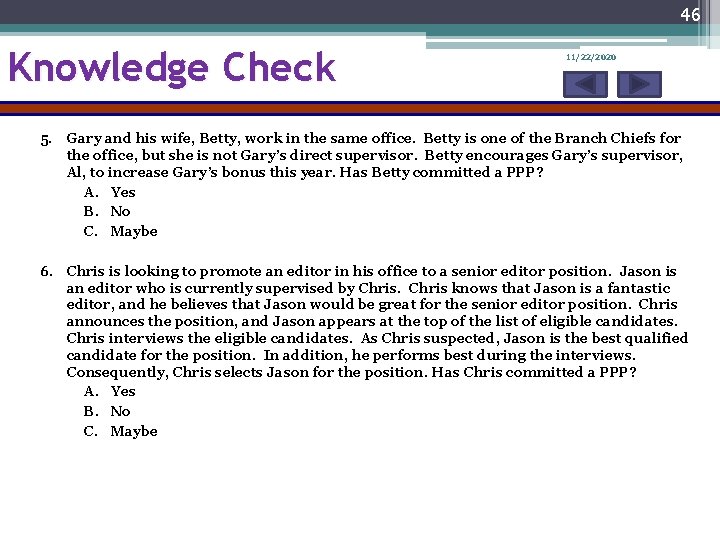
46 Knowledge Check 11/22/2020 5. Gary and his wife, Betty, work in the same office. Betty is one of the Branch Chiefs for the office, but she is not Gary’s direct supervisor. Betty encourages Gary’s supervisor, Al, to increase Gary’s bonus this year. Has Betty committed a PPP? A. Yes B. No C. Maybe 6. Chris is looking to promote an editor in his office to a senior editor position. Jason is an editor who is currently supervised by Chris knows that Jason is a fantastic editor, and he believes that Jason would be great for the senior editor position. Chris announces the position, and Jason appears at the top of the list of eligible candidates. Chris interviews the eligible candidates. As Chris suspected, Jason is the best qualified candidate for the position. In addition, he performs best during the interviews. Consequently, Chris selects Jason for the position. Has Chris committed a PPP? A. Yes B. No C. Maybe
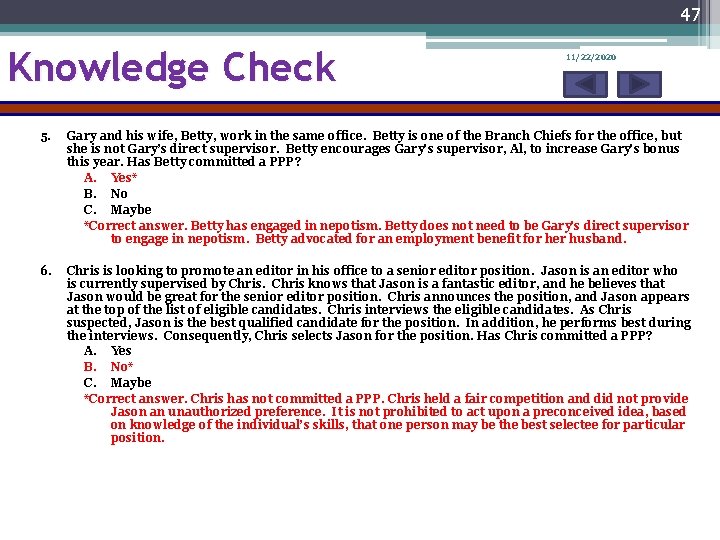
47 Knowledge Check 11/22/2020 5. Gary and his wife, Betty, work in the same office. Betty is one of the Branch Chiefs for the office, but she is not Gary’s direct supervisor. Betty encourages Gary’s supervisor, Al, to increase Gary’s bonus this year. Has Betty committed a PPP? A. Yes* B. No C. Maybe *Correct answer. Betty has engaged in nepotism. Betty does not need to be Gary’s direct supervisor to engage in nepotism. Betty advocated for an employment benefit for her husband. 6. Chris is looking to promote an editor in his office to a senior editor position. Jason is an editor who is currently supervised by Chris knows that Jason is a fantastic editor, and he believes that Jason would be great for the senior editor position. Chris announces the position, and Jason appears at the top of the list of eligible candidates. Chris interviews the eligible candidates. As Chris suspected, Jason is the best qualified candidate for the position. In addition, he performs best during the interviews. Consequently, Chris selects Jason for the position. Has Chris committed a PPP? A. Yes B. No* C. Maybe *Correct answer. Chris has not committed a PPP. Chris held a fair competition and did not provide Jason an unauthorized preference. It is not prohibited to act upon a preconceived idea, based on knowledge of the individual’s skills, that one person may be the best selectee for particular position.
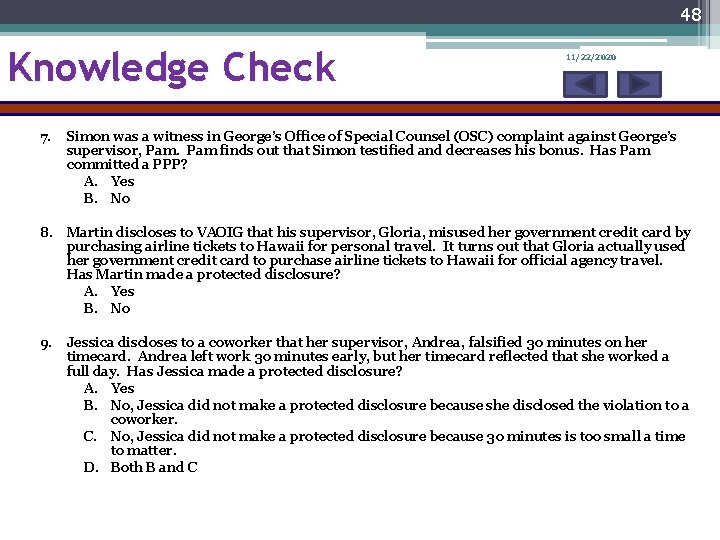
48 Knowledge Check 7. 11/22/2020 Simon was a witness in George’s Office of Special Counsel (OSC) complaint against George’s supervisor, Pam finds out that Simon testified and decreases his bonus. Has Pam committed a PPP? A. Yes B. No 8. Martin discloses to VAOIG that his supervisor, Gloria, misused her government credit card by purchasing airline tickets to Hawaii for personal travel. It turns out that Gloria actually used her government credit card to purchase airline tickets to Hawaii for official agency travel. Has Martin made a protected disclosure? A. Yes B. No 9. Jessica discloses to a coworker that her supervisor, Andrea, falsified 30 minutes on her timecard. Andrea left work 30 minutes early, but her timecard reflected that she worked a full day. Has Jessica made a protected disclosure? A. Yes B. No, Jessica did not make a protected disclosure because she disclosed the violation to a coworker. C. No, Jessica did not make a protected disclosure because 30 minutes is too small a time to matter. D. Both B and C
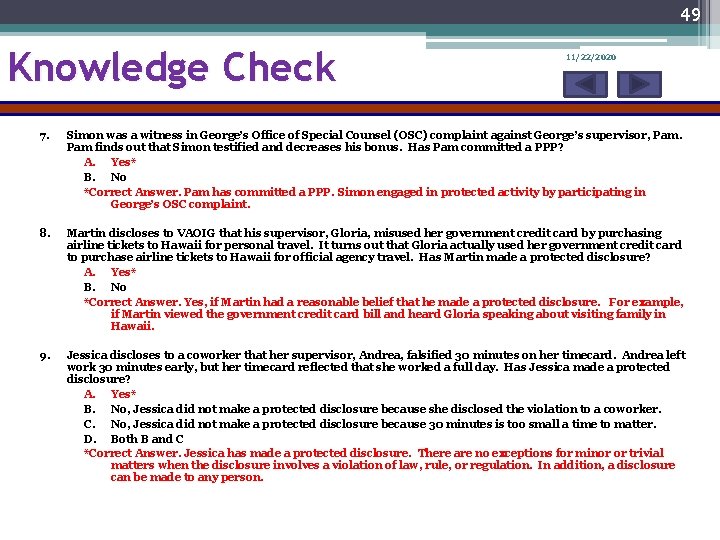
49 Knowledge Check 11/22/2020 7. Simon was a witness in George’s Office of Special Counsel (OSC) complaint against George’s supervisor, Pam finds out that Simon testified and decreases his bonus. Has Pam committed a PPP? A. Yes* B. No *Correct Answer. Pam has committed a PPP. Simon engaged in protected activity by participating in George’s OSC complaint. 8. Martin discloses to VAOIG that his supervisor, Gloria, misused her government credit card by purchasing airline tickets to Hawaii for personal travel. It turns out that Gloria actually used her government credit card to purchase airline tickets to Hawaii for official agency travel. Has Martin made a protected disclosure? A. Yes* B. No *Correct Answer. Yes, if Martin had a reasonable belief that he made a protected disclosure. For example, if Martin viewed the government credit card bill and heard Gloria speaking about visiting family in Hawaii. 9. Jessica discloses to a coworker that her supervisor, Andrea, falsified 30 minutes on her timecard. Andrea left work 30 minutes early, but her timecard reflected that she worked a full day. Has Jessica made a protected disclosure? A. Yes* B. No, Jessica did not make a protected disclosure because she disclosed the violation to a coworker. C. No, Jessica did not make a protected disclosure because 30 minutes is too small a time to matter. D. Both B and C *Correct Answer. Jessica has made a protected disclosure. There are no exceptions for minor or trivial matters when the disclosure involves a violation of law, rule, or regulation. In addition, a disclosure can be made to any person.
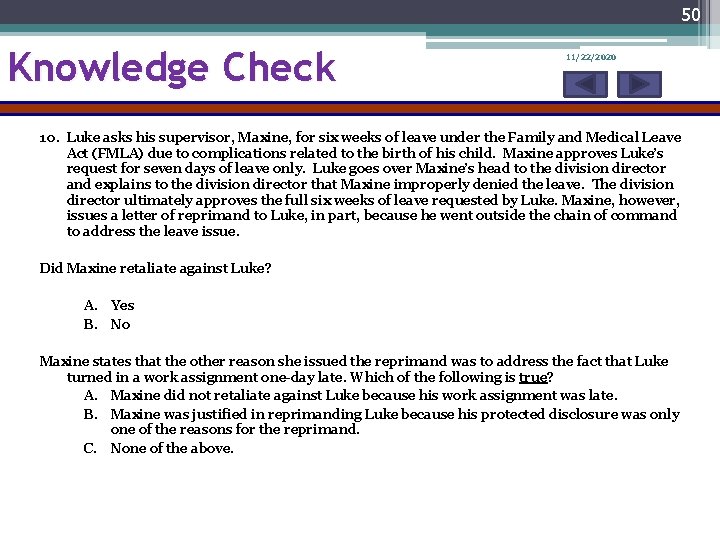
50 Knowledge Check 11/22/2020 10. Luke asks his supervisor, Maxine, for six weeks of leave under the Family and Medical Leave Act (FMLA) due to complications related to the birth of his child. Maxine approves Luke’s request for seven days of leave only. Luke goes over Maxine’s head to the division director and explains to the division director that Maxine improperly denied the leave. The division director ultimately approves the full six weeks of leave requested by Luke. Maxine, however, issues a letter of reprimand to Luke, in part, because he went outside the chain of command to address the leave issue. Did Maxine retaliate against Luke? A. Yes B. No Maxine states that the other reason she issued the reprimand was to address the fact that Luke turned in a work assignment one-day late. Which of the following is true? A. Maxine did not retaliate against Luke because his work assignment was late. B. Maxine was justified in reprimanding Luke because his protected disclosure was only one of the reasons for the reprimand. C. None of the above.
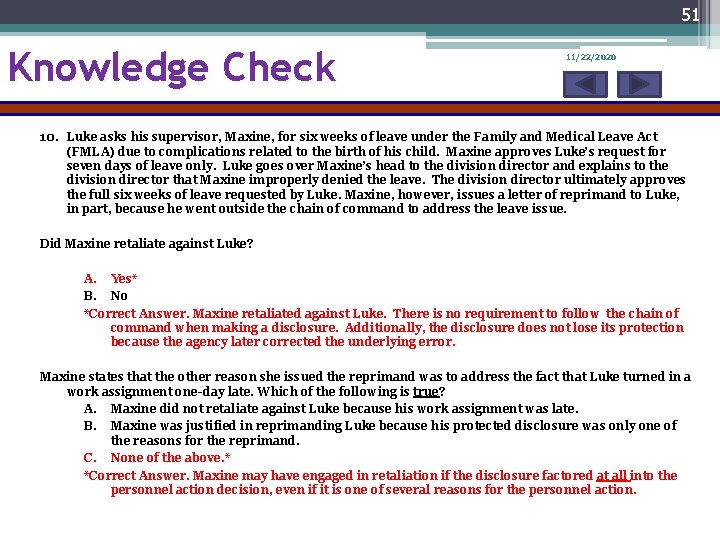
51 Knowledge Check 11/22/2020 10. Luke asks his supervisor, Maxine, for six weeks of leave under the Family and Medical Leave Act (FMLA) due to complications related to the birth of his child. Maxine approves Luke’s request for seven days of leave only. Luke goes over Maxine’s head to the division director and explains to the division director that Maxine improperly denied the leave. The division director ultimately approves the full six weeks of leave requested by Luke. Maxine, however, issues a letter of reprimand to Luke, in part, because he went outside the chain of command to address the leave issue. Did Maxine retaliate against Luke? A. Yes* B. No *Correct Answer. Maxine retaliated against Luke. There is no requirement to follow the chain of command when making a disclosure. Additionally, the disclosure does not lose its protection because the agency later corrected the underlying error. Maxine states that the other reason she issued the reprimand was to address the fact that Luke turned in a work assignment one-day late. Which of the following is true? A. Maxine did not retaliate against Luke because his work assignment was late. B. Maxine was justified in reprimanding Luke because his protected disclosure was only one of the reasons for the reprimand. C. None of the above. * *Correct Answer. Maxine may have engaged in retaliation if the disclosure factored at all into the personnel action decision, even if it is one of several reasons for the personnel action.
- Slides: 51