
Department of Transport Overview of the Departments Objectives
Department of Transport Overview of the Department’s Objectives, Functions and its Public Entities Presentation by Ms M. Mpofu Director General: Transport 17 JUNE 2009 1
Vision and Mission Our Vision “Transport, the Heartbeat of Economic Growth and Social Development” Our Mission to “Lead the development of efficient integrated transport systems by creating a framework of sustainable policies and regulators and implementable models to support government strategies for economic, social and international development. ” 2
DOT Mandate Our Mandate - to maximize the contribution of transport to the economic and social development goals of the society by providing fully integrated transport operations and infrastructure. 3
DOT Values Our Values • Maintain fairness and equity in all our operations • Strive for quality and affordable transport for all; • Stimulate innovation in the transport sector; • Ensure transparency, accountability and monitoring for all operations; • Ensure sustainability, financial affordability, accessibility as well as the upholding of the Batho Pele principles. 4
Departmental Structure 5
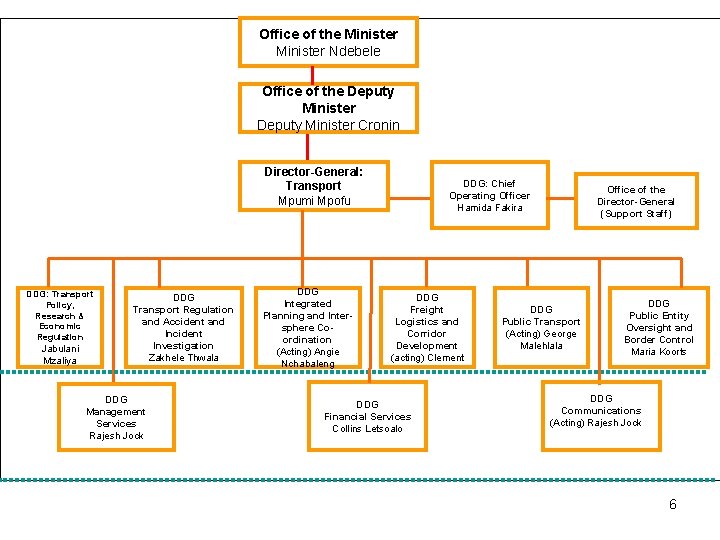
Office of the Minister Ndebele Office of the Deputy Minister Cronin Director-General: Transport Mpumi Mpofu DDG: Transport Policy, Research & Economic Regulation Jabulani Mzaliya DDG Transport Regulation and Accident and Incident Investigation Zakhele Thwala DDG Management Services Rajesh Jock DDG Integrated Planning and Intersphere Coordination (Acting) Angie Nchabaleng DDG: Chief Operating Officer Hamida Fakira DDG Freight Logistics and Corridor Development (acting) Clement DDG Financial Services Collins Letsoalo Office of the Director-General (Support Staff) DDG Public Transport (Acting) George Malehlala DDG Public Entity Oversight and Border Control Maria Koorts DDG Communications (Acting) Rajesh Jock 6
Structural Composition The Department consist of the following Branches: • • Branch Administration/Operations (includes the Office of the Director General, Transport Ministry, Management Services, Communication and Financial Services); Branch Transport Policy & Economic Regulation ; Branch Transport Regulation and Accident and Incident Investigation; Branch Integrated Planning & Inter-sphere Coordination; Branch Transport Logistics and Corridor Development; Branch Public Transport; and Branch Public Entity Oversight and Border Operations Control. 7
Do. T Strategic Objectives • To provide an integrated, sustainable, reliable and safe transport system, through safety and economic regulation, planning, development, coordination, promotion and implementation of transport policies and strategies. The key deliverables are: • Reduction in transport costs; • Improvement in safety; • Reduction in the backlog of road and rail infrastructure; • Accessibility and affordability to quality public transport in both rural and urban areas; and • Optimisation in freight logistics. 8
Key Functions of the Department • Coordinate and render an effective, efficient strategic support and administrative service to Ministry, DG and the Department; • Effectively manage a national innovative research and development programme, analyse strategic policies, develop appropriate legislation and provide economic advice and analysis for all modes of transport; • Create an enabling environment for regulating all transport modes and manage transport accidents and incident investigations; • Manage and facilitate the development of integrated planning and inter-sphere coordination for transport; 9

Key Functions of the Department • Manage the implementation of the transport logistics strategy and the development of freight movement corridors • Develop integrated accessible and affordable quality public transport networks that meet the needs of both rural and urban passengers • Develop appropriate mandates and monitoring mechanisms for public entities 10
Branch: Administration Purpose: • To coordinate and render an effective, efficient, strategic support and administrative service to Ministry, DG and the Department Overall Functions: • Provide an effective support service to Ministry of Transport; • Manage all communication activities; • Provide an effective support service to the DG; • Provide Financial services, Internal Audit Services, Risk Management services; and • Provide effective and efficient corporate support services to the Department 11
Branch: Administration The Administration Branch consists of the following main sub-branches: • Ministry • Office of the Director General • Communications • Financial Services • Management Services 12
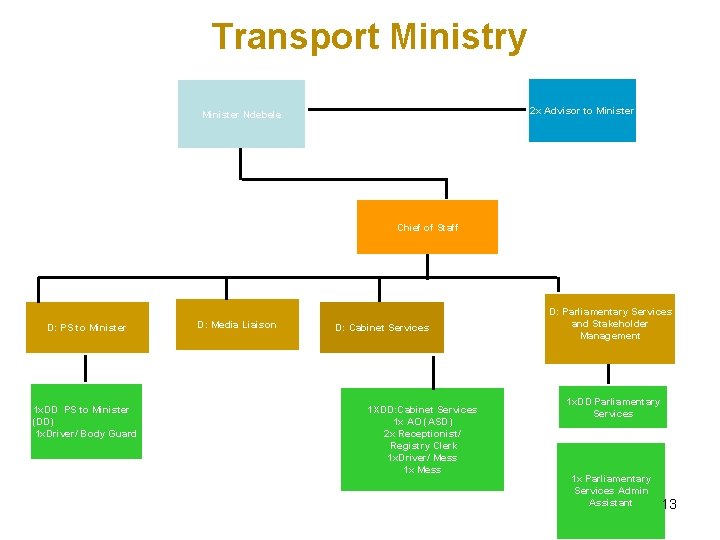
Transport Ministry 2 x Advisor to Minister Ndebele Chief of Staff D: PS to Minister 1 x. DD PS to Minister (DD) 1 x. Driver/ Body Guard D: Media Liaison D: Cabinet Services 1 XDD: Cabinet Services 1 x AO (ASD) 2 x Receptionist/ Registry Clerk 1 x. Driver/ Mess 1 x Mess D: Parliamentary Services and Stakeholder Management 1 x. DD Parliamentary Services 1 x Parliamentary Services Admin Assistant 13
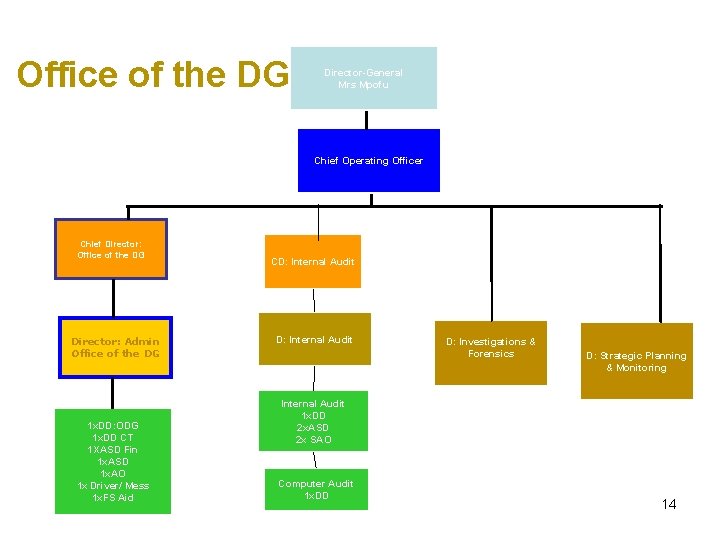
Office of the DG Director-General Mrs Mpofu Chief Operating Officer Chief Director: Office of the DG Director: Admin Office of the DG 1 x. DD: ODG 1 x. DD CT 1 XASD Fin 1 x. ASD 1 x. AO 1 x Driver/ Mess 1 x. FS Aid CD: Internal Audit D: Investigations & Forensics D: Strategic Planning & Monitoring Internal Audit 1 x. DD 2 x. ASD 2 x SAO Computer Audit 1 x. DD 14
Branch: Administration Purpose of Ministry • To provide effective support to the Minister and Deputy Minister Functions • Manage all matters pertaining to the Minister’s executive obligations • Manage and coordinate inputs for Cabinet • Enhance the public image of the Minister and manage media liaisons • Provide an efficient and dynamic interface between the Ministry, Department, National Parliament and Provincial Legislatures Purpose of Office of the Director General • To provide strategic support to the DG and the Department through managing the strategic process Functions • Manage the strategic planning process and provide overall support to the Office of the Director General • Provide sound internal audit services • Provide effective stakeholder management services 15
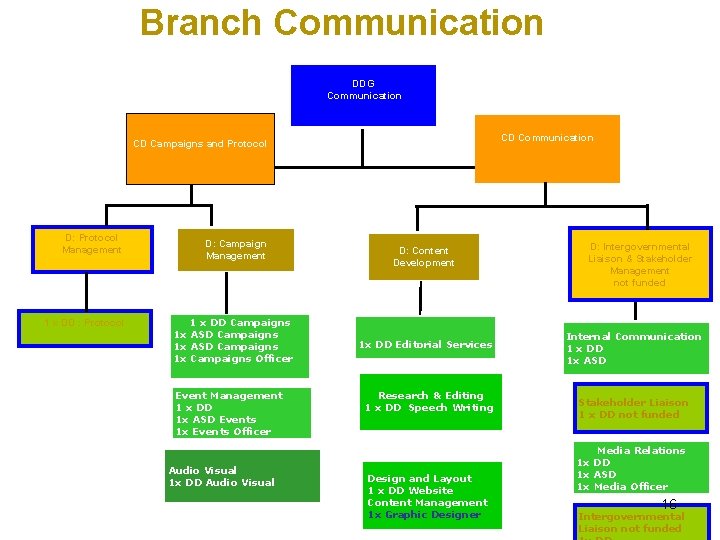
Branch Communication DDG Communication CD Campaigns and Protocol D: Protocol Management 1 x DD : Protocol D: Campaign Management 1 x DD Campaigns 1 x ASD Campaigns 1 x Campaigns Officer Event Management 1 x DD 1 x ASD Events 1 x Events Officer Audio Visual 1 x DD Audio Visual D: Content Development 1 x DD Editorial Services Research & Editing 1 x DD Speech Writing Design and Layout 1 x DD Website Content Management 1 x Graphic Designer D: Intergovernmental Liaison & Stakeholder Management not funded Internal Communication 1 x DD 1 x ASD Stakeholder Liaison 1 x DD not funded Media Relations 1 x DD 1 x ASD 1 x Media Officer 16 Intergovernmental Liaison not funded
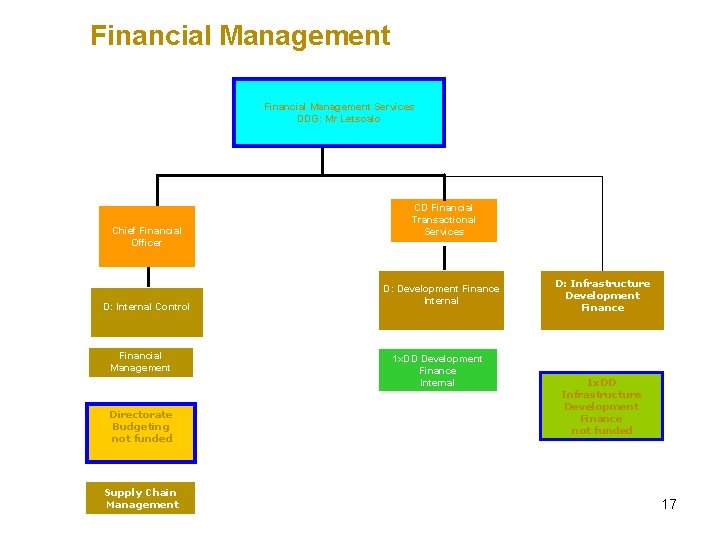
Financial Management Services DDG: Mr Letsoalo Chief Financial Officer D: Internal Control Financial Management Directorate Budgeting not funded Supply Chain Management CD Financial Transactional Services D: Development Finance Internal 1 x. DD Development Finance Internal D: Infrastructure Development Finance 1 x. DD Infrastructure Development Finance not funded 17
Branch: Administration Purpose of Communications • To coordinate and provide a sound communication strategy to enhance the image of Ministry as well as the Department Functions • Develop and implement a communication strategy for Ministry and Department • Manage all departmental campaigns and protocol matters Purpose of Financial Services • To manage the financial services for the Department Functions • Maintain financial management systems; • Provide financial transactional services; • Provide an Internal Audit Service to the Department. 18
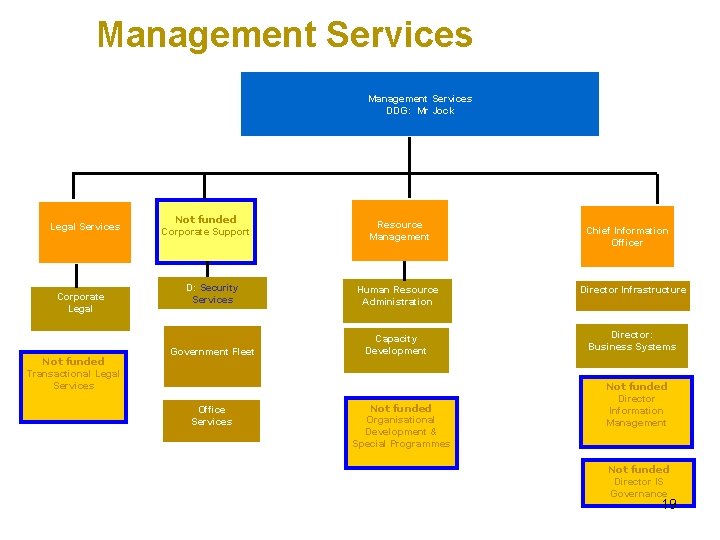
Management Services DDG: Mr Jock Legal Services Corporate Legal Not funded Transactional Legal Services Not funded Corporate Support Resource Management Chief Information Officer D: Security Services Human Resource Administration Director Infrastructure Government Fleet Capacity Development Director: Business Systems Office Services Not funded Organisational Development & Special Programmes Not funded Director Information Management Not funded Director IS Governance 19
Branch: Administration Purpose of Management Services • To provide strategic corporate support systems and services to the Department Functions • Provide sound legal services; • Manage and develop departmental human capital resources; • Ensure effective provision of information technology services; • Provide facilities management services and office support services; • Provide an effective international relations support services; • Establish a plan to increase the pool of critical skills in the transport industry (aviation, maritime, railways, road) 20
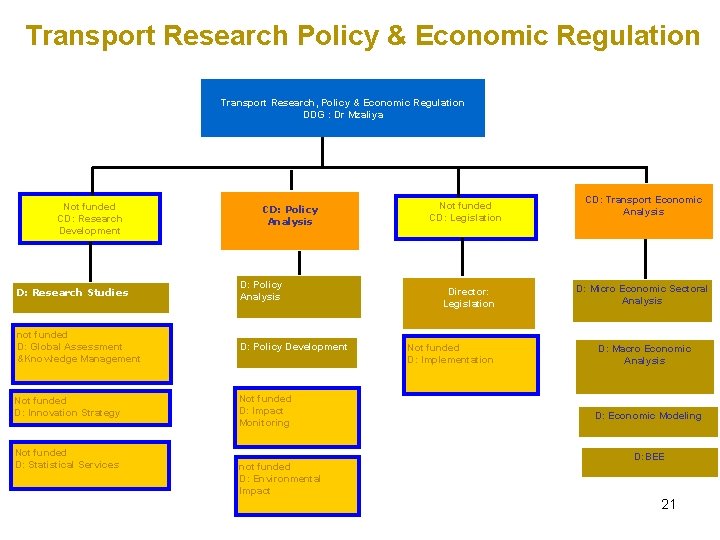
Transport Research Policy & Economic Regulation Transport Research, Policy & Economic Regulation DDG : Dr Mzaliya Not funded CD: Research Development CD: Policy Analysis D: Research Studies D: Policy Analysis not funded D: Global Assessment &Knowledge Management D: Policy Development Not funded D: Innovation Strategy Not funded D: Impact Monitoring Not funded D: Statistical Services not funded D: Environmental Impact Not funded CD: Legislation Director: Legislation Not funded D: Implementation CD: Transport Economic Analysis D: Micro Economic Sectoral Analysis D: Macro Economic Analysis D: Economic Modeling D: BEE 21
Branch: Transport Policy and Economic Regulation Purpose: • Manage a national innovative research and development programme, analyse strategic policies, develop appropriate legislation, develop transport economic regulations and provide economic advice and analysis for all modes of transport Overall Functions: • Effectively manage a national innovative research and development programme; • Ensure the analysis and development of integrated strategic transport policies; • Develop appropriate legislation in support of departmental policies; • Provide economic advice and analysis for all transport modes; • Provide general administrative and stakeholder management services to the Branch; • Manage the development and implementation of transport economic regulation frameworks 22
Branch: Transport Policy and Economic Regulation This branch consists of the following main subbranches: • Research and development • Policy analysis and impact monitoring • Legislation • Economic analysis • Economic regulation 23
Branch: Transport Policy and Economic Regulation Purpose of Research and Development • Manage a national innovative research and development programme Functions • Manage research studies for the department and public entities • Manage global assessment studies and knowledge assets • Develop and implement an innovation Strategy • Collect, analyse and publish transport statistics 24
Branch: Transport Policy and Economic Regulation Purpose of Policy Analysis and Impact Monitoring • To develop strategic transport policy for all modes of transport and monitor the translation of those policies into action. Functions • Analyse policies according to the sustainable livelihood principles; • Develop outcome focused, integrated and inclusive transport policies; • Provide an effective environmental management service; • Monitor the outcomes and impacts of policies on the performance of the transportation system. 25
Branch: Transport Policy and Economic Regulation Purpose of Legislation • To develop appropriate legislation in support of departmental policies Functions • Provide an effective professional legislation service to the Minister, Department and certain statutory bodies; • Manage the implementation of new and amended legislation Purpose of Economic Analysis • To collate and analyse critical supply and demand data for all modes of transport and provide relevant economic advice for the department’s priority areas Functions • Provide a micro sectoral economic analysis service; • Provide a macro economic analysis service ; • Provide an economic modelling service; • Manage the transport BEE programme. 26
Branch: Transport Policy and Economic Regulation Purpose of Economic Regulation • To manage the development and implementation of transport economic regulation frameworks Functions • Ensure affordable, reliable and sustainable rail transport services; • Ensure affordable, reliable and sustainable land transport services; • Ensure affordable, reliable and sustainable aviation and maritime transport services; • Ensure affordable, reliable and sustainable cross border services 27
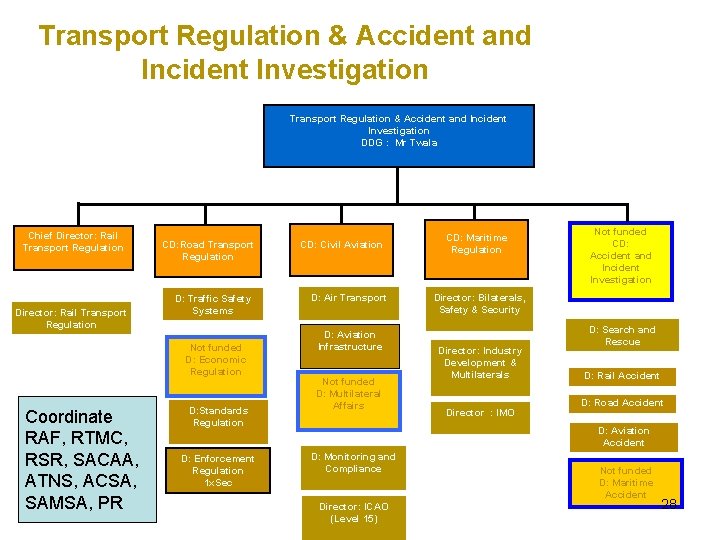
Transport Regulation & Accident and Incident Investigation DDG : Mr Twala Chief Director: Rail Transport Regulation CD: Road Transport Regulation D: Traffic Safety Systems Not funded D: Economic Regulation Coordinate RAF, RTMC, RSR, SACAA, ATNS, ACSA, SAMSA, PR D: Standards Regulation D: Enforcement Regulation 1 x. Sec CD: Civil Aviation D: Air Transport D: Aviation Infrastructure Not funded D: Multilateral Affairs CD: Maritime Regulation Not funded CD: Accident and Incident Investigation Director: Bilaterals, Safety & Security Director: Industry Development & Multilaterals Director : IMO D: Search and Rescue D: Rail Accident D: Road Accident D: Aviation Accident D: Monitoring and Compliance Director: ICAO (Level 15) Not funded D: Maritime Accident 28
Branch: Transport Regulation and Accident and Incident Investigation Purpose: • To create an enabling environment for the regulation of all transport modes and manage transport accidents and incident investigation Overall Functions: • Facilitate the management of a safe and internationally competitive regulatory framework for rail transport • Facilitate the management of a safe and internationally competitive regulatory framework for road transport regulation • Facilitate the management of a safe and internationally competitive regulatory framework for air transport • Facilitate the management of a safe and internationally competitive regulatory framework for maritime transport • Manage search and rescue operations and accident and incident investigations for all transport modes; and • Provide general administrative and stakeholder management services to the Branch 29
Branch: Transport Regulation and Accident and Incident Investigation This branch consists of the following main sub-branches: • • • Rail Regulations Road Transport Regulation Civil Aviation Maritime Regulation Accident and Incident Investigation 30
Branch: Transport Regulation and Accident and Incident Investigation Purpose of Rail Regulation • To facilitate the management of a safe and internationally competitive regulatory framework for rail transport Functions • Improve the current regulatory regimes, through revision and development of rail transport policy and regulatory frameworks Purpose of Road Transport Regulation • To facilitate the management of a safe and internationally competitive regulatory framework for road transport regulation Functions • Manage the development of IT systems in Road Safety and manage fraud and corruption investigations; • Manage the development of legislation, standards and norms for road transport regulation ; • Manage the application of enforcement standards; • Manage economic and infrastructure developments. 31
Branch: Transport Regulation and Accident and Incident Investigation Purpose of Civil Aviation • To facilitate the management of a safe and internationally competitive regulatory framework for air transport Functions • Coordinate and guide airport development in RSA and manage related matters; • Manage bilaterals and provide a support service to the two aviation councils; • Develop, implement and monitor the enforcement and compliance regime; • Represent South Africa at ICAO; • Manage Aviation Multilateral Affairs; 32
Branch: Transport Regulation and Accident and Incident Investigation Purpose of Maritime Regulation • To facilitate the management of a safe and internationally competitive regulatory framework for maritime transport Functions • Provide for the economic and multilateral development of the maritime transport industry; • Manage maritime bilateral agreements and the implement and maintain a maritime safety and security regulatory framework; • Represent South Africa at the IMO 33
Branch: Transport Regulation and Accident and Incident Investigation Purpose of Accident & Incident Investigation • To manage search and rescue operations and accident and incident investigations for all transport modes. Functions • Create an enabling environment for the provision of a search and rescue function within South Africa and in cooperation with other States. • Investigate and report on rail accidents and incidents • Investigate and report on road accidents and incidents • Investigate and report on aviation accidents and incidents • Investigate and report on maritime accidents and incidents 34
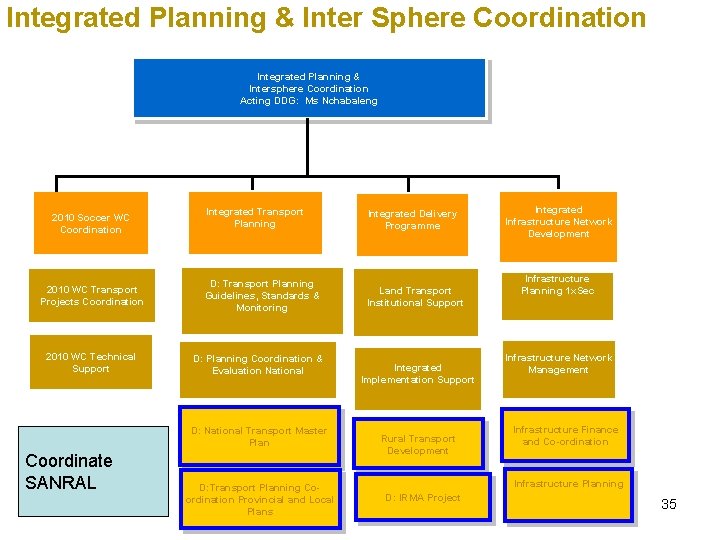
Integrated Planning & Inter Sphere Coordination Integrated Planning & Intersphere Coordination Acting DDG: Ms Nchabaleng 2010 Soccer WC Coordination 2010 WC Transport Projects Coordination 2010 WC Technical Support Integrated Transport Planning Integrated Delivery Programme D: Transport Planning Guidelines, Standards & Monitoring Land Transport Institutional Support D: Planning Coordination & Evaluation National D: National Transport Master Plan Coordinate SANRAL D: Transport Planning Coordination Provincial and Local Plans Integrated Implementation Support Rural Transport Development Integrated Infrastructure Network Development Infrastructure Planning 1 x. Sec Infrastructure Network Management Infrastructure Finance and Co-ordination Infrastructure Planning D: IRMA Project 35
Branch: Integrated Planning and Intersphere Coordination Purpose: • To manage and facilitate the development of an integrated planning and inter-sphere coordination for Transport. Overall Functions: • Manage Integrated Transport Planning, coordination and evaluation; • Manage transport integrated delivery programmes; • Manage integrated infrastructure network development; • Manage the coordination of transport projects in relation to the 2010 Soccer World Cup; and 36
Branch: Integrated Planning and Intersphere Coordination This branch consists of the following main sub-branches: • • Integrated Transport Planning Integrated Delivery Programme Integrated Infrastructure Network Development 2010 FIFA World Cup Coordination 37
Branch: Integrated Planning and Intersphere Coordination Purpose of Integrated Transport Planning: • To manage Integrated Transport Planning, coordination and evaluation Functions • Manage the implementation of the NLTTA and develop appropriate guidelines and standards • Manage the coordination of the development of transport plans of national government • Manage the coordination of the development of transport plans of provincial and local government • Manage and oversee the development of the National Transport Master Plan 38
Branch: Integrated Planning and Intersphere Coordination Purpose of Integrated Delivery Programme: • To manage transport integrated delivery programmes Functions: • Manage land transport institutional matters • Manage the implementation of integrated programmes • Coordinate and implement the rural developments project • Coordinate and implement the integrated rural mobility and access project Purpose of Integrated Infrastructure Network Development: • To manage integrated infrastructure network development Functions: • Manage infrastructure planning for road and rail; • Manage infrastructure planning for aviation and maritime; • Manage and coordinate infrastructure financing; • Coordinate and manage the development and maintenance of an integrated network for transport infrastructure across all modes to support economic and social development. 39
Branch: Integrated Planning and Intersphere Coordination Purpose of 2010 FIFA World Cup Coordination: • To manage the coordination of transport projects in relation to the 2010 Soccer World Cup Functions: • Coordinate all matters related to the World Cup across line functions, all modes and among all spheres of government; • Provide support to the 2010 Technical Coordinating Committee 40
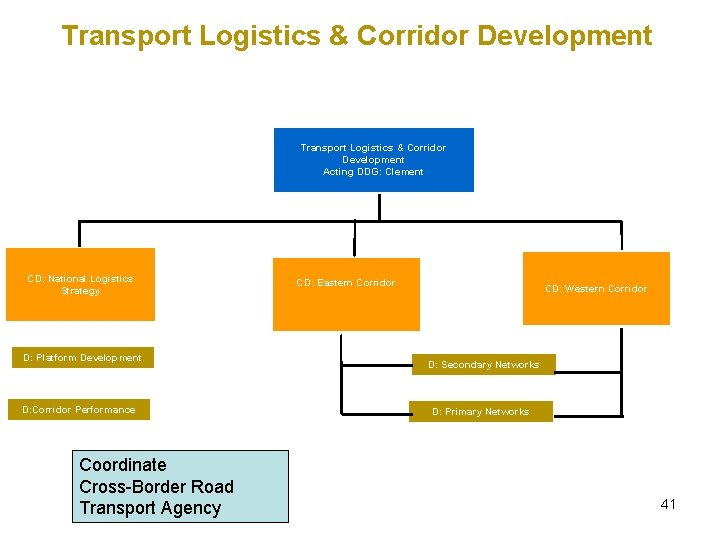
Transport Logistics & Corridor Development Acting DDG: Clement CD: National Logistics Strategy D: Platform Development D: Corridor Performance Coordinate Cross-Border Road Transport Agency CD: Eastern Corridor CD: Western Corridor D: Secondary Networks D: Primary Networks 41
Branch: Transport Logistics and Corridor Development Purpose: • To manage the implementation of the national freight logistics strategy and manage the development of logistic corridors Overall Functions: • Manage the implementation of the National Freight Logistics Strategy; • Manage the development of the Eastern Freight Corridors; and • Manage the development of the Western Freight Corridors; and • Provide general administrative and stakeholder management services to the Branch. 42
Branch: Transport Logistics and Corridor Development This branch consists of the following main sub-branches: • National Freight Logistics • Eastern and Western Corridor Development 43
Branch: Transport Logistics and Corridor Development Purpose of National Freight Logistics: • To manage the implementation of the National Freight Logistics Strategy Functions: • Develop and implement guidelines for effective national freight platforms; • Develop monitoring systems to measure the performance of freight corridors. Purpose of Eastern and Western Corridor Development • To develop the Western and Eastern freight corridors Functions: • Develop Primary Networks • Develop Secondary Networks 44
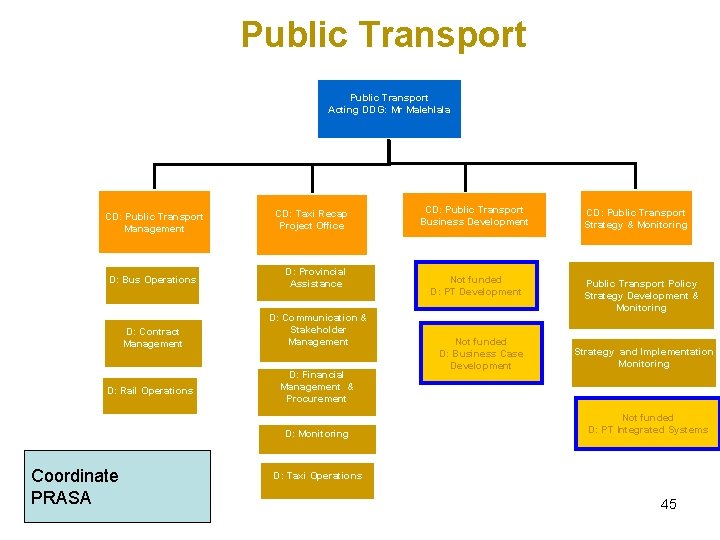
Public Transport Acting DDG: Mr Malehlala CD: Public Transport Management CD: Taxi Recap Project Office D: Bus Operations D: Provincial Assistance D: Contract Management D: Communication & Stakeholder Management D: Rail Operations D: Financial Management & Procurement D: Monitoring Coordinate PRASA CD: Public Transport Business Development Not funded D: PT Development Not funded D: Business Case Development CD: Public Transport Strategy & Monitoring Public Transport Policy Strategy Development & Monitoring Strategy and Implementation Monitoring Not funded D: PT Integrated Systems D: Taxi Operations 45
Branch: Public Transport Purpose : • To develop practices and norms that will increase access to appropriate and quality public transport to meet the socio-economic needs of both rural and urban passengers. Overall Functions: • Facilitate implementation of Public Transport service delivery through the management of the subsidy budget and promotion of strategic objectives; • Manage the implementation and monitoring of the Taxi Recap project; • Manage public transport business development; • Develop public transport implementation strategies and pilot projects; and • Provide general administrative and stakeholder management services to the Branch • Manage the responsibilities of government towards the taxi industry and render assistance to provinces within the framework of the NLTA 46
Branch: Public Transport This branch consists of the following main sub-branches: • • Public Transport Management Taxi Recapitalisation Project Office Public Transport Strategy and Monitoring Public Transport Business Development 47
Branch: Public Transport Purpose of Public Transport Management: • To facilitate the implementation of public transport service delivery through the management of the subsidy budget and promotion of strategic objectives Functions: • Manage and administrate rail passenger transport in line with the provisions of the PFMA, the NLTTA and related transport policy; • Manage and administrate bus subsidies in line with the provisions of the PFMA, the NLTTA and related transport policy; • Manage and administer the subsidy budget and ensure compliance to the NLTTA, PFMA and various contracts. 48
Branch: Public Transport Purpose of Taxi Recapitalisation Project Office: • To manage the implementation and monitoring of the Taxi Recap project Functions: • Manage the responsibilities of Government towards the taxi industry and render assistance to Provinces within the framework of the NLTTA; • Provide assistance to Provinces through liaison and coordination of the Taxi Recapitalisation Programme and other processes; • Promote the Taxi Recapitalisation Programme and its overall objectives; • Manage the Taxi Recapitalisation Programme budget; • Monitor the implementation and roll out of the Taxi Recapitalisation Programme 49
Branch: Public Transport Purpose of Public Transport Strategy and Monitoring: • To develop public transport implementation strategies and pilot projects Functions: • Implement and monitor Public Transport strategies; • Develop strategies to improve public transport service delivery in South Africa; • Develop Public Transport integrated systems. Purpose of Public Transport Business Development: • To manage public transport business development Functions: • Manage public transport business case development; • Manage public transport development. 50
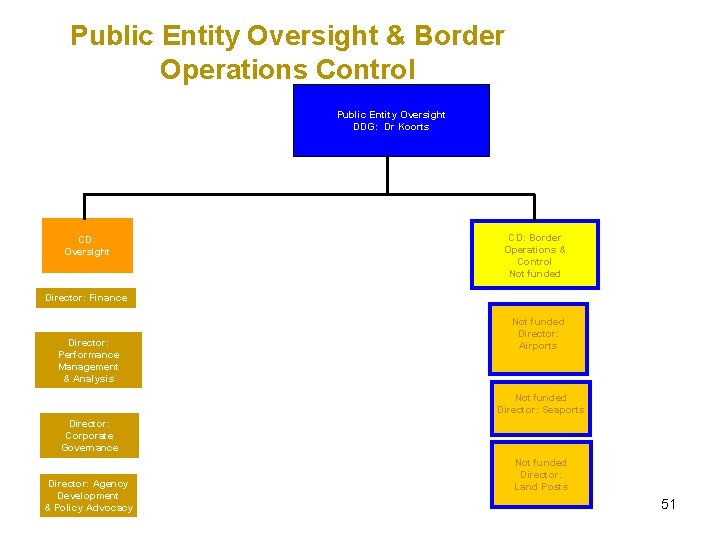
Public Entity Oversight & Border Operations Control Public Entity Oversight DDG: Dr Koorts CD: Oversight CD: Border Operations & Control Not funded Director: Finance Director: Performance Management & Analysis Not funded Director: Airports Not funded Director: Seaports Director: Corporate Governance Director: Agency Development & Policy Advocacy Not funded Director: Land Posts 51
Branch: Public Entity Oversight and Border Operations Control Purpose: • To develop appropriate mandates and monitoring mechanisms for public entities, develop and implement transport economic regulation and manage logistic border operations and control. Overall Functions: • Develop appropriate mandates and monitoring mechanisms for public entities; • Manage logistic border operations and control; and • Provide general administrative and stakeholder management services to the department. 52

Branch: Public Entity Oversight and Border Operations Control This branch consists of the following main sub-branches: • Public Entity Oversight • Border Operations and Control 53

Branch: Public Entity Oversight and Border Operations Control Purpose of Public Entity Oversight: • To develop appropriate mandates and monitoring mechanisms for public entities Functions: • Evaluate the financial performance of PE; • Manage PE with business development and restructuring; • Manage the corporate governance performance of the agencies against predetermined performance objectives and advising thereon; • Develop monitoring performance measurement frameworks • Develop information management systems for financial and risk management and internal control at public entities 54
Branch: Public Entity Oversight and Border Operations Control Purpose of Border Operations and Control: • To manage freight logistic border operations and control Functions: • Manage the coordination of all transport related activities in all Air and Seaports; • Manage the coordination of all transport related activities at all border posts. 55
Public Entities reporting to Do. T There are currently eleven Public Entities that report to the Minister of Transport: • • • Airports Company South Africa Air Traffic and Navigation Services Cross-Border Road Transport Agency South African Aviation Authority South African Maritime Safety Authority South African National Roads Agency Limited Road Accident Fund Road Traffic Management Corporation Railway Safety Regulator Ports Regulator Passenger Rail Agency of South Africa 56
Performance Areas Gov Finance PM Agency Dev Establish Governance structures Financial Oversight • Assess the financial performance of PEs • Evaluate & monitor annual budget • Evaluate and monitor annual financial statements • Risk management • Assess Annual reports Evaluate Performance Agency & Policy Dev • Appointment of Boards • Monitor Board performance • Annually review mandate of the board • Initiate remedial action where the strategic direction of the entity deviates from the preferred direction • Shareholder Compacts • Performance Agreements • Strategic plans • Quarterly reports • Manage restructuring of PEs • Evaluate performance of PEs in terms of national policies • Contribute to & edit technical content of inputs to Do. T major processes and documents 57
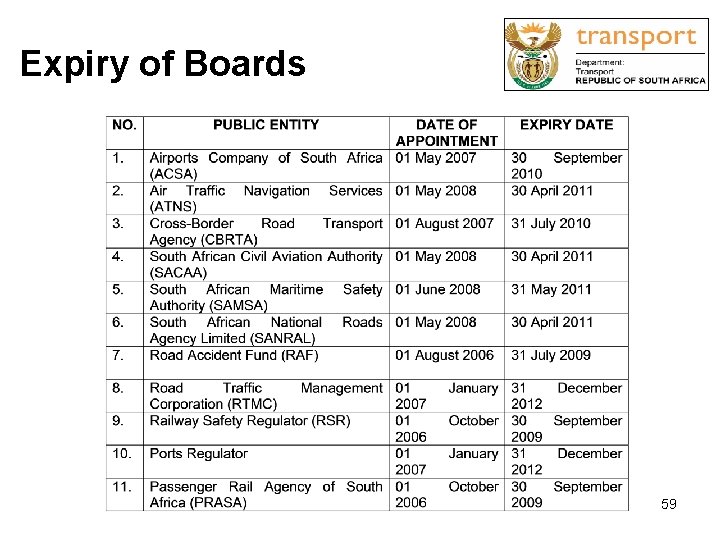
Expiry of Boards – The Road Accident Fund (RAF) Board will expire on 31 July 2009 and an advert was placed in the government gazette and mass media calling for nominations to the Board, with the closing date being 22 May 2009. Sixty three nominations were received and the Minister has approved that the list of nominations be published in the Government Gazette and national media. – The term of the Cross-Border Road Transport Agency (CBRTA) Board is for a period of three years and officially expires on 31 July 2010. In terms of section 7 (2)(b) of the Cross Border Transport Act, 1998, one half of the members of the Board, must vacate their offices every 18 months. Therefore 3 members must be retired an advertisement must be placed to invite nominations for these vacancies. A submission has been compiled and sent to the Minister for approval to retire by rotation three Board Members and to place an advertisement in the national media calling for nominations to replace outgoing board members. – A submission is currently being drafted to obtain the Minister’s approval to advertise for nominations to the Boards of the Railway Safety Regulator (RSR) and Passenger Rail Agency of South Africa (PRASA). The expiry dates for both Boards is 58 30 September 2009.
Expiry of Boards 59
Airports Company of South Africa (ACSA) • Regulated i. t. o Airports Company Act (1993), the Companies Act (1973) and listed as schedule 2 public entity i. t. o PFMA (1999) Core functions • Ensure airport capacity • Facilitate movement of passengers and goods 60
Airports Company of South Africa (ACSA) Corporate Governance – Board terms of office : 1 May 07 to 31 April 2010 – Board Chairperson : Dr F Sonn – Managing Director : Ms M Hlahla Key Projects • Completion of critical infrastructure to facilitate 2010 Soccer World Cup • Continuous airport operations efficiency improvements • Business excellence • Focus on efficiency (cost and revenue) • Employee development, succession planning and retention • Optimal capital structure and financing plan (Capex of R 22 billion over 5 yrs) • Long term business sustainability 61
Air Traffic Navigation Systems • Listed as a schedule 2 public entity i. t. o PFMA, and established i. t. o Air Traffic Navigations Services Act (1993) Core Mandate • Provision of safe, orderly expeditious and efficient air traffic and navigational and associated services. 62
Air Traffic Navigation Systems Corporate Governance • Board term : May 08 to May 2011 • Board Chairperson : Captain M Mamashela • CEO : Mr P. Dlamini Key Projects • The entity’s safety events is targeted at 2. 5 incidents per 100 000 movements. • The ATNS will complete the development of a new high frequency transmitter site, the installation and commissioning of the George radar, and the advance surface movement guidance and control system at both the OR Tambo and Cape Town International Airports. • Due to lower than expected air traffic movements in 2008/09, which has resulted in lower revenues, 2009/10 tariffs were increased by 11. 3%. This increase included a correction factor of 6. 5%. • The ATNS’s revenue is expected to increase significantly to R 1, 2 billion in 2010/11 from R 610 million in 2008/09, due to the 2010 Soccer World Cup 63
Cross Border Roads Transport Agency (C-BRTA) • statutory juristic entity established i. t. o. Cross-Border Road Transport Agency Act (1998) Core Mandate • To improve the flow of freight and passengers in the region • To introduce regulated competition in cross-border road transport • To reduce operational constraints for the cross-border road transport industry • To improve and strengthen the capacity of the public sector in support of its strategic planning, enabling and monitoring functions • To empower the cross border road transport industry to maximise business opportunities 64
Cross Border Roads Transport Agency (C-BRTA) Corporate Governance • Board term : August 07 to July 2010 • Board Chairperson : Mr G Phalafala • CEO : Mr S. Kgomo (Acting) Key Projects • Achieve full Corporate Governance, Controls and Compliance; • Sustain Good Financial Performance; • Turn the Agency Around into a Sustainable Business; • Establish a sound knowledge management system; • Review Information Systems to ensure efficient support of the Agency’s operational goals; • Introduce/encourage a Performance Driven Culture 65
South African Civil Aviation Authority (SACAA) • Established i. t. o South African Civil Aviation Act (1998) Core Mandate • Control and regulate civil aviation in South Africa • Oversee aviation safety and security in the aviation industry 66
South African Civil Aviation Authority (SACAA) Corporate Governance • Board term: May 08 to April 2011 • Board Chairperson : Ms N Msomi • CEO : Captain C Jordaan Key Projects • Developing scarce skills, such as piloting skills, in cooperation with the Department of Transport and other stakeholders; • Lowering the accident rate by identifying the causes of accidents; • Intensifying the oversight function; • Enforcing consistent actions against non-compliant operators and promoting a culture of voluntary compliance; • Improving joint oversight in the SADC region; and • Ensuring that the ageing aircraft operating in the country are airworthy. 67
South African Maritime Safety Authority (SAMSA) • Established under the South African Maritime Safety Authority Act (1998) Core Mandate • Ensure safety of life and property at sea • Prevent and combat pollution from ships • Promote South Africa’s maritime interests • Administer maritime related statutes such as ship registration, sea-farer training and certification • Coordinate maritime search and rescue operations 68
South African Maritime Safety Authority (SAMSA) Corporate Governance • Board terms of office : 1 June 08 to 31 May 2011 • Board Chairperson : Mr M Siko • CEO : Mr T Mokhele Key Projects • The implementation of the expanded regional Search & Research programmethrough the Maritime Rescue Co-ordinating Centre (MRCC). This is besides continuation of the domestic search and rescue mandate. • Implementation of the Small Vessels and Inland Waterways regulations. SAMSA is the delegated Small Vessels Authority now charged with all regulations as they affect boating in all inland dams and waterways. • Delivering on the IMO’s Safety of Life at Sea amendment Regulations on Long Range Identification and Tracking (LRIT). SAMSA, as the appointed authority on LRIT is required to both implement and operate the system. This will be done through the instrument of Port State Control. • The development of the National Maritime Skills Plan and the implementation of such plan. As a maritime nation South Africa requires a pool of skills commensurate with its position as a maritime nation. • The development of South Africa as an International Maritime Centre. This will be delivered through the cluster approach and whose key purpose is the development and positioning of the nation’s maritime economy. • The Western Indian Ocean Marine Highway Project (a World Bank and GEF sponsored project). 69
Rail Safety Regulator (RSR) • Established i. t. o National Railway Safety Regulator Act (2002) Core Mandate • Oversee and promote safety in railway transport through appropriate support, monitoring and enforcement, guided by enabling regulatory framework • Ensure improved safety performance by operators theough development of railway safety standards • Conduct safety audits and inspections • Conduct occurrence investigations and ensure corrective actions are put in place to prevent recurrence of railway occurrences 70
Rail Safety Regulator (RSR) Corporate Governance • Board terms of office : 1 October 06 to September 09 • Board Chairperson : Mr C Ntuli • CEO : Mr M. Mosengwa Key Projects • Undertaking of targeted technical audits on both Transnet Freight Rail (TFR) and Passenger Rail Agency of South Africa (PRASA) focussing on Infrastructure Integrity, train control systems, rolling stock and interface management. • Oversee the integration of safety requirements on dedicated passenger routes for the 2010 FIFA World Cup • Oversee the safety compliance of the Gautrain Rapid Rail Project throughout the project life cycle and ongoing reviews, assessment and acceptance of the proposed Gautrain standards. • Monitor and evaluate railway safety performance through the development of the annual state of safety report. • Strengthen the compliance enforcement capacity of the RSR through the development and eventual implementation of the penalty system. 71
Road Traffic Management Cooperation (RTMC) • Established i. t. o. section 3 of Road Traffic Management Corporation Act (1999) Core Mandate • Eliminate fragmentation of responsibilities regarding all aspects of road traffic management across various levels of government • Provide co-operative and coordinated strategic planning, regulation, facilitation and law enforcement in respect of road traffic matters by all levels of government 72
Road Traffic Management Cooperation (RTMC) Corporate Governance • Board term : January 07 to November 2010 • Board Chairperson : Dr J D Sampson • CEO : Mr R. Rakgoale Key Projects • Ensure inter-agency co-operation & co-ordination of enforcement operations in all prioritized (hazardous) routes with focused quick wins operations by 2012 • Develop, legislate and implement the National Traffic Law Enforcement Code (NRTLEC) by 2012 • Provision of high tech traffic law enforcement equipment for greater impact by 2012 • Develop and implement an Integrated Governance structure for Road Traffic Management by 2012 • Develop and implement specialized training courses in all Traffic training institutions by 2012 • Improve the collection, management and use of data on road deaths and injuries so as to formulate evidence-based policies by 2012 • Implement an effective & expeditious adjudication of traffic offences 73 • Implement an effective Points Demerit System
Ports Regulator • Established i. t. o National Ports Act (2005) Core Mandate • Economic regulations of the ports system • Promote equity access to ports and their facilities and services • Monitor the activities of the Transnet National Ports Authority • Process complaints against the Transnet National Ports Authority’s activities 74
Ports Regulator Corporate Governance • Board term : January 07 to December 2010 • Board Chairperson : Ms G. Serobe • CEO : Mr R Khan Key Projects • Industry performance and compliance monitoring will form a large part of the activities of the Regulator • The Ports Regulators key objectives are the achievement of functional administration and capacitation of the organisation to deliver the services that form the key mandate of the Regulator. • Over the MTEF period the Regulator will focus on establishing appropriate regulatory architecture, staff and systems for the port industry and provide services as mandated in the National and Ports Act (2005). • The main subsets of the regulatory architecture will be the regulator’s quasi-judicial regulatory functions and its mandated institutional reform support function. 75
South African National Road Agency Limited (SANRAL) • Established as a public company in South Africa i. t. o the Companies Act (1973) and is listed as a national public entity in schedule 3 A of the PFMA (1999) Core Mandate • Finance, manage, control, plan, develop, maintain and rehabilitate the National Road Network through the National Roads Act (1998) • Responsible for the existing National Road Network of 16 170 km • Incorporation of relevant provincial road, to bring the total network to 20 000 km by 2011 76
South African National Road Agency Limited (SANRAL) Corporate Governance • Board term : May 08 to April 2011 • Board Chairperson : Mr L. Ndhlovu • CEO : Mr N Alli Key Projects • Incidents Management Systems through appropriate technology • Toll Road Developments • Research and Development 77
Passenger Rail Agency of South Africa (PRASA) • Established under the Legal Succession to South African Transport Services Act (1989) as amended in December 2008 • incorporates the operations and assets of the South African Rail Commuter Corporation (SARCC), Metrorail, Intersite Property Management Services (Pty) Ltd, Shosholoza Meyl and Autopax Core Mandate • Deliver efficient, high-quality and affordable transport services on a sustainable basis 78
Passenger Rail Agency of South Africa (PRASA) Corporate Governance • Board term : October 06 to September 09 • Board Chairperson : Mr S Buthelezi • CEO : Mr L Montana Key Projects • Service Excellence within Metrorail, Shosholoza Meyl and Autopax • Property and Asset Development, and • Technology Upgrade or Modernization of its key transport systems 79
Road Accident Fund (RAF) • Established by the Road Accident Fund Act (1996) Core Mandate • Provide indemnity cover for all road users within the borders of South Africa • Compensate road accident victims for personal injury claims arising from the negligent actions of another driver 80
Road Accident Fund (RAF) Corporate Governance • Board term: August 06 to July 09 • Board Chairperson : Mr V Mahlangu • CEO : Mr J Modise Key Projects • Transforming the RAF into a world-class organization by modernising its systems and processes • Building a sustainable economic model and system of motor vehicle accident compensation for South Africa; • Ensuring the system is appropriately capitalized and funded on a regular basis. • Manage stakeholder relations, in particular relations with victims, government, legal representatives and service providers, in a manner that is driven by a risk management culture. 81

BUDGET 82
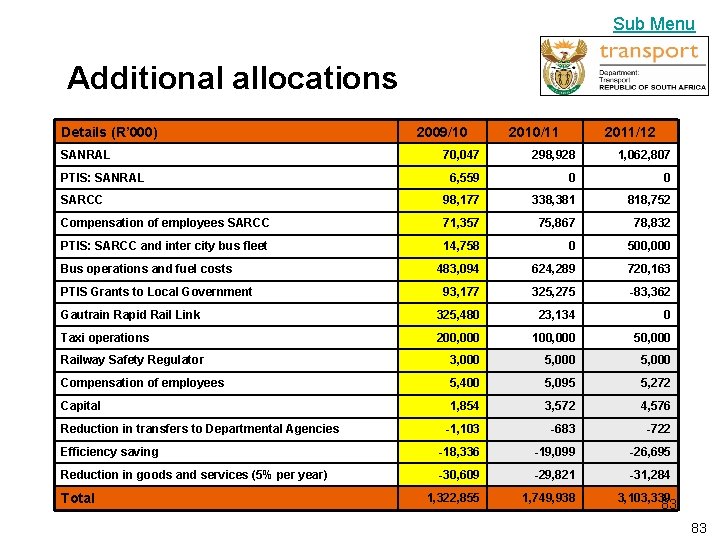
Sub Menu Additional allocations Details (R’ 000) SANRAL 2009/10 2010/11 2011/12 70, 047 298, 928 1, 062, 807 6, 559 0 0 SARCC 98, 177 338, 381 818, 752 Compensation of employees SARCC 71, 357 75, 867 78, 832 PTIS: SARCC and inter city bus fleet 14, 758 0 500, 000 483, 094 624, 289 720, 163 93, 177 325, 275 -83, 362 Gautrain Rapid Rail Link 325, 480 23, 134 0 Taxi operations 200, 000 100, 000 50, 000 Railway Safety Regulator 3, 000 5, 000 Compensation of employees 5, 400 5, 095 5, 272 Capital 1, 854 3, 572 4, 576 -1, 103 -683 -722 Efficiency saving -18, 336 -19, 099 -26, 695 Reduction in goods and services (5% per year) -30, 609 -29, 821 -31, 284 1, 322, 855 1, 749, 938 3, 103, 339 PTIS: SANRAL Bus operations and fuel costs PTIS Grants to Local Government Reduction in transfers to Departmental Agencies Total 83 83
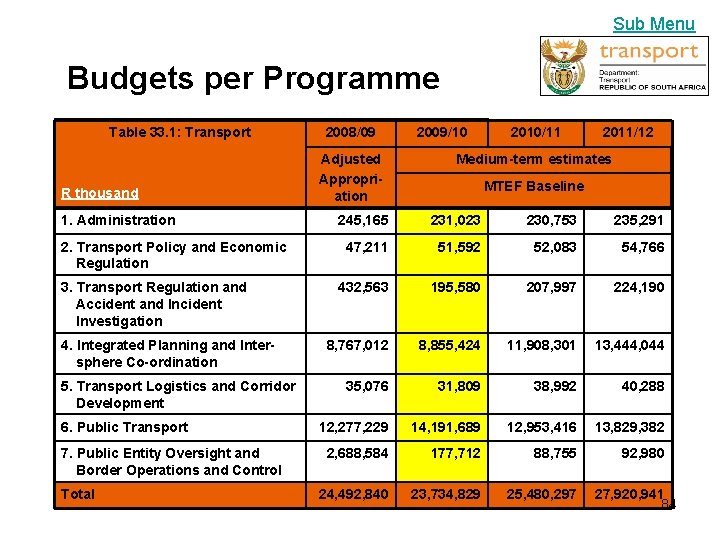
Sub Menu Budgets per Programme Table 33. 1: Transport R thousand 1. Administration 2. Transport Policy and Economic Regulation 3. Transport Regulation and Accident and Incident Investigation 4. Integrated Planning and Intersphere Co-ordination 5. Transport Logistics and Corridor Development 6. Public Transport 7. Public Entity Oversight and Border Operations and Control Total 2008/09 Adjusted Appropriation 2009/10 2010/11 2011/12 Medium-term estimates MTEF Baseline 245, 165 231, 023 230, 753 235, 291 47, 211 51, 592 52, 083 54, 766 432, 563 195, 580 207, 997 224, 190 8, 767, 012 8, 855, 424 11, 908, 301 13, 444, 044 35, 076 31, 809 38, 992 40, 288 12, 277, 229 14, 191, 689 12, 953, 416 13, 829, 382 2, 688, 584 177, 712 88, 755 92, 980 24, 492, 840 23, 734, 829 25, 480, 297 27, 920, 941 84
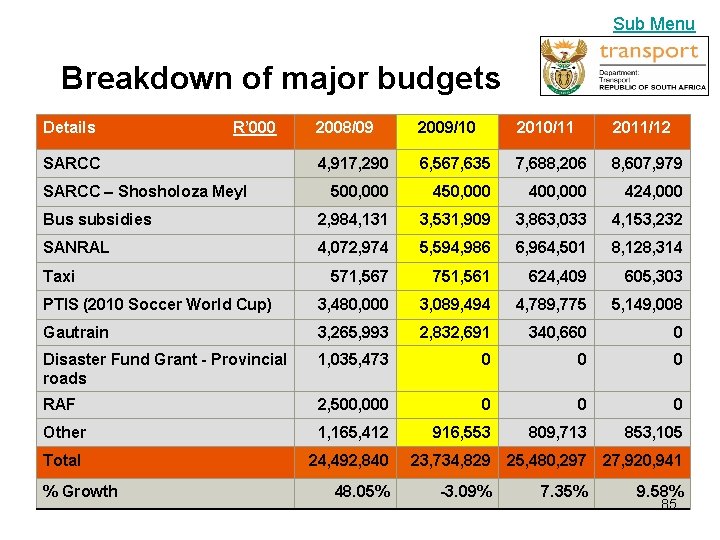
Sub Menu Breakdown of major budgets Details R’ 000 2008/09 2009/10 2010/11 2011/12 4, 917, 290 6, 567, 635 7, 688, 206 8, 607, 979 500, 000 450, 000 400, 000 424, 000 Bus subsidies 2, 984, 131 3, 531, 909 3, 863, 033 4, 153, 232 SANRAL 4, 072, 974 5, 594, 986 6, 964, 501 8, 128, 314 571, 567 751, 561 624, 409 605, 303 PTIS (2010 Soccer World Cup) 3, 480, 000 3, 089, 494 4, 789, 775 5, 149, 008 Gautrain 3, 265, 993 2, 832, 691 340, 660 0 Disaster Fund Grant - Provincial roads 1, 035, 473 0 0 0 RAF 2, 500, 000 0 Other 1, 165, 412 916, 553 809, 713 853, 105 Total 24, 492, 840 SARCC – Shosholoza Meyl Taxi % Growth 48. 05% 23, 734, 829 25, 480, 297 27, 920, 941 -3. 09% 7. 35% 9. 58% 85
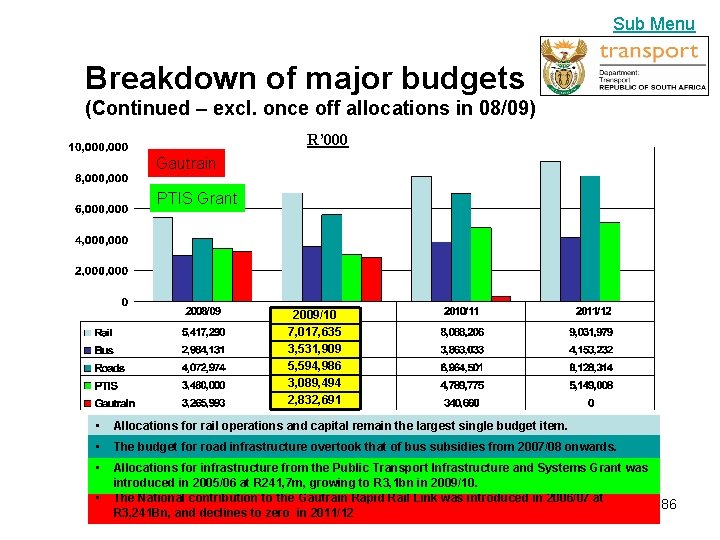
Sub Menu Breakdown of major budgets (Continued – excl. once off allocations in 08/09) R’ 000 Gautrain PTIS Grant 2009/10 7, 017, 635 3, 531, 909 5, 594, 986 3, 089, 494 2, 832, 691 • Allocations for rail operations and capital remain the largest single budget item. • The budget for road infrastructure overtook that of bus subsidies from 2007/08 onwards. • Allocations for infrastructure from the Public Transport Infrastructure and Systems Grant was introduced in 2005/06 at R 241, 7 m, growing to R 3, 1 bn in 2009/10. The National contribution to the Gautrain Rapid Rail Link was introduced in 2006/07 at R 3, 241 Bn, and declines to zero in 2011/12 • 86
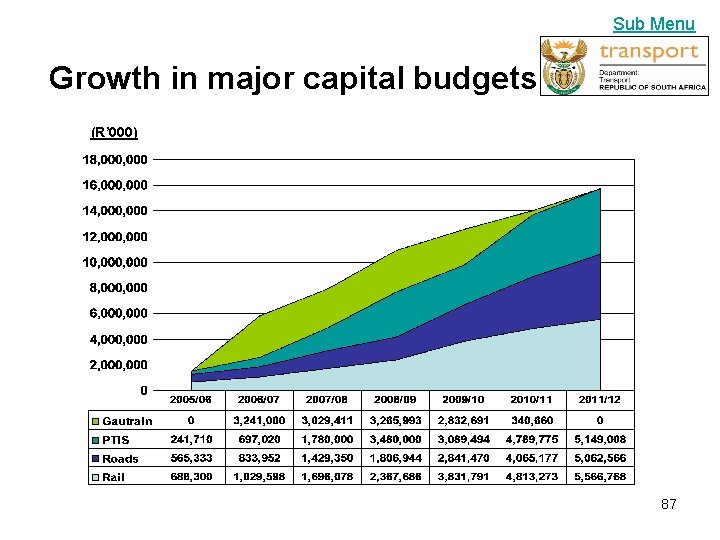
Sub Menu Growth in major capital budgets (R’ 000) 87
Performance Highlights 2008 -09 88
Performance Highlights 2008 -09 • Draft documents for the following policies have been developed and are awaiting Cabinet approval: – National Maritime Transport Policy: Awaiting the Minister’s approval for submission – National Scholar Transport Policy: Awaiting meeting between the department and the Department of Education – The department’s Executive Committee approved the Transport Research and Innovation Strategy • A Draft Rail Economic Regulator Bill was developed to provide a legislative framework for the Rail Economic Regulator • The National Airports Development Policy document has been completed and is in consultation • A Rural Transport Services and Infrastructure Grant Framework was concluded with National Treasury • As part of the 10 year Shova Kalula rollout operation plan, 23 200 bicycles have been distributed to provinces • Completed phase 1 of the Rural Transport Mapping Project for South Africa 89
Performance Highlights 2008 -09 • Scrapped 9 068 500 taxis • Refurbished 709 Commuter rail coaches • Completed National Freight Monitoring Framework • TRP Policy and Regulatory Framework for the Taxi Industry approved by Cabinet February 2009 • Strategy for the legalisation of semi legal taxi operators and Turn Around Strategy for OLBs approved by Cabinet February 2009 • A 4 th draft accessible PT Strategy and 2 nd draft Implementation Plan has been finalised • Published Electronic Fare Collection Regulation for comment • Taxi Subsidy Framework approved by Cabinet for consultation with National Treasury and Industry • Integration of the Gautrain Rapid Rail Link included rail plan alignment, physical integration, and integrated ticketing 90

Thank You 91
- Slides: 91