
Department of the Air Force Integrity Service Excellence
- Slides: 28
Department of the Air Force Integrity - Service - Excellence AFCP 101: An Overview of the Air Force Community Partnership Program Teran Judd Director 1
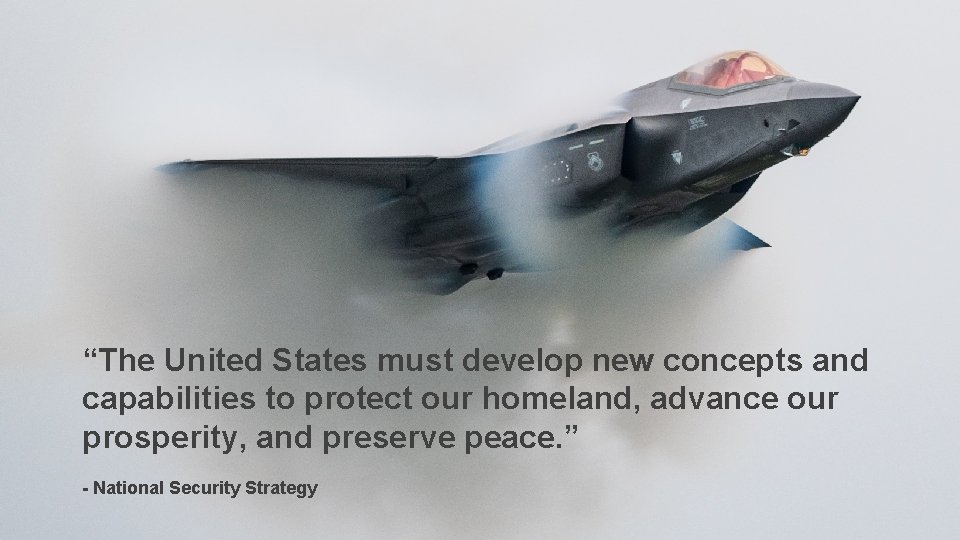
“The United States must develop new concepts and capabilities to protect our homeland, advance our prosperity, and preserve peace. ” - National Security Strategy Integrity - Service - Excellence
Why am I sitting in a briefing about partnerships? A vital pillar of our National Security Strategy consists of renewing America’s competitive military advantage: “The United States must develop new concepts and capabilities to protect our homeland, advance our prosperity, and preserve peace. ” National Security Strategy, page 26. Integrity - Service - Excellence
Stemming from this need, the National Defense Strategy mandates that we: - Rebuild military readiness while building a more lethal joint force - Strengthen alliances as we attract new partners - Reform department’s business practices for improved performance and affordability The following briefing will explain how partnerships further the US Air Force’s objective to fly, fight, and win. Integrity - Service - Excellence
Table of Contents n Your Mission n Base POC Best Practices n AFCP Purpose and Value n Common Partnerships n Partnership Impact on Mission n Common Partnership Tools n Working with AFCP n Intergovernmental Support n Program Updates n Agreements Importance of a Base POC n AFCP Program Performance n Contact Us Integrity - Service - Excellence 5
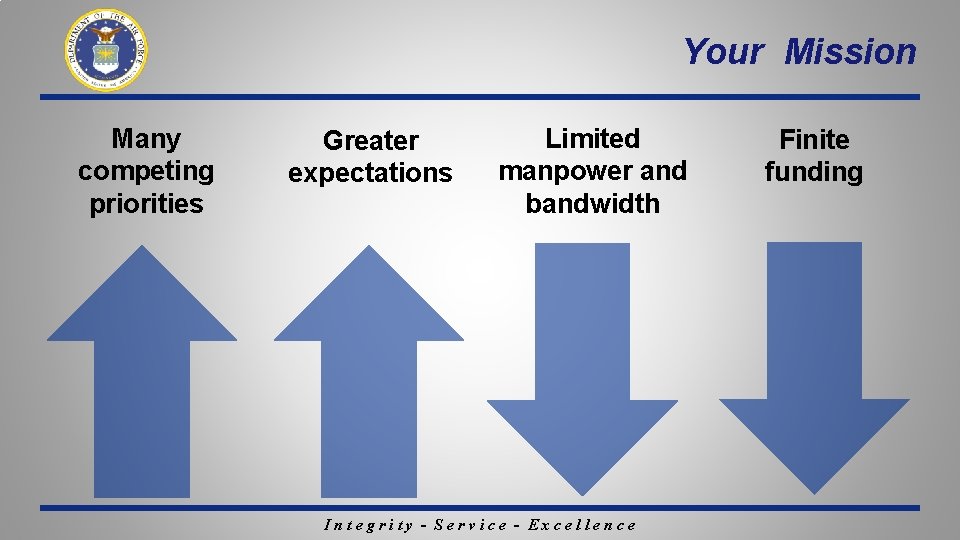
Your Mission Many competing priorities Greater expectations Limited manpower and bandwidth Integrity - Service - Excellence Finite funding
Your Mission We understand that you, as installation leaders, have many pressing, competing priorities. The Air Force continuously adds new missions to our portfolio, while expecting more out of existing missions. This increases competition for finite resources across the Air Force (and the entire DOD). This briefing will explain how a well-run partnership program acts as a forcemultiplier, expanding your capacity and making resources like manpower and money go farther. Integrity - Service - Excellence
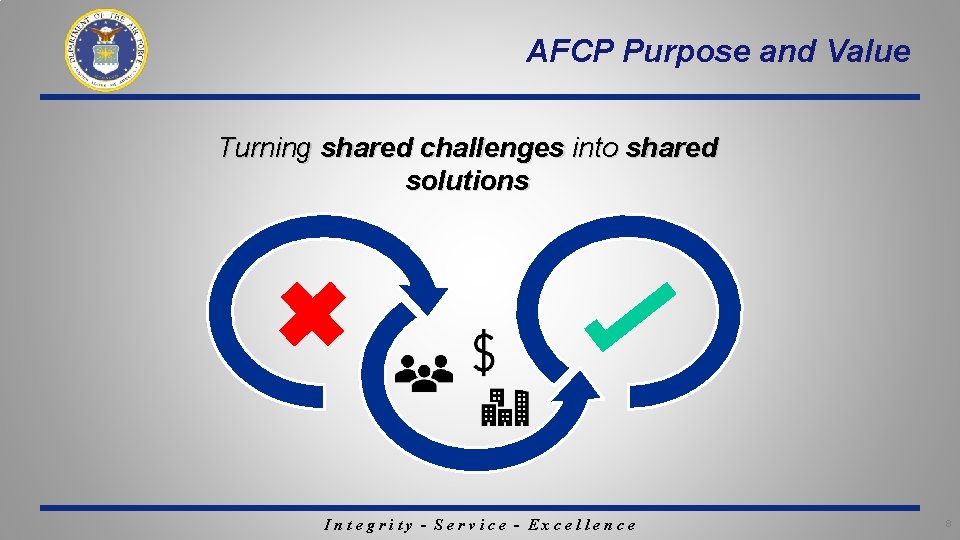
AFCP Purpose and Value Turning shared challenges into shared solutions Integrity - Service - Excellence 8
AFCP Purpose and Value How can partnerships help you thrive in this environment? By recognizing that installations and the communities they call home share many similar challenges; subsequently, joining forces can lead to mutually-beneficial solutions. But you’re not in this alone: The Air Force Community Partnership (AFCP) Program is here to empower installation and community leaders to pursue these mutually-valuable collaborations. Integrity - Service - Excellence 9
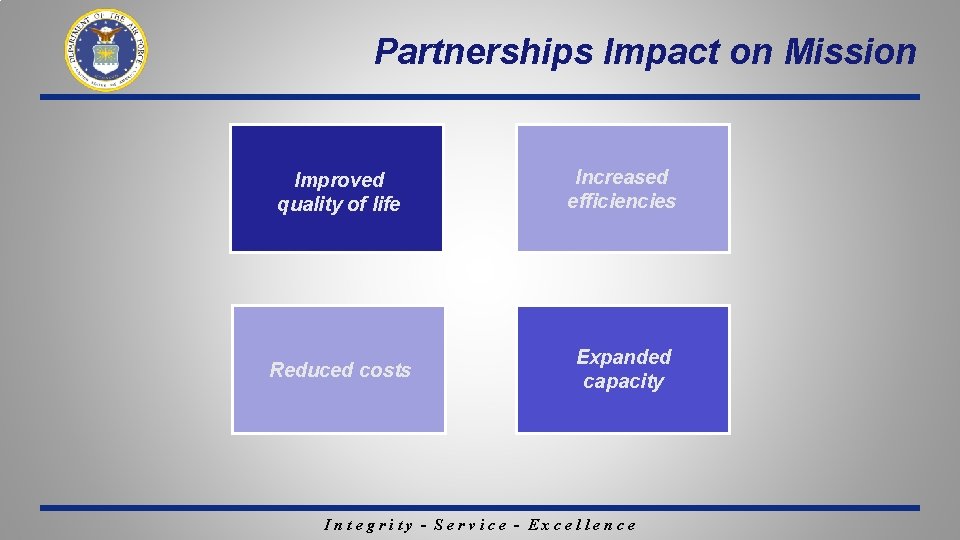
Partnerships Impact on Mission Improved quality of life Increased efficiencies Reduced costs Expanded capacity Integrity - Service - Excellence
Partnerships Impact on Mission Can partnerships actually help me accomplish my mission, rather than acting as a distraction from my mission? A proper partnership program ties collaborations directly to mission needs. Subsequently, partnerships can further the following goals: - Improved quality of life: By increasing the quantity and quality of training and education opportunities, access to recreation and entertainment options, employment opportunities, etc. , partnerships can substantially improve quality of life for Airmen and their families. Integrity - Service - Excellence
Partnerships Impact on Mission - Reduced costs and increased efficiencies: By harnessing economies of scale, eliminating duplicative efforts, taking advantage of outside expertise, etc. , partnerships enable increased efficiencies and reduced costs, thus allowing leaders to act as responsible stewards of government resources. - Expanded capacity: By cross-pollinating intellectual capital, pooling capabilities, and finding efficiencies, collaboration increases an installation’s capacity to execute their mission. Integrity - Service - Excellence
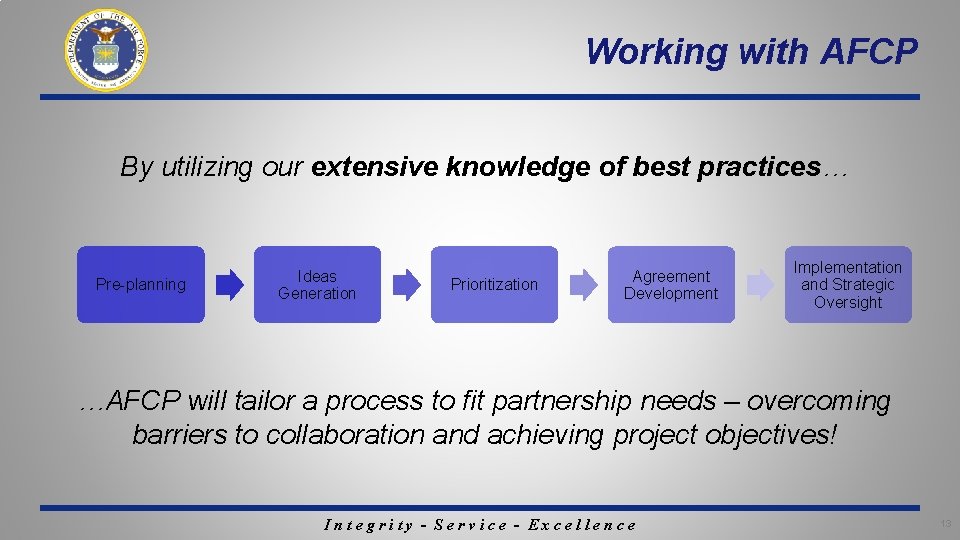
Working with AFCP By utilizing our extensive knowledge of best practices… Pre-planning Ideas Generation Prioritization Agreement Development Implementation and Strategic Oversight …AFCP will tailor a process to fit partnership needs – overcoming barriers to collaboration and achieving project objectives! Integrity - Service - Excellence 13
Working with AFCP Yes, working with the community can be challenging – and that’s why we’re here! AFCP has a structured process for: Identifying requirements Liaising with collaborators Determining COA Troubleshooting legal and policy obstacles Executing COA and maintaining partner relationship We stand ready to tailor our process to meet your needs and maximize benefits. Integrity - Service - Excellence 14
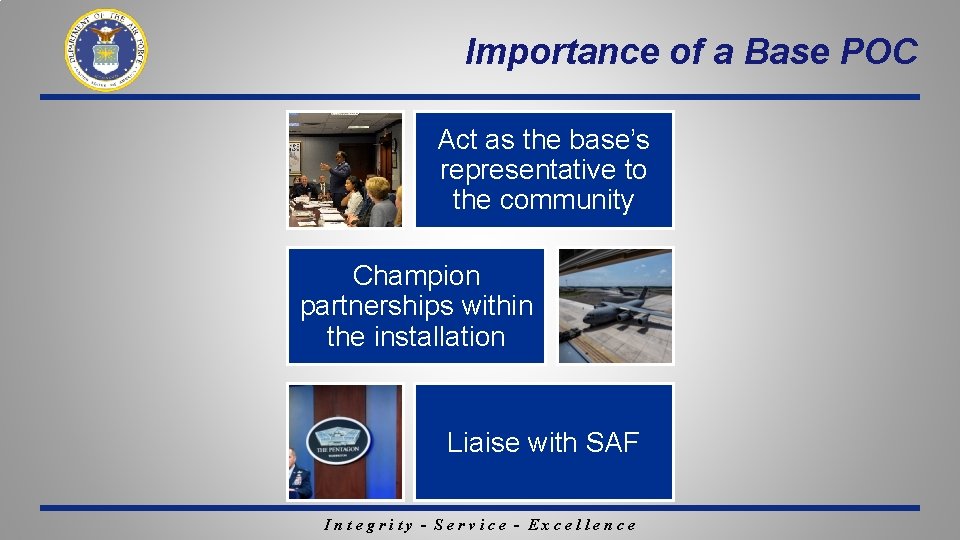
Importance of a Base POC Act as the base’s representative to the community Champion partnerships within the installation Liaise with SAF Integrity - Service - Excellence
Designate a Base POC Designating a base points of contact (POC) is, in many respects, a prerequisite to a successful partnership program. Having a partnership point person goes a long way in mitigating the obstacles that act as barriers to partnerships by ensuring someone: - Provides continuity and develops long-term relationships - Coordinates cooperation across the installation’s functional areas - Learns and utilizes resources from AFCP - Knows when to ask to help Integrity - Service - Excellence
Designate a Base POCs are the partnership champions to three important audiences: - They champion partnerships within the installation, engaging with base leadership and with SMEs across the base’s functional areas - They are the community’s primary representative, acting as the face of the base - They liaise with SAF, acting as the installation’s representative, as well as implementing the AFCP process within their own partnership program Integrity - Service - Excellence
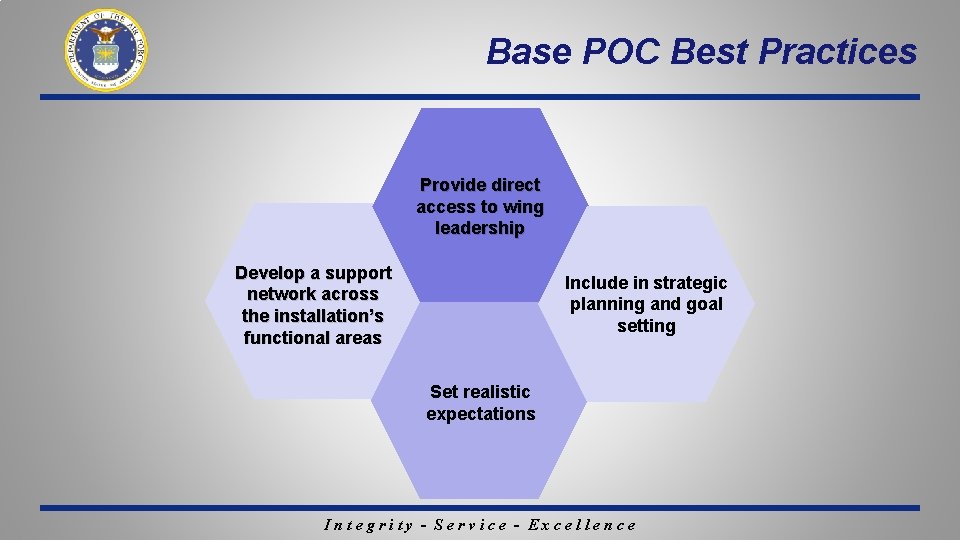
Base POC Best Practices Provide direct access to wing leadership Develop a support network across the installation’s functional areas Include in strategic planning and goal setting Set realistic expectations Integrity - Service - Excellence
Base POC Best Practices Set your program and your base POC up for success by following these best practices - Acknowledge the limitations of your base POC – and the limitations of base and community leaders, and others involved – by setting realistic expectations about what can be accomplished, and by when - Empower your base POC by providing them with direct access to wing leadership. This enables a productive two-way flow of information, ensuring that partnerships are in line with leadership objectives and leaders are up-to-date on partnerships. - Develop a supportive network across installation functional areas Integrity - Service - Excellence
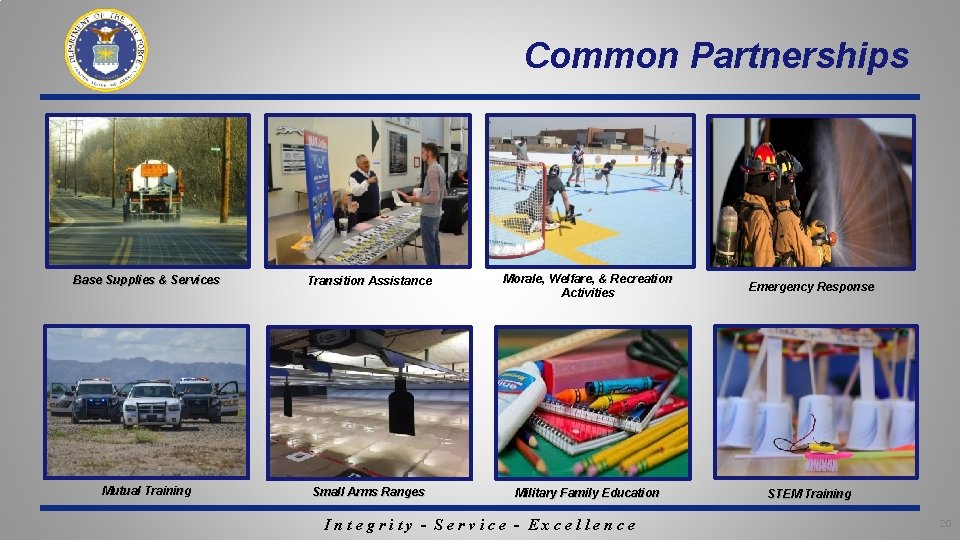
Common Partnerships Base Supplies & Services Transition Assistance Morale, Welfare, & Recreation Activities Emergency Response Mutual Training Small Arms Ranges Military Family Education STEM Training Integrity - Service - Excellence 20
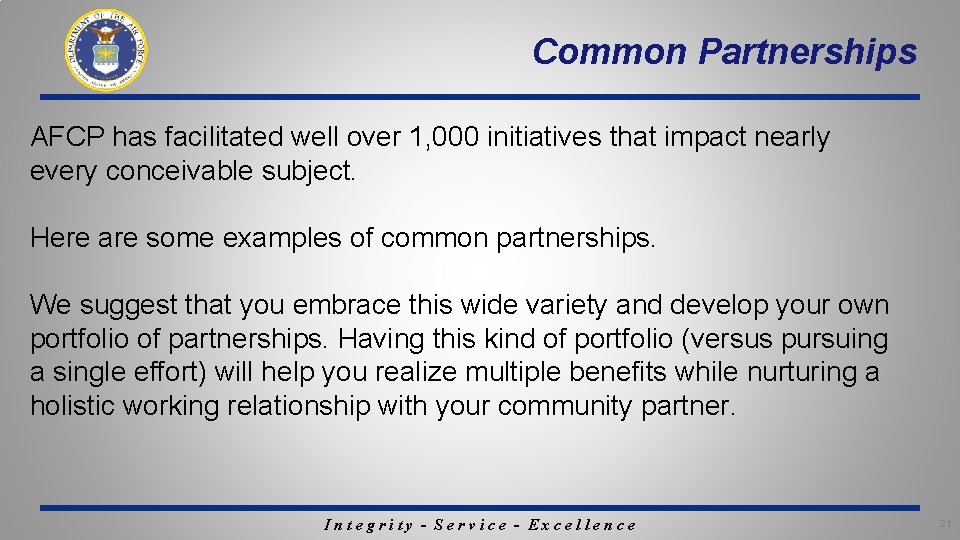
Common Partnerships AFCP has facilitated well over 1, 000 initiatives that impact nearly every conceivable subject. Here are some examples of common partnerships. We suggest that you embrace this wide variety and develop your own portfolio of partnerships. Having this kind of portfolio (versus pursuing a single effort) will help you realize multiple benefits while nurturing a holistic working relationship with your community partner. Integrity - Service - Excellence 21
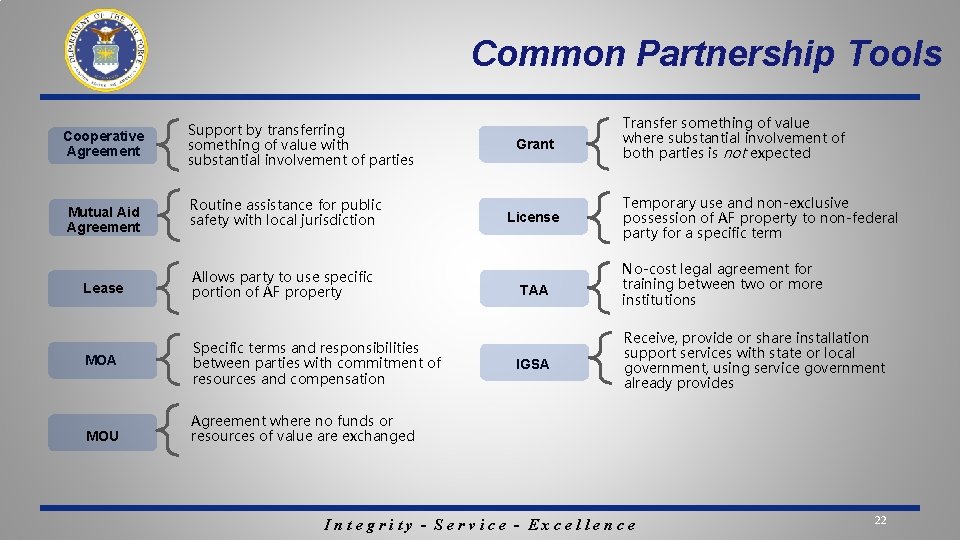
Common Partnership Tools Cooperative Agreement Support by transferring something of value with substantial involvement of parties Mutual Aid Agreement Routine assistance for public safety with local jurisdiction Lease Allows party to use specific portion of AF property MOA Specific terms and responsibilities between parties with commitment of resources and compensation MOU Grant License TAA IGSA Transfer something of value where substantial involvement of both parties is not expected Temporary use and non-exclusive possession of AF property to non-federal party for a specific term No-cost legal agreement for training between two or more institutions Receive, provide or share installation support services with state or local government, using service government already provides Agreement where no funds or resources of value are exchanged Integrity - Service - Excellence 22
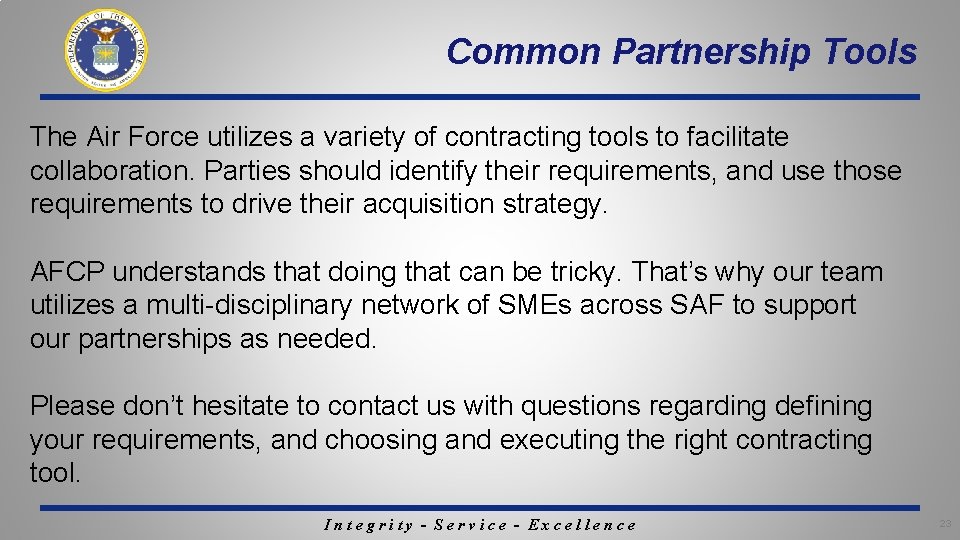
Common Partnership Tools The Air Force utilizes a variety of contracting tools to facilitate collaboration. Parties should identify their requirements, and use those requirements to drive their acquisition strategy. AFCP understands that doing that can be tricky. That’s why our team utilizes a multi-disciplinary network of SMEs across SAF to support our partnerships as needed. Please don’t hesitate to contact us with questions regarding defining your requirements, and choosing and executing the right contracting tool. Integrity - Service - Excellence 23
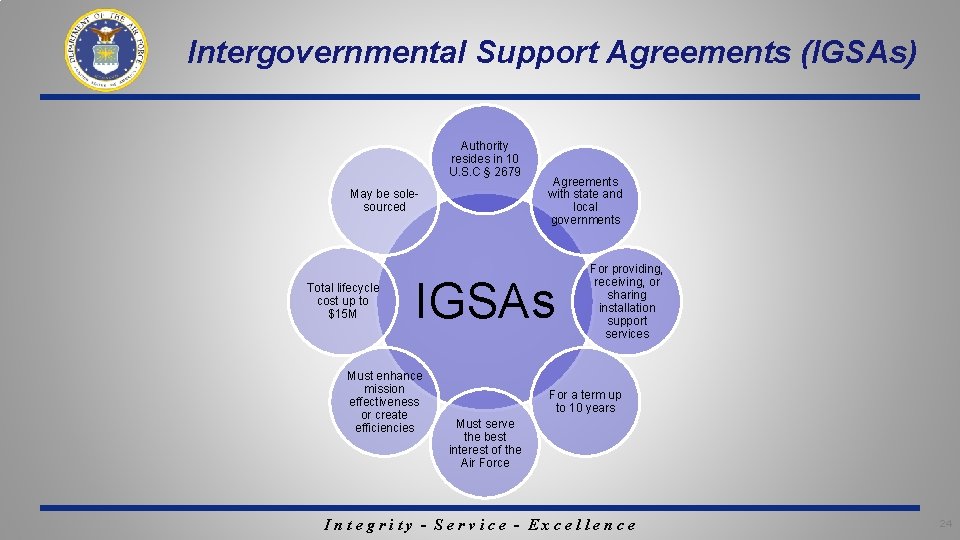
Intergovernmental Support Agreements (IGSAs) Authority resides in 10 U. S. C § 2679 May be solesourced Total lifecycle cost up to $15 M Agreements with state and local governments IGSAs Must enhance mission effectiveness or create efficiencies For providing, receiving, or sharing installation support services For a term up to 10 years Must serve the best interest of the Air Force Integrity - Service - Excellence 24
Intergovernmental Support Agreements (IGSAs) AFCP has been charged with the responsibility of overseeing the use of Intergovernmental Support Agreements (IGSAs) Authority resides in 10 U. S. C § 2679 Relatively new vehicle available that can help supplement the array of tools already available to an installation The Service Secretaries can enter into IGSAs with State and local governments to provide, receive or share installation support services Entity must already provide the service for its own use Ability to sole-source Not exceed a term of up to ten years May use wage grades normally paid by the State or local government Integrity - Service - Excellence 25
Intergovernmental Support Agreements (IGSAs) The Secretary must determine that an IGSA will: Serve the best interests of the Air Force Enhance mission effectiveness, or create efficiencies or economies of scale, including by reducing costs SAF/IEI deleted approval authority to Installation Commanders for IGSA that have a term of less than 10 years and a total cost of less than $15 M Integrity - Service - Excellence 26
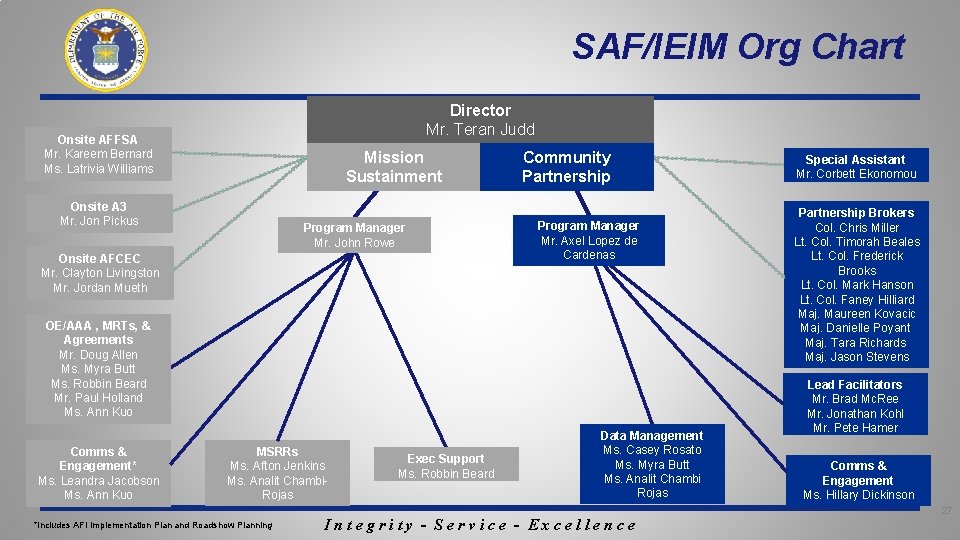
SAF/IEIM Org Chart Director Mr. Teran Judd Onsite AFFSA Mr. Kareem Bernard Ms. Latrivia Williams Mission Sustainment Onsite A 3 Mr. Jon Pickus Program Manager Mr. John Rowe Onsite AFCEC Mr. Clayton Livingston Mr. Jordan Mueth Community Partnership Program Manager Mr. Axel Lopez de Cardenas OE/AAA , MRTs, & Agreements Mr. Doug Allen Ms. Myra Butt Ms. Robbin Beard Mr. Paul Holland Ms. Ann Kuo Comms & Engagement* Ms. Leandra Jacobson Ms. Ann Kuo MSRRs Ms. Afton Jenkins Ms. Analit Chambi. Rojas *Includes AFI Implementation Plan and Roadshow Planning Exec Support Ms. Robbin Beard Data Management Ms. Casey Rosato Ms. Myra Butt Ms. Analit Chambi Rojas Integrity - Service - Excellence Special Assistant Mr. Corbett Ekonomou Partnership Brokers Col. Chris Miller Lt. Col. Timorah Beales Lt. Col. Frederick Brooks Lt. Col. Mark Hanson Lt. Col. Faney Hilliard Maj. Maureen Kovacic Maj. Danielle Poyant Maj. Tara Richards Maj. Jason Stevens Lead Facilitators Mr. Brad Mc. Ree Mr. Jonathan Kohl Mr. Pete Hamer Comms & Engagement Ms. Hillary Dickinson 27
SAF/IEIM Org Chart Seeing this organizational chart can help you see for yourself the broad array of staff that stand ready to assist you in your partnership efforts. Furthermore, note that AFCP falls under the same director as Mission Sustainment (formerly Encroachment). There are many synergies between the two offices, which reflect the many areas of overlap between the two programs. Integrity - Service - Excellence 28