
DEPARTMENT OF REHABILITATION SCIENCES NEWSLETTER JANUARYJULY 2020 EDITION
DEPARTMENT OF REHABILITATION SCIENCES NEWSLETTER JANUARY-JULY 2020 EDITION 5. 1 Read Current Newsletter Jan-July 2020
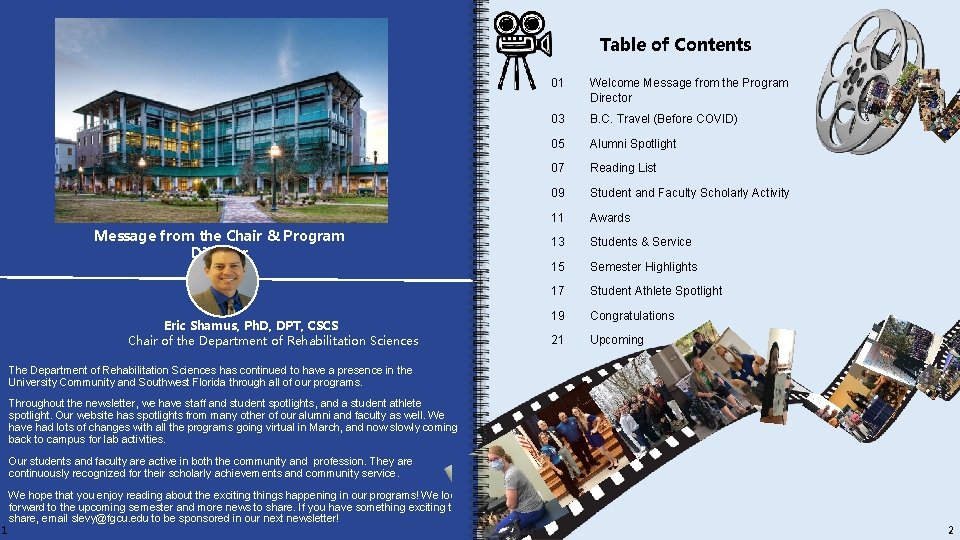
Table of Contents Message from the Chair & Program Director Eric Shamus, Ph. D, DPT, CSCS Chair of the Department of Rehabilitation Sciences 01 Welcome Message from the Program Director 03 B. C. Travel (Before COVID) 05 Alumni Spotlight 07 Reading List 09 Student and Faculty Scholarly Activity 11 Awards 13 Students & Service 15 Semester Highlights 17 Student Athlete Spotlight 19 Congratulations 21 Upcoming The Department of Rehabilitation Sciences has continued to have a presence in the University Community and Southwest Florida through all of our programs. Throughout the newsletter, we have staff and student spotlights, and a student athlete spotlight. Our website has spotlights from many other of our alumni and faculty as well. We have had lots of changes with all the programs going virtual in March, and now slowly coming back to campus for lab activities. Our students and faculty are active in both the community and profession. They are continuously recognized for their scholarly achievements and community service. 1 We hope that you enjoy reading about the exciting things happening in our programs! We look forward to the upcoming semester and more news to share. If you have something exciting to share, email slevy@fgcu. edu to be sponsored in our next newsletter! 2
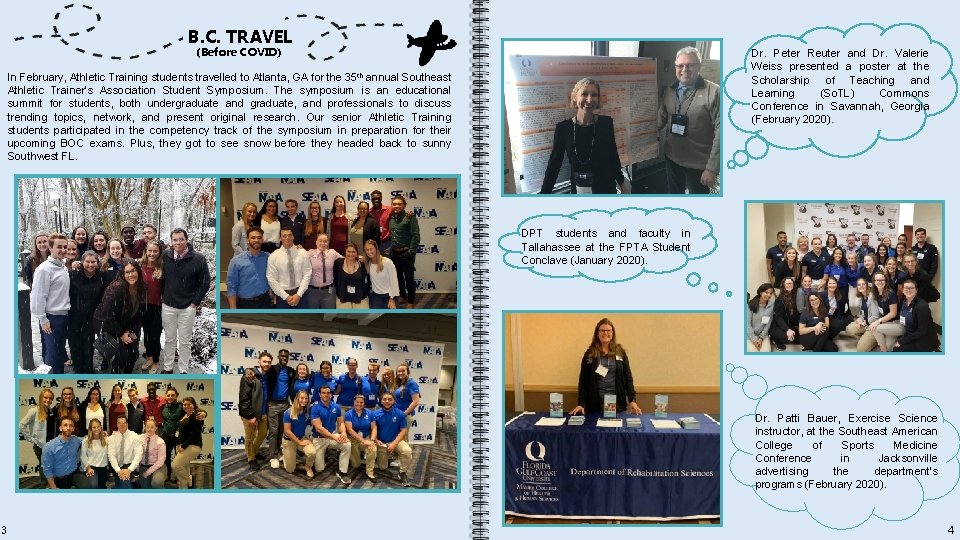
B. C. TRAVEL (Before COVID) Dr. Peter Reuter and Dr. Valerie Weiss presented a poster at the Scholarship of Teaching and Learning (So. TL) Commons Conference in Savannah, Georgia (February 2020). In February, Athletic Training students travelled to Atlanta, GA for the 35 th annual Southeast Athletic Trainer’s Association Student Symposium. The symposium is an educational summit for students, both undergraduate and graduate, and professionals to discuss trending topics, network, and present original research. Our senior Athletic Training students participated in the competency track of the symposium in preparation for their upcoming BOC exams. Plus, they got to see snow before they headed back to sunny Southwest FL. DPT students and faculty in Tallahassee at the FPTA Student Conclave (January 2020). Dr. Patti Bauer, Exercise Science instructor, at the Southeast American College of Sports Medicine Conference in Jacksonville advertising the department’s programs (February 2020). 3 4
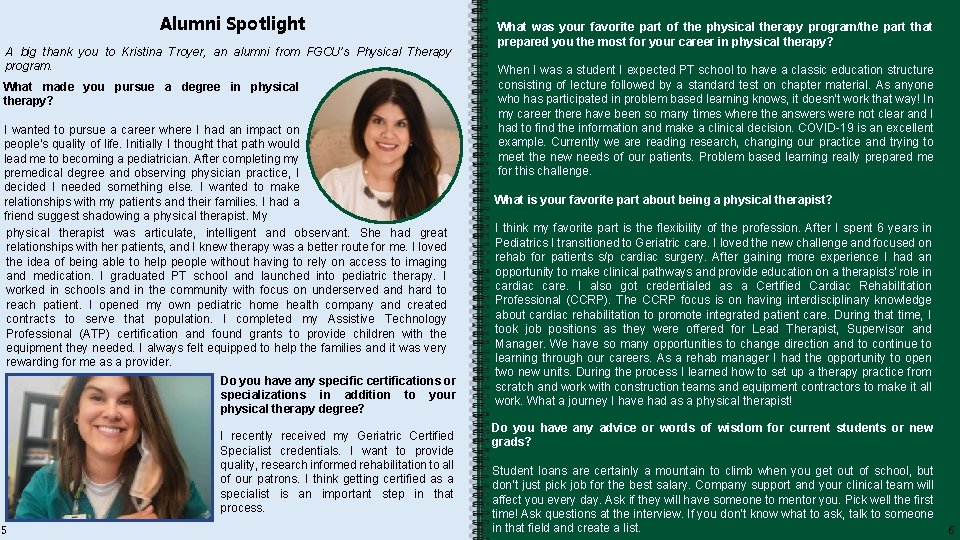
Alumni Spotlight A big thank you to Kristina Troyer, an alumni from FGCU’s Physical Therapy program. What made you pursue a degree in physical therapy? I wanted to pursue a career where I had an impact on people’s quality of life. Initially I thought that path would lead me to becoming a pediatrician. After completing my premedical degree and observing physician practice, I decided I needed something else. I wanted to make relationships with my patients and their families. I had a friend suggest shadowing a physical therapist. My physical therapist was articulate, intelligent and observant. She had great relationships with her patients, and I knew therapy was a better route for me. I loved the idea of being able to help people without having to rely on access to imaging and medication. I graduated PT school and launched into pediatric therapy. I worked in schools and in the community with focus on underserved and hard to reach patient. I opened my own pediatric home health company and created contracts to serve that population. I completed my Assistive Technology Professional (ATP) certification and found grants to provide children with the equipment they needed. I always felt equipped to help the families and it was very rewarding for me as a provider. Do you have any specific certifications or specializations in addition to your physical therapy degree? I recently received my Geriatric Certified Specialist credentials. I want to provide quality, research informed rehabilitation to all of our patrons. I think getting certified as a specialist is an important step in that process. 5 What was your favorite part of the physical therapy program/the part that prepared you the most for your career in physical therapy? When I was a student I expected PT school to have a classic education structure consisting of lecture followed by a standard test on chapter material. As anyone who has participated in problem based learning knows, it doesn’t work that way! In my career there have been so many times where the answers were not clear and I had to find the information and make a clinical decision. COVID-19 is an excellent example. Currently we are reading research, changing our practice and trying to meet the new needs of our patients. Problem based learning really prepared me for this challenge. What is your favorite part about being a physical therapist? I think my favorite part is the flexibility of the profession. After I spent 6 years in Pediatrics I transitioned to Geriatric care. I loved the new challenge and focused on rehab for patients s/p cardiac surgery. After gaining more experience I had an opportunity to make clinical pathways and provide education on a therapists’ role in cardiac care. I also got credentialed as a Certified Cardiac Rehabilitation Professional (CCRP). The CCRP focus is on having interdisciplinary knowledge about cardiac rehabilitation to promote integrated patient care. During that time, I took job positions as they were offered for Lead Therapist, Supervisor and Manager. We have so many opportunities to change direction and to continue to learning through our careers. As a rehab manager I had the opportunity to open two new units. During the process I learned how to set up a therapy practice from scratch and work with construction teams and equipment contractors to make it all work. What a journey I have had as a physical therapist! Do you have any advice or words of wisdom for current students or new grads? Student loans are certainly a mountain to climb when you get out of school, but don’t just pick job for the best salary. Company support and your clinical team will affect you every day. Ask if they will have someone to mentor you. Pick well the first time! Ask questions at the interview. If you don’t know what to ask, talk to someone in that field and create a list. 6
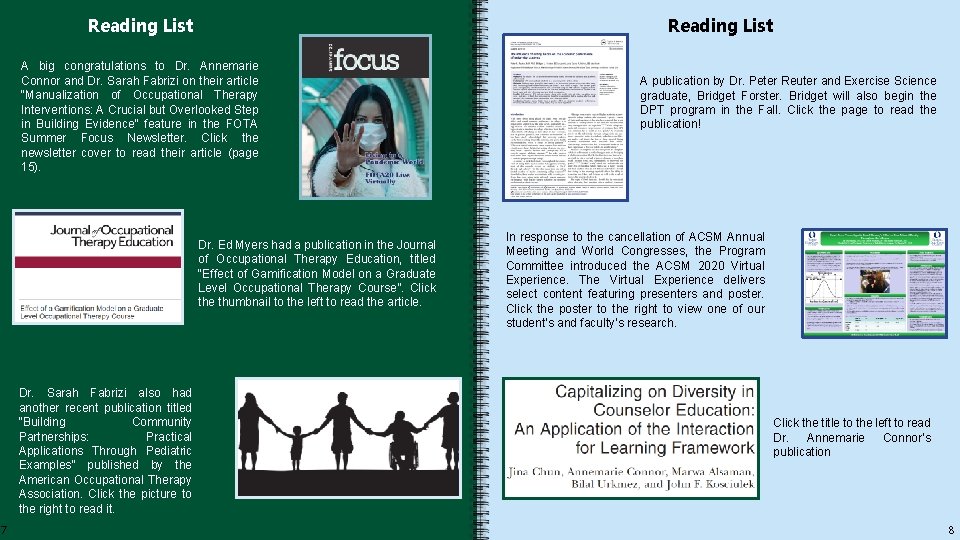
Reading List A big congratulations to Dr. Annemarie Connor and Dr. Sarah Fabrizi on their article “Manualization of Occupational Therapy Interventions: A Crucial but Overlooked Step in Building Evidence” feature in the FOTA Summer Focus Newsletter. Click the newsletter cover to read their article (page 15). Dr. Ed Myers had a publication in the Journal of Occupational Therapy Education, titled “Effect of Gamification Model on a Graduate Level Occupational Therapy Course”. Click the thumbnail to the left to read the article. Dr. Sarah Fabrizi also had another recent publication titled “Building Community Partnerships: Practical Applications Through Pediatric Examples” published by the American Occupational Therapy Association. Click the picture to the right to read it. 7 A publication by Dr. Peter Reuter and Exercise Science graduate, Bridget Forster. Bridget will also begin the DPT program in the Fall. Click the page to read the publication! In response to the cancellation of ACSM Annual Meeting and World Congresses, the Program Committee introduced the ACSM 2020 Virtual Experience. The Virtual Experience delivers select content featuring presenters and poster. Click the poster to the right to view one of our student’s and faculty’s research. Click the title to the left to read Dr. Annemarie Connor’s publication 8
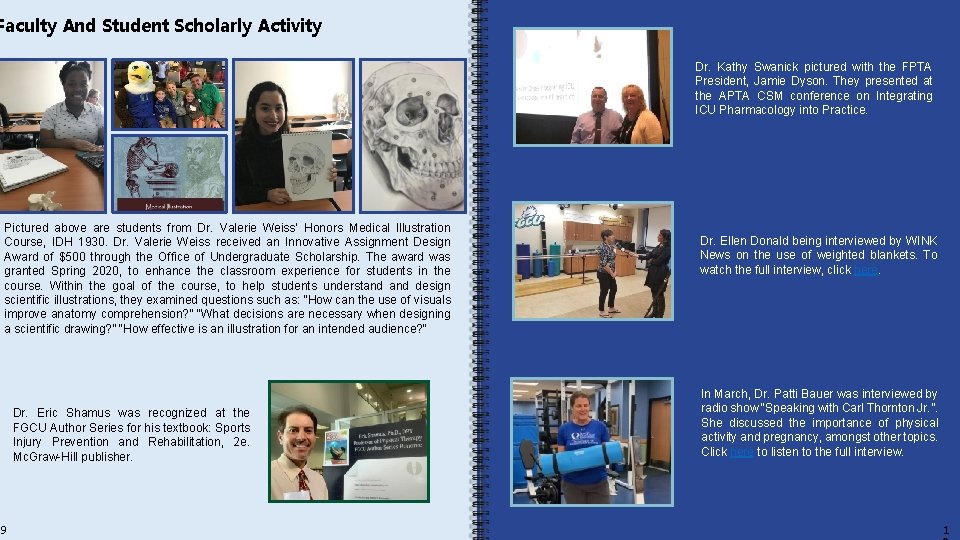
Faculty And Student Scholarly Activity Dr. Kathy Swanick pictured with the FPTA President, Jamie Dyson. They presented at the APTA CSM conference on Integrating ICU Pharmacology into Practice. Pictured above are students from Dr. Valerie Weiss’ Honors Medical Illustration Course, IDH 1930. Dr. Valerie Weiss received an Innovative Assignment Design Award of $500 through the Office of Undergraduate Scholarship. The award was granted Spring 2020, to enhance the classroom experience for students in the course. Within the goal of the course, to help students understand design scientific illustrations, they examined questions such as: “How can the use of visuals improve anatomy comprehension? ” “What decisions are necessary when designing a scientific drawing? ” “How effective is an illustration for an intended audience? ” Dr. Eric Shamus was recognized at the FGCU Author Series for his textbook: Sports Injury Prevention and Rehabilitation, 2 e. Mc. Graw-Hill publisher. 9 Dr. Ellen Donald being interviewed by WINK News on the use of weighted blankets. To watch the full interview, click here. In March, Dr. Patti Bauer was interviewed by radio show “Speaking with Carl Thornton Jr. ”. She discussed the importance of physical activity and pregnancy, amongst other topics. Click here to listen to the full interview. 1
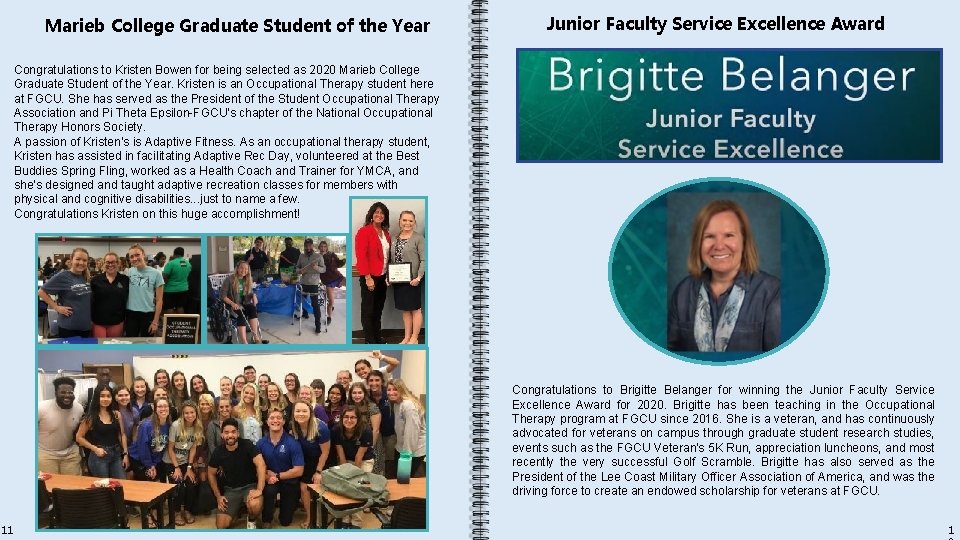
Marieb College Graduate Student of the Year Junior Faculty Service Excellence Award Congratulations to Kristen Bowen for being selected as 2020 Marieb College Graduate Student of the Year. Kristen is an Occupational Therapy student here at FGCU. She has served as the President of the Student Occupational Therapy Association and Pi Theta Epsilon-FGCU’s chapter of the National Occupational Therapy Honors Society. A passion of Kristen’s is Adaptive Fitness. As an occupational therapy student, Kristen has assisted in facilitating Adaptive Rec Day, volunteered at the Best Buddies Spring Fling, worked as a Health Coach and Trainer for YMCA, and she’s designed and taught adaptive recreation classes for members with physical and cognitive disabilities. . . just to name a few. Congratulations Kristen on this huge accomplishment! Congratulations to Brigitte Belanger for winning the Junior Faculty Service Excellence Award for 2020. Brigitte has been teaching in the Occupational Therapy program at FGCU since 2016. She is a veteran, and has continuously advocated for veterans on campus through graduate student research studies, events such as the FGCU Veteran's 5 K Run, appreciation luncheons, and most recently the very successful Golf Scramble. Brigitte has also served as the President of the Lee Coast Military Officer Association of America, and was the driving force to create an endowed scholarship for veterans at FGCU. 11 1
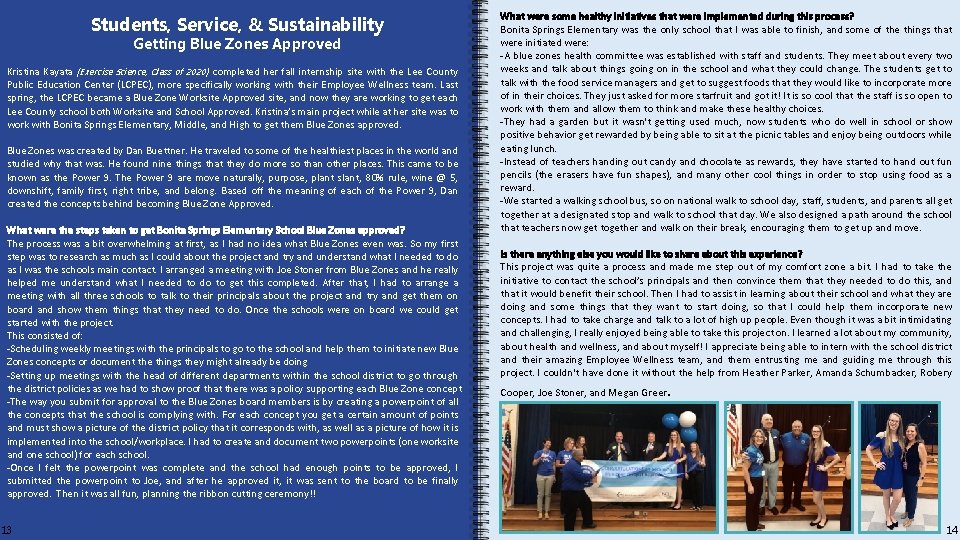
Students, Service, & Sustainability Getting Blue Zones Approved Kristina Kayata (Exercise Science, Class of 2020) completed her fall internship site with the Lee County Public Education Center (LCPEC), more specifically working with their Employee Wellness team. Last spring, the LCPEC became a Blue Zone Worksite Approved site, and now they are working to get each Lee County school both Worksite and School Approved. Kristina’s main project while at her site was to work with Bonita Springs Elementary, Middle, and High to get them Blue Zones approved. Blue Zones was created by Dan Buettner. He traveled to some of the healthiest places in the world and studied why that was. He found nine things that they do more so than other places. This came to be known as the Power 9. The Power 9 are move naturally, purpose, plant slant, 80% rule, wine @ 5, downshift, family first, right tribe, and belong. Based off the meaning of each of the Power 9, Dan created the concepts behind becoming Blue Zone Approved. What were the steps taken to get Bonita Springs Elementary School Blue Zones approved? The process was a bit overwhelming at first, as I had no idea what Blue Zones even was. So my first step was to research as much as I could about the project and try and understand what I needed to do as I was the schools main contact. I arranged a meeting with Joe Stoner from Blue Zones and he really helped me understand what I needed to do to get this completed. After that, I had to arrange a meeting with all three schools to talk to their principals about the project and try and get them on board and show them things that they need to do. Once the schools were on board we could get started with the project. This consisted of: -Scheduling weekly meetings with the principals to go to the school and help them to initiate new Blue Zones concepts or document the things they might already be doing -Setting up meetings with the head of different departments within the school district to go through the district policies as we had to show proof that there was a policy supporting each Blue Zone concept -The way you submit for approval to the Blue Zones board members is by creating a powerpoint of all the concepts that the school is complying with. For each concept you get a certain amount of points and must show a picture of the district policy that it corresponds with, as well as a picture of how it is implemented into the school/workplace. I had to create and document two powerpoints (one worksite and one school) for each school. -Once I felt the powerpoint was complete and the school had enough points to be approved, I submitted the powerpoint to Joe, and after he approved it, it was sent to the board to be finally approved. Then it was all fun, planning the ribbon cutting ceremony!! 13 What were some healthy initiatives that were implemented during this process? Bonita Springs Elementary was the only school that I was able to finish, and some of the things that were initiated were: -A blue zones health committee was established with staff and students. They meet about every two weeks and talk about things going on in the school and what they could change. The students get to talk with the food service managers and get to suggest foods that they would like to incorporate more of in their choices. They just asked for more starfruit and got it! It is so cool that the staff is so open to work with them and allow them to think and make these healthy choices. -They had a garden but it wasn't getting used much, now students who do well in school or show positive behavior get rewarded by being able to sit at the picnic tables and enjoy being outdoors while eating lunch. -Instead of teachers handing out candy and chocolate as rewards, they have started to hand out fun pencils (the erasers have fun shapes), and many other cool things in order to stop using food as a reward. -We started a walking school bus, so on national walk to school day, staff, students, and parents all get together at a designated stop and walk to school that day. We also designed a path around the school that teachers now get together and walk on their break, encouraging them to get up and move. Is there anything else you would like to share about this experience? This project was quite a process and made me step out of my comfort zone a bit. I had to take the initiative to contact the school’s principals and then convince them that they needed to do this, and that it would benefit their school. Then I had to assist in learning about their school and what they are doing and some things that they want to start doing, so that I could help them incorporate new concepts. I had to take charge and talk to a lot of high up people. Even though it was a bit intimidating and challenging, I really enjoyed being able to take this project on. I learned a lot about my community, about health and wellness, and about myself! I appreciate being able to intern with the school district and their amazing Employee Wellness team, and them entrusting me and guiding me through this project. I couldn't have done it without the help from Heather Parker, Amanda Schumbacker, Robery . Cooper, Joe Stoner, and Megan Greer 14
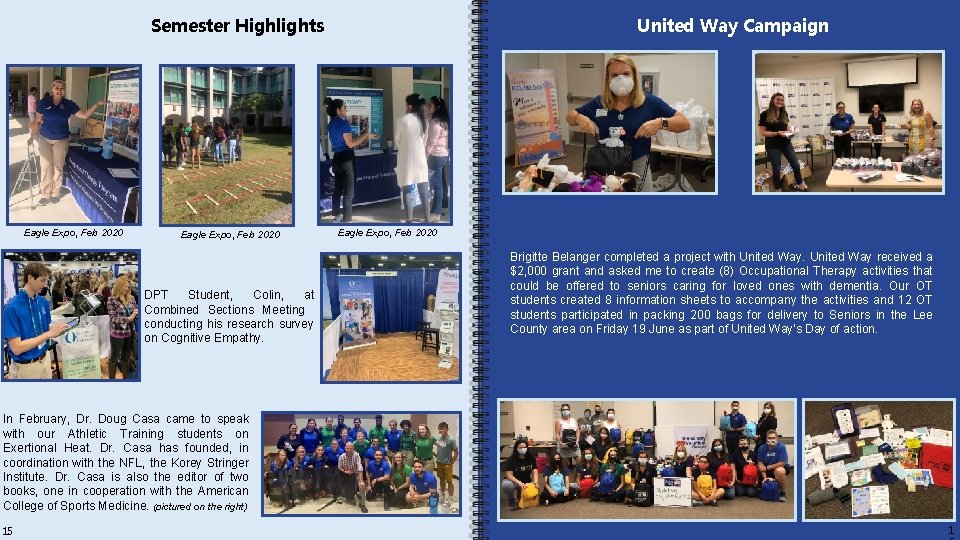
United Way Campaign Semester Highlights Eagle Expo, Feb 2020 DPT Student, Colin, at Combined Sections Meeting conducting his research survey on Cognitive Empathy. Eagle Expo, Feb 2020 Brigitte Belanger completed a project with United Way received a $2, 000 grant and asked me to create (8) Occupational Therapy activities that could be offered to seniors caring for loved ones with dementia. Our OT students created 8 information sheets to accompany the activities and 12 OT students participated in packing 200 bags for delivery to Seniors in the Lee County area on Friday 19 June as part of United Way's Day of action. In February, Dr. Doug Casa came to speak with our Athletic Training students on Exertional Heat. Dr. Casa has founded, in coordination with the NFL, the Korey Stringer Institute. Dr. Casa is also the editor of two books, one in cooperation with the American College of Sports Medicine. (pictured on the right) 15 1
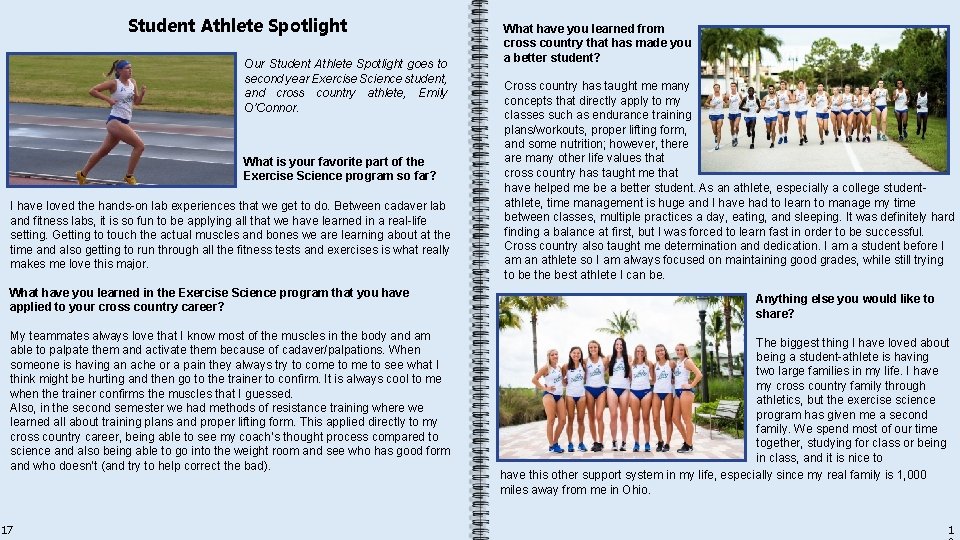
Student Athlete Spotlight Our Student Athlete Spotlight goes to second year Exercise Science student, and cross country athlete, Emily O’Connor. What is your favorite part of the Exercise Science program so far? I have loved the hands-on lab experiences that we get to do. Between cadaver lab and fitness labs, it is so fun to be applying all that we have learned in a real-life setting. Getting to touch the actual muscles and bones we are learning about at the time and also getting to run through all the fitness tests and exercises is what really makes me love this major. What have you learned in the Exercise Science program that you have applied to your cross country career? My teammates always love that I know most of the muscles in the body and am able to palpate them and activate them because of cadaver/palpations. When someone is having an ache or a pain they always try to come to see what I think might be hurting and then go to the trainer to confirm. It is always cool to me when the trainer confirms the muscles that I guessed. Also, in the second semester we had methods of resistance training where we learned all about training plans and proper lifting form. This applied directly to my cross country career, being able to see my coach’s thought process compared to science and also being able to go into the weight room and see who has good form and who doesn’t (and try to help correct the bad). 17 What have you learned from cross country that has made you a better student? Cross country has taught me many concepts that directly apply to my classes such as endurance training plans/workouts, proper lifting form, and some nutrition; however, there are many other life values that cross country has taught me that have helped me be a better student. As an athlete, especially a college studentathlete, time management is huge and I have had to learn to manage my time between classes, multiple practices a day, eating, and sleeping. It was definitely hard finding a balance at first, but I was forced to learn fast in order to be successful. Cross country also taught me determination and dedication. I am a student before I am an athlete so I am always focused on maintaining good grades, while still trying to be the best athlete I can be. Anything else you would like to share? The biggest thing I have loved about being a student-athlete is having two large families in my life. I have my cross country family through athletics, but the exercise science program has given me a second family. We spend most of our time together, studying for class or being in class, and it is nice to have this other support system in my life, especially since my real family is 1, 000 miles away from me in Ohio. 1
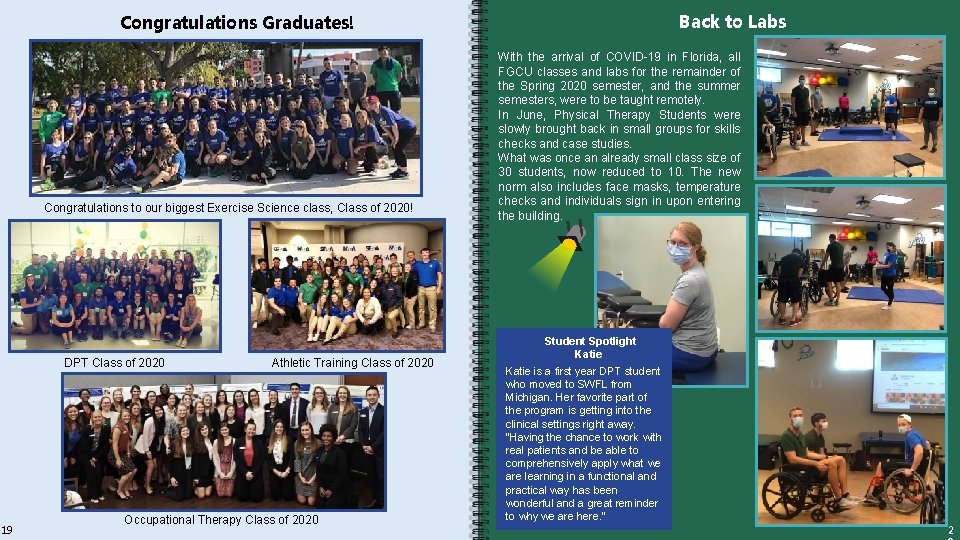
Back to Labs Congratulations Graduates! Congratulations to our biggest Exercise Science class, Class of 2020! DPT Class of 2020 19 Athletic Training Class of 2020 Occupational Therapy Class of 2020 With the arrival of COVID-19 in Florida, all FGCU classes and labs for the remainder of the Spring 2020 semester, and the summer semesters, were to be taught remotely. In June, Physical Therapy Students were slowly brought back in small groups for skills checks and case studies. What was once an already small class size of 30 students, now reduced to 10. The new norm also includes face masks, temperature checks and individuals sign in upon entering the building. Student Spotlight Katie is a first year DPT student who moved to SWFL from Michigan. Her favorite part of the program is getting into the clinical settings right away. “Having the chance to work with real patients and be able to comprehensively apply what we are learning in a functional and practical way has been wonderful and a great reminder to why we are here. ” 2
BE SURE TO FOLLOW US DEPARTMEN T OF REHABILITAT ION SCIENCES CHECK OUT OUR DEPARTMENT WEBSITES Exercis e Science (BS) UPCOMING EVENTS August 13 & 14 August 17 Physical Therapy Orientation Exercise Science Orientation Occupational Therapy Orientation First Day of Fall Semester Physic al Therap y (DPT) Athleti c Trainin g (MSAT) Occupatio nal Therapy (MSOT) Thank you to all of our students, faculty, clinical instructors, and community partners for making this (virtual) semester so great! The Department wishes everyone a great start to the Fall semester! If you’d like to see something featured in the Newsletter, email slevy@fgcu. edu
- Slides: 12