
DEPARTMENT OF PHYSICS AND ASTRONOMY LIFECYCLES OF STARS
- Slides: 43
DEPARTMENT OF PHYSICS AND ASTRONOMY LIFECYCLES OF STARS Option 2601 M. R. Burleigh 2601/Unit 4
Stellar Physics § Unit 1 - Observational properties of stars § Unit 2 - Stellar Spectra § Unit 3 - The Sun § Unit 4 - Stellar Structure § Unit 5 - Stellar Evolution § Unit 6 - Stars of particular interest M. R. Burleigh 2601/Unit 4
DEPARTMENT OF PHYSICS AND ASTRONOMY Unit 4 Stellar Structure M. R. Burleigh 2601/Unit 4
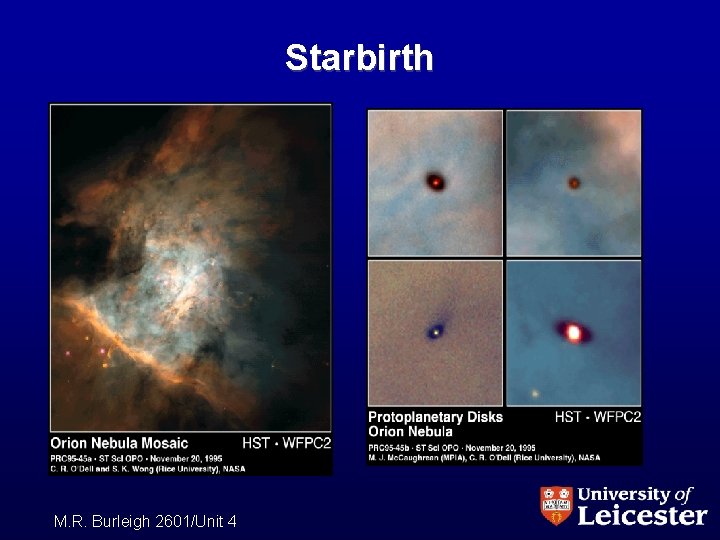
Starbirth M. R. Burleigh 2601/Unit 4
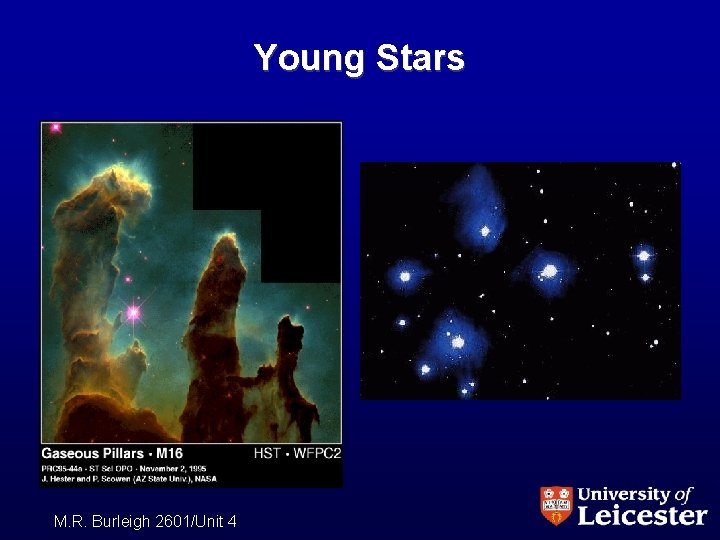
Young Stars M. R. Burleigh 2601/Unit 4
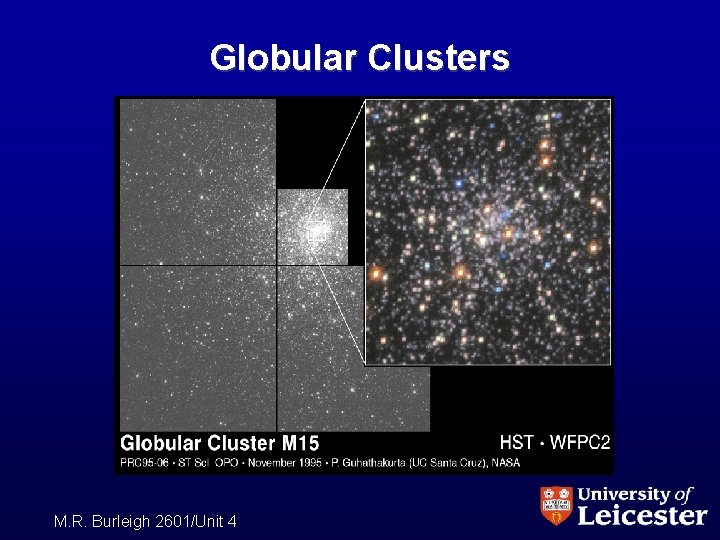
Globular Clusters M. R. Burleigh 2601/Unit 4
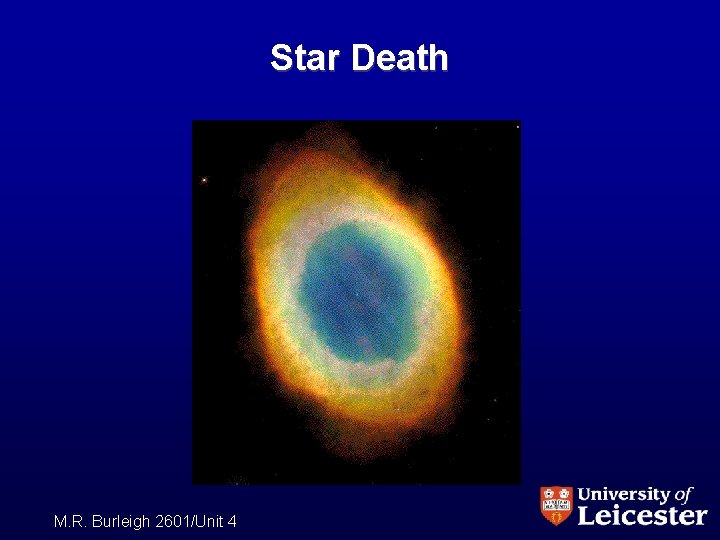
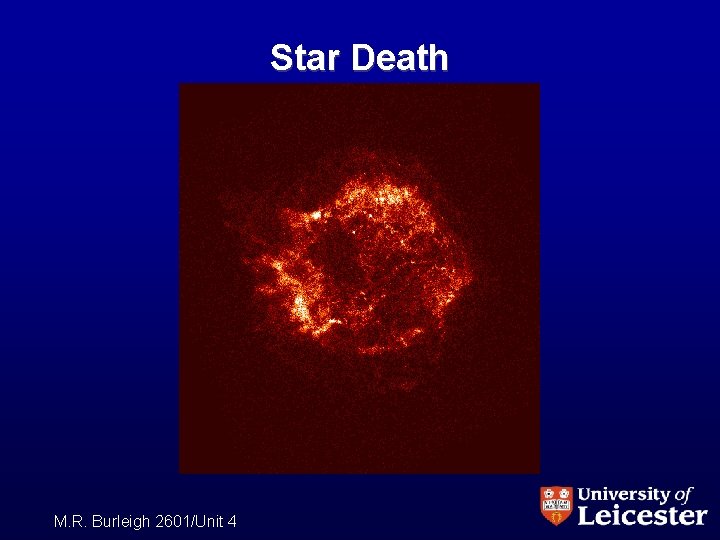
Star Death M. R. Burleigh 2601/Unit 4
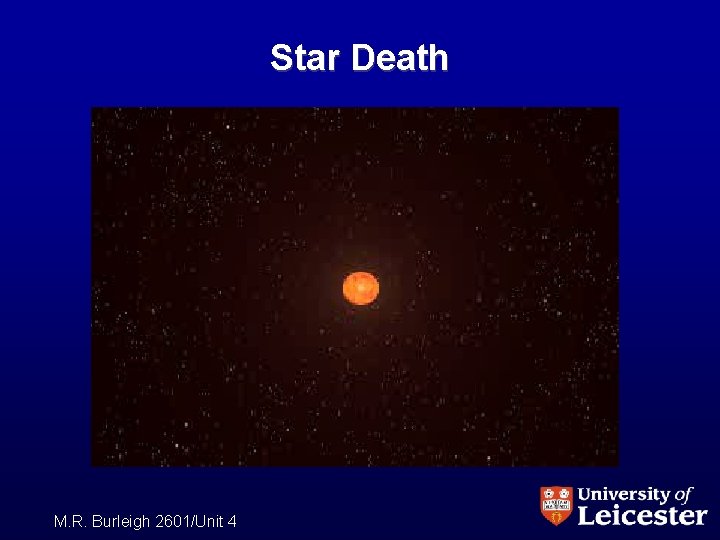
Star Death M. R. Burleigh 2601/Unit 4
Star Death M. R. Burleigh 2601/Unit 4
Star Death M. R. Burleigh 2601/Unit 4
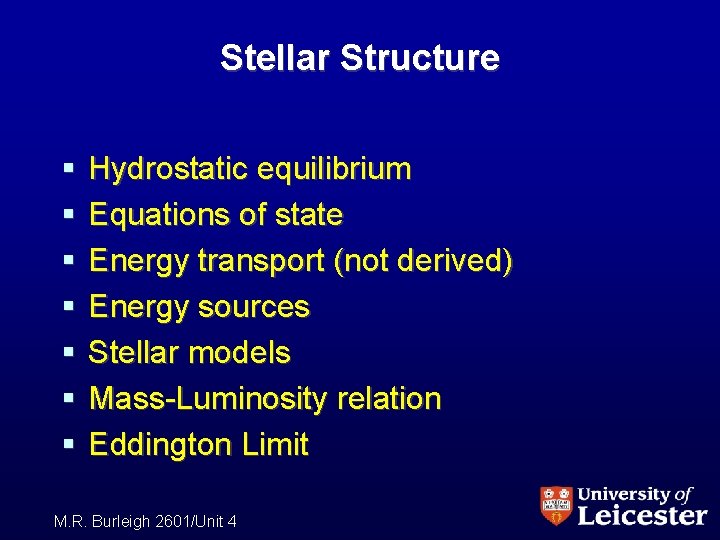
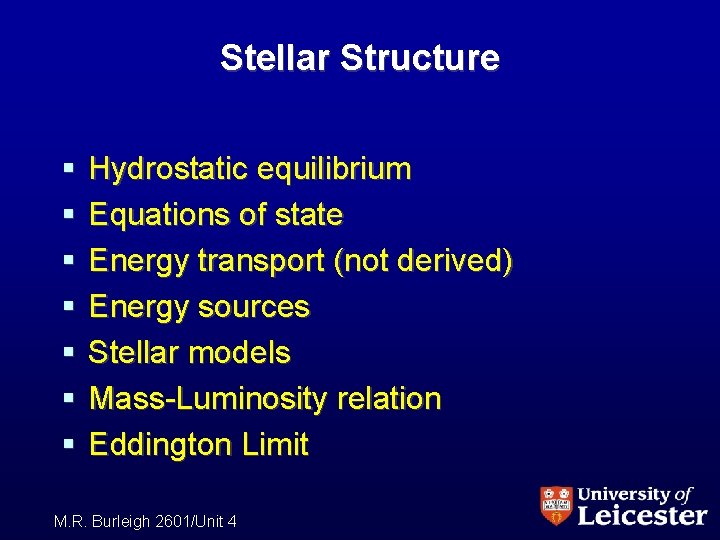
Stellar Structure § § § § Hydrostatic equilibrium Equations of state Energy transport (not derived) Energy sources Stellar models Mass-Luminosity relation Eddington Limit M. R. Burleigh 2601/Unit 4
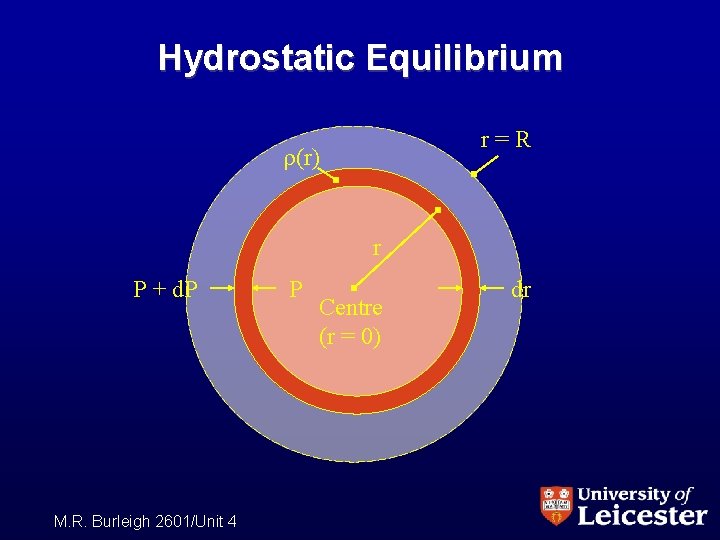
Hydrostatic Equilibrium r=R (r) r P + d. P M. R. Burleigh 2601/Unit 4 P Centre (r = 0) dr
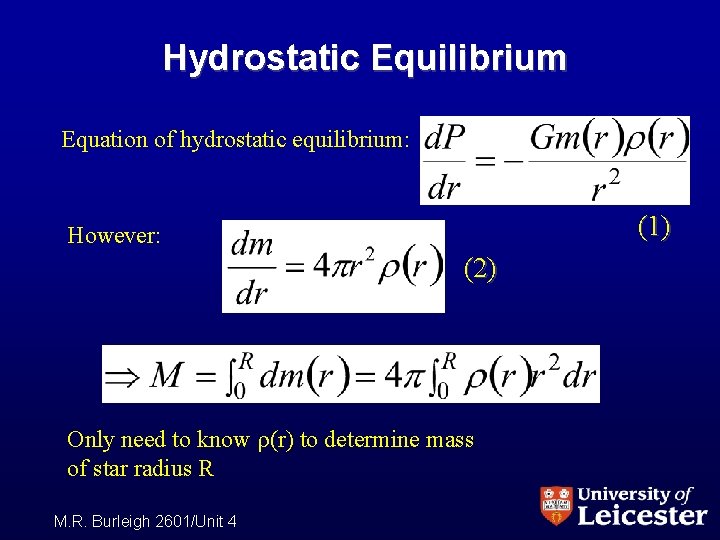
Hydrostatic Equilibrium Equation of hydrostatic equilibrium: (1) However: (2) Only need to know (r) to determine mass of star radius R M. R. Burleigh 2601/Unit 4
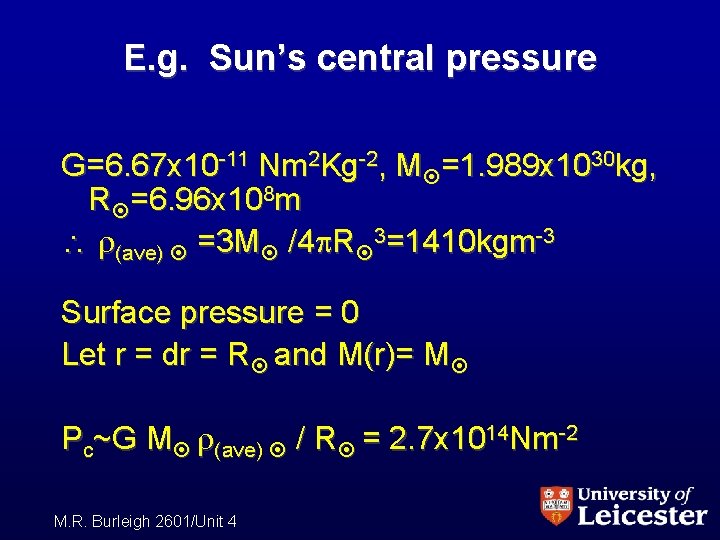
E. g. Sun’s central pressure G=6. 67 x 10 -11 Nm 2 Kg-2, M =1. 989 x 1030 kg, R =6. 96 x 108 m (ave) =3 M /4 R 3=1410 kgm-3 Surface pressure = 0 Let r = dr = R and M(r)= M Pc~G M (ave) / R = 2. 7 x 10¹⁴ Nm-2 M. R. Burleigh 2601/Unit 4
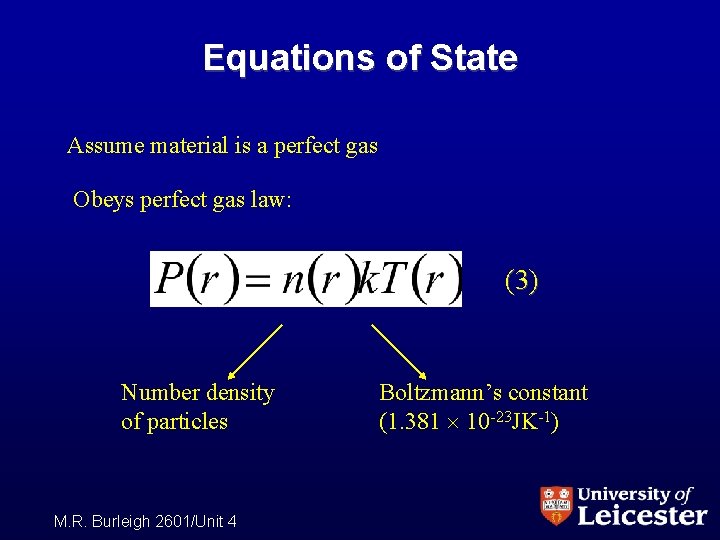
Equations of State Assume material is a perfect gas Obeys perfect gas law: (3) Number density of particles M. R. Burleigh 2601/Unit 4 Boltzmann’s constant (1. 381 10 -23 JK-1)
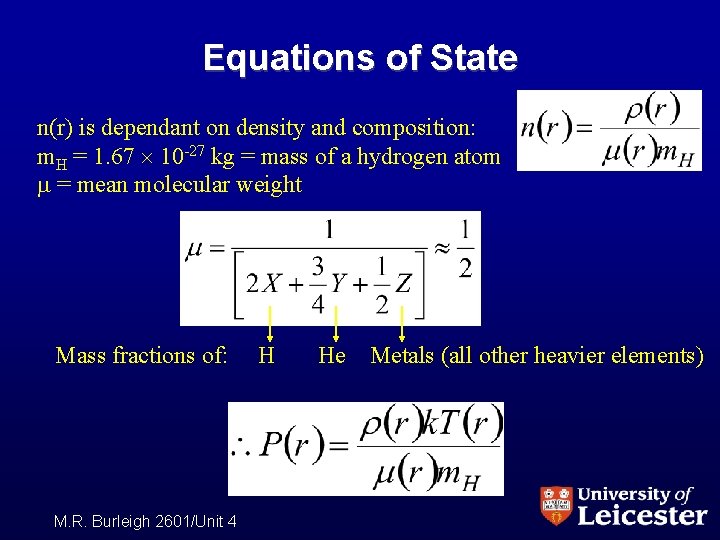
Equations of State n(r) is dependant on density and composition: m. H = 1. 67 10 -27 kg = mass of a hydrogen atom = mean molecular weight Mass fractions of: M. R. Burleigh 2601/Unit 4 H He Metals (all other heavier elements)
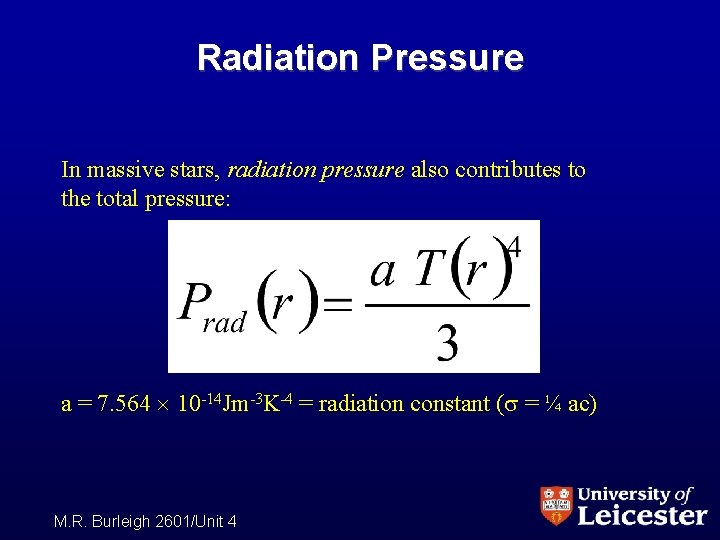
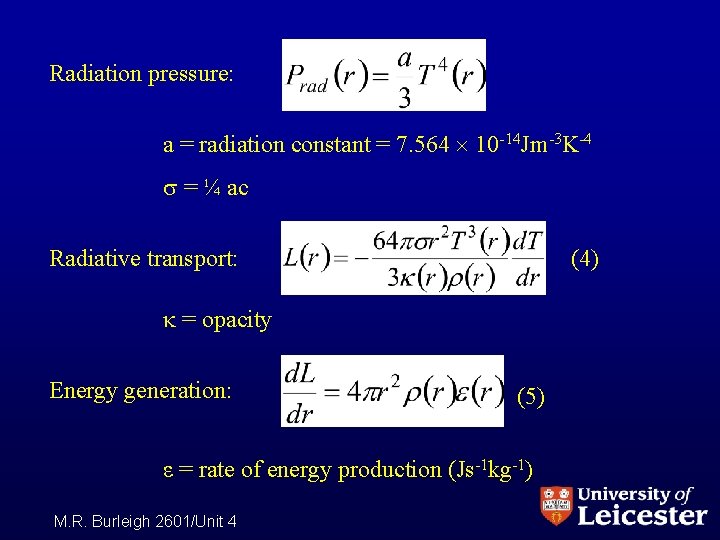
Radiation Pressure In massive stars, radiation pressure also contributes to the total pressure: a = 7. 564 10 -14 Jm-3 K-4 = radiation constant ( = ¼ ac) M. R. Burleigh 2601/Unit 4
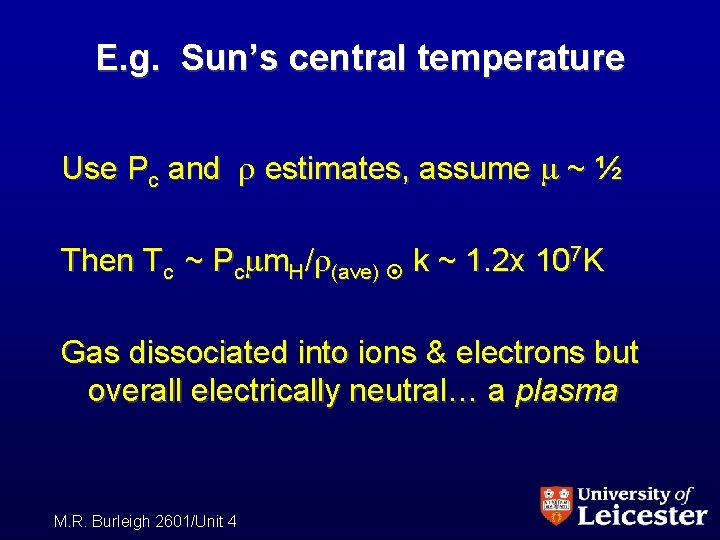
E. g. Sun’s central temperature Use Pc and estimates, assume ~ ½ Then Tc ~ Pc m. H/ (ave) k ~ 1. 2 x 10⁷ K Gas dissociated into ions & electrons but overall electrically neutral… a plasma M. R. Burleigh 2601/Unit 4
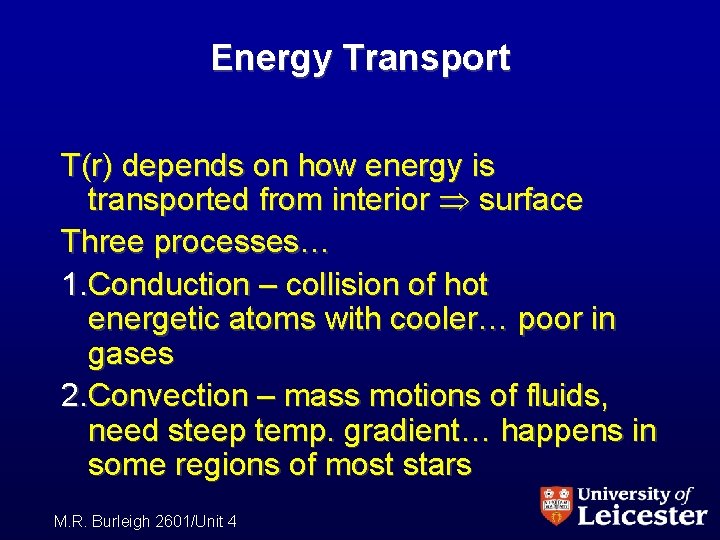
Energy Transport T(r) depends on how energy is transported from interior surface Three processes… 1. Conduction – collision of hot energetic atoms with cooler… poor in gases 2. Convection – mass motions of fluids, need steep temp. gradient… happens in some regions of most stars M. R. Burleigh 2601/Unit 4
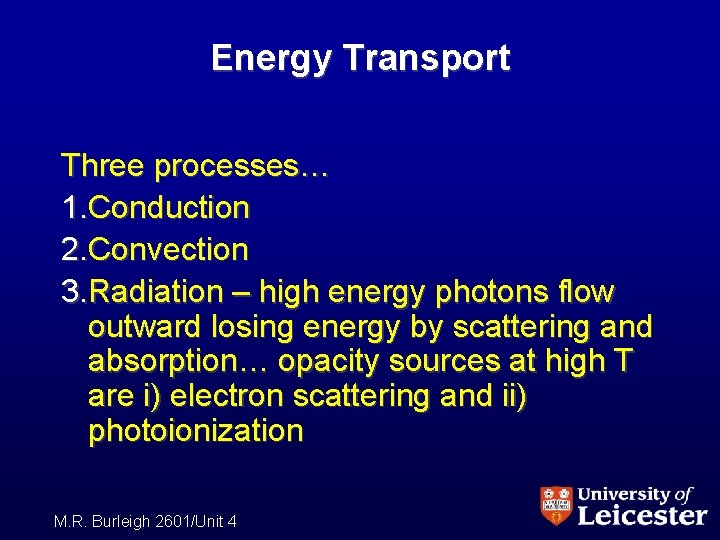
Energy Transport Three processes… 1. Conduction 2. Convection 3. Radiation – high energy photons flow outward losing energy by scattering and absorption… opacity sources at high T are i) electron scattering and ii) photoionization M. R. Burleigh 2601/Unit 4
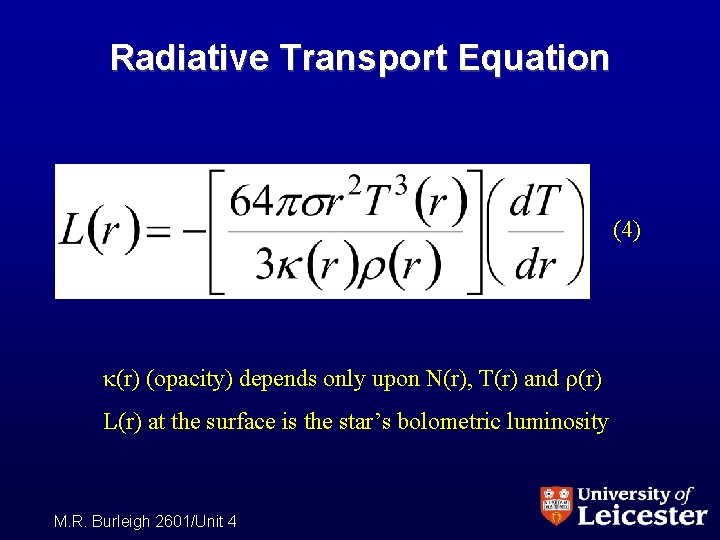
Radiative Transport Equation (4) (r) (opacity) depends only upon N(r), T(r) and (r) L(r) at the surface is the star’s bolometric luminosity M. R. Burleigh 2601/Unit 4
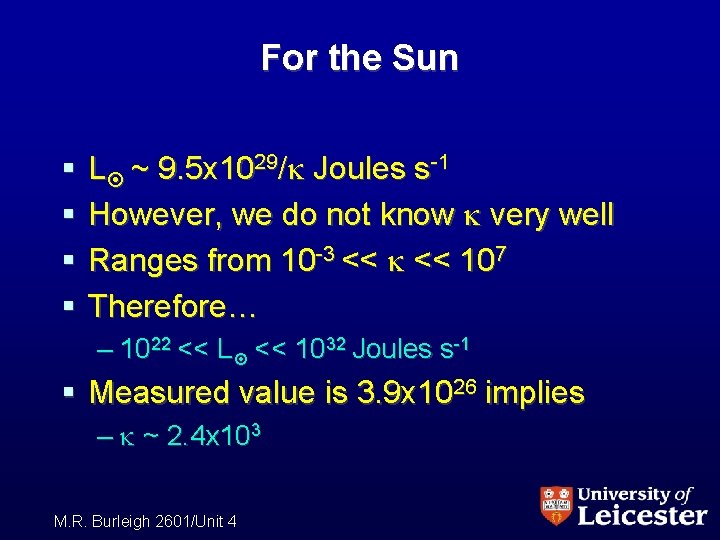
For the Sun § § L ~ 9. 5 x 1029/ Joules s-1 However, we do not know very well Ranges from 10 -3 << 107 Therefore… – 1022 << L << 1032 Joules s-1 § Measured value is 3. 9 x 1026 implies – ~ 2. 4 x 10³ M. R. Burleigh 2601/Unit 4
The Virial Theorem § § § Considers total energy in a star Gravitational contraction Gravitational potential energy kinetic energy § Kinetic energy in bulk Heat M. R. Burleigh 2601/Unit 4
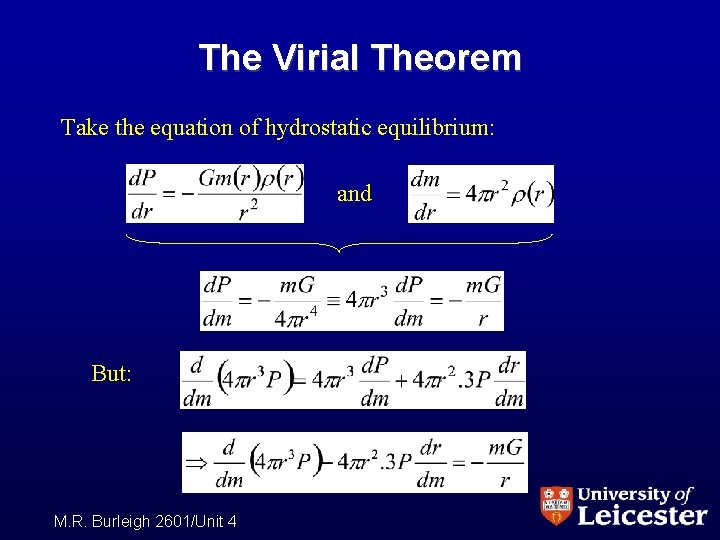
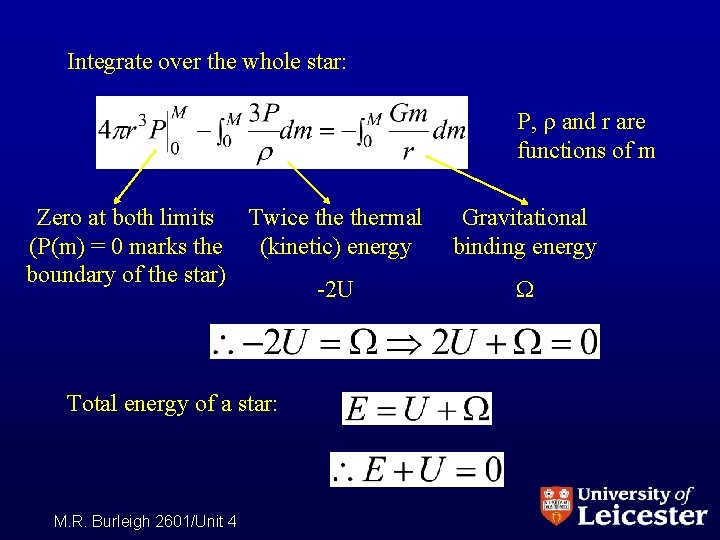
The Virial Theorem Take the equation of hydrostatic equilibrium: and But: M. R. Burleigh 2601/Unit 4
Integrate over the whole star: P, and r are functions of m Zero at both limits Twice thermal (P(m) = 0 marks the (kinetic) energy boundary of the star) -2 U Total energy of a star: M. R. Burleigh 2601/Unit 4 Gravitational binding energy
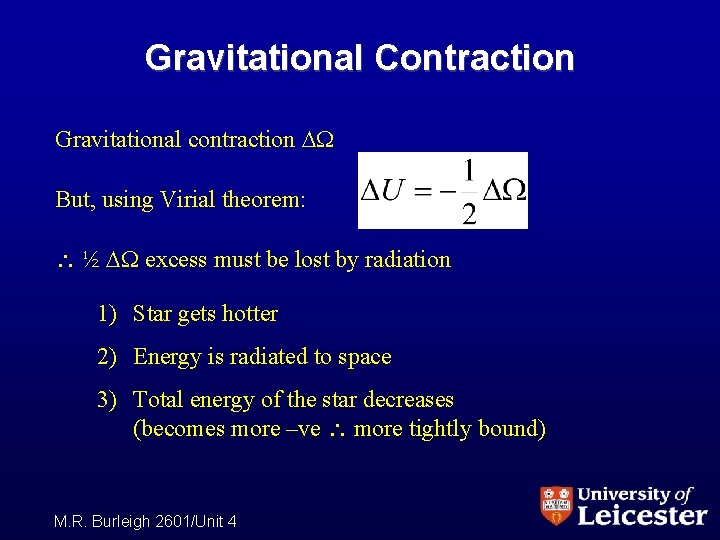
Gravitational Contraction Gravitational contraction But, using Virial theorem: ½ excess must be lost by radiation 1) Star gets hotter 2) Energy is radiated to space 3) Total energy of the star decreases (becomes more –ve more tightly bound) M. R. Burleigh 2601/Unit 4
Stellar Thermonuclear Reactions § Light elements “burn” to form heavier elements § Stellar cores have high enough T and for nuclear fusion § Work (after 1938) by Hans Bethe and Fred Hoyle M. R. Burleigh 2601/Unit 4
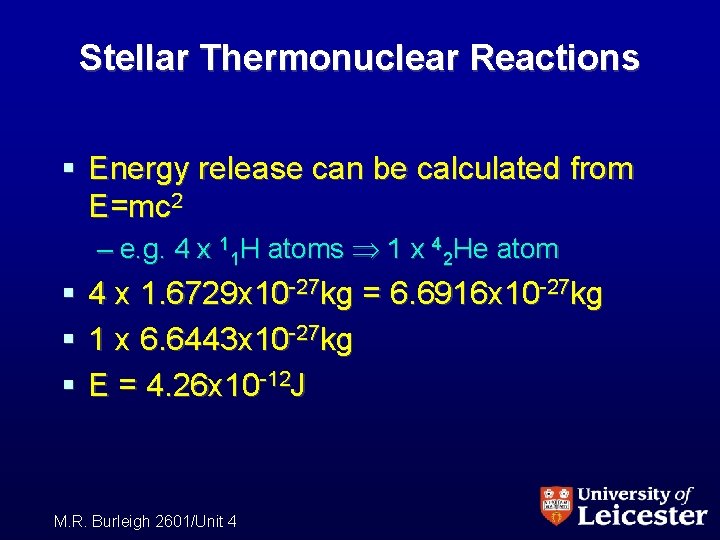
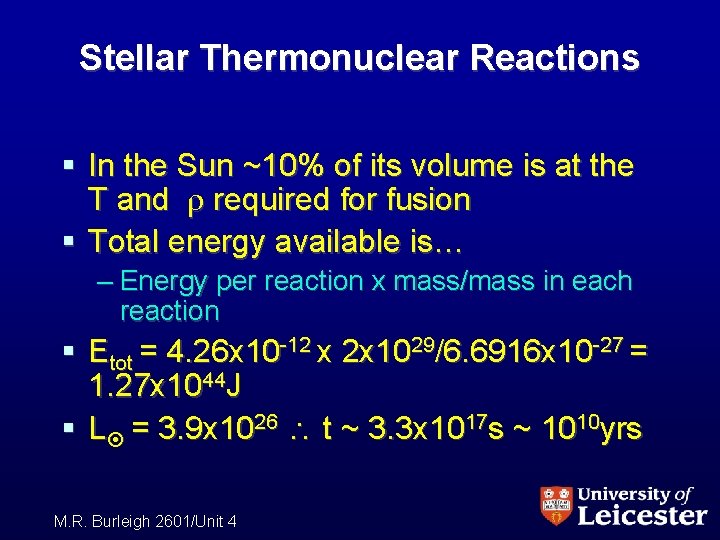
Stellar Thermonuclear Reactions § Energy release can be calculated from E=mc 2 – e. g. 4 x 11 H atoms 1 x 42 He atom § § § 4 x 1. 6729 x 10 -27 kg = 6. 6916 x 10 -27 kg 1 x 6. 6443 x 10 -27 kg E = 4. 26 x 10 -12 J M. R. Burleigh 2601/Unit 4
Stellar Thermonuclear Reactions § In the Sun ~10% of its volume is at the T and required for fusion § Total energy available is… – Energy per reaction x mass/mass in each reaction § Etot = 4. 26 x 10 -12 x 2 x 1029/6. 6916 x 10 -27 = 1. 27 x 1044 J § L = 3. 9 x 1026 t ~ 3. 3 x 10¹⁷ s ~ 1010 yrs M. R. Burleigh 2601/Unit 4
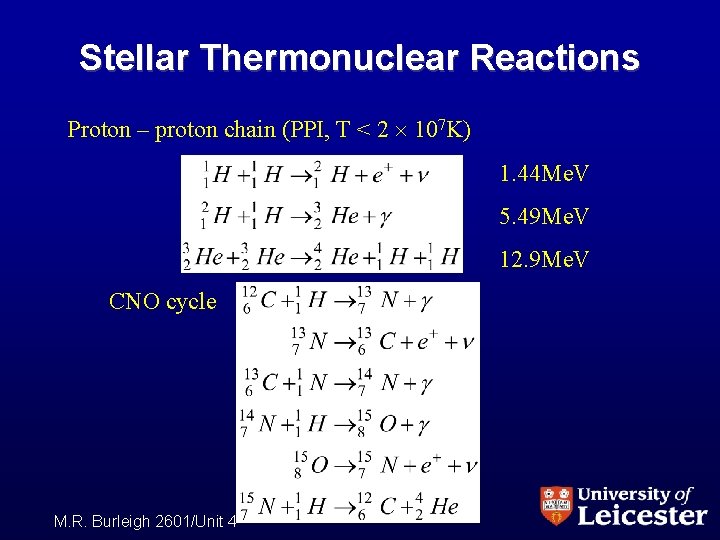
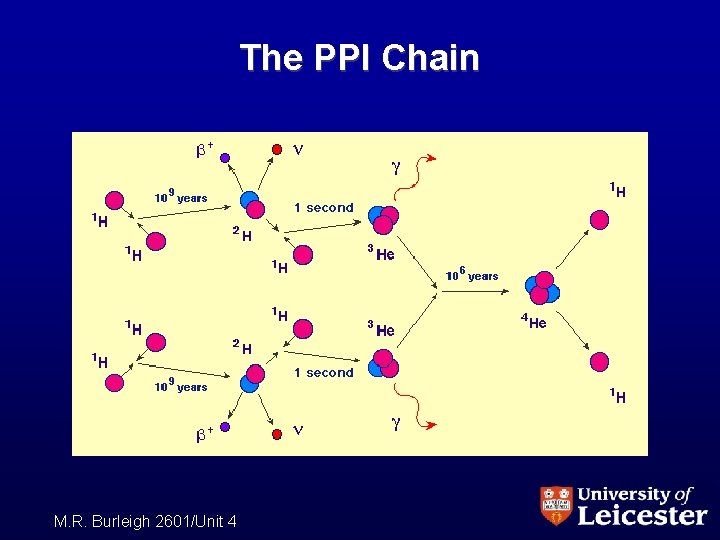
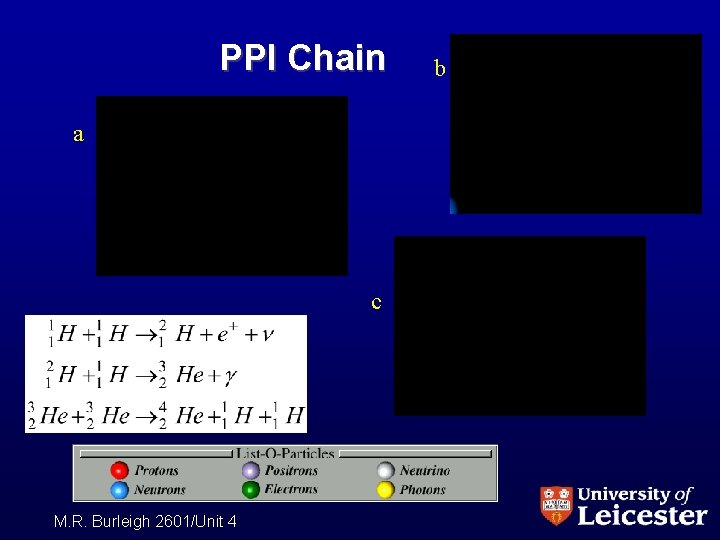
Stellar Thermonuclear Reactions Proton – proton chain (PPI, T < 2 107 K) 1. 44 Me. V 5. 49 Me. V 12. 9 Me. V CNO cycle M. R. Burleigh 2601/Unit 4
The PPI Chain M. R. Burleigh 2601/Unit 4
PPI Chain a c M. R. Burleigh 2601/Unit 4 b
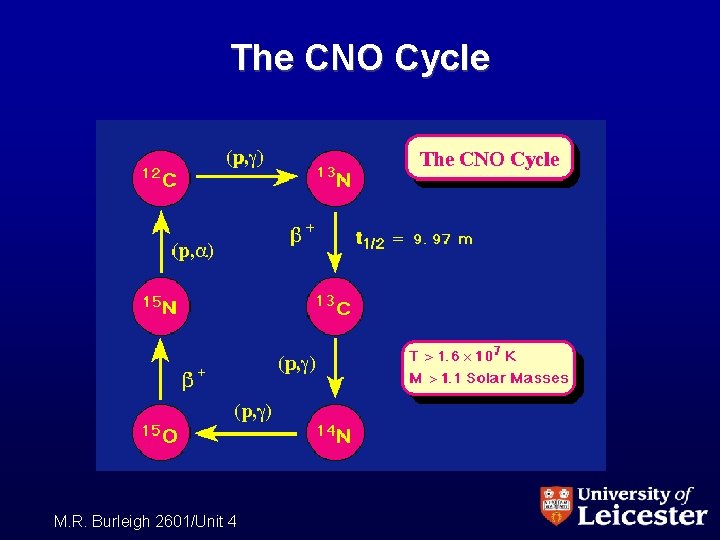
The CNO Cycle M. R. Burleigh 2601/Unit 4
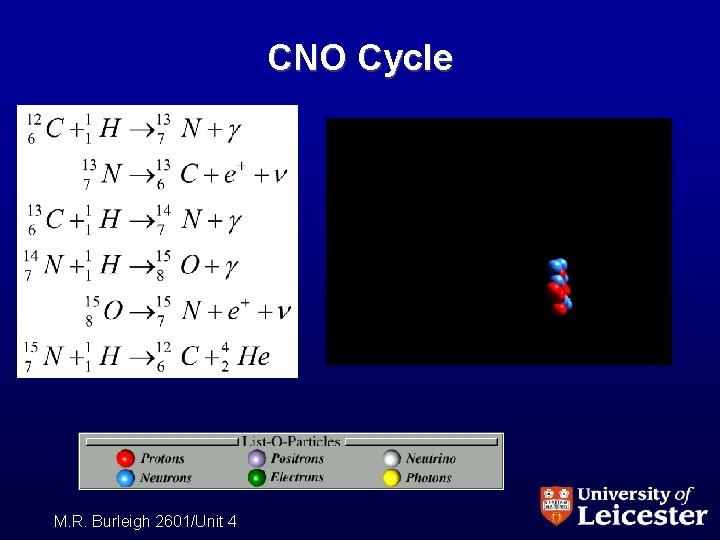
CNO Cycle M. R. Burleigh 2601/Unit 4
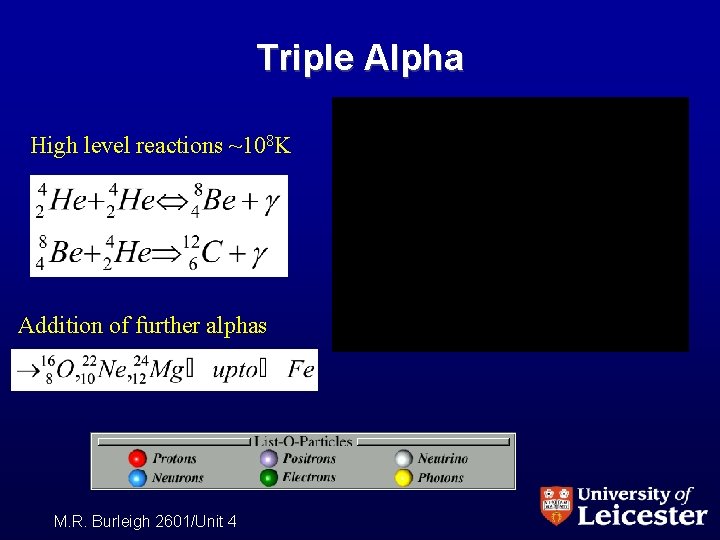
Triple Alpha High level reactions ~108 K Addition of further alphas M. R. Burleigh 2601/Unit 4
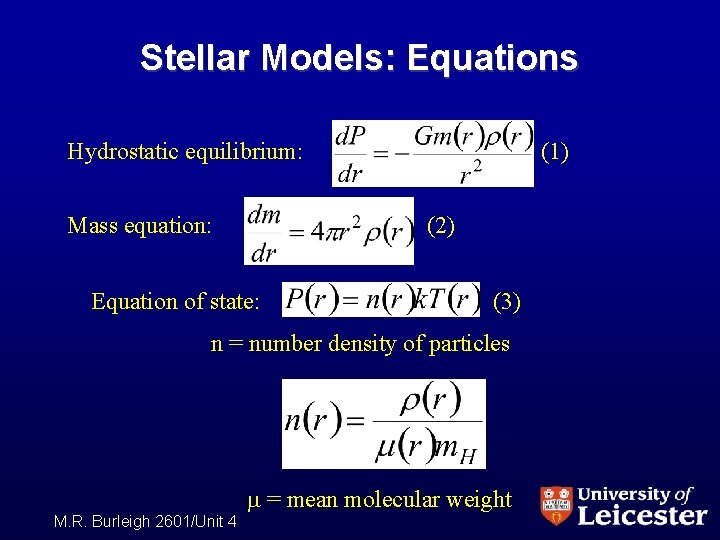
Stellar Models: Equations Hydrostatic equilibrium: Mass equation: (1) (2) Equation of state: (3) n = number density of particles = mean molecular weight M. R. Burleigh 2601/Unit 4
Radiation pressure: a = radiation constant = 7. 564 10 -14 Jm-3 K-4 = ¼ ac Radiative transport: (4) = opacity Energy generation: (5) ε = rate of energy production (Js-1 kg-1) M. R. Burleigh 2601/Unit 4
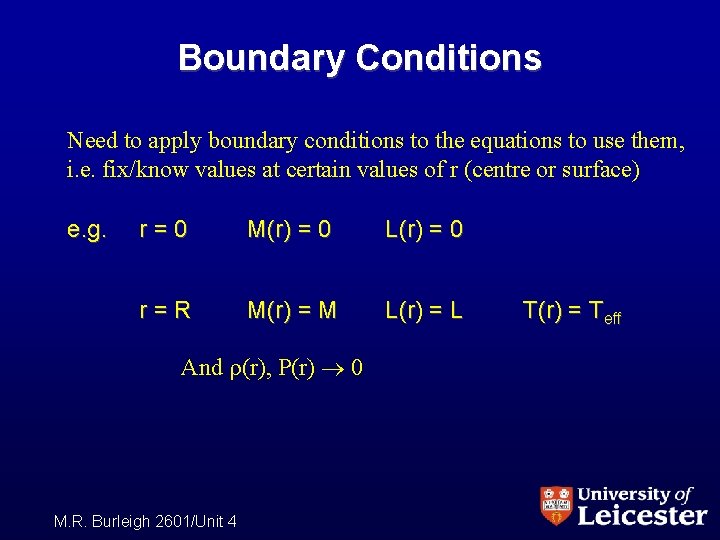
Boundary Conditions Need to apply boundary conditions to the equations to use them, i. e. fix/know values at certain values of r (centre or surface) e. g. r=0 M(r) = 0 L(r) = 0 r=R M(r) = M L(r) = L And (r), P(r) 0 M. R. Burleigh 2601/Unit 4 T(r) = Teff
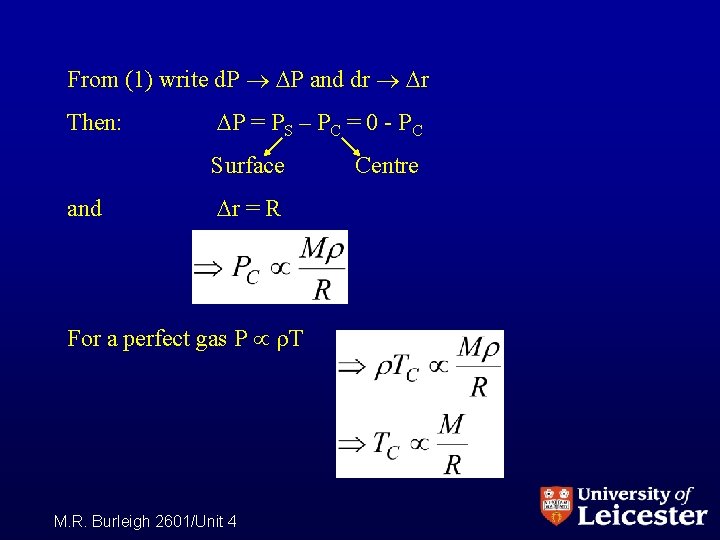
From (1) write d. P P and dr r Then: P = PS – PC = 0 - PC Surface and r = R For a perfect gas P T M. R. Burleigh 2601/Unit 4 Centre
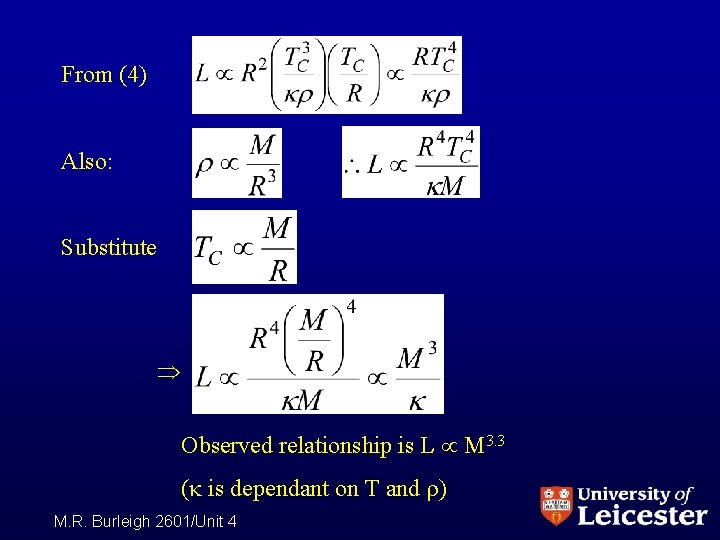
From (4) Also: Substitute Observed relationship is L M 3. 3 ( is dependant on T and ) M. R. Burleigh 2601/Unit 4
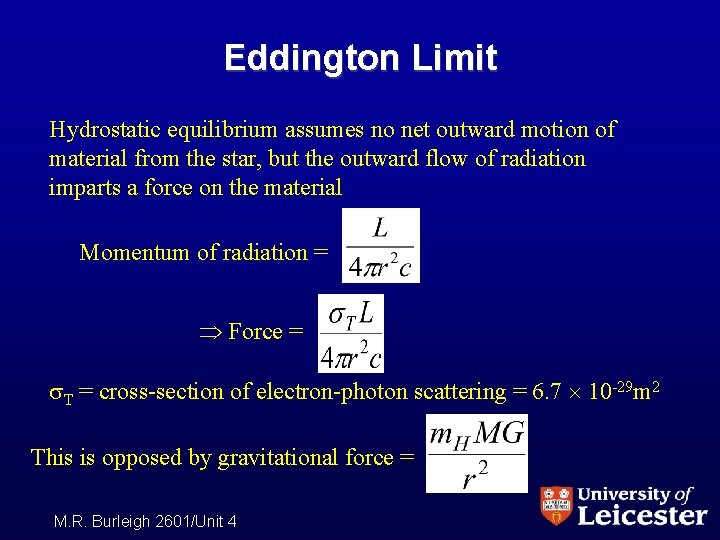
Eddington Limit Hydrostatic equilibrium assumes no net outward motion of material from the star, but the outward flow of radiation imparts a force on the material Momentum of radiation = Force = T = cross-section of electron-photon scattering = 6. 7 10 -29 m 2 This is opposed by gravitational force = M. R. Burleigh 2601/Unit 4
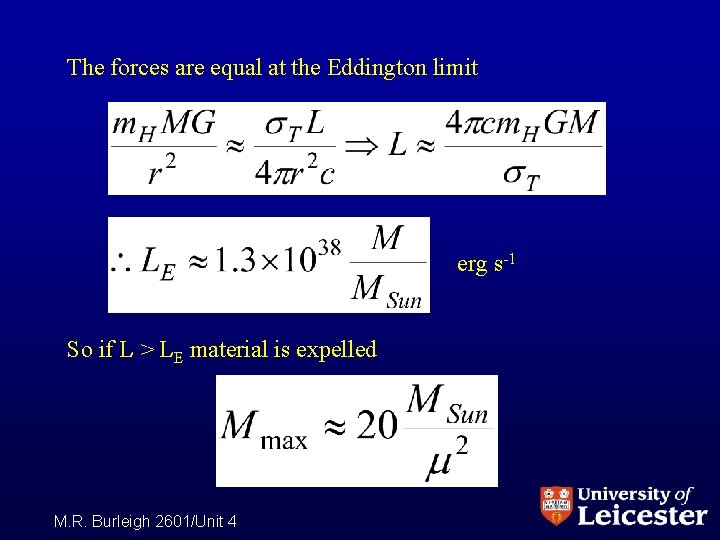
The forces are equal at the Eddington limit erg s-1 So if L > LE material is expelled M. R. Burleigh 2601/Unit 4
Stellar Structure § § § § Hydrostatic equilibrium Equations of state Energy transport (not derived) Energy sources Stellar models Mass-Luminosity relation Eddington Limit M. R. Burleigh 2601/Unit 4