
Department of Meteorology The contribution of stingjet windstorms
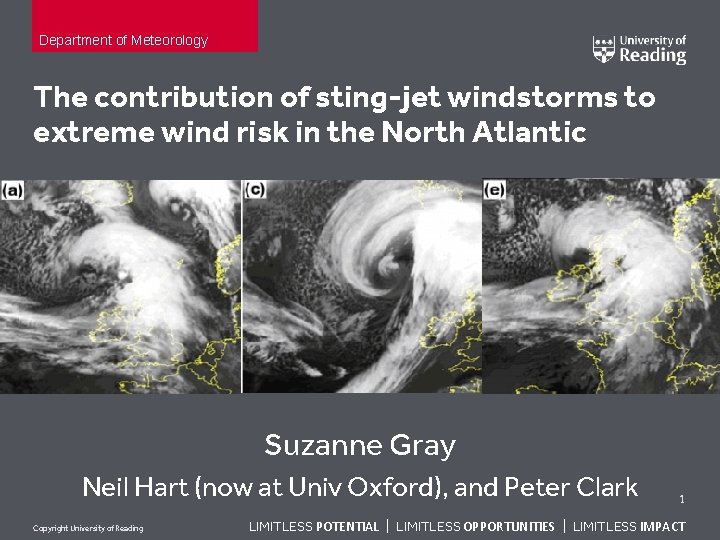
Department of Meteorology The contribution of sting-jet windstorms to extreme wind risk in the North Atlantic Suzanne Gray Neil Hart (now at Univ Oxford), and Peter Clark Copyright University of Reading 1 LIMITLESS POTENTIAL | LIMITLESS OPPORTUNITIES | LIMITLESS IMPACT
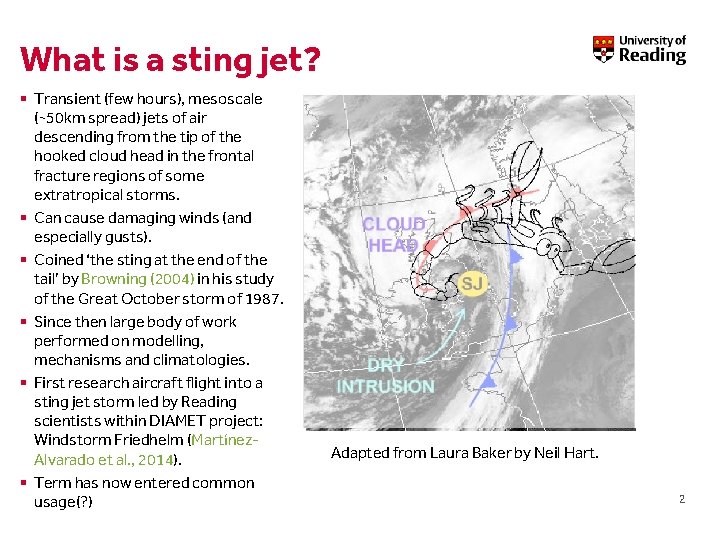
What is a sting jet? § Transient (few hours), mesoscale (~50 km spread) jets of air descending from the tip of the hooked cloud head in the frontal fracture regions of some extratropical storms. § Can cause damaging winds (and especially gusts). § Coined ‘the sting at the end of the tail’ by Browning (2004) in his study of the Great October storm of 1987. § Since then large body of work performed on modelling, mechanisms and climatologies. § First research aircraft flight into a sting jet storm led by Reading scientists within DIAMET project: Windstorm Friedhelm (Martínez. Alvarado et al. , 2014). § Term has now entered common usage(? ) Adapted from Laura Baker by Neil Hart. 2
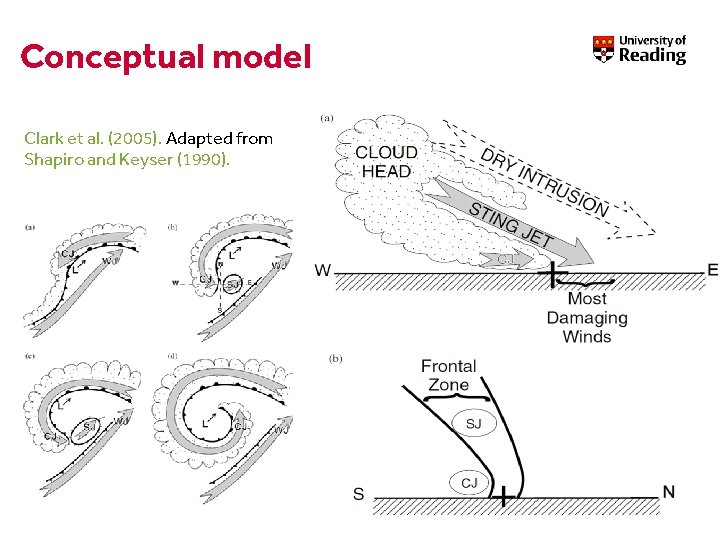
Conceptual model Clark et al. (2005). Adapted from Shapiro and Keyser (1990). 3
Questions § What is the prevalence of sting-jet cyclones in the North Atlantic? § Are the characteristics of sting-jet cyclones different to those of non sting-jet cyclones: § storm track? § deepening rate? § low-level wind speed? § seasonal cycle? § What is the relative contribution of sting-jet cyclones to strong wind events in Europe or the UK? 4
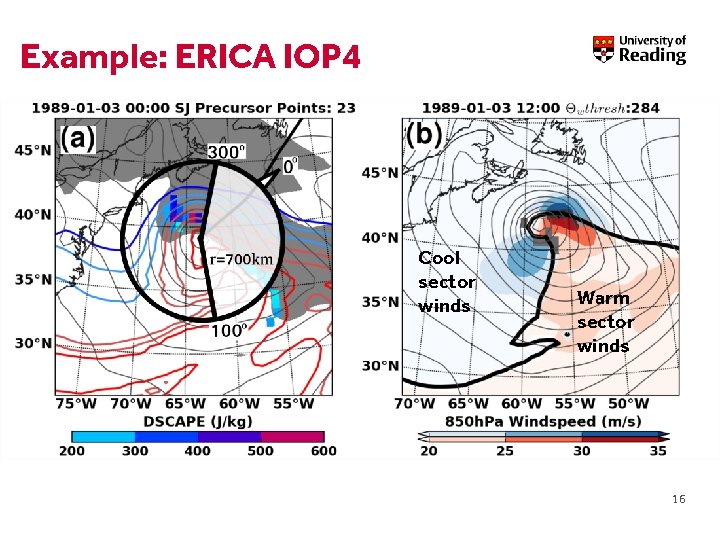
Identification method § ERA-Interim data (1979 -2011): 6 hourly, Sept. to May inclusive. § Extratropical cyclone tracks diagnosed using TRACK algorithm (e. g. Hodges and Hoskins, 2002) using ξ 850 smoothed to T 42 resolution. § Cyclones reaching their ξmax within a specified North Atlantic domain analysed. § Sting-jet precursors diagnosed assuming release of atmospheric instability generates or strengthens sting jets (Gray et al. , 2011). § Midtropospheric atmospheric instability to slantwise descent diagnosed using downdraught slantwise CAPE (DSCAPE). § Cyclones considered to have the potential to produce sting jets have a sufficiently large contiguous region of DSCAPE exceeding 200 Jkg-1 in their cloud head. § Identification of cloud head and ‘sufficient’ DSCAPE is threshold dependant, but previous work (Martínez-Alvarado et al. , 2011) has demonstrated skill in identification of cyclones that generated sting jets in weather forecasts. 5
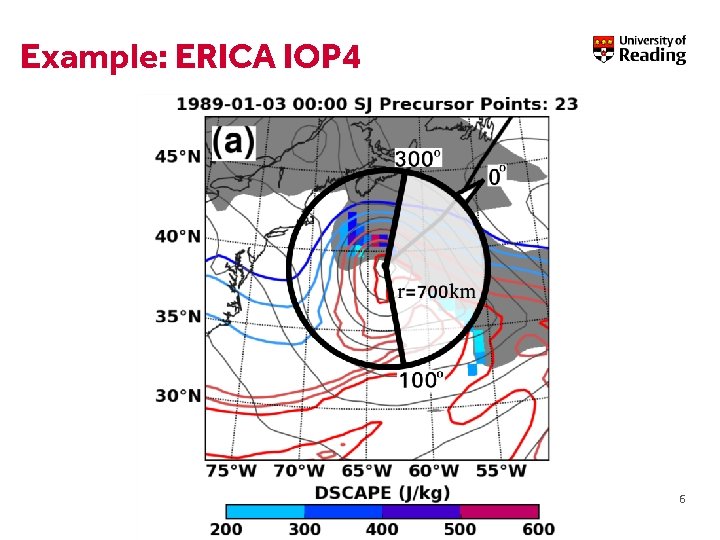
Example: ERICA IOP 4 6
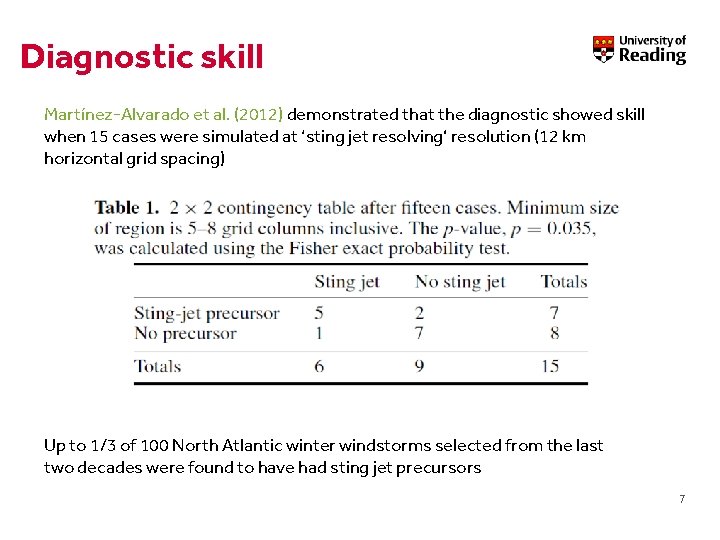
Diagnostic skill Martínez-Alvarado et al. (2012) demonstrated that the diagnostic showed skill when 15 cases were simulated at ‘sting jet resolving’ resolution (12 km horizontal grid spacing) Up to 1/3 of 100 North Atlantic winter windstorms selected from the last two decades were found to have had sting jet precursors 7
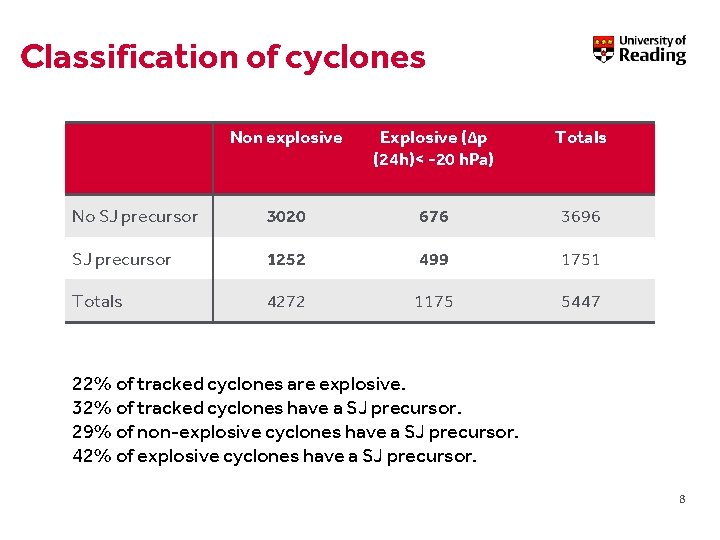
Classification of cyclones Non explosive Explosive (Δp (24 h)< -20 h. Pa) Totals No SJ precursor 3020 676 3696 SJ precursor 1252 499 1751 Totals 4272 1175 5447 22% of tracked cyclones are explosive. 32% of tracked cyclones have a SJ precursor. 29% of non-explosive cyclones have a SJ precursor. 42% of explosive cyclones have a SJ precursor. 8
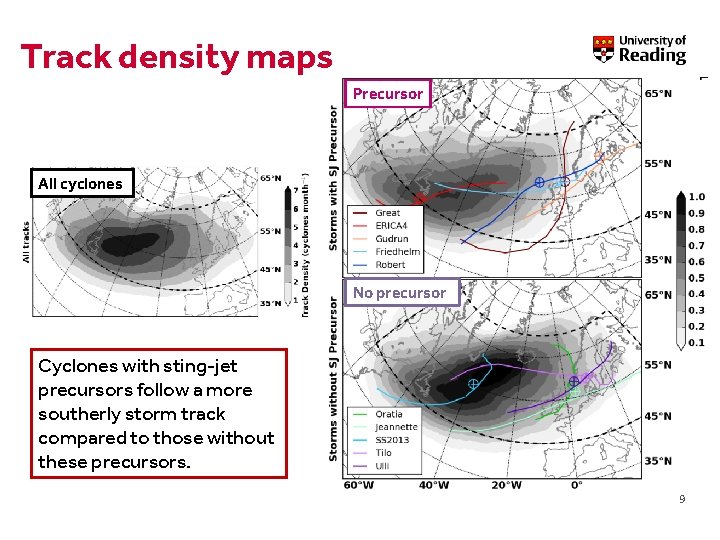
Track density maps Precursor All cyclones No precursor Cyclones with sting-jet precursors follow a more southerly storm track compared to those without these precursors. 9
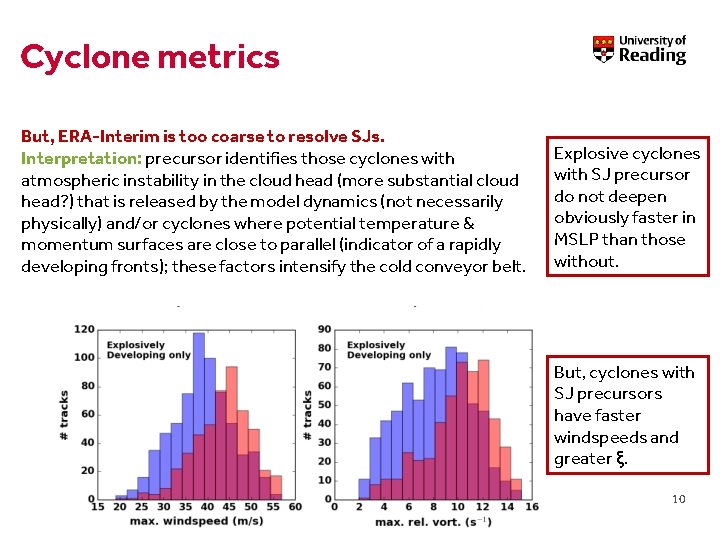
Cyclone metrics But, ERA-Interim is too coarse to resolve SJs. Interpretation: precursor identifies those cyclones with atmospheric instability in the cloud head (more substantial cloud head? ) that is released by the model dynamics (not necessarily physically) and/or cyclones where potential temperature & momentum surfaces are close to parallel (indicator of a rapidly developing fronts); these factors intensify the cold conveyor belt. Explosive cyclones with SJ precursor do not deepen obviously faster in MSLP than those without. But, cyclones with SJ precursors have faster windspeeds and greater ξ. 10
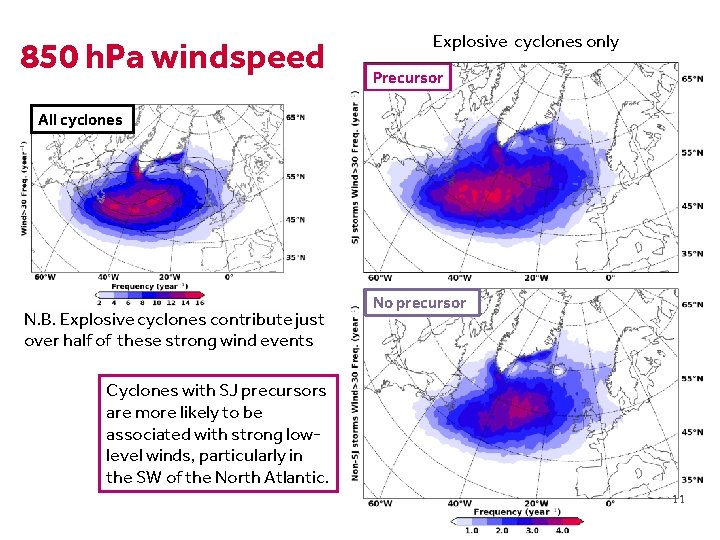
850 h. Pa windspeed Explosive cyclones only Precursor All cyclones N. B. Explosive cyclones contribute just over half of these strong wind events No precursor Cyclones with SJ precursors are more likely to be associated with strong lowlevel winds, particularly in the SW of the North Atlantic. 11
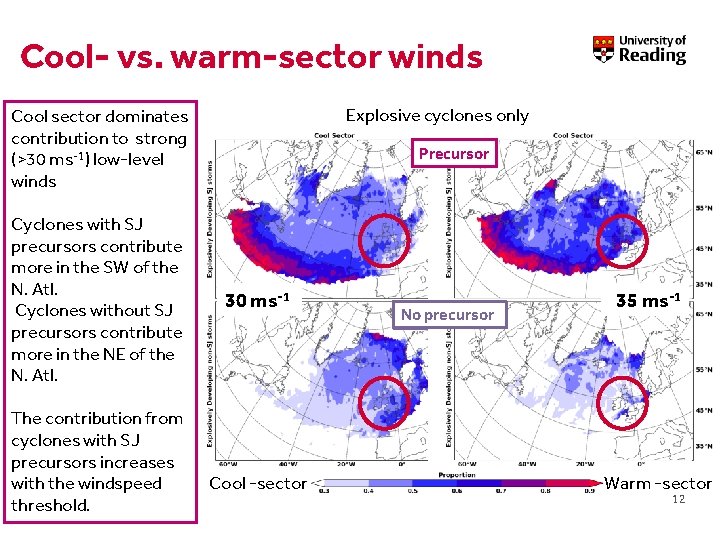
Cool- vs. warm-sector winds Explosive cyclones only Cool sector dominates contribution to strong (>30 ms-1) low-level winds Cyclones with SJ precursors contribute more in the SW of the N. Atl. Cyclones without SJ precursors contribute more in the NE of the N. Atl. The contribution from cyclones with SJ precursors increases with the windspeed threshold. Precursor 30 ms-1 Cool -sector No precursor 35 ms-1 Warm -sector 12
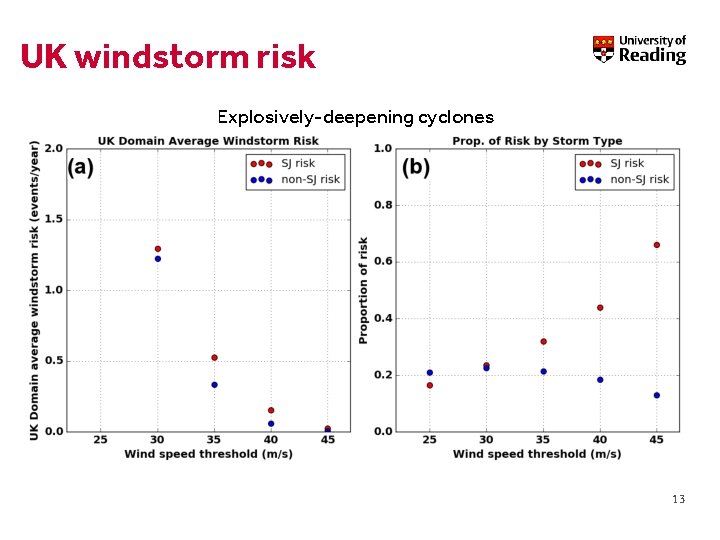
UK windstorm risk Explosively-deepening cyclones 13
Conclusions § A diagnostic for sting jet precursors has been applied to tracked North Atlantic cyclones in the ERA-Interim reanalysis (1979 -2011). § 32% of all cyclones have SJ precursors; 42% of explosively developing cyclones have SJ precursors. § For explosively developing cyclones the low-level maximum windspeed and ξ is distributed towards much higher values for those cyclones with SJ precursors. § For explosive cyclones, those with SJ precursors dominate the contribution to strong low-level winds events, particularly in the SW North Atlantic; these winds are generally in the cool sector of the cyclone. § These cyclones with SJ precursors become more dominant as the windspeed threshold is increased. Of all cyclones leading to winds exceeding 45 ms-1 over the UK, nearly 70% of them are explosively-deepening cyclones with SJ precursors. § The precursor diagnostic thus identifies systems that develop stronger cold conveyor belts. In real systems (or sting-jet resolving weather forecasts) the sting jet is likely to be an additional cause of strong cold-sector winds, either directly or through enhancement of the cold conveyor belt. 14
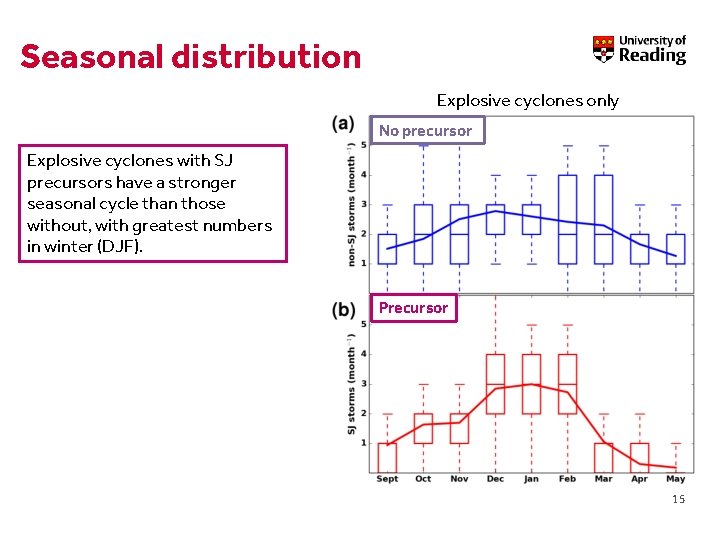
Seasonal distribution Explosive cyclones only No precursor Explosive cyclones with SJ precursors have a stronger seasonal cycle than those without, with greatest numbers in winter (DJF). Precursor 15
Example: ERICA IOP 4 Cool sector winds Warm sector winds 16
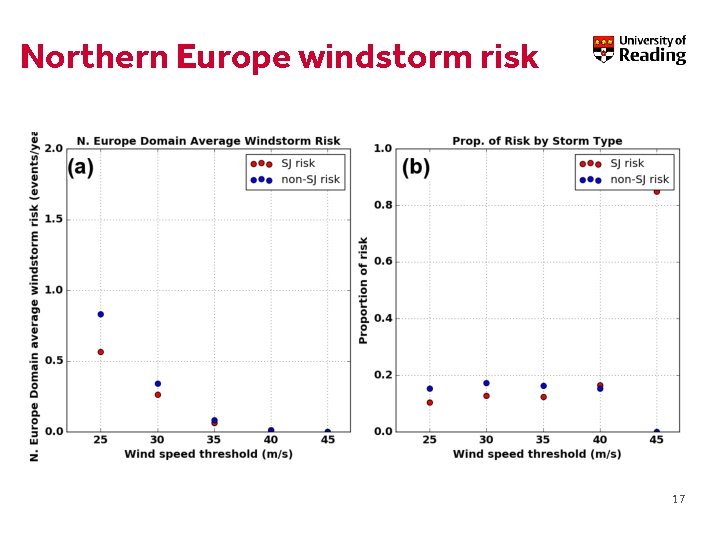
Northern Europe windstorm risk 17
- Slides: 17