
Department of Mathematical Sciences 40 Faculty 41 Graduate
















- Slides: 64
Department of Mathematical Sciences
• 40 Faculty • 41 Graduate Students • Approximately 80 Undergraduate Students
Research Areas • Applied Mathematics • Statistics • Combinatorics and Pure Math • Mathematics Education
Applied Mathematics – Computational Engine Research – F. Tanner – Simulation of Food Sprays – F. Tanner – Multiphase Fluid Systems – K. Feigl – Cardiac Dynamics – W. Ying – Computational Biology – L. Zhang March 2008 Computing Initiative
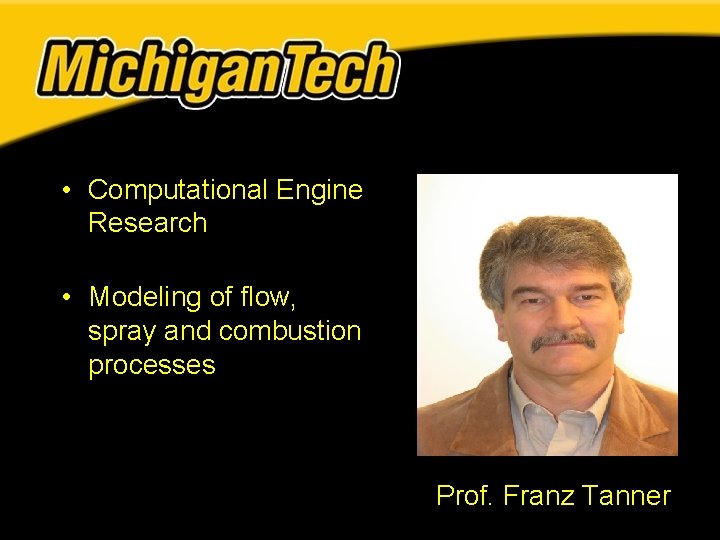
• Computational Engine Research • Modeling of flow, spray and combustion processes Prof. Franz Tanner
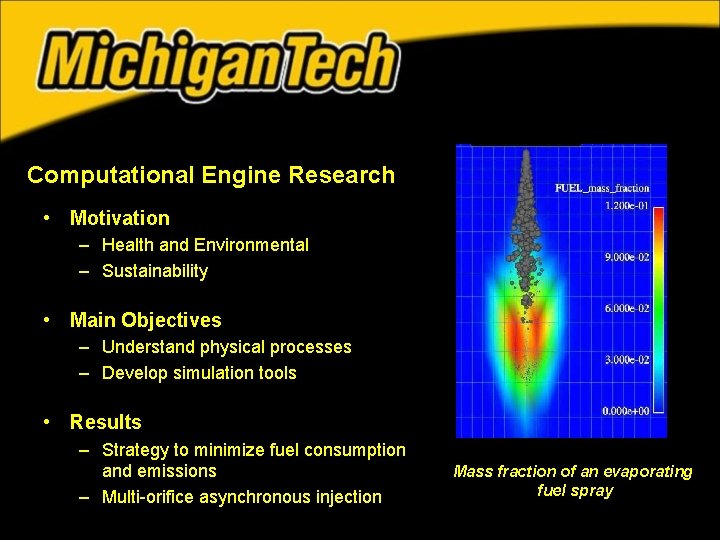
Computational Engine Research • Motivation – Health and Environmental – Sustainability • Main Objectives – Understand physical processes – Develop simulation tools • Results – Strategy to minimize fuel consumption and emissions – Multi-orifice asynchronous injection Mass fraction of an evaporating fuel spray
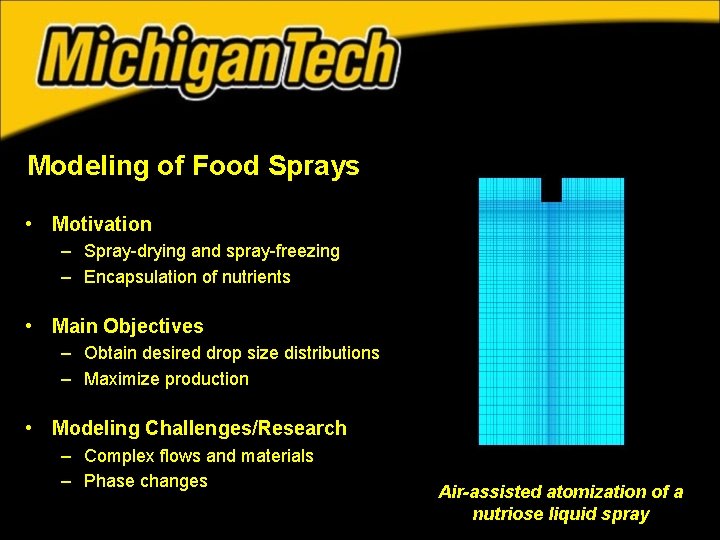
Modeling of Food Sprays • Motivation – Spray-drying and spray-freezing – Encapsulation of nutrients • Main Objectives – Obtain desired drop size distributions – Maximize production • Modeling Challenges/Research – Complex flows and materials – Phase changes Air-assisted atomization of a nutriose liquid spray
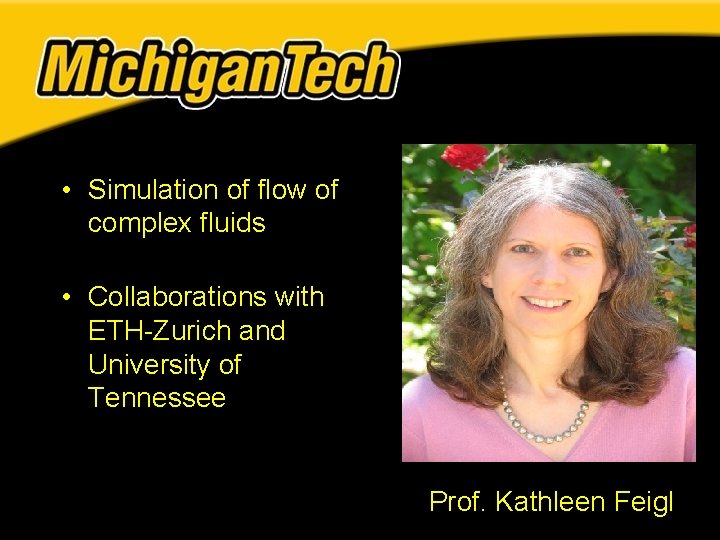
• Simulation of flow of complex fluids • Collaborations with ETH-Zurich and University of Tennessee Prof. Kathleen Feigl
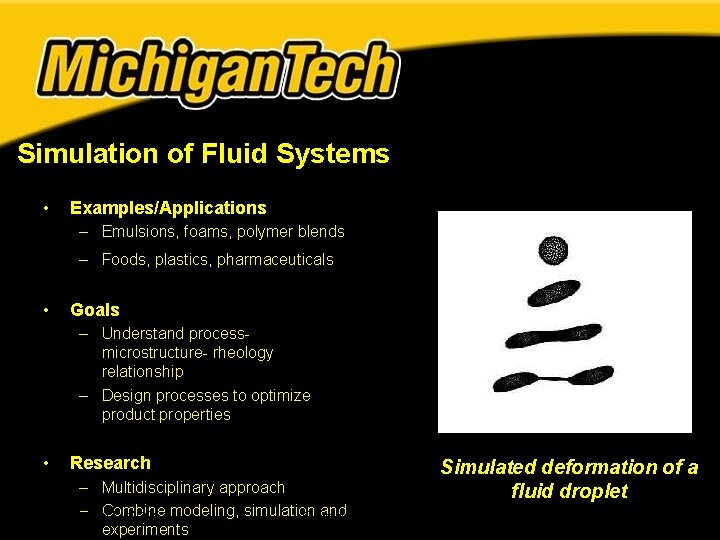
Simulation of Fluid Systems • Examples/Applications – Emulsions, foams, polymer blends – Foods, plastics, pharmaceuticals • Goals – Understand processmicrostructure- rheology relationship – Design processes to optimize product properties • Research Simulated deformation of a fluid droplet – Multidisciplinary approach – Combine and March 2008 modeling, simulation Computing Initiative experiments
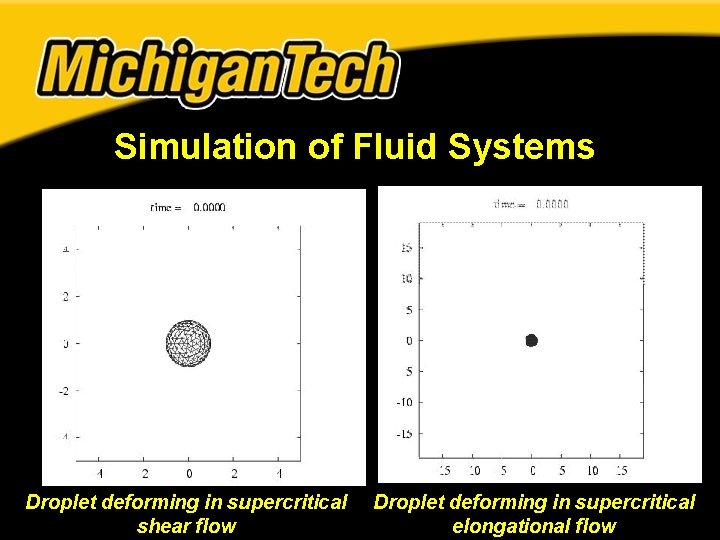
Simulation of Fluid Systems Droplet deforming in supercritical shear flow Droplet deforming in supercritical elongational flow
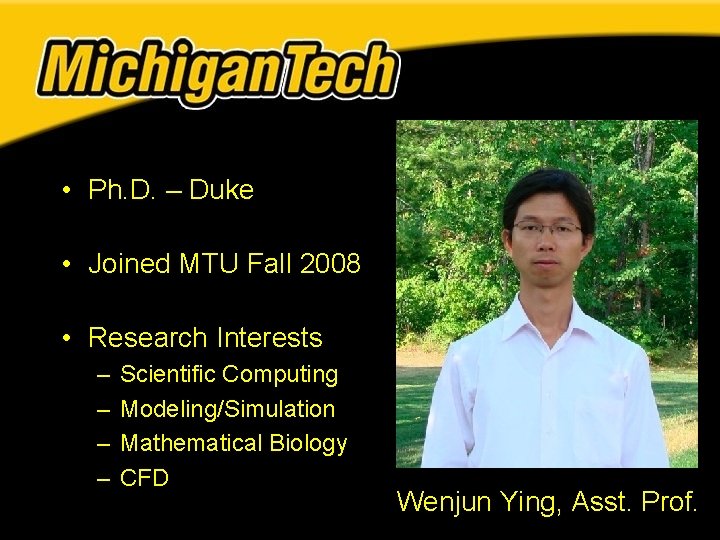
• Ph. D. – Duke • Joined MTU Fall 2008 • Research Interests – – Scientific Computing Modeling/Simulation Mathematical Biology CFD Wenjun Ying, Asst. Prof.
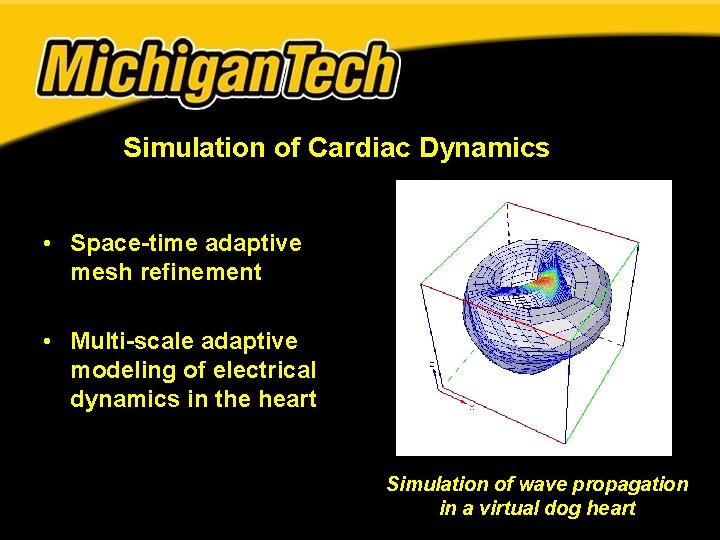
Simulation of Cardiac Dynamics • Space-time adaptive mesh refinement • Multi-scale adaptive modeling of electrical dynamics in the heart Simulation of wave propagation in a virtual dog heart
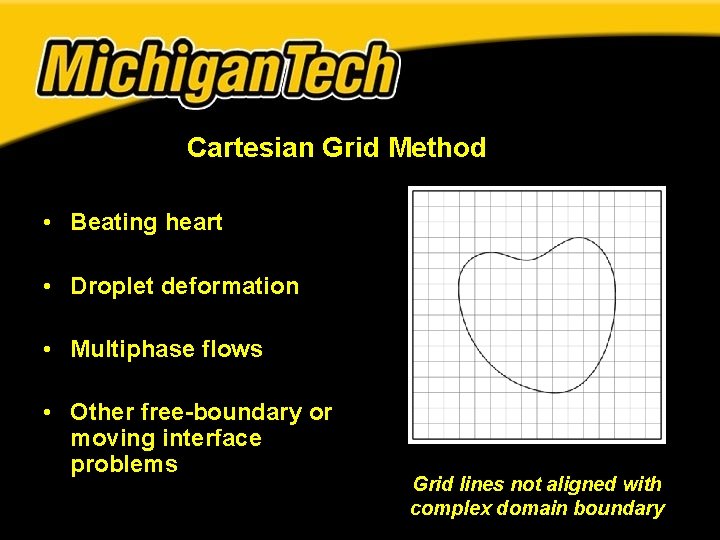
Cartesian Grid Method • Beating heart • Droplet deformation • Multiphase flows • Other free-boundary or moving interface problems Grid lines not aligned with complex domain boundary
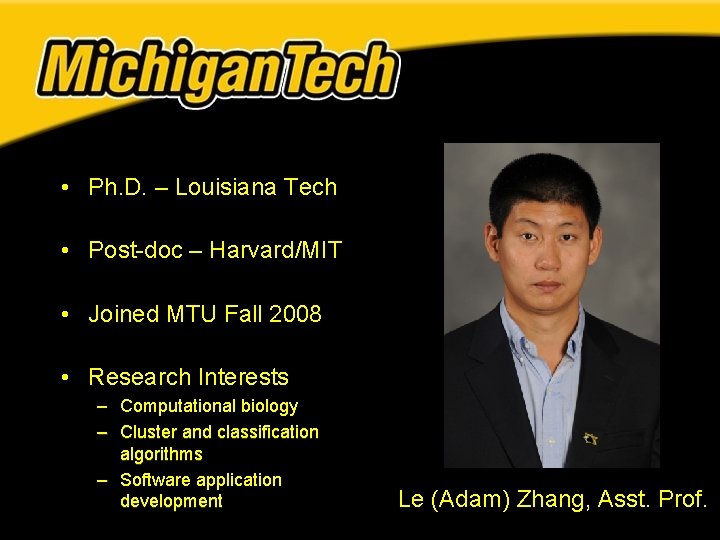
• Ph. D. – Louisiana Tech • Post-doc – Harvard/MIT • Joined MTU Fall 2008 • Research Interests – Computational biology – Cluster and classification algorithms – Software application development Le (Adam) Zhang, Asst. Prof.
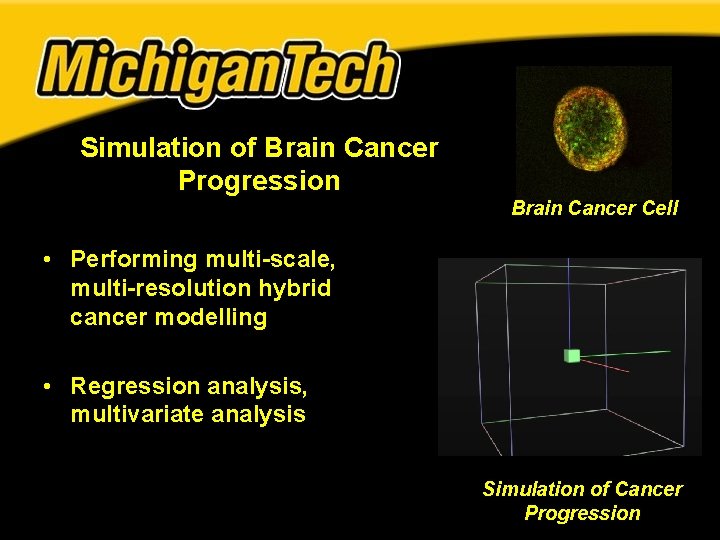
Simulation of Brain Cancer Progression Brain Cancer Cell • Performing multi-scale, multi-resolution hybrid cancer modelling • Regression analysis, multivariate analysis Simulation of Cancer Progression
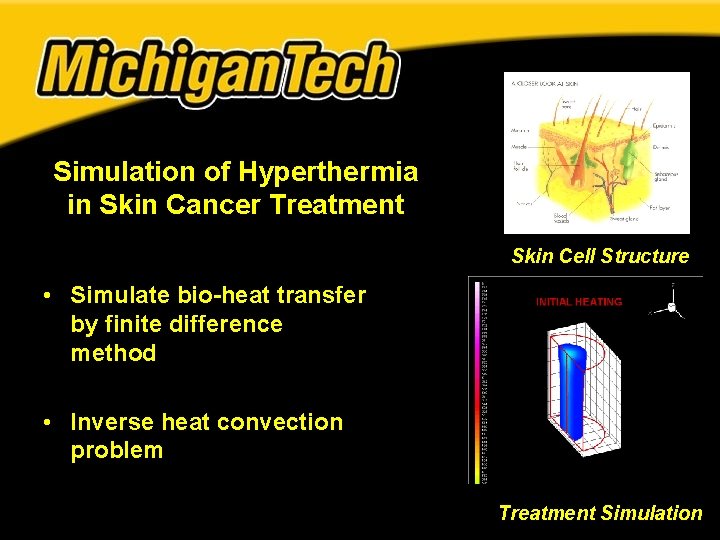
Simulation of Hyperthermia in Skin Cancer Treatment Skin Cell Structure • Simulate bio-heat transfer by finite difference method • Inverse heat convection problem Treatment Simulation
Statistics – Statistical Genetics – Q. Sha, R. Jiang, J. Dong, S. Zhang, H. Chen – Wildlife Population Studies – T. Drummer – Statistics , Probability, Optimization – I. Pinelis – Statistical Methodolgy and Data Analysis – Y. Munoz –Maldonado March 2008 Computing Initiative
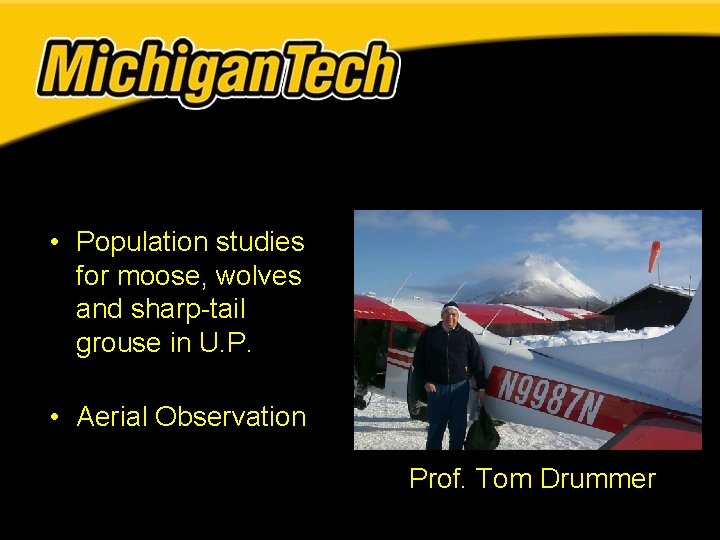
• Population studies for moose, wolves and sharp-tail grouse in U. P. • Aerial Observation Prof. Tom Drummer
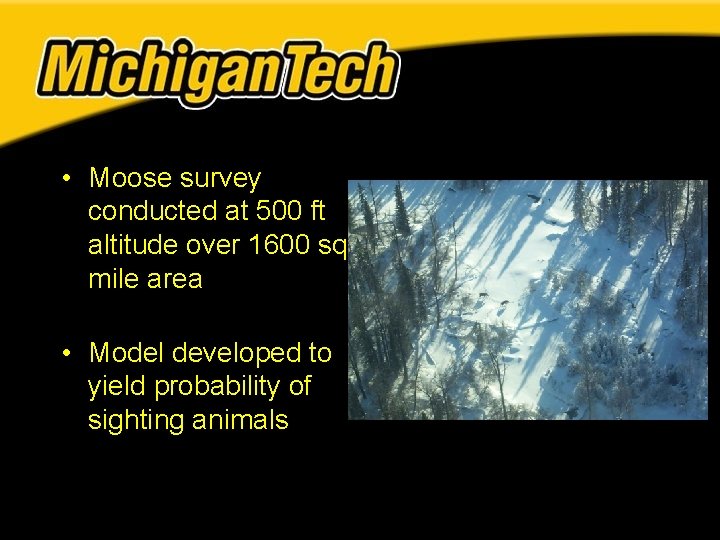
• Moose survey conducted at 500 ft altitude over 1600 sq. mile area • Model developed to yield probability of sighting animals
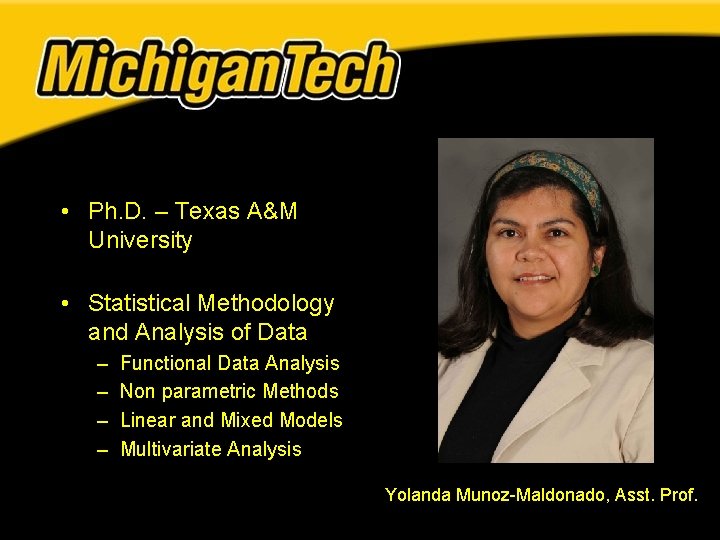
• Ph. D. – Texas A&M University • Statistical Methodology and Analysis of Data – – Functional Data Analysis Non parametric Methods Linear and Mixed Models Multivariate Analysis Yolanda Munoz-Maldonado, Asst. Prof.
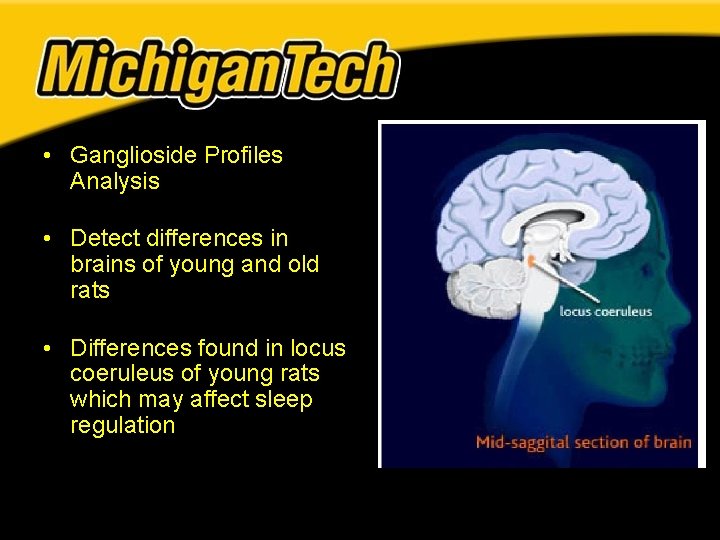
• Ganglioside Profiles Analysis • Detect differences in brains of young and old rats • Differences found in locus coeruleus of young rats which may affect sleep regulation
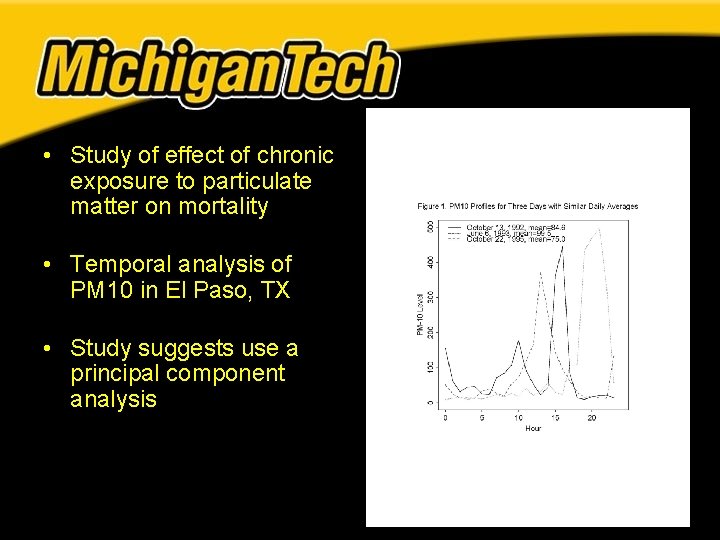
• Study of effect of chronic exposure to particulate matter on mortality • Temporal analysis of PM 10 in El Paso, TX • Study suggests use a principal component analysis
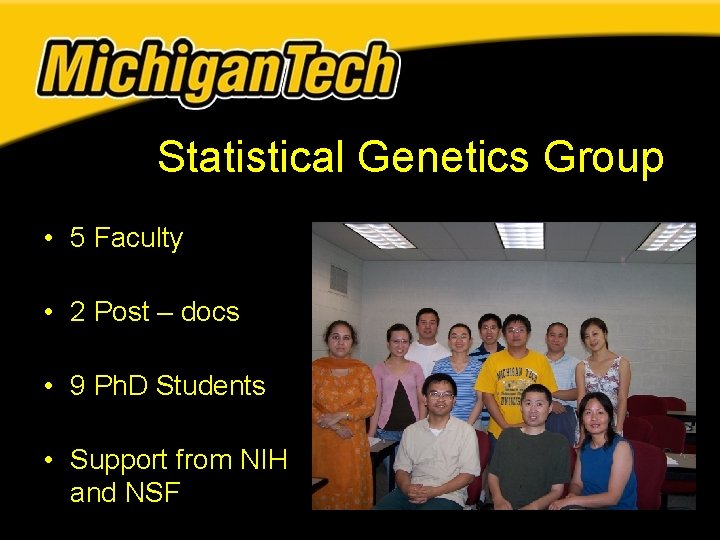
Statistical Genetics Group • 5 Faculty • 2 Post – docs • 9 Ph. D Students • Support from NIH and NSF
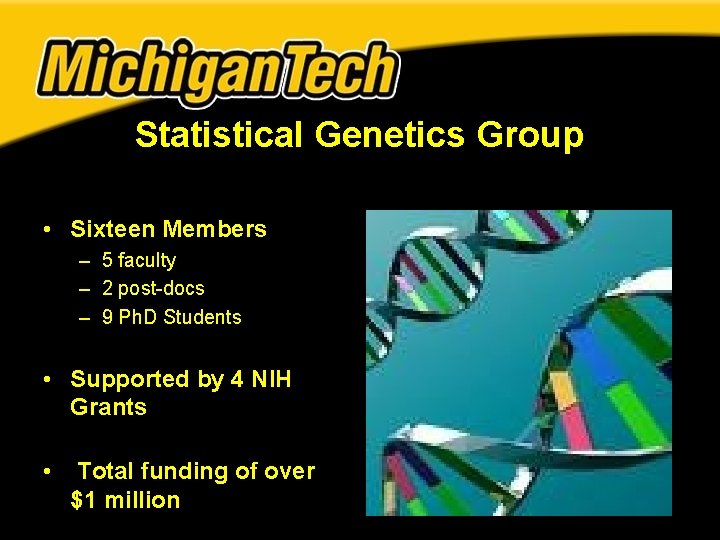
Statistical Genetics Group • Sixteen Members – 5 faculty – 2 post-docs – 9 Ph. D Students • Supported by 4 NIH Grants • Total funding of over $1 million
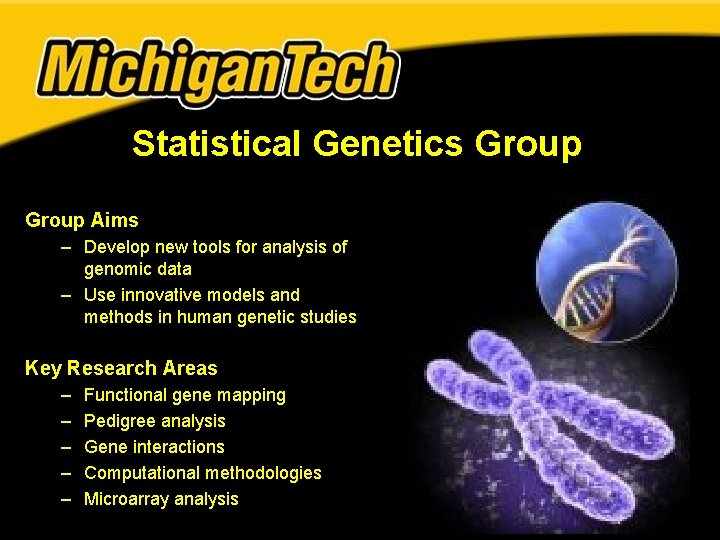
Statistical Genetics Group Aims – Develop new tools for analysis of genomic data – Use innovative models and methods in human genetic studies Key Research Areas – – – Functional gene mapping Pedigree analysis Gene interactions Computational methodologies Microarray analysis
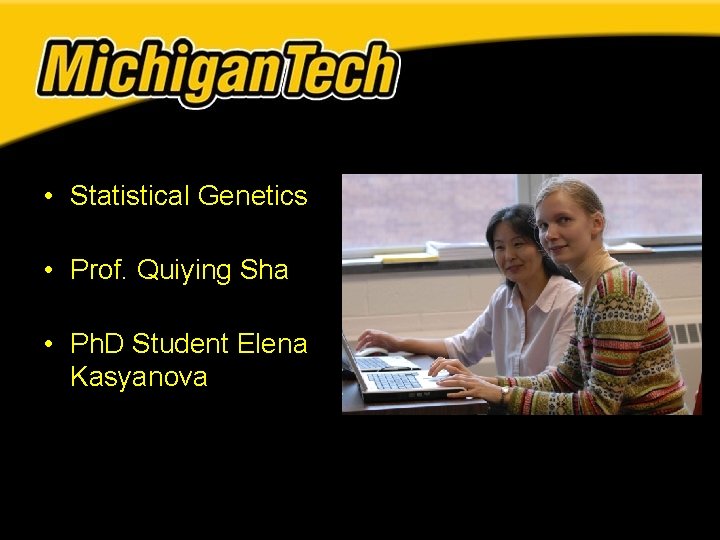
• Statistical Genetics • Prof. Quiying Sha • Ph. D Student Elena Kasyanova
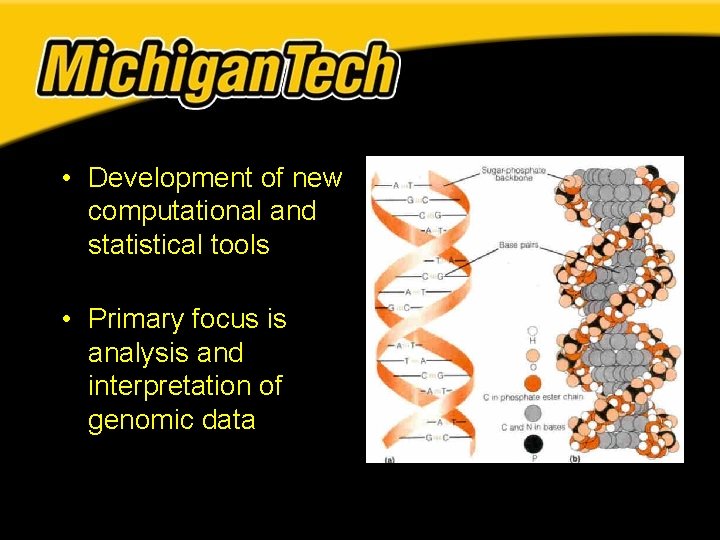
• Development of new computational and statistical tools • Primary focus is analysis and interpretation of genomic data
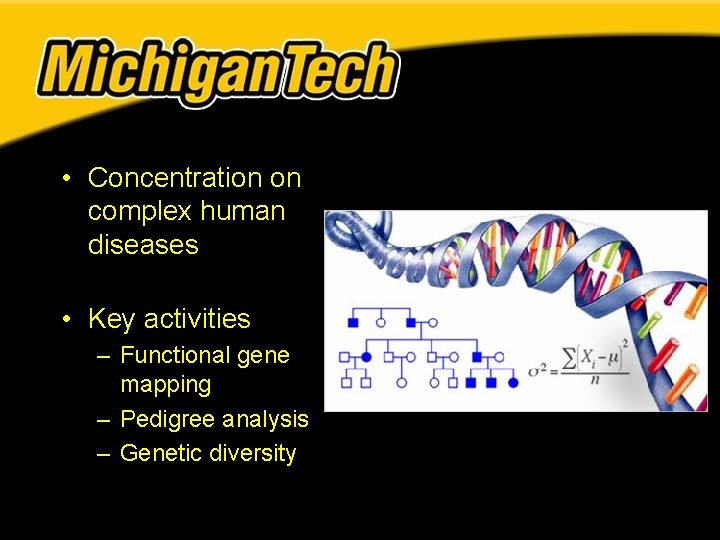
• Concentration on complex human diseases • Key activities – Functional gene mapping – Pedigree analysis – Genetic diversity
Combinatorics and Pure Math – Combinatorics – J. Bierbauer, D. Kreher, P. Merkey, V. Tonchev, M. Keranen – Commutative Algebra – F. Zanello March 2008 Computing Initiative
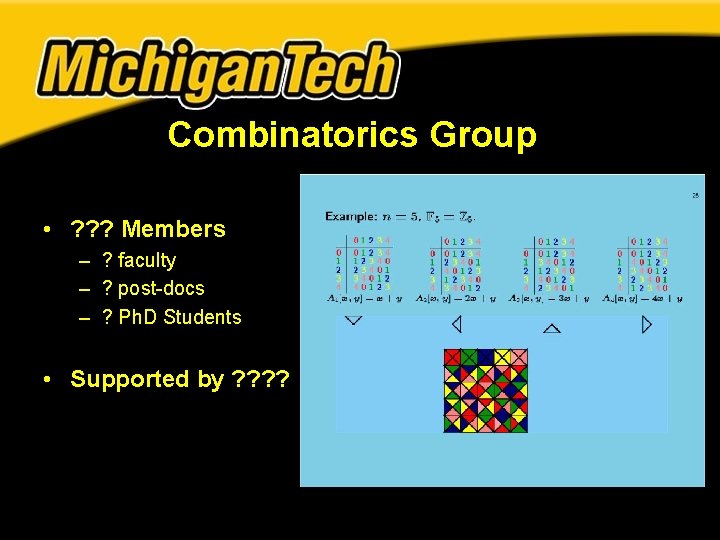
Combinatorics Group • ? ? ? Members – ? faculty – ? post-docs – ? Ph. D Students • Supported by ? ?
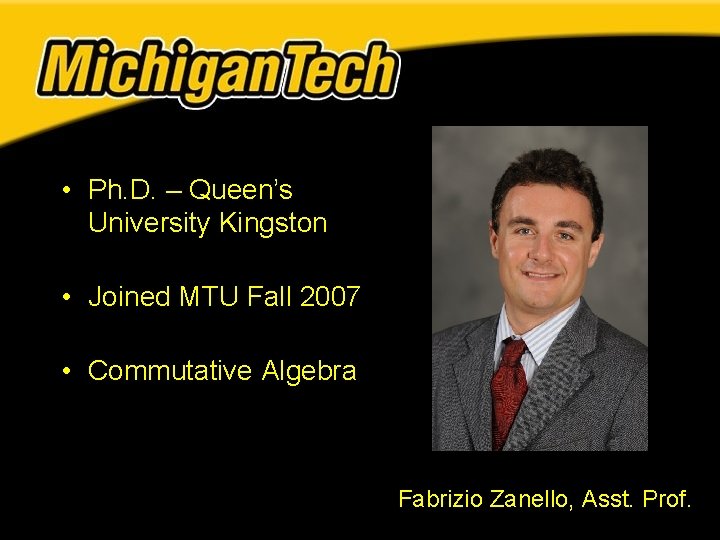
• Ph. D. – Queen’s University Kingston • Joined MTU Fall 2007 • Commutative Algebra Fabrizio Zanello, Asst. Prof.
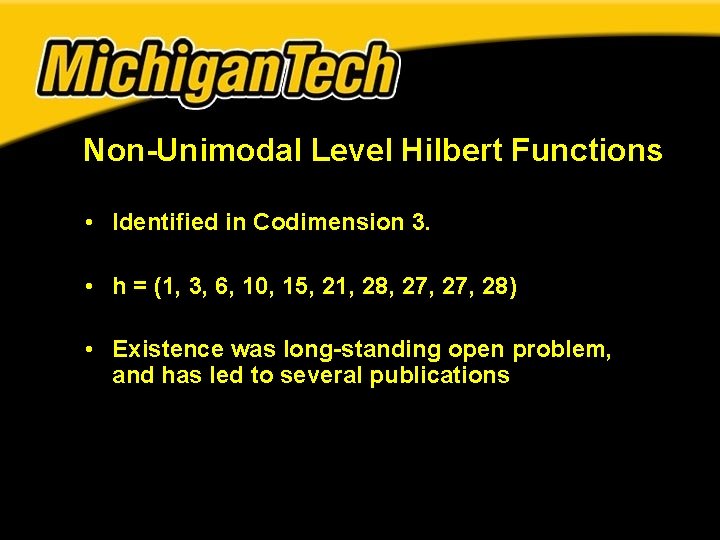
Non-Unimodal Level Hilbert Functions • Identified in Codimension 3. • h = (1, 3, 6, 10, 15, 21, 28, 27, 28) • Existence was long-standing open problem, and has led to several publications
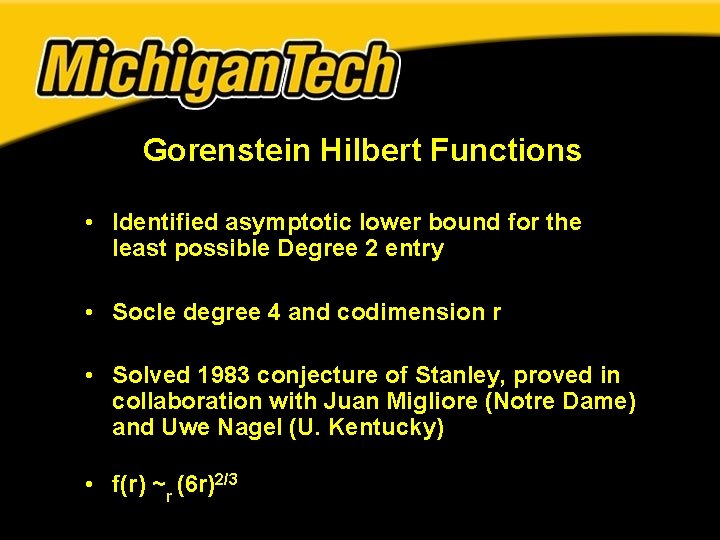
Gorenstein Hilbert Functions • Identified asymptotic lower bound for the least possible Degree 2 entry • Socle degree 4 and codimension r • Solved 1983 conjecture of Stanley, proved in collaboration with Juan Migliore (Notre Dame) and Uwe Nagel (U. Kentucky) • f(r) ~r (6 r)2/3
Teaching and Instructional Resources
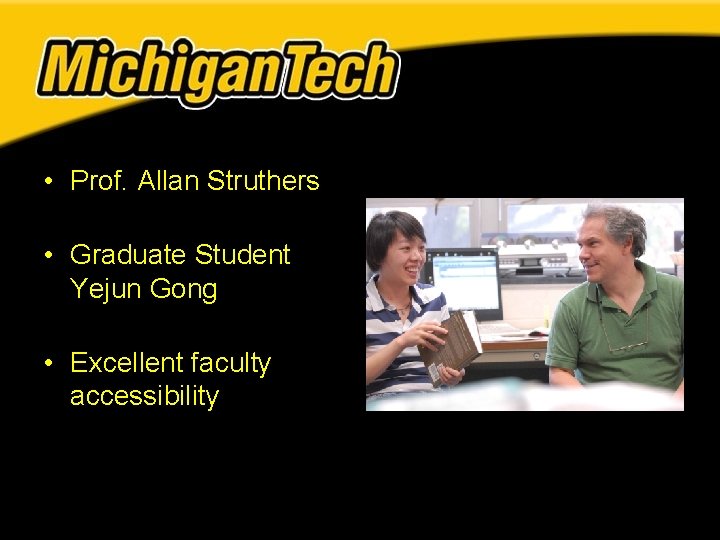
• Prof. Allan Struthers • Graduate Student Yejun Gong • Excellent faculty accessibility
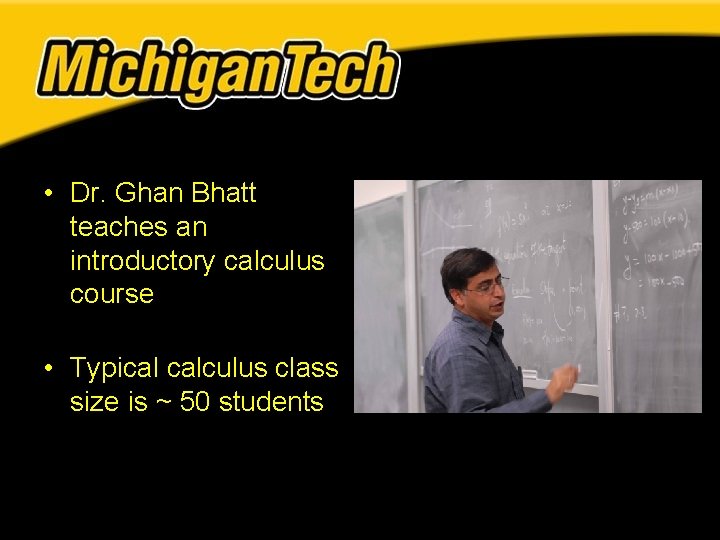
• Dr. Ghan Bhatt teaches an introductory calculus course • Typical calculus class size is ~ 50 students
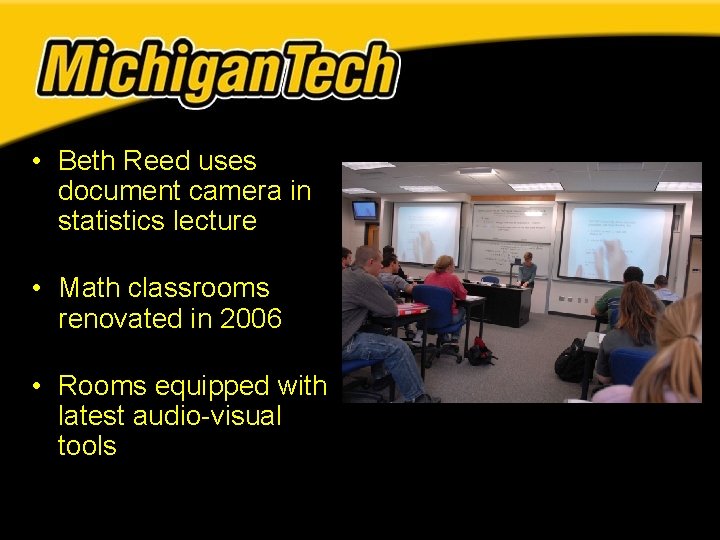
• Beth Reed uses document camera in statistics lecture • Math classrooms renovated in 2006 • Rooms equipped with latest audio-visual tools
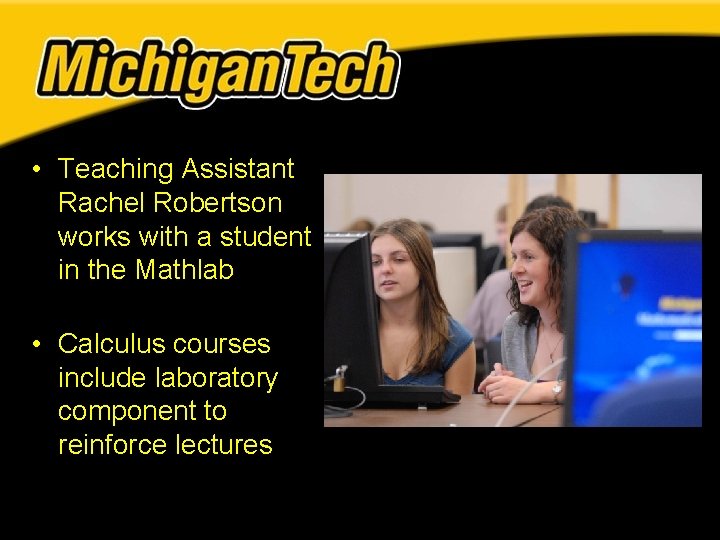
• Teaching Assistant Rachel Robertson works with a student in the Mathlab • Calculus courses include laboratory component to reinforce lectures
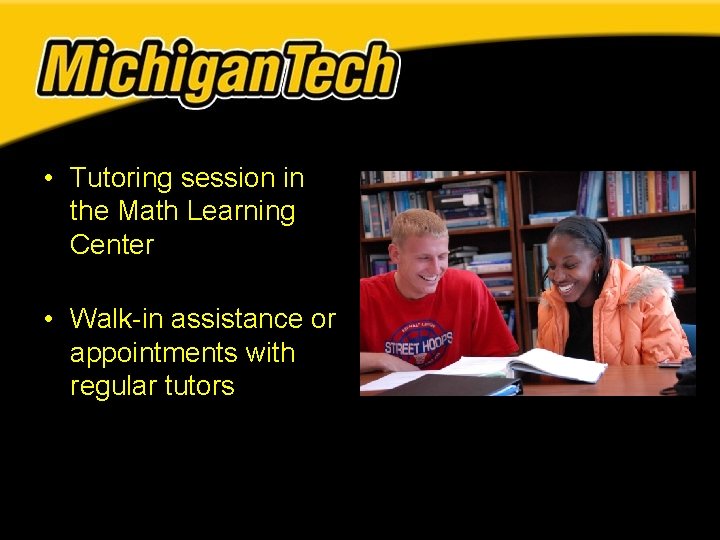
• Tutoring session in the Math Learning Center • Walk-in assistance or appointments with regular tutors
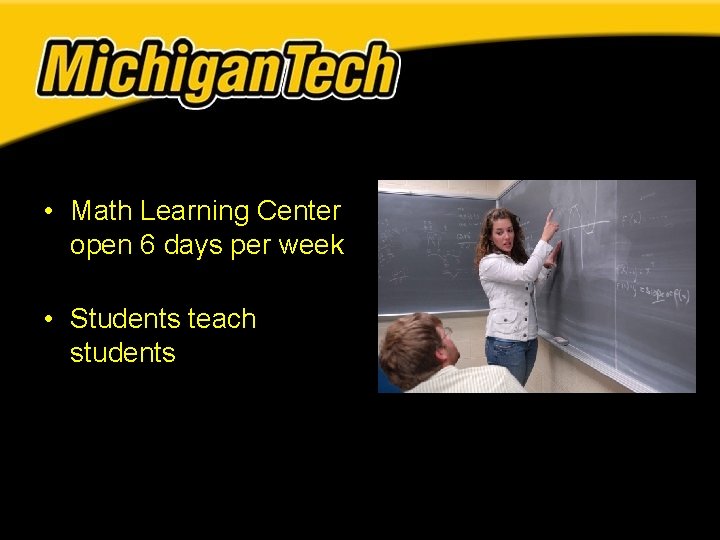
• Math Learning Center open 6 days per week • Students teach students