
Department of infectious diseases Classification of infectious Diseases

- Slides: 31
Department of infectious diseases Classification of infectious Diseases Epidemiological characteristics of intestinal infections. Gafarova M. T.
Epidemiology studies infectious disease. And as the general number of infectious diseases achieves several thousand, there is a necessity for their classification and it determines our representations about measures of struggle against extensive group of pathology of the person. There is great number of classifications:
• 1. Classification on an a belonging of pathogens of diseases to determined taxonomic group: bacterial, viral, rickettsial, spirochetotic infections, mycosises, helminthosises, leptospirosises. • 2. Classification on the basis of features of the reservoir of pathogen: anthroponosis, zoonosis. For anthroponosises and zoonosises it is offered L. V. Gromashevsky classification – on the basis of specific localization of pathogen in an organism of the host and to the mechanism of transmission corresponding to it:
Anthroponosises: • • • Intestinal infections – localization of pathogen in a gastroenteric path and accordingly the fecal-oral mechanism of transmission (cholera, dysentery, poliomyelitis, viral hepatitis A (VHA), viral hepatitis E (VHE)); · Infections of respiratory tracts – localization of pathogen in respiratory tracts and the aerogenic mechanism of transmission (diphtheria, meningococcus infection, flu, measles, epidemic parotitis, chicken pox); · Blood infections – localization of pathogen in blood and transmissible mechanism of transmission ( malaria, ricketsiosises, tick-borne encephalitis); · Infection of external covers – localization on integuments both mucous and the contact mechanism of transmission (furiousness, superficial mycosises, a physiognomy, tetanus); · Infections with plural localization and plural ways of transmission (plague, tularemia, Q fever);
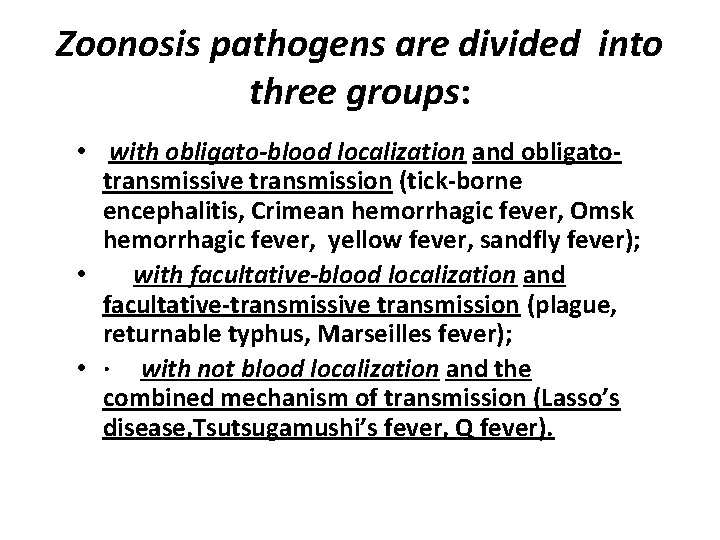
Zoonosis pathogens are divided into three groups: • with obligato-blood localization and obligatotransmissive transmission (tick-borne encephalitis, Crimean hemorrhagic fever, Omsk hemorrhagic fever, yellow fever, sandfly fever); • with facultative-blood localization and facultative-transmissive transmission (plague, returnable typhus, Marseilles fever); • · with not blood localization and the combined mechanism of transmission (Lasso’s disease, Tsutsugamushi’s fever, Q fever).
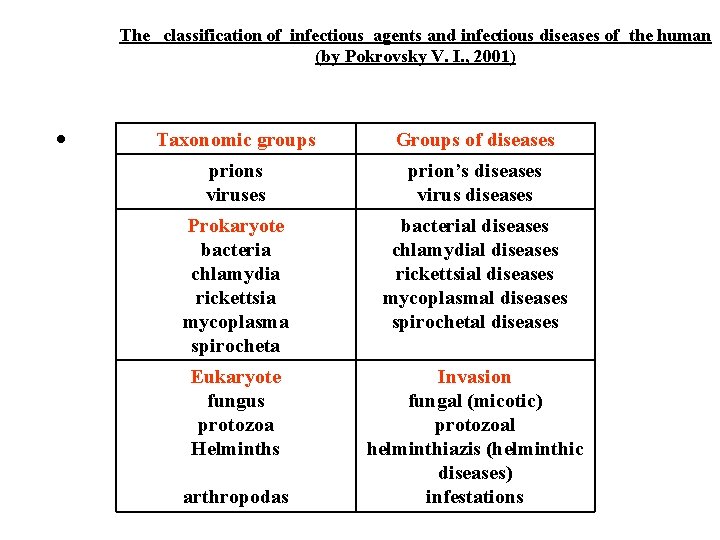
The classification of infectious agents and infectious diseases of the human (by Pokrovsky V. I. , 2001) • Taxonomic groups Groups of diseases prions viruses prion’s diseases virus diseases Prokaryote bacteria chlamydia rickettsia mycoplasma spirocheta bacterial diseases chlamydial diseases rickettsial diseases mycoplasmal diseases spirochetal diseases Eukaryote fungus protozoa Helminths Invasion fungal (micotic) protozoal helminthiazis (helminthic diseases) infestations arthropodas
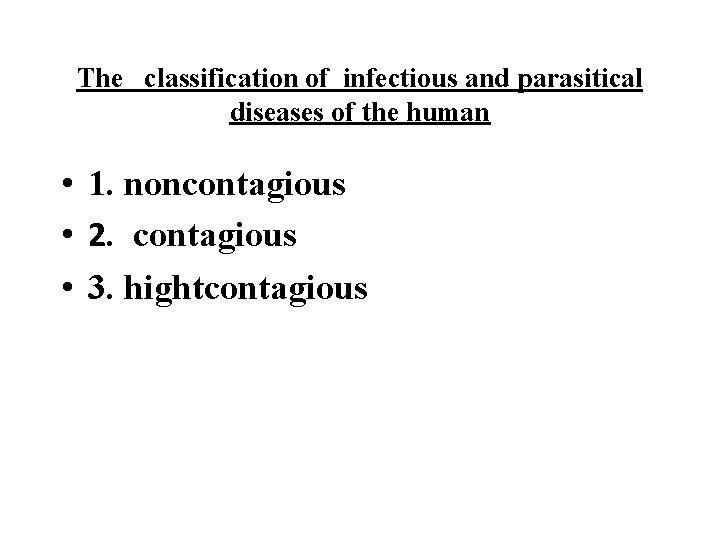
The classification of infectious and parasitical diseases of the human • 1. noncontagious • 2. contagious • 3. hightcontagious
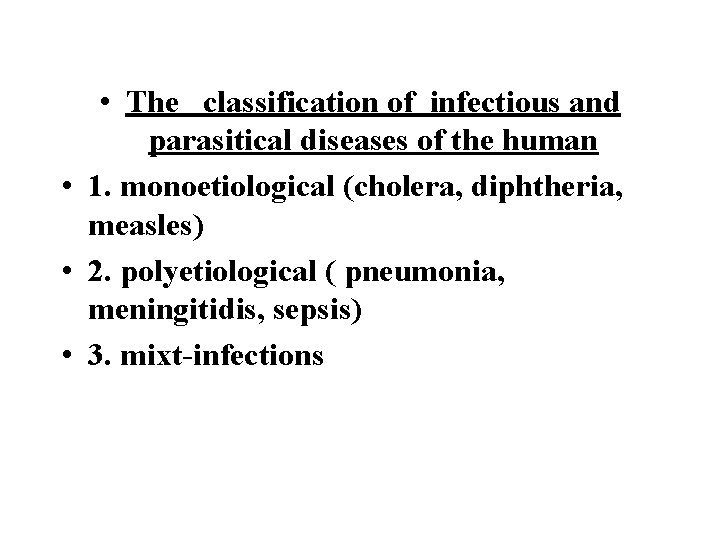
• The classification of infectious and parasitical diseases of the human • 1. monoetiological (cholera, diphtheria, measles) • 2. polyetiological ( pneumonia, meningitidis, sepsis) • 3. mixt-infections
• The epidemic characteristic of intestinal infections The significant part in structure of infectious disease is made with intestinal infections. There are polyetiologic diseases, various in the epidemiological relation, but the general features of clinical display unite them – diarrhea and the fecal-oral mechanism of transmission. • So, for infections with intestinal localization of pathogen the fecal-oral mechanism of transmission is characteristic. • Allocation of pathogen from the infected organism (the 1 st stage) is connected to the act of defecation or vomiting. The 2 nd stage of the fecal-oral mechanism is not always obvious. Well and penetration of pathogen into an organism (the 3 -d stage) occurs through a mouth. It is allocated three types of particularly developing ways of transmission: contact, food and water. Variants of food and waterway of transmission are rather various and depend on the mechanism of hit of virulent pathogens on food and water.
The epidemic characteristic of intestinal infections The significant part in structure of infectious disease is made with intestinal infections. There are polyetiologic diseases, various in the epidemiological relation, but the general features of clinical display unite them – diarrhea and the fecal-oral mechanism of transmission. • So, for infections with intestinal localization of pathogen the fecal-oral mechanism of transmission is characteristic.
• The basic and intermediate factors of carry of pathogens on food are flies, water, hands and subjects of life are. Variants of infection of water are diverse and depend on conditions of penetration of the infected excrements in water. • Contact transmission is realized in the organized collectives among children (less often than adults) and in families, but concrete factors of transmission are difficultly revealed. • Depending on activity of the fecal-oral mechanism of transmission it is possible to allocate 2 groups of diseases: •
• The basic and intermediate factors of carry of pathogens on food are flies, water, hands and subjects of life are. Variants of infection of water are diverse and depend on conditions of penetration of the infected excrements in water. • Contact transmission is realized in the organized collectives among children (less often than adults) and in families, but concrete factors of transmission are difficultly revealed. • Depending on activity of the fecal-oral mechanism of transmission it is possible to allocate 2 groups of diseases: •
• The 1 st group of diseases – a poliomyelitis, VHA, VHE, oral-viral infection, Zonne’s dysentery – is characterized by high activity of contact transmission, especially, in children's age, the contents virulent pathogens in feces of infection sources is so great, that even it is enough small particles of the infected feces for effective infection. • The 2 nd group of diseases – the typhoid fever, Flexner’s dysentery, cholera, for them is characteristic mainly food and water ways of infection which are realized in much old age groups is more often, providing chronic or slow epidemics.
• At intestinal infections the basic preconditions of activization of the fecal-oral mechanism of transmission of pathogen and complications of an epidemic situation can be: • · household discomfort and low sanitary culture of people; • · system of gathering and removal of sewages (presence or absence of the sewerage system); • · the general municipal accomplishment (a place of flies birth); • · the organization of water supply, (presence or absence of a water-pipe, probability of faecal infection of water sources, a degree of disinfecting of the water, the insufficient control over quality of water);
At intestinal infections the basic preconditions of activization of the fecaloral mechanism of transmission of pathogen and complications of an epidemic situation can be: household discomfort and low sanitary culture of people; • system of gathering and removal of sewages (presence or absence of the sewerage system); • the general municipal accomplishment (a place of flies birth); • the organization of water supply, (presence or absence of a water-pipe, probability of faecal infection of water sources, a degree of disinfecting of the water, the insufficient control over quality of water); •
• catering services, probability of faecal pollution of fruit (flies) and vegetables (on irrigation fields), probability of access to foodstuff (milk, bread) infected people; • infringement of a mode of pasteurization of milk on milk factory and release of the dairy production which is not adequate to sanitary requirements;
• receipt in sale of the big parties of imported vegetables, fruit, greens, etc. · emergency dumps of sewer waters in open reservoirs; • mass bathing's in intensively polluted open reservoirs, etc. • At intestinal infections in the development countries harbingers of complication of an epidemic situation can be the following signs: increase seeding of pathogenic microorganisms from people and objects of an environment (water, food); revealing of carriers of pathogens of intestinal infections among the personnel; • · microbes pollution of foodstuff;
Epidemiology of typhoid-paratyphoid fever • The typhoid fever meets in all parts of the world, in all climatic zones. In Africa – Egypt and Morocco, on American are most infected continent – Columbia, Mexico, Peru, Chile, Ecuador, in Asia – Indonesia, Iran, Turkey. In Europe the highest disease in Italy, Spain, Portugal, Greece. • The analysis of dynamics diseases by various infections has allowed revealing two types of periodicity: seasonal variations and the cyclic changes covering of some years. Seasonal prevalence of morbidity is characterized by increases during the summer-autumnal period, it is especially typical for territories with the increased morbidity feebly marked.
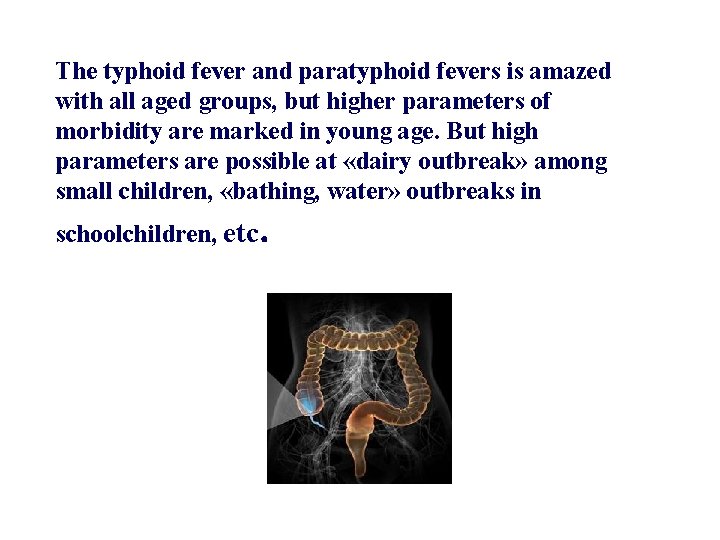
The typhoid fever and paratyphoid fevers is amazed with all aged groups, but higher parameters of morbidity are marked in young age. But high parameters are possible at «dairy outbreak» among small children, «bathing, water» outbreaks in schoolchildren, etc .
Epidemic characteristics of shigelloses • Shigelloses have the first place in structure of acute intestinal infections (AII). Universal spreading of disease, polyetiologicity, a variety of clinical forms, significant children's death rate, dearness effective preventive and anti-epidemic means make this infection by an actual problem. Dependence of morbidity from sanitary-municipal accomplishment is proved to that shigellosis is registered more frequently among urban population, especially, among children preschool children’s establishments and collectives.
• Children are ill more often in comparison with adults (high susceptibility, opportunity of infection at infringements of meal and regimen in crèches and kindergartens). The best addressing for medical aid and more full revealing of patients. Morbidity by shigellosis are registered within all year, seasonal growth in summertime is connected to activation of a food way (dairy products) in transmission of Zone's shigellosis.
• Flexner’s shigellosis is determined by activity of water and household ways of transmission of an infection in conditions of the lowest level sanitary-municipal accomplishments. • Zone's shigellosis – activity of a food way of transmission of an infection in conditions of a high level of centralization of public catering and population supply.
• Thus, at uniform fecal-oral mechanism of infection transmission, determining the basic laws of the basic shigellosis forms, Zonne’s dysentery should be characterized as food (mainly dairy) infection, Flexner’s dysentery – as water and Grigoriev-Shiga’s dysentery – as a household infection. It is a basic postulate of theory of conformity (V. I. Pokrovsky and Yu. P. Solodovnikov, 1978), i. e. for each kind of pathogen of dysentery there is the main (primary) way of transmission providing preservation and spreading of shigella of the given kind (serotype, subtype).
• Epidemic practice included the term «epidemic control» which is a basis of the modern organization of anti-epidemic works. By definition the WHO – epidemic control – is a system of dynamic and complex tracking for epidemic process in the certain territory. Control includes gathering, transmission, analysis and estimation of the epidemiological information with the purpose of development of recommendations for preventive maintenance and the organizations of anti-epidemic measures.
Epidemic control of typhoid-paratyphoid fever diseases • The purpose is a decrease of parameters of morbidity and the prevention of outbreaks. For what the account of risk of infection through water, seasonal prevalence of disease, group of "risk" of the population, revealing of carriers, their account, specific prophylaxis (vaccine), under epidemic indications emergency prophylaxis (bacteriophage, chloramphenicol by ambulatory) is necessary; all complex of sanitary-and-hygienic actions and if necessary attraction of corresponding departments and measures.
Epidemic control at shigellosises • At Zonne’s dysentery the basic efforts are concentrated on maintenance of control for preschool children’s establishments and application bacteriophage under indications; the sanitary control over quality of manufacture and consumption of milk and dairy products; sanitary-and-hygienic measures; maintenance of a good-quality meal and water supply.
• Flexner’s dysentery – is a risk of formation of the focus in the collective, the rest taking place in zones which are not provided with good-quality potable water – bacteriophage during a summer season.
• Grigoriev-Shiga’s dysentery – it is duly revealing of diseases (whether delivery was) and corresponding anti-epidemic measures. Diagnostics: reaction of passive agglutination (RPGA) with erythocytic diagnosticum (the Central Africa, South-East Asia, Central America).
I thank for attention