
Department of Higher Education and Training OVERVIEW SOUTH

- Slides: 27
Department of Higher Education and Training OVERVIEW: SOUTH AFRICAN HIGHER EDUCATION AND TRAINING LANDSCAPE Presentation to the Joint Portfolio Committees on Basic Education, and Higher Education and Training 17 March 2016
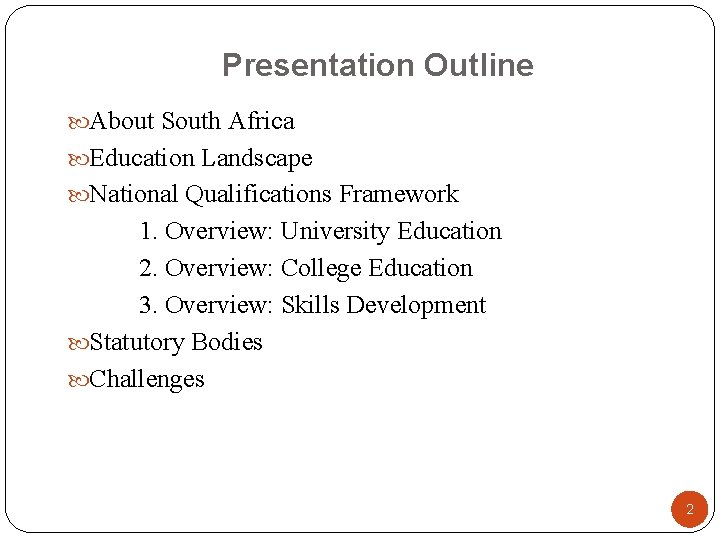
Presentation Outline About South Africa Education Landscape National Qualifications Framework 1. Overview: University Education 2. Overview: College Education 3. Overview: Skills Development Statutory Bodies Challenges 2
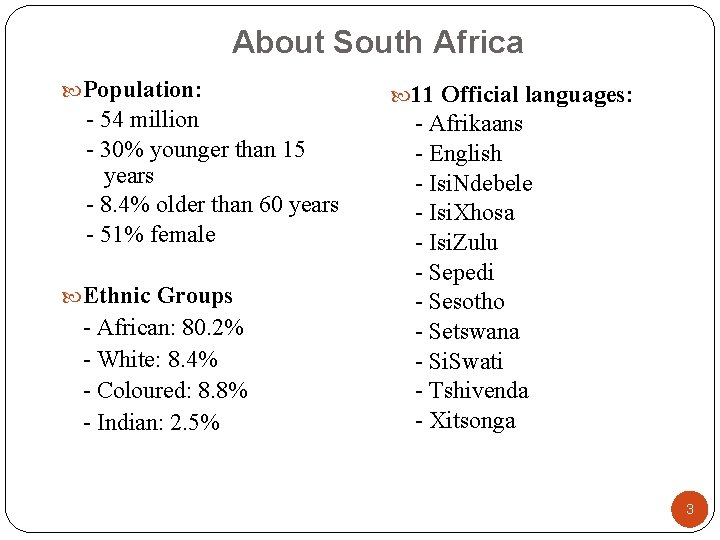
About South Africa Population: - 54 million - 30% younger than 15 years - 8. 4% older than 60 years - 51% female Ethnic Groups - African: 80. 2% - White: 8. 4% - Coloured: 8. 8% - Indian: 2. 5% 11 Official languages: - Afrikaans - English - Isi. Ndebele - Isi. Xhosa - Isi. Zulu - Sepedi - Sesotho - Setswana - Si. Swati - Tshivenda - Xitsonga 3
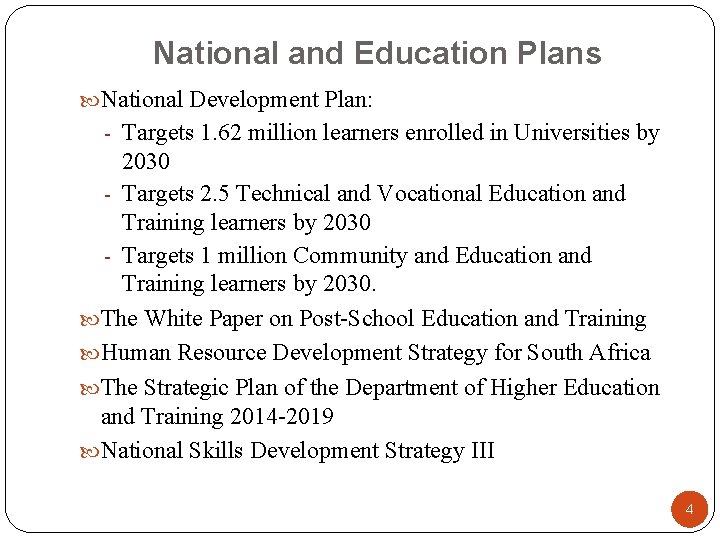
National and Education Plans National Development Plan: - Targets 1. 62 million learners enrolled in Universities by 2030 - Targets 2. 5 Technical and Vocational Education and Training learners by 2030 - Targets 1 million Community and Education and Training learners by 2030. The White Paper on Post-School Education and Training Human Resource Development Strategy for South Africa The Strategic Plan of the Department of Higher Education and Training 2014 -2019 National Skills Development Strategy III 4
Education Landscape DHET was established as a result of government’s post 2009 election restructuring process Integrated approach to education and training. The Department of Education was split into two Departments, i. e. : - Department of Basic Education (DBE): dealing with only schooling and adult literacy - Department of Higher Education and Training: dealing with higher education, vocational education, all postliteracy adult education, and workplace skills training. DHET also has responsibility for the country’s Human Resource Development (HRD) Strategy whose mission is to strengthen the skills and human resource base of the country 5
Vision, Mission & Value Statement VISION Leading post-school education and training for growth MISSION To provide national strategic leadership in support of an integrated Post-School Education and Training system towards improved quality of life of South African citizenry VALUE STATEMENT DHET subscribes to the following core business values: - Integrity, Accountable, Committed, Responsive, Proactive, Continuous learning - Rational, Team work, Emotionally intelligent It should be noted that approximately 3 young people of about 10 people are “Not in Employment, Education or Training (NEET)”. The DHET has to service approximately 22 million people who have an education attainment level of not having completed 6
How Will We Undertake Our Mission An integrated, articulated, differentiated and fully inclusive post -school system that allows all South Africans to access relevant post-school education and training, in order to fulfil the economic and social goals of participation in an inclusive economy and society For DHET to develop capable, well educated and skilled citizens that are able to compete in a sustainable, diversified and knowledge-intensive international economy, which meets the developmental goals of the country By reducing the skills bottlenecks, especially in priority and scarce skills areas; improving participation rates in the postschool system; correcting distortions in the shape, size and distribution of access to post-school education and training; and improving quality and efficiency in the system, its sub-systems 7
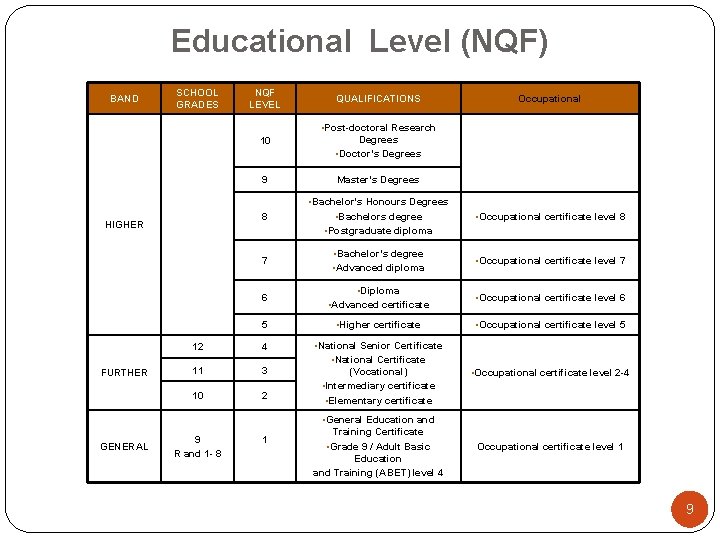
National Qualifications Framework The National Qualifications Framework (NQF) is a framework which sets boundaries, principles and guidelines that provide a vision, a philosophical base and an organisational structure – for the construction of a qualifications system. All education and training in South Africa fits within this framework South African levels of Education are detailed in the NQF In short, the NQF is a set of principles and guidelines by which records of learner achievement are registered to enable national recognition of acquired skills and knowledge, thereby ensuring an integrated system that encourages lifelong learning The NQF consist of 10 levels divided into three bands, namely: 1. General Education (level 1 – schooling up to Grade 9 and ABET) 2. Further Education and Training (levels 2 – 4: Grade 10 – 12) 8
Educational Level (NQF) BAND SCHOOL GRADES NQF LEVEL QUALIFICATIONS 10 • Post-doctoral Research Degrees • Doctor’s Degrees 9 Master’s Degrees 8 • Bachelor’s Honours Degrees • Bachelors degree • Postgraduate diploma • Occupational certificate level 8 7 • Bachelor’s degree • Advanced diploma • Occupational certificate level 7 6 • Diploma • Advanced certificate • Occupational certificate level 6 5 • Higher certificate • Occupational certificate level 5 12 4 11 3 • Occupational certificate level 2 -4 10 2 • National Senior Certificate • National Certificate (Vocational) • Intermediary certificate • Elementary certificate • General Education and Training Certificate • Grade 9 / Adult Basic Education and Training (ABET) level 4 Occupational certificate level 1 HIGHER FURTHER GENERAL 9 R and 1 - 8 1 Occupational 9
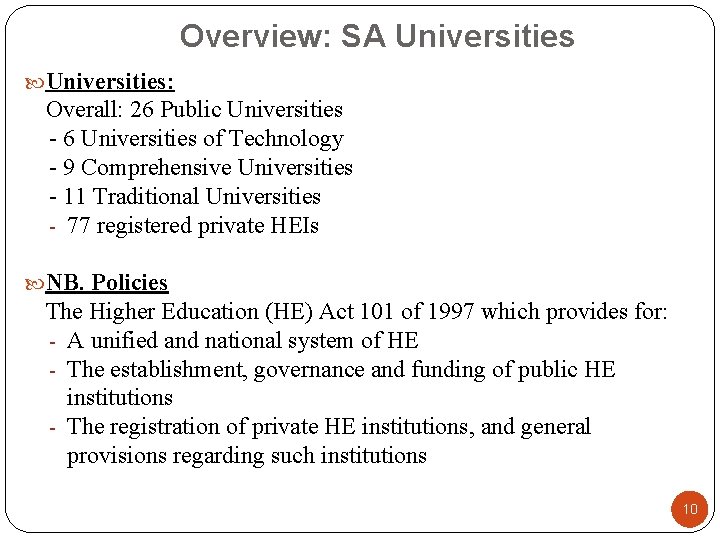
Overview: SA Universities: Overall: 26 Public Universities - 6 Universities of Technology - 9 Comprehensive Universities - 11 Traditional Universities - 77 registered private HEIs NB. Policies The Higher Education (HE) Act 101 of 1997 which provides for: - A unified and national system of HE - The establishment, governance and funding of public HE institutions - The registration of private HE institutions, and general provisions regarding such institutions 10
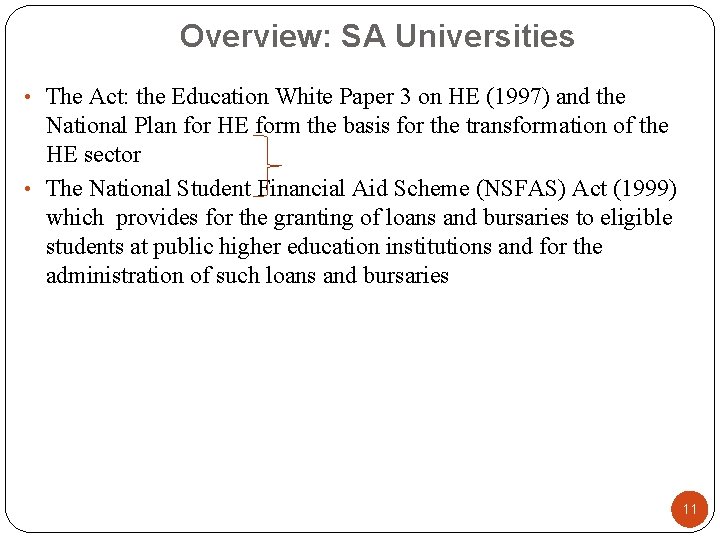
Overview: SA Universities • The Act: the Education White Paper 3 on HE (1997) and the National Plan for HE form the basis for the transformation of the HE sector • The National Student Financial Aid Scheme (NSFAS) Act (1999) which provides for the granting of loans and bursaries to eligible students at public higher education institutions and for the administration of such loans and bursaries 11
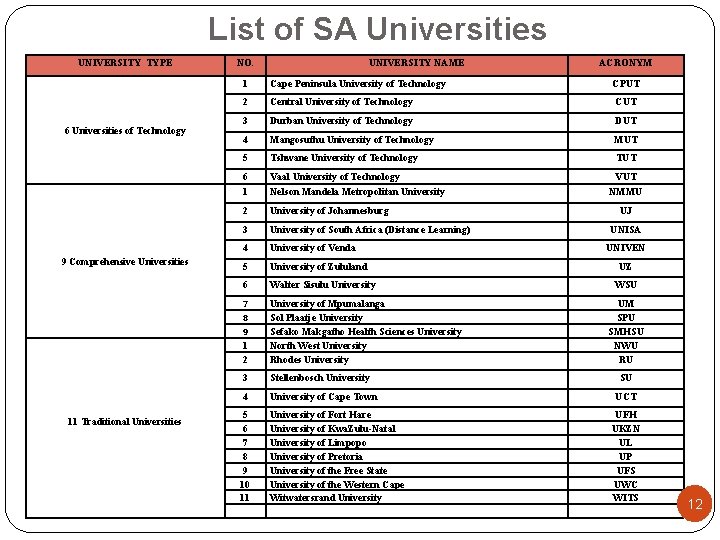
List of SA Universities UNIVERSITY TYPE 6 Universities of Technology 9 Comprehensive Universities 11 Traditional Universities NO. UNIVERSITY NAME ACRONYM 1 Cape Peninsula University of Technology CPUT 2 Central University of Technology CUT 3 Durban University of Technology DUT 4 Mangosuthu University of Technology MUT 5 Tshwane University of Technology TUT 6 Vaal University of Technology VUT 1 Nelson Mandela Metropolitan University 2 University of Johannesburg 3 University of South Africa (Distance Learning) 4 University of Venda 5 University of Zululand 6 Walter Sisulu University 7 8 9 1 2 University of Mpumalanga Sol Plaatje University Sefako Makgatho Health Sciences University North West University Rhodes University 3 Stellenbosch University 4 University of Cape Town 5 6 7 8 9 10 11 University of Fort Hare University of Kwa. Zulu-Natal University of Limpopo University of Pretoria University of the Free State University of the Western Cape Witwatersrand University NMMU UJ UNISA UNIVEN UZ WSU UM SPU SMHSU NWU RU SU UCT UFH UKZN UL UP UFS UWC WITS 12
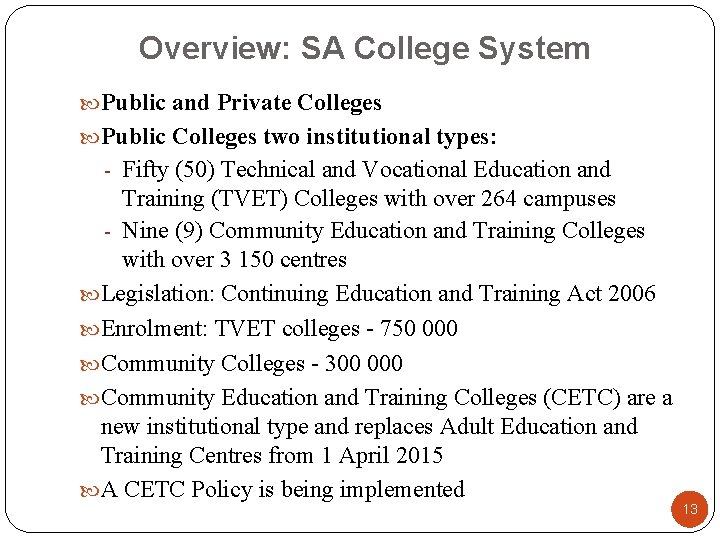
Overview: SA College System Public and Private Colleges Public Colleges two institutional types: - Fifty (50) Technical and Vocational Education and Training (TVET) Colleges with over 264 campuses - Nine (9) Community Education and Training Colleges with over 3 150 centres Legislation: Continuing Education and Training Act 2006 Enrolment: TVET colleges - 750 000 Community Colleges - 300 000 Community Education and Training Colleges (CETC) are a new institutional type and replaces Adult Education and Training Centres from 1 April 2015 A CETC Policy is being implemented 13
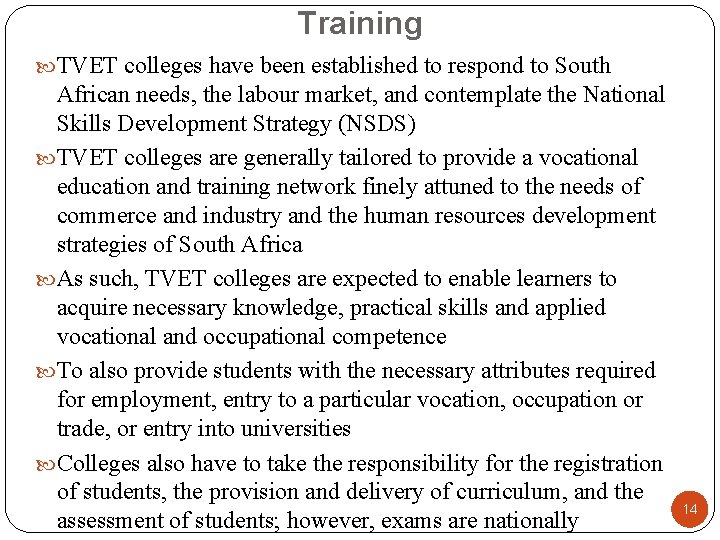
Training TVET colleges have been established to respond to South African needs, the labour market, and contemplate the National Skills Development Strategy (NSDS) TVET colleges are generally tailored to provide a vocational education and training network finely attuned to the needs of commerce and industry and the human resources development strategies of South Africa As such, TVET colleges are expected to enable learners to acquire necessary knowledge, practical skills and applied vocational and occupational competence To also provide students with the necessary attributes required for employment, entry to a particular vocation, occupation or trade, or entry into universities Colleges also have to take the responsibility for the registration of students, the provision and delivery of curriculum, and the assessment of students; however, exams are nationally 14
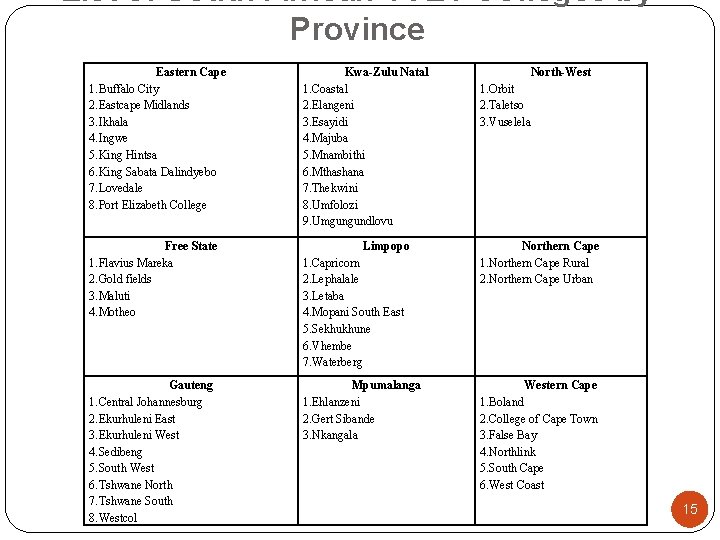
List of South African TVET Colleges by Province Eastern Cape 1. Buffalo City 2. Eastcape Midlands 3. Ikhala 4. Ingwe 5. King Hintsa 6. King Sabata Dalindyebo 7. Lovedale 8. Port Elizabeth College Free State 1. Flavius Mareka 2. Gold fields 3. Maluti 4. Motheo Gauteng 1. Central Johannesburg 2. Ekurhuleni East 3. Ekurhuleni West 4. Sedibeng 5. South West 6. Tshwane North 7. Tshwane South 8. Westcol Kwa-Zulu Natal 1. Coastal 2. Elangeni 3. Esayidi 4. Majuba 5. Mnambithi 6. Mthashana 7. Thekwini 8. Umfolozi 9. Umgungundlovu Limpopo 1. Capricorn 2. Lephalale 3. Letaba 4. Mopani South East 5. Sekhukhune 6. Vhembe 7. Waterberg Mpumalanga 1. Ehlanzeni 2. Gert Sibande 3. Nkangala North-West 1. Orbit 2. Taletso 3. Vuselela Northern Cape 1. Northern Cape Rural 2. Northern Cape Urban Western Cape 1. Boland 2. College of Cape Town 3. False Bay 4. Northlink 5. South Cape 6. West Coast 15
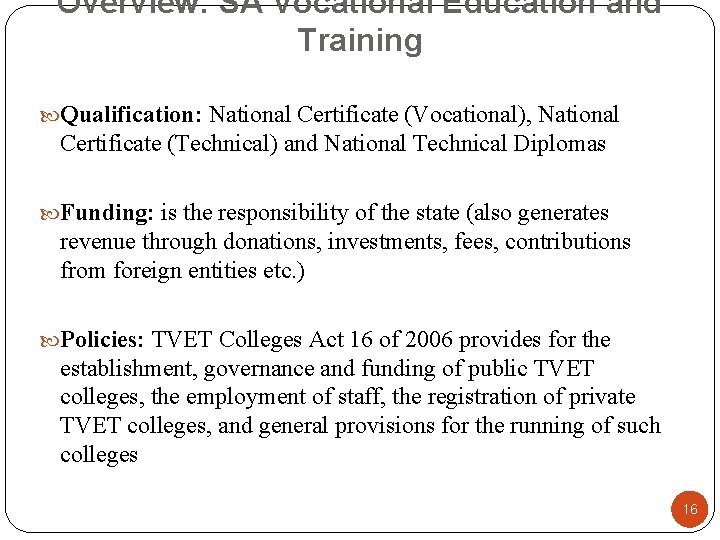
Overview: SA Vocational Education and Training Qualification: National Certificate (Vocational), National Certificate (Technical) and National Technical Diplomas Funding: is the responsibility of the state (also generates revenue through donations, investments, fees, contributions from foreign entities etc. ) Policies: TVET Colleges Act 16 of 2006 provides for the establishment, governance and funding of public TVET colleges, the employment of staff, the registration of private TVET colleges, and general provisions for the running of such colleges 16
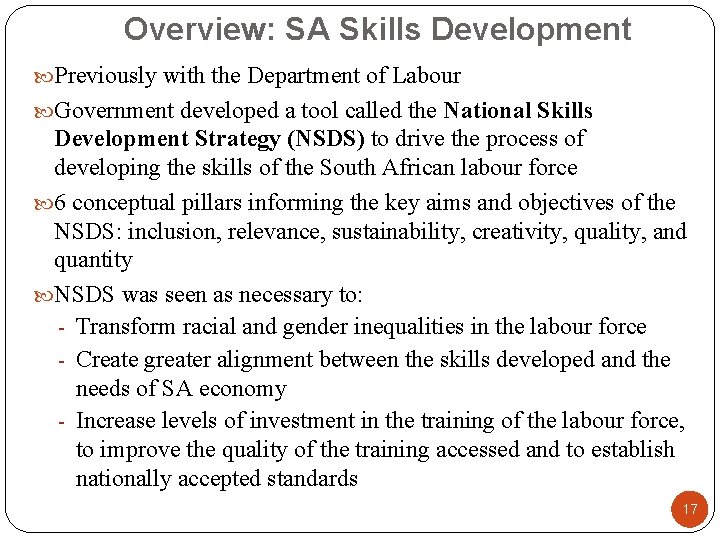
Overview: SA Skills Development Previously with the Department of Labour Government developed a tool called the National Skills Development Strategy (NSDS) to drive the process of developing the skills of the South African labour force 6 conceptual pillars informing the key aims and objectives of the NSDS: inclusion, relevance, sustainability, creativity, quality, and quantity NSDS was seen as necessary to: - Transform racial and gender inequalities in the labour force - Create greater alignment between the skills developed and the needs of SA economy - Increase levels of investment in the training of the labour force, to improve the quality of the training accessed and to establish nationally accepted standards 17
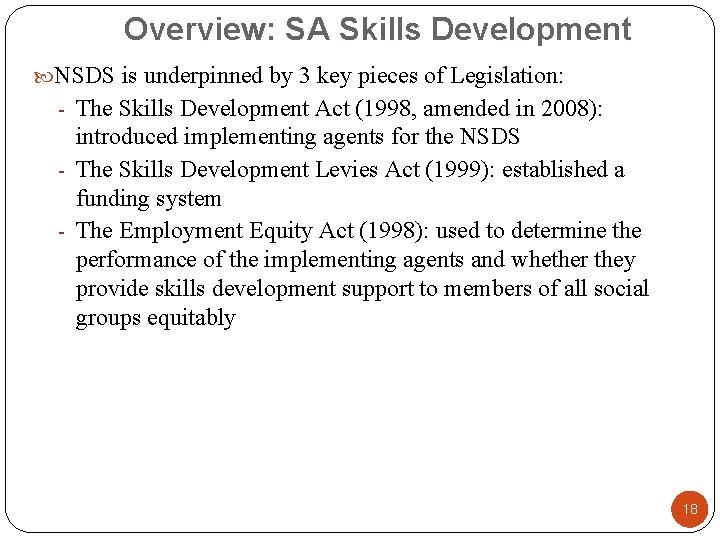
Overview: SA Skills Development NSDS is underpinned by 3 key pieces of Legislation: - The Skills Development Act (1998, amended in 2008): introduced implementing agents for the NSDS - The Skills Development Levies Act (1999): established a funding system - The Employment Equity Act (1998): used to determine the performance of the implementing agents and whether they provide skills development support to members of all social groups equitably 18
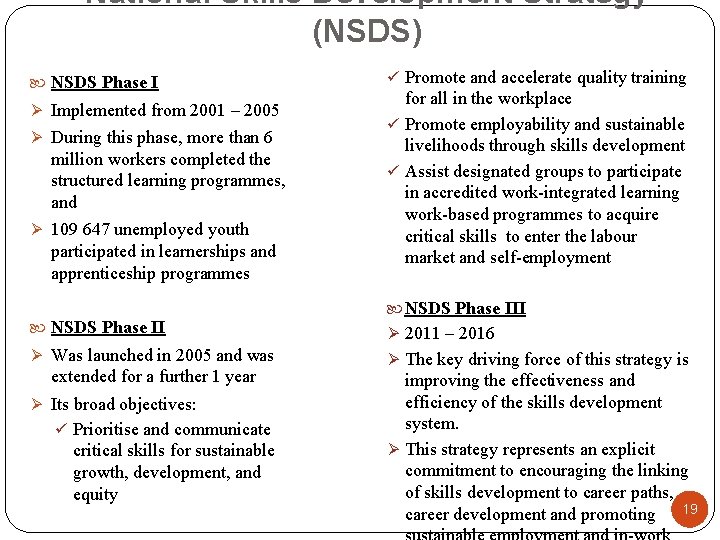
National Skills Development Strategy (NSDS) NSDS Phase I Ø Implemented from 2001 – 2005 Ø During this phase, more than 6 million workers completed the structured learning programmes, and Ø 109 647 unemployed youth participated in learnerships and apprenticeship programmes NSDS Phase II Ø Was launched in 2005 and was extended for a further 1 year Ø Its broad objectives: ü Prioritise and communicate critical skills for sustainable growth, development, and equity ü Promote and accelerate quality training for all in the workplace ü Promote employability and sustainable livelihoods through skills development ü Assist designated groups to participate in accredited work-integrated learning work-based programmes to acquire critical skills to enter the labour market and self-employment NSDS Phase III Ø 2011 – 2016 Ø The key driving force of this strategy is improving the effectiveness and efficiency of the skills development system. Ø This strategy represents an explicit commitment to encouraging the linking of skills development to career paths, career development and promoting 19
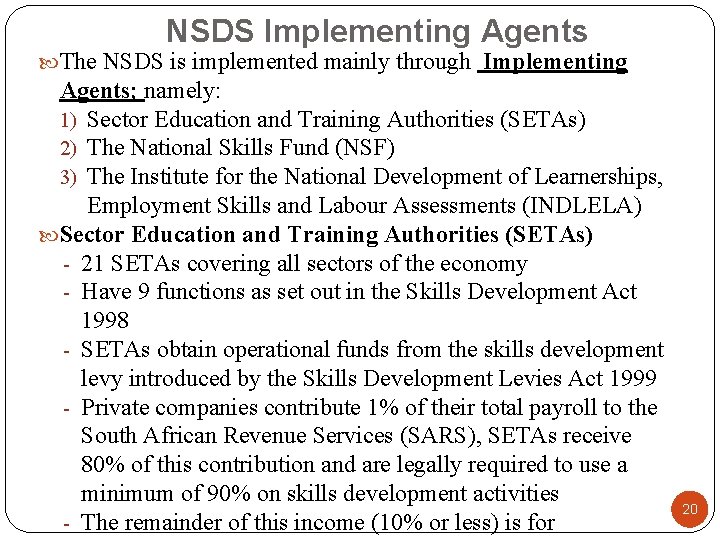
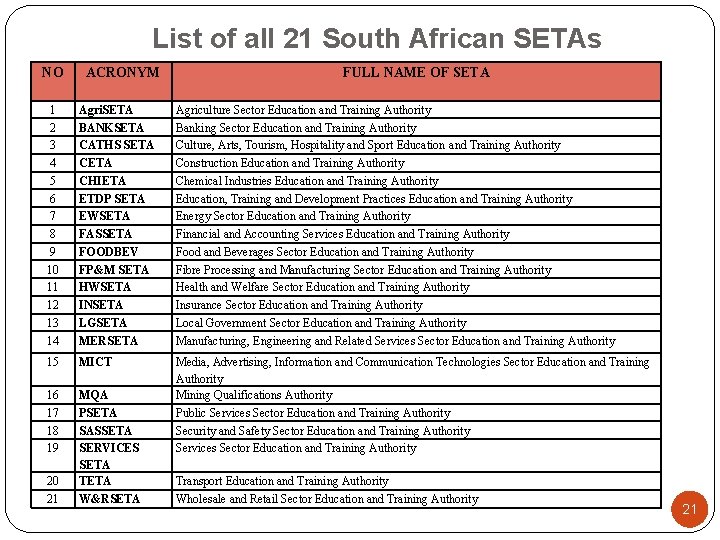
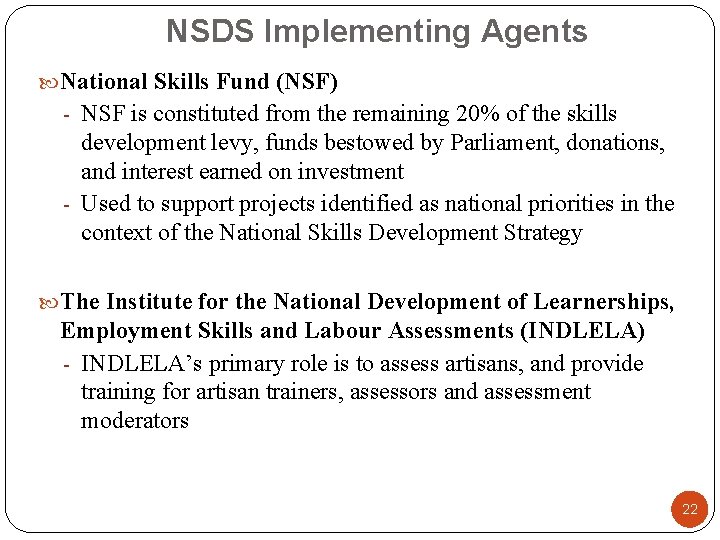
NSDS Implementing Agents The NSDS is implemented mainly through Implementing Agents; namely: 1) Sector Education and Training Authorities (SETAs) 2) The National Skills Fund (NSF) 3) The Institute for the National Development of Learnerships, Employment Skills and Labour Assessments (INDLELA) Sector Education and Training Authorities (SETAs) - 21 SETAs covering all sectors of the economy - Have 9 functions as set out in the Skills Development Act 1998 - SETAs obtain operational funds from the skills development levy introduced by the Skills Development Levies Act 1999 - Private companies contribute 1% of their total payroll to the South African Revenue Services (SARS), SETAs receive 80% of this contribution and are legally required to use a minimum of 90% on skills development activities - The remainder of this income (10% or less) is for 20
List of all 21 South African SETAs NO ACRONYM FULL NAME OF SETA 1 2 3 4 5 6 7 8 9 10 11 12 13 14 Agri. SETA BANKSETA CATHS SETA CHIETA ETDP SETA EWSETA FASSETA FOODBEV FP&M SETA HWSETA INSETA LGSETA MERSETA Agriculture Sector Education and Training Authority Banking Sector Education and Training Authority Culture, Arts, Tourism, Hospitality and Sport Education and Training Authority Construction Education and Training Authority Chemical Industries Education and Training Authority Education, Training and Development Practices Education and Training Authority Energy Sector Education and Training Authority Financial and Accounting Services Education and Training Authority Food and Beverages Sector Education and Training Authority Fibre Processing and Manufacturing Sector Education and Training Authority Health and Welfare Sector Education and Training Authority Insurance Sector Education and Training Authority Local Government Sector Education and Training Authority Manufacturing, Engineering and Related Services Sector Education and Training Authority 15 MICT 16 17 18 19 MQA PSETA SASSETA SERVICES SETA TETA W&RSETA Media, Advertising, Information and Communication Technologies Sector Education and Training Authority Mining Qualifications Authority Public Services Sector Education and Training Authority Security and Safety Sector Education and Training Authority Services Sector Education and Training Authority 20 21 Transport Education and Training Authority Wholesale and Retail Sector Education and Training Authority 21
NSDS Implementing Agents National Skills Fund (NSF) - NSF is constituted from the remaining 20% of the skills development levy, funds bestowed by Parliament, donations, and interest earned on investment - Used to support projects identified as national priorities in the context of the National Skills Development Strategy The Institute for the National Development of Learnerships, Employment Skills and Labour Assessments (INDLELA) - INDLELA’s primary role is to assess artisans, and provide training for artisan trainers, assessors and assessment moderators 22
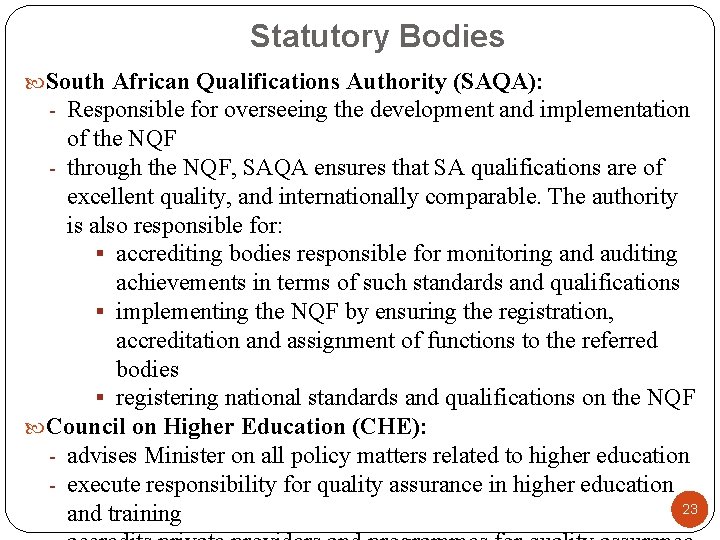
Statutory Bodies South African Qualifications Authority (SAQA): - Responsible for overseeing the development and implementation of the NQF - through the NQF, SAQA ensures that SA qualifications are of excellent quality, and internationally comparable. The authority is also responsible for: § accrediting bodies responsible for monitoring and auditing achievements in terms of such standards and qualifications § implementing the NQF by ensuring the registration, accreditation and assignment of functions to the referred bodies § registering national standards and qualifications on the NQF Council on Higher Education (CHE): - advises Minister on all policy matters related to higher education - execute responsibility for quality assurance in higher education 23 and training
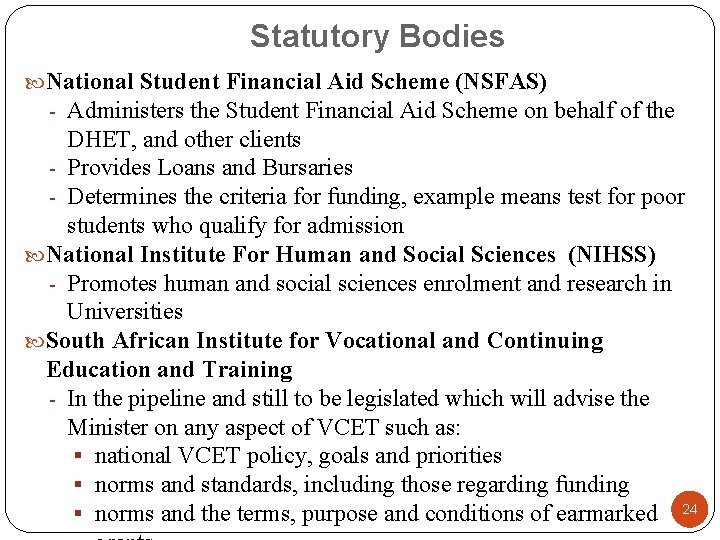
Statutory Bodies National Student Financial Aid Scheme (NSFAS) - Administers the Student Financial Aid Scheme on behalf of the DHET, and other clients - Provides Loans and Bursaries - Determines the criteria for funding, example means test for poor students who qualify for admission National Institute For Human and Social Sciences (NIHSS) - Promotes human and social sciences enrolment and research in Universities South African Institute for Vocational and Continuing Education and Training - In the pipeline and still to be legislated which will advise the Minister on any aspect of VCET such as: § national VCET policy, goals and priorities § norms and standards, including those regarding funding § norms and the terms, purpose and conditions of earmarked 24
Statutory Bodies Quality Council for Trades and Occupations (QCTO) - Skills Development Act introduces QCTO which has been established to support and improve quality assurance for learning in and for the workplace - Was legally established in April 2009 and became fully functionally in April 2010. It: § Manages and coordinates the qualifications in the occupational qualifications framework in terms of their development, provision, assessment and impact § Develops fit-for-purpose occupational qualifications that will be certificated as National Occupational Awards of National Skills Certificates 25
Challenges Increasing access, especially for Black Africans and especially in Mathematics, Science and Technology Increasing access to funding for the poor for post-schooling Lecturer Development Relevance of Occupational, Vocational and Technical Education and Training Qualifications, Programmes and Qualifications Work integrated learning International Scholarships Institutional management and governance in colleges Monitoring and Evaluation Education Managers Capacity 26
Thank You