
Department of Environmental Quality Environmental Management System Overview










- Slides: 47
Department of Environmental Quality Environmental Management System Overview
Course Objectives • EMS concepts • Discuss DEQ EMS – Development process – Contents – Staff responsibilities • Review information resources for future reference
What is an EMS? An EMS is a tool for an organization to: • Determine the interactions of its activities and products with the environment • To manage them so as to achieve continually improving environmental performance
Typical EMS Benefits • Enhanced regulatory compliance • Identification of cost saving environmental opportunities • Reduced risk and liability • Enhanced relationship with regulators • Improved public, customer & shareholder relations • May be required by customers
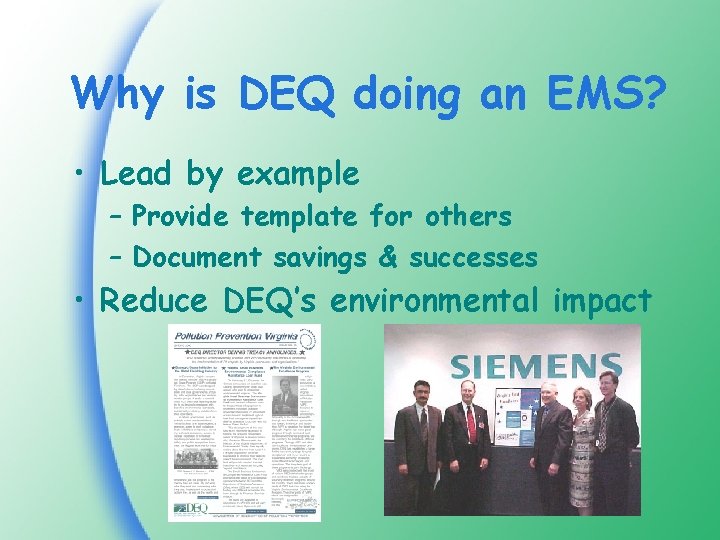
Why is DEQ doing an EMS? • Lead by example – Provide template for others – Document savings & successes • Reduce DEQ’s environmental impact
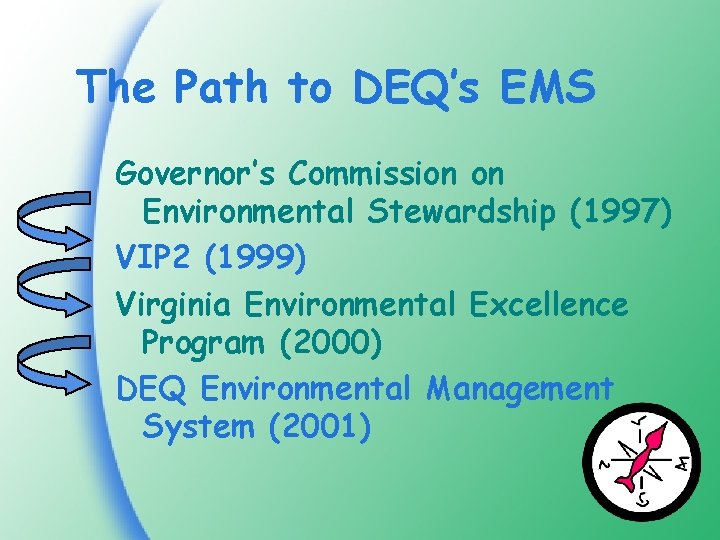
The Path to DEQ’s EMS Governor’s Commission on Environmental Stewardship (1997) VIP 2 (1999) Virginia Environmental Excellence Program (2000) DEQ Environmental Management System (2001)
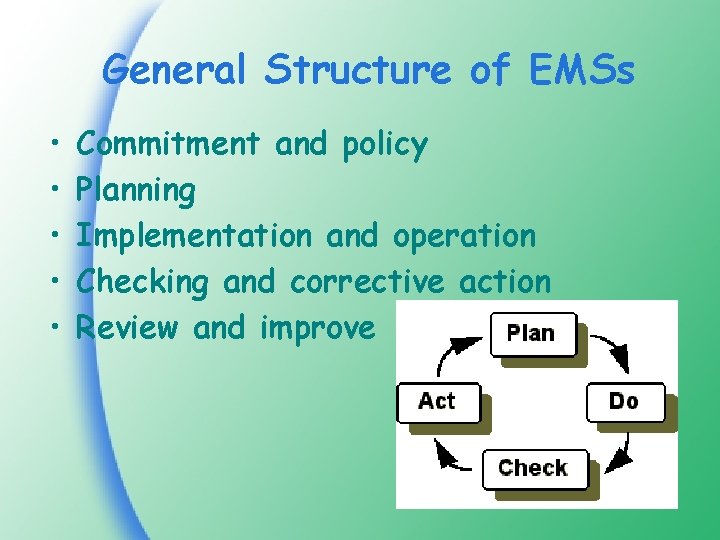
General Structure of EMSs • • • Commitment and policy Planning Implementation and operation Checking and corrective action Review and improve
DEQ EMS • Development Process • Procedures Manual • Implementation Plan
DEQ EMS Development Process • • • Regional/CO representation Followed ISO 14001 model Assistance of consultant Development period January - June Builds on/relates to some existing policies & procedures • EMS Program Team Charter
DEQ Procedures Manual 1. Environmental Policy 2. Environmental Aspects, Objectives, Targets 3. Legal & Other Requirements 4. Structure & Responsibility 5. Training, Awareness & Competence 6. Communication 7. Documentation, Document Control/Records 8. Operational Controls 9. Emergency Preparedness & Response 10. Monitoring & Measurement 11. Nonconformance, Corrective & Preventive Action 12. Environmental Management System Audits 13. Management Review
1. Environmental Policy Commitments: The DEQ, in its operations and activities, will demonstrate leadership & environmental stewardship through an EMS that: · Ensures DEQ’s compliance with all applicable environmental laws and regulations; · Identifies and implements techniques and environmentally sound practices that emphasize the environmental management hierarchy of pollution prevention (source reduction), reuse, recycling, treatment, and environmentally safe disposal; · Promotes continual improvement in the DEQ’s EMS practices and procedures leading to improved environmental performance;
1. Environmental Policy 1. Openly communicates to all employees and the public, the DEQ’s EMS policy, our identified environmental aspects, objectives and targets and programs to achieve them, and the results of these efforts; 2. Provides human, financial and technical resources appropriate to the active management and maintenance of the EMS; and 3. Encourages all employees, to the best of their abilities, to be accountable for implementing, maintaining, and upholding this policy.
1. Environmental Policy Partnership: The DEQ will encourage environmental stewardship and foster improved environmental collaboration with stakeholders by: · Exchanging mutually beneficial knowledge with, and encouraging open communication among, all partners including the regulated and nonregulated communities, the general public, DEQ employees, and other State agencies; and · Encouraging and recognizing innovative ideas and solutions.
1. Environmental Policy Performance: To achieve the goals and objectives of the EMS, and to promote continual improvement, the DEQ will develop and implement an environmental management system that includes: · A direct link to DEQ’s strategic planning and budgeting process; · Appropriate procedures and training; and · Performance measures, self-assessment, and independent assurance reviews.
2. Environmental Aspects, Objectives & Targets • Each February: – develop inventory of aspects and impacts – determine which are significant – establish objectives & targets for next year – establish plans and programs to achieve objectives & targets
3. Legal & Other Requirements • CO & RO will compile archives of relevant environmental laws, regulations, ordinances and other requirements • Policy Office to maintain archives • Reviewed annually for compliance • Establish plans to achieve full compliance
4. Structure & Responsibility • EMS Program Team: establish & maintain EMS • EMS Manager: chair of EMS Program Team, maintain EMS day-to-day • Director & EMT: provide resources • Management Review Team: conduct annual review each November
5. Training, Awareness & Competence • All staff will be trained • Training needs identified during annual review of aspects • Records of EMS training will be maintained
6. Communication • Internally communicate: – Environmental aspects & impacts – Environmental objectives & targets – Environmental management roles & responsibilities – DEQ’s performance on objectives & targets – Environmental policies & procedures
6. Communication • Externally communicate: – EMS Manager will respond to external inquiries – EMS Program Team will establish outreach objectives – DEQ will maintain EMS information on its website
7. Documentation, Document Control & Records • Procedures Manual documents EMS • Legal archive • Training records
8. Operational Controls • Each February: – Identify operations & activities associated with significant impacts and establish operational controls – Determine potential significant impacts associated with good and services and communicate relevant information to suppliers and contractors
9. Emergency Preparedness & Response • EMS Program Team has established an Emergency Response Subcommittee • Each October: – Develop inventory of emergency & accident exposures – Determine which are significant – Establish management objectives and targets for next year • Review and revise Plan as necessary
10. Monitoring & Measurement • Each February, EMS Program Team will establish procedures to monitor and measure potentially significant impacts • Internal audit each October of regulatory requirements • External audit once every 5 years
11. Nonconformance, Corrective & Preventive Action • DEQ will investigate nonconformance with EMS – Regional/CO – Agency-Wide – Individual Employee
12. Environmental Management System Audits • EMS audit by 5 -person internal team each October • EMS audit by external auditors in October once every five years
13. Management Review • Management Review of the EMS will take place every November: – – – Environmental policy appropriateness EMS effectiveness Changing circumstances influencing EMS Adequacy of roles & responsibilities Achievement of objectives & targets Adequacy of resources
13. Management Review – – Results of legal review Results of compliance and EMS audits Monitoring results Whether EMS still meets VEEP requirements – Improvement in EMS during last year
DEQ Procedures Manual 1. Environmental Policy 2. Environmental Aspects, Objectives, Targets 3. Legal & Other Requirements 4. Structure & Responsibility 5. Training, Awareness & Competence 6. Communication 7. Documentation, Document Control/Records 8. Operational Controls 9. Emergency Preparedness & Response 10. Monitoring & Measurement 11. Nonconformance, Corrective & Preventive Action 12. Environmental Management System Audits 13. Management Review
2. Environmental Aspects, Objectives & Targets • Each February: – develop inventory of aspects and impacts – determine which are significant – establish objectives & targets for next year – establish plans and programs to achieve objectives & targets
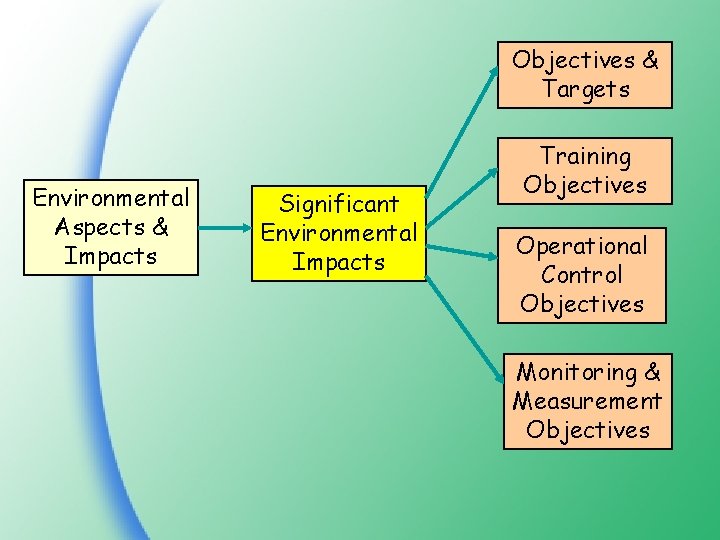
Objectives & Targets Environmental Aspects & Impacts Significant Environmental Impacts Training Objectives Operational Control Objectives Monitoring & Measurement Objectives
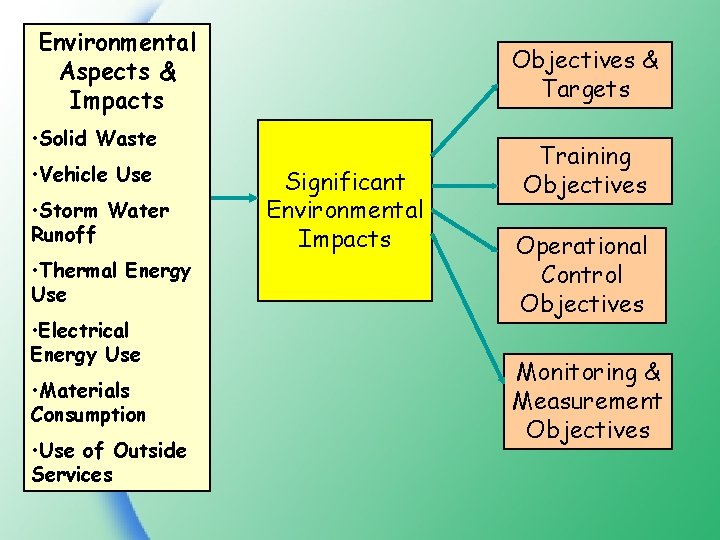
Environmental Aspects & Impacts Objectives & Targets • Solid Waste • Vehicle Use • Storm Water Runoff • Thermal Energy Use • Electrical Energy Use • Materials Consumption • Use of Outside Services Significant Environmental Impacts Training Objectives Operational Control Objectives Monitoring & Measurement Objectives
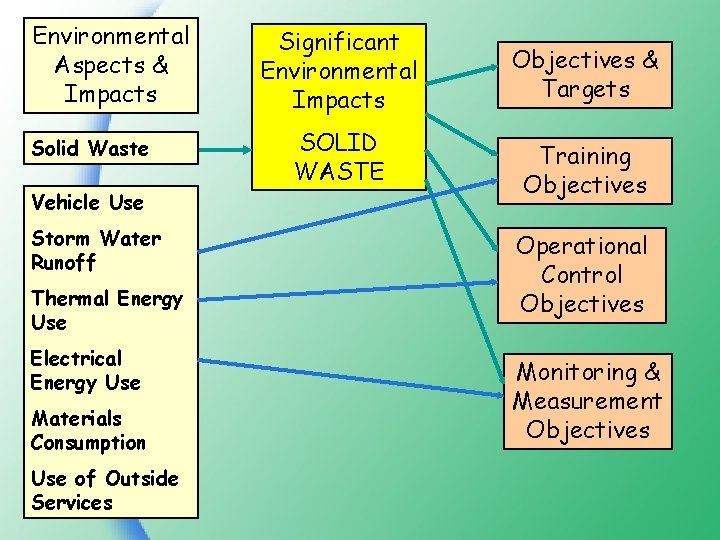
Environmental Aspects & Impacts • Solid Waste • Vehicle Use • Storm Water Runoff • Thermal Energy Use • Electrical Energy Use • Materials Consumption • Use of Outside Services Objectives & Targets Significant Environmental Impacts SOLID WASTE Training Objectives Operational Control Objectives Monitoring & Measurement Objectives
Environmental Aspects & Impacts Solid Waste Vehicle Use Storm Water Runoff Thermal Energy Use Electrical Energy Use Materials Consumption Use of Outside Services Significant Environmental Impacts SOLID WASTE Objectives & Targets Training Objectives Operational Control Objectives Monitoring & Measurement Objectives
EMS Implementation Plan • • • Environmental Objectives Training Objectives Operational Control Objectives Monitoring and Measuring Objectives E 3 Requirements
Environmental Objectives • Solid Waste Generation – Reduce volume by 5% 6/30/02 – Reduce volume by 25% by 6/30/06
Training Objectives • • Vehicle Use Flex-time Alternatives Storm-Water Runoff Electrical Energy Use Thermal Energy Use Solid Waste Generation Materials Consumption Use of Outside Services
Operational Controls • • • Vehicle Use Storm-Water Runoff Electrical Energy Use Thermal Energy Use Materials Consumption Outside Services
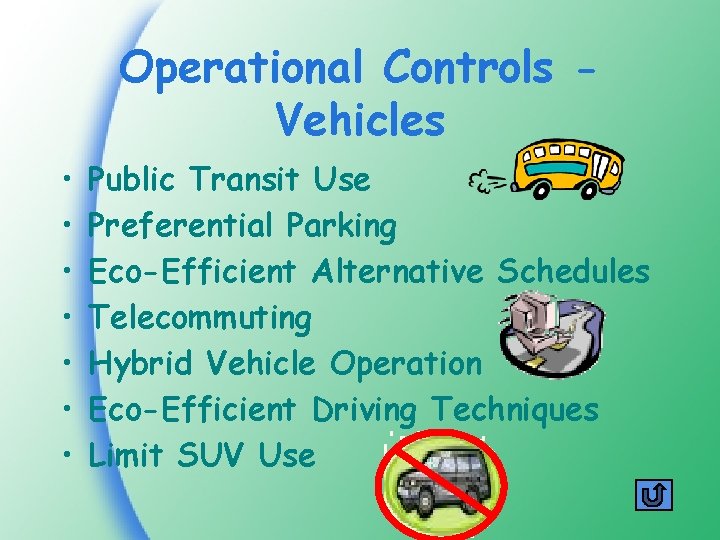
Operational Controls Vehicles • • Public Transit Use Preferential Parking Eco-Efficient Alternative Schedules Telecommuting Hybrid Vehicle Operation Eco-Efficient Driving Techniques Limit SUV Use
Operational Controls Electrical Energy • • Review Power Contracts Lights Off When Unoccupied Cleaning Crew Power Shutdown Energy Efficiency in Leases
Operational Controls Outside Services • EMS as condition for contract for outside services • Require E 2 for emergency services contractors • Encourage consultants on DEQ websites to apply for E 2
Monitoring and Measurement • • • Vehicle Use Storm-water Runoff Electrical Energy Use Thermal Energy Use Solid Waste Generation Materials Consumption
VEEP E 3 Requirements Exemplary Environmental Enterprise (E 3): – Fully developed EMS – Pollution Prevention Program (8/01)
Next Steps • DEQ Staff Training • Prepare Emergency Preparedness Plan • Establish Legal Archive • RO/CO Team Formation • External Communication • EMS Plan Assessment • E 3 Application Review (External)
DEQ EMS Web Site www. deq. state. va. us/p 2/ems
Additional Resources • OPP web site: www. deq. state. va. us/p 2 • Regional Office EMS Teams • EMS Program Team • DEQ OPP staff
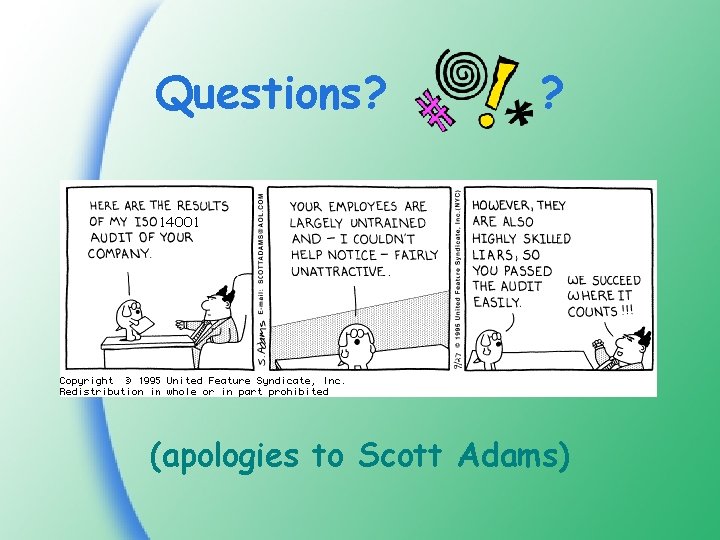
Questions? ? (apologies to Scott Adams)