
DEPARTMENT OF ENVIRONMENT FORESTRY AND FISHERIES Fishing Sector

- Slides: 20
DEPARTMENT OF ENVIRONMENT, FORESTRY AND FISHERIES Fishing Sector Transformation Profile FISHERIES MANAGEMENT
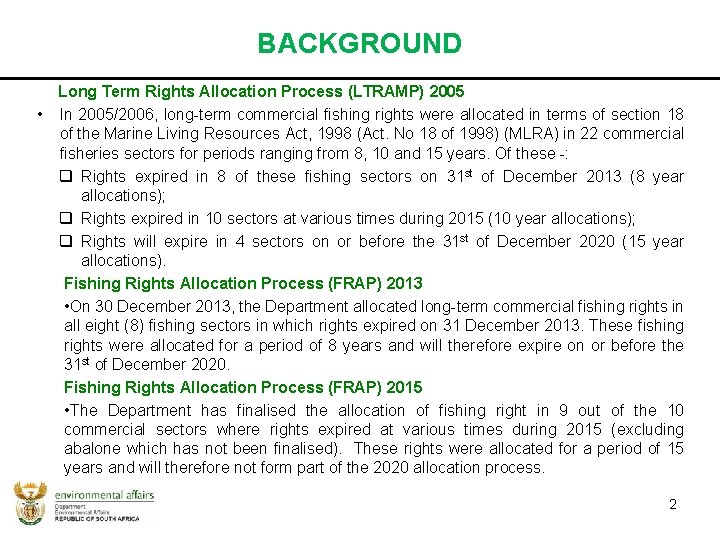
BACKGROUND Long Term Rights Allocation Process (LTRAMP) 2005 • In 2005/2006, long-term commercial fishing rights were allocated in terms of section 18 of the Marine Living Resources Act, 1998 (Act. No 18 of 1998) (MLRA) in 22 commercial fisheries sectors for periods ranging from 8, 10 and 15 years. Of these -: q Rights expired in 8 of these fishing sectors on 31 st of December 2013 (8 year allocations); q Rights expired in 10 sectors at various times during 2015 (10 year allocations); q Rights will expire in 4 sectors on or before the 31 st of December 2020 (15 year allocations). Fishing Rights Allocation Process (FRAP) 2013 • On 30 December 2013, the Department allocated long-term commercial fishing rights in all eight (8) fishing sectors in which rights expired on 31 December 2013. These fishing rights were allocated for a period of 8 years and will therefore expire on or before the 31 st of December 2020. Fishing Rights Allocation Process (FRAP) 2015 • The Department has finalised the allocation of fishing right in 9 out of the 10 commercial sectors where rights expired at various times during 2015 (excluding abalone which has not been finalised). These rights were allocated for a period of 15 years and will therefore not form part of the 2020 allocation process. 2
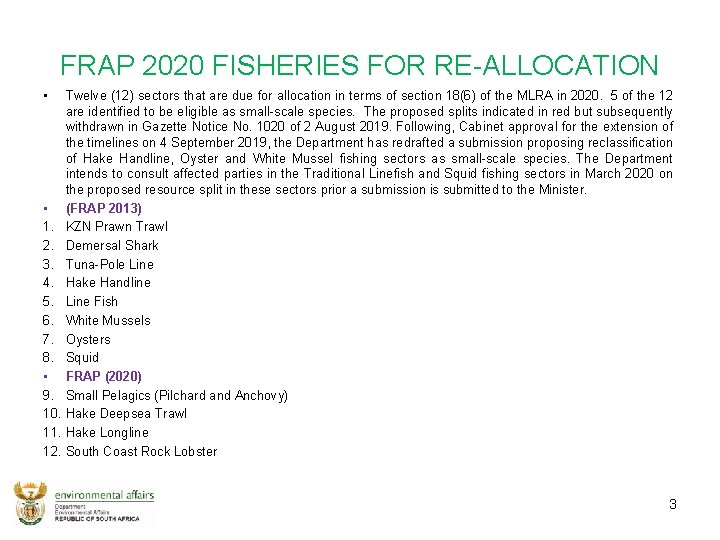
FRAP 2020 FISHERIES FOR RE-ALLOCATION • Twelve (12) sectors that are due for allocation in terms of section 18(6) of the MLRA in 2020. 5 of the 12 are identified to be eligible as small-scale species. The proposed splits indicated in red but subsequently withdrawn in Gazette Notice No. 1020 of 2 August 2019. Following, Cabinet approval for the extension of the timelines on 4 September 2019, the Department has redrafted a submission proposing reclassification of Hake Handline, Oyster and White Mussel fishing sectors as small-scale species. The Department intends to consult affected parties in the Traditional Linefish and Squid fishing sectors in March 2020 on the proposed resource split in these sectors prior a submission is submitted to the Minister. • (FRAP 2013) 1. KZN Prawn Trawl 2. Demersal Shark 3. Tuna-Pole Line 4. Hake Handline 5. Line Fish 6. White Mussels 7. Oysters 8. Squid • FRAP (2020) 9. Small Pelagics (Pilchard and Anchovy) 10. Hake Deepsea Trawl 11. Hake Longline 12. South Coast Rock Lobster 3
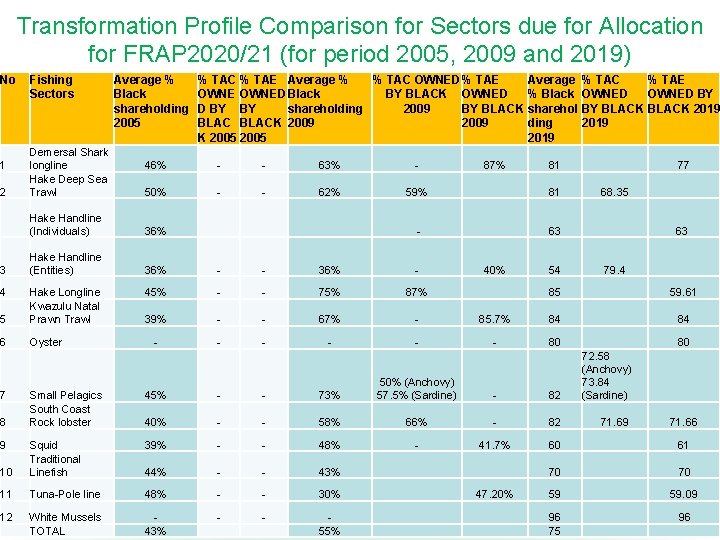
Transformation Profile Comparison for Sectors due for Allocation for FRAP 2020/21 (for period 2005, 2009 and 2019) No 1 2 3 4 Fishing Sectors Demersal Shark longline Hake Deep Sea Trawl Average % Black shareholding 2005 % TAC % TAE Average % % TAC OWNED % TAE OWNED Black BY BLACK OWNED D BY BY shareholding 2009 BY BLACK 2009 K 2005 46% - - 63% - 50% - - 62% 59% 81 - 63 Hake Handline (Individuals) 36% Hake Handline (Entities) 36% - - 36% - 45% - - 75% 87% 39% - - 67% - - - 5 Hake Longline Kwazulu Natal Prawn Trawl 6 Oyster 87% Average % Black sharehol ding 2019 40% % TAC % TAE OWNED BY BY BLACK 2019 81 54 77 68. 35 63 79. 4 85 59. 61 85. 7% 84 84 - 80 80 Small Pelagics South Coast Rock lobster 45% - - 73% 50% (Anchovy) 57. 5% (Sardine) - 82 72. 58 (Anchovy) 73. 84 (Sardine) 40% - - 58% 66% - 82 71. 69 39% - - 48% - 41. 7% 60 61 10 Squid Traditional Linefish 44% - - 43% 70 70 11 Tuna-Pole line 48% - - 30% 59 59. 09 12 White Mussels TOTAL 43% - - 55% 96 75 96 7 8 9 47. 20% 71. 66 4
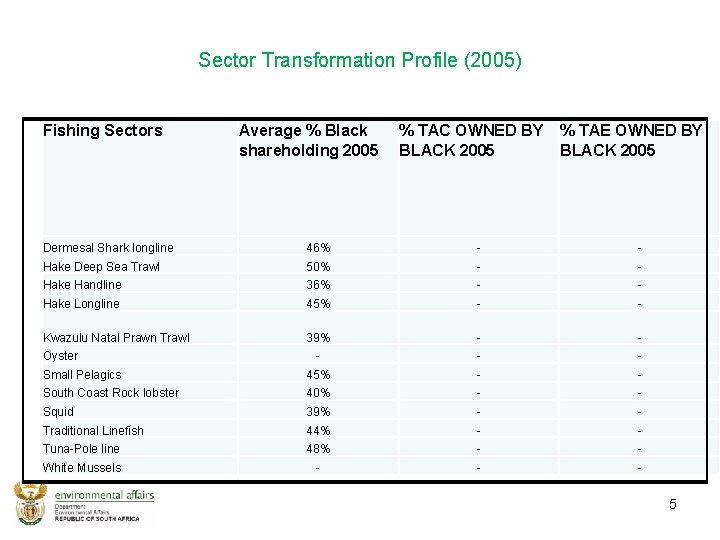
Sector Transformation Profile (2005) Fishing Sectors Average % Black shareholding 2005 % TAC OWNED BY BLACK 2005 % TAE OWNED BY BLACK 2005 Dermesal Shark longline 46% - - Hake Deep Sea Trawl 50% - - Hake Handline 36% - - Hake Longline 45% - - Kwazulu Natal Prawn Trawl 39% - - - Small Pelagics 45% - - South Coast Rock lobster 40% - - Squid 39% - - Traditional Linefish 44% - - Tuna-Pole line 48% - - White Mussels - - - Oyster 5
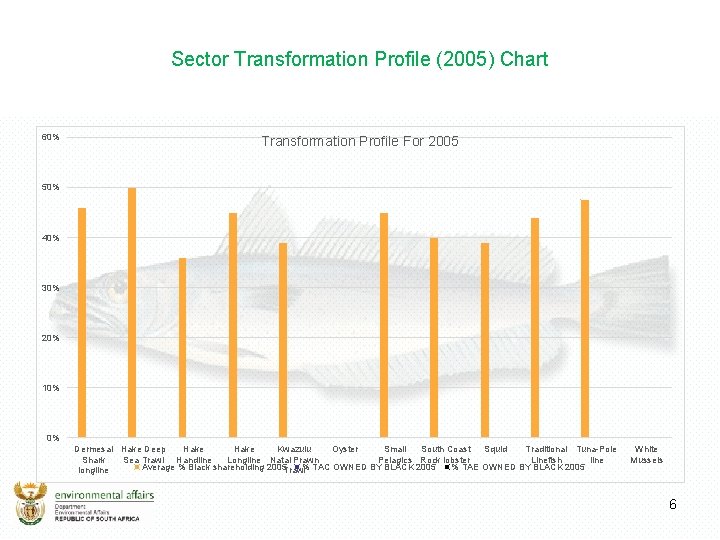
Sector Transformation Profile (2005) Chart 60% Transformation Profile For 2005 50% 40% 30% 20% 10% 0% Dermesal Hake Deep Hake Kwazulu Oyster Small South Coast Squid Traditional Tuna-Pole Shark Sea Trawl Handline Longline Natal Prawn Pelagics Rock lobster Linefish line Average % Black shareholding 2005 Trawl% TAC OWNED BY BLACK 2005 % TAE OWNED BY BLACK 2005 longline White Mussels 6
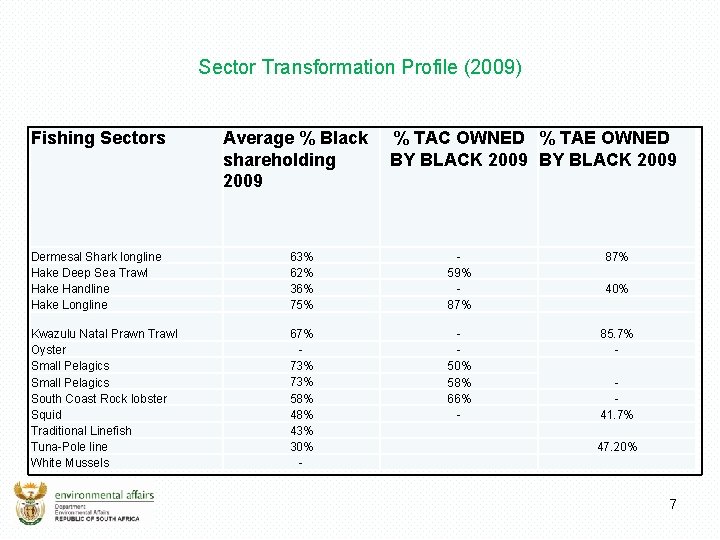
Sector Transformation Profile (2009) Fishing Sectors Average % Black shareholding 2009 % TAC OWNED % TAE OWNED BY BLACK 2009 Dermesal Shark longline Hake Deep Sea Trawl Hake Handline Hake Longline 63% 62% 36% 75% 59% 87% Kwazulu Natal Prawn Trawl Oyster Small Pelagics South Coast Rock lobster Squid Traditional Linefish Tuna-Pole line White Mussels 67% 73% 58% 43% 30% - 50% 58% 66% - 85. 7% - 40% 41. 7% 47. 20% 7
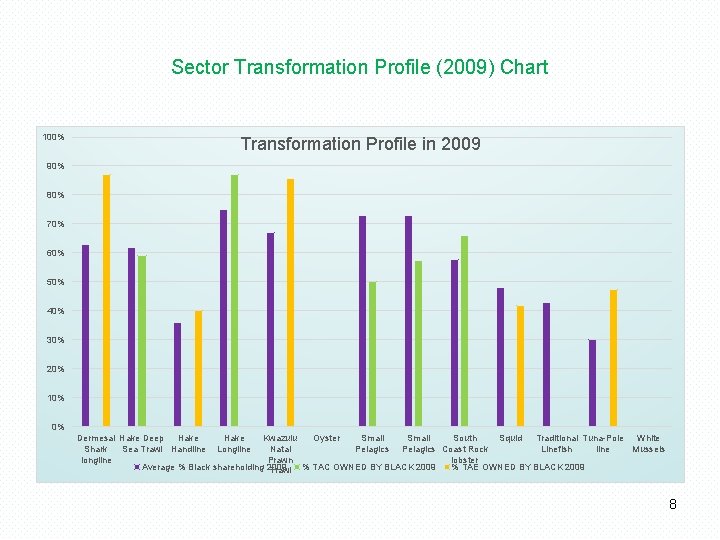
Sector Transformation Profile (2009) Chart 100% Transformation Profile in 2009 90% 80% 70% 60% 50% 40% 30% 20% 10% 0% Dermesal Hake Deep Hake Kwazulu Oyster Small South Squid Traditional Tuna-Pole White Shark Sea Trawl Handline Longline Natal Pelagics Coast Rock Linefish line Mussels longline Prawn lobster Average % Black shareholding 2009 % TAE OWNED BY BLACK 2009 Trawl % TAC OWNED BY BLACK 2009 8
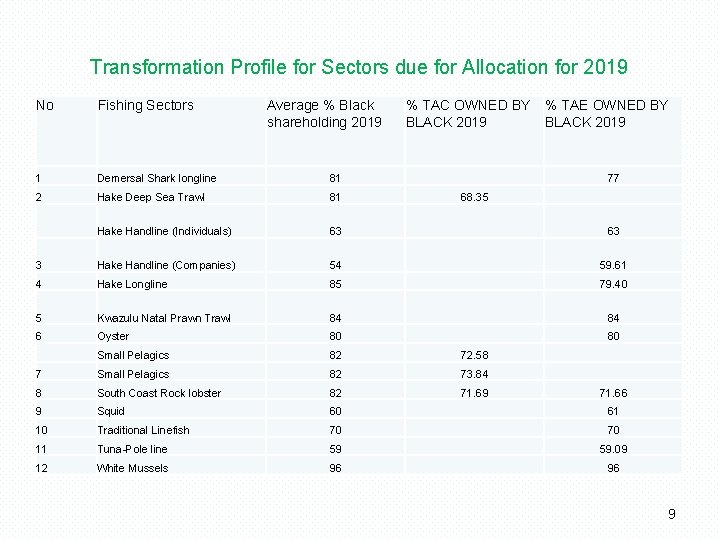
Transformation Profile for Sectors due for Allocation for 2019 No Fishing Sectors Average % Black shareholding 2019 % TAC OWNED BY BLACK 2019 % TAE OWNED BY BLACK 2019 1 Demersal Shark longline 81 2 Hake Deep Sea Trawl 81 Hake Handline (Individuals) 63 63 3 Hake Handline (Companies) 54 59. 61 4 Hake Longline 85 79. 40 5 Kwazulu Natal Prawn Trawl 84 84 6 Oyster 80 80 Small Pelagics 82 72. 58 7 Small Pelagics 82 73. 84 8 South Coast Rock lobster 82 71. 69 9 Squid 60 61 10 Traditional Linefish 70 70 11 Tuna-Pole line 59 59. 09 12 White Mussels 96 96 77 68. 35 71. 66 9
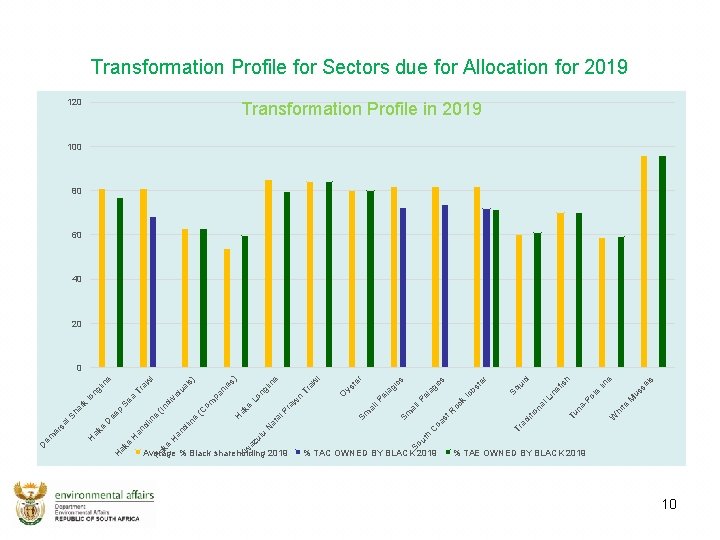
% TAC OWNED BY BLACK 2019 So te hi W ls e lin h fis se us M ol e -P na Tu ne ui d Sq te r bs cs ag i lo Li k oc R on al ad iti Tr st r cs ag i el l. P al Sm el l. P al te l aw Tr O ys n e ng lin Lo aw Pr Sm al oa C at N e ) es 120 ut h u ak ni pa om l s) al du vi di aw Tr e lin lo ng Se a rk (In (C H e e ee p in in an dl ul D an dl H H az Kw e ak Average % Black shareholding 2019 H e ak H ha l. S sa er em D Transformation Profile for Sectors due for Allocation for 2019 Transformation Profile in 2019 100 80 60 40 20 0 % TAE OWNED BY BLACK 2019 10
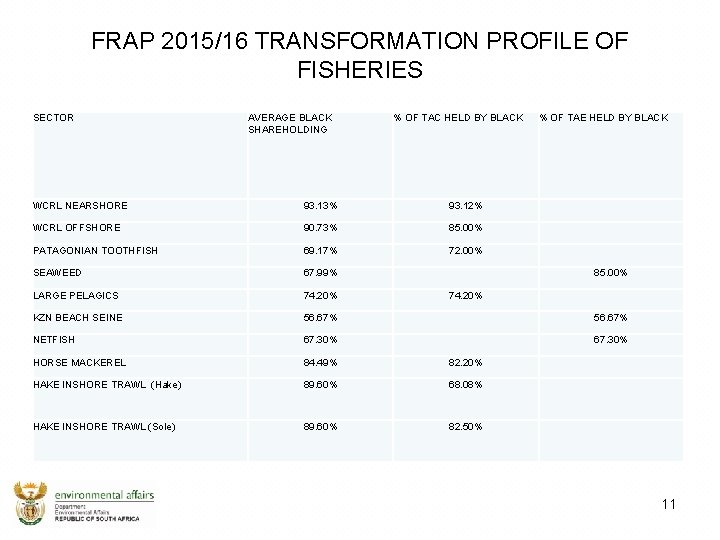
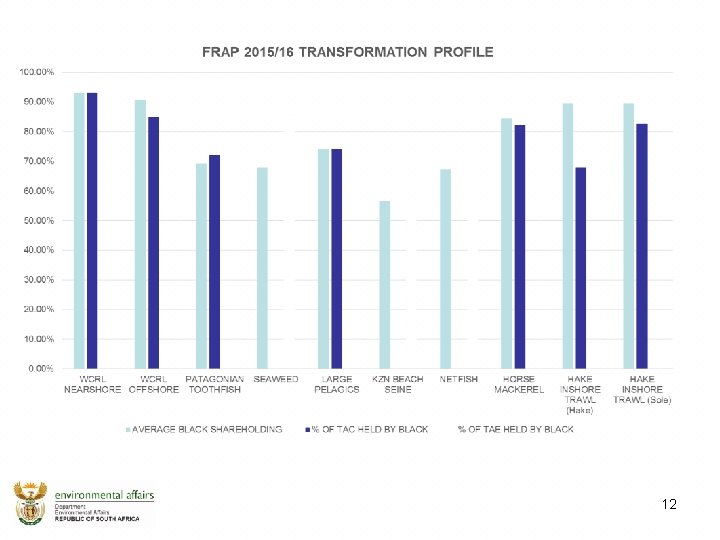
FRAP 2015/16 TRANSFORMATION PROFILE OF FISHERIES SECTOR AVERAGE BLACK SHAREHOLDING % OF TAC HELD BY BLACK % OF TAE HELD BY BLACK WCRL NEARSHORE 93. 13% 93. 12% WCRL OFFSHORE 90. 73% 85. 00% PATAGONIAN TOOTHFISH 69. 17% 72. 00% SEAWEED 67. 99% LARGE PELAGICS 74. 20% KZN BEACH SEINE 56. 67% NETFISH 67. 30% HORSE MACKEREL 84. 49% 82. 20% HAKE INSHORE TRAWL (Hake) 89. 60% 68. 08% HAKE INSHORE TRAWL (Sole) 89. 60% 82. 50% 85. 00% 74. 20% 11
12
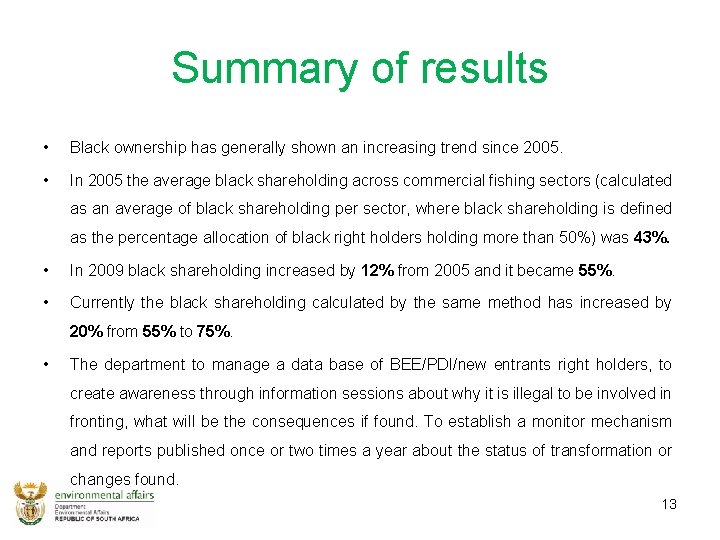
Summary of results • Black ownership has generally shown an increasing trend since 2005. • In 2005 the average black shareholding across commercial fishing sectors (calculated as an average of black shareholding per sector, where black shareholding is defined as the percentage allocation of black right holders holding more than 50%) was 43%. • In 2009 black shareholding increased by 12% from 2005 and it became 55%. • Currently the black shareholding calculated by the same method has increased by 20% from 55% to 75%. • The department to manage a data base of BEE/PDI/new entrants right holders, to create awareness through information sessions about why it is illegal to be involved in fronting, what will be the consequences if found. To establish a monitor mechanism and reports published once or two times a year about the status of transformation or changes found. 13
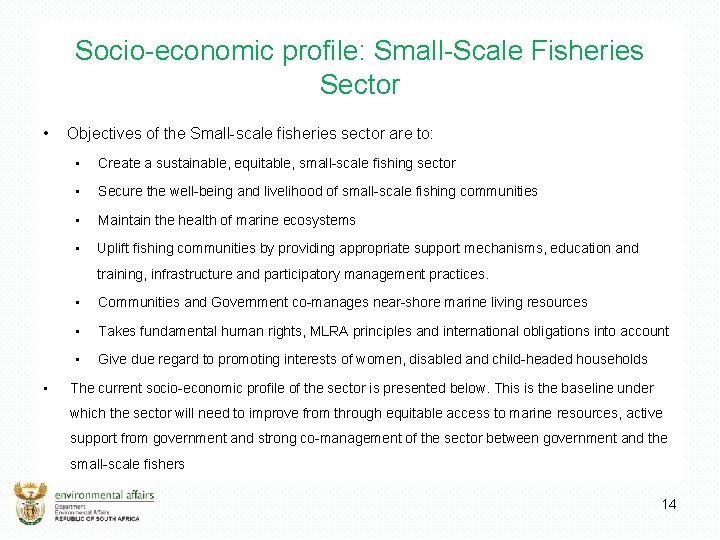
Socio-economic profile: Small-Scale Fisheries Sector • Objectives of the Small-scale fisheries sector are to: • Create a sustainable, equitable, small-scale fishing sector • Secure the well-being and livelihood of small-scale fishing communities • Maintain the health of marine ecosystems • Uplift fishing communities by providing appropriate support mechanisms, education and training, infrastructure and participatory management practices. • • Communities and Government co-manages near-shore marine living resources • Takes fundamental human rights, MLRA principles and international obligations into account • Give due regard to promoting interests of women, disabled and child-headed households The current socio-economic profile of the sector is presented below. This is the baseline under which the sector will need to improve from through equitable access to marine resources, active support from government and strong co-management of the sector between government and the small-scale fishers 14
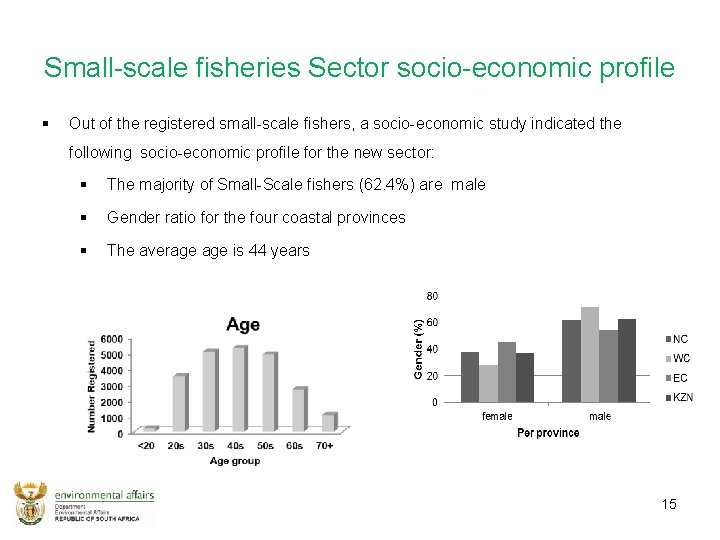
Small-scale fisheries Sector socio-economic profile § Out of the registered small-scale fishers, a socio-economic study indicated the following socio-economic profile for the new sector: § The majority of Small-Scale fishers (62. 4%) are male § Gender ratio for the four coastal provinces § The average is 44 years 15
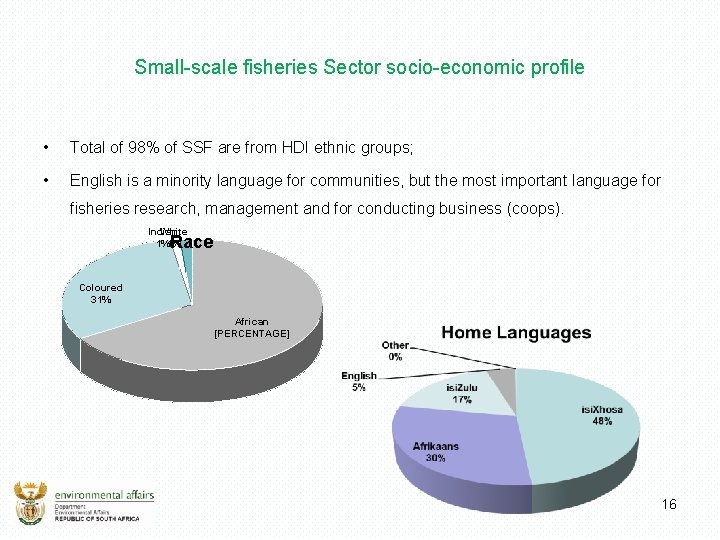
Small-scale fisheries Sector socio-economic profile • Total of 98% of SSF are from HDI ethnic groups; • English is a minority language for communities, but the most important language for fisheries research, management and for conducting business (coops). Indian White 1%1% Race Coloured 31% African [PERCENTAGE] 16
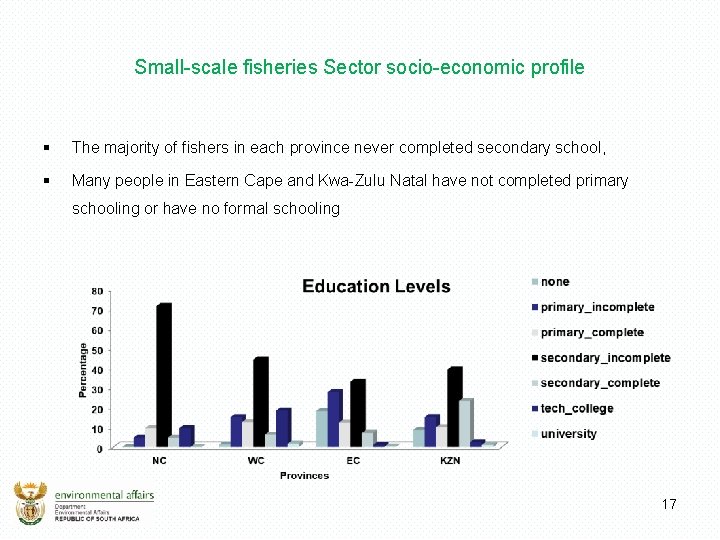
Small-scale fisheries Sector socio-economic profile § The majority of fishers in each province never completed secondary school, § Many people in Eastern Cape and Kwa-Zulu Natal have not completed primary schooling or have no formal schooling 17
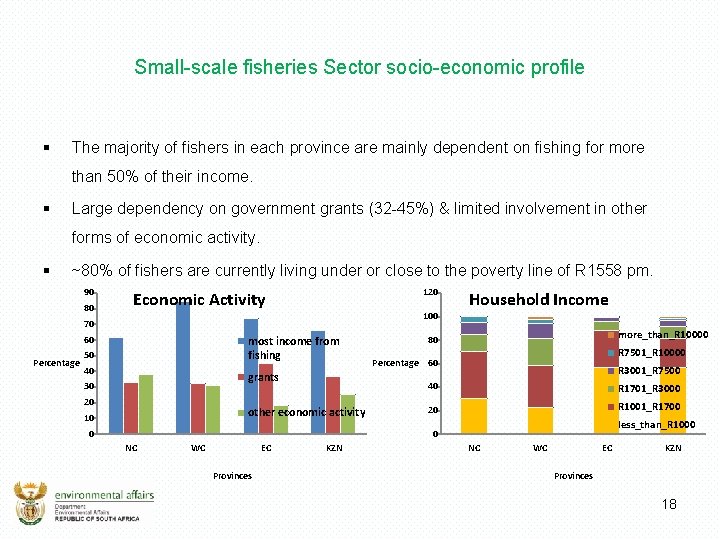
Small-scale fisheries Sector socio-economic profile § The majority of fishers in each province are mainly dependent on fishing for more than 50% of their income. § Large dependency on government grants (32 -45%) & limited involvement in other forms of economic activity. § ~80% of fishers are currently living under or close to the poverty line of R 1558 pm. 90 80 120 Economic Activity 70 Percentage Household Income 100 60 50 most income from fishing 40 30 grants 20 other economic activity 10 0 more_than_R 10000 80 R 7501_R 10000 Percentage 60 R 3001_R 7500 40 R 1701_R 3000 20 R 1001_R 1700 less_than_R 1000 0 NC WC EC Provinces KZN NC WC EC KZN Provinces 18
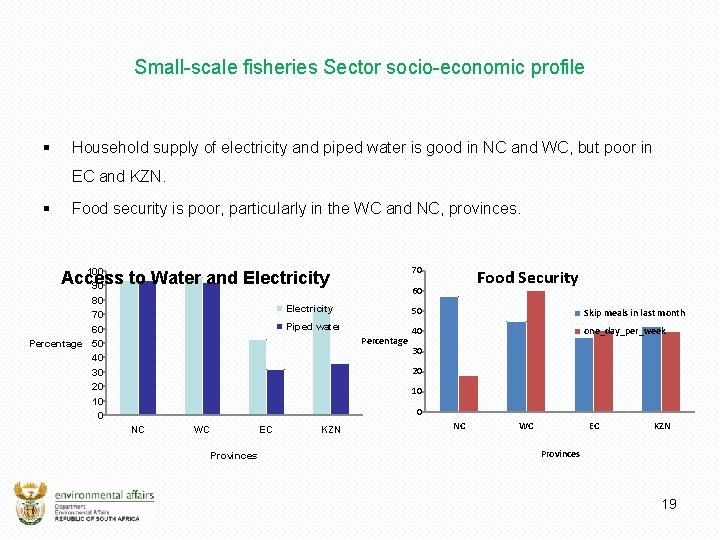
Small-scale fisheries Sector socio-economic profile § Household supply of electricity and piped water is good in NC and WC, but poor in EC and KZN. § Food security is poor, particularly in the WC and NC, provinces. 70 100 Access to Water and Electricity 90 80 70 60 Percentage 50 40 30 20 10 0 Food Security 60 Electricity Piped water Percentage 50 Skip meals in last month 40 one_day_per_week 30 20 10 0 NC WC Provinces EC KZN NC WC EC KZN Provinces 19
20