
Department of Electrical and Computer Engineering An Guide
![Arrival Envelopes Department of Electrical and Computer Engineering • MGF envelope [4], [8] •](https://slidetodoc.com/presentation_image_h/2e774e71829f39776c47a8ca4e94a3c1/image-15.jpg "Arrival Envelopes Department of Electrical and Computer Engineering • MGF envelope [4], [8] •")

- Slides: 38
Department of Electrical and Computer Engineering An Guide to the Stochastic Network Calculus Zhu Han Thanks to Prof. Xuefang Liu and Dr. Yan Zhu
Department of Electrical and Computer Engineering Outline Ø Ø Ø Stochastic Network Calculus Arrival Envelopes Service Envelopes Backlog and Delay Bounds Applications v Convolution-Form Networks v Statistical Multiplexing Ø Conclusion 2
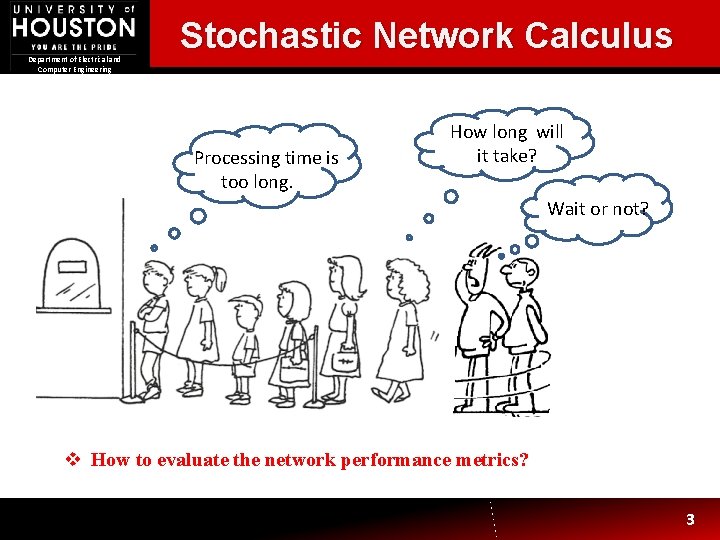
Department of Electrical and Computer Engineering Stochastic Network Calculus Processing time is too long. How long will it take? Wait or not? v How to evaluate the network performance metrics? 3
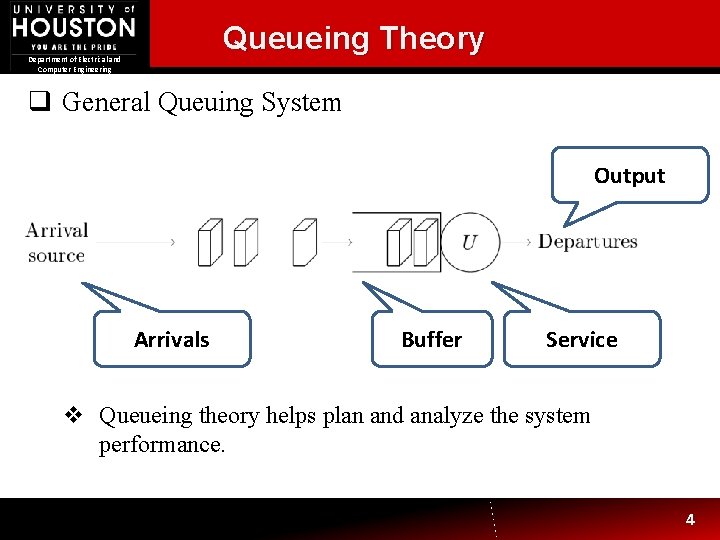
Queueing Theory Department of Electrical and Computer Engineering q General Queuing System Output Arrivals Buffer Service v Queueing theory helps plan and analyze the system performance. 4
Department of Electrical and Computer Engineering Network Calculus q R. Cruz. lays the foundation of Network Calculus. [1] R. L. Cruz. A calculus for network delay, Part I: Network elements in isolation. IEEE Transactions on Information Theory, 37(1): 114 -131, January 1991. [2] R. L. Cruz. A calculus for network delay, Part II: Network analysis. IEEE Transactions on Information Theory, 37(1): 132 -141, January 1991. q Goal: 1) A theoretical framework to analyze performance guarantees (maximum delays, maximum buffer space requirements…) in network. 2) Transform complex non-linear network systems into analytically tractable linear systems. 5
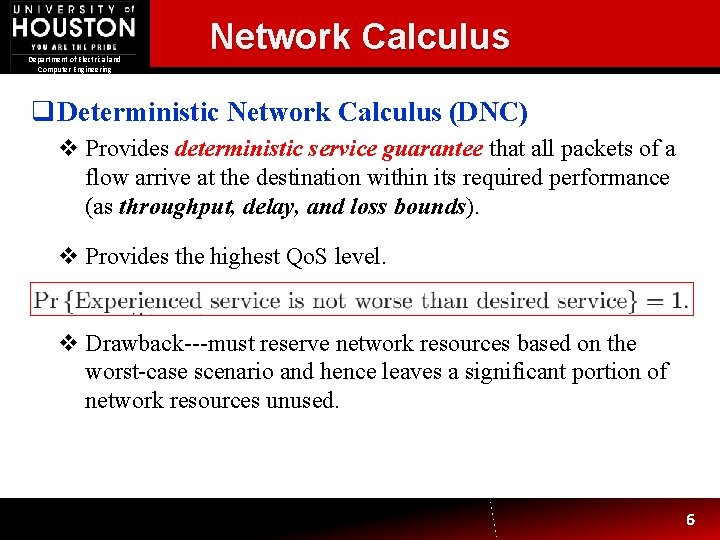
Department of Electrical and Computer Engineering Network Calculus q Deterministic Network Calculus (DNC) v Provides deterministic service guarantee that all packets of a flow arrive at the destination within its required performance (as throughput, delay, and loss bounds). v Provides the highest Qo. S level. v Drawback---must reserve network resources based on the worst-case scenario and hence leaves a significant portion of network resources unused. 6
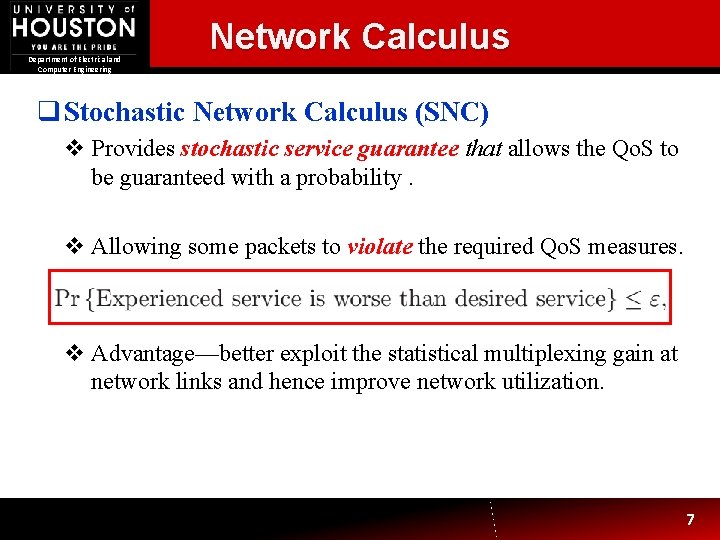
Department of Electrical and Computer Engineering Network Calculus q Stochastic Network Calculus (SNC) v Provides stochastic service guarantee that allows the Qo. S to be guaranteed with a probability. v Allowing some packets to violate the required Qo. S measures. v Advantage—better exploit the statistical multiplexing gain at network links and hence improve network utilization. 7
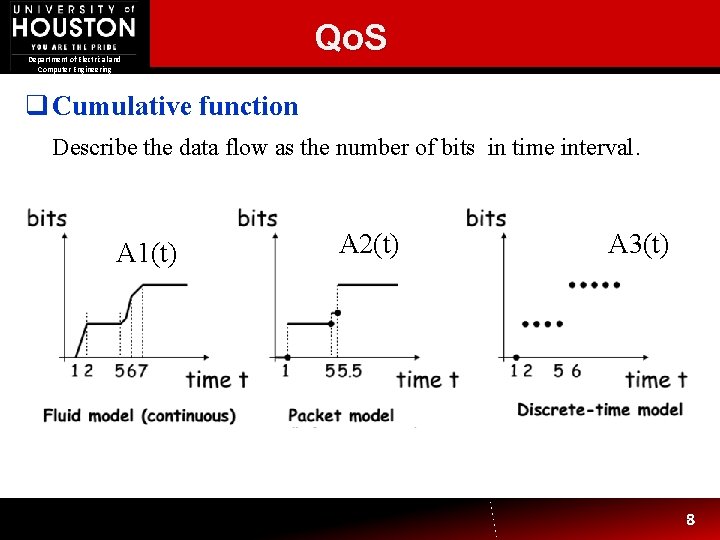
Department of Electrical and Computer Engineering Qo. S q Cumulative function Describe the data flow as the number of bits in time interval. A 1(t) A 2(t) A 3(t) 8
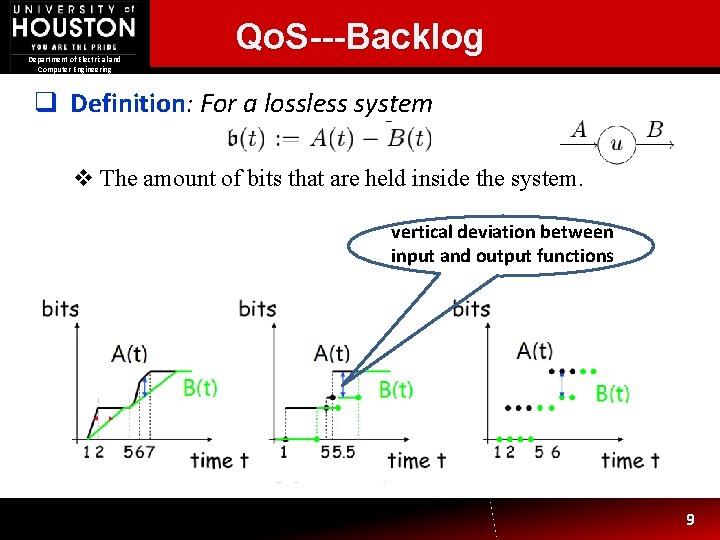
Department of Electrical and Computer Engineering Qo. S---Backlog q Definition: For a lossless system v The amount of bits that are held inside the system. vertical deviation between input and output functions 9
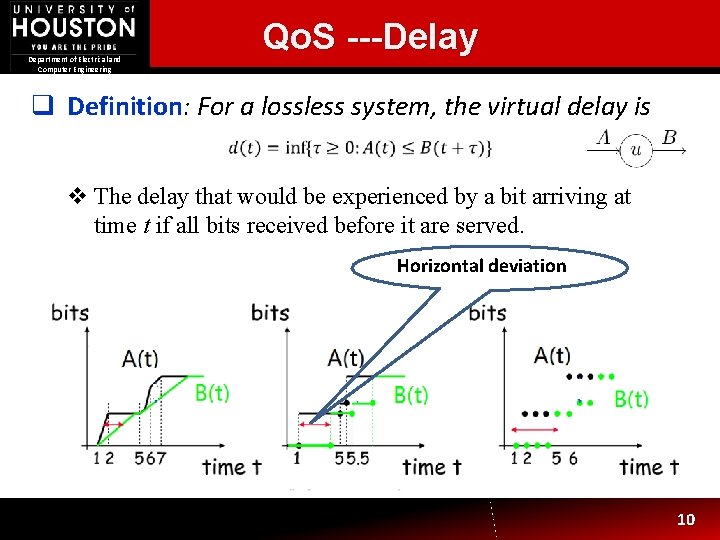
Qo. S ---Delay Department of Electrical and Computer Engineering q Definition: For a lossless system, the virtual delay is v The delay that would be experienced by a bit arriving at time t if all bits received before it are served. Horizontal deviation 10
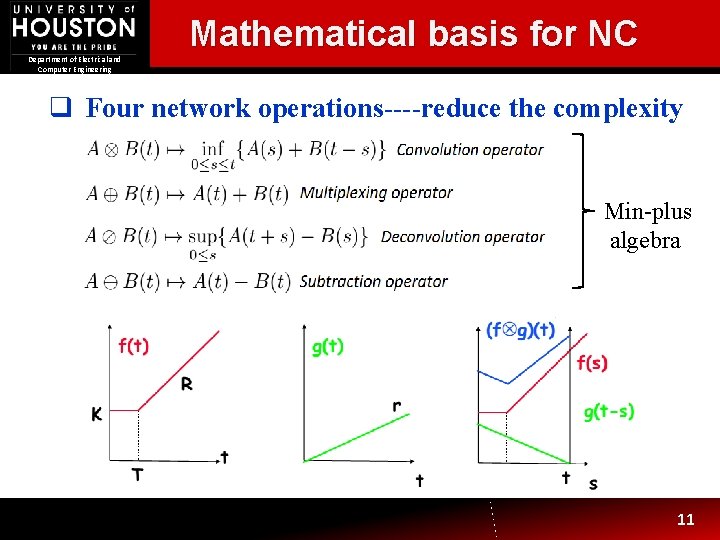
Department of Electrical and Computer Engineering Mathematical basis for NC q Four network operations----reduce the complexity Min-plus algebra 11
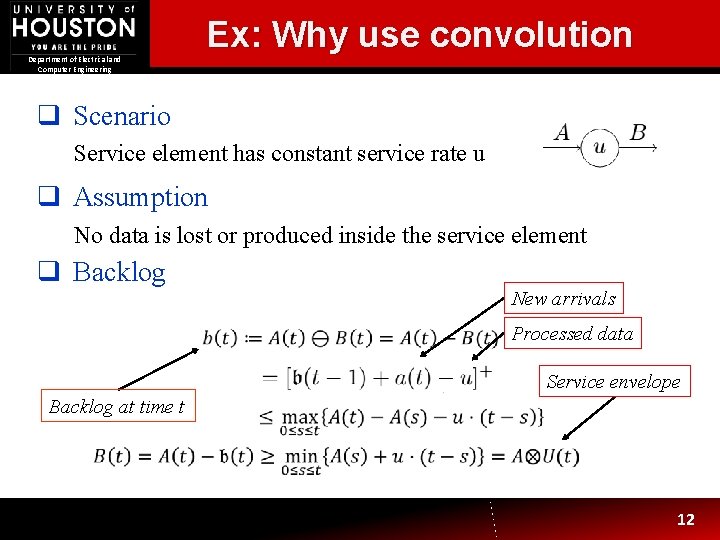
Department of Electrical and Computer Engineering Ex: Why use convolution q Scenario Service element has constant service rate u q Assumption No data is lost or produced inside the service element q Backlog New arrivals Processed data Service envelope Backlog at time t 12
Department of Electrical and Computer Engineering Outline Ø Ø Ø Stochastic Network Calculus Arrival Envelopes Service Envelopes Backlog and Delay Bounds Applications v Convolution-Form Networks v Statistical Multiplexing Ø Conclusion 13
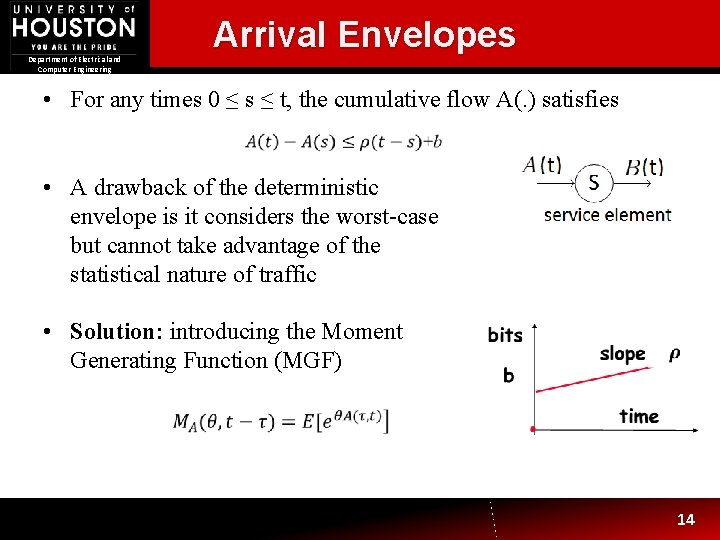
Arrival Envelopes Department of Electrical and Computer Engineering • For any times 0 ≤ s ≤ t, the cumulative flow A(. ) satisfies • A drawback of the deterministic envelope is it considers the worst-case but cannot take advantage of the statistical nature of traffic • Solution: introducing the Moment Generating Function (MGF) 14
Arrival Envelopes Department of Electrical and Computer Engineering • MGF envelope [4], [8] • A related statistical envelope, referred to as Exponentially Bounded Burstiness (EBB), is defined in [9] to provide a guarantee of the form [4] C. -S. Chang, Performance Guarantees in Communication Networks London, U. K. : Springer-Verlag, 2000. [8] C. -S. Chang, “Stability, queue length and delay of deterministic and stochastic queueing networks, ” IEEE Trans. Autom. Control, vol. 39, no. 5, pp. 913– 931, May 1994. [9] O. Yaron and M. Sidi, “Performance and stability of communication networks via robust exponential bounds, ” IEEE/ACM Trans. Netw. , vol. 1, no. 3, pp. 372– 385, Jun. 1993. 15
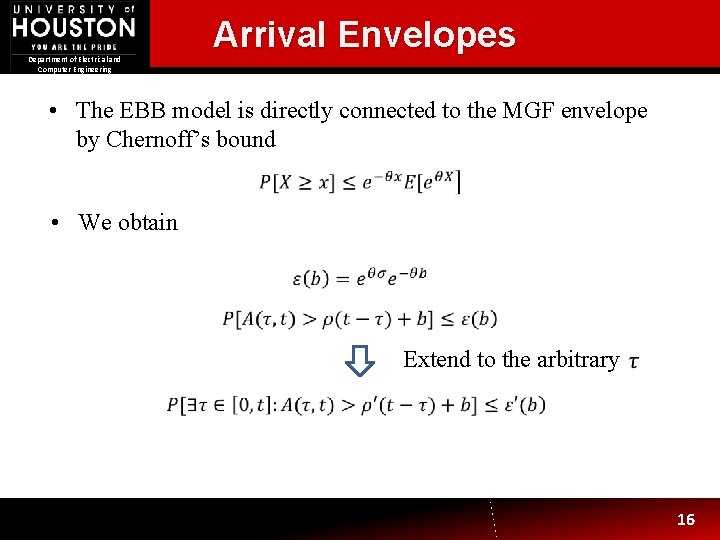
Arrival Envelopes Department of Electrical and Computer Engineering • The EBB model is directly connected to the MGF envelope by Chernoff’s bound • We obtain Extend to the arbitrary 16
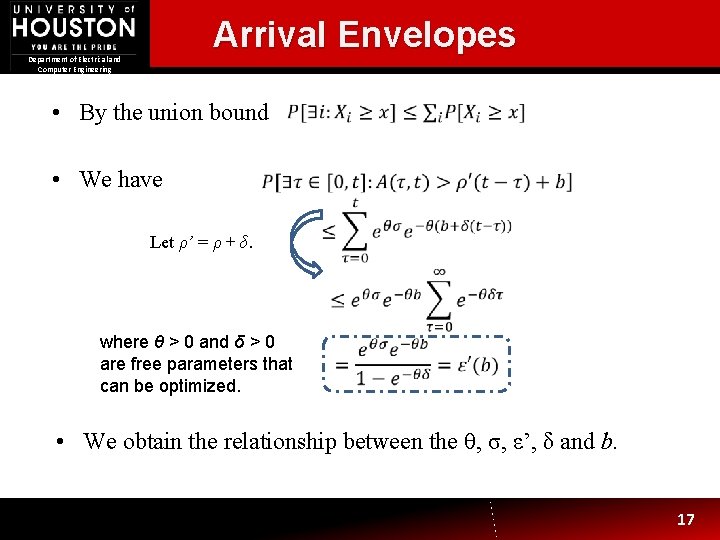
Arrival Envelopes Department of Electrical and Computer Engineering • By the union bound • We have Let ρ’ = ρ + δ. where θ > 0 and δ > 0 are free parameters that can be optimized. • We obtain the relationship between the θ, σ, ε’, δ and b. 17
Department of Electrical and Computer Engineering Outline Ø Ø Ø Stochastic Network Calculus Arrival Envelopes Service Envelopes Backlog and Delay Bounds Applications v Convolution-Form Networks v Statistical Multiplexing Ø Conclusion 18
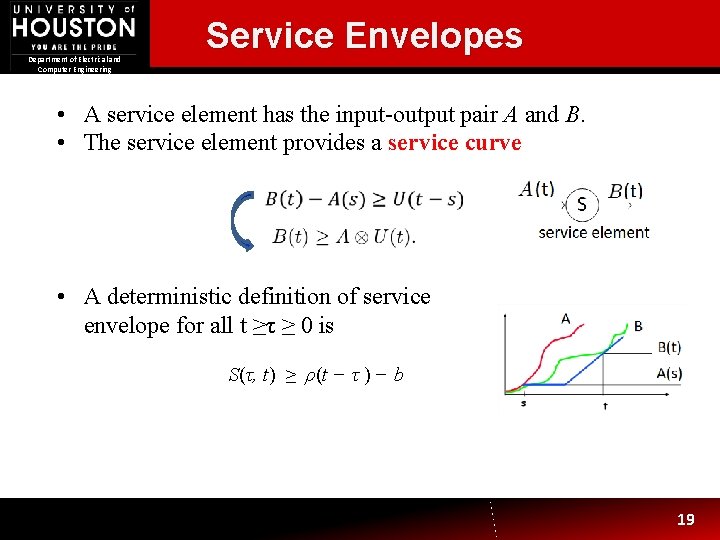
Service Envelopes Department of Electrical and Computer Engineering • A service element has the input-output pair A and B. • The service element provides a service curve • A deterministic definition of service envelope for all t ≥τ ≥ 0 is S(τ, t) ≥ ρ(t − τ ) − b 19
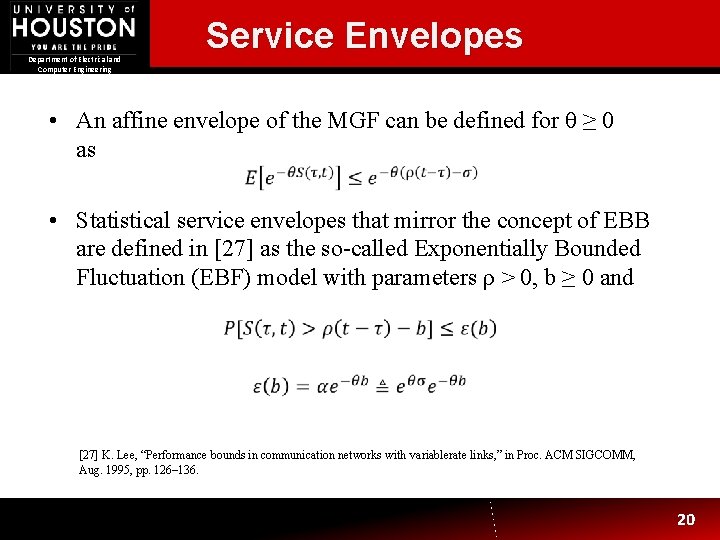
Service Envelopes Department of Electrical and Computer Engineering • An affine envelope of the MGF can be defined for θ ≥ 0 as • Statistical service envelopes that mirror the concept of EBB are defined in [27] as the so-called Exponentially Bounded Fluctuation (EBF) model with parameters ρ > 0, b ≥ 0 and [27] K. Lee, “Performance bounds in communication networks with variablerate links, ” in Proc. ACM SIGCOMM, Aug. 1995, pp. 126– 136. 20
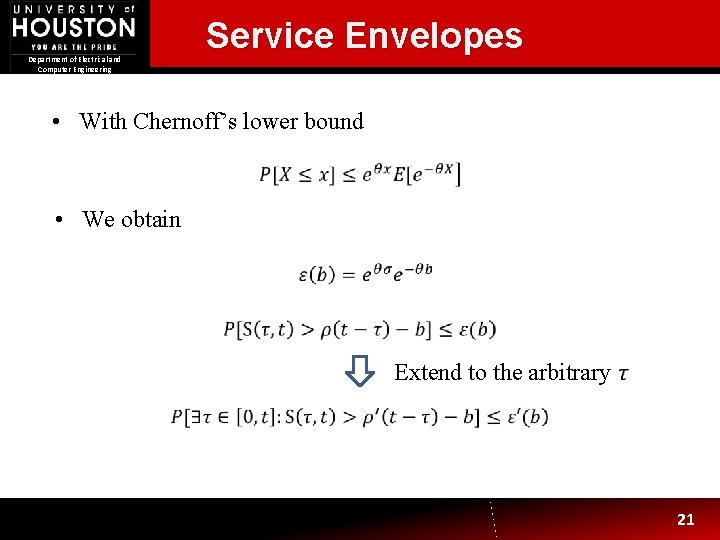
Service Envelopes Department of Electrical and Computer Engineering • With Chernoff’s lower bound • We obtain Extend to the arbitrary 21
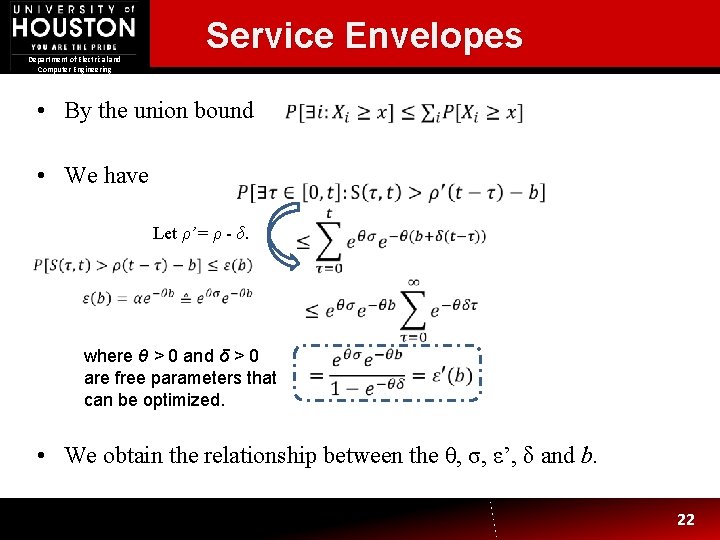
Department of Electrical and Computer Engineering Service Envelopes • By the union bound • We have Let ρ’ = ρ - δ. where θ > 0 and δ > 0 are free parameters that can be optimized. • We obtain the relationship between the θ, σ, ε’, δ and b. 22
Department of Electrical and Computer Engineering Outline Ø Ø Ø Stochastic Network Calculus Arrival Envelopes Service Envelopes Backlog and Delay Bounds Applications v Convolution-Form Networks v Statistical Multiplexing Ø Conclusion 23
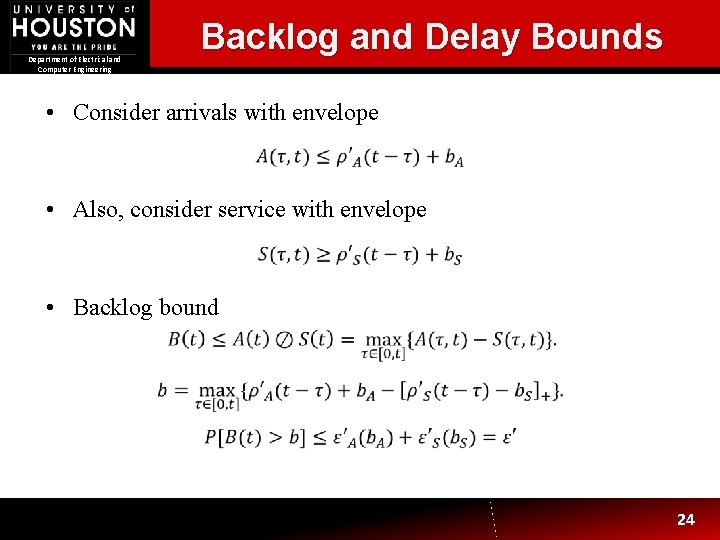
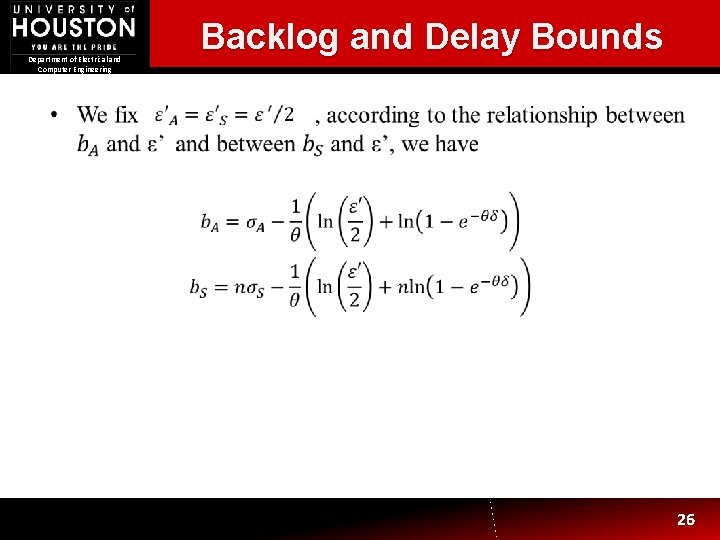
Backlog and Delay Bounds Department of Electrical and Computer Engineering • Consider arrivals with envelope • Also, consider service with envelope • Backlog bound 24
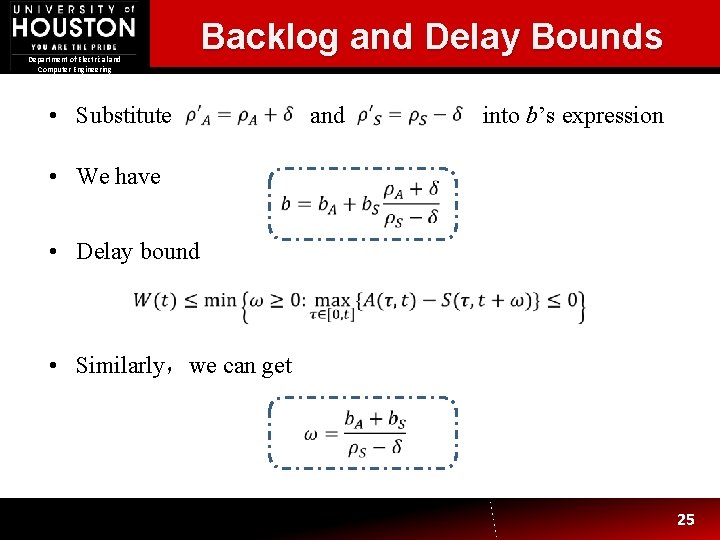
Backlog and Delay Bounds Department of Electrical and Computer Engineering • Substitute • We have and into b’s expression • Delay bound • Similarly,we can get 25
Backlog and Delay Bounds Department of Electrical and Computer Engineering 26
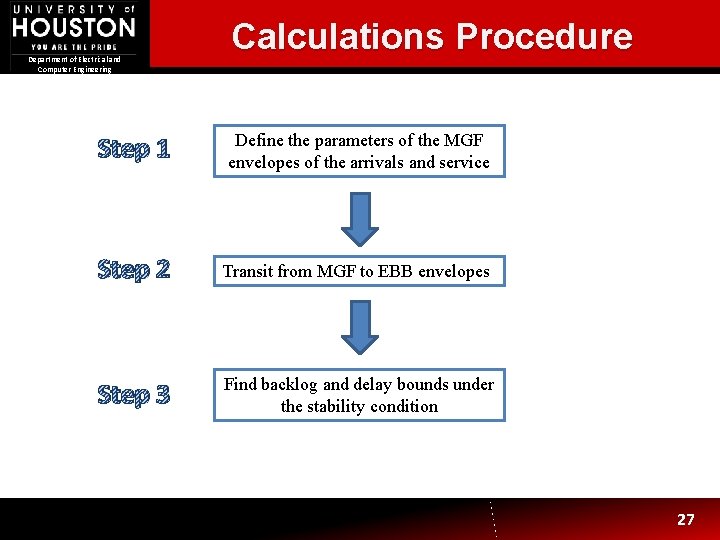
Department of Electrical and Computer Engineering Calculations Procedure Step 1 Define the parameters of the MGF envelopes of the arrivals and service Step 2 Transit from MGF to EBB envelopes Step 3 Find backlog and delay bounds under the stability condition 27
Department of Electrical and Computer Engineering Outline Ø Ø Ø Stochastic Network Calculus Arrival Envelopes Service Envelopes Backlog and Delay Bounds Applications v Convolution-Form Networks v Statistical Multiplexing Ø Conclusion 28
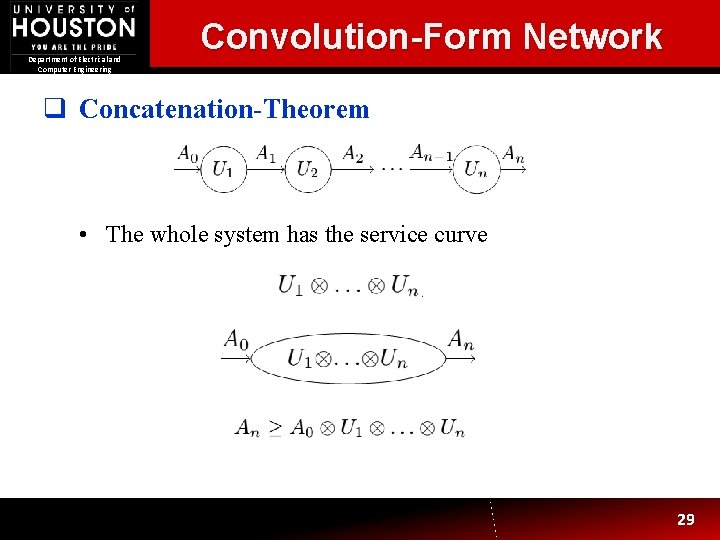
Department of Electrical and Computer Engineering Convolution-Form Network q Concatenation-Theorem • The whole system has the service curve 29
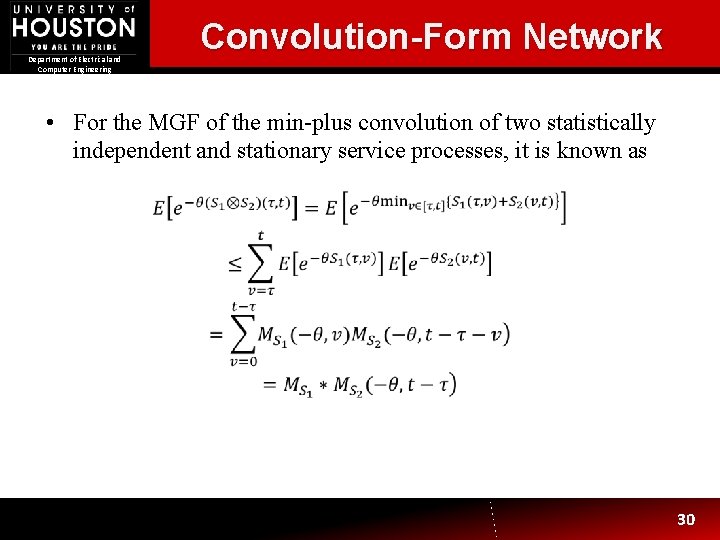
Convolution-Form Network Department of Electrical and Computer Engineering • For the MGF of the min-plus convolution of two statistically independent and stationary service processes, it is known as 30
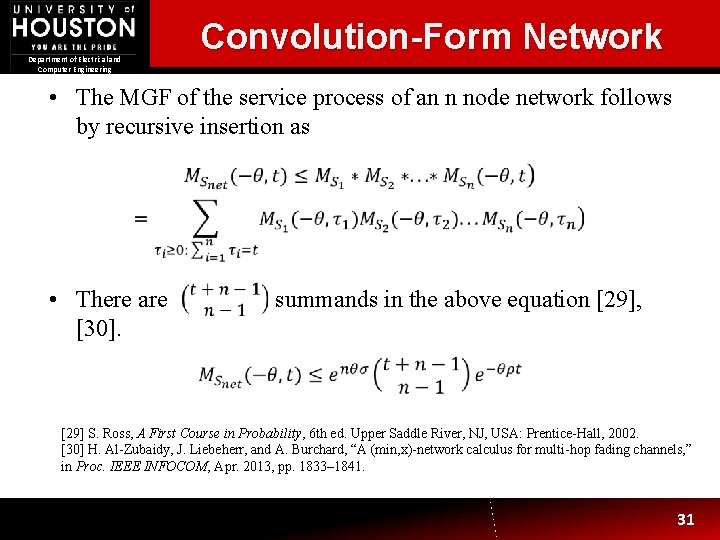
Convolution-Form Network Department of Electrical and Computer Engineering • The MGF of the service process of an n node network follows by recursive insertion as • There are [30]. summands in the above equation [29], [29] S. Ross, A First Course in Probability, 6 th ed. Upper Saddle River, NJ, USA: Prentice-Hall, 2002. [30] H. Al-Zubaidy, J. Liebeherr, and A. Burchard, “A (min, x)-network calculus for multi-hop fading channels, ” in Proc. IEEE INFOCOM, Apr. 2013, pp. 1833– 1841. 31
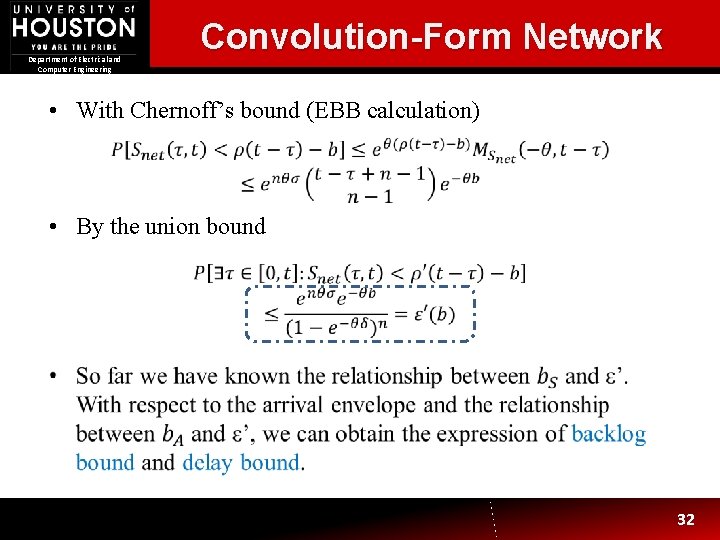
Convolution-Form Network Department of Electrical and Computer Engineering • With Chernoff’s bound (EBB calculation) • By the union bound 32
Department of Electrical and Computer Engineering Outline Ø Ø Ø Stochastic Network Calculus Arrival Envelopes Service Envelopes Backlog and Delay Bounds Applications v Convolution-Form Networks v Statistical Multiplexing Ø Conclusion 33
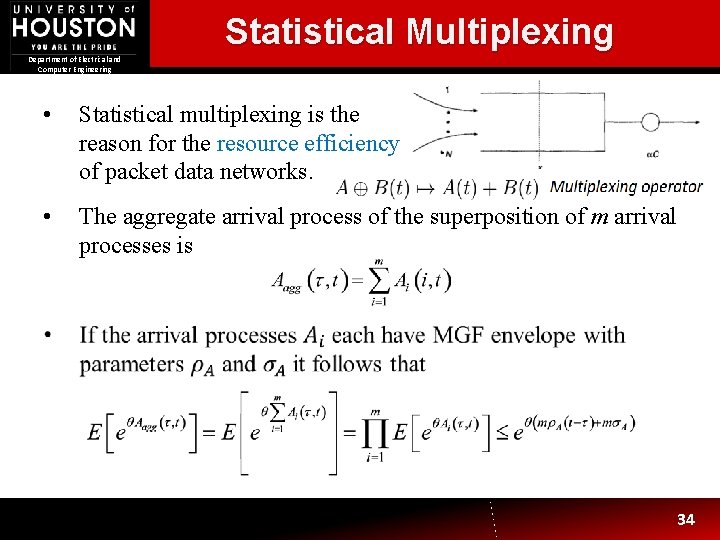
Statistical Multiplexing Department of Electrical and Computer Engineering • Statistical multiplexing is the reason for the resource efficiency of packet data networks. • The aggregate arrival process of the superposition of m arrival processes is 34
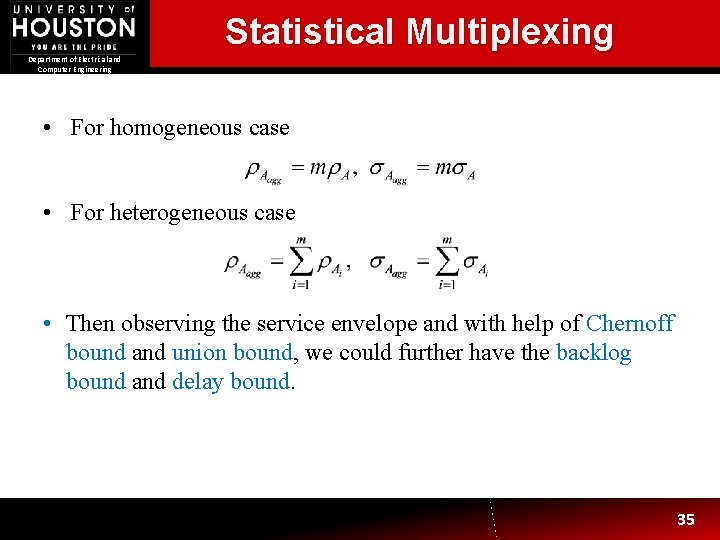
Statistical Multiplexing Department of Electrical and Computer Engineering • For homogeneous case • For heterogeneous case • Then observing the service envelope and with help of Chernoff bound and union bound, we could further have the backlog bound and delay bound. 35
Department of Electrical and Computer Engineering Outline Ø Ø Ø Stochastic Network Calculus Arrival Envelopes Service Envelopes Backlog and Delay Bounds Applications v Convolution-Form Networks v Statistical Multiplexing Ø Conclusion 36
Department of Electrical and Computer Engineering Conclusion 1. SNC is another performance analysis method which can provide the performance bound to complex network. 2. SNC is feasible to the concatenation network by the mean of convolutional operation. 3. SNC is able to deal with the network multiplexing performance evaluation including homogeneous case and heterogeneous case. 37
Department of Electrical and Computer Engineering Q&A Thank You! Department of Electrical and Computer Engineering University of Houston, TX, USA