
Department of Education Region III Division of Zambales
Department of Education Region III Division of Zambales DON MARCELO C. MARTY HIGH SCHOOL Poblacion North, Sta. Cruz, Zambales “PLATE BOUNDARY CONVERGENCE” STRATEGIC INTERVENTION MATERIALS (SIM) SCIENCE 10 John Paul A. Montalla T-1 TITLE CARD
OBJECTIVES This Strategic Learning Material will focused on “Plate Boundary Convergence—types, geologic features and events”. At the end of this intervention, learners are expected to accomplish the following objectives; 1. 2. 3. 4. Identify the characteristics of a Convergent plate boundary movement. Recognize the different types of plate convergence Predict the possible geologic formations found on plate convergence. Give the possible geological phenomena occur on plate convergence. GUIDE CARD 1
LEAST LEARNED CONCEPT • Explain the different processes that occur along the “convergent” plate boundaries. (S 9 ES-Ia-j-36. 3) GUIDE CARD 2
OVERVIEW Plate boundaries are the line between two different plates—and they are in constant movement! There are three types of Plate Tectonic Boundaries which are classified according to plate movements—the Divergent, the Transform fault and the CONVERGENT PLATE BOUNDARIES. Plate movements contribute to the formation of geologic features and occurrence of different geological phenomena. Types of crust (oceanic or continental) is a factor to be consider in predicting geologic formations on convergence boundaries. GUIDE CARD 3
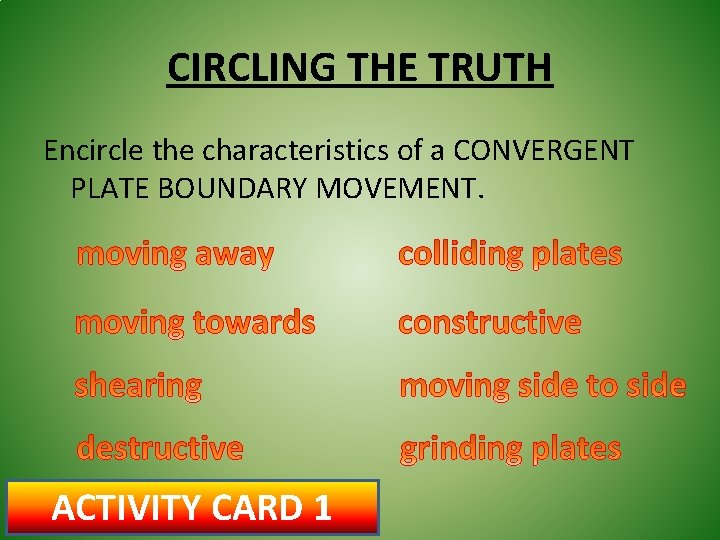
CIRCLING THE TRUTH Encircle the characteristics of a CONVERGENT PLATE BOUNDARY MOVEMENT. ACTIVITY CARD 1
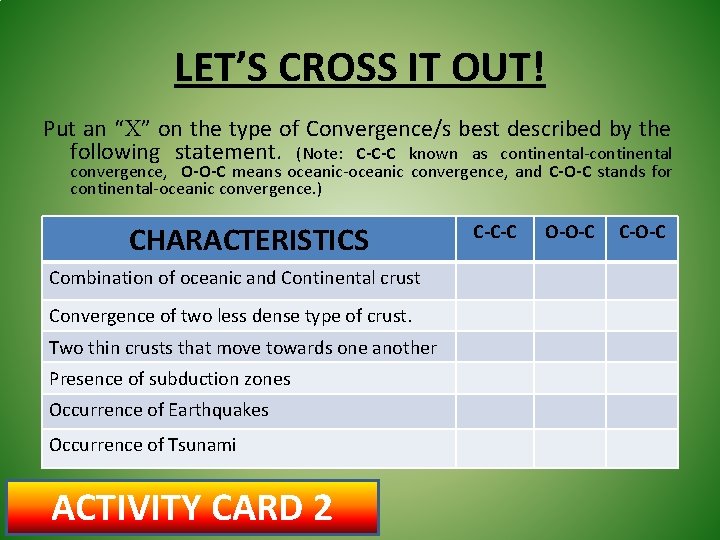
LET’S CROSS IT OUT! Put an “X” on the type of Convergence/s best described by the following statement. (Note: C-C-C known as continental-continental convergence, O-O-C means oceanic-oceanic convergence, and C-O-C stands for continental-oceanic convergence. ) CHARACTERISTICS Combination of oceanic and Continental crust Convergence of two less dense type of crust. Two thin crusts that move towards one another Presence of subduction zones Occurrence of Earthquakes Occurrence of Tsunami ACTIVITY CARD 2 C-C-C O-O-C C-O-C
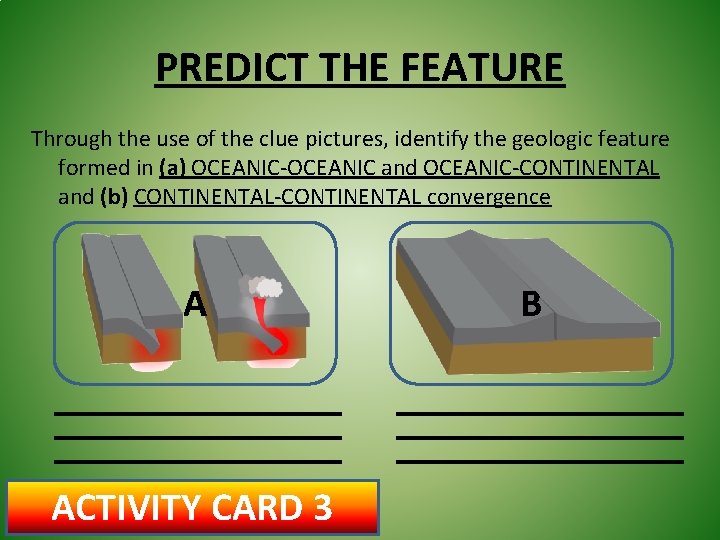
PREDICT THE FEATURE Through the use of the clue pictures, identify the geologic feature formed in (a) OCEANIC-OCEANIC and OCEANIC-CONTINENTAL and (b) CONTINENTAL-CONTINENTAL convergence A ACTIVITY CARD 3 B
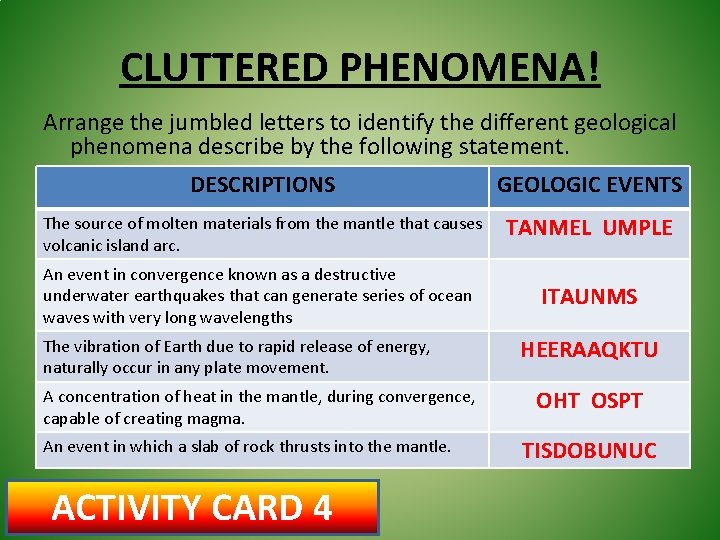
CLUTTERED PHENOMENA! Arrange the jumbled letters to identify the different geological phenomena describe by the following statement. DESCRIPTIONS GEOLOGIC EVENTS The source of molten materials from the mantle that causes volcanic island arc. TANMEL UMPLE An event in convergence known as a destructive underwater earthquakes that can generate series of ocean waves with very long wavelengths ITAUNMS The vibration of Earth due to rapid release of energy, naturally occur in any plate movement. A concentration of heat in the mantle, during convergence, capable of creating magma. An event in which a slab of rock thrusts into the mantle. ACTIVITY CARD 4 HEERAAQKTU OHT OSPT TISDOBUNUC
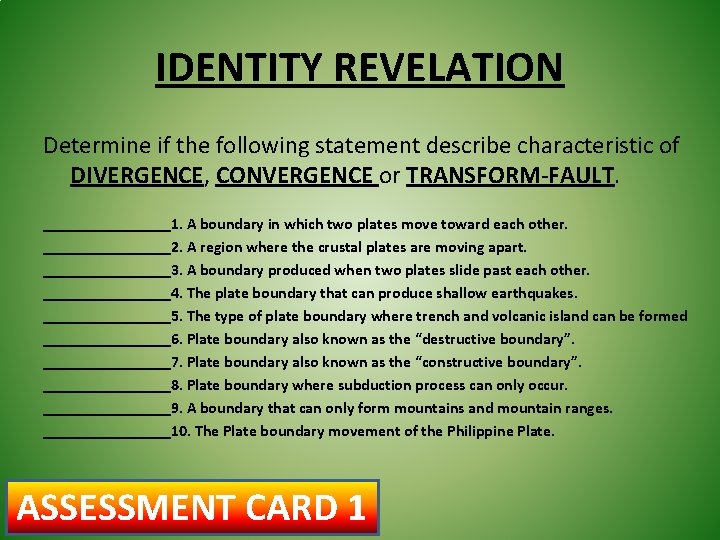
IDENTITY REVELATION Determine if the following statement describe characteristic of DIVERGENCE, CONVERGENCE or TRANSFORM-FAULT. ________1. A boundary in which two plates move toward each other. ________2. A region where the crustal plates are moving apart. ________3. A boundary produced when two plates slide past each other. ________4. The plate boundary that can produce shallow earthquakes. ________5. The type of plate boundary where trench and volcanic island can be formed ________6. Plate boundary also known as the “destructive boundary”. ________7. Plate boundary also known as the “constructive boundary”. ________8. Plate boundary where subduction process can only occur. ________9. A boundary that can only form mountains and mountain ranges. ________10. The Plate boundary movement of the Philippine Plate. ASSESSMENT CARD 1
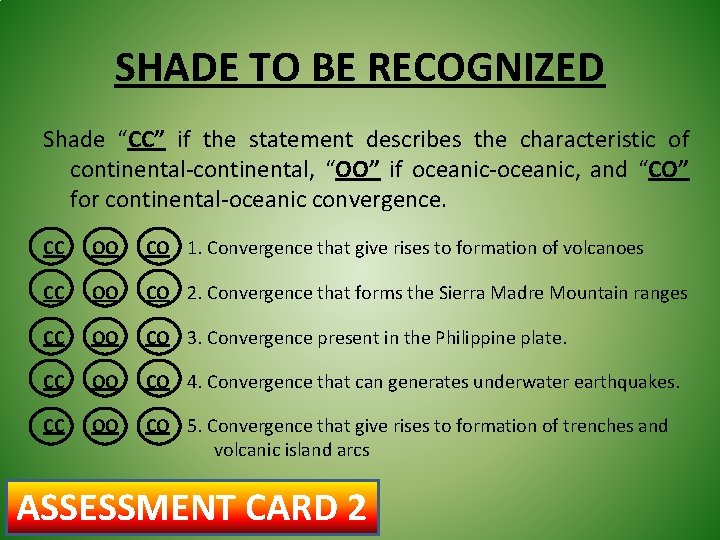
SHADE TO BE RECOGNIZED Shade “CC” if the statement describes the characteristic of continental-continental, “OO” if oceanic-oceanic, and “CO” for continental-oceanic convergence. CC OO CO 1. Convergence that give rises to formation of volcanoes CC OO CO 2. Convergence that forms the Sierra Madre Mountain ranges CC OO CO 3. Convergence present in the Philippine plate. CC OO CO 4. Convergence that can generates underwater earthquakes. CC OO CO 5. Convergence that give rises to formation of trenches and volcanic island arcs ASSESSMENT CARD 2
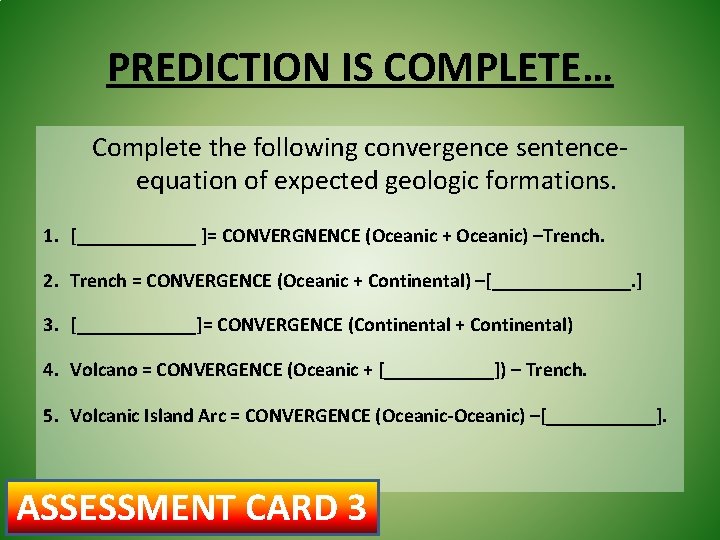
PREDICTION IS COMPLETE… Complete the following convergence sentenceequation of expected geologic formations. 1. [______ ]= CONVERGNENCE (Oceanic + Oceanic) –Trench. 2. Trench = CONVERGENCE (Oceanic + Continental) –[_______. ] 3. [______]= CONVERGENCE (Continental + Continental) 4. Volcano = CONVERGENCE (Oceanic + [______]) – Trench. 5. Volcanic Island Arc = CONVERGENCE (Oceanic-Oceanic) –[______]. ASSESSMENT CARD 3
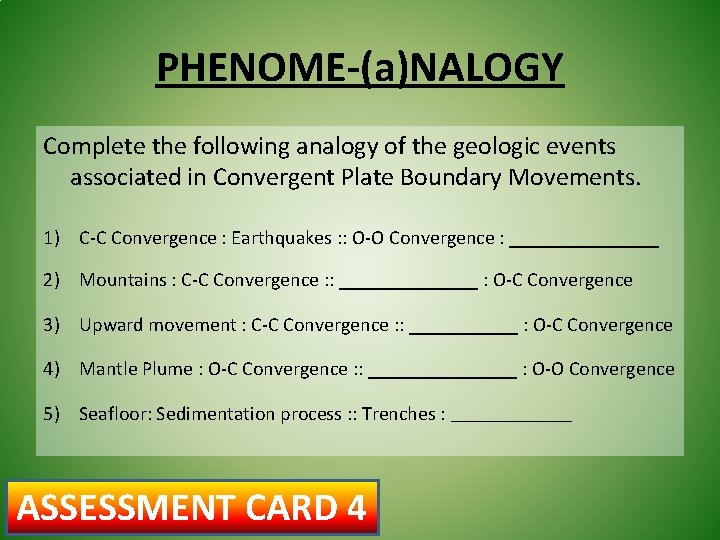
PHENOME-(a)NALOGY Complete the following analogy of the geologic events associated in Convergent Plate Boundary Movements. 1) C-C Convergence : Earthquakes : : O-O Convergence : ________ 2) Mountains : C-C Convergence : : _______ : O-C Convergence 3) Upward movement : C-C Convergence : : ______ : O-C Convergence 4) Mantle Plume : O-C Convergence : : ________ : O-O Convergence 5) Seafloor: Sedimentation process : : Trenches : ___________ ASSESSMENT CARD 4
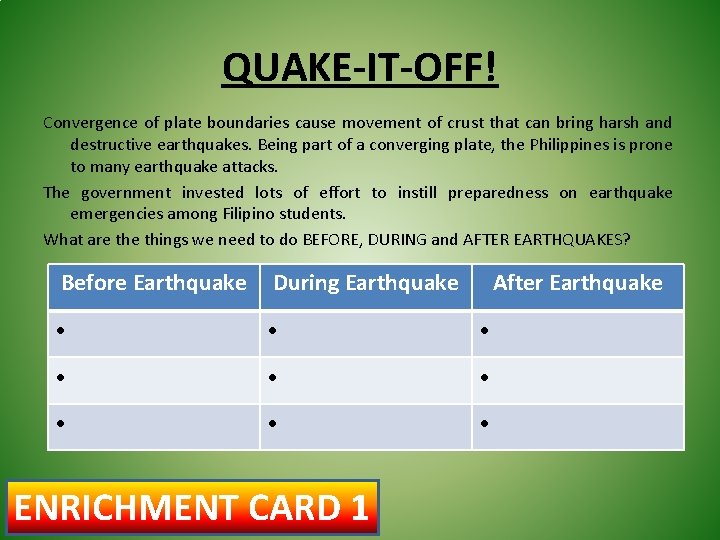
QUAKE-IT-OFF! Convergence of plate boundaries cause movement of crust that can bring harsh and destructive earthquakes. Being part of a converging plate, the Philippines is prone to many earthquake attacks. The government invested lots of effort to instill preparedness on earthquake emergencies among Filipino students. What are things we need to do BEFORE, DURING and AFTER EARTHQUAKES? Before Earthquake During Earthquake • • • ENRICHMENT CARD 1 After Earthquake
MY “EARTHQUAKEMERGENCY” KIT Illustrate on the box the 15 things that you need to have in your “Family Emergency Kit” that can be use during or after a disaster. ENRICHMENT CARD 2
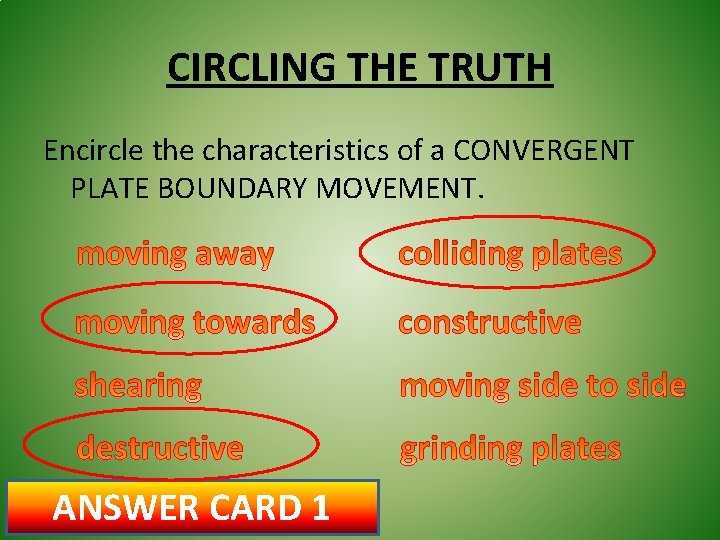
CIRCLING THE TRUTH Encircle the characteristics of a CONVERGENT PLATE BOUNDARY MOVEMENT. ANSWER CARD 1
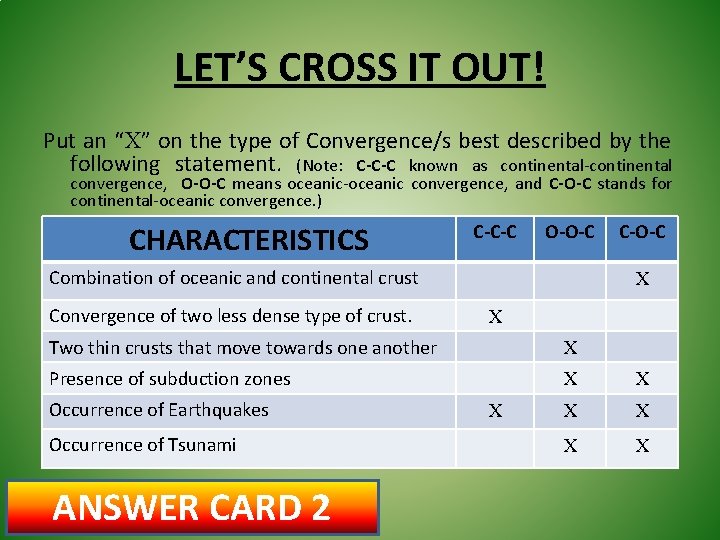
LET’S CROSS IT OUT! Put an “X” on the type of Convergence/s best described by the following statement. (Note: C-C-C known as continental-continental convergence, O-O-C means oceanic-oceanic convergence, and C-O-C stands for continental-oceanic convergence. ) CHARACTERISTICS C-C-C O-O-C Combination of oceanic and continental crust Convergence of two less dense type of crust. C-O-C X X Two thin crusts that move towards one another X Presence of subduction zones X X X Occurrence of Earthquakes Occurrence of Tsunami ANSWER CARD 2 X
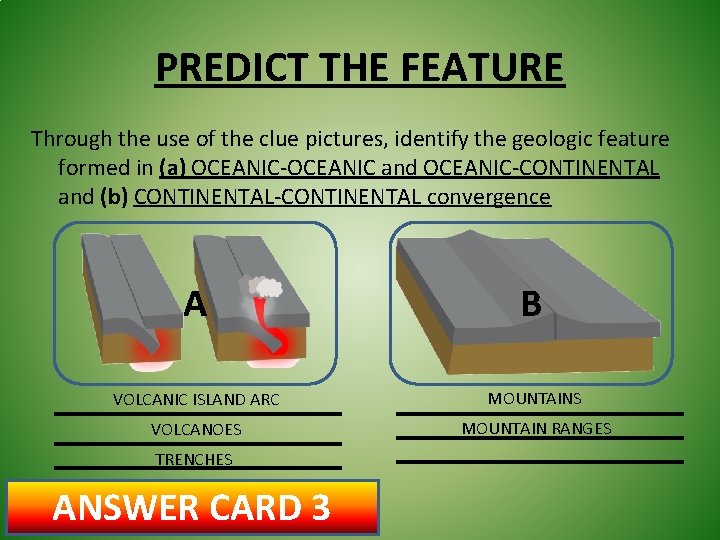
PREDICT THE FEATURE Through the use of the clue pictures, identify the geologic feature formed in (a) OCEANIC-OCEANIC and OCEANIC-CONTINENTAL and (b) CONTINENTAL-CONTINENTAL convergence A B VOLCANIC ISLAND ARC MOUNTAINS VOLCANOES MOUNTAIN RANGES TRENCHES ANSWER CARD 3
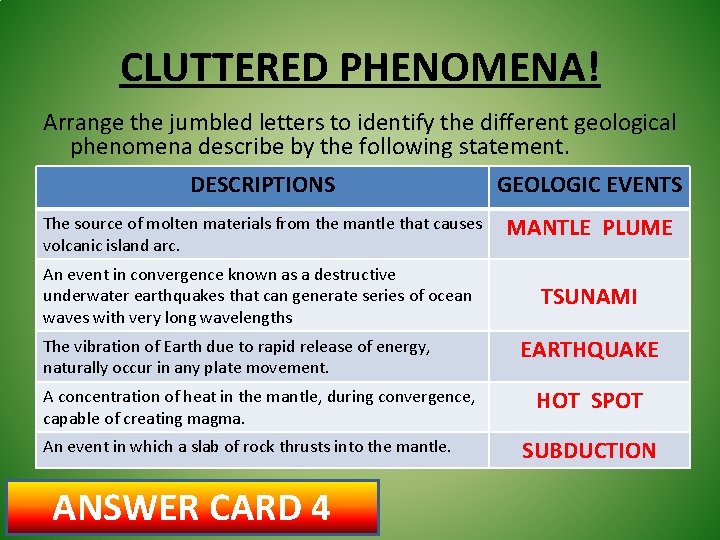
CLUTTERED PHENOMENA! Arrange the jumbled letters to identify the different geological phenomena describe by the following statement. DESCRIPTIONS GEOLOGIC EVENTS The source of molten materials from the mantle that causes volcanic island arc. MANTLE PLUME An event in convergence known as a destructive underwater earthquakes that can generate series of ocean waves with very long wavelengths TSUNAMI The vibration of Earth due to rapid release of energy, naturally occur in any plate movement. A concentration of heat in the mantle, during convergence, capable of creating magma. An event in which a slab of rock thrusts into the mantle. ANSWER CARD 4 EARTHQUAKE HOT SPOT SUBDUCTION
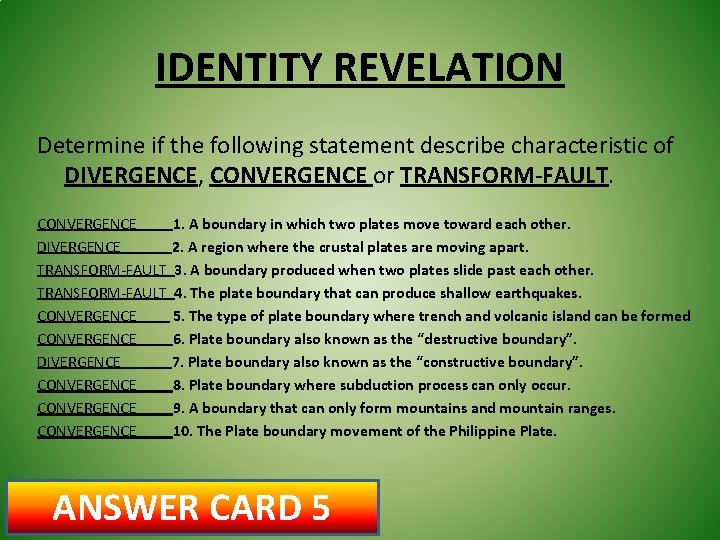
IDENTITY REVELATION Determine if the following statement describe characteristic of DIVERGENCE, CONVERGENCE or TRANSFORM-FAULT. CONVERGENCE 1. A boundary in which two plates move toward each other. DIVERGENCE 2. A region where the crustal plates are moving apart. TRANSFORM-FAULT 3. A boundary produced when two plates slide past each other. TRANSFORM-FAULT 4. The plate boundary that can produce shallow earthquakes. CONVERGENCE 5. The type of plate boundary where trench and volcanic island can be formed CONVERGENCE 6. Plate boundary also known as the “destructive boundary”. DIVERGENCE 7. Plate boundary also known as the “constructive boundary”. CONVERGENCE 8. Plate boundary where subduction process can only occur. CONVERGENCE 9. A boundary that can only form mountains and mountain ranges. CONVERGENCE 10. The Plate boundary movement of the Philippine Plate. ANSWER CARD 5
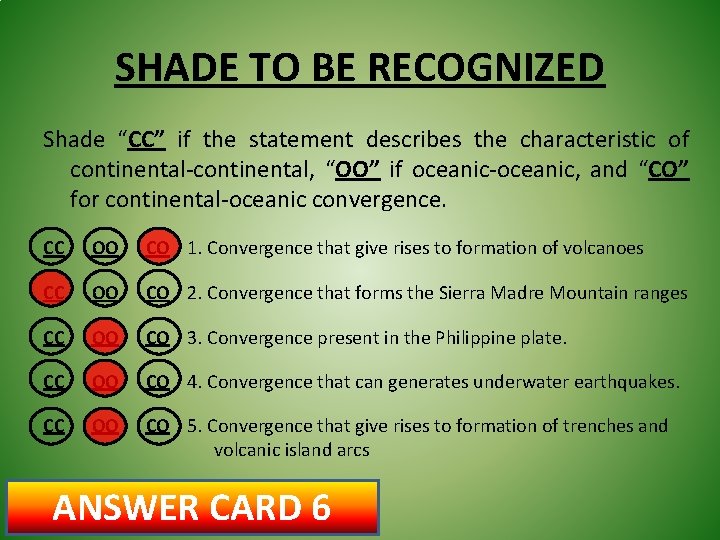
SHADE TO BE RECOGNIZED Shade “CC” if the statement describes the characteristic of continental-continental, “OO” if oceanic-oceanic, and “CO” for continental-oceanic convergence. CC OO CO 1. Convergence that give rises to formation of volcanoes CC OO CO 2. Convergence that forms the Sierra Madre Mountain ranges CC OO CO 3. Convergence present in the Philippine plate. CC OO CO 4. Convergence that can generates underwater earthquakes. CC OO CO 5. Convergence that give rises to formation of trenches and volcanic island arcs ANSWER CARD 6
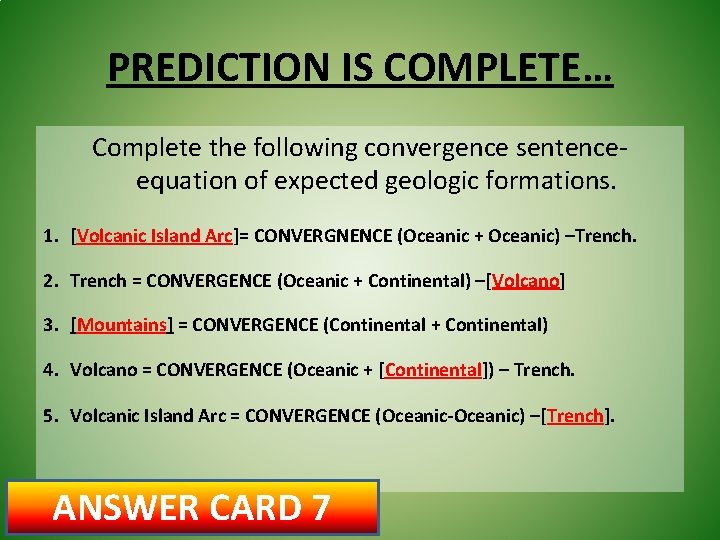
PREDICTION IS COMPLETE… Complete the following convergence sentenceequation of expected geologic formations. 1. [Volcanic Island Arc]= CONVERGNENCE (Oceanic + Oceanic) –Trench. 2. Trench = CONVERGENCE (Oceanic + Continental) –[Volcano] 3. [Mountains] = CONVERGENCE (Continental + Continental) 4. Volcano = CONVERGENCE (Oceanic + [Continental]) – Trench. 5. Volcanic Island Arc = CONVERGENCE (Oceanic-Oceanic) –[Trench]. ANSWER CARD 7
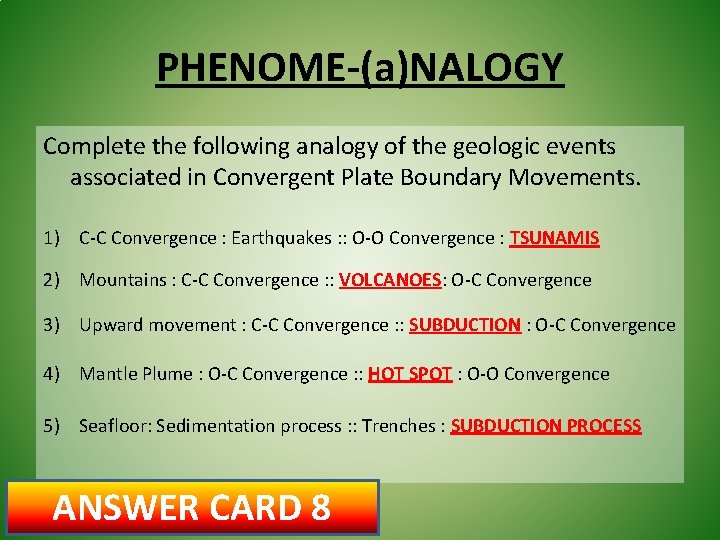
PHENOME-(a)NALOGY Complete the following analogy of the geologic events associated in Convergent Plate Boundary Movements. 1) C-C Convergence : Earthquakes : : O-O Convergence : TSUNAMIS 2) Mountains : C-C Convergence : : VOLCANOES: O-C Convergence 3) Upward movement : C-C Convergence : : SUBDUCTION : O-C Convergence 4) Mantle Plume : O-C Convergence : : HOT SPOT : O-O Convergence 5) Seafloor: Sedimentation process : : Trenches : SUBDUCTION PROCESS ANSWER CARD 8
THANK YOU VERY MUCH!!! Department of Education, Bureau of Secondary Education. Project EASE Integrated Science 1, Module 12 : Inside Earth. Department of Education, Bureau of Secondary Education (2013). Science Grade 8 Learner’s Module. Vibal Publishing House, Inc. Tarbuck, E. J. et al. (2009). Earth Science 12 th ed. Pearson Education South Asia Pte Ltd. http: //www. skoool. ie/ accessed March 3, 2014 http: //earthds. info/ accessed March 3, 2014 http: //www. platetectonics. com accessed March 5, 2014 REFERENCE CARD 8
- Slides: 23