
DEPARTMENT OF ECONOMIC DEVELOPMENT Work Plan DRAFT Framework
- Slides: 13
DEPARTMENT OF ECONOMIC DEVELOPMENT Work Plan – DRAFT
Framework for Engagement and Work Plan Strategy The DED will go about its work through close collaboration with constituents and partners The strategy for the DED will focus on five key areas Organization Business Development Place Making, Redevelopment and Revitalization Arts and Culture Research, Marketing and Communications
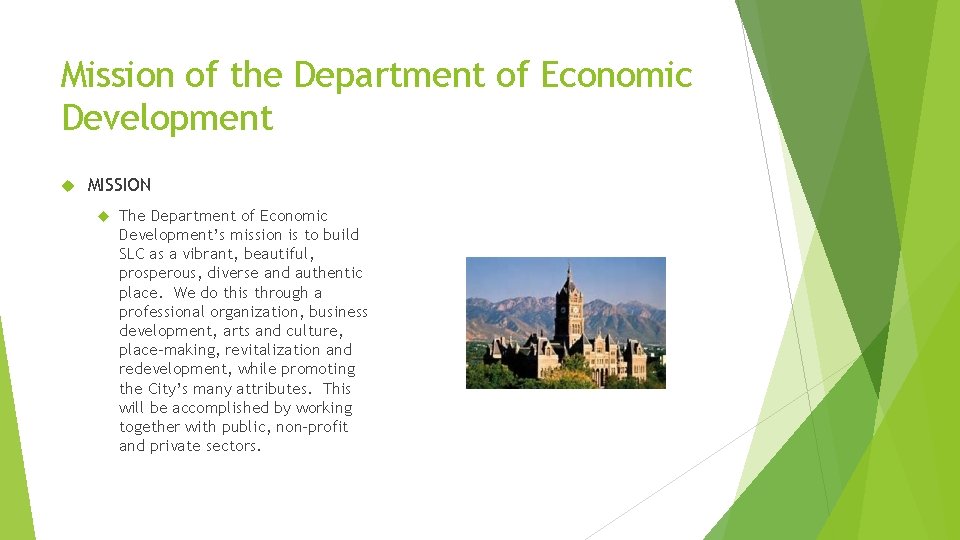
Mission of the Department of Economic Development MISSION The Department of Economic Development’s mission is to build SLC as a vibrant, beautiful, prosperous, diverse and authentic place. We do this through a professional organization, business development, arts and culture, place-making, revitalization and redevelopment, while promoting the City’s many attributes. This will be accomplished by working together with public, non-profit and private sectors.
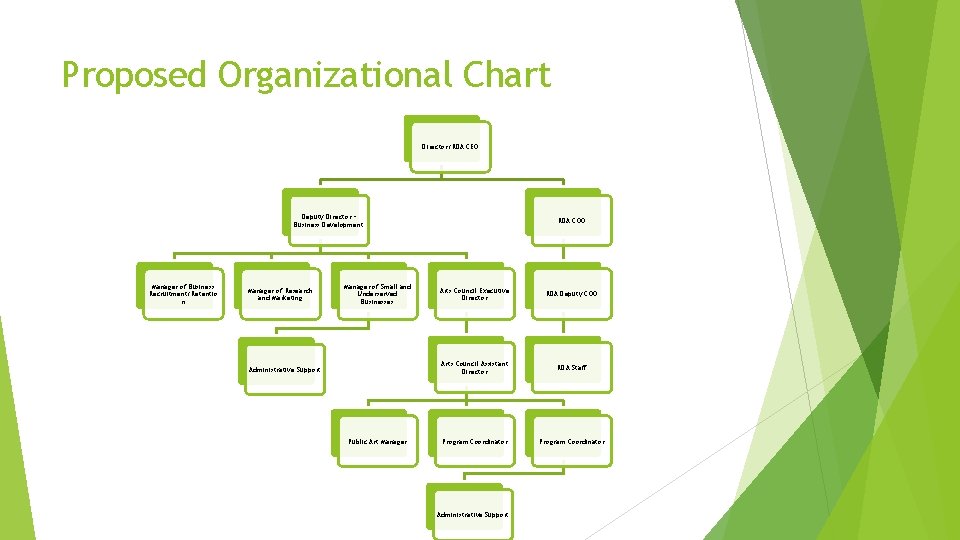
Proposed Organizational Chart Director/RDA CEO Deputy Director – Business Development Manager of Business Recruitment/Retentio n Manager of Research and Marketing Manager of Small and Underserved Businesses Administrative Support Public Art Manager RDA COO Arts Council Executive Director RDA Deputy COO Arts Council Assistant Director RDA Staff Program Coordinator Administrative Support
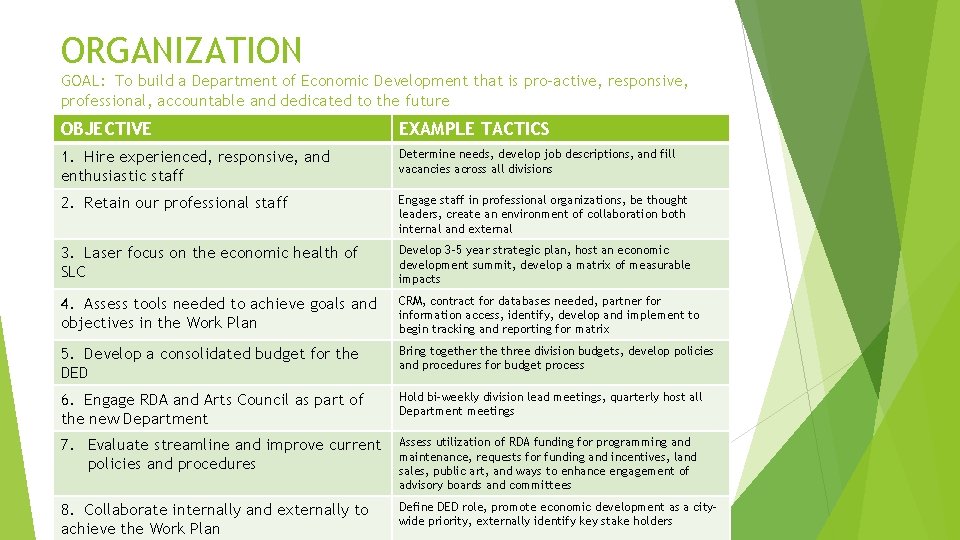
ORGANIZATION GOAL: To build a Department of Economic Development that is pro-active, responsive, professional, accountable and dedicated to the future OBJECTIVE EXAMPLE TACTICS 1. Hire experienced, responsive, and enthusiastic staff Determine needs, develop job descriptions, and fill vacancies across all divisions 2. Retain our professional staff Engage staff in professional organizations, be thought leaders, create an environment of collaboration both internal and external 3. Laser focus on the economic health of SLC Develop 3 -5 year strategic plan, host an economic development summit, develop a matrix of measurable impacts 4. Assess tools needed to achieve goals and objectives in the Work Plan CRM, contract for databases needed, partner for information access, identify, develop and implement to begin tracking and reporting for matrix 5. Develop a consolidated budget for the DED Bring together the three division budgets, develop policies and procedures for budget process 6. Engage RDA and Arts Council as part of the new Department Hold bi-weekly division lead meetings, quarterly host all Department meetings 7. Evaluate streamline and improve current policies and procedures Assess utilization of RDA funding for programming and maintenance, requests for funding and incentives, land sales, public art, and ways to enhance engagement of advisory boards and committees 8. Collaborate internally and externally to achieve the Work Plan Define DED role, promote economic development as a citywide priority, externally identify key stake holders
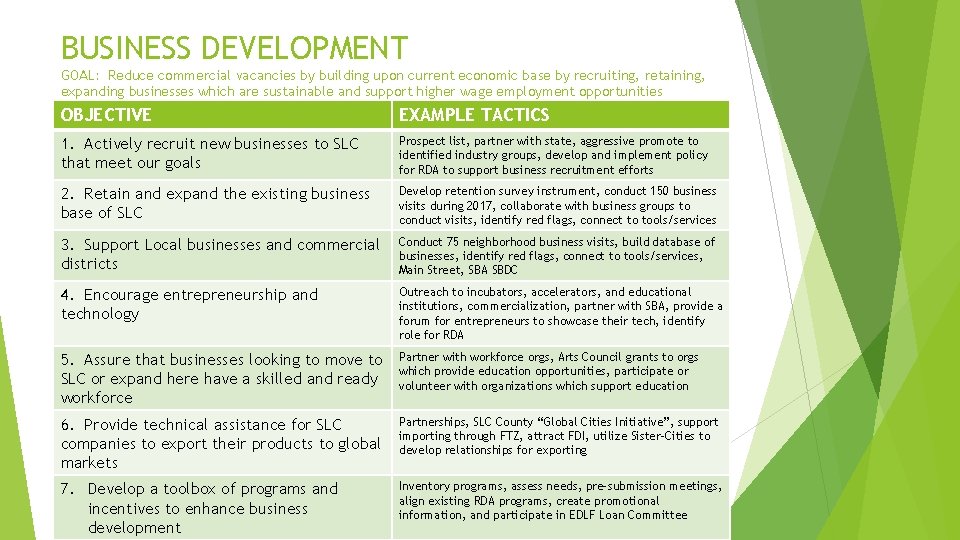
BUSINESS DEVELOPMENT GOAL: Reduce commercial vacancies by building upon current economic base by recruiting, retaining, expanding businesses which are sustainable and support higher wage employment opportunities OBJECTIVE EXAMPLE TACTICS 1. Actively recruit new businesses to SLC that meet our goals Prospect list, partner with state, aggressive promote to identified industry groups, develop and implement policy for RDA to support business recruitment efforts 2. Retain and expand the existing business base of SLC Develop retention survey instrument, conduct 150 business visits during 2017, collaborate with business groups to conduct visits, identify red flags, connect to tools/services 3. Support Local businesses and commercial districts Conduct 75 neighborhood business visits, build database of businesses, identify red flags, connect to tools/services, Main Street, SBA SBDC 4. Encourage entrepreneurship and technology Outreach to incubators, accelerators, and educational institutions, commercialization, partner with SBA, provide a forum for entrepreneurs to showcase their tech, identify role for RDA 5. Assure that businesses looking to move to SLC or expand here have a skilled and ready workforce Partner with workforce orgs, Arts Council grants to orgs which provide education opportunities, participate or volunteer with organizations which support education 6. Provide technical assistance for SLC companies to export their products to global markets Partnerships, SLC County “Global Cities Initiative”, support importing through FTZ, attract FDI, utilize Sister-Cities to develop relationships for exporting 7. Develop a toolbox of programs and incentives to enhance business development Inventory programs, assess needs, pre-submission meetings, align existing RDA programs, create promotional information, and participate in EDLF Loan Committee
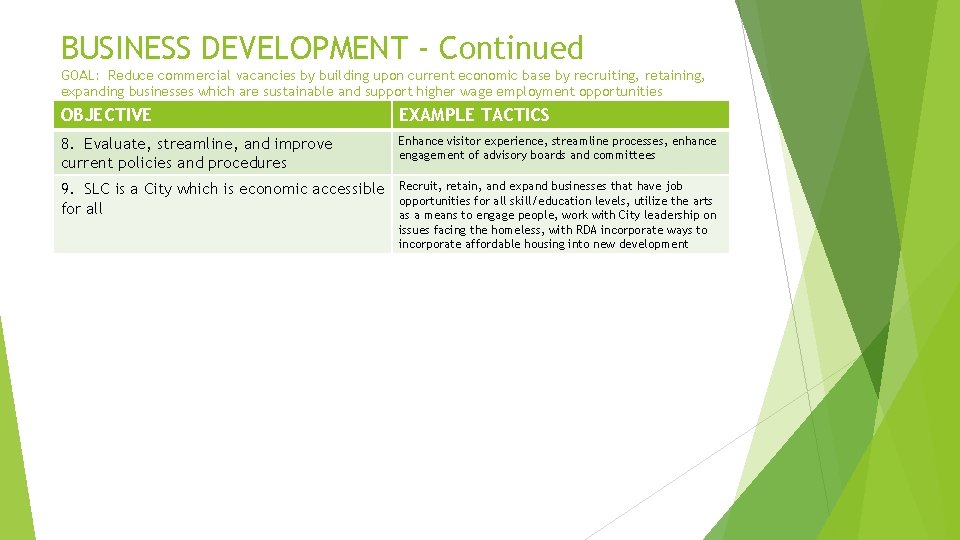
BUSINESS DEVELOPMENT - Continued GOAL: Reduce commercial vacancies by building upon current economic base by recruiting, retaining, expanding businesses which are sustainable and support higher wage employment opportunities OBJECTIVE EXAMPLE TACTICS 8. Evaluate, streamline, and improve current policies and procedures Enhance visitor experience, streamline processes, enhance engagement of advisory boards and committees 9. SLC is a City which is economic accessible for all Recruit, retain, and expand businesses that have job opportunities for all skill/education levels, utilize the arts as a means to engage people, work with City leadership on issues facing the homeless, with RDA incorporate ways to incorporate affordable housing into new development
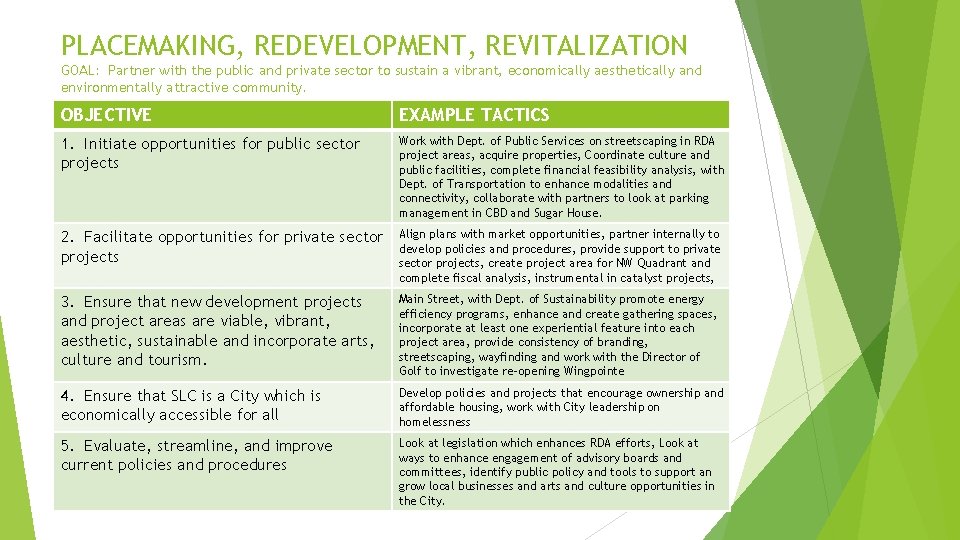
PLACEMAKING, REDEVELOPMENT, REVITALIZATION GOAL: Partner with the public and private sector to sustain a vibrant, economically aesthetically and environmentally attractive community. OBJECTIVE EXAMPLE TACTICS 1. Initiate opportunities for public sector projects Work with Dept. of Public Services on streetscaping in RDA project areas, acquire properties, Coordinate culture and public facilities, complete financial feasibility analysis, with Dept. of Transportation to enhance modalities and connectivity, collaborate with partners to look at parking management in CBD and Sugar House. 2. Facilitate opportunities for private sector projects Align plans with market opportunities, partner internally to develop policies and procedures, provide support to private sector projects, create project area for NW Quadrant and complete fiscal analysis, instrumental in catalyst projects, 3. Ensure that new development projects and project areas are viable, vibrant, aesthetic, sustainable and incorporate arts, culture and tourism. Main Street, with Dept. of Sustainability promote energy efficiency programs, enhance and create gathering spaces, incorporate at least one experiential feature into each project area, provide consistency of branding, streetscaping, wayfinding and work with the Director of Golf to investigate re-opening Wingpointe 4. Ensure that SLC is a City which is economically accessible for all Develop policies and projects that encourage ownership and affordable housing, work with City leadership on homelessness 5. Evaluate, streamline, and improve current policies and procedures Look at legislation which enhances RDA efforts, Look at ways to enhance engagement of advisory boards and committees, identify public policy and tools to support an grow local businesses and arts and culture opportunities in the City.
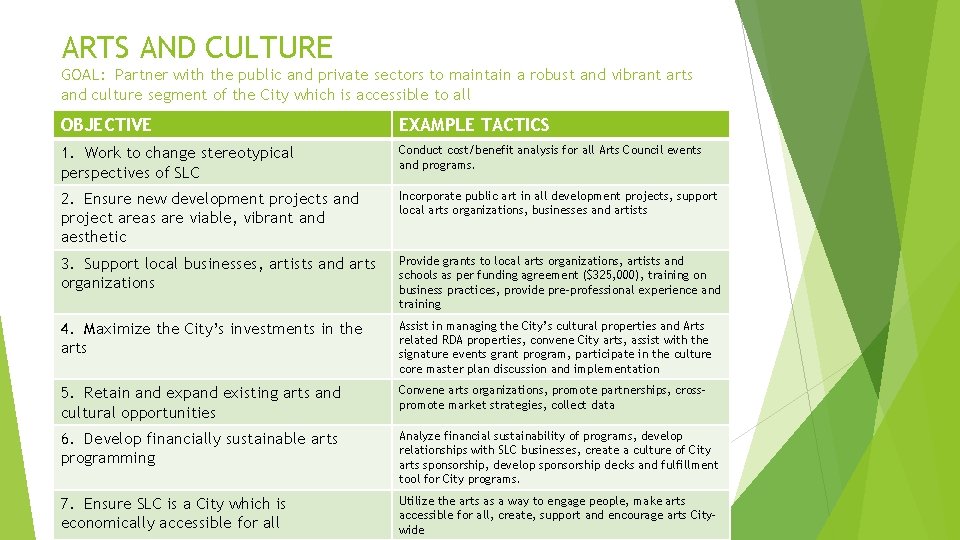
ARTS AND CULTURE GOAL: Partner with the public and private sectors to maintain a robust and vibrant arts and culture segment of the City which is accessible to all OBJECTIVE EXAMPLE TACTICS 1. Work to change stereotypical perspectives of SLC Conduct cost/benefit analysis for all Arts Council events and programs. 2. Ensure new development projects and project areas are viable, vibrant and aesthetic Incorporate public art in all development projects, support local arts organizations, businesses and artists 3. Support local businesses, artists and arts organizations Provide grants to local arts organizations, artists and schools as per funding agreement ($325, 000), training on business practices, provide pre-professional experience and training 4. Maximize the City’s investments in the arts Assist in managing the City’s cultural properties and Arts related RDA properties, convene City arts, assist with the signature events grant program, participate in the culture core master plan discussion and implementation 5. Retain and expand existing arts and cultural opportunities Convene arts organizations, promote partnerships, crosspromote market strategies, collect data 6. Develop financially sustainable arts programming Analyze financial sustainability of programs, develop relationships with SLC businesses, create a culture of City arts sponsorship, develop sponsorship decks and fulfillment tool for City programs. 7. Ensure SLC is a City which is economically accessible for all Utilize the arts as a way to engage people, make arts accessible for all, create, support and encourage arts Citywide
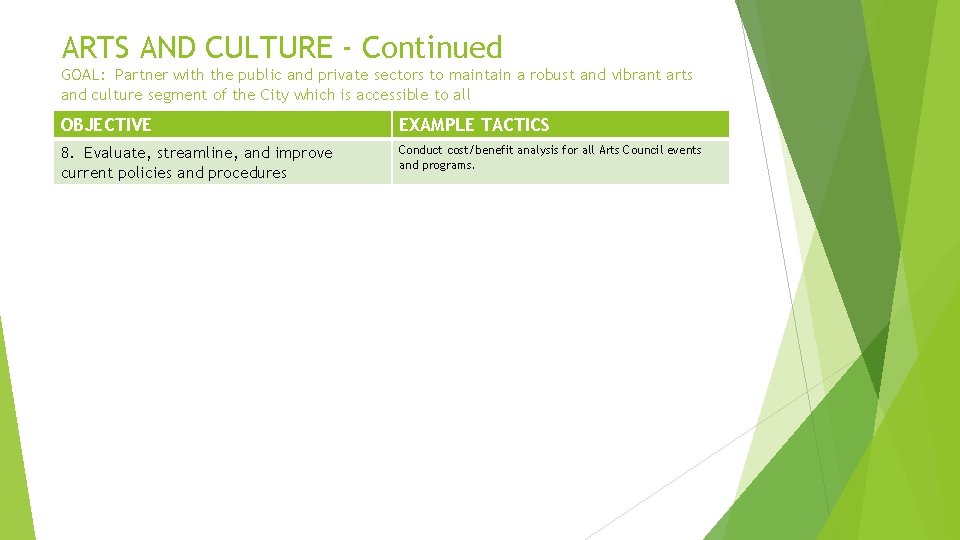
ARTS AND CULTURE - Continued GOAL: Partner with the public and private sectors to maintain a robust and vibrant arts and culture segment of the City which is accessible to all OBJECTIVE EXAMPLE TACTICS 8. Evaluate, streamline, and improve current policies and procedures Conduct cost/benefit analysis for all Arts Council events and programs.
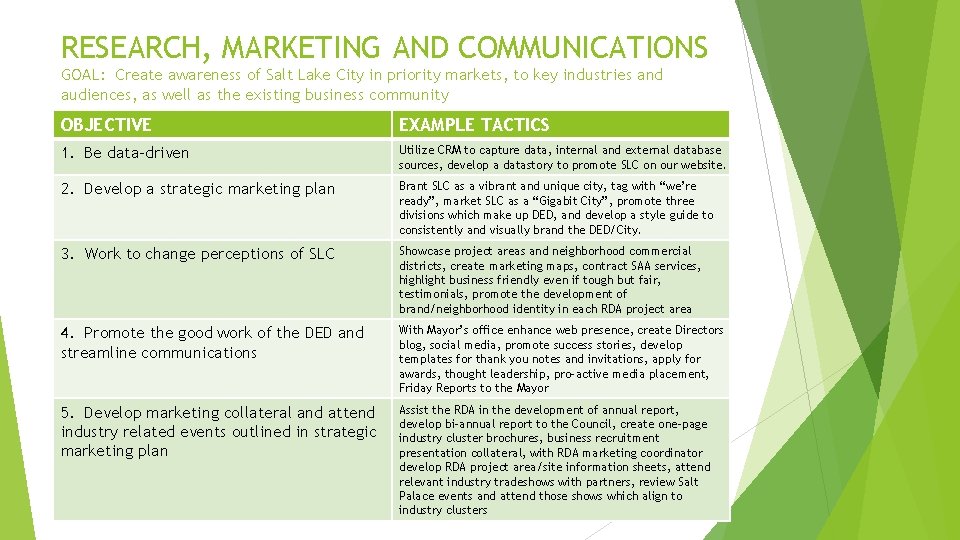
RESEARCH, MARKETING AND COMMUNICATIONS GOAL: Create awareness of Salt Lake City in priority markets, to key industries and audiences, as well as the existing business community OBJECTIVE EXAMPLE TACTICS 1. Be data-driven Utilize CRM to capture data, internal and external database sources, develop a datastory to promote SLC on our website. 2. Develop a strategic marketing plan Brant SLC as a vibrant and unique city, tag with “we’re ready”, market SLC as a “Gigabit City”, promote three divisions which make up DED, and develop a style guide to consistently and visually brand the DED/City. 3. Work to change perceptions of SLC Showcase project areas and neighborhood commercial districts, create marketing maps, contract SAA services, highlight business friendly even if tough but fair, testimonials, promote the development of brand/neighborhood identity in each RDA project area 4. Promote the good work of the DED and streamline communications With Mayor’s office enhance web presence, create Directors blog, social media, promote success stories, develop templates for thank you notes and invitations, apply for awards, thought leadership, pro-active media placement, Friday Reports to the Mayor 5. Develop marketing collateral and attend industry related events outlined in strategic marketing plan Assist the RDA in the development of annual report, develop bi-annual report to the Council, create one-page industry cluster brochures, business recruitment presentation collateral, with RDA marketing coordinator develop RDA project area/site information sheets, attend relevant industry tradeshows with partners, review Salt Palace events and attend those shows which align to industry clusters
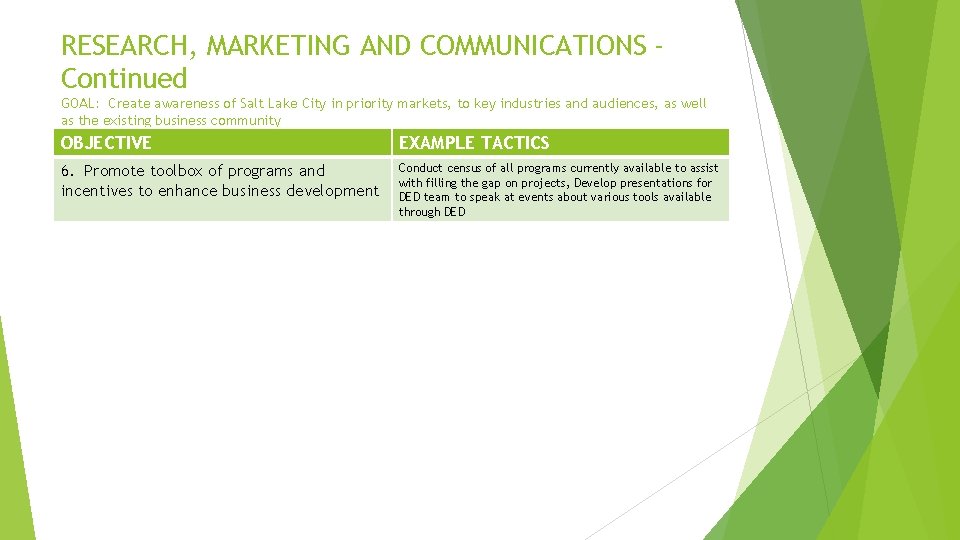
RESEARCH, MARKETING AND COMMUNICATIONS Continued GOAL: Create awareness of Salt Lake City in priority markets, to key industries and audiences, as well as the existing business community OBJECTIVE EXAMPLE TACTICS 6. Promote toolbox of programs and incentives to enhance business development Conduct census of all programs currently available to assist with filling the gap on projects, Develop presentations for DED team to speak at events about various tools available through DED
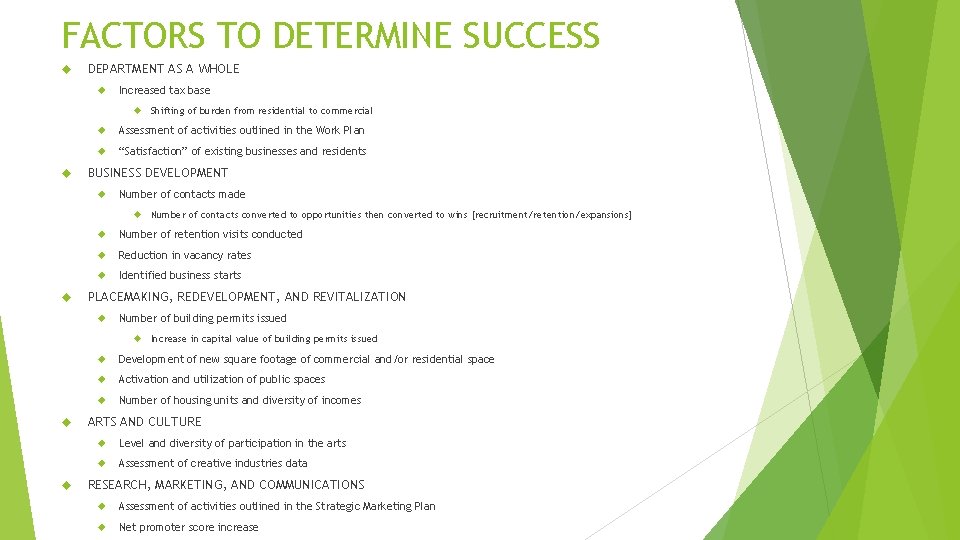
FACTORS TO DETERMINE SUCCESS DEPARTMENT AS A WHOLE Increased tax base Assessment of activities outlined in the Work Plan “Satisfaction” of existing businesses and residents BUSINESS DEVELOPMENT Number of contacts made Number of retention visits conducted Reduction in vacancy rates Identified business starts PLACEMAKING, REDEVELOPMENT, AND REVITALIZATION Number of building permits issued Number of contacts converted to opportunities then converted to wins [recruitment/retention/expansions] Shifting of burden from residential to commercial Increase in capital value of building permits issued Development of new square footage of commercial and/or residential space Activation and utilization of public spaces Number of housing units and diversity of incomes ARTS AND CULTURE Level and diversity of participation in the arts Assessment of creative industries data RESEARCH, MARKETING, AND COMMUNICATIONS Assessment of activities outlined in the Strategic Marketing Plan Net promoter score increase