
Department of Defence Annual Report FY 201516 Together
![Defence Mandate • Through the DOD Strategy Map [AR p 36], the mandate is](https://slidetodoc.com/presentation_image_h/c9d96ea97eec8b3102b04b2b5867abbf/image-8.jpg "Defence Mandate • Through the DOD Strategy Map [AR p 36], the mandate is")
- Slides: 50
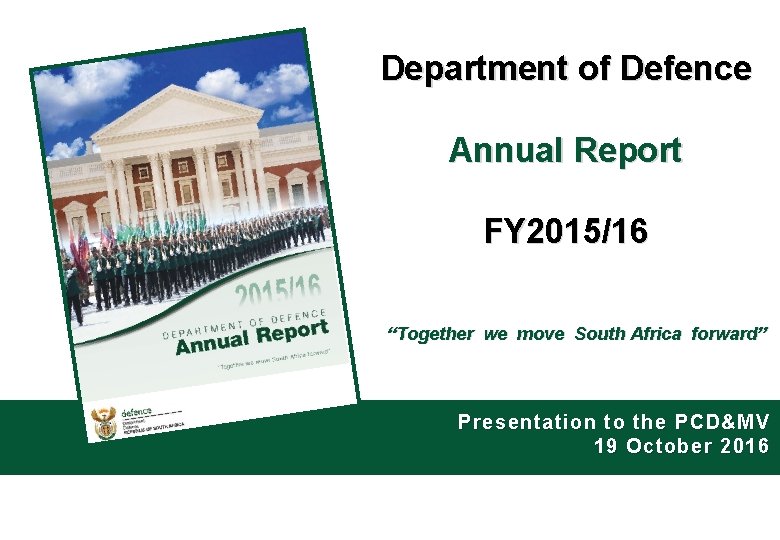
Department of Defence Annual Report FY 2015/16 “Together we move South Africa forward” Presentation to the PCD&MV 19 October 2016
Aim To brief the Portfolio Committee on Defence and Military Veterans (PCD&MV) on the Department of Defence (DOD) Annual Report for FY 2015/16. 2
Scope • Introduction • Defence Mandate • Medium Term Strategic Framework (MTSF) Outcomes and Outputs • Key Policy Developments • Financial Performance Information • Non-Financial Performance Information • Noteworthy Achievements • DOD Audit Outcomes 3
Introduction • The DOD Annual Report FY 2015/16 was prepared in accordance with the following legislative guidelines and prescripts: - Section 40 (1) (d) of the Public Finance Management Act (PFMA), 1999 (Act No. 1 of 1999). - Treasury Regulations, 2005 Chapter 18 Section. - Public Service Regulations, 2001, Chapter 1 Part III. - National Treasury Guide for the Preparation of Annual Reports. - DOD Planning Instruments for FY 2015/16. 4
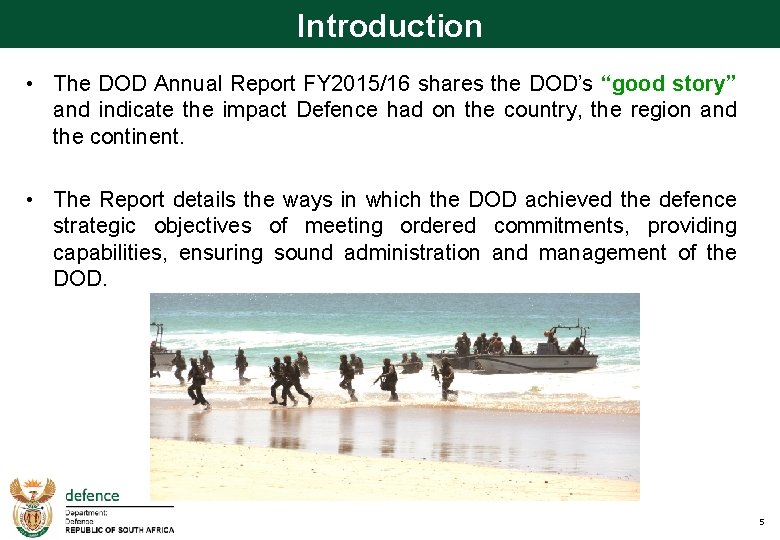
Introduction • The DOD Annual Report FY 2015/16 shares the DOD’s “good story” and indicate the impact Defence had on the country, the region and the continent. • The Report details the ways in which the DOD achieved the defence strategic objectives of meeting ordered commitments, providing capabilities, ensuring sound administration and management of the DOD. 5
Defence Mandate • The DOD derives its mandate from Section 200(2) of the Constitution. • The mandate is given substance by: - The Defence Act. - The White Paper on Defence (1996). - The Defence Review (1998) – Defence Review 2015 in future. - Delegated legislation. 6
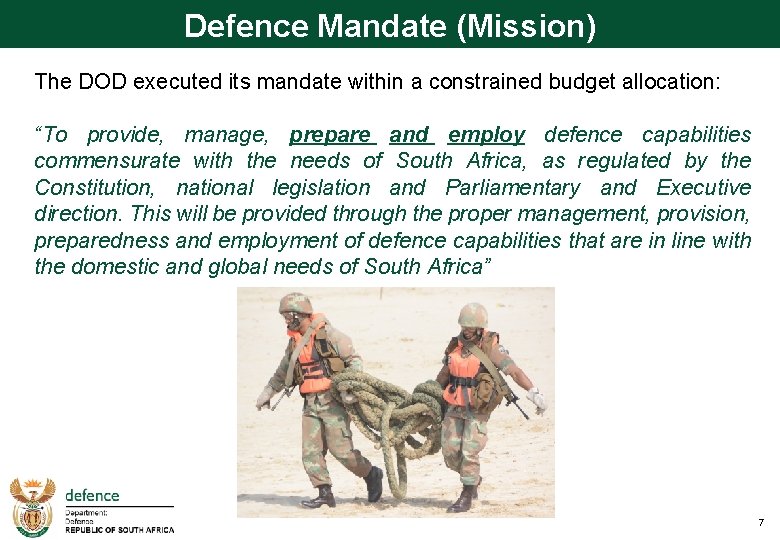
Defence Mandate (Mission) The DOD executed its mandate within a constrained budget allocation: “To provide, manage, prepare and employ defence capabilities commensurate with the needs of South Africa, as regulated by the Constitution, national legislation and Parliamentary and Executive direction. This will be provided through the proper management, provision, preparedness and employment of defence capabilities that are in line with the domestic and global needs of South Africa” 7
Defence Mandate • Through the DOD Strategy Map [AR p 36], the mandate is translated into Defence outcomes: - RSA is defended and protected. - Enhanced Civil Control of Defence. • The DOD outputs express aspects of the MTSF in relation to: - Outcome 3: “All people in South Africa are and feel safe”. - Outcome 11: “Creating a better South Africa and contributing to a better and safer Africa in a better World”. 8
MTSF Outcomes and Outputs • In pursuance of its legislative mandate and utilising its inherent defence capabilities, the DOD continued to provide support to the Government’s MTSF Outcomes relevant to the Defence mandate. • The MOD&MV is the Chairperson and jointly responsible for the coordination of the Justice, Crime Prevention and Security (JCPS) Cluster and member of the Joint International Cooperation Trade and Security (ICTS) Cluster for the MTSF Outcomes 3 and 11 respectively. • The DOD’s contributions to the MTSF outcomes are as follows: 9
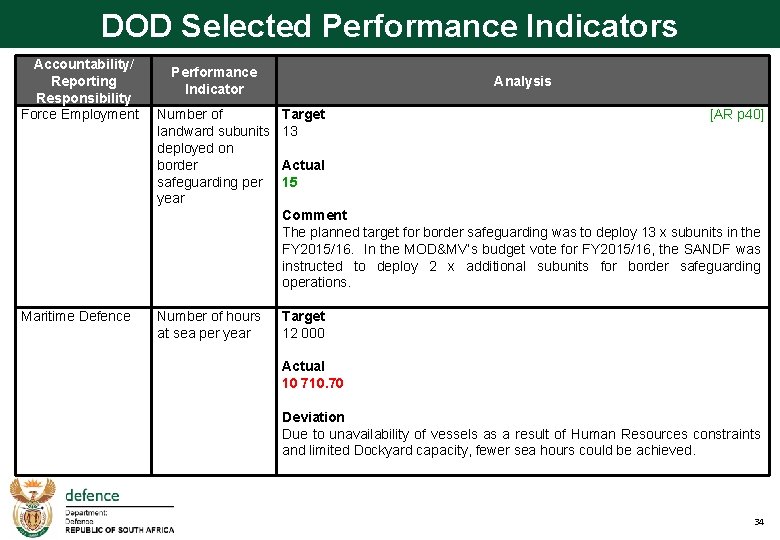
MTSF Outcomes and Outputs Outcome 3: All people in South Africa are and feel safe. • Sub-outcome 3: South Africa’s borders effectively defended, protected, secured and well managed. [AR p 36] Development of the Border Safeguarding Strategy (substrategy) in support of the overarching strategy by securing the land, airspace and maritime borders (this strategy is dependent on the overarching national strategy, which is the responsibility of the Border Management Agency). Ito the pronouncement during the MOD&MV’s Budget Vote of 19 May 2015, the DOD increased the number of companies for border safeguarding operations with two additional companies, increasing from 13 to 15 companies. The DOD called-up two additional Reserve Force companies for border safeguarding operations, giving a total of 15 landward subunits deployed to safeguard and maintain the integrity of the borderline. 10
MTSF Outcomes and Outputs Outcome 3: All people in South Africa are and feel safe. • Sub-outcome 4: Secure Cyberspace. [AR p 37] The DOD contributed towards the development of the National Cyberwarfare (Security) Strategy and Implementation Plan, by developing and submitting a Cyberwarfare Strategy and Implementation Plan for approval by the C SANDF. During the FY 2016/17, the DOD will approve the Cyberwarfare Implementation Plan, as well as continue to contribute towards capacitating and establishing a Cyberwarfare Command Centre Headquarters by FY 2018/19 (budgetary constraints). [AR p 89] 11
MTSF Outcomes and Outputs Outcome 3: All people in South Africa are and feel safe. • Sub-outcome 7: Corruption in the Public and Private Sectors Reduced. [AR p 37] The DOD contributed to this sub-outcome by means of reducing departmental levels of corruption where prevalent, thus contributing to improving investor perception, trust in and willingness to invest in South Africa. No corruption and fraud cases of Rm 5 and over were reported in the DOD during FY 2015/16. The DOD presented fraud and corruption awareness roadshows to 10 248 members, including the command cadre of the SANDF. The DOD is contributing towards the development of the National Anti-Corruption Strategy, which is now in the final stages of completion. 12
MTSF Outcomes and Outputs Outcome 11: Creating a better South Africa and contributing to a better and safer Africa in a better world. • Sub-outcome 3: Political cohesion in Southern Africa to ensure a peaceful, secure and stable Southern African Region. [AR p 37] Deployment of the SANDF for peace support operations (on instruction by the Commander-in-Chief). - Deployment of 10 Defence Attachés in the SADC (Angola, Botswana, DRC, Lesotho, Mozambique, Namibia, Swaziland, Tanzania, Zambia and Zimbabwe). - The DOD complied 100% with all ordered commitments (external deployments ordered by the Commander-in-Chief in accordance with the Constitution). 13
MTSF Outcomes and Outputs Outcome 11: Creating a better South Africa and contributing to a better and safer Africa in a better world. • Sub-outcome 3: Political cohesion in Southern Africa to ensure a peaceful, secure and stable Southern African Region. [AR p 38] External operations included: - Participation in the UN Peace Support Operation in the DRC. - Anti-piracy operations in the Mozambique Channel. - UN/AU Hybrid Peace Support Operation in the Sudan (SANDF forces were withdrawn by the Commander-in-Chief. Commenced withdrawing on 01 April 2016). 14
MTSF Outcomes and Outputs Outcome 11: Creating a better South Africa and contributing to a better and safer Africa in a better world. • Sub-outcome 3: Political cohesion in Southern Africa to ensure a peaceful, secure and stable Southern African Region. [AR p 38] The DOD also provided forces in the following two General Military Assistance operations which are still ongoing: - Team BULISA - seven members are deployed to the Forces Armées de la Républigue Démocratique du Congo (FARDC) to assist with the publication and popularisation of their Military Strategy. - Mission THEBE - eight members are deployed in the DRC for the safe guarding of SANDF equipment and in preparation for training support of the FARDC. 15
MTSF Outcomes and Outputs Outcome 11: Creating a better South Africa and contributing to a better and safer Africa in a better world. • Sub-outcome 3: Political cohesion in Southern Africa to ensure a peaceful, secure and stable Southern African Region. [AR p 38] The DOD was involved in the following Joint, Interdepartmental, Interagency and Multinational military exercises: - Exercise WAYSIDE I and II – To exercise the maintenance of the provincial Chemical, Biological and Radiological (CBR) Response Teams and interdepartmental cooperation for the management of CBR incidents. These exercises took place in Pretoria. - Exercise OXIDE - To develop and maintain maritime cooperation at the operational and tactical levels between the SA Navy and the French Forces stationed in the La Reunion. This exercise took place in Richards Bay. 16
MTSF Outcomes and Outputs Outcome 11: Creating a better South Africa and contributing to a better and safer Africa in a better world. • Sub-outcome 3: Political cohesion in Southern Africa to ensure a peaceful, secure and stable Southern African Region. [AR p 38] - Exercise BLUE ZAMBEZI - This was a Humanitarian Aid Exercise between SADC Air Forces Components, aimed at achieving the readiness in Humanitarian Aid Assistance Operations and related Supporting Operations. The exercise was conducted in Botswana. - Exercise AMANI AFRICA II - The SANDF successfully participated in Ex AMANI AFRICA II at the SA Army Combat Training Centre at Lohatlha in the Northern Cape where 4 650 military troops, police and civilians participated in the exercise. This exercise evaluated the state of readiness of the African Standby Force and exercised the rapid deployment capability. 17 major troop contributing countries participated (Algeria, Angola, Botswana, Burkina Faso, Ethiopia, Kenya, Lesotho, Malawi, Mozambique, Namibia, Nigeria, RSA, Rwanda, Uganda, Zambia and Zimbabwe). 17
MTSF Outcomes and Outputs Outcome 11: Creating a better South Africa and contributing to a better and safer Africa in a better world. • Sub-outcome 3: Political cohesion in Southern Africa to ensure a peaceful, secure and stable Southern African Region. [AR p 38 & p 78] - Exercise IBSAMAR - multinational maritime exercise held between the navies of SA, Brazil and India (extension of the IBSA agreement). The exercise took place in Indian waters to coincide with the international fleet review. 18
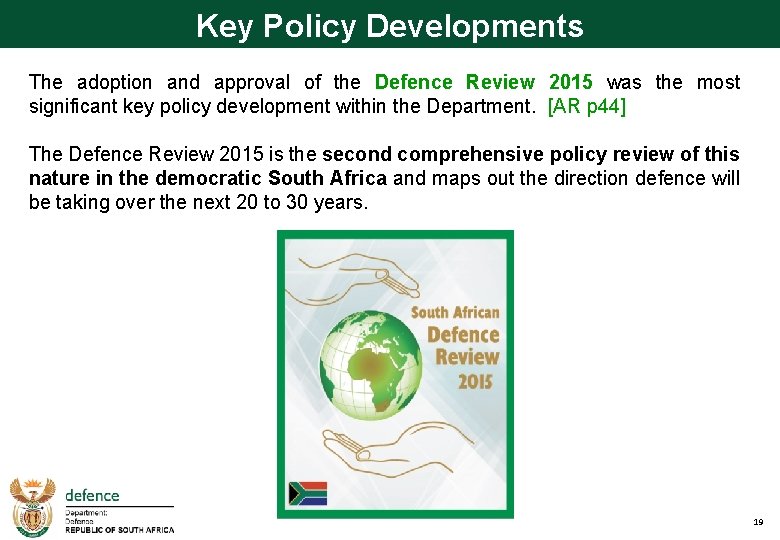
Key Policy Developments The adoption and approval of the Defence Review 2015 was the most significant key policy development within the Department. [AR p 44] The Defence Review 2015 is the second comprehensive policy review of this nature in the democratic South Africa and maps out the direction defence will be taking over the next 20 to 30 years. 19
Key Policy Developments • The DOD devoted FY 2015/16 to the planning for the incremental implementation of the Defence Review 2015 (Milestone 1) to ‘arrest the decline’. • The Defence Review 2015 (Milestone 1) Implementation Plan consists of two primary work packages. • The 1 st package being those interventions that can be pursued within the current Defence budget allocation and which will improve organisational efficiency and effectiveness. • The 2 nd package, being those interventions that need additional funding and which will improve operational performance. • The planning team is finalising the cost-driven component to the Defence Review 2015 (Milestone 1) Implementation Plan which will be included in the Planning Instruments of FY 2017/18 onwards, should the required additional funding be contained in the FY 2017/18 appropriation to Defence. [AR p 42 & 43] 20
Financial Performance Information 21
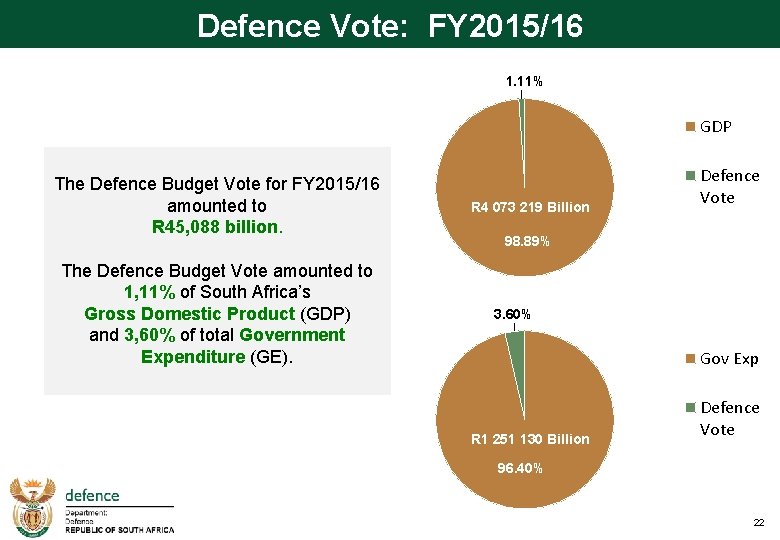
Defence Vote: FY 2015/16 1. 11% GDP The Defence Budget Vote for FY 2015/16 amounted to R 45, 088 billion. The Defence Budget Vote amounted to 1, 11% of South Africa’s Gross Domestic Product (GDP) and 3, 60% of total Government Expenditure (GE). R 4 073 219 Billion Defence Vote 98. 89% 3. 60% Gov Exp R 1 251 130 Billion Defence Vote 96. 40% 22
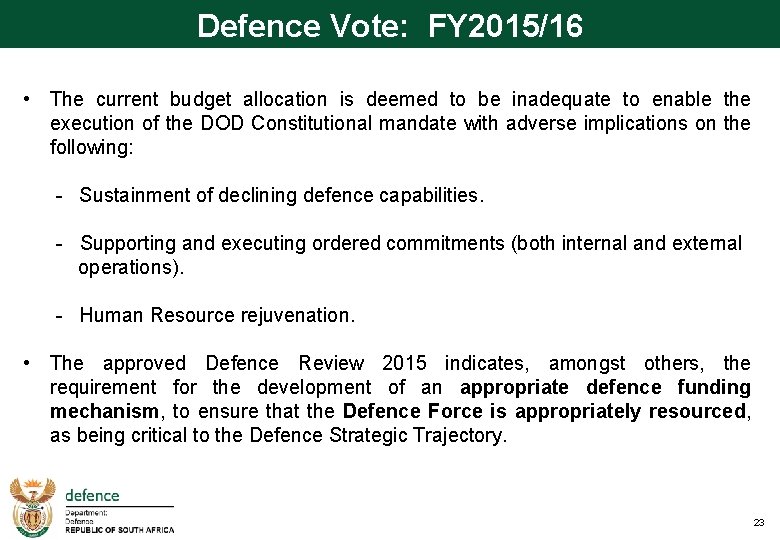
Defence Vote: FY 2015/16 • The current budget allocation is deemed to be inadequate to enable the execution of the DOD Constitutional mandate with adverse implications on the following: - Sustainment of declining defence capabilities. - Supporting and executing ordered commitments (both internal and external operations). - Human Resource rejuvenation. • The approved Defence Review 2015 indicates, amongst others, the requirement for the development of an appropriate defence funding mechanism, to ensure that the Defence Force is appropriately resourced, as being critical to the Defence Strategic Trajectory. 23
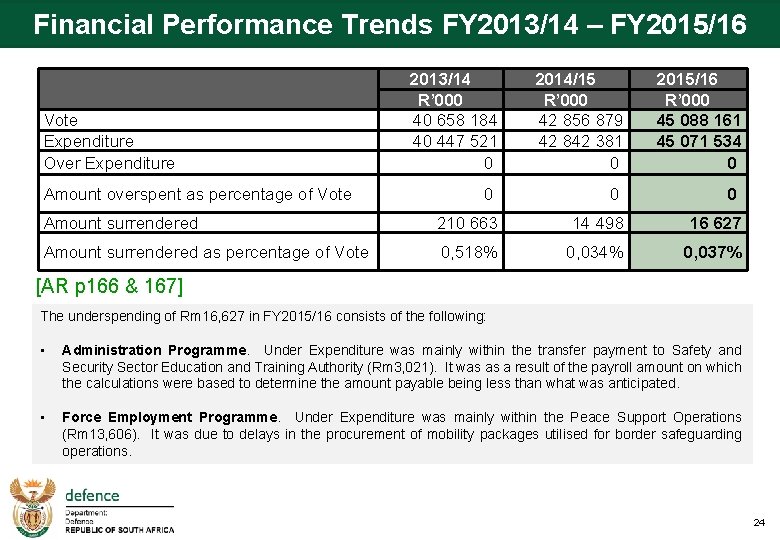
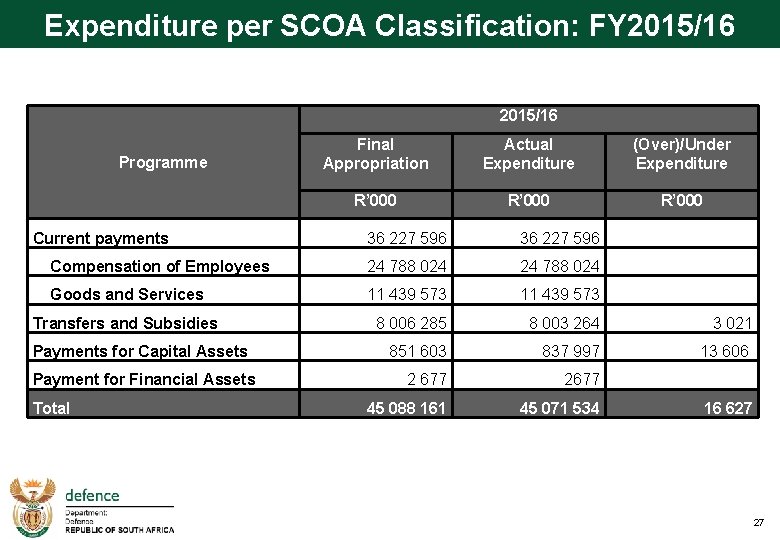
Financial Performance Trends FY 2013/14 – FY 2015/16 2013/14 R’ 000 40 658 184 40 447 521 0 2014/15 R’ 000 42 856 879 42 842 381 0 2015/16 R’ 000 45 088 161 45 071 534 0 0 Amount surrendered 210 663 14 498 16 627 Amount surrendered as percentage of Vote 0, 518% 0, 034% 0, 037% Vote Expenditure Over Expenditure Amount overspent as percentage of Vote [AR p 166 & 167] The underspending of Rm 16, 627 in FY 2015/16 consists of the following: • Administration Programme. Under Expenditure was mainly within the transfer payment to Safety and Security Sector Education and Training Authority (Rm 3, 021). It was as a result of the payroll amount on which the calculations were based to determine the amount payable being less than what was anticipated. • Force Employment Programme. Under Expenditure was mainly within the Peace Support Operations (Rm 13, 606). It was due to delays in the procurement of mobility packages utilised for border safeguarding operations. 24
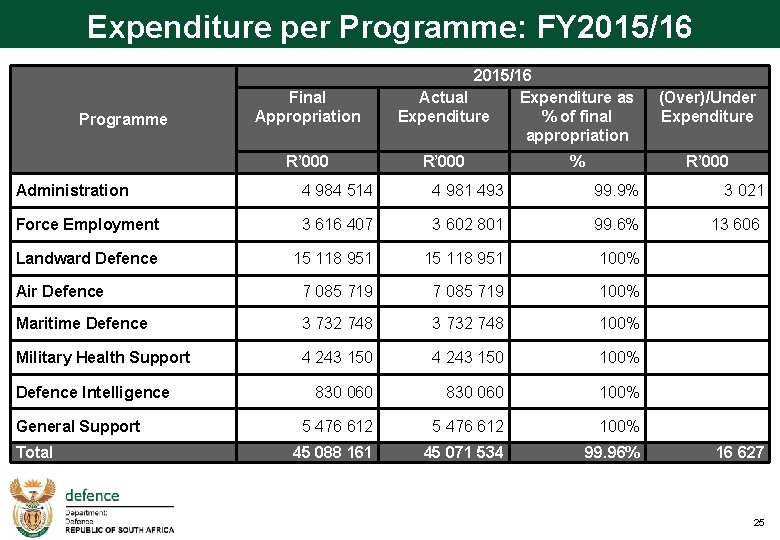
Expenditure per Programme: FY 2015/16 Programme Final Appropriation R’ 000 2015/16 Actual Expenditure as Expenditure % of final appropriation R’ 000 % (Over)/Under Expenditure R’ 000 Administration 4 984 514 4 981 493 99. 9% 3 021 Force Employment 3 616 407 3 602 801 99. 6% 13 606 Landward Defence 15 118 951 100% Air Defence 7 085 719 100% Maritime Defence 3 732 748 100% Military Health Support 4 243 150 100% 830 060 100% 5 476 612 100% 45 088 161 45 071 534 99. 96% 16 627 Defence Intelligence General Support Total 25
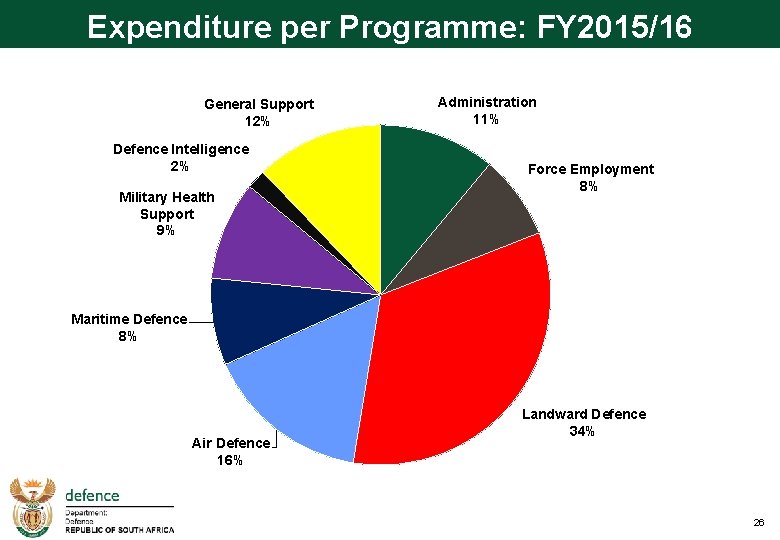
Expenditure per Programme: FY 2015/16 General Support 12% Defence Intelligence 2% Military Health Support 9% Administration 11% Force Employment 8% Maritime Defence 8% Air Defence 16% Landward Defence 34% 26
Expenditure per SCOA Classification: FY 2015/16 Programme Final Appropriation Actual Expenditure (Over)/Under Expenditure R’ 000 Current payments 36 227 596 Compensation of Employees 24 788 024 Goods and Services 11 439 573 8 006 285 8 003 264 3 021 851 603 837 997 13 606 2 677 2677 45 088 161 45 071 534 16 627 Transfers and Subsidies Payments for Capital Assets Payment for Financial Assets Total 27
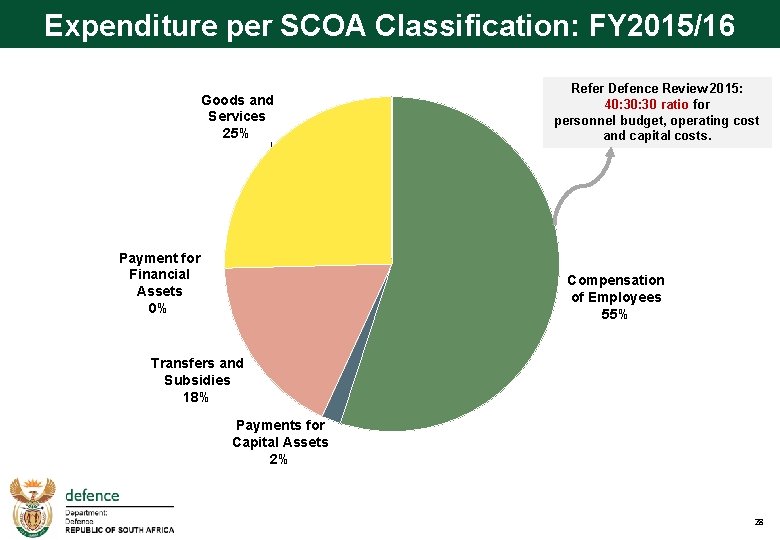
Expenditure per SCOA Classification: FY 2015/16 Goods and Services 25% Payment for Financial Assets 0% Refer Defence Review 2015: 40: 30 ratio for personnel budget, operating cost and capital costs. Compensation of Employees 55% Transfers and Subsidies 18% Payments for Capital Assets 2% 28
Non-Financial Performance Information 29
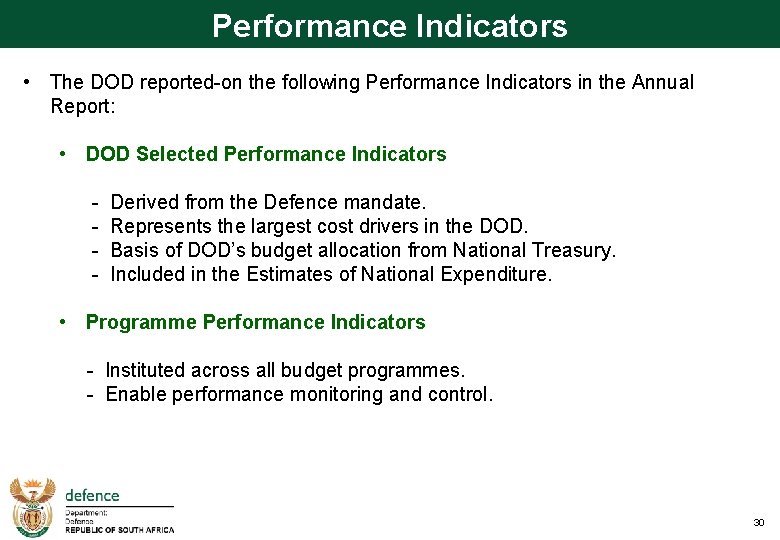
Performance Indicators • The DOD reported-on the following Performance Indicators in the Annual Report: • DOD Selected Performance Indicators - Derived from the Defence mandate. - Represents the largest cost drivers in the DOD. - Basis of DOD’s budget allocation from National Treasury. - Included in the Estimates of National Expenditure. • Programme Performance Indicators - Instituted across all budget programmes. - Enable performance monitoring and control. 30
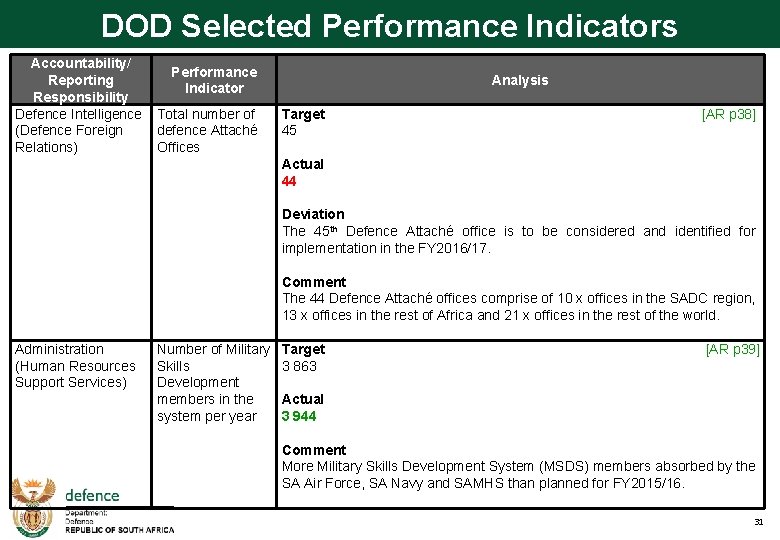
DOD Selected Performance Indicators Accountability/ Performance Reporting Indicator Responsibility Defence Intelligence Total number of (Defence Foreign defence Attaché Relations) Offices Administration (Human Resources Support Services) Number of Military Skills Development members in the system per year Analysis Target [AR p 38] 45 Actual 44 Deviation The 45 th Defence Attaché office is to be considered and identified for implementation in the FY 2016/17. Comment The 44 Defence Attaché offices comprise of 10 x offices in the SADC region, 13 x offices in the rest of Africa and 21 x offices in the rest of the world. Target [AR p 39] 3 863 Actual 3 944 Comment More Military Skills Development System (MSDS) members absorbed by the SA Air Force, SA Navy and SAMHS than planned for FY 2015/16. 31
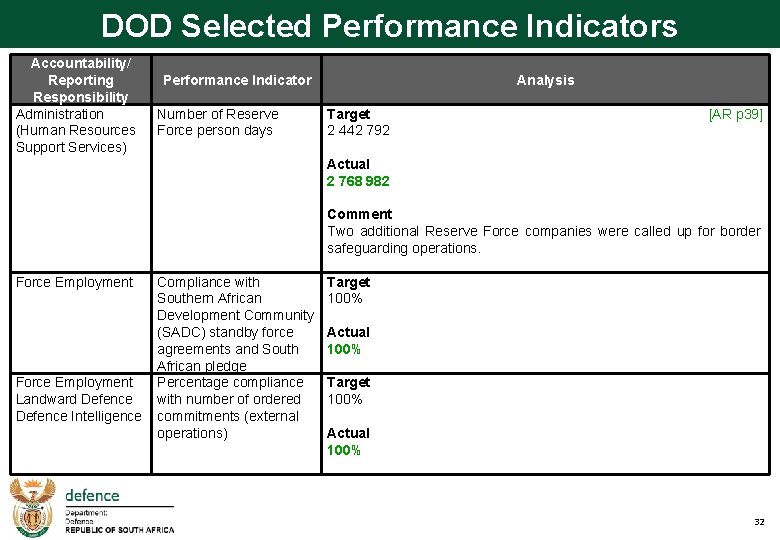
DOD Selected Performance Indicators Accountability/ Reporting Responsibility Administration (Human Resources Support Services) Force Employment Performance Indicator Number of Reserve Force person days Compliance with Southern African Development Community (SADC) standby force agreements and South African pledge Force Employment Percentage compliance Landward Defence with number of ordered Defence Intelligence commitments (external operations) Analysis Target [AR p 39] 2 442 792 Actual 2 768 982 Comment Two additional Reserve Force companies were called up for border safeguarding operations. Target 100% Actual 100% 32
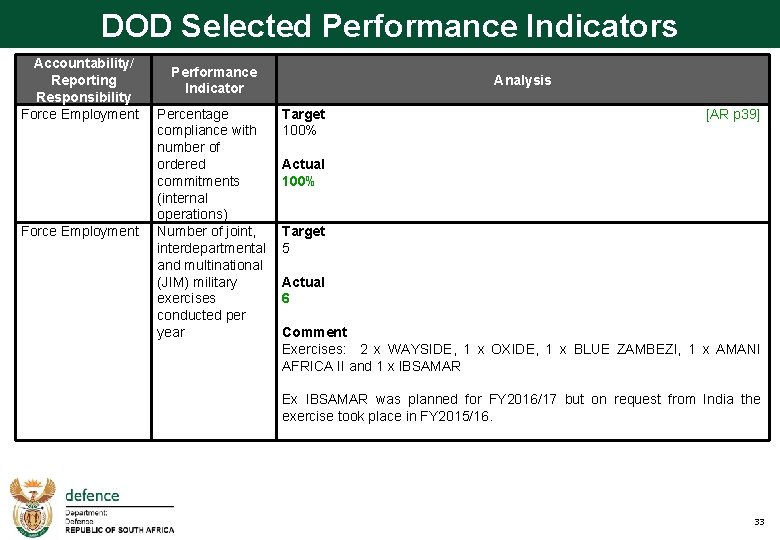
DOD Selected Performance Indicators Accountability/ Reporting Responsibility Force Employment Performance Indicator Percentage compliance with number of ordered commitments (internal operations) Number of joint, interdepartmental and multinational (JIM) military exercises conducted per year Analysis Target [AR p 39] 100% Actual 100% Target 5 Actual 6 Comment Exercises: 2 x WAYSIDE, 1 x OXIDE, 1 x BLUE ZAMBEZI, 1 x AMANI AFRICA II and 1 x IBSAMAR Ex IBSAMAR was planned for FY 2016/17 but on request from India the exercise took place in FY 2015/16. 33
DOD Selected Performance Indicators Accountability/ Reporting Responsibility Force Employment Maritime Defence Performance Indicator Analysis Number of landward subunits deployed on border safeguarding per year Target [AR p 40] 13 Actual 15 Comment The planned target for border safeguarding was to deploy 13 x subunits in the FY 2015/16. In the MOD&MV’s budget vote for FY 2015/16, the SANDF was instructed to deploy 2 x additional subunits for border safeguarding operations. Number of hours at sea per year Target 12 000 Actual 10 710. 70 Deviation Due to unavailability of vessels as a result of Human Resources constraints and limited Dockyard capacity, fewer sea hours could be achieved. 34
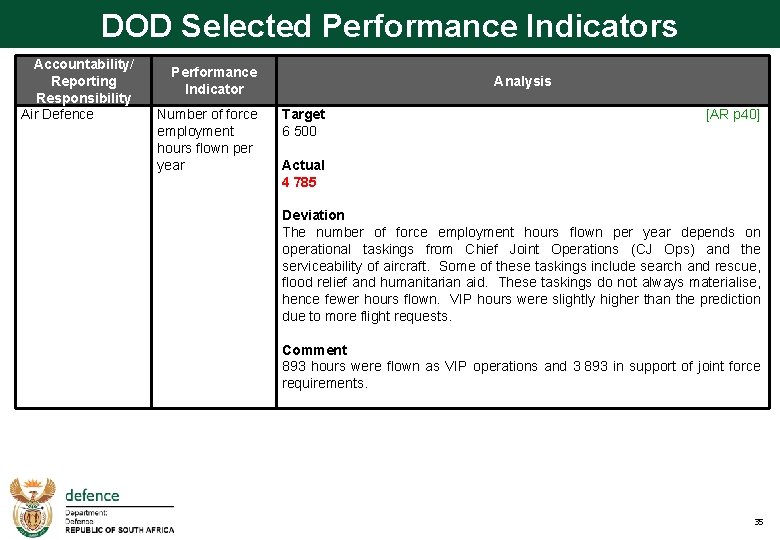
DOD Selected Performance Indicators Accountability/ Reporting Responsibility Air Defence Performance Indicator Number of force employment hours flown per year Analysis Target [AR p 40] 6 500 Actual 4 785 Deviation The number of force employment hours flown per year depends on operational taskings from Chief Joint Operations (CJ Ops) and the serviceability of aircraft. Some of these taskings include search and rescue, flood relief and humanitarian aid. These taskings do not always materialise, hence fewer hours flown. VIP hours were slightly higher than the prediction due to more flight requests. Comment 893 hours were flown as VIP operations and 3 893 in support of joint force requirements. 35
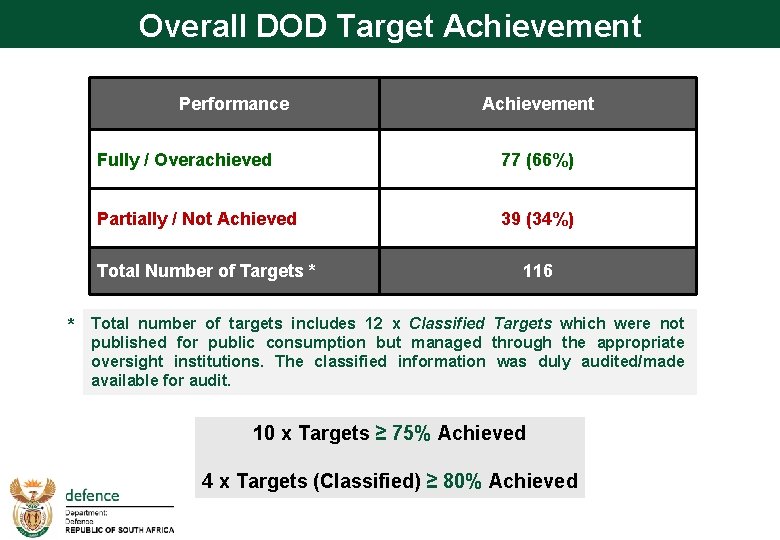
Overall DOD Target Achievement Performance Achievement Fully / Overachieved 77 (66%) Partially / Not Achieved 39 (34%) Total Number of Targets * 116 * Total number of targets includes 12 x Classified Targets which were not published for public consumption but managed through the appropriate oversight institutions. The classified information was duly audited/made available for audit. 10 x Targets ≥ 75% Achieved 4 x Targets (Classified) ≥ 80% Achieved
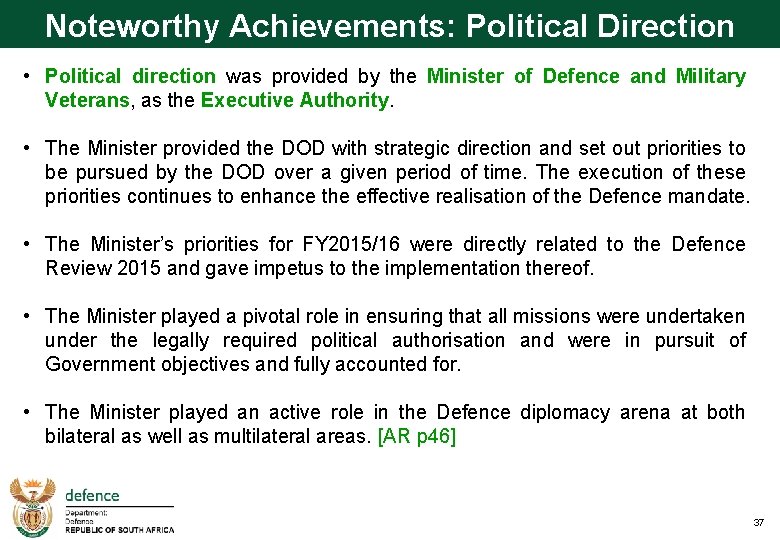
Noteworthy Achievements: Political Direction • Political direction was provided by the Minister of Defence and Military Veterans, as the Executive Authority. • The Minister provided the DOD with strategic direction and set out priorities to be pursued by the DOD over a given period of time. The execution of these priorities continues to enhance the effective realisation of the Defence mandate. • The Minister’s priorities for FY 2015/16 were directly related to the Defence Review 2015 and gave impetus to the implementation thereof. • The Minister played a pivotal role in ensuring that all missions were undertaken under the legally required political authorisation and were in pursuit of Government objectives and fully accounted for. • The Minister played an active role in the Defence diplomacy arena at both bilateral as well as multilateral areas. [AR p 46] 37
Noteworthy Achievements: Governance and Accountability (G&A) • The Secretary for Defence, as the Head of the Department and the Accounting Officer, oversaw matters of governance and accountability. • The Secretary for Defence provided strategic direction to the DOD through various governance activities and interventions, ie timeous decision-making on strategic and defence diplomacy matters, effective management and processing of official Departmental documents, chairing of various DOD management bodies, as well as the attendance of Director-Generals’ meetings, Cabinet Legotla and Government Clusters. • The Minister launched the National Defence Industry Council (NDIC) in March 2016, Chaired by the Secretary for Defence. NDIC is a collaborative structure between Government and defence industry and seeks to strengthen the relationship between the two, while concurrently supporting local defence industry in its export endeavours. NDIC places South Africa on par with countries such as the UK and Canada that established similar structures to support their defence industry. [AR p 8 & 9] 38
Noteworthy Achievements: G&A • During early 2016, the DOD signed a MOU with the Department of Small Business Development. This MOU lays out the plan for DOD to migrate from 30% spend on SMMEs to more than 50% spend in the next five years. • The DOD is involved in initiatives that seek to educate SMMEs about the requirements of doing business with the DOD, and assist them with compliance requirements. The DOD is leveraging its SCM processes to get large companies to ensure participation by SMMEs in their respective product value chain. This will ensure that SMMEs develop quicker to the required competency and sustainable level. • The DOD and the CSIR launched an enterprise development initiative known as ‘Defence Transformative Enterprise Development’ which looks at taking young engineers who started their own business and incubating them within the CSIR environment to work on sophisticated Defence Technology projects. This initiative is a first in South Africa and is tipped to change the outlook of the defence industry, which is still largely untransformed. • Through appropriate budget control measures, 99. 99% of the allocated General Vote was spent. 39
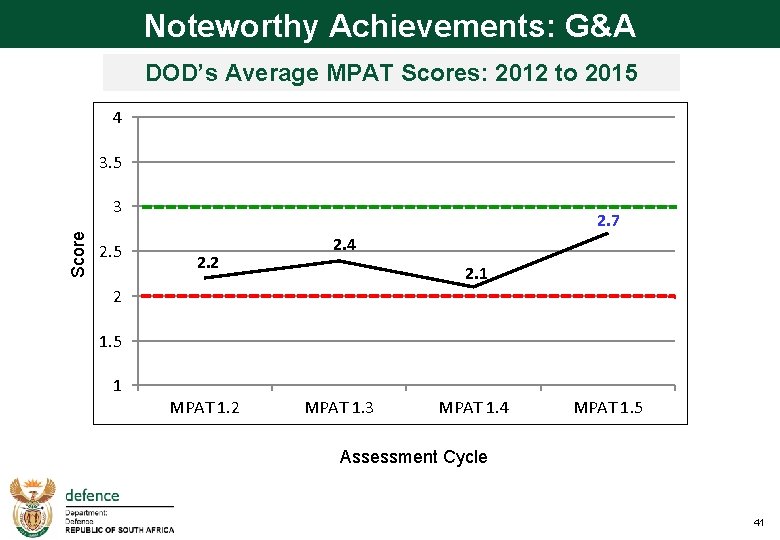
Noteworthy Achievements: G&A • A concerted effort was made to enhance the ability to pay DOD suppliers within the prescribed 30 -day period (after receipt of a legitimate invoice). Performance in this regard improved significantly from 72% payment of suppliers within 30 days in the 1 st quarter to 85% in the 4 th quarter (average of just over 80% for FY 2015/16). • The appointment of the GITO was finalised and the GITO assumed duty on 01 May 2016. It is foreseen that the DOD will now be able to make progress with the establishment of an approved Information and Technology Governance Framework and related Strategic Plan during the FY 2016/17. • The DOD strived to enhance its internal controls and to be more efficient and effective in the application of management practices and adherence to the regulatory framework. To this extent, the DOD utilised the MPAT results to enhance its internal controls, which should in effect improve service delivery and overall performance. The DOD’s MPAT 1. 5 average score was 2. 7 which relates to a year-on-year improvement from an average score of 2. 1 during the MPAT 1. 4 assessment period to an average score of 2. 7 during the MPAT 1. 5 assessment period. [AR p 99 - 102] 40
Noteworthy Achievements: G&A DOD’s Average MPAT Scores: 2012 to 2015 4 3. 5 Score 3 2. 5 2. 7 2. 2 2. 4 2. 1 2 1. 5 1 MPAT 1. 2 MPAT 1. 3 MPAT 1. 4 MPAT 1. 5 Assessment Cycle 41
Noteworthy Achievements: Command & Control • The C SANDF ensured the preparation and employment of forces in pursuance of set missions. • The C SANDF provided strategic military direction and instructions to ensure the effective Command of Forces. • In a zealous effort to reduce the porosity of South Africa’s borders, the SANDF increased its footprint on the borderline by deploying two additional subunits. This contingent of 15 subunits continued to register tangible operational successes, mainly to curb the flow of illicit activities across our borderline. • Since the deployment of Naval assets in the Mozambique Channel, no further incidences of piracy were reported. The DOD is mindful of the developing challenges in the Gulf of Guinea and have entered into discussions with the Namibian and Angolan governments. [AR p 10 & 11] 42
Noteworthy Achievements: Command & Control • The SANDF was at the forefront of creating the African Capacity for Immediate Response to Crises (ACIRC) as an interim measure towards establishing the African Standby Force. South Africa was also tasked with being the Framework Nation for ACIRC until June 2016. • The DOD hosted Exercise AMANI AFRICA II on behalf of the AU to assess the readiness of the African Standby Force. • In support of the MTSF’s Outcome 11, Sub-outcome 3 “Political cohesion in Southern Africa to ensure a peaceful, secure and stable Southern African Region”, the SANDF ensured regional security by supporting peace, security and stability in the region. During these missions/operations, approximately 2 211 members were deployed in two UN/AU-mandated peace support operations in the DRC and Sudan. 43
Noteworthy Achievements: Command & Control • In support of the MTSF’s Outcome 3, Sub-outcome 3 “South Africa’s borders effectively defended, protected, secured and well managed, ” the SANDF continued to execute border safeguarding operations by deploying 15 subunits along the borders in Limpopo, Mpumalanga, Kwa. Zulu-Natal, Free State, Eastern Cape, Northern Cape and North West provinces. • Operational successes included: [AR p 75 & 76] − − − 41 weapons recovered, 16 812 undocumented immigrants apprehended, 447 criminals arrested, 93 stolen vehicles recovered, 5 220 kg dagga confiscated, 259 Mandrax tablets confiscated, 776 Ecstasy tablets confiscated, 48 Tik tablets confiscated, 812 head of livestock recovered, 72. 7 kg copper recovered and contraband goods to the value of R 68 145 277, 00 confiscated. 44
DOD Audit Outcomes 45
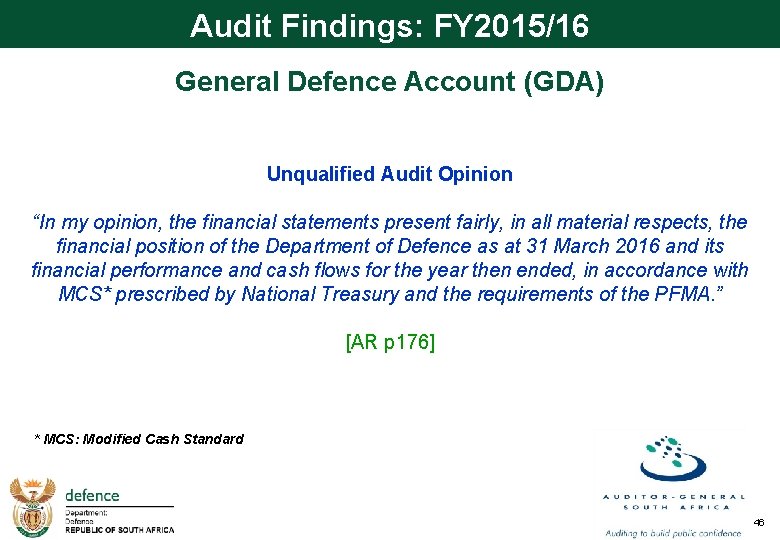
Audit Findings: FY 2015/16 General Defence Account (GDA) Unqualified Audit Opinion “In my opinion, the financial statements present fairly, in all material respects, the financial position of the Department of Defence as at 31 March 2016 and its financial performance and cash flows for the year then ended, in accordance with MCS* prescribed by National Treasury and the requirements of the PFMA. ” [AR p 176] * MCS: Modified Cash Standard 46
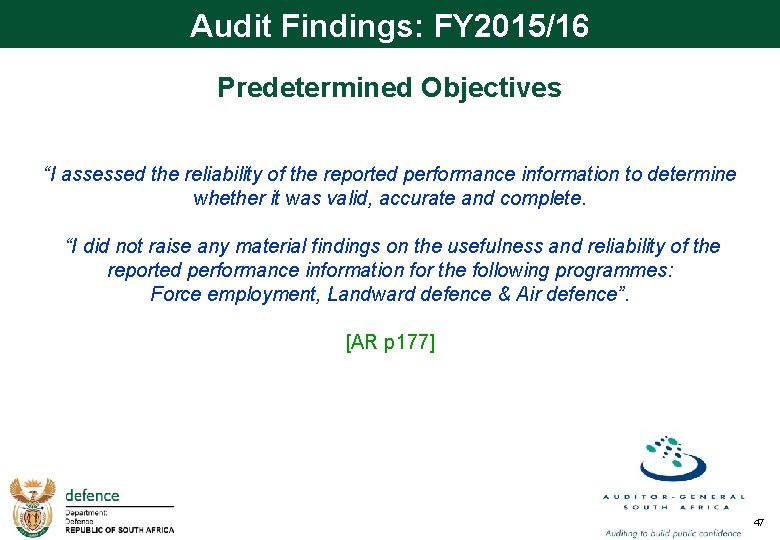
Audit Findings: FY 2015/16 Predetermined Objectives “I assessed the reliability of the reported performance information to determine whether it was valid, accurate and complete. “I did not raise any material findings on the usefulness and reliability of the reported performance information for the following programmes: Force employment, Landward defence & Air defence”. [AR p 177] 47
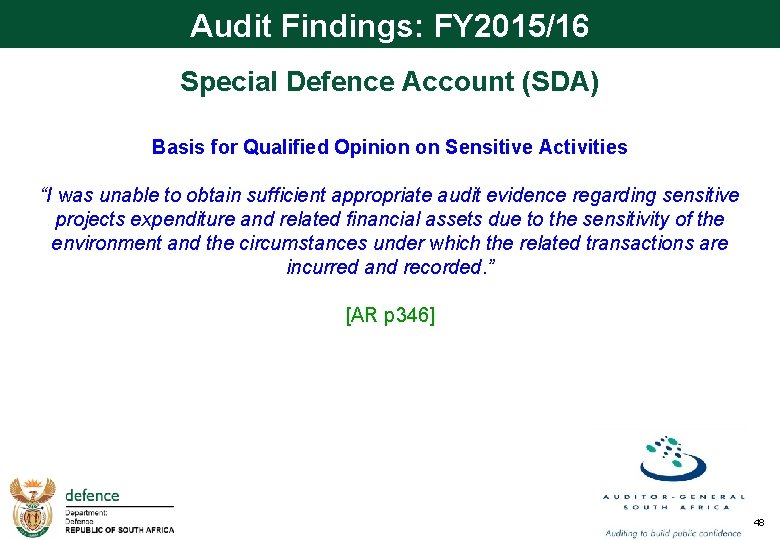
Audit Findings: FY 2015/16 Special Defence Account (SDA) Basis for Qualified Opinion on Sensitive Activities “I was unable to obtain sufficient appropriate audit evidence regarding sensitive projects expenditure and related financial assets due to the sensitivity of the environment and the circumstances under which the related transactions are incurred and recorded. ” [AR p 346] 48
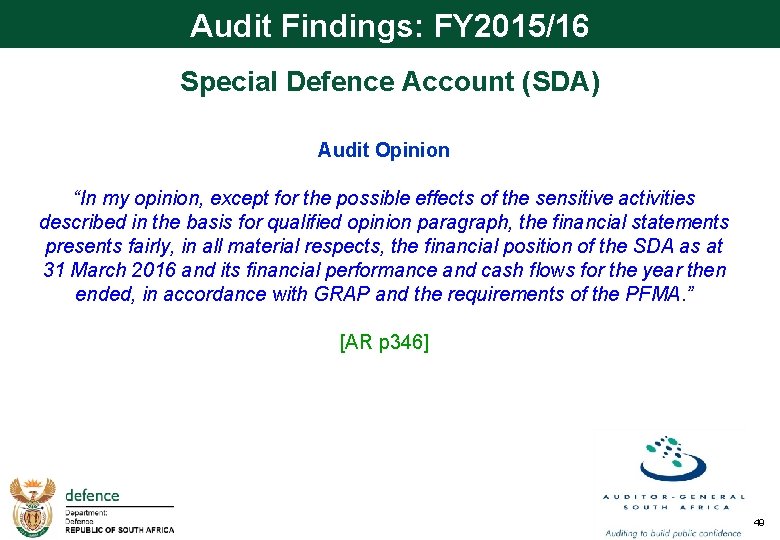
Audit Findings: FY 2015/16 Special Defence Account (SDA) Audit Opinion “In my opinion, except for the possible effects of the sensitive activities described in the basis for qualified opinion paragraph, the financial statements presents fairly, in all material respects, the financial position of the SDA as at 31 March 2016 and its financial performance and cash flows for the year then ended, in accordance with GRAP and the requirements of the PFMA. ” [AR p 346] 49
Any questions or comments? Thank You!