
Department of Computer Science University of Toronto Lecture
- Slides: 13
Department of Computer Science University of Toronto Lecture 5: Decomposition and Abstraction Decomposition When to decompose Identifying components Modelling components Abstraction by parameterization Abstraction by specification Pre-conditions and Post-conditions © 2001, Steve Easterbrook CSC 444 Lec 05 - 1
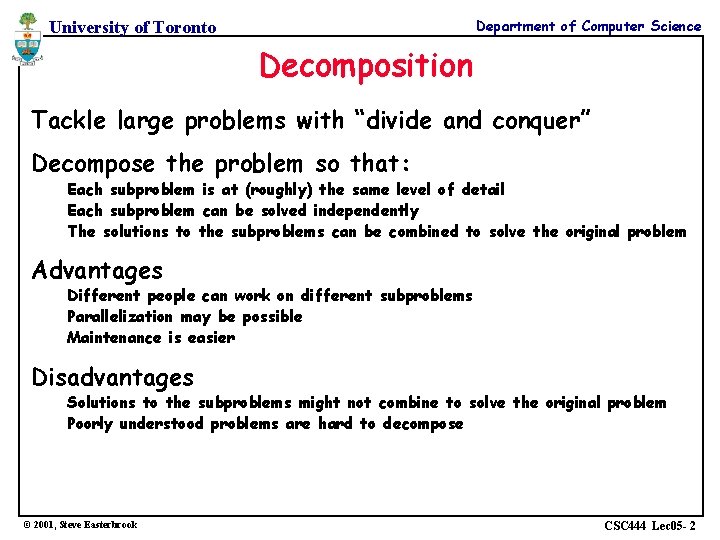
Department of Computer Science University of Toronto Decomposition Tackle large problems with “divide and conquer” Decompose the problem so that: Each subproblem is at (roughly) the same level of detail Each subproblem can be solved independently The solutions to the subproblems can be combined to solve the original problem Advantages Different people can work on different subproblems Parallelization may be possible Maintenance is easier Disadvantages Solutions to the subproblems might not combine to solve the original problem Poorly understood problems are hard to decompose © 2001, Steve Easterbrook CSC 444 Lec 05 - 2
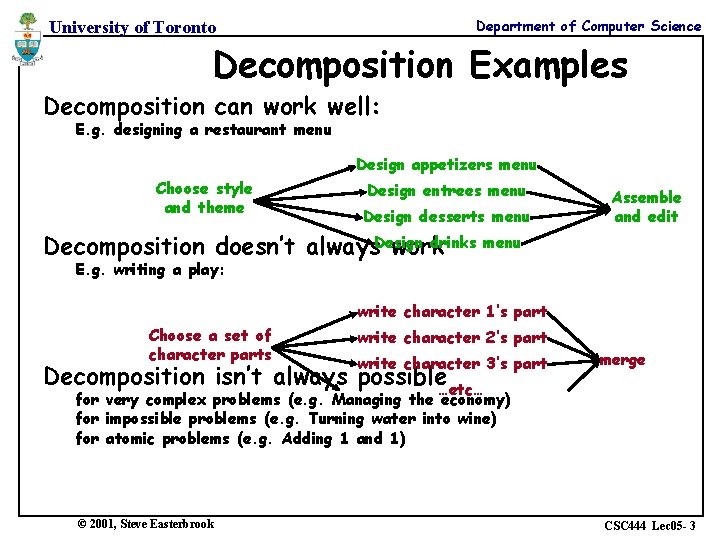
Department of Computer Science University of Toronto Decomposition Examples Decomposition can work well: E. g. designing a restaurant menu Design appetizers menu Choose style and theme Design entrees menu Design desserts menu Assemble and edit drinks menu Decomposition doesn’t always. Design work E. g. writing a play: write character 1’s part Choose a set of character parts write character 2’s part write character 3’s part Decomposition isn’t always possible…etc… merge for very complex problems (e. g. Managing the economy) for impossible problems (e. g. Turning water into wine) for atomic problems (e. g. Adding 1 and 1) © 2001, Steve Easterbrook CSC 444 Lec 05 - 3
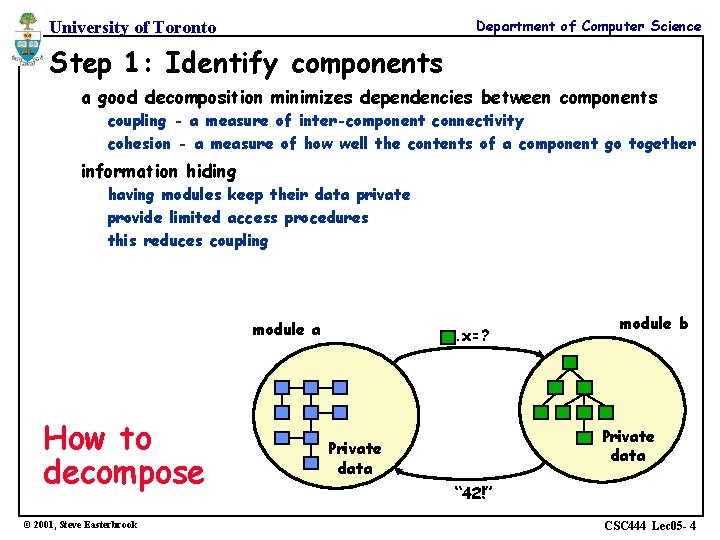
Department of Computer Science University of Toronto Step 1: Identify components a good decomposition minimizes dependencies between components coupling - a measure of inter-component connectivity cohesion - a measure of how well the contents of a component go together information hiding having modules keep their data private provide limited access procedures this reduces coupling module a How to decompose © 2001, Steve Easterbrook . x=? module b Private data “ 42!” CSC 444 Lec 05 - 4
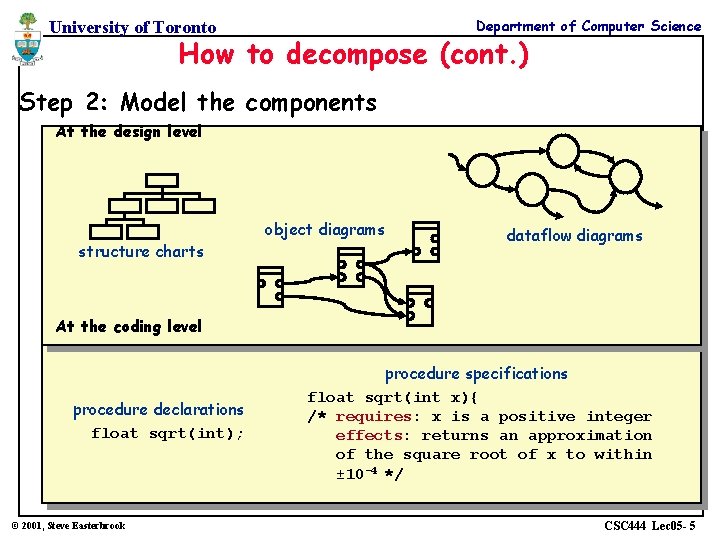
Department of Computer Science University of Toronto How to decompose (cont. ) Step 2: Model the components At the design level object diagrams structure charts dataflow diagrams At the coding level procedure declarations float sqrt(int); © 2001, Steve Easterbrook procedure specifications float sqrt(int x){ /* requires: x is a positive integer effects: returns an approximation of the square root of x to within ± 10 -4 */ CSC 444 Lec 05 - 5
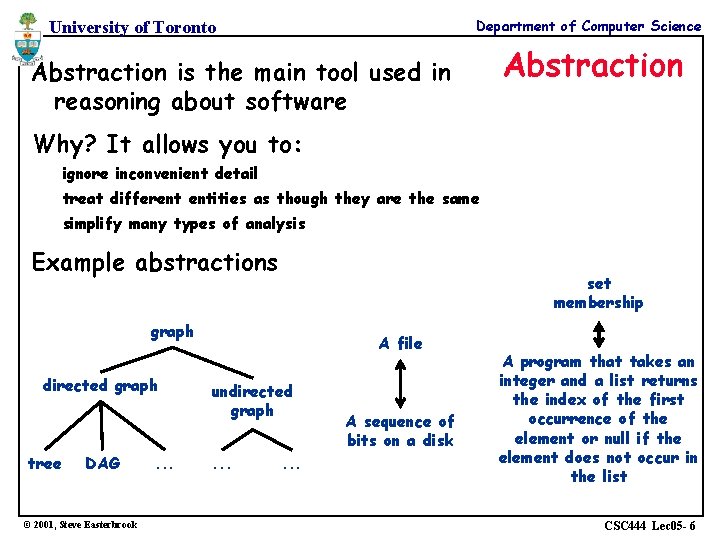
Department of Computer Science University of Toronto Abstraction is the main tool used in reasoning about software Abstraction Why? It allows you to: ignore inconvenient detail treat different entities as though they are the same simplify many types of analysis Example abstractions set membership graph directed graph tree DAG © 2001, Steve Easterbrook . . . A file undirected graph. . . A sequence of bits on a disk A program that takes an integer and a list returns the index of the first occurrence of the element or null if the element does not occur in the list CSC 444 Lec 05 - 6
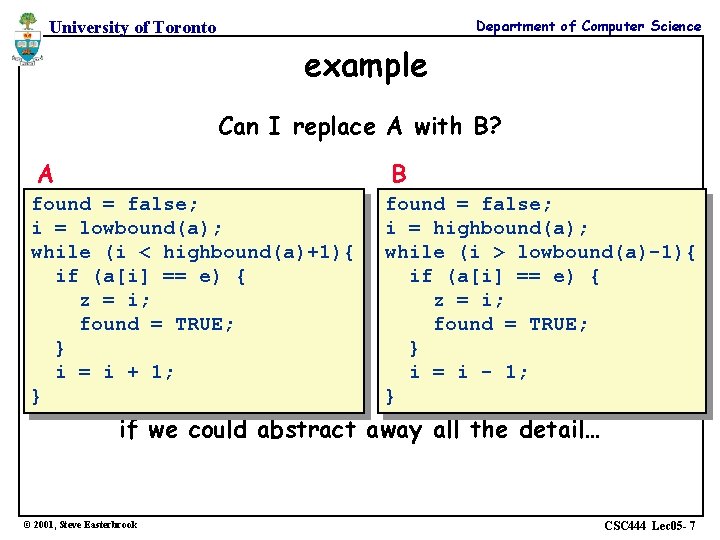
Department of Computer Science University of Toronto example Can I replace A with B? A B found = false; i = lowbound(a); while (i < highbound(a)+1){ if (a[i] == e) { z = i; found = TRUE; } i = i + 1; } found = false; i = highbound(a); while (i > lowbound(a)-1){ if (a[i] == e) { z = i; found = TRUE; } i = i - 1; } if we could abstract away all the detail… © 2001, Steve Easterbrook CSC 444 Lec 05 - 7
Department of Computer Science University of Toronto Using Abstraction can help with Decomposition e. g. To manage the economy, try focussing on some abstracted features such as inflation, growth, GDP, etc. Abstraction allows us to ignore inconvenient details In programming: Abstraction is the process of naming compound objects and dealing with them as single entities (i. e. ignoring their details) Abstraction doesn’t solve problems… …but it allows us to simplify them © 2001, Steve Easterbrook CSC 444 Lec 05 - 8
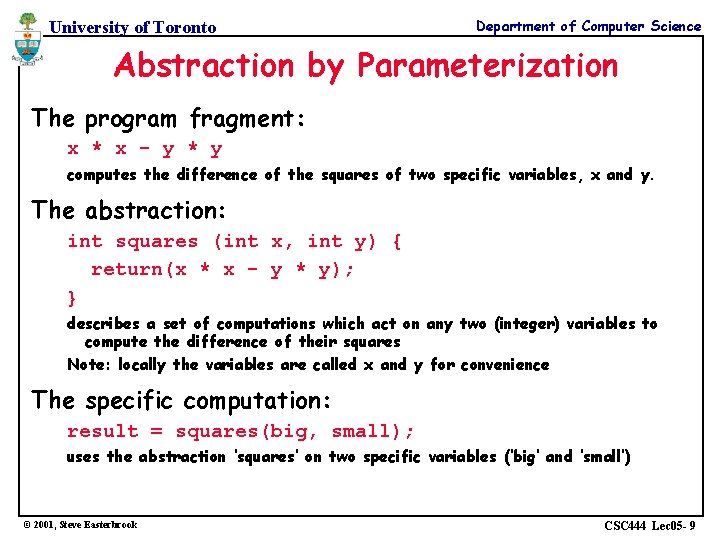
University of Toronto Department of Computer Science Abstraction by Parameterization The program fragment: x * x - y * y computes the difference of the squares of two specific variables, x and y. The abstraction: int squares (int x, int y) { return(x * x - y * y); } describes a set of computations which act on any two (integer) variables to compute the difference of their squares Note: locally the variables are called x and y for convenience The specific computation: result = squares(big, small); uses the abstraction ‘squares’ on two specific variables (‘big’ and ‘small’) © 2001, Steve Easterbrook CSC 444 Lec 05 - 9
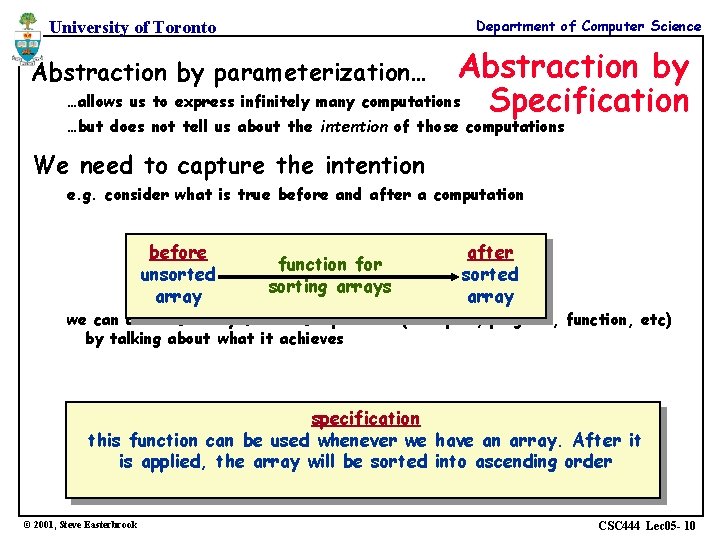
Department of Computer Science University of Toronto Abstraction by …allows us to express infinitely many computations Specification Abstraction by parameterization… …but does not tell us about the intention of those computations We need to capture the intention e. g. consider what is true before and after a computation before unsorted array function for sorting arrays after sorted array we can abstract away from a computation (or a plan, program, function, etc) by talking about what it achieves specification this function can be used whenever we have an array. After it is applied, the array will be sorted into ascending order © 2001, Steve Easterbrook CSC 444 Lec 05 - 10
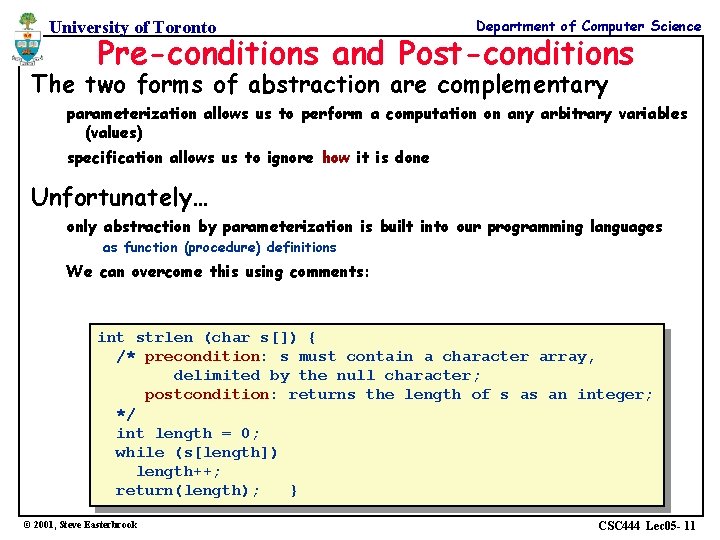
University of Toronto Department of Computer Science Pre-conditions and Post-conditions The two forms of abstraction are complementary parameterization allows us to perform a computation on any arbitrary variables (values) specification allows us to ignore how it is done Unfortunately… only abstraction by parameterization is built into our programming languages as function (procedure) definitions We can overcome this using comments: int strlen (char s[]) { /* precondition: s must contain a character array, delimited by the null character; postcondition: returns the length of s as an integer; */ int length = 0; while (s[length]) length++; return(length); } © 2001, Steve Easterbrook CSC 444 Lec 05 - 11
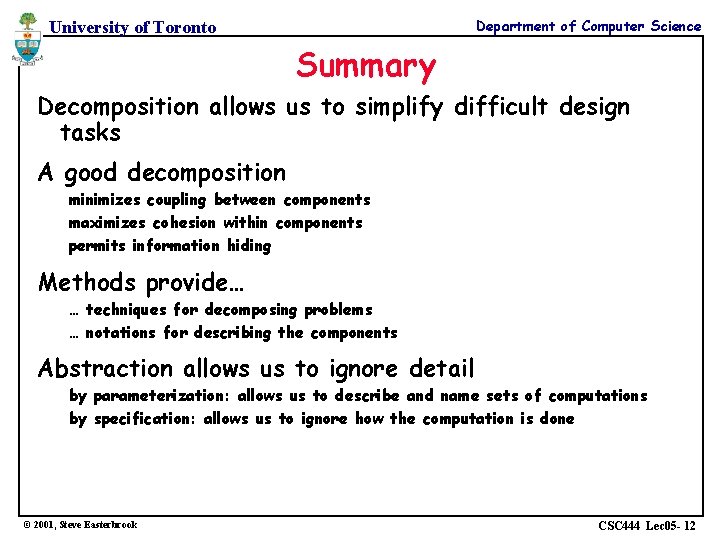
Department of Computer Science University of Toronto Summary Decomposition allows us to simplify difficult design tasks A good decomposition minimizes coupling between components maximizes cohesion within components permits information hiding Methods provide… … techniques for decomposing problems … notations for describing the components Abstraction allows us to ignore detail by parameterization: allows us to describe and name sets of computations by specification: allows us to ignore how the computation is done © 2001, Steve Easterbrook CSC 444 Lec 05 - 12
Department of Computer Science University of Toronto References van Vliet, H. “Software Engineering: Principles and Practice (2 nd Edition)” Wiley, 1999. Ä Chapter 11 provides an introduction to the concepts in this lecture, especially section 11. 1. However, van Vliet does not go into much detail about documenting procedural and data abstractions in the style I use in this and the next two lectures. For this you’ll need: Liskov, B. and Guttag, J. , “Program Development in Java: Abstraction, Specification and Object-Oriented Design”, 2000, Addison-Wesley. Ä See especially chapters 1 and 3. I draw on Liskov’s ideas extensively for advice on program design in this course. The commenting style I use (“requires”, “effects”, etc) is Liskov’s. If you plan to do any extensive programming in Java, you should buy this book. If you don’t buy it, borrow it and read the first few chapters. © 2001, Steve Easterbrook CSC 444 Lec 05 - 13