
Department of Computer Science CS 3304 Comparative Languages
- Slides: 24
Department of Computer Science CS 3304 Comparative Languages Lecture 2: Compilation and Interpretation 19 January 2012 © 2012 Denis Gracanin
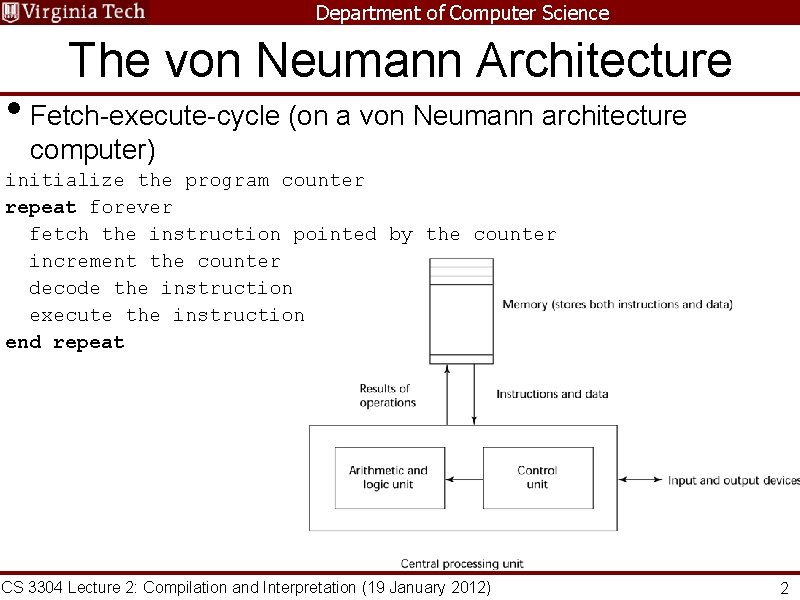
Department of Computer Science The von Neumann Architecture • Fetch-execute-cycle (on a von Neumann architecture computer) initialize the program counter repeat forever fetch the instruction pointed by the counter increment the counter decode the instruction execute the instruction end repeat CS 3304 Lecture 2: Compilation and Interpretation (19 January 2012) 2
Department of Computer Science Compilation vs. Interpretation • Not opposites. • Not a clear-cut distinction. • Interpretation: • Greater flexibility. • Better diagnostics (error messages). • Compilation: • Better performance. CS 3304 Lecture 2: Compilation and Interpretation (19 January 2012) 4
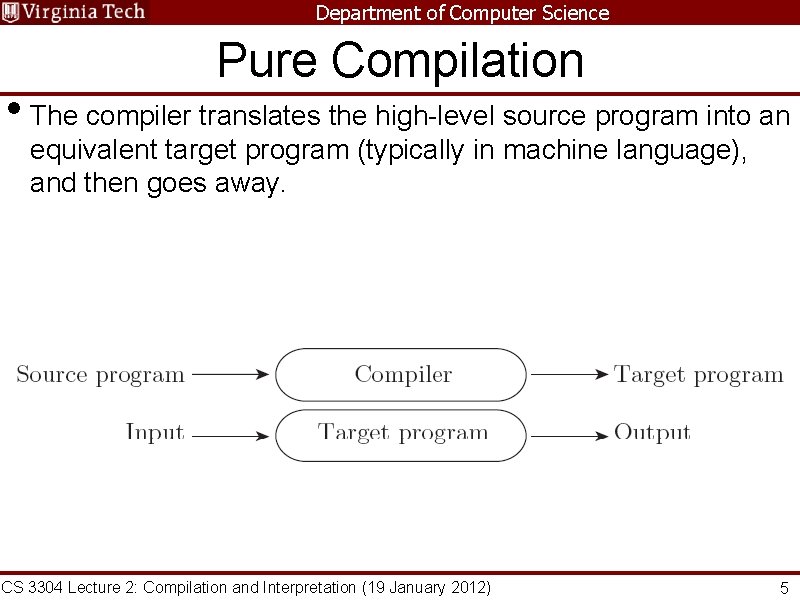
Department of Computer Science Pure Compilation • The compiler translates the high-level source program into an equivalent target program (typically in machine language), and then goes away. CS 3304 Lecture 2: Compilation and Interpretation (19 January 2012) 5
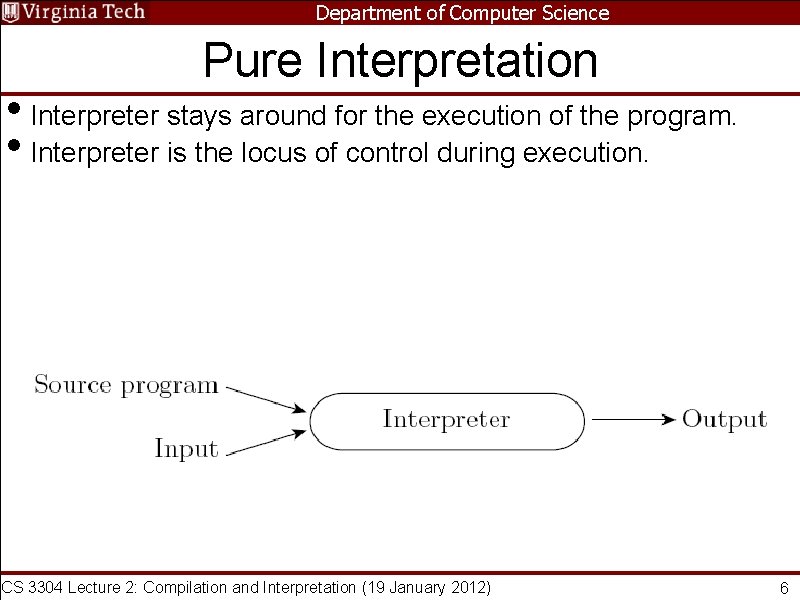
Department of Computer Science Pure Interpretation • Interpreter stays around for the execution of the program. • Interpreter is the locus of control during execution. CS 3304 Lecture 2: Compilation and Interpretation (19 January 2012) 6
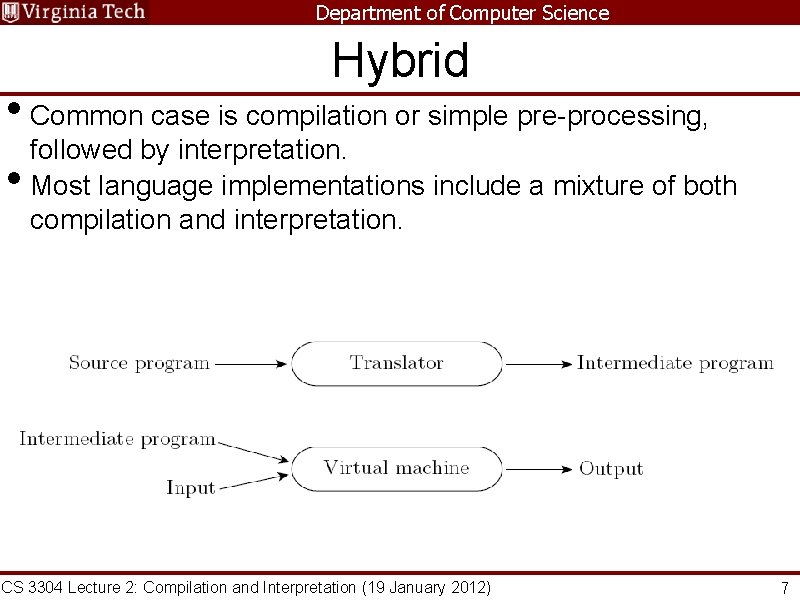
Department of Computer Science Hybrid • Common case is compilation or simple pre-processing, followed by interpretation. • Most language implementations include a mixture of both compilation and interpretation. CS 3304 Lecture 2: Compilation and Interpretation (19 January 2012) 7
Department of Computer Science Compilation and Pre-Processing • Note that compilation does NOT have to produce machine language for some sort of hardware. • Compilation is translation from one language into another, with full analysis of the meaning of the input. • Compilation entails semantic understanding of what is being processed; pre-processing does not. • A pre-processor will often let errors through. • A compiler hides further steps; a pre-processor does not. CS 3304 Lecture 2: Compilation and Interpretation (19 January 2012) 8
Department of Computer Science Compilation vs. Interpretation • Many compiled languages have interpreted pieces, e. g. , formats in Fortran or C. • Most use “virtual instructions”: • Set operations in Pascal. • String manipulation in Basic. • Some compilers produce nothing but virtual instructions, e. g. , Pascal P-code, Java byte code, Microsoft COM+. CS 3304 Lecture 2: Compilation and Interpretation (19 January 2012) 9
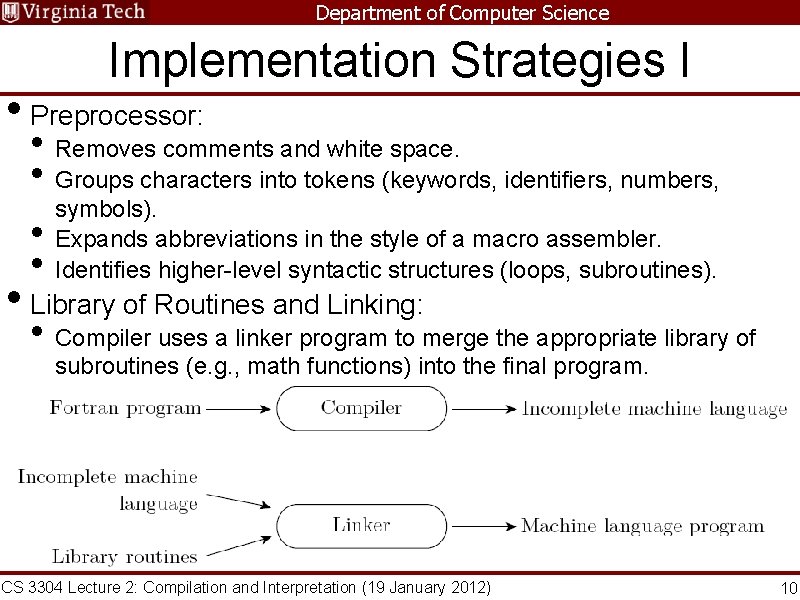
Department of Computer Science Implementation Strategies I • Preprocessor: • Removes comments and white space. • Groups characters into tokens (keywords, identifiers, numbers, symbols). • Expands abbreviations in the style of a macro assembler. • Identifies higher-level syntactic structures (loops, subroutines). • Library of Routines and Linking: • Compiler uses a linker program to merge the appropriate library of subroutines (e. g. , math functions) into the final program. CS 3304 Lecture 2: Compilation and Interpretation (19 January 2012) 10
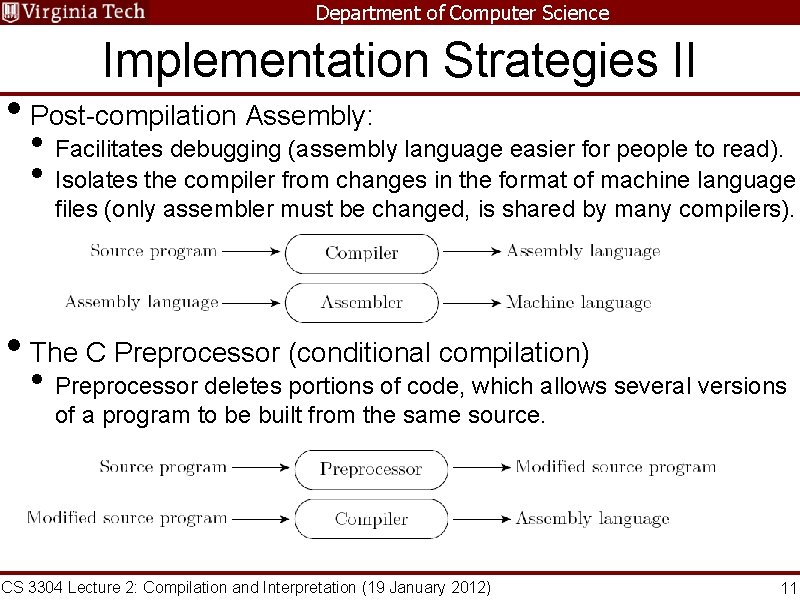
Department of Computer Science Implementation Strategies II • Post-compilation Assembly: • Facilitates debugging (assembly language easier for people to read). • Isolates the compiler from changes in the format of machine language files (only assembler must be changed, is shared by many compilers). • The C Preprocessor (conditional compilation) • Preprocessor deletes portions of code, which allows several versions of a program to be built from the same source. CS 3304 Lecture 2: Compilation and Interpretation (19 January 2012) 11
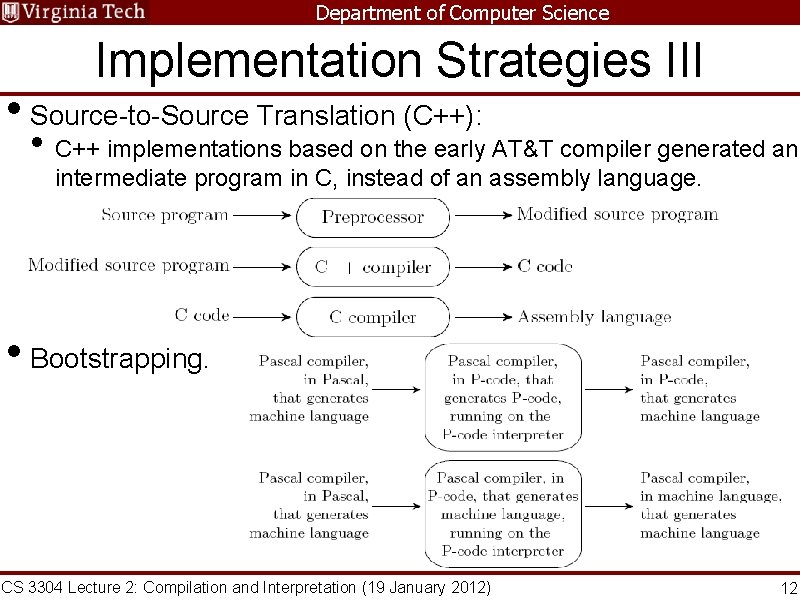
Department of Computer Science Implementation Strategies III • Source-to-Source Translation (C++): • C++ implementations based on the early AT&T compiler generated an intermediate program in C, instead of an assembly language. • Bootstrapping. CS 3304 Lecture 2: Compilation and Interpretation (19 January 2012) 12
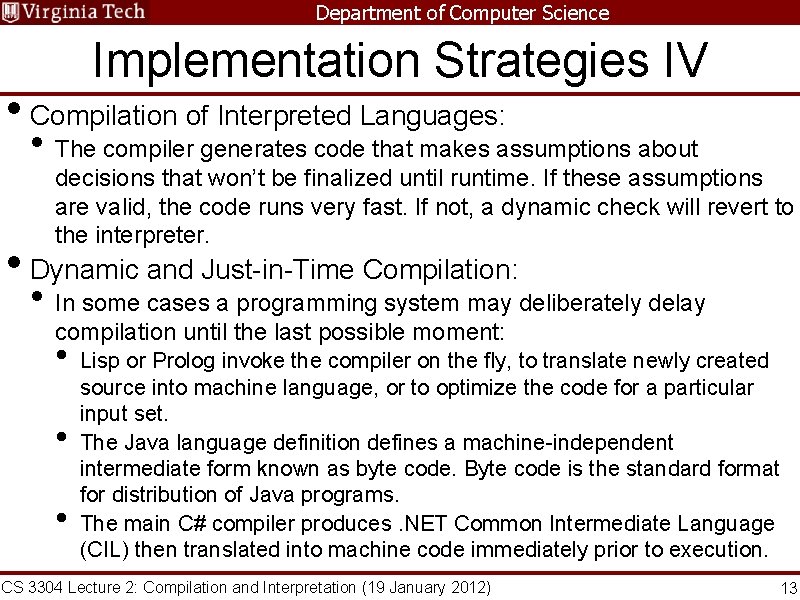
Department of Computer Science Implementation Strategies IV • Compilation of Interpreted Languages: • The compiler generates code that makes assumptions about decisions that won’t be finalized until runtime. If these assumptions are valid, the code runs very fast. If not, a dynamic check will revert to the interpreter. • Dynamic and Just-in-Time Compilation: • In some cases a programming system may deliberately delay compilation until the last possible moment: • • • Lisp or Prolog invoke the compiler on the fly, to translate newly created source into machine language, or to optimize the code for a particular input set. The Java language definition defines a machine-independent intermediate form known as byte code. Byte code is the standard format for distribution of Java programs. The main C# compiler produces. NET Common Intermediate Language (CIL) then translated into machine code immediately prior to execution. CS 3304 Lecture 2: Compilation and Interpretation (19 January 2012) 13
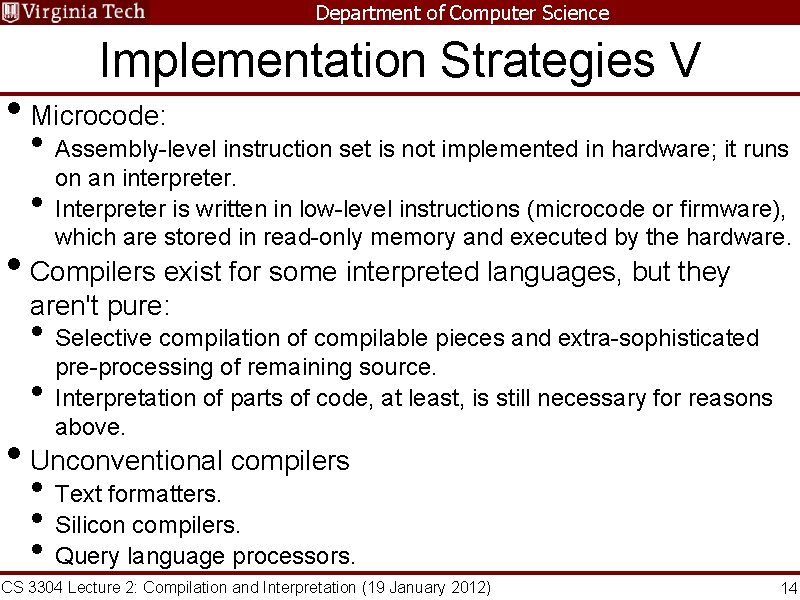
Department of Computer Science Implementation Strategies V • Microcode: • Assembly-level instruction set is not implemented in hardware; it runs on an interpreter. • Interpreter is written in low-level instructions (microcode or firmware), which are stored in read-only memory and executed by the hardware. • Compilers exist for some interpreted languages, but they aren't pure: • Selective compilation of compilable pieces and extra-sophisticated pre-processing of remaining source. • Interpretation of parts of code, at least, is still necessary for reasons above. • Unconventional compilers • Text formatters. • Silicon compilers. • Query language processors. CS 3304 Lecture 2: Compilation and Interpretation (19 January 2012) 14
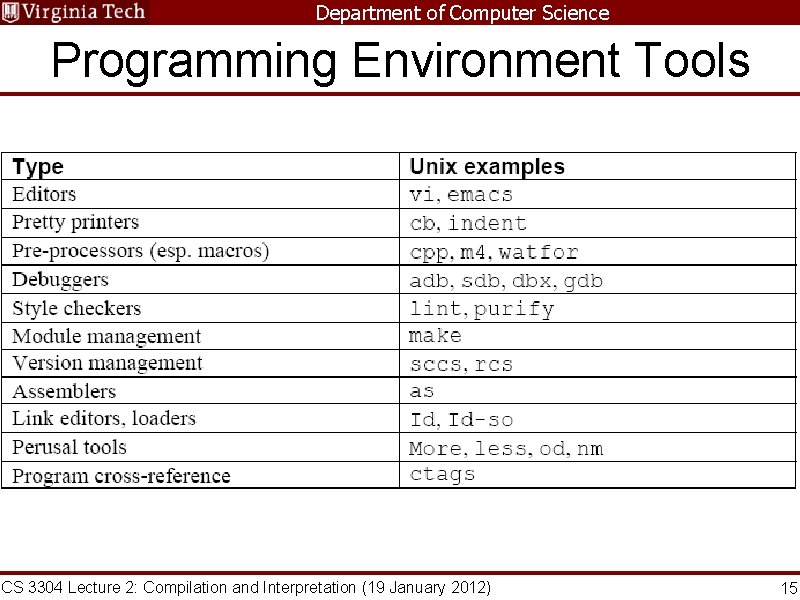
Department of Computer Science Programming Environment Tools CS 3304 Lecture 2: Compilation and Interpretation (19 January 2012) 15
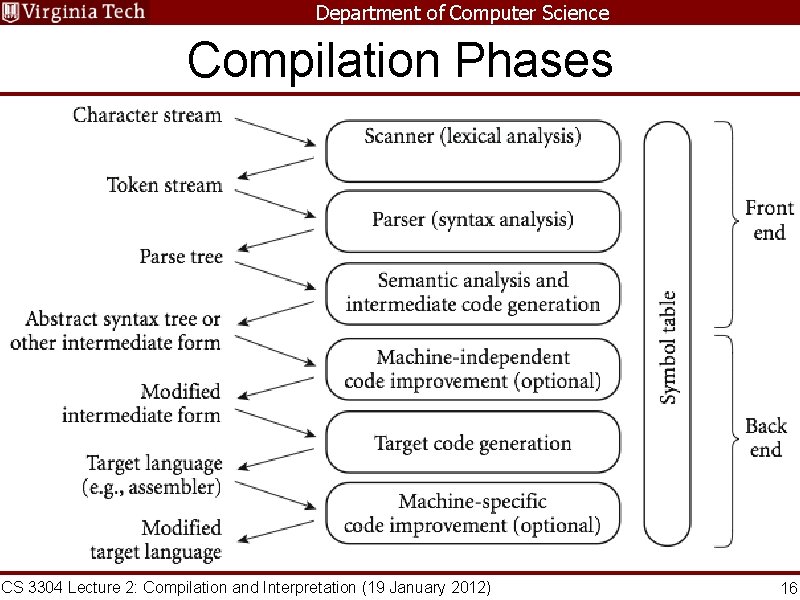
Department of Computer Science Compilation Phases CS 3304 Lecture 2: Compilation and Interpretation (19 January 2012) 16
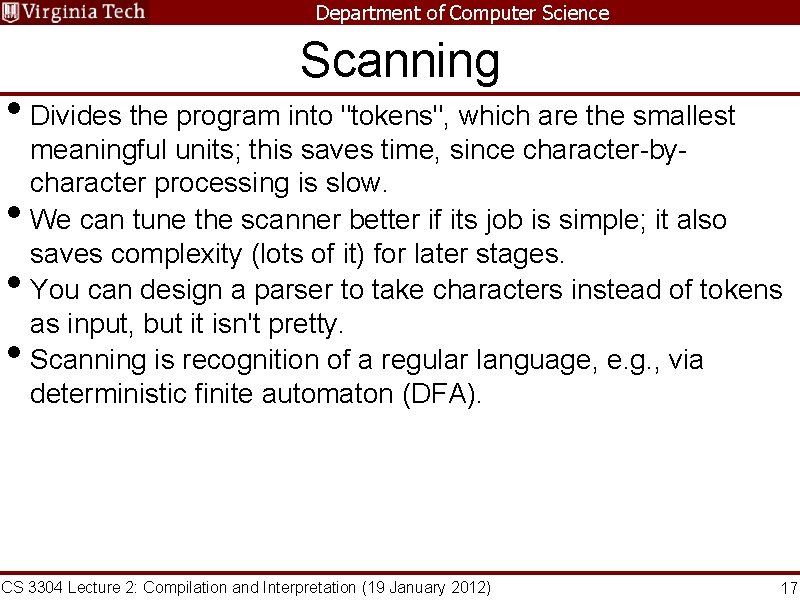
Department of Computer Science Scanning • Divides the program into "tokens", which are the smallest • • • meaningful units; this saves time, since character-bycharacter processing is slow. We can tune the scanner better if its job is simple; it also saves complexity (lots of it) for later stages. You can design a parser to take characters instead of tokens as input, but it isn't pretty. Scanning is recognition of a regular language, e. g. , via deterministic finite automaton (DFA). CS 3304 Lecture 2: Compilation and Interpretation (19 January 2012) 17
Department of Computer Science Parsing • Parsing is recognition of a context-free language, e. g. , via push-down automaton (PDA). • Parsing discovers the "context free" structure of the program • Informally, it finds the structure you can describe with syntax diagrams (the "circles and arrows" in a Pascal manual). CS 3304 Lecture 2: Compilation and Interpretation (19 January 2012) 18
Department of Computer Science Semantic Analysis • Semantic analysis is the discovery of meaning in the program • The compiler actually does what is called STATIC semantic • analysis. That's the meaning that can be figured out at compile time. Some things (e. g. , array subscript out of bounds) can't be figured out until run time. Things like that are part of the program's DYNAMIC semantics. CS 3304 Lecture 2: Compilation and Interpretation (19 January 2012) 19
Department of Computer Science Intermediate Form • Intermediate form (IF) done after semantic analysis (if the program passes all checks). • IFs are often chosen for machine independence, ease of • • optimization, or compactness (these are somewhat contradictory). They often resemble machine code for some imaginary idealized machine; e. g. a stack machine, or a machine with arbitrarily many registers. Many compilers actually move the code through more than one IF. CS 3304 Lecture 2: Compilation and Interpretation (19 January 2012) 20
Department of Computer Science Other Phases • Optimization takes an intermediate-code program and produces another one that does the same thing faster, or in less space: • The term is a misnomer; we just improve code. • The optimization phase is optional. • Code generation phase produces assembly language or (sometime) relocatable machine language. • Certain machine-specific optimizations (use of special instructions or addressing modes, etc. ) may be performed during or after target code generation. CS 3304 Lecture 2: Compilation and Interpretation (19 January 2012) 21
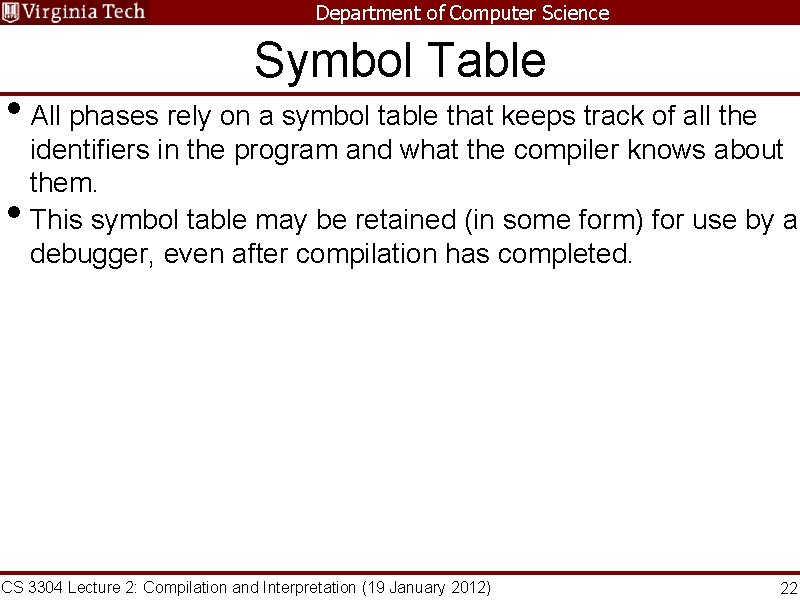
Department of Computer Science Symbol Table • All phases rely on a symbol table that keeps track of all the • identifiers in the program and what the compiler knows about them. This symbol table may be retained (in some form) for use by a debugger, even after compilation has completed. CS 3304 Lecture 2: Compilation and Interpretation (19 January 2012) 22
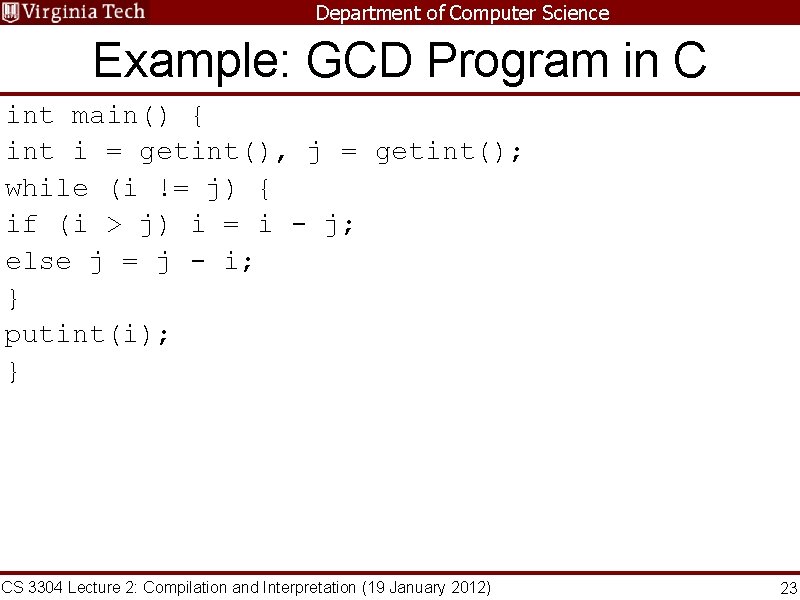
Department of Computer Science Example: GCD Program in C int main() { int i = getint(), j = getint(); while (i != j) { if (i > j) i = i - j; else j = j - i; } putint(i); } CS 3304 Lecture 2: Compilation and Interpretation (19 January 2012) 23
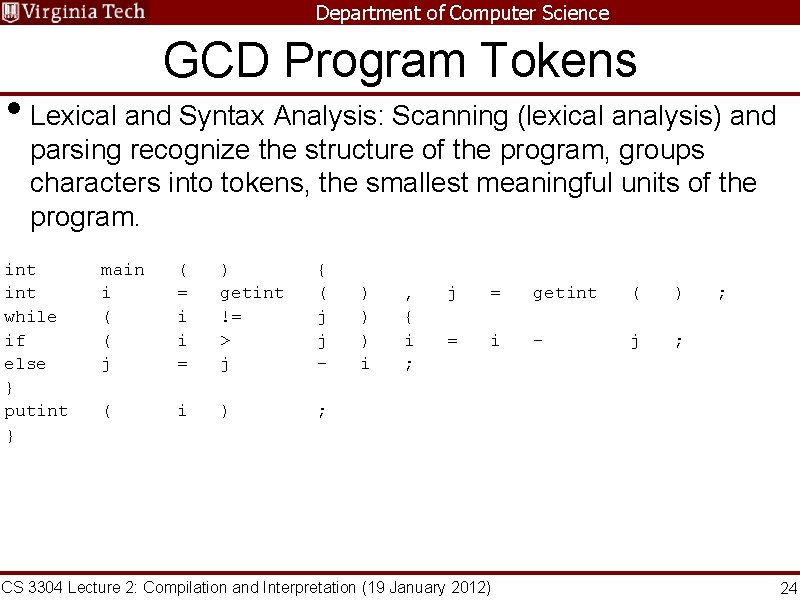
Department of Computer Science GCD Program Tokens • Lexical and Syntax Analysis: Scanning (lexical analysis) and parsing recognize the structure of the program, groups characters into tokens, the smallest meaningful units of the program. int while if else } putint } main i ( ( j ( = i i = ) getint != > j { ( j j - ( i ) ; ) ) ) i , { i ; j = getint ( ) = i - j ; CS 3304 Lecture 2: Compilation and Interpretation (19 January 2012) ; 24
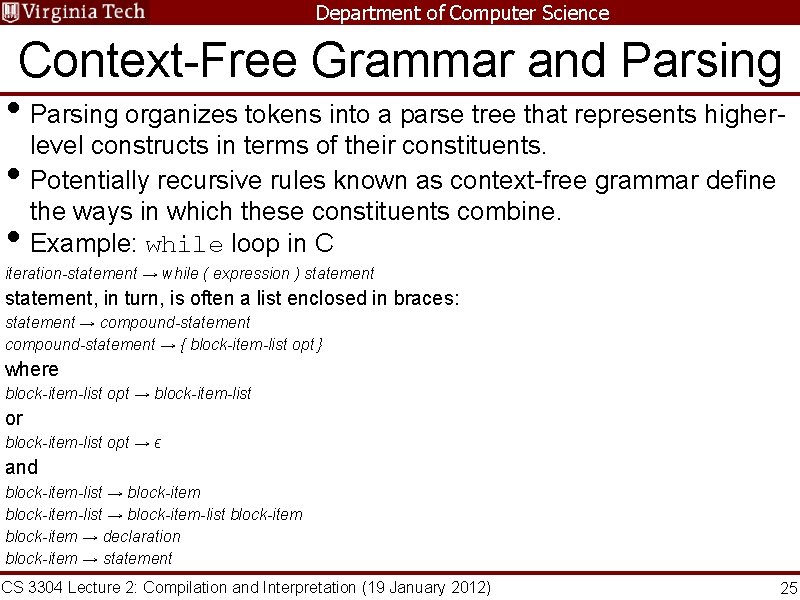
Department of Computer Science Context-Free Grammar and Parsing • Parsing organizes tokens into a parse tree that represents higherlevel constructs in terms of their constituents. • Potentially recursive rules known as context-free grammar define the ways in which these constituents combine. • Example: while loop in C iteration-statement → while ( expression ) statement, in turn, is often a list enclosed in braces: statement → compound-statement → { block-item-list opt } where block-item-list opt → block-item-list or block-item-list opt → ϵ and block-item-list → block-item-list block-item → declaration block-item → statement CS 3304 Lecture 2: Compilation and Interpretation (19 January 2012) 25