
Department of Computer Engineering Recursive Problem Solving 2140101
Department of Computer Engineering Recursive Problem Solving 2140101 Computer Programming for International Engineers 2140101 Computer Programming for International Engineers INTERNATIONAL SCHOOL OF ENGINEERING CHULALONGKORN UNIVERSITY
Department of Computer Engineering Objectives Students should: • Be able to explain the concept of recursive definition. • Be able to use recursion in Java to solve problems. 2140101 Computer Programming for International Engineers INTERNATIONAL SCHOOL OF ENGINEERING CHULALONGKORN UNIVERSITY 2
Department of Computer Engineering Recursive Problem Solving How to solve problem recursively ? • Break a problem into identical but smaller, or simpler problems. • Solve smaller problems to obtain a solution to the original one. 2140101 Computer Programming for International Engineers INTERNATIONAL SCHOOL OF ENGINEERING CHULALONGKORN UNIVERSITY 3
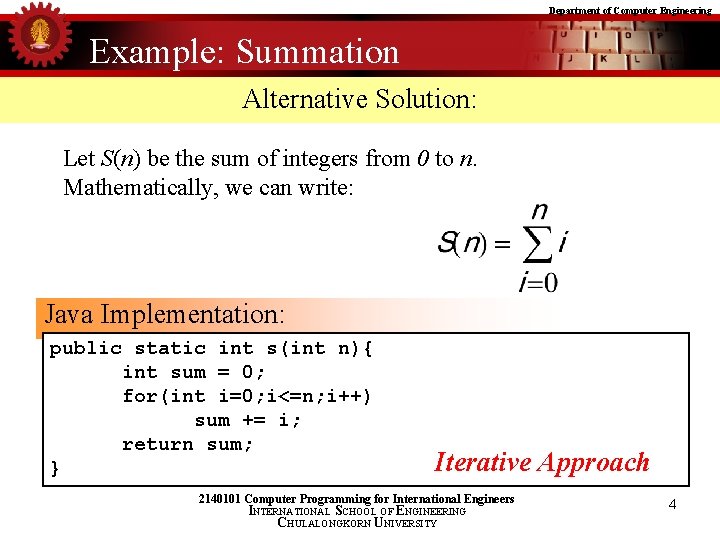
Department of Computer Engineering Example: Summation Alternative Solution: Let S(n) be the sum of integers from 0 to n. Mathematically, we can write: Java Implementation: public static int s(int n){ int sum = 0; for(int i=0; i<=n; i++) sum += i; return sum; } Iterative Approach 2140101 Computer Programming for International Engineers INTERNATIONAL SCHOOL OF ENGINEERING CHULALONGKORN UNIVERSITY 4
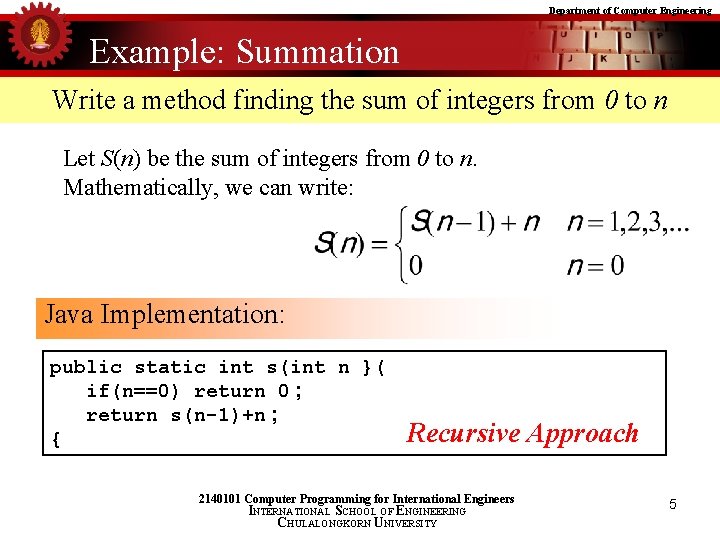
Department of Computer Engineering Example: Summation Write a method finding the sum of integers from 0 to n Let S(n) be the sum of integers from 0 to n. Mathematically, we can write: Java Implementation: public static int s(int n }( if(n==0) return 0 ; return s(n-1)+n ; { Recursive Approach 2140101 Computer Programming for International Engineers INTERNATIONAL SCHOOL OF ENGINEERING CHULALONGKORN UNIVERSITY 5
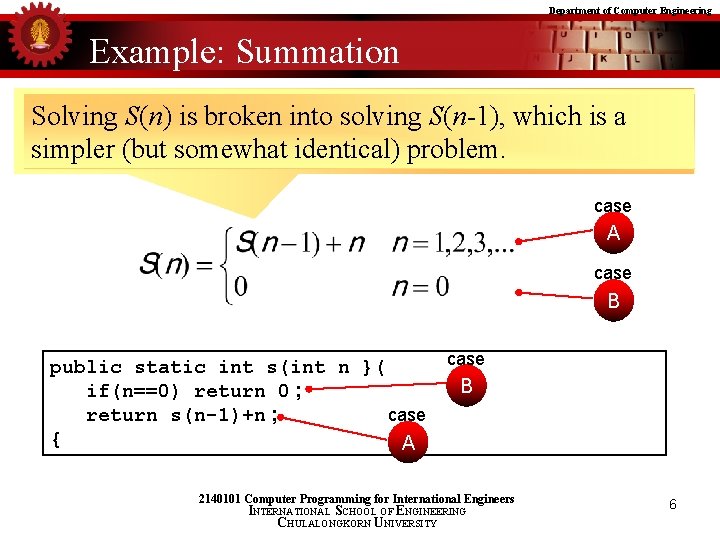
Department of Computer Engineering Example: Summation Solving S(n) is broken into solving S(n-1), which is a simpler (but somewhat identical) problem. case A case B public static int s(int n }( if(n==0) return 0 ; return s(n-1)+n ; case { A case B 2140101 Computer Programming for International Engineers INTERNATIONAL SCHOOL OF ENGINEERING CHULALONGKORN UNIVERSITY 6
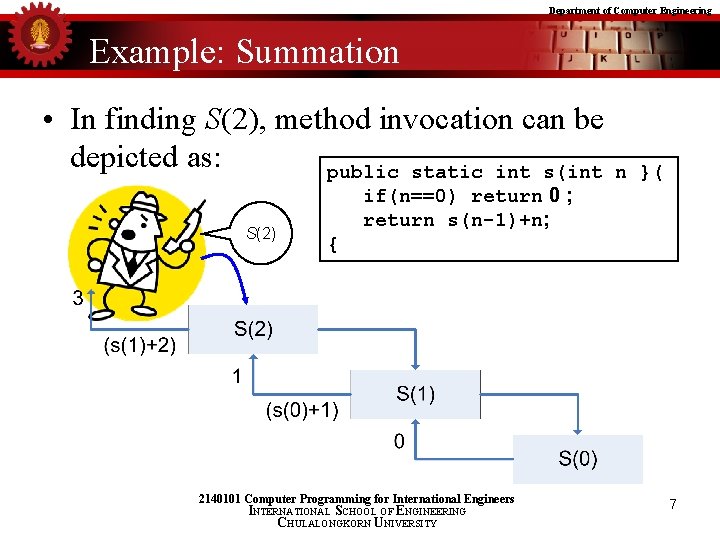
Department of Computer Engineering Example: Summation • In finding S(2), method invocation can be depicted as: public static int s(int S(2) if(n==0) return 0 ; return s(n-1)+n; n }( { 2140101 Computer Programming for International Engineers INTERNATIONAL SCHOOL OF ENGINEERING CHULALONGKORN UNIVERSITY 7
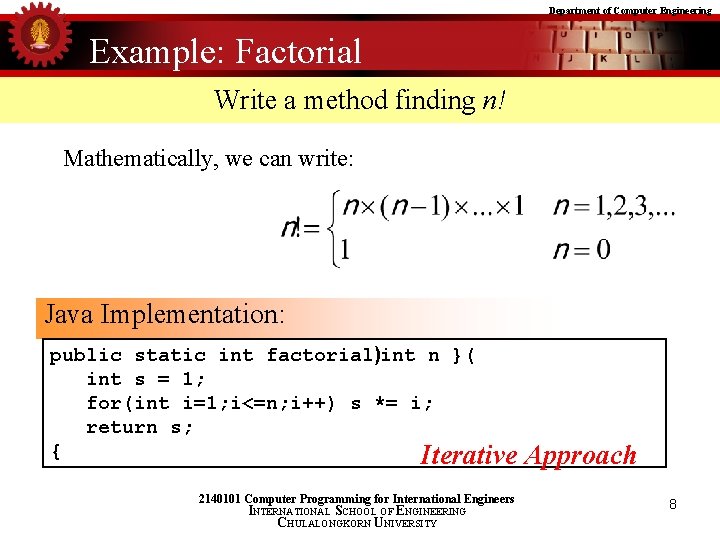
Department of Computer Engineering Example: Factorial Write a method finding n! Mathematically, we can write: Java Implementation: public static int factorial)int n }( int s = 1; for(int i=1; i<=n; i++) s *= i; return s; { Iterative 2140101 Computer Programming for International Engineers INTERNATIONAL SCHOOL OF ENGINEERING CHULALONGKORN UNIVERSITY Approach 8
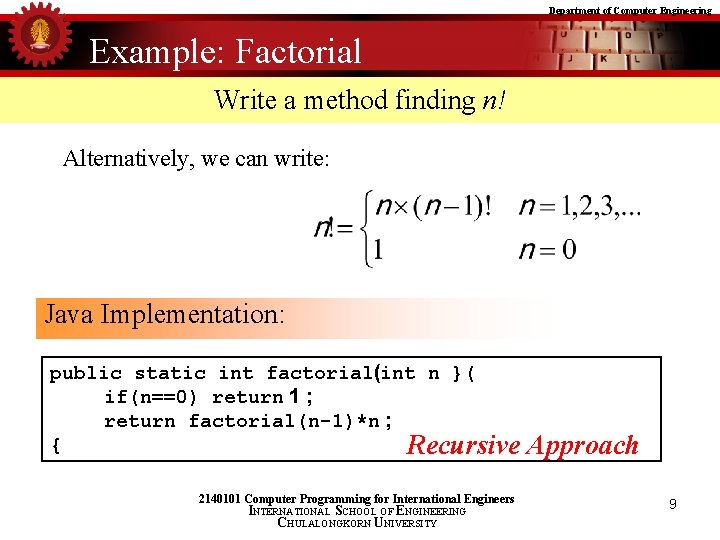
Department of Computer Engineering Example: Factorial Write a method finding n! Alternatively, we can write: Java Implementation: public static int factorial(int n }( if(n==0) return 1 ; return factorial(n-1)*n ; { Recursive 2140101 Computer Programming for International Engineers INTERNATIONAL SCHOOL OF ENGINEERING CHULALONGKORN UNIVERSITY Approach 9
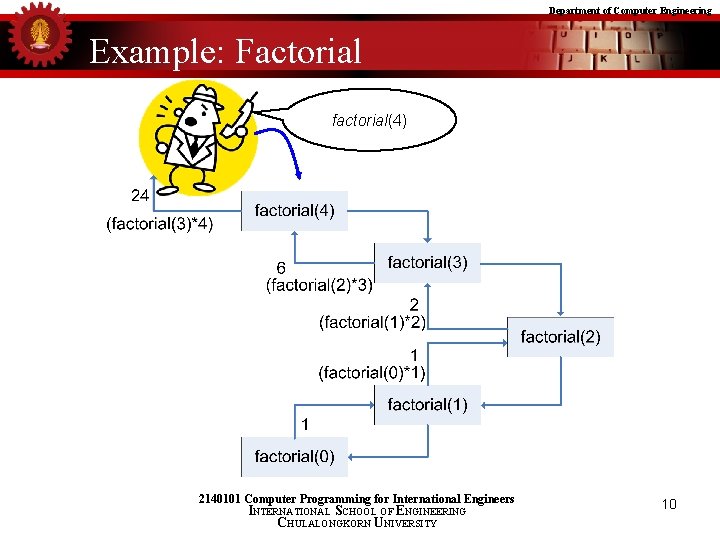
Department of Computer Engineering Example: Factorial factorial(4) 2140101 Computer Programming for International Engineers INTERNATIONAL SCHOOL OF ENGINEERING CHULALONGKORN UNIVERSITY 10
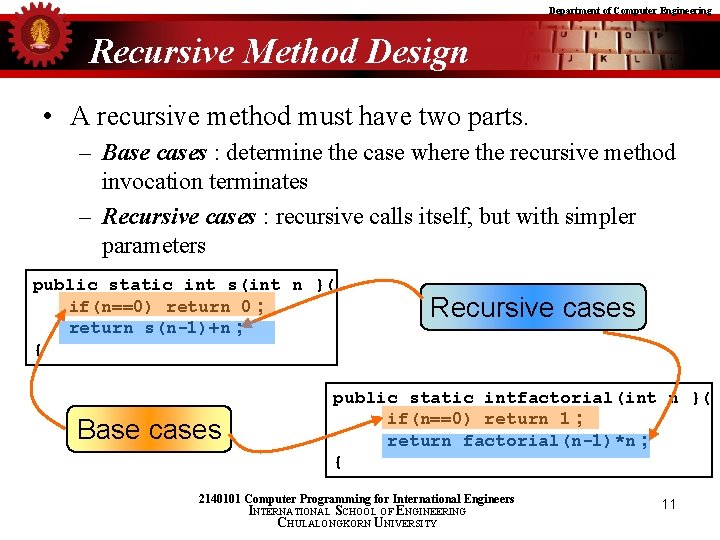
Department of Computer Engineering Recursive Method Design • A recursive method must have two parts. – Base cases : determine the case where the recursive method invocation terminates – Recursive cases : recursive calls itself, but with simpler parameters public static int s(int n }( if(n==0) return 0 ; return s(n-1)+n ; { Base cases Recursive cases public static intfactorial(int n }( if(n==0) return 1 ; return factorial(n-1)*n ; { 2140101 Computer Programming for International Engineers INTERNATIONAL SCHOOL OF ENGINEERING CHULALONGKORN UNIVERSITY 11
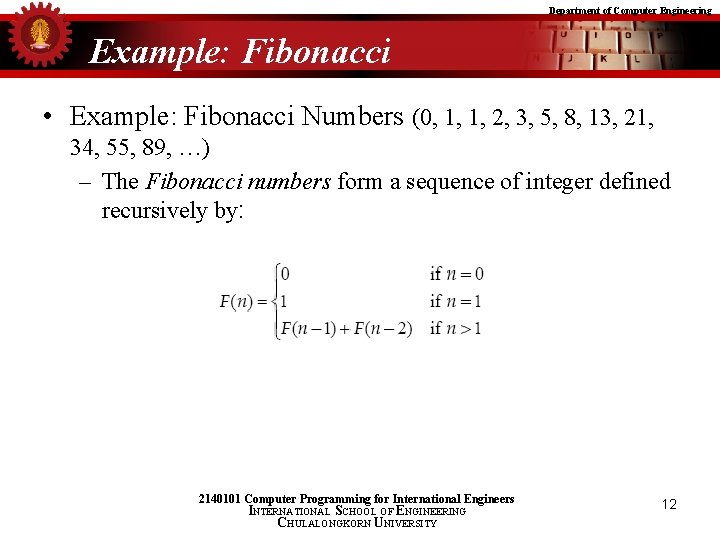
Department of Computer Engineering Example: Fibonacci • Example: Fibonacci Numbers (0, 1, 1, 2, 3, 5, 8, 13, 21, 34, 55, 89, …) – The Fibonacci numbers form a sequence of integer defined recursively by: 2140101 Computer Programming for International Engineers INTERNATIONAL SCHOOL OF ENGINEERING CHULALONGKORN UNIVERSITY 12
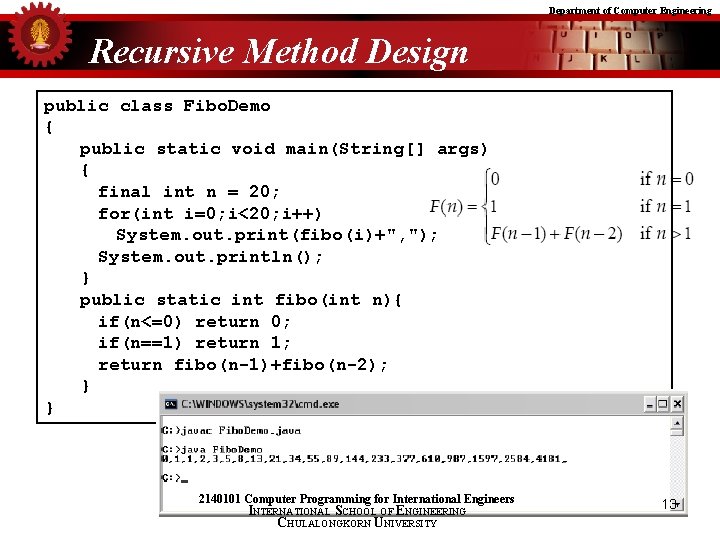
Department of Computer Engineering Recursive Method Design public class Fibo. Demo { public static void main(String[] args) { final int n = 20; for(int i=0; i<20; i++) System. out. print(fibo(i)+", "); System. out. println(); } public static int fibo(int n){ if(n<=0) return 0; if(n==1) return 1; return fibo(n-1)+fibo(n-2); } } 2140101 Computer Programming for International Engineers INTERNATIONAL SCHOOL OF ENGINEERING CHULALONGKORN UNIVERSITY 13
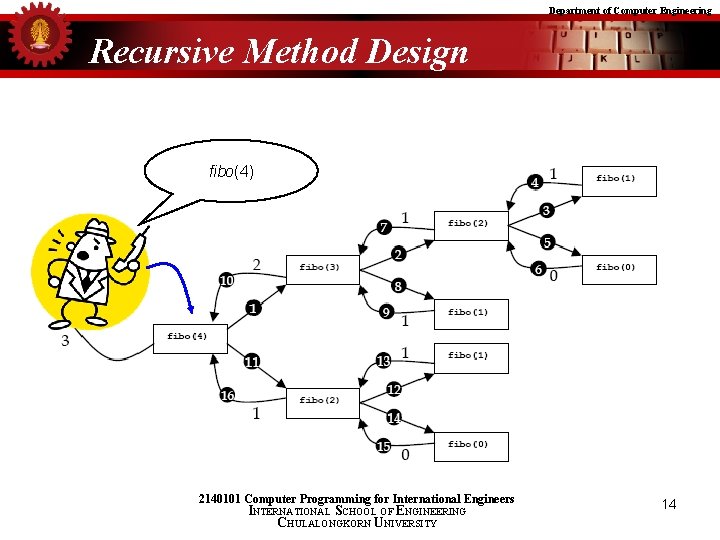
Department of Computer Engineering Recursive Method Design fibo(4) 2140101 Computer Programming for International Engineers INTERNATIONAL SCHOOL OF ENGINEERING CHULALONGKORN UNIVERSITY 14
Department of Computer Engineering Costs of Recursion • A recursive method accomplishes its task by successively calling itself. • Therefore, there are many invocations of method involved. • Each time a recursive call is made, a certain amount of memory must be allocated. • For a recursive method that makes very deep recursions, a large amount of memory is required. Does this mean we should avoid recursive algorithms ? 2140101 Computer Programming for International Engineers INTERNATIONAL SCHOOL OF ENGINEERING CHULALONGKORN UNIVERSITY 15
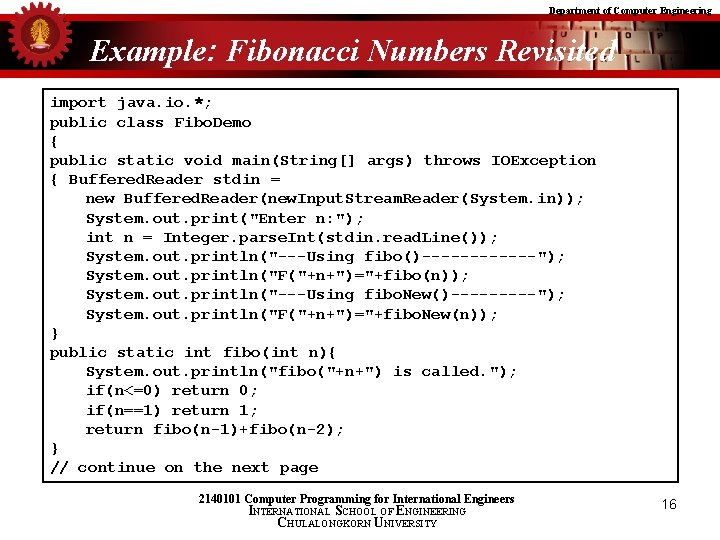
Department of Computer Engineering Example: Fibonacci Numbers Revisited import java. io. *; public class Fibo. Demo { public static void main(String[] args) throws IOException { Buffered. Reader stdin = new Buffered. Reader(new. Input. Stream. Reader(System. in)); System. out. print("Enter n: "); int n = Integer. parse. Int(stdin. read. Line()); System. out. println("---Using fibo()------"); System. out. println("F("+n+")="+fibo(n)); System. out. println("---Using fibo. New()-----"); System. out. println("F("+n+")="+fibo. New(n)); } public static int fibo(int n){ System. out. println("fibo("+n+") is called. "); if(n<=0) return 0; if(n==1) return 1; return fibo(n-1)+fibo(n-2); } // continue on the next page 2140101 Computer Programming for International Engineers INTERNATIONAL SCHOOL OF ENGINEERING CHULALONGKORN UNIVERSITY 16
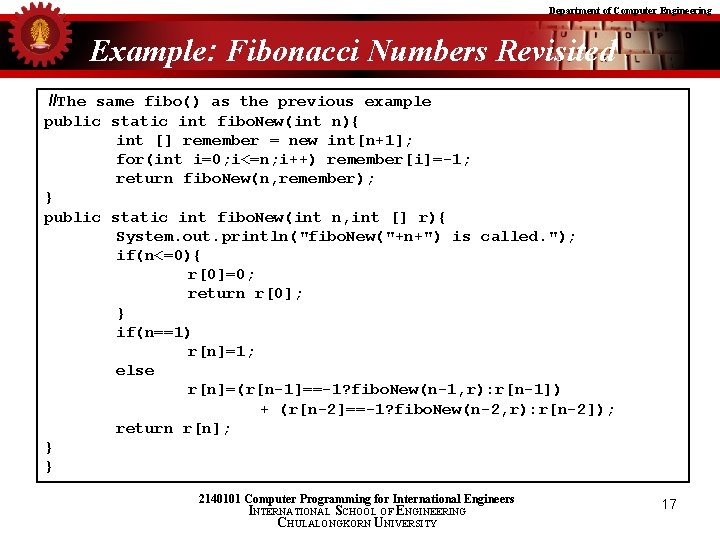
Department of Computer Engineering Example: Fibonacci Numbers Revisited //The same fibo() as the previous example public static int fibo. New(int n){ int [] remember = new int[n+1]; for(int i=0; i<=n; i++) remember[i]=-1; return fibo. New(n, remember); } public static int fibo. New(int n, int [] r){ System. out. println("fibo. New("+n+") is called. "); if(n<=0){ r[0]=0; return r[0]; } if(n==1) r[n]=1; else r[n]=(r[n-1]==-1? fibo. New(n-1, r): r[n-1]) + (r[n-2]==-1? fibo. New(n-2, r): r[n-2]); return r[n]; } } 2140101 Computer Programming for International Engineers INTERNATIONAL SCHOOL OF ENGINEERING CHULALONGKORN UNIVERSITY 17
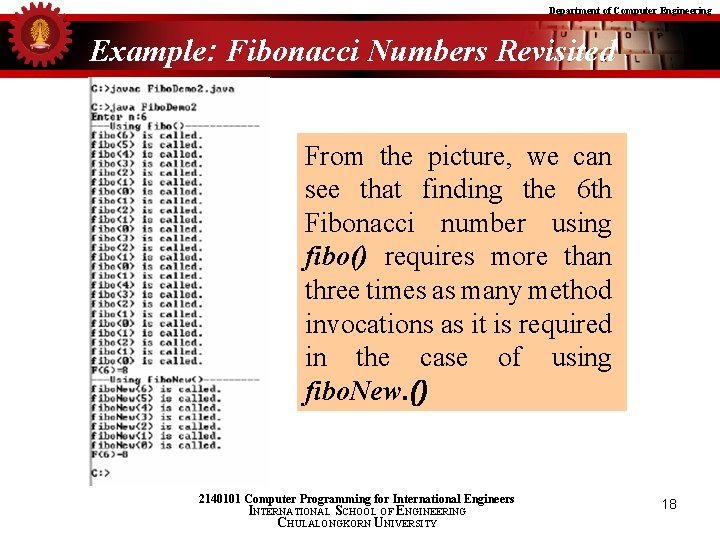
Department of Computer Engineering Example: Fibonacci Numbers Revisited From the picture, we can see that finding the 6 th Fibonacci number using fibo() requires more than three times as many method invocations as it is required in the case of using fibo. New. () 2140101 Computer Programming for International Engineers INTERNATIONAL SCHOOL OF ENGINEERING CHULALONGKORN UNIVERSITY 18
Department of Computer Engineering Example: The Towers of Hanoi • Sometimes, the easiest and the least errorprone ways to write programs for solving some problems are recursivemethods. • Sometimes, an iterative approach is much more difficult than the recursive ones. • See example “Towers of Hanoi” 2140101 Computer Programming for International Engineers INTERNATIONAL SCHOOL OF ENGINEERING CHULALONGKORN UNIVERSITY 19
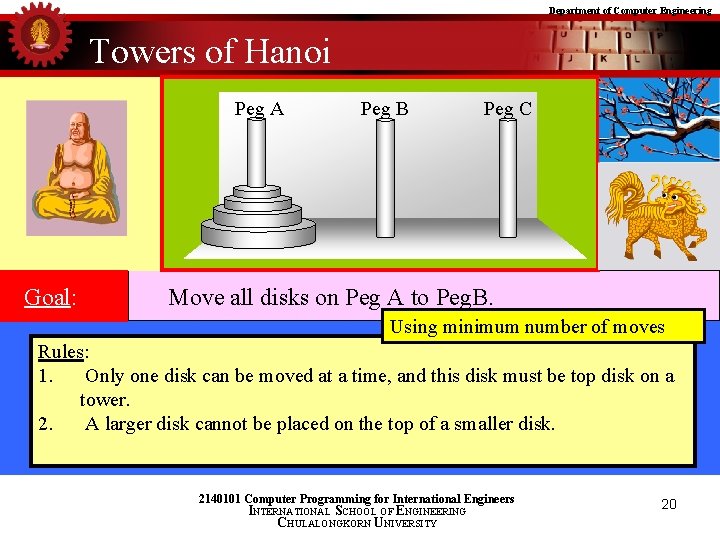
Department of Computer Engineering Towers of Hanoi Peg A Goal: Peg B Peg C Move all disks on Peg A to Peg. B. Using minimum number of moves Rules: 1. Only one disk can be moved at a time, and this disk must be top disk on a tower. 2. A larger disk cannot be placed on the top of a smaller disk. 2140101 Computer Programming for International Engineers INTERNATIONAL SCHOOL OF ENGINEERING CHULALONGKORN UNIVERSITY 20
Department of Computer Engineering Towers of Hanoi 2140101 Computer Programming for International Engineers INTERNATIONAL SCHOOL OF ENGINEERING CHULALONGKORN UNIVERSITY 21
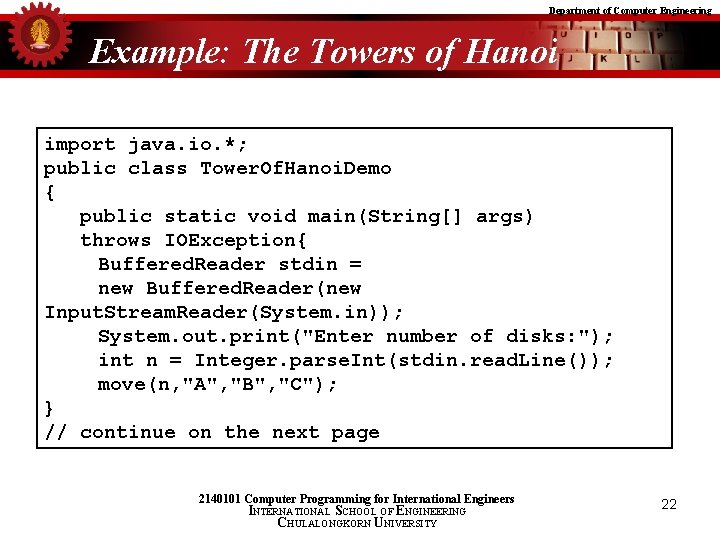
Department of Computer Engineering Example: The Towers of Hanoi import java. io. *; public class Tower. Of. Hanoi. Demo { public static void main(String[] args) throws IOException{ Buffered. Reader stdin = new Buffered. Reader(new Input. Stream. Reader(System. in)); System. out. print("Enter number of disks: "); int n = Integer. parse. Int(stdin. read. Line()); move(n, "A", "B", "C"); } // continue on the next page 2140101 Computer Programming for International Engineers INTERNATIONAL SCHOOL OF ENGINEERING CHULALONGKORN UNIVERSITY 22
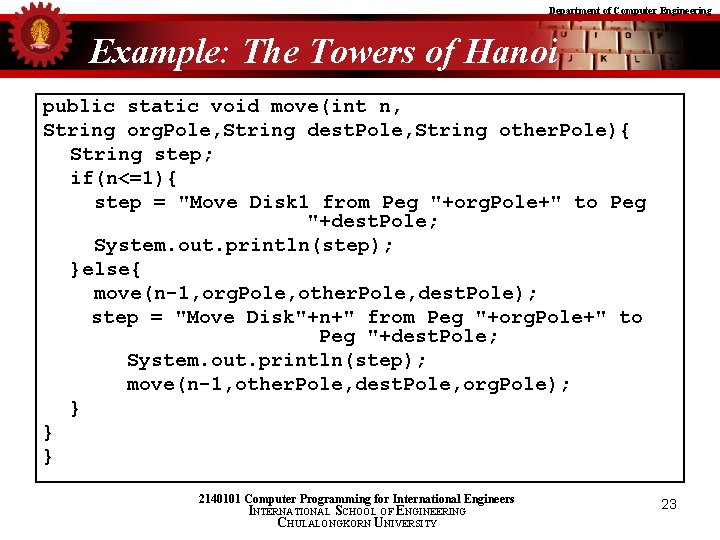
Department of Computer Engineering Example: The Towers of Hanoi public static void move(int n, String org. Pole, String dest. Pole, String other. Pole){ String step; if(n<=1){ step = "Move Disk 1 from Peg "+org. Pole+" to Peg "+dest. Pole; System. out. println(step); }else{ move(n-1, org. Pole, other. Pole, dest. Pole); step = "Move Disk"+n+" from Peg "+org. Pole+" to Peg "+dest. Pole; System. out. println(step); move(n-1, other. Pole, dest. Pole, org. Pole); } } } 2140101 Computer Programming for International Engineers INTERNATIONAL SCHOOL OF ENGINEERING CHULALONGKORN UNIVERSITY 23
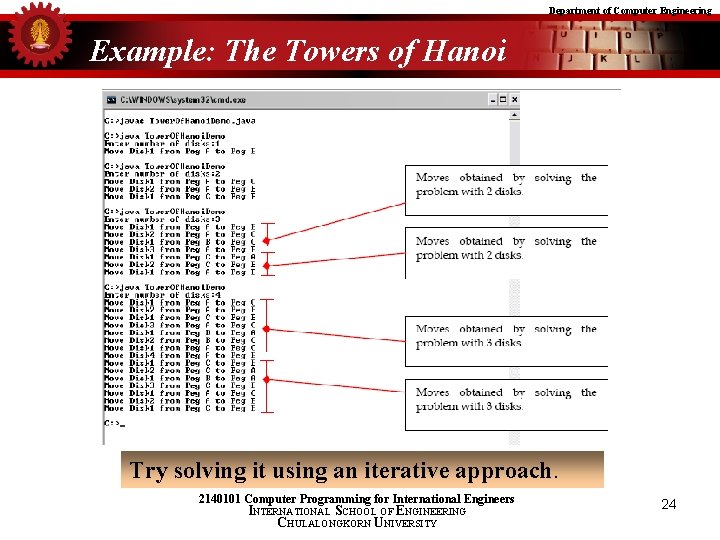
Department of Computer Engineering Example: The Towers of Hanoi Try solving it using an iterative approach. 2140101 Computer Programming for International Engineers INTERNATIONAL SCHOOL OF ENGINEERING CHULALONGKORN UNIVERSITY 24
- Slides: 24