
Department of Chemical Engineering Presentation An Introduction to

![Exponential Models - closer look Initial height, h 0 [ft] Height, h(t) [ft] Area,](https://slidetodoc.com/presentation_image_h2/feeb210f107d6f313f60f326b839c31a/image-8.jpg "Exponential Models - closer look Initial height, h 0 [ft] Height, h(t) [ft] Area,")

- Slides: 24
Department of Chemical Engineering Presentation An Introduction to Modeling by Richard Gilbert Nihat Gürmen 10/19/98 University of South Florida, Tampa
Objective • Exponential Model - understand how to explore a mathematical model in engineering Richard Gilbert Nihat Gürmen U. South Florida
Richard Gilbert Nihat Gürmen U. South Florida
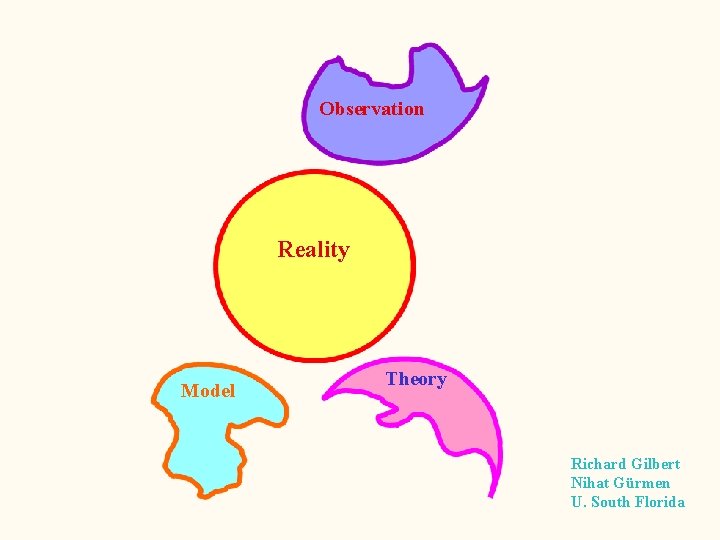
Observation Reality Model Theory Richard Gilbert Nihat Gürmen U. South Florida
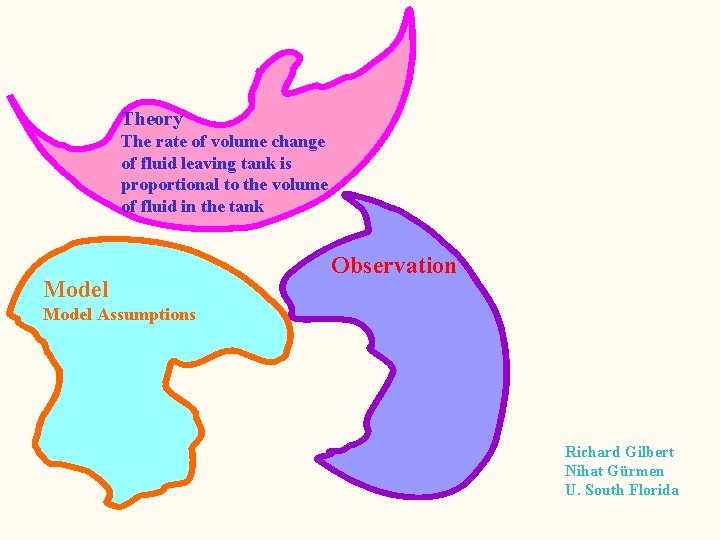
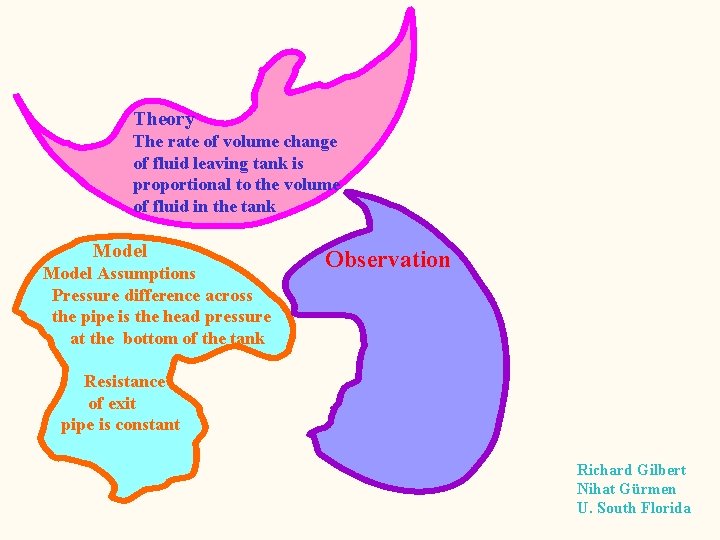
Theory The rate of volume change of fluid leaving tank is proportional to the volume of fluid in the tank Model Observation Model Assumptions Richard Gilbert Nihat Gürmen U. South Florida
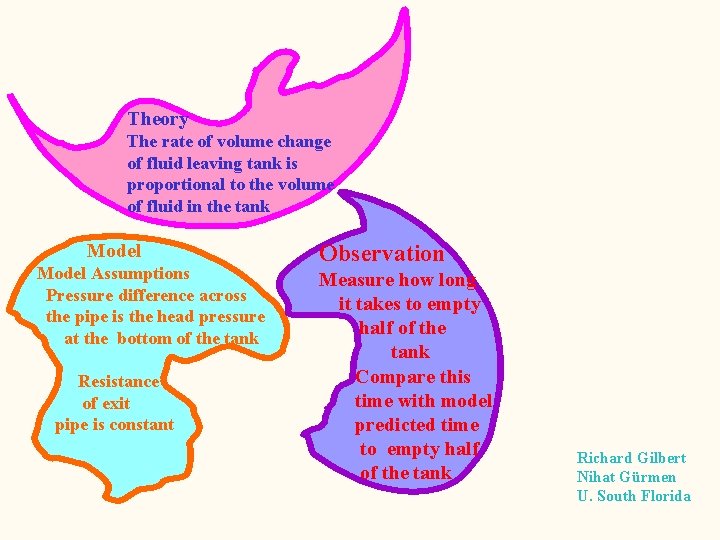
Theory The rate of volume change of fluid leaving tank is proportional to the volume of fluid in the tank Model Assumptions Pressure difference across the pipe is the head pressure at the bottom of the tank Observation Resistance of exit pipe is constant Richard Gilbert Nihat Gürmen U. South Florida
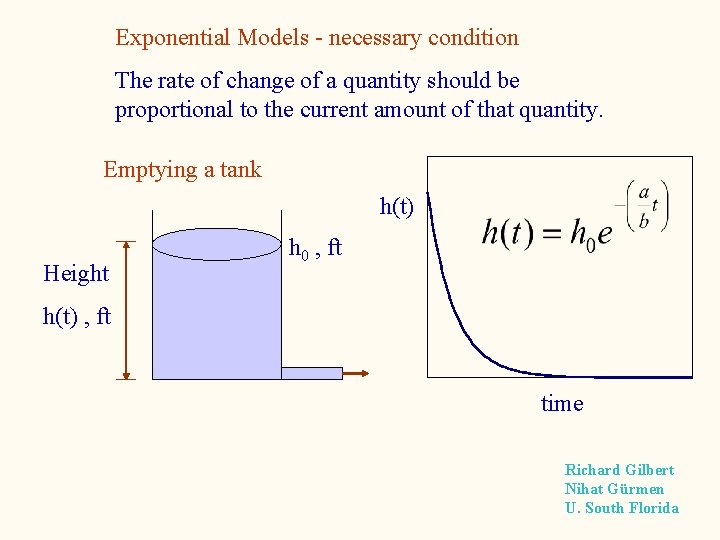
Exponential Models - necessary condition The rate of change of a quantity should be proportional to the current amount of that quantity. Emptying a tank h(t) Height h 0 , ft h(t) , ft time Richard Gilbert Nihat Gürmen U. South Florida
Exponential Models - closer look Initial height, h 0 [ft] Height, h(t) [ft] Area, A ft 2 Resistance, R [min/cm 2] Flow, q [ft 2/min] Richard Gilbert Nihat Gürmen U. South Florida
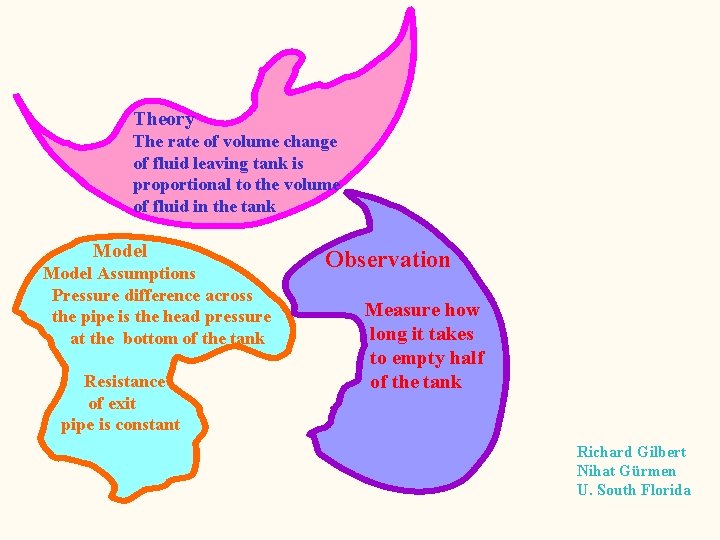
Theory The rate of volume change of fluid leaving tank is proportional to the volume of fluid in the tank Model Assumptions Pressure difference across the pipe is the head pressure at the bottom of the tank Resistance of exit pipe is constant Observation Measure how long it takes to empty half of the tank Richard Gilbert Nihat Gürmen U. South Florida
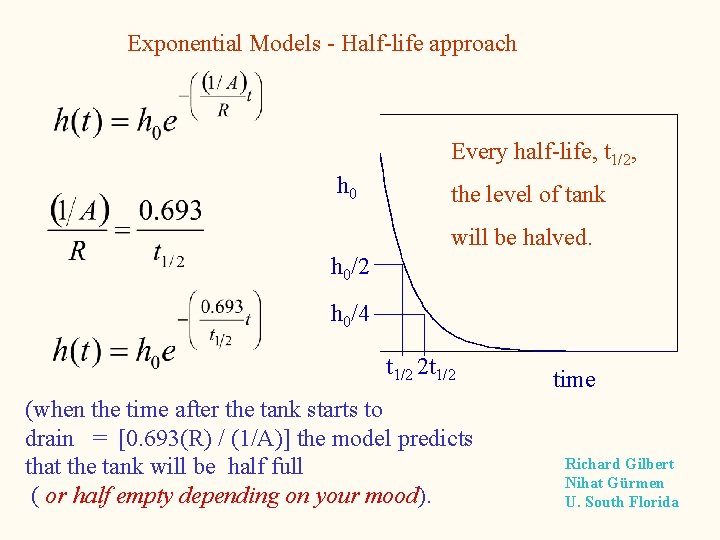
Exponential Models - Half-life approach Every half-life, t 1/2, h 0 the level of tank will be halved. h 0/2 h 0/4 t 1/2 2 t 1/2 (when the time after the tank starts to drain = [0. 693(R) / (1/A)] the model predicts that the tank will be half full ( or half empty depending on your mood). time Richard Gilbert Nihat Gürmen U. South Florida
Theory The rate of volume change of fluid leaving tank is proportional to the volume of fluid in the tank Model Assumptions Pressure difference across the pipe is the head pressure at the bottom of the tank Resistance of exit pipe is constant Observation Measure how long it takes to empty half of the tank Compare this time with model predicted time to empty half of the tank Richard Gilbert Nihat Gürmen U. South Florida
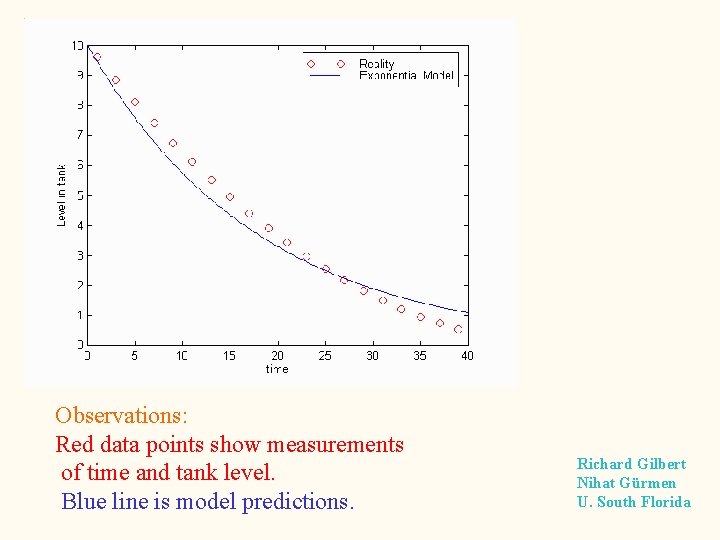
Observations: Red data points show measurements of time and tank level. Blue line is model predictions. Richard Gilbert Nihat Gürmen U. South Florida
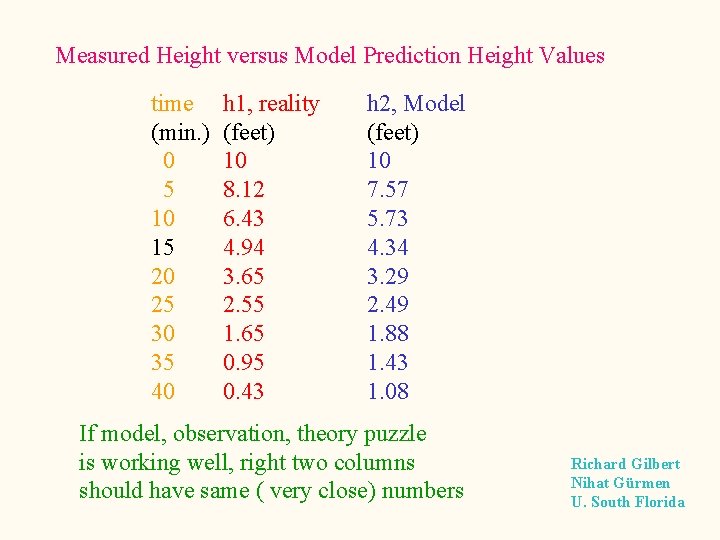
Measured Height versus Model Prediction Height Values time (min. ) 0 5 10 15 20 25 30 35 40 h 1, reality (feet) 10 8. 12 6. 43 4. 94 3. 65 2. 55 1. 65 0. 95 0. 43 h 2, Model (feet) 10 7. 57 5. 73 4. 34 3. 29 2. 49 1. 88 1. 43 1. 08 If model, observation, theory puzzle is working well, right two columns should have same ( very close) numbers Richard Gilbert Nihat Gürmen U. South Florida
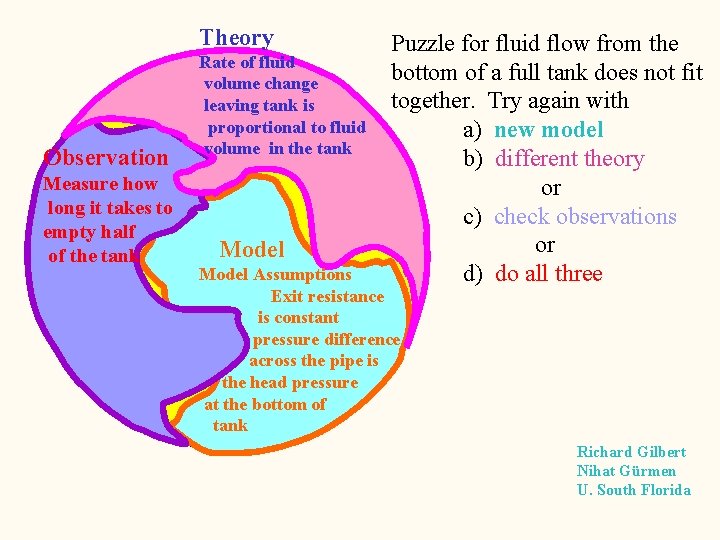
Theory Observation Measure how long it takes to empty half of the tank Rate of fluid volume change leaving tank is proportional to fluid volume in the tank Model Puzzle for fluid flow from the bottom of a full tank does not fit together. Try again with a) new model b) different theory or c) check observations or d) do all three Model Assumptions Exit resistance is constant pressure difference across the pipe is the head pressure at the bottom of tank Richard Gilbert Nihat Gürmen U. South Florida
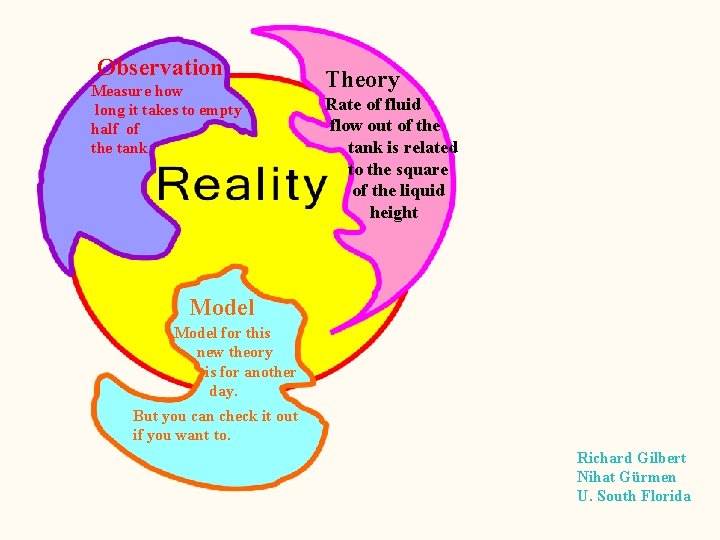
Observation Measure how long it takes to empty half of the tank Theory Rate of fluid flow out of the tank is related to the square of the liquid height Model for this new theory is for another day. But you can check it out if you want to. Richard Gilbert Nihat Gürmen U. South Florida
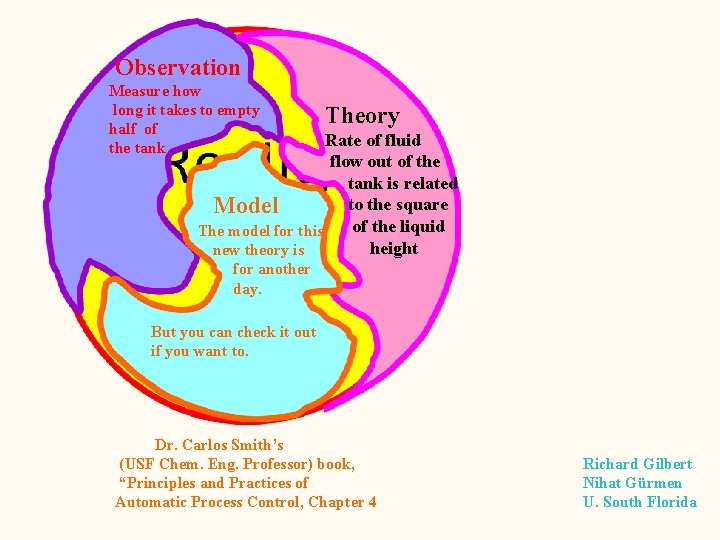
Observation Measure how long it takes to empty half of the tank Theory Rate of fluid flow out of the tank is related to the square Model of the liquid The model for this height new theory is for another day. But you can check it out if you want to. Dr. Carlos Smith’s (USF Chem. Eng. Professor) book, “Principles and Practices of Automatic Process Control, Chapter 4 Richard Gilbert Nihat Gürmen U. South Florida
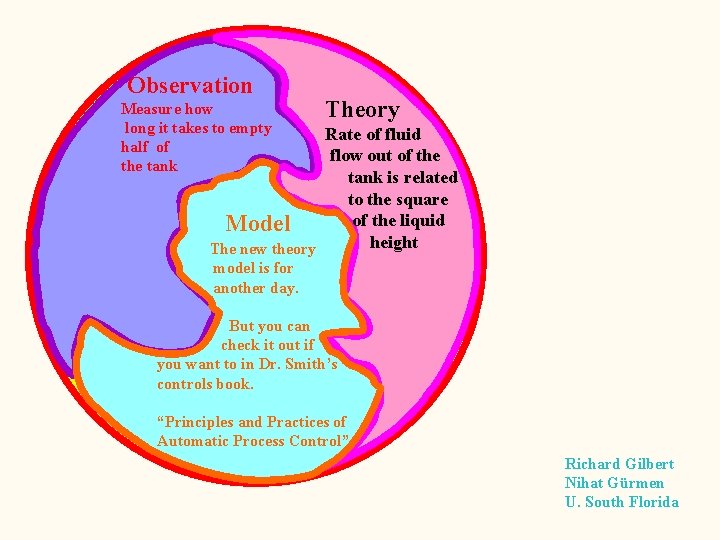
Observation Measure how long it takes to empty half of the tank Theory Rate of fluid flow out of the tank is related to the square of the liquid Model height The new theory model is for another day. But you can check it out if you want to in Dr. Smith’s controls book. “Principles and Practices of Automatic Process Control” Richard Gilbert Nihat Gürmen U. South Florida
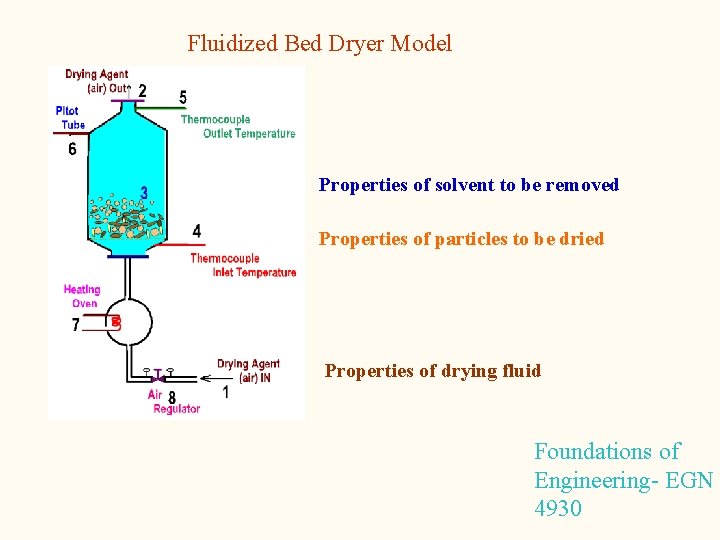
Fluidized Bed Dryer Model Properties of solvent to be removed Properties of particles to be dried Properties of drying fluid Foundations of Engineering- EGN 4930
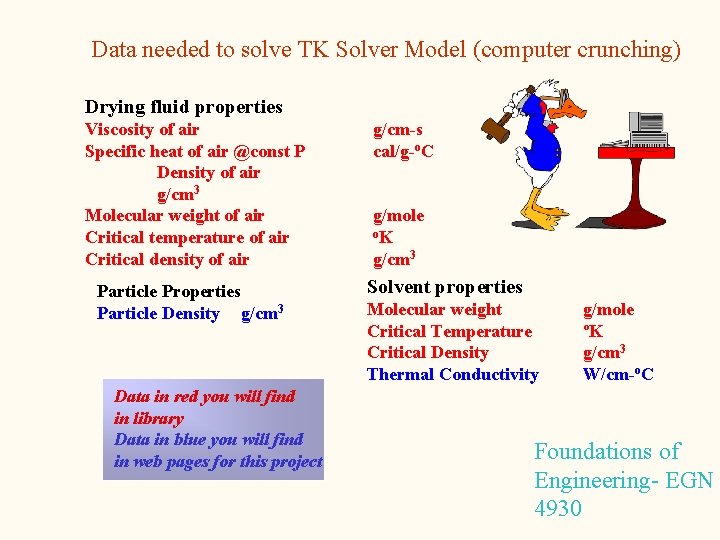
Data needed to solve TK Solver Model (computer crunching) Drying fluid properties Viscosity of air Specific heat of air @const P Density of air g/cm 3 Molecular weight of air Critical temperature of air Critical density of air Particle Properties Particle Density g/cm 3 Data in red you will find in library Data in blue you will find in web pages for this project g/cm-s cal/g-o. C g/mole o. K g/cm 3 Solvent properties Molecular weight Critical Temperature Critical Density Thermal Conductivity g/mole ºK g/cm 3 W/cm-o. C Foundations of Engineering- EGN 4930
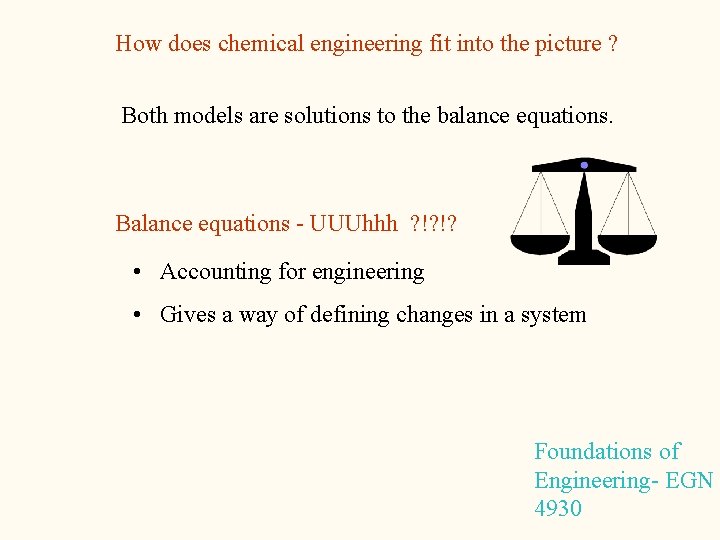
How does chemical engineering fit into the picture ? Both models are solutions to the balance equations. Balance equations - UUUhhh ? !? !? • Accounting for engineering • Gives a way of defining changes in a system Foundations of Engineering- EGN 4930
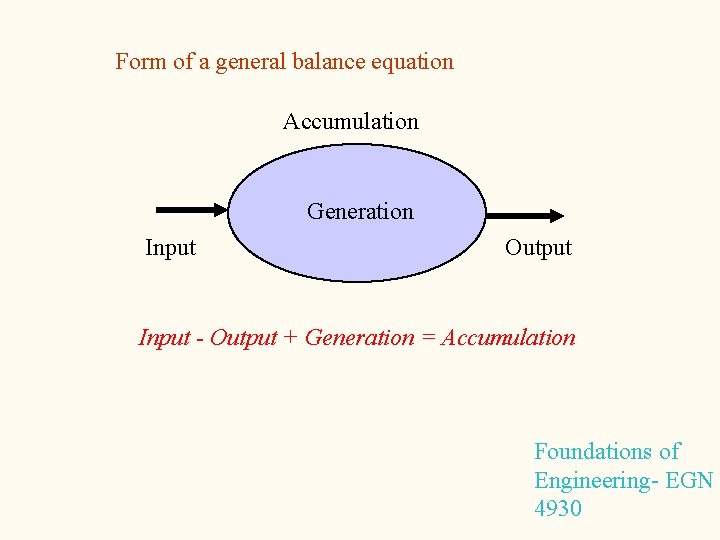
Form of a general balance equation Accumulation Generation Input Output Input - Output + Generation = Accumulation Foundations of Engineering- EGN 4930
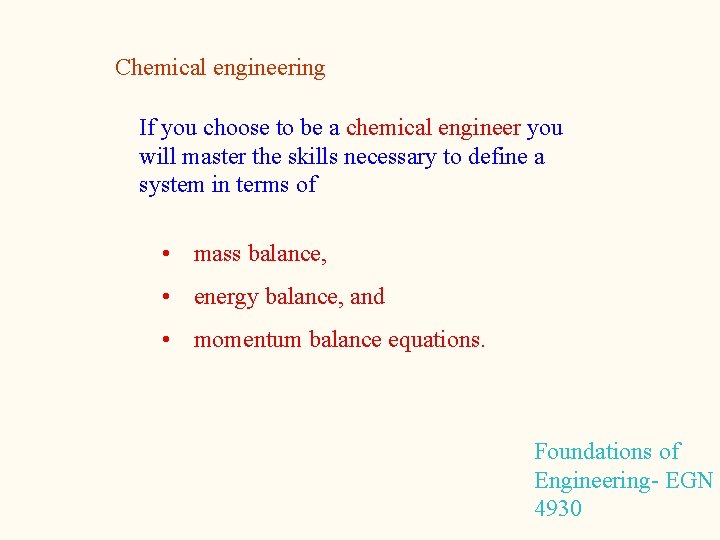
Chemical engineering If you choose to be a chemical engineer you will master the skills necessary to define a system in terms of • mass balance, • energy balance, and • momentum balance equations. Foundations of Engineering- EGN 4930
Department of Chemical Engineering at USF Chairperson L. H. Garcia-Rubio garcia@eng. usf. edu Undergraduate Advisors C. Beaver beaver@eng. usf. edu C. Busot busot@eng. usf. edu C. Smith csmith@eng. usf. edu W. E. Lee (Bio-Engineering) lee@eng. usf. edu Room number Phone numbers Kopp Engineering building • (813) 974 -3997 ENG 346 • (813) 974 -3651 (fax) Foundations of Engineering- EGN 4930
Thanks for your time. We hope the presentation put a bit of light on the subject. Chemical Engineering College of Engineering U. South Florida Tampa, Florida 33620