
DEPARTMENT OF AGRICULTURE GOVERNMENT OF ANDHRA PRADESH NATIONAL

- Slides: 36
DEPARTMENT OF AGRICULTURE GOVERNMENT OF ANDHRA PRADESH NATIONAL CONFERENCE ON AGRICULTURE FOR KHARIF CAMPAIGN, 2018 by Sri B. Rajsekhar, IAS. , Spl. Chief Secretary Agri & Coop Department Amaravathi, Andhra Pradesh 1
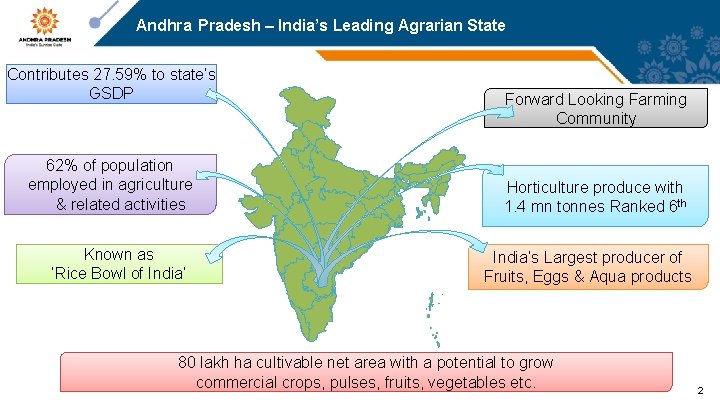
Andhra Pradesh – India’s Leading Agrarian State Contributes 27. 59% to state’s GSDP 62% of population employed in agriculture & related activities Known as ‘Rice Bowl of India’ Forward Looking Farming Community Horticulture produce with 1. 4 mn tonnes Ranked 6 th India’s Largest producer of Fruits, Eggs & Aqua products 80 lakh ha cultivable net area with a potential to grow commercial crops, pulses, fruits, vegetables etc. 2
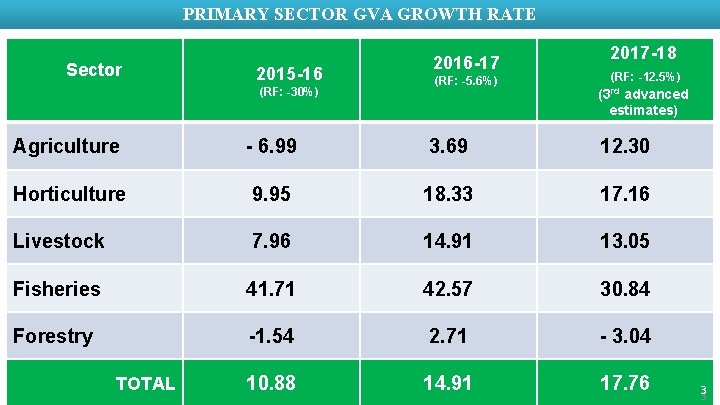
PRIMARY SECTOR GVA GROWTH RATE Sector 2015 -16 (RF: -30%) 2016 -17 (RF: -5. 6%) 2017 -18 (RF: -12. 5%) (3 rd advanced estimates) Agriculture - 6. 99 3. 69 12. 30 Horticulture 9. 95 18. 33 17. 16 Livestock 7. 96 14. 91 13. 05 Fisheries 41. 71 42. 57 30. 84 Forestry -1. 54 2. 71 - 3. 04 10. 88 14. 91 17. 76 TOTAL 3 3
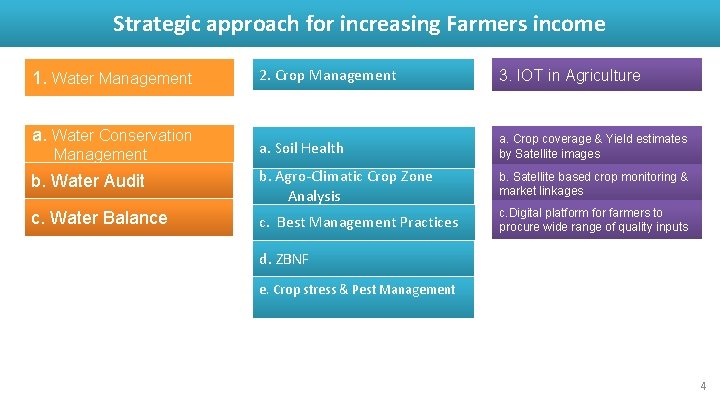
Strategic approach for increasing Farmers income 2. Crop Management 3. IOT in Agriculture Management a. Soil Health a. Crop coverage & Yield estimates by Satellite images b. Water Audit b. Agro-Climatic Crop Zone Analysis b. Satellite based crop monitoring & market linkages c. Water Balance c. Best Management Practices c. Digital platform for farmers to procure wide range of quality inputs 1. Water Management a. Water Conservation d. ZBNF e. Crop stress & Pest Management 4
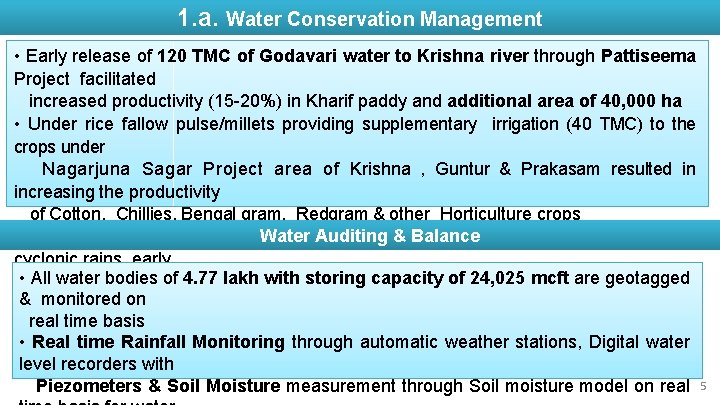
1. a. Water Conservation Management • Early release of 120 TMC of Godavari water to Krishna river through Pattiseema Project facilitated increased productivity (15 -20%) in Kharif paddy and additional area of 40, 000 ha • Under rice fallow pulse/millets providing supplementary irrigation (40 TMC) to the crops under Nagarjuna Sagar Project area of Krishna , Guntur & Prakasam resulted in increasing the productivity of Cotton, Chillies, Bengal gram, Redgram & other Horticulture crops Water Auditing & Balance • Early release of Godavari water advanced the sowings of Kharif paddy avoiding cyclonic rains, early • All water bodies of 4. 77 lakh with storing capacity of 24, 025 mcft are geotagged Rabi paddy resulted in increase the area under summer pulses in Godavari & monitored on districts real time basis • Real time Rainfall Monitoring through automatic weather stations, Digital water level recorders with Piezometers & Soil Moisture measurement through Soil moisture model on real 5
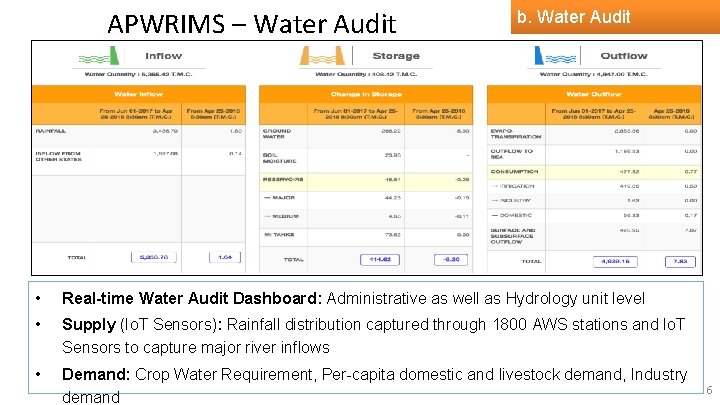
APWRIMS – Water Audit b. Water Audit • Real-time Water Audit Dashboard: Administrative as well as Hydrology unit level • Supply (Io. T Sensors): Rainfall distribution captured through 1800 AWS stations and Io. T Sensors to capture major river inflows • Demand: Crop Water Requirement, Per-capita domestic and livestock demand, Industry demand 6
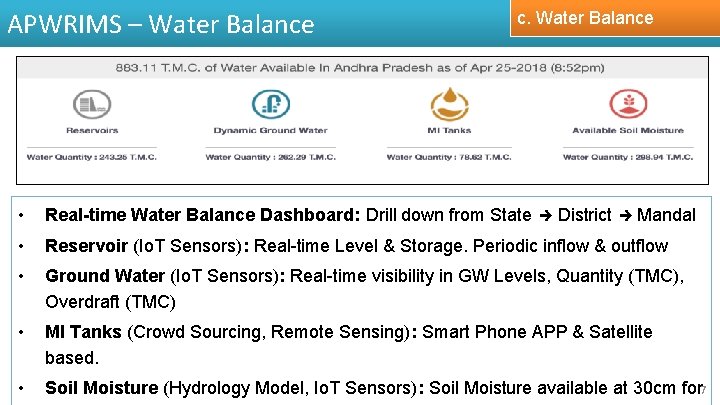
APWRIMS – Water Balance c. Water Balance • Real-time Water Balance Dashboard: Drill down from State District Mandal • Reservoir (Io. T Sensors): Real-time Level & Storage. Periodic inflow & outflow • Ground Water (Io. T Sensors): Real-time visibility in GW Levels, Quantity (TMC), Overdraft (TMC) • MI Tanks (Crowd Sourcing, Remote Sensing): Smart Phone APP & Satellite based. • Soil Moisture (Hydrology Model, Io. T Sensors): Soil Moisture available at 30 cm for 7
2. Crop Management 8
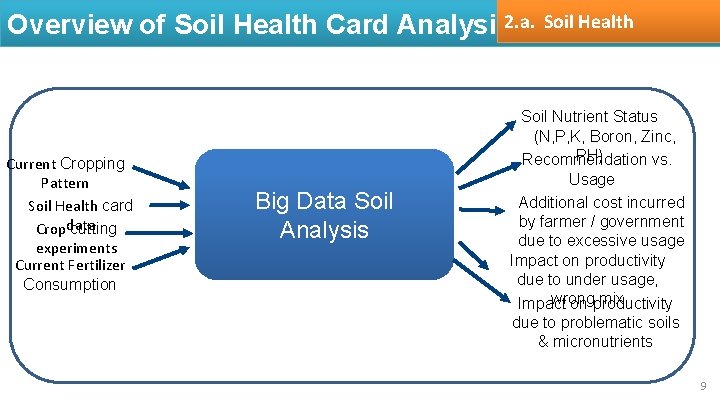
Overview of Soil Health Card Analysis 2. a. Soil Health Current Cropping Pattern Soil Health card Cropdata cutting experiments Current Fertilizer Consumption Big Data Soil Analysis Soil Nutrient Status (N, P, K, Boron, Zinc, PH) Recommendation vs. Usage Additional cost incurred by farmer / government due to excessive usage Impact on productivity due to under usage, wrong mix Impact on productivity due to problematic soils & micronutrients 9
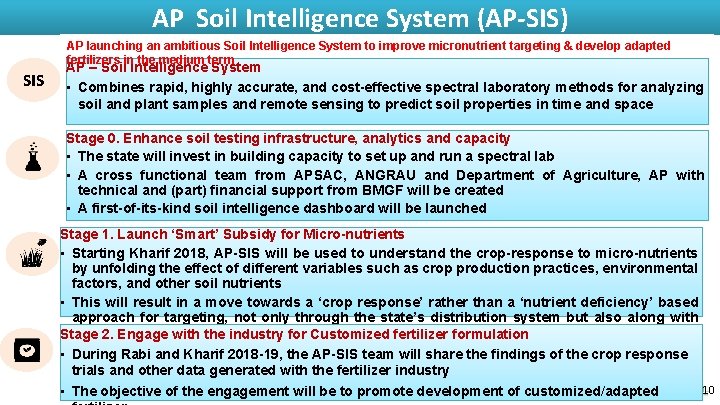
AP Soil Intelligence System (AP-SIS) AP launching an ambitious Soil Intelligence System to improve micronutrient targeting & develop adapted fertilizers in the medium term SIS AP – Soil Intelligence System • Combines rapid, highly accurate, and cost-effective spectral laboratory methods for analyzing soil and plant samples and remote sensing to predict soil properties in time and space Stage 0. Enhance soil testing infrastructure, analytics and capacity • The state will invest in building capacity to set up and run a spectral lab • A cross functional team from APSAC, ANGRAU and Department of Agriculture, AP with technical and (part) financial support from BMGF will be created • A first-of-its-kind soil intelligence dashboard will be launched Stage 1. Launch ‘Smart’ Subsidy for Micro-nutrients • Starting Kharif 2018, AP-SIS will be used to understand the crop-response to micro-nutrients by unfolding the effect of different variables such as crop production practices, environmental factors, and other soil nutrients • This will result in a move towards a ‘crop response’ rather than a ‘nutrient deficiency’ based approach for targeting, not only through the state’s distribution system but also along with the private sector Stage 2. Engage with the industry for Customized fertilizer formulation • During Rabi and Kharif 2018 -19, the AP-SIS team will share the findings of the crop response trials and other data generated with the fertilizer industry 10 • The objective of the engagement will be to promote development of customized/adapted
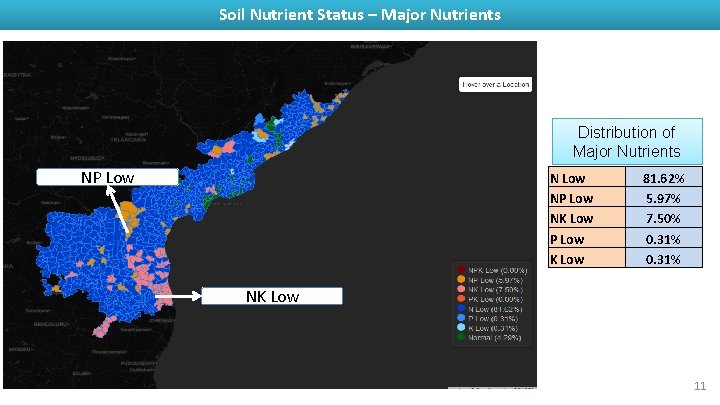
Soil Nutrient Status – Major Nutrients Distribution of Major Nutrients NP Low NK Low P Low K Low 81. 62% 5. 97% 7. 50% 0. 31% NK Low 11
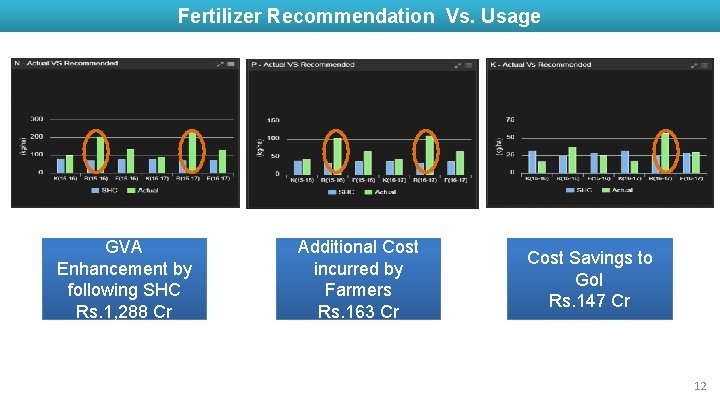
Fertilizer Recommendation Vs. Usage GVA Enhancement by following SHC Rs. 1, 288 Cr Additional Cost incurred by Farmers Rs. 163 Cr Cost Savings to Go. I Rs. 147 Cr 12
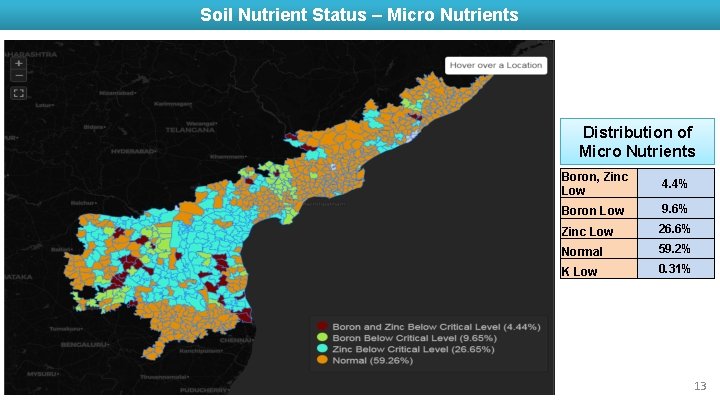
Soil Nutrient Status – Micro Nutrients Distribution of Micro Nutrients Boron, Zinc Low 4. 4% Boron Low 9. 6% Zinc Low 26. 6% Normal 59. 2% K Low 0. 31% 13
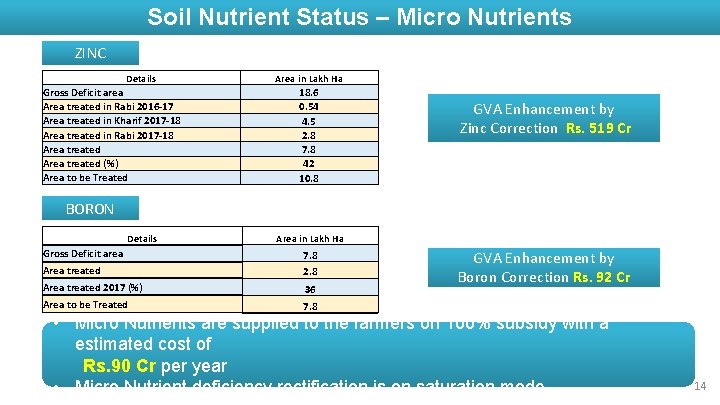
Soil Nutrient Status – Micro Nutrients ZINC Details Gross Deficit area Area treated in Rabi 2016 -17 Area treated in Kharif 2017 -18 Area treated in Rabi 2017 -18 Area treated (%) Area to be Treated Area in Lakh Ha 18. 6 0. 54 4. 5 2. 8 7. 8 42 10. 8 GVA Enhancement by Zinc Correction Rs. 519 Cr BORON Details Gross Deficit area Area in Lakh Ha Area treated 7. 8 2. 8 Area treated 2017 (%) 36 Area to be Treated 7. 8 GVA Enhancement by Boron Correction Rs. 92 Cr • Micro Nutrients are supplied to the farmers on 100% subsidy with a estimated cost of Rs. 90 Cr per year • Micro Nutrient deficiency rectification is on saturation mode 14
2. b. Agro climatic crop zone analysis 15
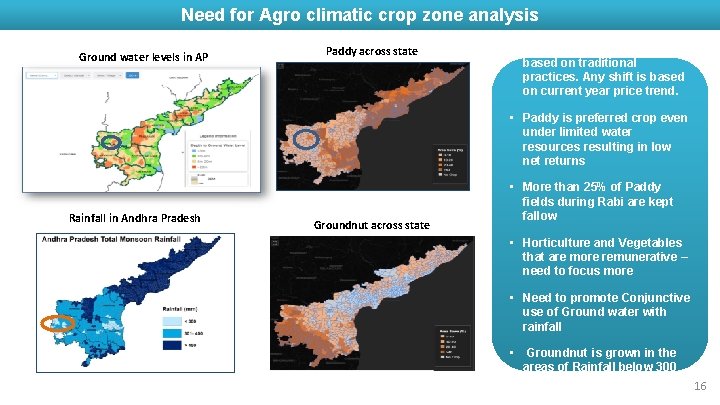
Need for Agro climatic crop zone analysis Ground water levels in AP Paddy across state • Current crop distribution is based on traditional practices. Any shift is based on current year price trend. • Paddy is preferred crop even under limited water resources resulting in low net returns Rainfall in Andhra Pradesh Groundnut across state • More than 25% of Paddy fields during Rabi are kept fallow • Horticulture and Vegetables that are more remunerative – need to focus more • Need to promote Conjunctive use of Ground water with rainfall • Groundnut is grown in the areas of Rainfall below 300 mm in Rayalaseema districts 16
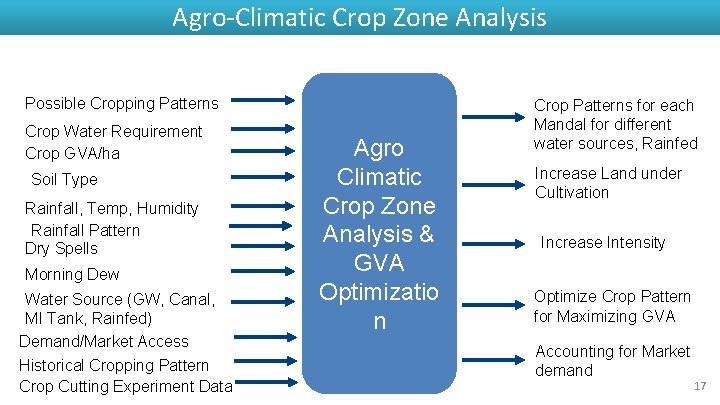
Agro-Climatic Crop Zone Analysis Possible Cropping Patterns Crop Water Requirement Crop GVA/ha Soil Type Rainfall, Temp, Humidity Rainfall Pattern Dry Spells Morning Dew Water Source (GW, Canal, MI Tank, Rainfed) Demand/Market Access Historical Cropping Pattern Crop Cutting Experiment Data Agro Climatic Crop Zone Analysis & GVA Optimizatio n Crop Patterns for each Mandal for different water sources, Rainfed Increase Land under Cultivation Increase Intensity Optimize Crop Pattern for Maximizing GVA Accounting for Market demand 17
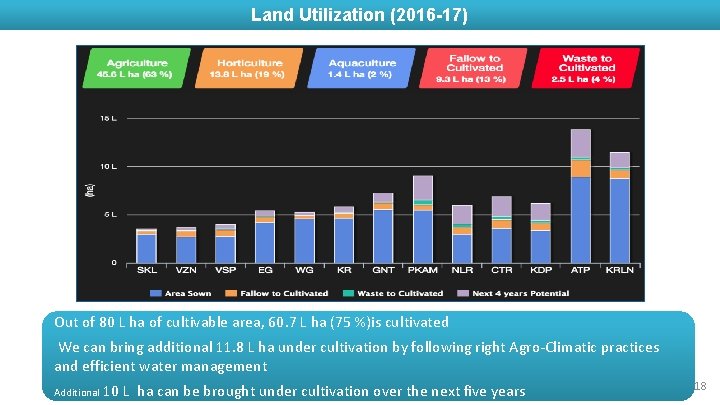
Land Utilization (2016 -17) Out of 80 L ha of cultivable area, 60. 7 L ha (75 %)is cultivated We can bring additional 11. 8 L ha under cultivation by following right Agro-Climatic practices and efficient water management Additional 10 L ha can be brought under cultivation over the next five years 18
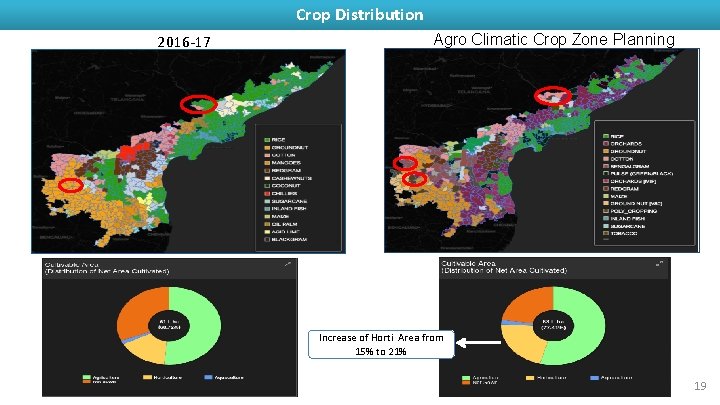
Crop Distribution 2016 -17 Agro Climatic Crop Zone Planning Increase of Horti Area from 15% to 21% 19
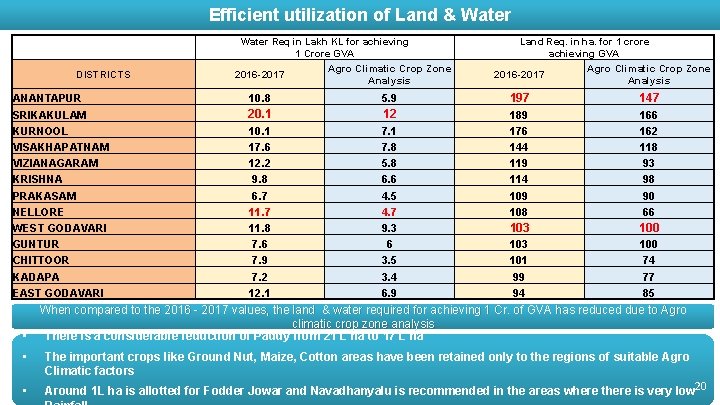
Efficient utilization of Land & Water Req in Lakh KL for achieving 1 Crore GVA DISTRICTS ANANTAPUR SRIKAKULAM KURNOOL VISAKHAPATNAM VIZIANAGARAM KRISHNA PRAKASAM NELLORE WEST GODAVARI GUNTUR CHITTOOR KADAPA EAST GODAVARI • Land Req. in ha. for 1 crore achieving GVA 2016 -2017 Agro Climatic Crop Zone Analysis 10. 8 5. 9 197 147 20. 1 12 10. 1 17. 6 12. 2 9. 8 6. 7 11. 8 7. 6 7. 9 7. 2 12. 1 7. 8 5. 8 6. 6 4. 5 4. 7 9. 3 6 3. 5 3. 4 6. 9 189 176 144 119 114 109 108 166 162 118 93 98 90 66 103 100 103 101 99 94 100 74 77 85 When compared to the 2016 - 2017 values, the land & water required for achieving 1 Cr. of of GVA has reduced due to Agro When compared to the 2016 - 2017 values, the land & water required for achieving 1 Cr. climatic crop zone analysis There is a considerable reduction of Paddy from 21 L ha to 17 L ha • The important crops like Ground Nut, Maize, Cotton areas have been retained only to the regions of suitable Agro Climatic factors • Around 1 L ha is allotted for Fodder Jowar and Navadhanyalu is recommended in the areas where there is very low 20
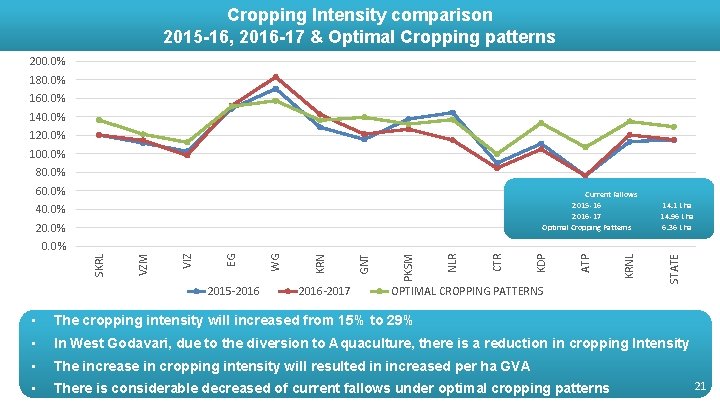
Cropping Intensity comparison 2015 -16, 2016 -17 & Optimal Cropping patterns 200. 0% 180. 0% 160. 0% 140. 0% 120. 0% 100. 0% 80. 0% 60. 0% Current Fallows 2015 -16 2016 -17 Optimal Cropping Patterns 40. 0% 20. 0% 14. 1 L ha 14. 96 L ha 6. 36 L ha 2015 -2016 -2017 STATE KRNL ATP KDP CTR NLR PKSM GNT KRN WG EG VIZ VZM SKRL 0. 0% OPTIMAL CROPPING PATTERNS • The cropping intensity will increased from 15% to 29% • In West Godavari, due to the diversion to Aquaculture, there is a reduction in cropping Intensity • The increase in cropping intensity will resulted in increased per ha GVA • There is considerable decreased of current fallows under optimal cropping patterns 21
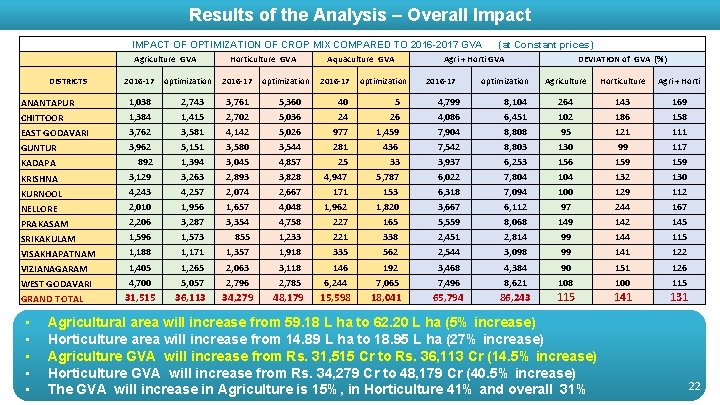
Results of the Analysis – Overall Impact IMPACT OF OPTIMIZATION OF CROP MIX COMPARED TO 2016 -2017 GVA (at Constant prices) Agriculture GVA DISTRICTS 2016 -17 optimization Horticulture GVA 2016 -17 optimization Aquaculture GVA 2016 -17 optimization Agri + Horti GVA 2016 -17 optimization DEVIATION of GVA (%) Agriculture Horticulture Agri + Horti ANANTAPUR 1, 038 2, 743 3, 761 5, 360 40 5 4, 799 8, 104 264 143 169 CHITTOOR 1, 384 1, 415 2, 702 5, 036 24 26 4, 086 6, 451 102 186 158 EAST GODAVARI 3, 762 3, 581 4, 142 5, 026 977 1, 459 7, 904 8, 808 95 121 111 GUNTUR 3, 962 5, 151 3, 580 3, 544 281 436 7, 542 8, 803 130 99 117 KADAPA 892 1, 394 3, 045 4, 857 25 33 3, 937 6, 253 156 159 KRISHNA 3, 129 3, 263 2, 893 3, 828 4, 947 5, 787 6, 022 7, 804 104 132 130 KURNOOL 4, 243 4, 257 2, 074 2, 667 171 153 6, 318 7, 094 100 129 112 NELLORE 2, 010 1, 956 1, 657 4, 048 1, 962 1, 820 3, 667 6, 112 97 244 167 PRAKASAM 2, 206 3, 287 3, 354 4, 758 227 165 5, 559 8, 068 149 142 145 SRIKAKULAM 1, 596 1, 573 855 1, 233 221 338 2, 451 2, 814 99 144 115 VISAKHAPATNAM 1, 188 1, 171 1, 357 1, 918 335 562 2, 544 3, 098 99 141 122 VIZIANAGARAM 1, 405 1, 265 2, 063 3, 118 146 192 3, 468 4, 384 90 151 126 WEST GODAVARI 4, 700 5, 057 2, 796 2, 785 6, 244 7, 065 7, 496 8, 621 108 100 115 GRAND TOTAL 31, 515 36, 113 34, 279 48, 179 15, 598 18, 041 65, 794 86, 243 115 141 131 • • • Agricultural area will increase from 59. 18 L ha to 62. 20 L ha (5% increase) Horticulture area will increase from 14. 89 L ha to 18. 95 L ha (27% increase) Agriculture GVA will increase from Rs. 31, 515 Cr to Rs. 36, 113 Cr (14. 5% increase) Horticulture GVA will increase from Rs. 34, 279 Cr to 48, 179 Cr (40. 5% increase) The GVA will increase in Agriculture is 15%, in Horticulture 41% and overall 31% 22
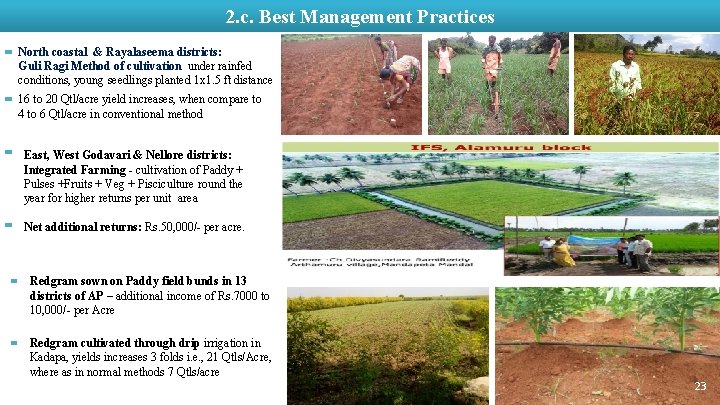
2. c. Best Management Practices North coastal & Rayalaseema districts: Guli Ragi Method of cultivation under rainfed conditions, young seedlings planted 1 x 1. 5 ft distance 16 to 20 Qtl/acre yield increases, when compare to 4 to 6 Qtl/acre in conventional method East, West Godavari & Nellore districts: Integrated Farming - cultivation of Paddy + Pulses +Fruits + Veg + Pisciculture round the year for higher returns per unit area Net additional returns: Rs. 50, 000/- per acre. Redgram sown on Paddy field bunds in 13 districts of AP – additional income of Rs. 7000 to 10, 000/- per Acre Redgram cultivated through drip irrigation in Kadapa, yields increases 3 folds i. e. , 21 Qtls/Acre, where as in normal methods 7 Qtls/acre 23 23
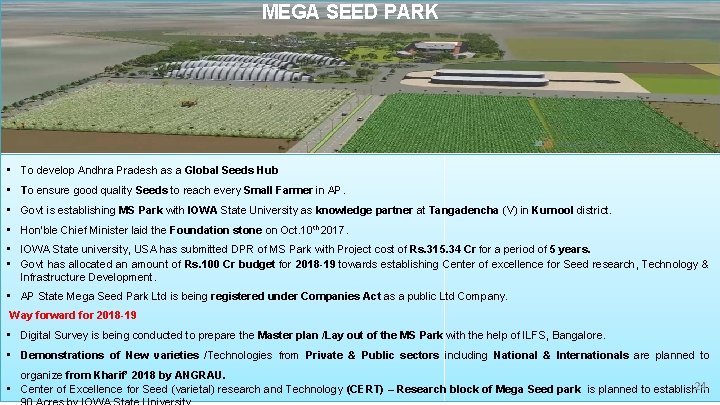
MEGA SEED PARK • To develop Andhra Pradesh as a Global Seeds Hub • To ensure good quality Seeds to reach every Small Farmer in AP. • Govt is establishing MS Park with IOWA State University as knowledge partner at Tangadencha (V) in Kurnool district. • Hon’ble Chief Minister laid the Foundation stone on Oct. 10 th 2017. • IOWA State university, USA has submitted DPR of MS Park with Project cost of Rs. 315. 34 Cr for a period of 5 years. • Govt has allocated an amount of Rs. 100 Cr budget for 2018 -19 towards establishing Center of excellence for Seed research, Technology & Infrastructure Development. • AP State Mega Seed Park Ltd is being registered under Companies Act as a public Ltd Company. Way forward for 2018 -19 • Digital Survey is being conducted to prepare the Master plan /Lay out of the MS Park with the help of ILFS, Bangalore. • Demonstrations of New varieties /Technologies from Private & Public sectors including National & Internationals are planned to organize from Kharif’ 2018 by ANGRAU. 24 • Center of Excellence for Seed (varietal) research and Technology (CERT) – Research block of Mega Seed park is planned to establish in
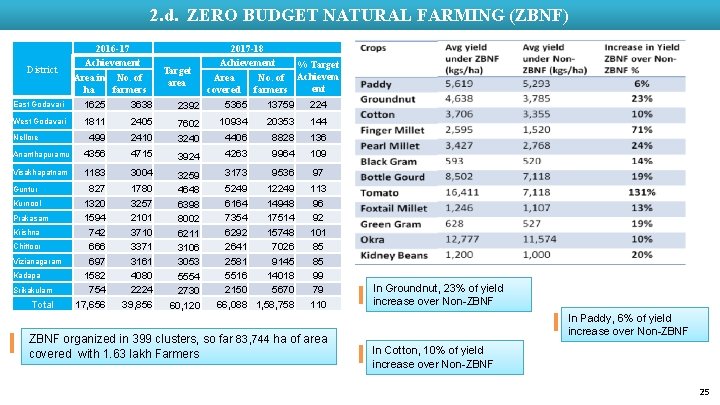
2. d. ZERO BUDGET NATURAL FARMING (ZBNF) District 2016 -17 Achievement Area in No. of ha farmers Target area 2017 -18 Achievement Area covered % Target Achievem No. of ent farmers East Godavari 1625 3638 2392 5365 13759 224 West Godavari 1811 2405 10934 20353 144 499 2410 7602 3240 4406 8828 136 Ananthapuramu 4356 4715 3924 4263 9964 109 Visakhapatnam 1183 3004 3173 9536 97 827 1320 1594 742 666 697 1582 754 17, 656 1780 3257 2101 3710 3371 3161 4080 2224 39, 856 3259 4648 6398 8002 6211 3106 3053 5554 2730 60, 120 5249 12249 6164 14948 7354 17514 6292 15748 2641 7026 2581 9145 5516 14018 2150 5670 66, 088 1, 58, 758 113 96 92 101 85 85 99 79 110 Nellore Guntur Kurnool Prakasam Krishna Chittoor Vizianagaram Kadapa Srikakulam Total ZBNF organized in 399 clusters, so far 83, 744 ha of area covered with 1. 63 lakh Farmers In Groundnut, 23% of yield increase over Non-ZBNF In Paddy, 6% of yield increase over Non-ZBNF In Cotton, 10% of yield increase over Non-ZBNF 25
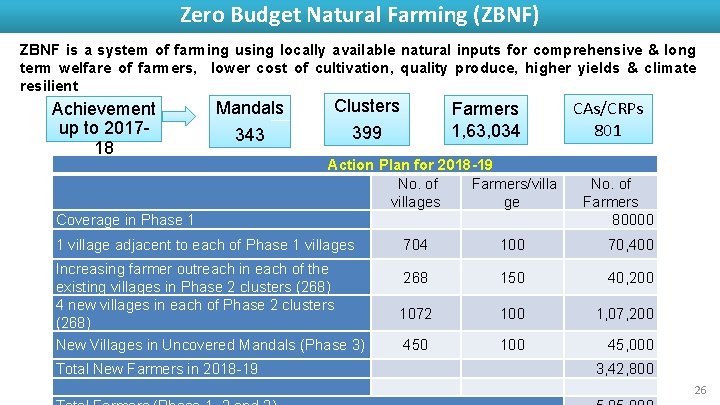
Zero Budget Natural Farming (ZBNF) ZBNF is a system of farming using locally available natural inputs for comprehensive & long term welfare of farmers, lower cost of cultivation, quality produce, higher yields & climate resilient Achievement up to 201718 Mandals Clusters 343 399 CAs/CRPs 801 Farmers 1, 63, 034 Action Plan for 2018 -19 No. of Farmers/villages ge No. of Farmers 80000 Coverage in Phase 1 1 village adjacent to each of Phase 1 villages Increasing farmer outreach in each of the existing villages in Phase 2 clusters (268) 4 new villages in each of Phase 2 clusters (268) New Villages in Uncovered Mandals (Phase 3) Total New Farmers in 2018 -19 704 100 70, 400 268 150 40, 200 1072 100 1, 07, 200 450 100 45, 000 3, 42, 800 26
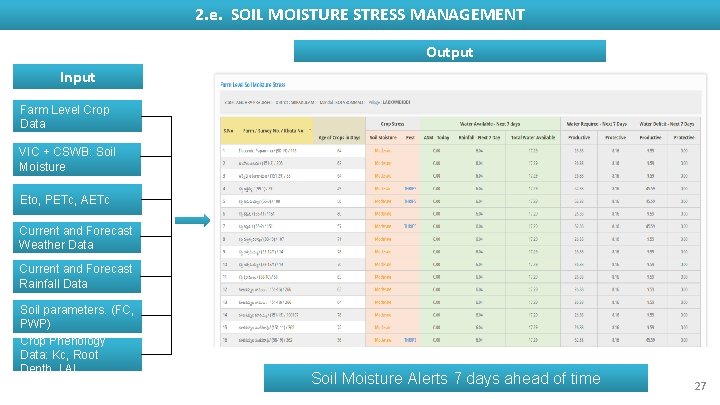
2. e. SOIL MOISTURE STRESS MANAGEMENT Output Input Farm Level Crop Data VIC + CSWB: Soil Moisture Eto, PETc, AETc Current and Forecast Weather Data Current and Forecast Rainfall Data Soil parameters. (FC, PWP) Crop Phenology Data: Kc, Root Depth, LAI Soil Moisture Alerts 7 days ahead of time 27
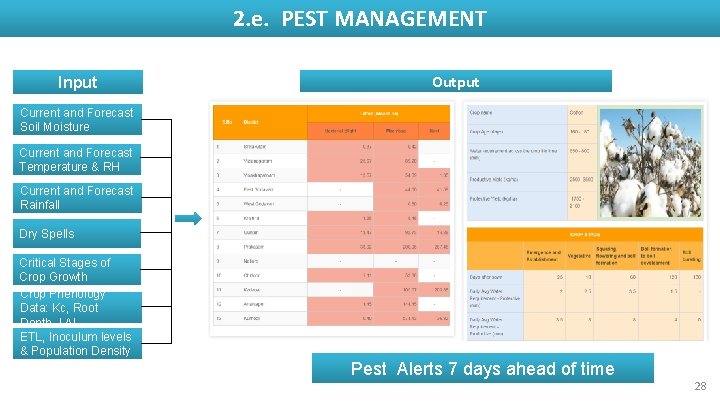
2. e. PEST MANAGEMENT Input Output Current and Forecast Soil Moisture Current and Forecast Temperature & RH Current and Forecast Rainfall Dry Spells Critical Stages of Crop Growth Crop Phenology Data: Kc, Root Depth, LAI ETL, Inoculum levels & Population Density Pest Alerts 7 days ahead of time 28
3. IOT in Agriculture 29
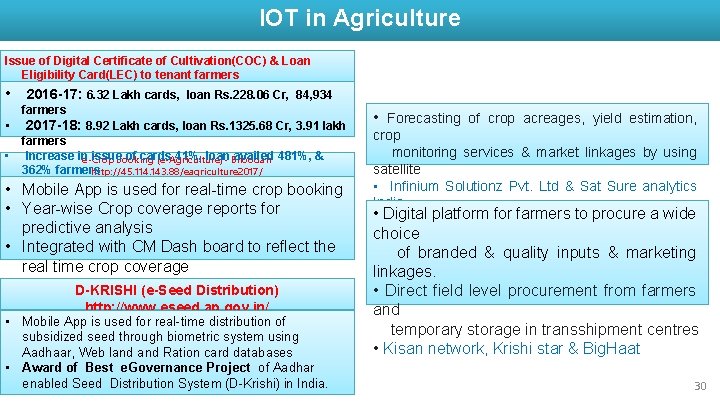
IOT in Agriculture Issue of Digital Certificate of Cultivation(COC) & Loan Eligibility Card(LEC) to tenant farmers • 2016 -17: 6. 32 Lakh cards, loan Rs. 228. 06 Cr, 84, 934 farmers • 2017 -18: 8. 92 Lakh cards, loan Rs. 1325. 68 Cr, 3. 91 lakh • farmers Increase in issue of cards 41%, loan availed 481%, & e-Crop Booking (e-Agriculture)- Bhoodan 362% farmers http: //45. 114. 143. 88/eagriculture 2017/ • Mobile App is used for real-time crop booking • Year-wise Crop coverage reports for predictive analysis • Integrated with CM Dash board to reflect the real time crop coverage D-KRISHI (e-Seed Distribution) http: //www. eseed. ap. gov. in/ • Mobile App is used for real-time distribution of subsidized seed through biometric system using Aadhaar, Web land Ration card databases • Award of Best e. Governance Project of Aadhar enabled Seed Distribution System (D-Krishi) in India. • Forecasting of crop acreages, yield estimation, crop monitoring services & market linkages by using satellite • Infinium Solutionz Pvt. Ltd & Sat Sure analytics India • Digital platform for farmers to procure a wide choice of branded & quality inputs & marketing linkages. • Direct field level procurement from farmers and temporary storage in transshipment centres • Kisan network, Krishi star & Big. Haat 30
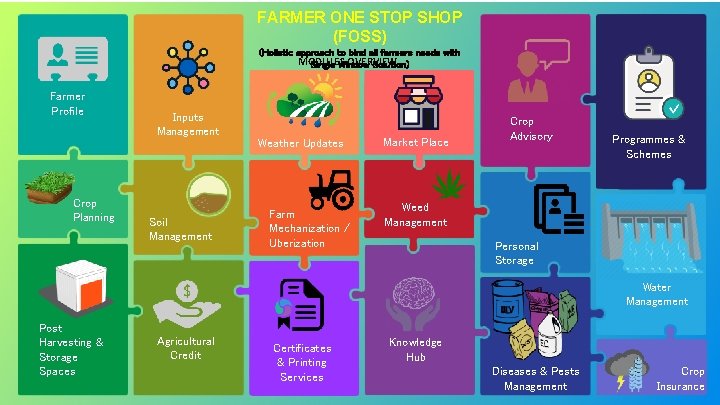
FARMER ONE STOP SHOP (FOSS) (Holistic approach to bind all farmers needs with MODULES OVERVIEW Single Window Solution) Farmer Profile Crop Planning Inputs Management Soil Management Weather Updates Farm Mechanization / Uberization Market Place Crop Advisory Programmes & Schemes Weed Management Personal Storage Water Management Post Harvesting & Storage Spaces Agricultural Credit Certificates & Printing Services Knowledge Hub Diseases & Pests Management Crop Insurance
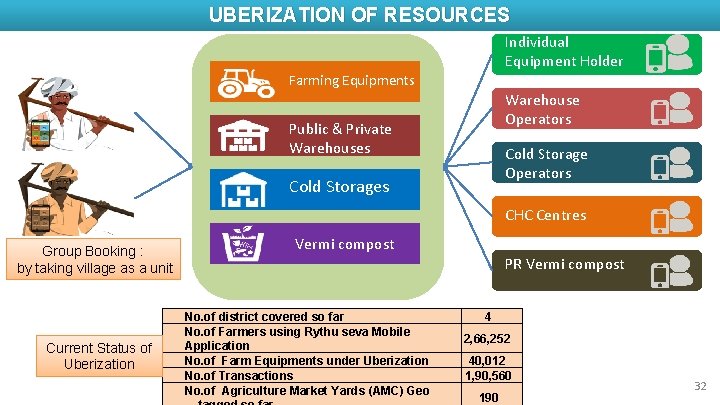
UBERIZATION OF RESOURCES Individual Equipment Holder Farming Equipments Warehouse Operators Public & Private Warehouses Cold Storage Operators Cold Storages CHC Centres Group Booking : by taking village as a unit Current Status of Uberization Vermi compost No. of district covered so far No. of Farmers using Rythu seva Mobile Application No. of Farm Equipments under Uberization No. of Transactions No. of Agriculture Market Yards (AMC) Geo PR Vermi compost 4 2, 66, 252 40, 012 1, 90, 560 190 32
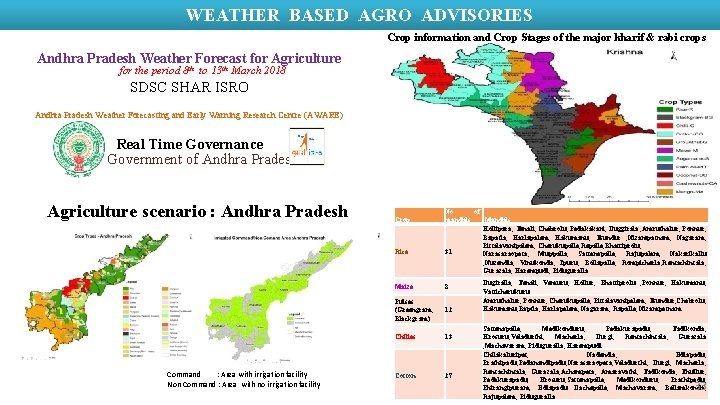
WEATHER BASED AGRO ADVISORIES Crop information and Crop Stages of the major kharif & rabi crops Andhra Pradesh Weather Forecast for Agriculture for the period 8 th to 13 th March 2018 SDSC SHAR ISRO Andhra Pradesh Weather Forecasting and Early Warning Research Centre (AWARE) Real Time Governance Government of Andhra Pradesh Agriculture scenario : Andhra Pradesh Crop Rice Command : Area with irrigation facility Non Command : Area with no irrigation facility No of mandals Mandals Kollipara, Tenali, Chebrolu, Pedakakani, Duggirala , Amruthalur, Ponnur, Bapatla, Karlapalem, Kakumanu, Tsundur , Nizampatnam, Nagaram, Pittalavanipalem, Cherukupalle, Repalle, Bhattiprolu, 31 Narasaraopeta, Muppalla, Sattenapalle, Rajupalem, Nakarikallu , Nuzendla, Vinukonda, Ipuru, Bollapalle, Rompicherla, Rentachintala, Gurazala, Karempudi, Piduguralla Maize 8 Pulses (Greengram, Blackgram) 12 Chilies 13 Cotton 27 Dugiralla, Tenali, Vemuru, Kollur, Bhattiprolu , Ponnur, Kakumanu, Vatticherukuru Amruthalur, Ponnur, Cherukupalle, Pittalavanipalem, Tsundur, Chebrolu, Kakumanu, Baptla, Karlapalem, Nagaram, Rapalle, Nizampatnam Sattenapalle, Medikonduru, Pedakurapadu, Tadikonda, Krosuru, Veladurthi, Macherla, Durgi, Rentachintala, Gurazala , Machavaram, Piduguralla, Karempudi Chilakaluripet, Nadendla, Edlapadu, Prathipadu, Pedanandipadu, Narasaraopeta, Veladurthi, Durgi, Macherla, Rentachintala, Gurazala, Achampeta, Amaravathi, Tadikonda, Thullur, Pedakurapadu, Krosuru, Sattenapalle, Medikonduru, Prathipadu, Phirangipuram, Edlapadu Dachepalle, Machavaram, Bellamkonda, Rajupalem, Piduguralla 33
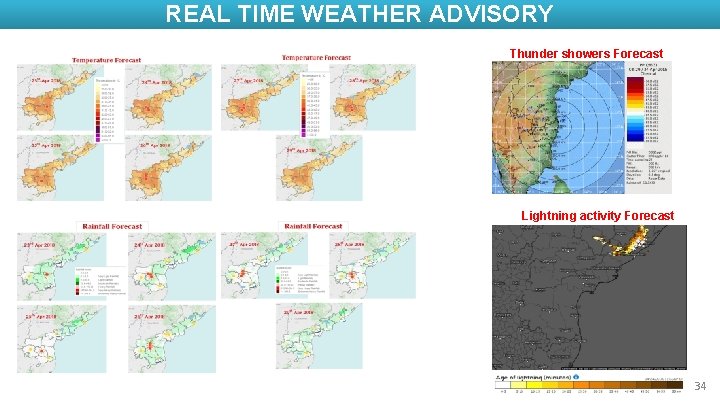
REAL TIME WEATHER ADVISORY Thunder showers Forecast Lightning activity Forecast 34
“We need a new vision for Agriculture …to spread happiness among farm & rural families. Bio happiness through the conversion of our bio resources into wealth meaningful to our rural families should be the goal of our national policy for farmers” Dr. M. S. Swaminadhan Agriculture not by chance… …but by Business 35
THANK YOU