
DEPARTMENT AGRICULTURE Integrated Food Security and Nutrition Programme
- Slides: 16
DEPARTMENT: AGRICULTURE Integrated Food Security and Nutrition Programme for South Africa PRESENTATION ON FOOD SECURITY PORTFOLIO COMMITTEE ON AGRICULTURE AND LAND AFFAIRS 08 FEBRUARY 2005
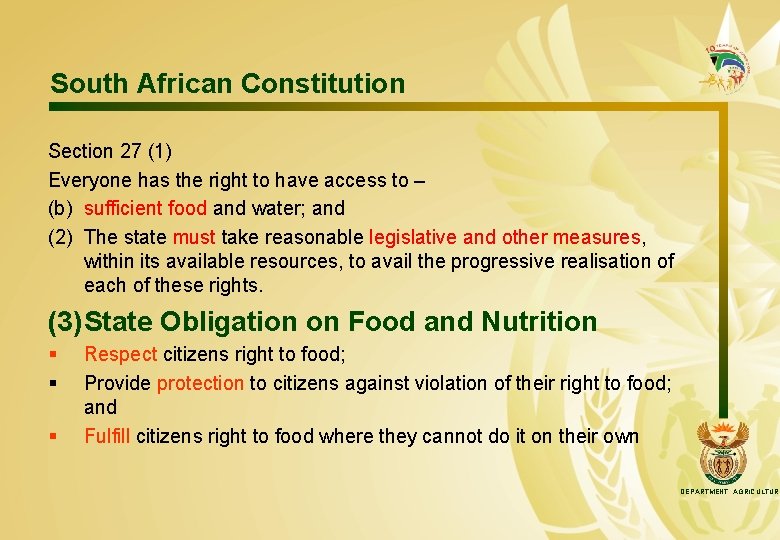
South African Constitution Section 27 (1) Everyone has the right to have access to – (b) sufficient food and water; and (2) The state must take reasonable legislative and other measures, within its available resources, to avail the progressive realisation of each of these rights. (3) State Obligation on Food and Nutrition § § § Respect citizens right to food; Provide protection to citizens against violation of their right to food; and Fulfill citizens right to food where they cannot do it on their own DEPARTMENT: AGRICULTURE
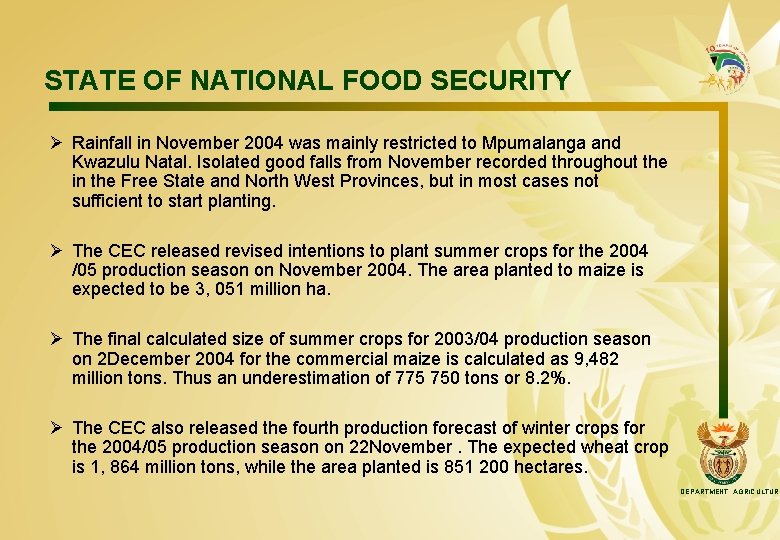
STATE OF NATIONAL FOOD SECURITY Ø Rainfall in November 2004 was mainly restricted to Mpumalanga and Kwazulu Natal. Isolated good falls from November recorded throughout the in the Free State and North West Provinces, but in most cases not sufficient to start planting. Ø The CEC released revised intentions to plant summer crops for the 2004 /05 production season on November 2004. The area planted to maize is expected to be 3, 051 million ha. Ø The final calculated size of summer crops for 2003/04 production season on 2 December 2004 for the commercial maize is calculated as 9, 482 million tons. Thus an underestimation of 775 750 tons or 8. 2%. Ø The CEC also released the fourth production forecast of winter crops for the 2004/05 production season on 22 November. The expected wheat crop is 1, 864 million tons, while the area planted is 851 200 hectares. DEPARTMENT: AGRICULTURE
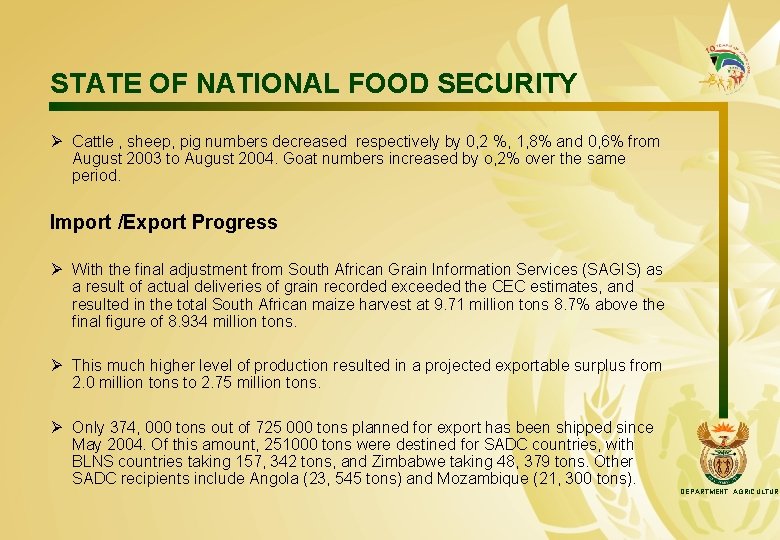
STATE OF NATIONAL FOOD SECURITY Ø Cattle , sheep, pig numbers decreased respectively by 0, 2 %, 1, 8% and 0, 6% from August 2003 to August 2004. Goat numbers increased by o, 2% over the same period. Import /Export Progress Ø With the final adjustment from South African Grain Information Services (SAGIS) as a result of actual deliveries of grain recorded exceeded the CEC estimates, and resulted in the total South African maize harvest at 9. 71 million tons 8. 7% above the final figure of 8. 934 million tons. Ø This much higher level of production resulted in a projected exportable surplus from 2. 0 million tons to 2. 75 million tons. Ø Only 374, 000 tons out of 725 000 tons planned for export has been shipped since May 2004. Of this amount, 251000 tons were destined for SADC countries, with BLNS countries taking 157, 342 tons, and Zimbabwe taking 48, 379 tons. Other SADC recipients include Angola (23, 545 tons) and Mozambique (21, 300 tons). DEPARTMENT: AGRICULTURE
IMPORT/EXPORT PROGRESS Cont. Ø Planned exports represent 26% of the total exportable surplus, while total exported so far is just 14%. With the slow progress on export rates South Africa faces a large carry over stock, which may influence farmers to reduce planted area in the 2004/ 05, and may continue to keep farm gate prices of maize low. Ø It is expected for wheat the South African gross wheat production will amount to 1, 759 million tons ( including the estimated 7000 tons from developing agriculture) Total requirements are estimated at 2, 741 million tons. With import arrangements in place the total closing stocks at the end of September 2005 are estimated at 651 000 tons slightly above the desired stocks of 591 000 tons. DEPARTMENT: AGRICULTURE
IMPORT/EXPORT PROGRESS Ø The domestic demand for rice at the end of 2004/2005 season is projected at 762 000 tons. It is expected that 8000 tons will be imported. Ø South Africa receives no food aid. DEPARTMENT: AGRICULTURE
HOUSEHOLD FOOD INSECURITY & VULNERABILITY The extent of food insecurity: Ø 1. 5 million children experience under nutrition Ø 14 -15 million people suffer from food insecurity ØMalnutrition over time is worsening ØAt national level a quarter and a third of households are unable to purchase food for dietary requirements of children and elderly and the sick. ØGreater percent of households in rural areas experiencing hunger relative to urban areas. DEPARTMENT: AGRICULTURE
HOUSEHOLD FOOD INSECURITY & VULNERABILITY Some determinants – feeding into the hypotheses underpinning the measurement of food insecurity: ØHouseholds main income from wages &salaries(57%) followed by social grants(14%), remittances(10%) and others including informal sector, natural resources, agriculture etc(19%) ØAgriculture income contributes less than 4% total income for poorest quintiles – even for poorest households agriculture income is minimal ØGreater reliance on purchased food & not own produced food – exposing households to adverse effects of price fluctuations. ØThe rate of growth of the macro –economy is therefore the most important determinant of income and food security (with increasing pressure on social grants DEPARTMENT: AGRICULTURE
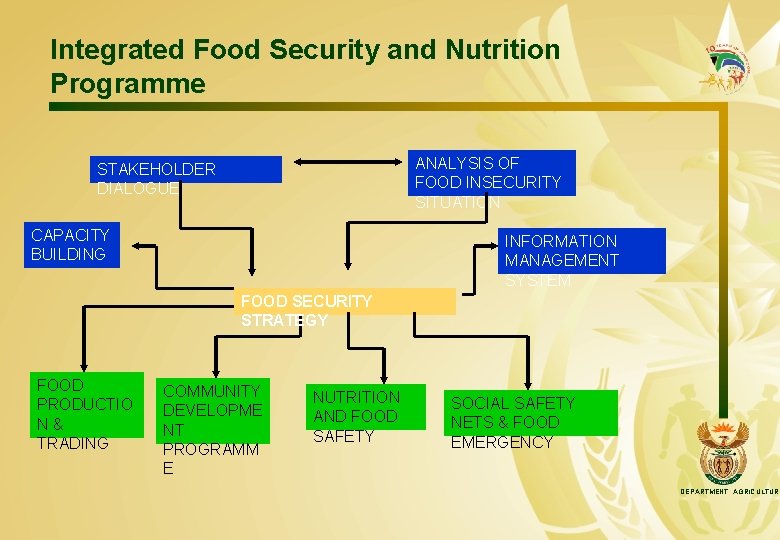
Integrated Food Security and Nutrition Programme ANALYSIS OF FOOD INSECURITY SITUATION STAKEHOLDER DIALOGUE CAPACITY BUILDING INFORMATION MANAGEMENT SYSTEM FOOD SECURITY STRATEGY FOOD PRODUCTIO N& TRADING COMMUNITY DEVELOPME NT PROGRAMM E NUTRITION AND FOOD SAFETY SOCIAL SAFETY NETS & FOOD EMERGENCY DEPARTMENT: AGRICULTURE
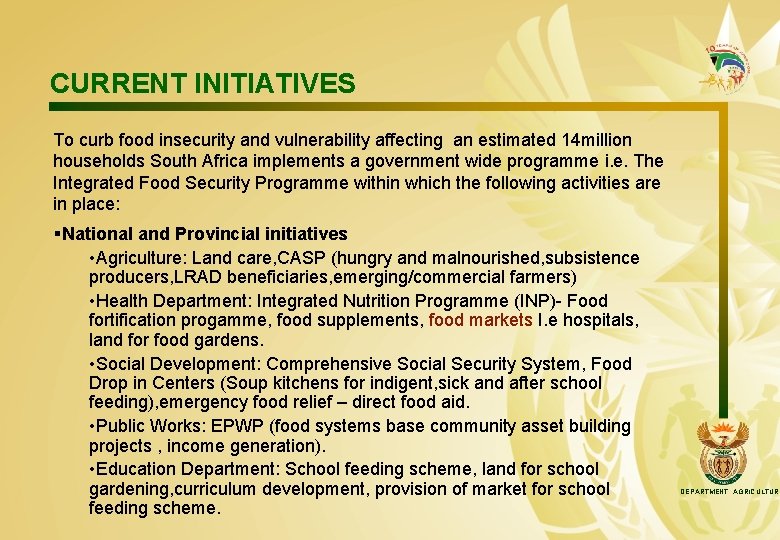
CURRENT INITIATIVES To curb food insecurity and vulnerability affecting an estimated 14 million households South Africa implements a government wide programme i. e. The Integrated Food Security Programme within which the following activities are in place: §National and Provincial initiatives • Agriculture: Land care, CASP (hungry and malnourished, subsistence producers, LRAD beneficiaries, emerging/commercial farmers) • Health Department: Integrated Nutrition Programme (INP)- Food fortification progamme, food supplements, food markets I. e hospitals, land for food gardens. • Social Development: Comprehensive Social Security System, Food Drop in Centers (Soup kitchens for indigent, sick and after school feeding), emergency food relief – direct food aid. • Public Works: EPWP (food systems base community asset building projects , income generation). • Education Department: School feeding scheme, land for school gardening, curriculum development, provision of market for school feeding scheme. DEPARTMENT: AGRICULTURE
CURRENT INITIATIVES Cont. §Provincial Campaigns Various forms of Agricultural Starter Packs Programmes: • Xoshindlala in KZN? • Letsema/Kgora in North West? • Siyazondla in EC DEPARTMENT: AGRICULTURE
Achievements to Date: ØSpecial fund allocation to DSD to distribute food parcels to 245 000 households since 2003/04 financial year. Ø Food fortification programmed launched by Do. H in 2003 ØDistribution of food production starter –packs to 59 000 households the past two years. ØThe release and adoption of recommendations of the Food Price Monitoring Committee. Ø The transfer of school feeding scheme from Do. H to Do. E ØThe allocation of R 200 m to WFP for SADC food emergency operations in the six severely affected countries. DEPARTMENT: AGRICULTURE Ø Launch of the pilot FIVIMS project in Ga-Sekhukhuni District
ISSUES OF FOCUS FOR 2005/06 Ø Establishment and roll-out of an effective Food Insecurity and Vulnerability Information Monitoring System to be rolled out to 10 District Municipalities in 2005. Ø The adoption of a right based approach to food security as reflected in the SA Constitution, following the adoption by UN-FAO Council the Voluntary Guidelines on the Right of Access to Food within the context of National Food Security. Ø Fostering effective partnerships with various stakeholders for effective delivery through municipality IDPs Ø Effective planning and implementation of EPWP to strengthen the development of local food supply and distribution systems. Ø Continued SADC-RISDP Support. RSA donated through the WFP US$16 m. of 70% was targeted for production support in the six countries affected by food emegencies, 20% allocated for direct food aid and 10% aimed at strengthening Regional Food Insecurity and Vulnerability Information Systems capability DEPARTMENT: AGRICULTURE
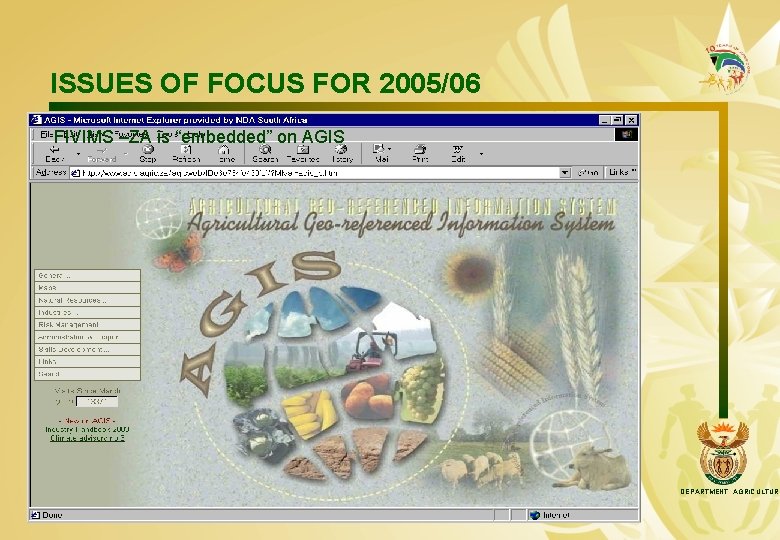
ISSUES OF FOCUS FOR 2005/06 FIVIMS –ZA is “embedded” on AGIS DEPARTMENT: AGRICULTURE
FIVIMS-ZA will consist of: ØA database produced through the FIVIMS-za survey that strengthens AGIS by; -feeding into AGIS to complement existing data and to provide lower resolution information (that at municipal and provincial level) Ø Survey analysis provided through reports, tables, graphs and maps. Ø Ongoing monitoring through future FIVIMS surveys and other “refreshed” data( Stats SA ; municipal level sources). Ø Food insecurity and vulnerability models that interprets and explain livelihoods DEPARTMENT: AGRICULTURE
ØFIVIMS-ZA will consist of: ØReporting capability through trained personnel who understand vulnerability and food insecurity. ØDissemination strategy to ensure outputs reach policy makers, programmers, technicians and councilors at various levels(esp. local) ØDissemination strategy that ensure information flow from local level into system – to enhance data and to confirm analysis. ØA repository of relevant papers and analyses (to further enable the interpretation of data) DEPARTMENT: AGRICULTURE