
Dentin forms the main bulk of the tooth

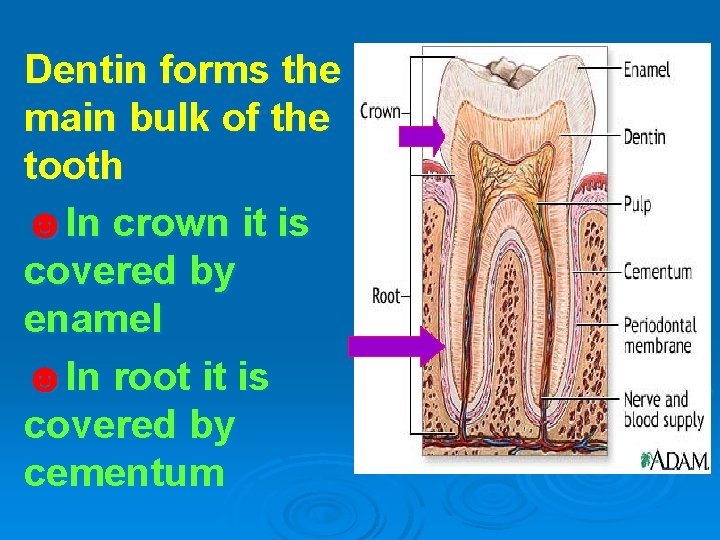
Dentin forms the main bulk of the tooth ☻In crown it is covered by enamel ☻In root it is covered by cementum
Physical Characteristics Ø Yellowish in color. Ø Elastic. Ø Hard ( less than enamel but more than cementum and bone). Ø By X-ray : more radiolucent than enamel and more radio-opaque than cementum. Ø Thickness varies from 3 -10 mm.
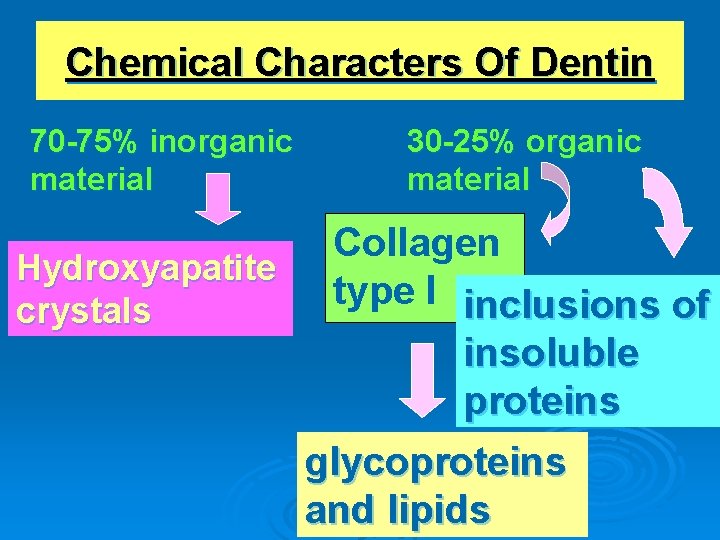
Chemical Characters Of Dentin 70 -75% inorganic material Hydroxyapatite crystals 30 -25% organic material Collagen type I inclusions of insoluble proteins glycoproteins and lipids
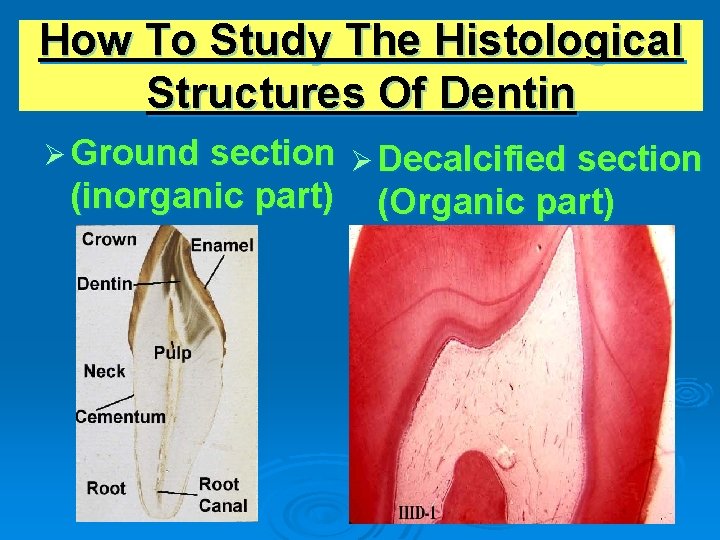
How To Study The Histological Structures Of Dentin Ø Ground section Ø Decalcified section (inorganic part) (Organic part)
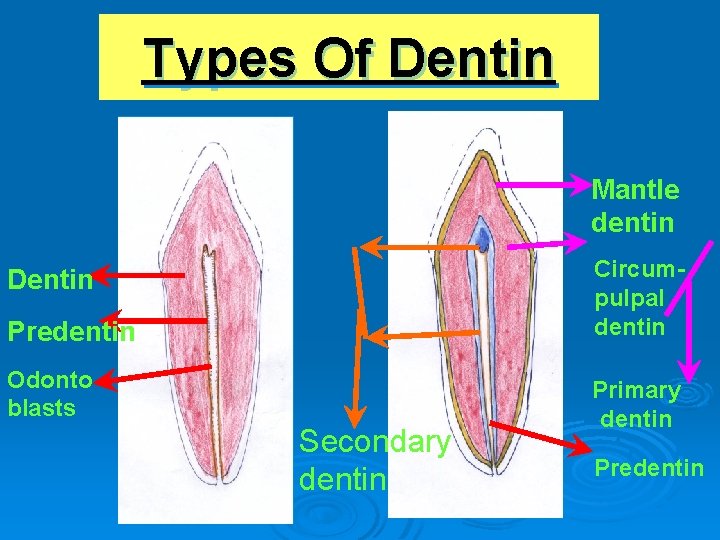
Types Of Dentin Mantle dentin Predentin Circumpulpal dentin Odonto blasts Primary dentin Dentin Secondary dentin Predentin
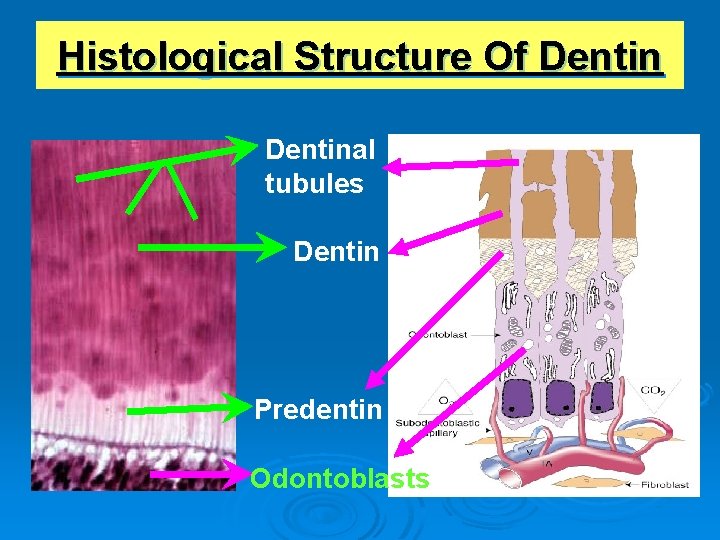
Histological Structure Of Dentinal tubules Dentin Predentin Odontoblasts
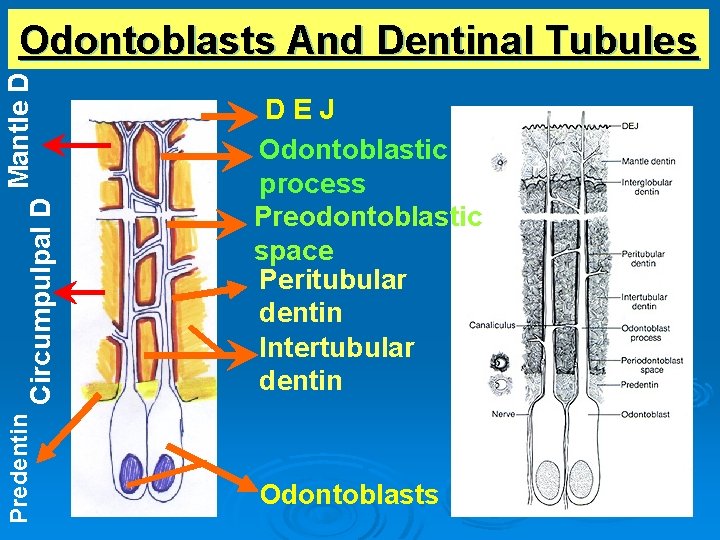
Predentin Circumpulpal D Mantle D Odontoblasts And Dentinal Tubules DEJ Odontoblastic process Preodontoblastic space Peritubular dentin Intertubular dentin Odontoblasts
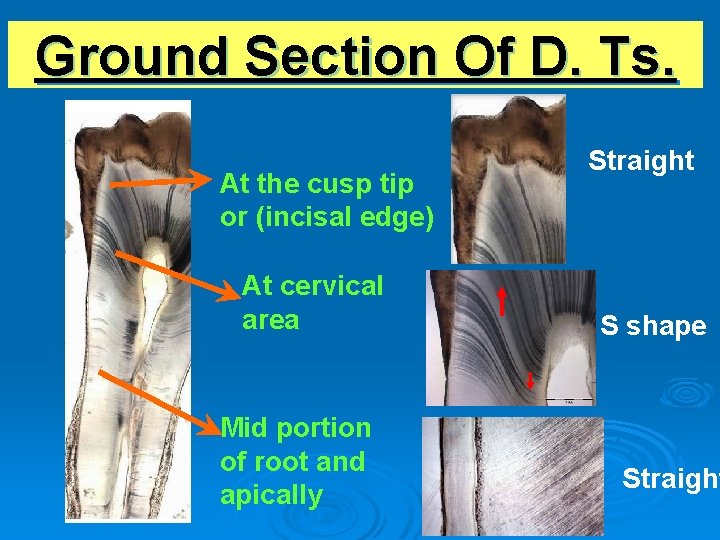
Ground Section Of D. Ts. At the cusp tip or (incisal edge) At cervical area Mid portion of root and apically Straight S shape Straight
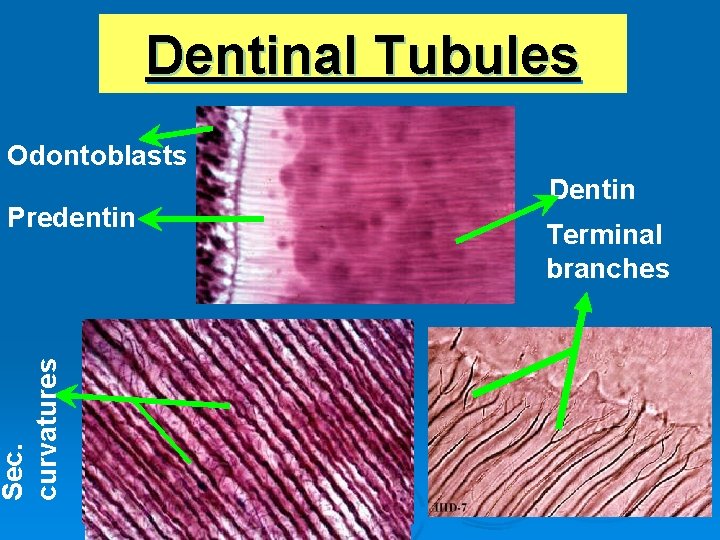
Dentinal Tubules Odontoblasts Sec. curvatures Predentin Dentin Terminal branches
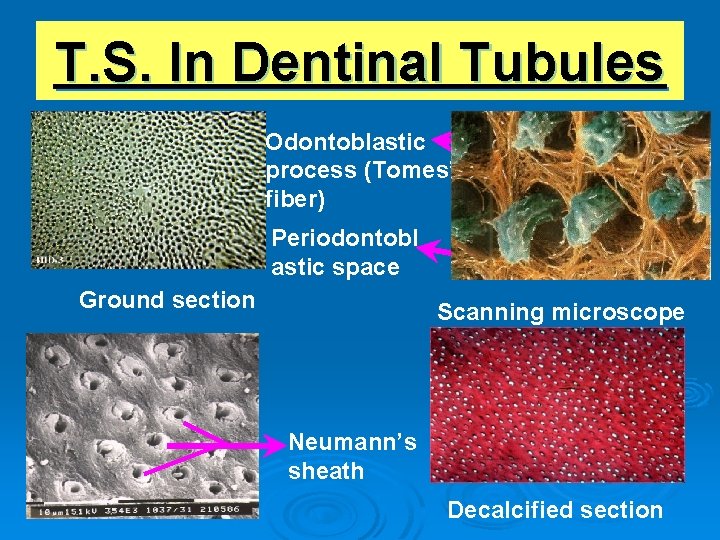
T. S. In Dentinal Tubules Odontoblastic process (Tomes’ fiber) Periodontobl astic space Ground section Scanning microscope Neumann’s sheath Decalcified section
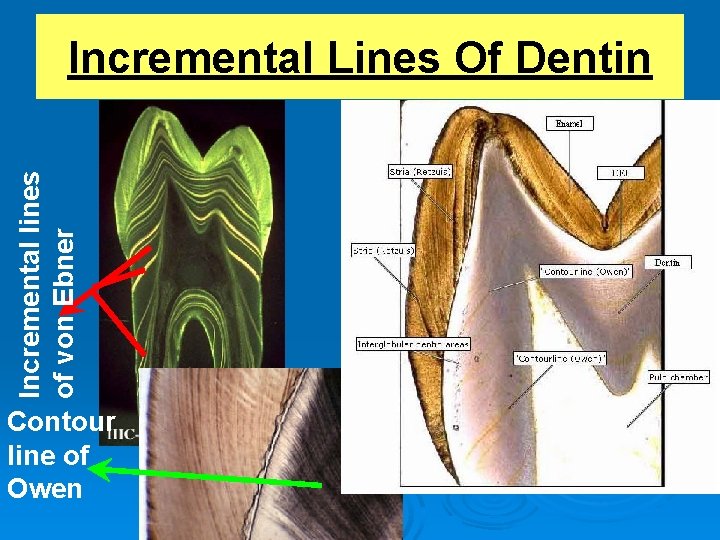
Incremental lines of von Ebner Incremental Lines Of Dentin Contour line of Owen
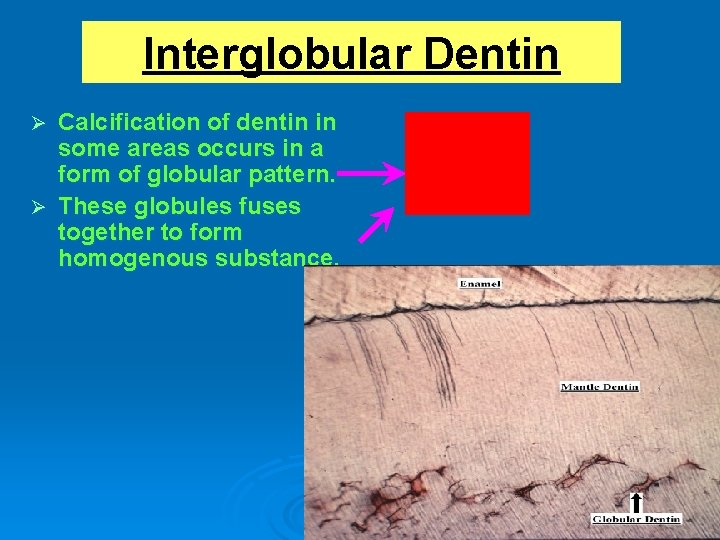
Interglobular Dentin Calcification of dentin in some areas occurs in a form of globular pattern. Ø These globules fuses together to form homogenous substance. Ø
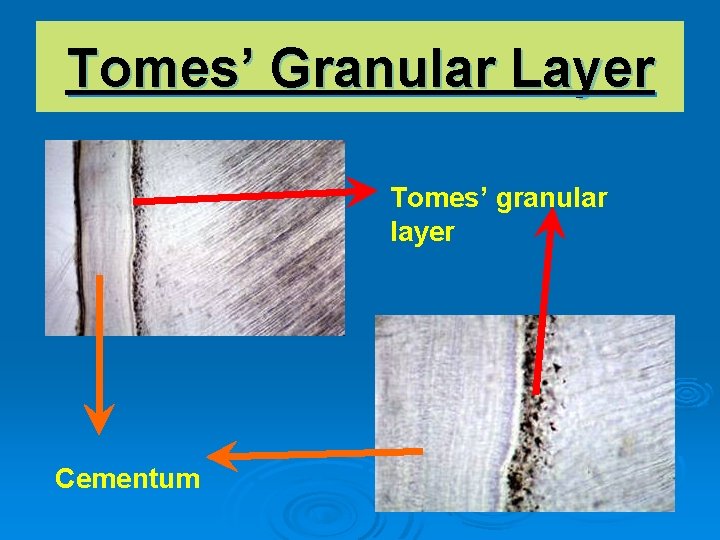
Tomes’ Granular Layer Tomes’ granular layer Cementum

Interglobular dentin Ø (Size) Large (Cause) Areas of unmineralized or hypomineralized dentin (sometimes present). Ø (Site) Appear in the crown just below mantle dentin. Ø (IL) Follow incremental line pattern Ø In badly formed tooth it appears in the root dentin Ø Ø Tomes’ granular layer (Size) Small granular in appearance Ø (Cause) it results from the looping of the terminal portions of DT which is a result different orientation of odontoblastic process (always present). Ø (Site) Appear in the root adjacent to the cementum. Ø (IL) Does not follow any incremental pattern.
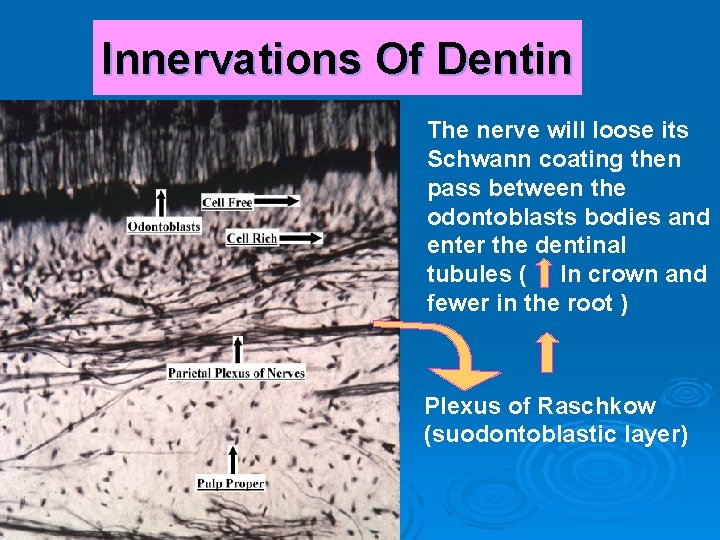
Innervations Of Dentin The nerve will loose its Schwann coating then pass between the odontoblasts bodies and enter the dentinal tubules ( In crown and fewer in the root ) Plexus of Raschkow (suodontoblastic layer)
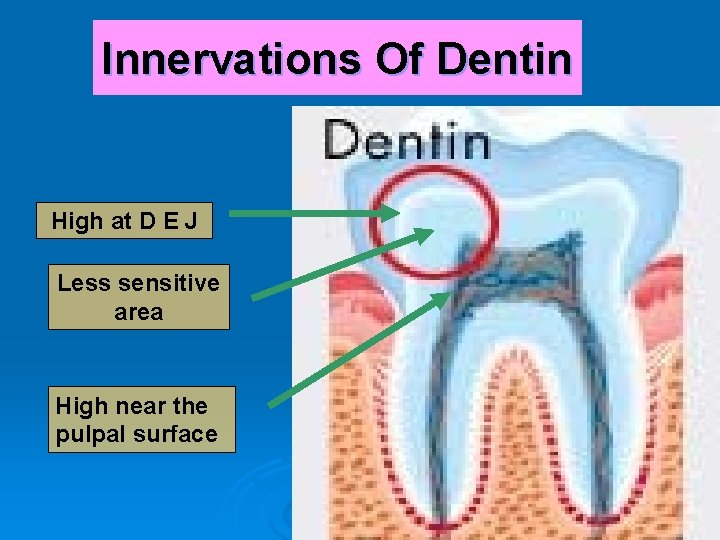
Innervations Of Dentin High at D E J Less sensitive area High near the pulpal surface
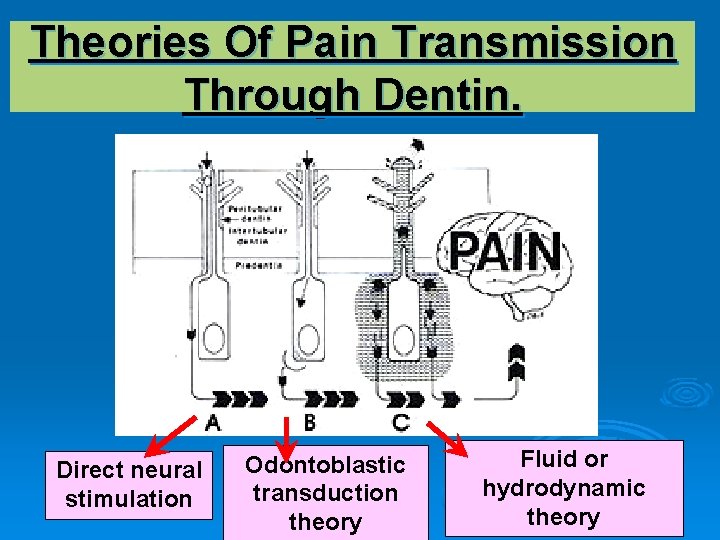
Theories Of Pain Transmission Through Dentin. Direct neural stimulation Odontoblastic transduction theory Fluid or hydrodynamic theory
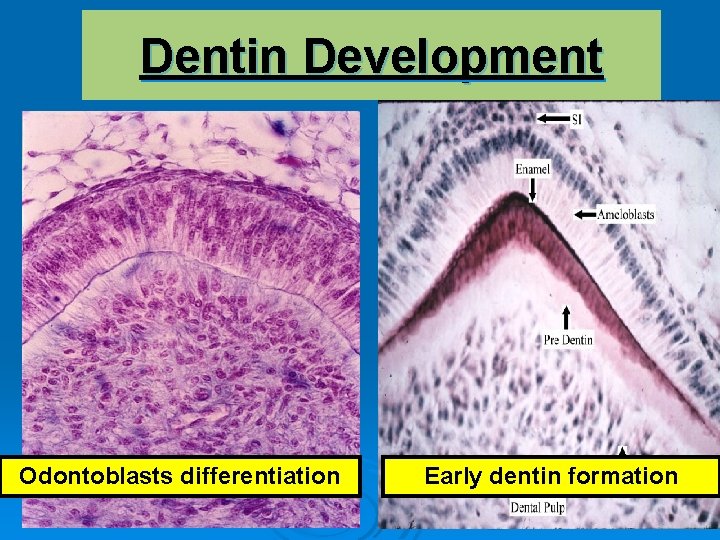
Dentin Development Odontoblasts differentiation Early dentin formation
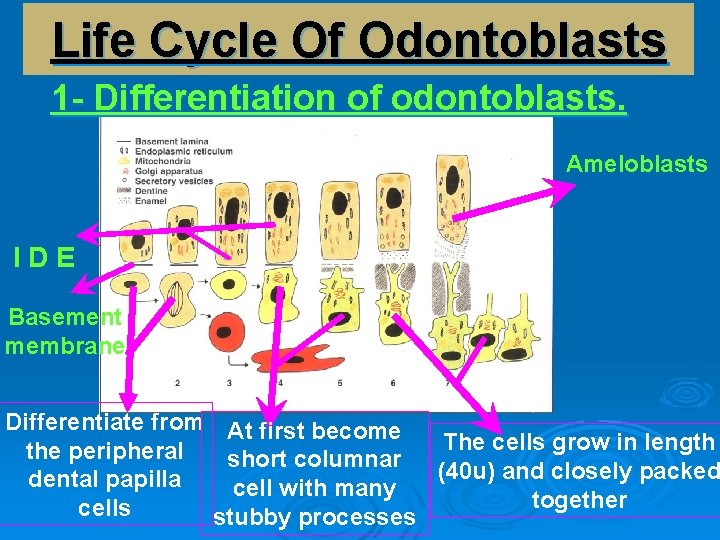
Life Cycle Of Odontoblasts 1 - Differentiation of odontoblasts. Ameloblasts IDE Basement membrane Differentiate from At first become The cells grow in length the peripheral short columnar (40 u) and closely packed dental papilla cell with many together cells stubby processes
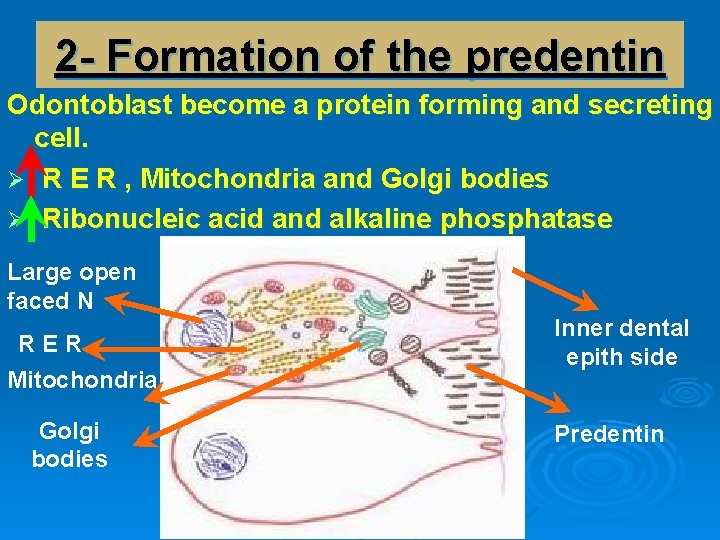
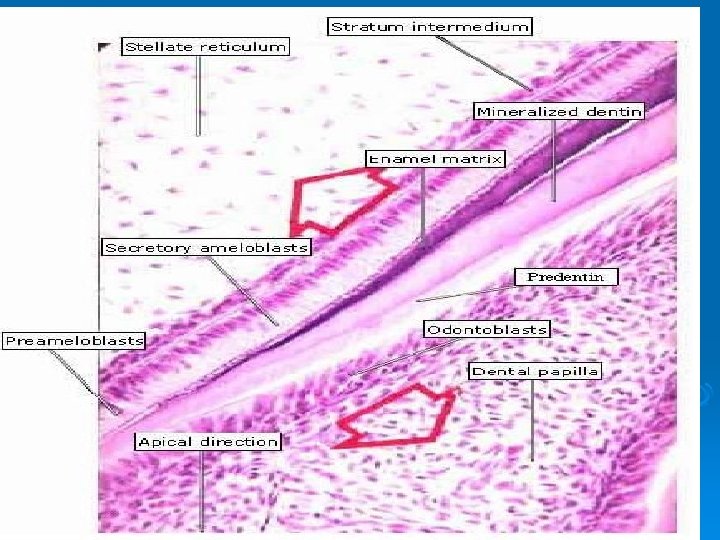
2 - Formation of the predentin Odontoblast become a protein forming and secreting cell. Ø R E R , Mitochondria and Golgi bodies Ø Ribonucleic acid and alkaline phosphatase Large open faced N RER Mitochondria Golgi bodies Inner dental epith side Predentin
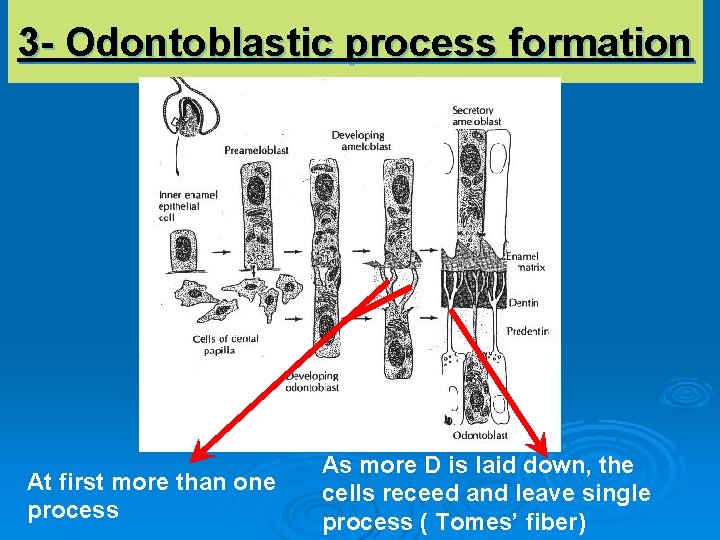
3 - Odontoblastic process formation At first more than one process As more D is laid down, the cells receed and leave single process ( Tomes’ fiber)
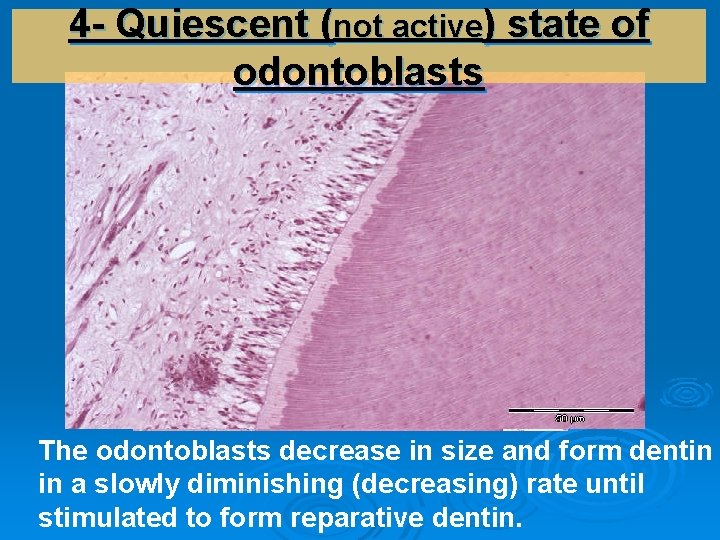
4 - Quiescent (not active) state of odontoblasts The odontoblasts decrease in size and form dentin in a slowly diminishing (decreasing) rate until stimulated to form reparative dentin.
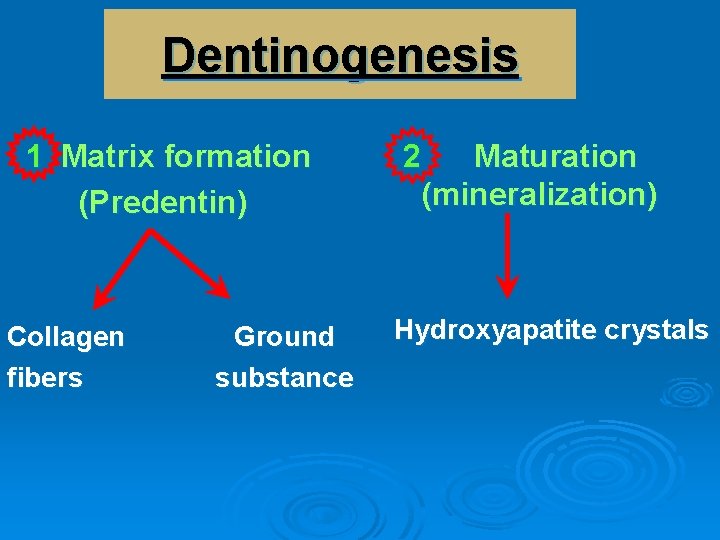
Dentinogenesis 1 Matrix formation (Predentin) Collagen fibers Ground substance 2 Maturation (mineralization) Hydroxyapatite crystals
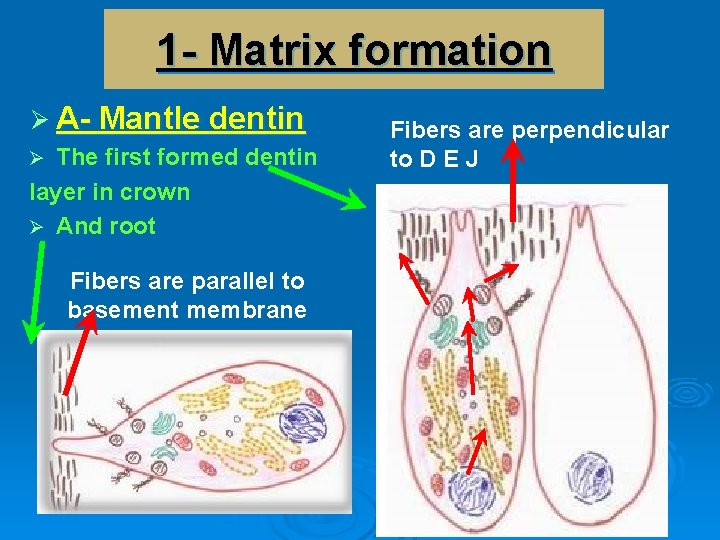
1 - Matrix formation Ø A- Mantle dentin The first formed dentin layer in crown Ø And root Ø Fibers are parallel to basement membrane Fibers are perpendicular to D E J
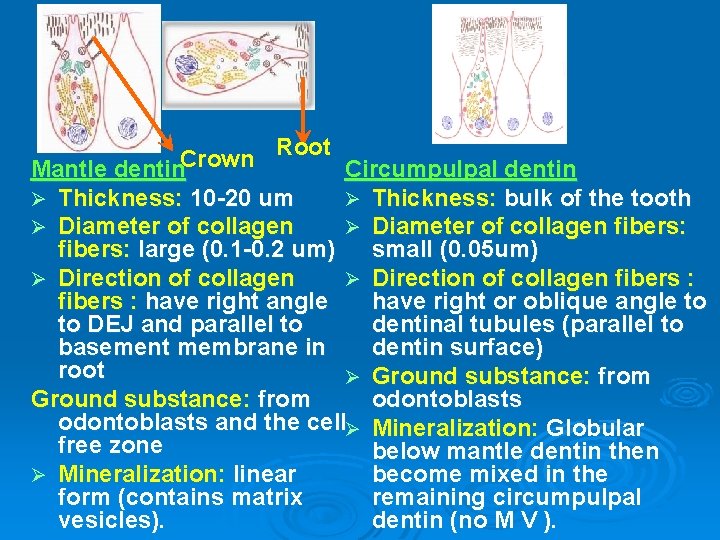
Root Crown Mantle dentin Circumpulpal dentin Ø Thickness: 10 -20 um Ø Thickness: bulk of the tooth Ø Diameter of collagen fibers: large (0. 1 -0. 2 um) small (0. 05 um) Ø Direction of collagen fibers : have right angle have right or oblique angle to to DEJ and parallel to dentinal tubules (parallel to basement membrane in dentin surface) root Ø Ground substance: from odontoblasts and the cellØ Mineralization: Globular free zone below mantle dentin then become mixed in the Ø Mineralization: linear remaining circumpulpal form (contains matrix dentin (no M V ). vesicles).
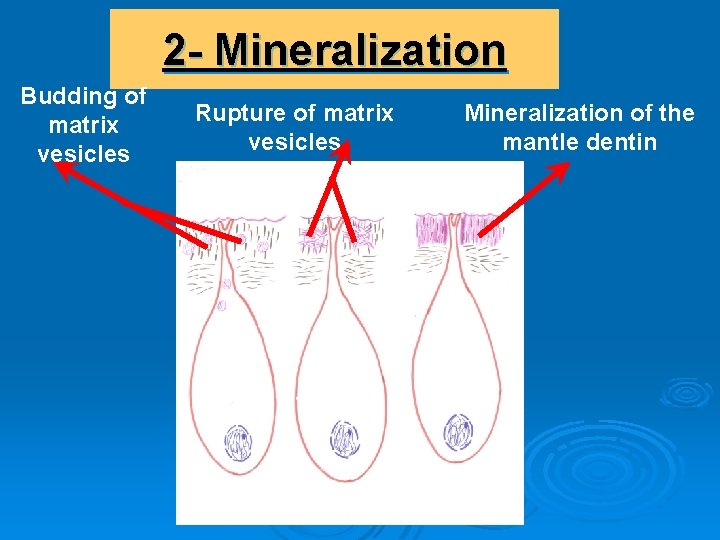
2 - Mineralization Budding of matrix vesicles Rupture of matrix vesicles Mineralization of the mantle dentin
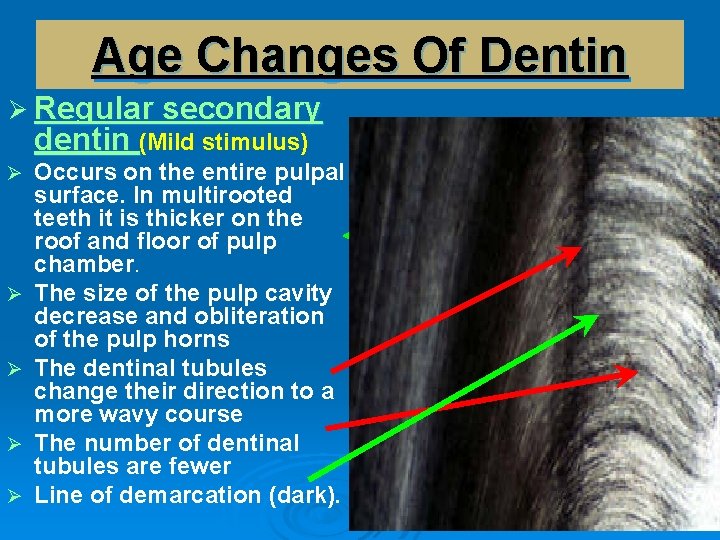
Age Changes Of Dentin Ø Regular secondary dentin (Mild stimulus) Ø Ø Ø Occurs on the entire pulpal surface. In multirooted teeth it is thicker on the roof and floor of pulp chamber. The size of the pulp cavity decrease and obliteration of the pulp horns The dentinal tubules change their direction to a more wavy course The number of dentinal tubules are fewer Line of demarcation (dark).
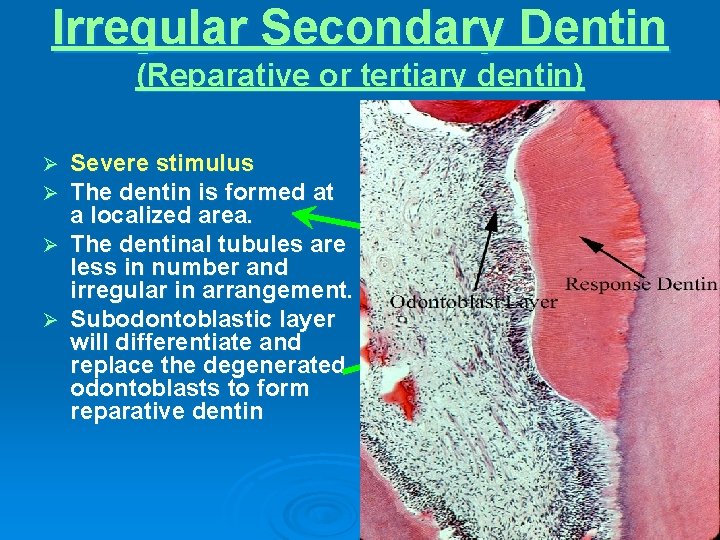
Irregular Secondary Dentin (Reparative or tertiary dentin) Severe stimulus The dentin is formed at a localized area. Ø The dentinal tubules are less in number and irregular in arrangement. Ø Subodontoblastic layer will differentiate and replace the degenerated odontoblasts to form reparative dentin Ø Ø
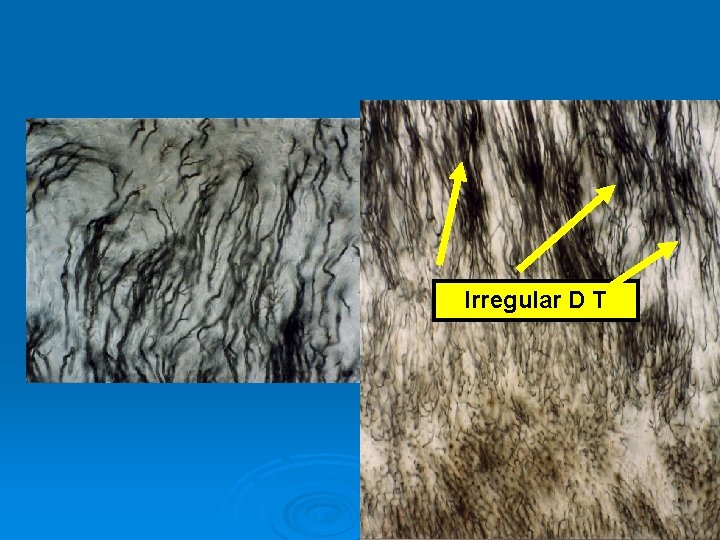
Irregular D T
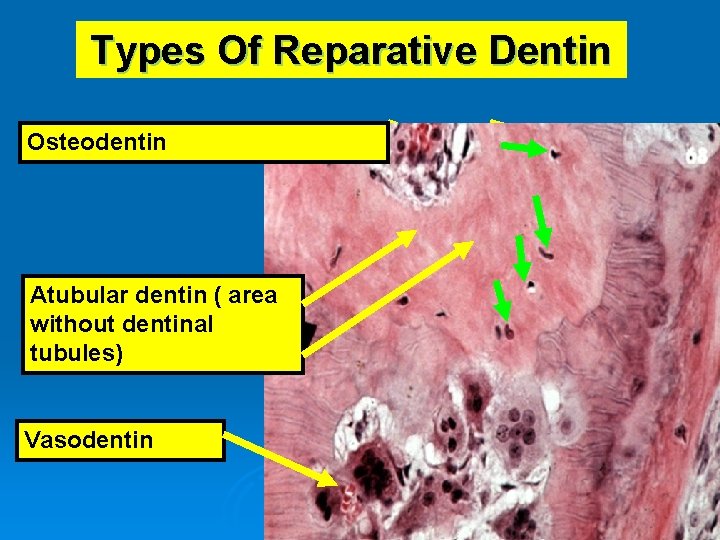
Types Of Reparative Dentin Osteodentin Atubular dentin ( area without dentinal tubules) Vasodentin
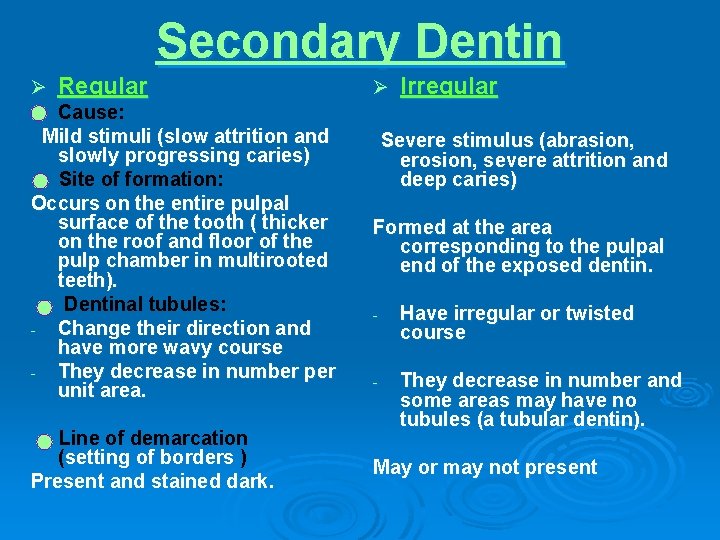
Secondary Dentin Ø Regular Ø Irregular Cause: Mild stimuli (slow attrition and slowly progressing caries) Site of formation: Occurs on the entire pulpal surface of the tooth ( thicker on the roof and floor of the pulp chamber in multirooted teeth). Dentinal tubules: - Change their direction and have more wavy course - They decrease in number per unit area. Formed at the area corresponding to the pulpal end of the exposed dentin. Line of demarcation (setting of borders ) Present and stained dark. May or may not present Ø Severe stimulus (abrasion, erosion, severe attrition and deep caries) - Have irregular or twisted course - They decrease in number and some areas may have no tubules (a tubular dentin).
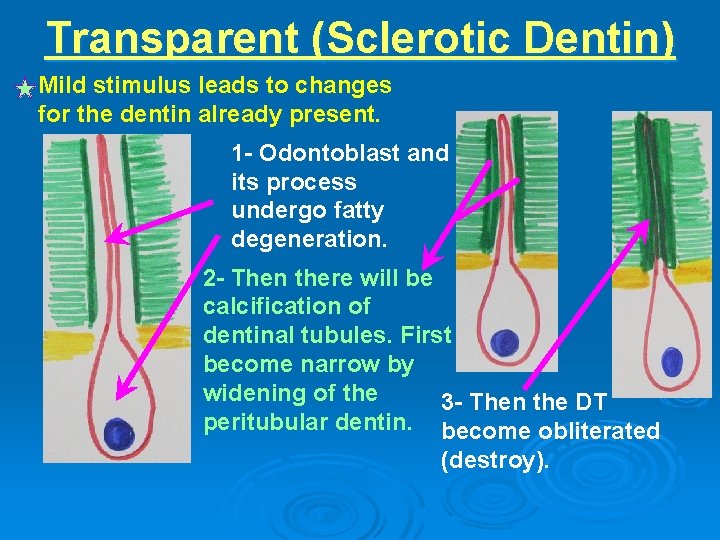
Transparent (Sclerotic Dentin) Mild stimulus leads to changes for the dentin already present. 1 - Odontoblast and its process undergo fatty degeneration. 2 - Then there will be calcification of dentinal tubules. First become narrow by widening of the 3 - Then the DT peritubular dentin. become obliterated (destroy).
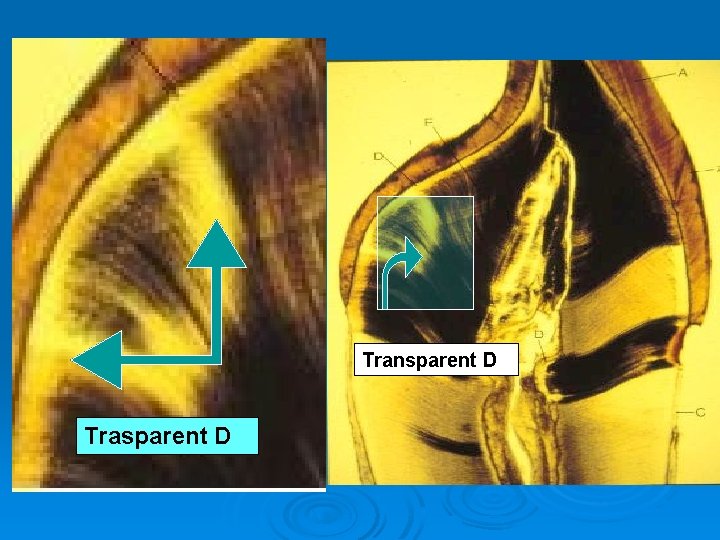
Transparent D Trasparent D
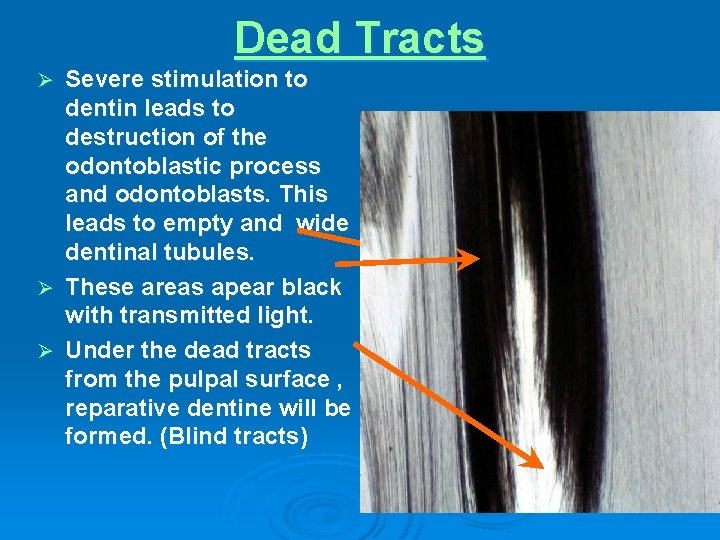
Dead Tracts Severe stimulation to dentin leads to destruction of the odontoblastic process and odontoblasts. This leads to empty and wide dentinal tubules. Ø These areas apear black with transmitted light. Ø Under the dead tracts from the pulpal surface , reparative dentine will be formed. (Blind tracts) Ø

- Slides: 37