
Dental pulp and tooth pain Dr omar MSc


- Slides: 23
Dental pulp and tooth pain Dr. omar MSc, Ph D Medical physiology 2017 -2018
What is the pulp • the dental pulp is a soft connective tissue that normally is not mineralized. • The pulpal cells are from different origins. • two structurally different vascular networks supply the pulp
Pulp layers • Cell free zone outer layer • Cell rich zone beneath it • Central pulp
Pulp tissue component and cells • Similar to connective tissue in other locations, the extracellular matrix of the dental pulp consists of collagens, non- collagenous proteins, glycoproteins, proteoglycans, enzymes, growth factors, various phospholipids and proteolipids, and components derivedfrom plasma
pulpobalst • fibroblast-like pulp cells synthesize and secretecollagenous and non-collagenous proteins
Inflammatory cells • It has inflammtory cells like neutrophils lymphocyte b t • Dendritic cells, resident macrophages and histiocytes, mast cells, and • polymorphonuclear leukocytes.
Innervation • The dental pulp is innervated by afferent sensory fibers that are branches of the fifth cranial (trigeminal) nerve, and sympathetic and parasympathetic fibers that travel with the trigeminal nerve.
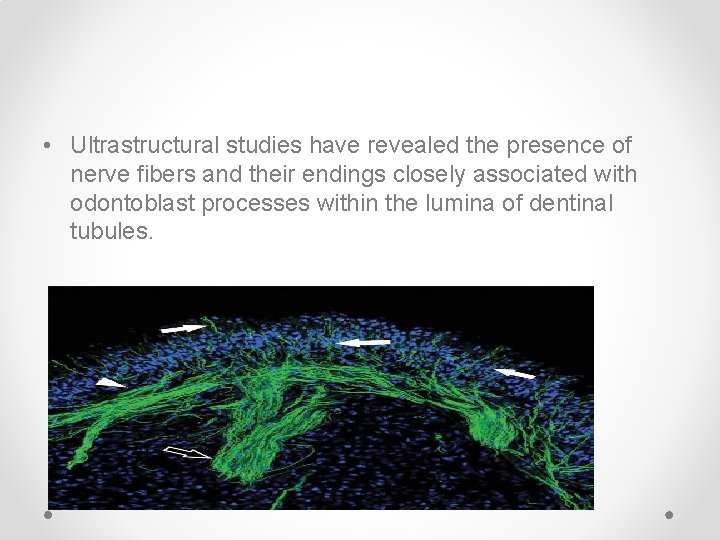
• Ultrastructural studies have revealed the presence of nerve fibers and their endings closely associated with odontoblast processes within the lumina of dentinal tubules.
• Sensory nerve fibers responsible for the sensitivity of dentin are implicated in events associated with early aspects of pain and sharp pain (A-β, A-δ fast nerves). • ● A-δ slow, intradental C fiber polymodal and silent, and C fiber nerves are concerned with ache.
Mechanisms of tooth pain • the mechanisms of tooth sensitivity and pain are not fully elucidated. • The remaining open question, therefore, is why and how dentin sensitivity appears in the outerdentin, especially at the dentinoenamel junction (DEJ), a noninnervated region of the crown. The same question arises concerning the cervical zone. Again, although they are very sensitive regions, no innervation has been found in these areas.
• . Direct and indirect mechanisms have been proposed
Direct mechansim • Odontoblast cells has characteristics of sympathetic and parsympathetic neurons • Odontoblasts play a role in tooth pain transmission as mediators of mechanotransduction, identified on the basis of mechanosensitive ion channels
Nerve fibers for pain transmission • A-fibers are responsible for the sensitivity of dentin and for the mediation of sharp pain induced by dentinal stimulation. • 2. Pre-pain (non-painful sensations) results with the activation of the lowest threshold A-fibers, some of which areclassified as Aβ-fibers. Aβ- and Aδ-fibers belong to the same functional group. • 3. Intradental C fibers are activated only when the external stimuli reach the pulp itself. • They induce a dull pain by intense thermal stimulation associated with pulpal inflammation.
Neuromediators released by nerve ending • Activation of transient receptor potential (TRP) channels is involved in tooth pain. The melastatin (TRPM 8) receptor is found on Aδ fibers in dentin and on C fibers in the pulp
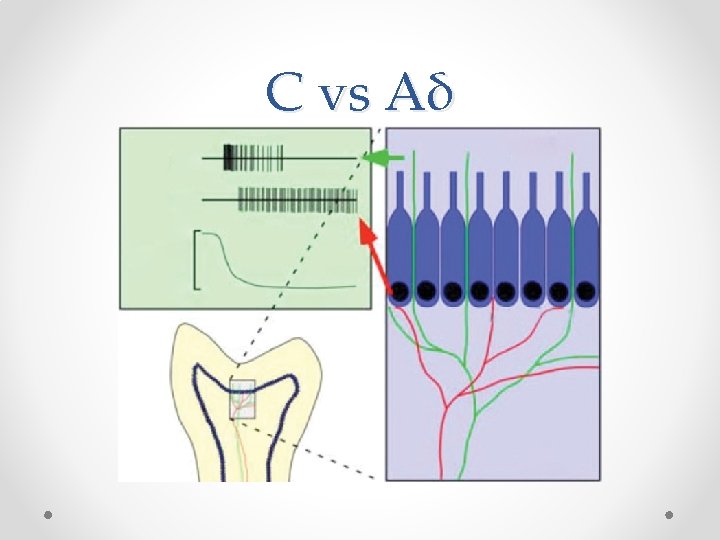
• First, Aδ fibers mediate a sharp shooting pain, followed by C fibers mediating a dull persistent pain. • Myelinated Aδ fibers transmit information faster (5– 30 m/sec, or 70 mph) than unmyelinated C fibers (<2 m/sec, or < 4. 5 mph • Aδ pass through odontoblast layer and end in dentin layer vs c fibers those end in the pulp
C vs Aδ
• All these explain why there is initial shooting pain followed by dull pain after cooling of the tooth
Indirect mechnism • dentin surface exposure leads to the displacement of the dentinal fluid. The movement of the dentinal fluid stimulates an odontoblast- nerve mechanosensory complex, resulting in pain sensation.
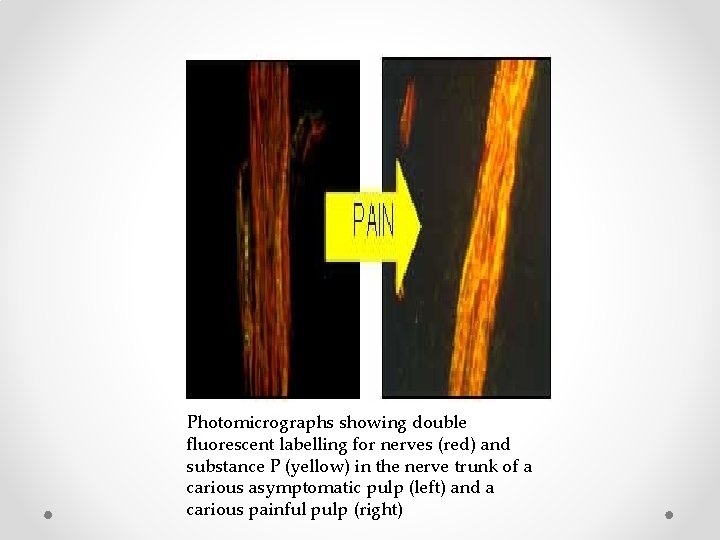
• The numerous presence of p subctance has been found in painful pulpitis
Photomicrographs showing double fluorescent labelling for nerves (red) and substance P (yellow) in the nerve trunk of a carious asymptomatic pulp (left) and a carious painful pulp (right)
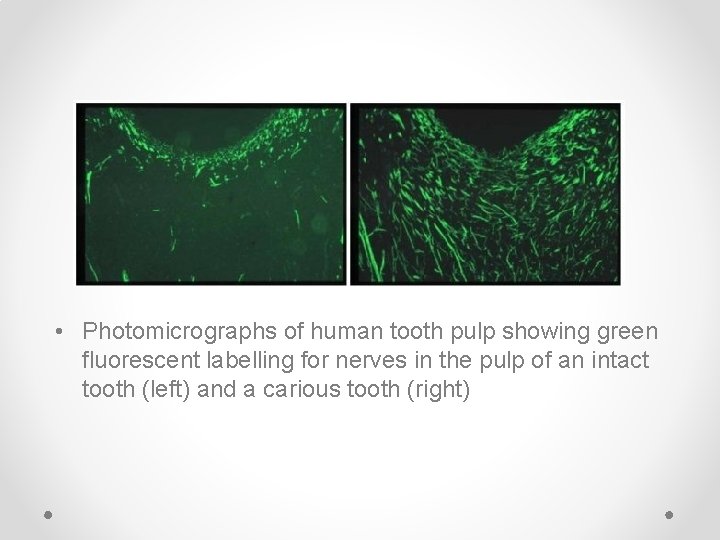
• Photomicrographs of human tooth pulp showing green fluorescent labelling for nerves in the pulp of an intact tooth (left) and a carious tooth (right)
• P primarily acts on NK 1(tachynin) receptors and simulation of the NK 1 receptor induces several second messengers systems like phospholipase