
Dental Directional Terminology Rostral refers to a structure
- Slides: 26
Dental Directional Terminology �Rostral refers to a structure that is closer to the front of the head in comparison with another structure. �Caudal describes a structure toward the back of the head when compared to another structure. �Vestibular describes the tooth surface facing the lips. Buccal if mandibular; labial if maxillary �Facial describes vestibular surface of teeth visible from the front (only used for incisors). �Lingual refers to the surface of the mandibular teeth adjacent to the tongue. �Palatal refers to the surface of maxillary teeth adjacent to the palate.
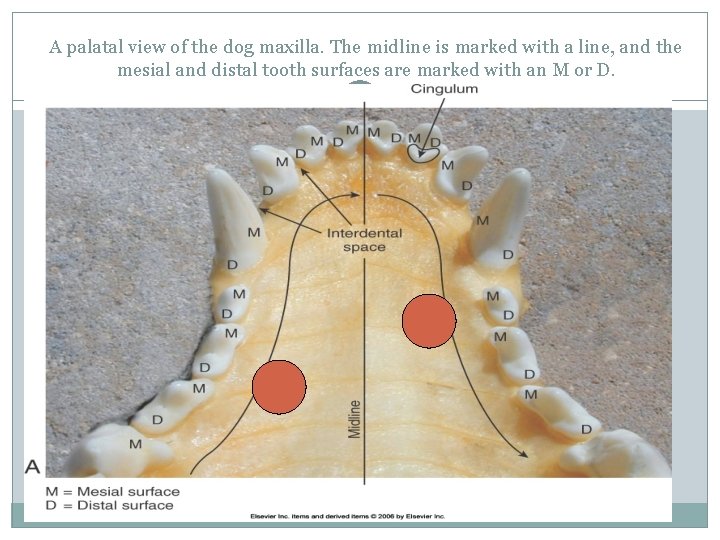
Dental Terminology �Mesial refers to the portion of the tooth in line with the dental arcade that is closest to the most rostral portion of the midline of the dental arch. �Distal refers to the portion of the tooth that is closest to the most caudal portion of the midline of the dental arch. �Apical refers to a portion of the tooth closer to the apex, or tip of the root. �Coronal refers to a structure within a location closer to the crown of the tooth in relation to another structure. �Occlusal refers to the part of a tooth that meets with, or occludes with, the teeth of the opposite dental arcade. �Interdental space refers to the space between each individual tooth.
A palatal view of the dog maxilla. The midline is marked with a line, and the mesial and distal tooth surfaces are marked with an M or D.
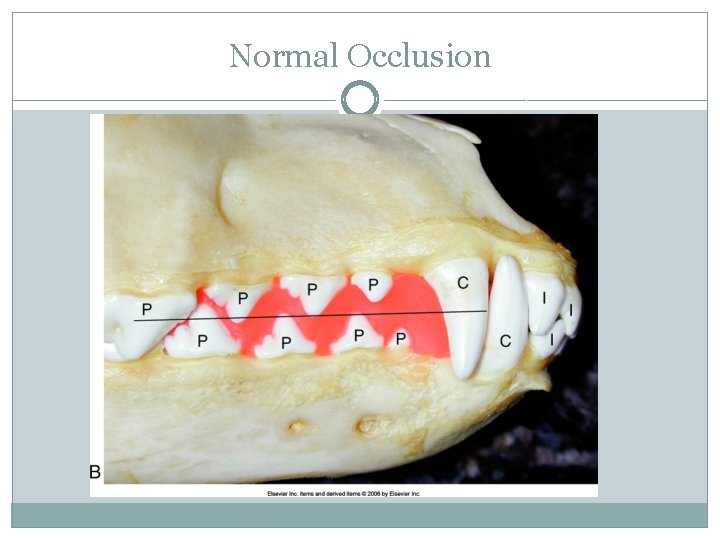
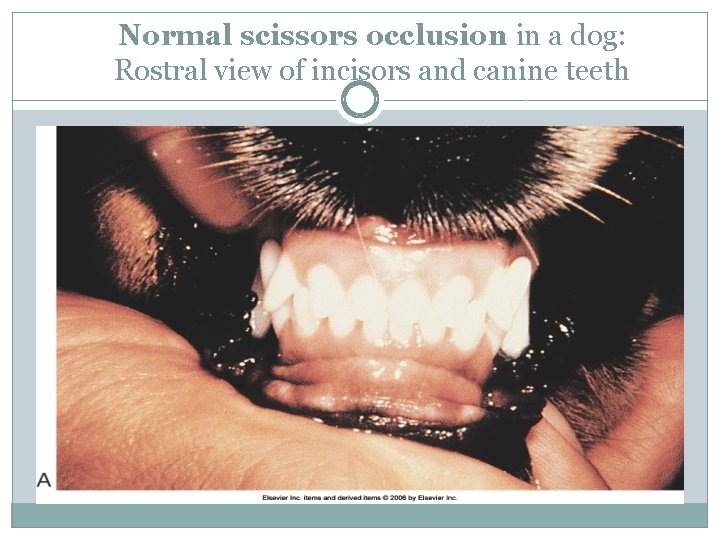
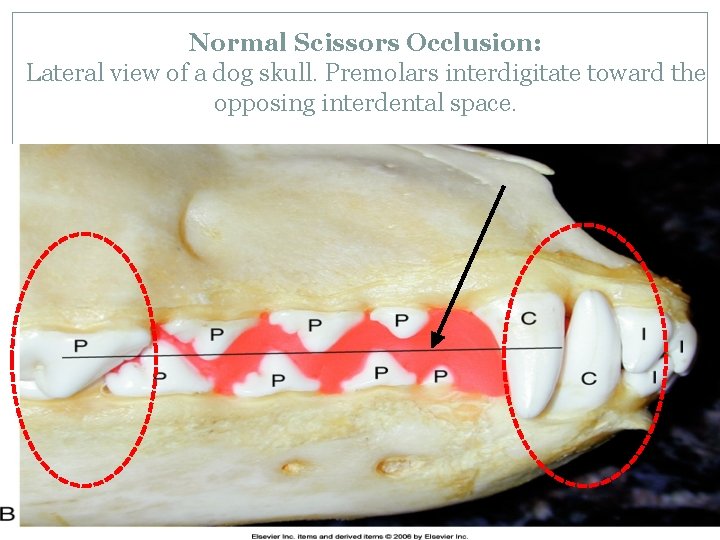
Occlusion �Orthodontics studies the way in which the teeth meet each other (occlude). �Occlusion is defined as the normal position of the teeth when the jaws are closed. In normal occlusion, teeth come together in a scissors bite. �The mandibular canine tooth resides in the interdental space of the upper third incisor and the upper canine tooth. �The upper fourth premolar tooth overlaps the lower first molar, which together, constitute the carnassial teeth.
Normal Occlusion
Normal scissors occlusion in a dog: Rostral view of incisors and canine teeth
Normal Scissors Occlusion: Lateral view of a dog skull. Premolars interdigitate toward the opposing interdental space.
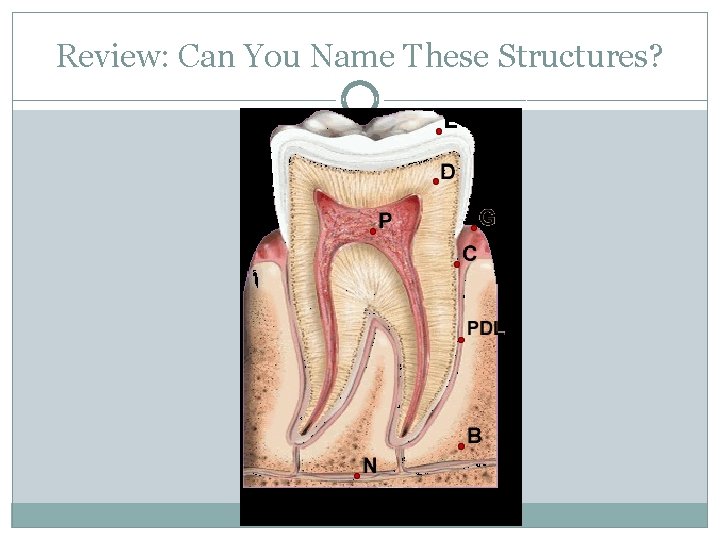
Review: Can You Name These Structures?
Malocclusion �Malocclusion is an abnormality in the position of the teeth. It can occur in any of the three head shapes, but is more common in brachycephalic breeds. �It is more common in dogs but also occurs in cats. �There are four classes of malocclusions. (Class I, III, and IV) Class I- easily fixed with orthodontic correction Class II-IV are skeletal malocclusions due to differing jaw length
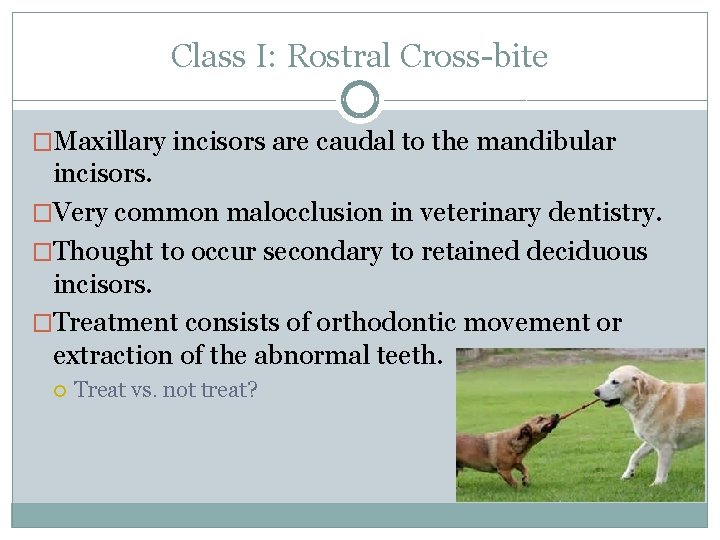
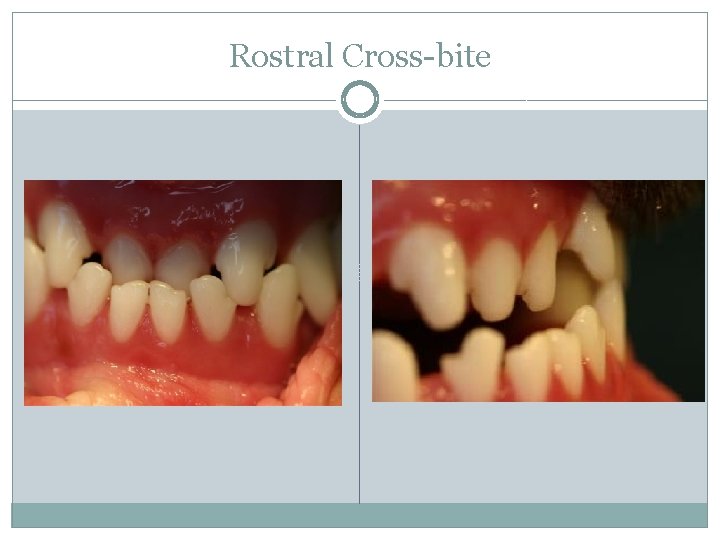
Class I: Rostral Cross-bite �Maxillary incisors are caudal to the mandibular incisors. �Very common malocclusion in veterinary dentistry. �Thought to occur secondary to retained deciduous incisors. �Treatment consists of orthodontic movement or extraction of the abnormal teeth. Treat vs. not treat?
Rostral Cross-bite
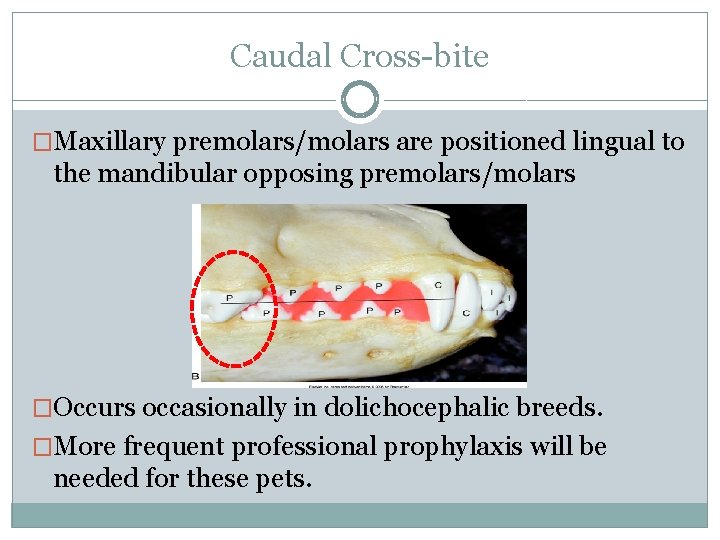
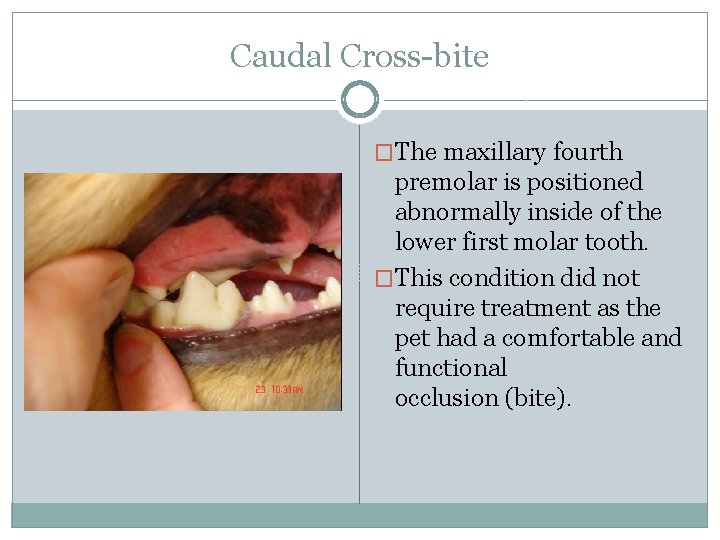
Caudal Cross-bite �Maxillary premolars/molars are positioned lingual to the mandibular opposing premolars/molars �Occurs occasionally in dolichocephalic breeds. �More frequent professional prophylaxis will be needed for these pets.
Caudal Cross-bite �The maxillary fourth premolar is positioned abnormally inside of the lower first molar tooth. �This condition did not require treatment as the pet had a comfortable and functional occlusion (bite).
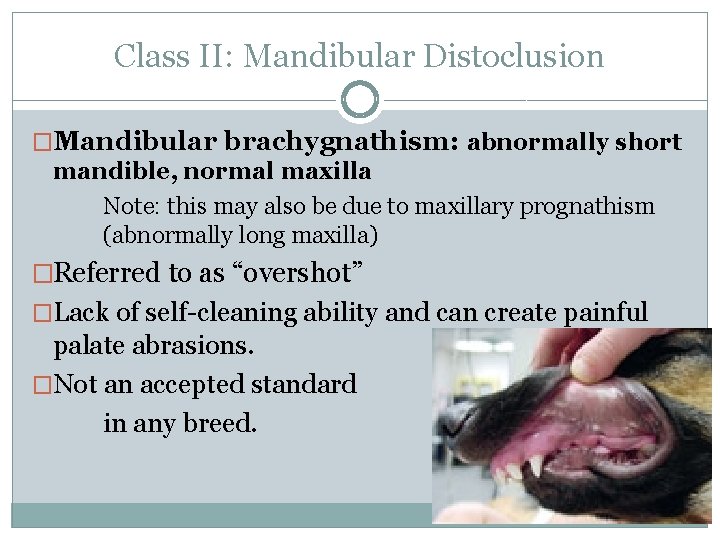
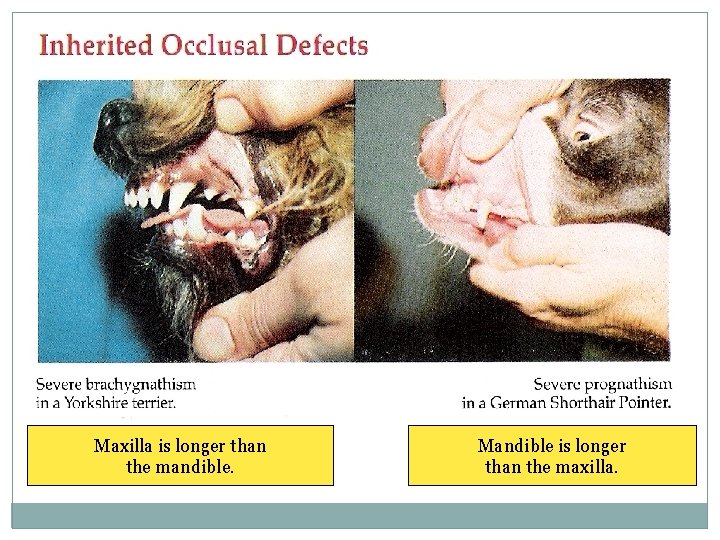
Class II: Mandibular Distoclusion �Mandibular brachygnathism: abnormally short mandible, normal maxilla Note: this may also be due to maxillary prognathism (abnormally long maxilla) �Referred to as “overshot” �Lack of self-cleaning ability and can create painful palate abrasions. �Not an accepted standard in any breed.
Maxilla is longer than the mandible. Mandible is longer than the maxilla.
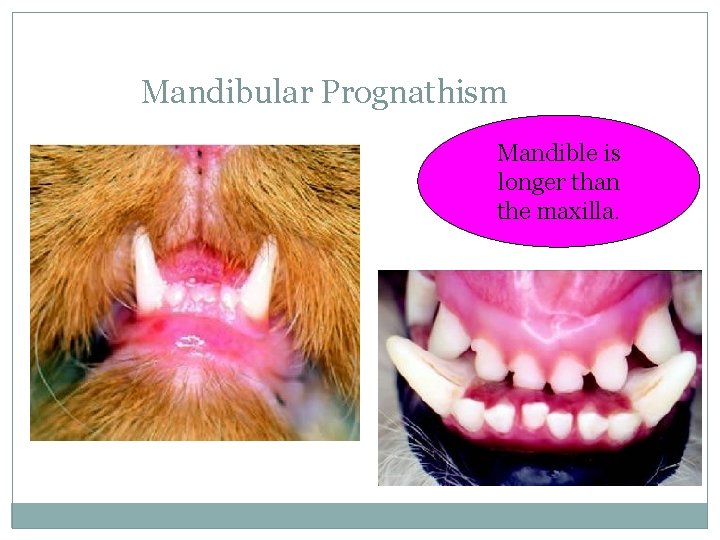
Class III: Mandibular Mesioclussion �Mandibular prognathism: abnormally long mandible, normal length maxilla Note: Could also be maxillary brachygnathism (not common) �Referred to as “undershot” �These dogs will lose some of their self-cleaning ability and trap plaque and debris more easily. �Maxillary incisors can traumatize the mandible. �Accepted as normal in brachycephalic breeds such as Bulldogs, Pekingese, Boston terriers, Pugs, and Persian cats.
Mandibular Prognathism Mandible is longer than the maxilla.
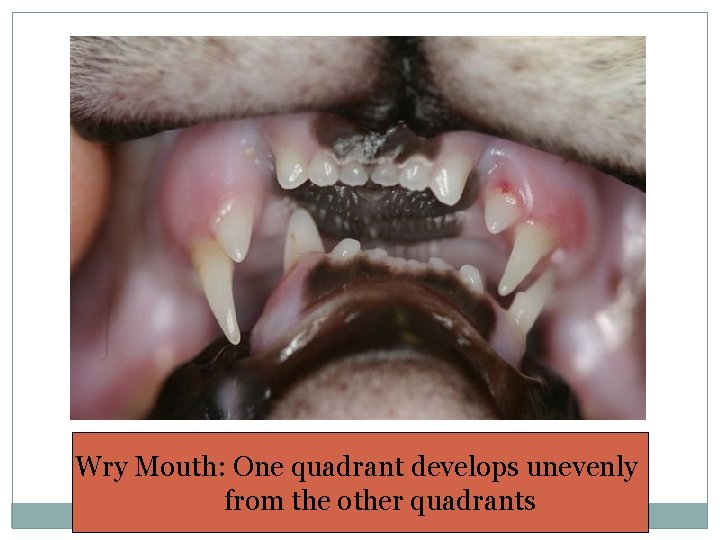
Wry Mouth �Each upper and lower right and left quadrant of the mouth is independent of the other, resulting in uneven growth which produces a wry occlusion (wry bite). �In its mildest form, a one-sided prognathic or brachygnathic bite forms. In more severe cases, a crooked head and bite develop. �A triangular opening (open bite) will also appear in the incisor area where the affected incisors do not meet. In severe cases, the tongue protrudes from the open bite.
Wry Mouth: One quadrant develops unevenly from the other quadrants
Persistent Deciduous Teeth �Interfere with normal eruption pathway of permanent teeth malocclusion �Are a reservoir for debris dental disease �Early detection is key! �Common in small breed dogs �Extraction is almost always necessary Referred to as Interceptive Orthodontics
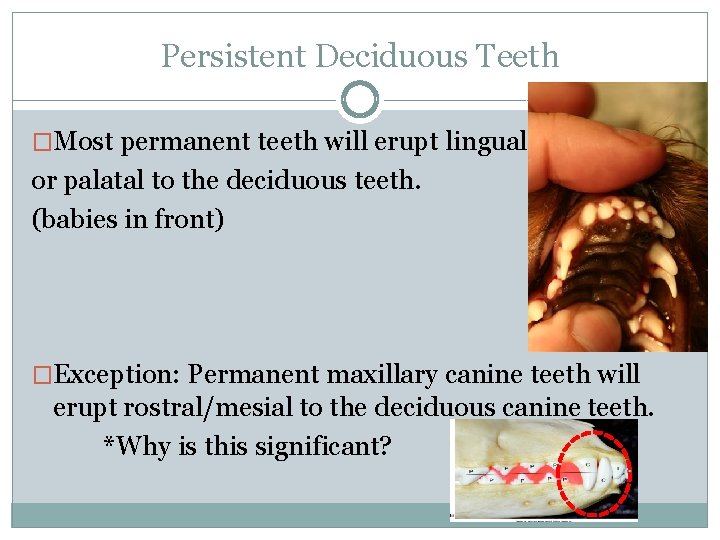
Persistent Deciduous Teeth �Most permanent teeth will erupt lingual or palatal to the deciduous teeth. (babies in front) �Exception: Permanent maxillary canine teeth will erupt rostral/mesial to the deciduous canine teeth. *Why is this significant?
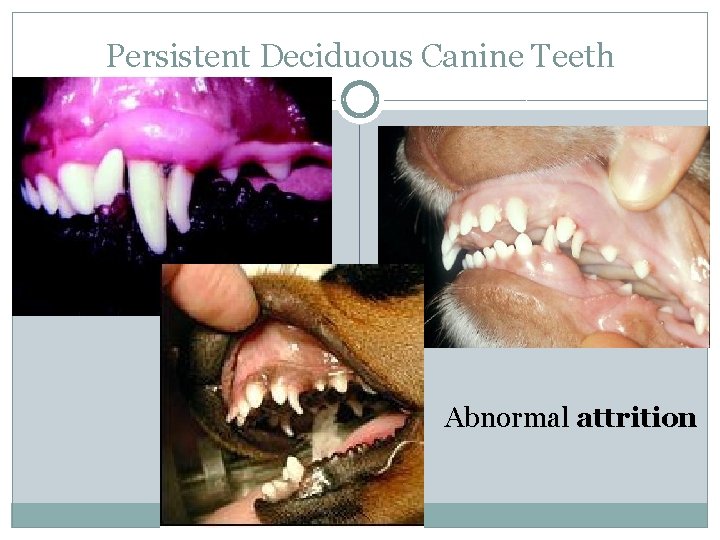
Persistent Deciduous Canine Teeth Abnormal attrition
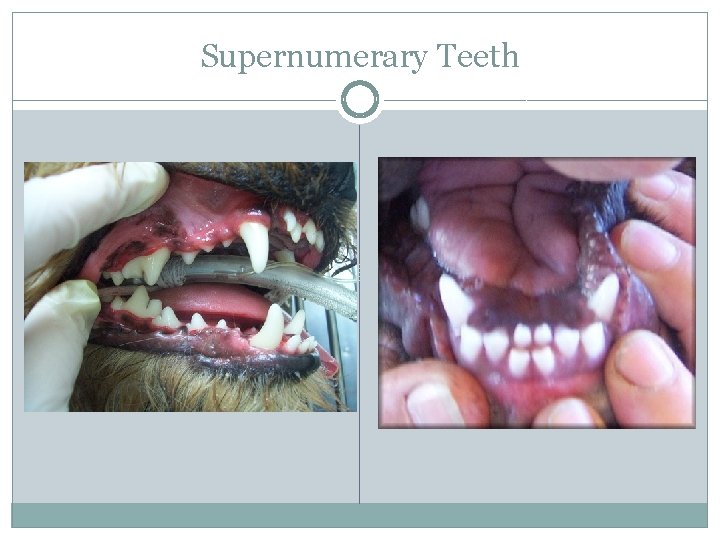
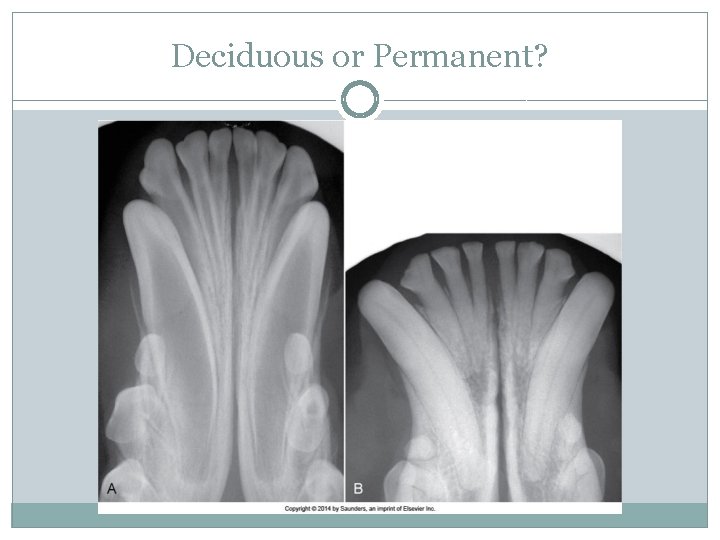
Polydontia �Supernumerary teeth should not be confused with retained deciduous teeth. �Radiographs aid in differentiation. How? �Occurs in about 10% of dogs and rarely in cats. �Unless extra tooth causes crowding, no treatment is necessary. Occasionally the extra teeth will erupt in an abnormal angle or be impacted. �If crowding increased chance of periodontal disease. (Extraction necessary)
Supernumerary Teeth
Deciduous or Permanent?
Oligodontia �Also called hypodontia �One or more teeth (usually incisors or premolars) do not form in the dental arcade. �Many breeds are affected. �Unerrupted or hypodontia? �If permanent tooth is absent, a baby tooth will often remain in the arch for months to years. �No treatment; usually does not cause any problems.