
Dental Conference MID Periodontal Disease November 11 2004
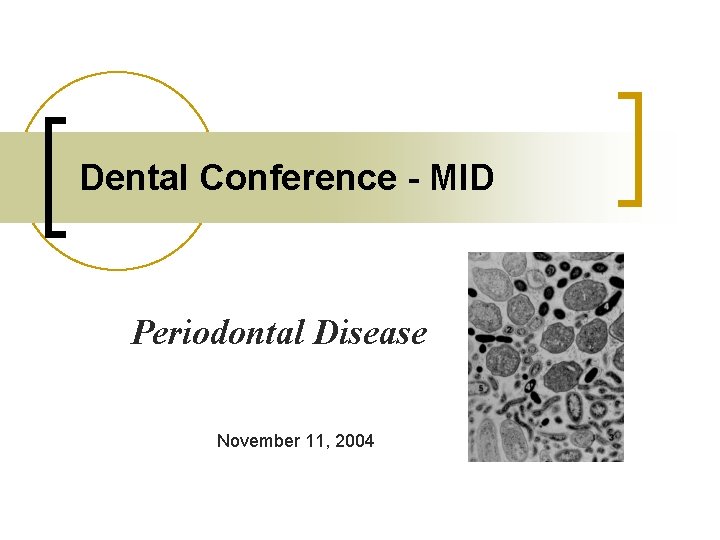
Dental Conference - MID Periodontal Disease November 11, 2004

Destructive Periodontal Disease Active Disease Susceptible Host Presence of Pathogens -- From Socransky et al. (1992) Absence of Beneficial Species
Dental plaque biofilm infection n Ecological point of view ¡ ¡ n Ecological community evolved for survival as a whole Complex community of more than 400 bacterial species Dynamic equilibrium between bacteria and a host defense ¡ ¡ Adopted survival strategies favoring growth in plaque “Selection” of “pathogenic” bacteria among microbial community n Selection pressure coupled to environmental changes Disturbed equilibrium leading to pathology Opportunistic infection

Dental Plaque Hypothesis` n Specific plaque hypothesis n Non-specific plaque hypothesis n Intermediate or ecological plaque hypothesis ¡ ¡ ¡ Qualitatively distinct bacterial composition: healthy vs. disease (subjects, sites) Pathogenic shift; disturbed equilibrium A small group of bacteria: Gram (-), anaerobic
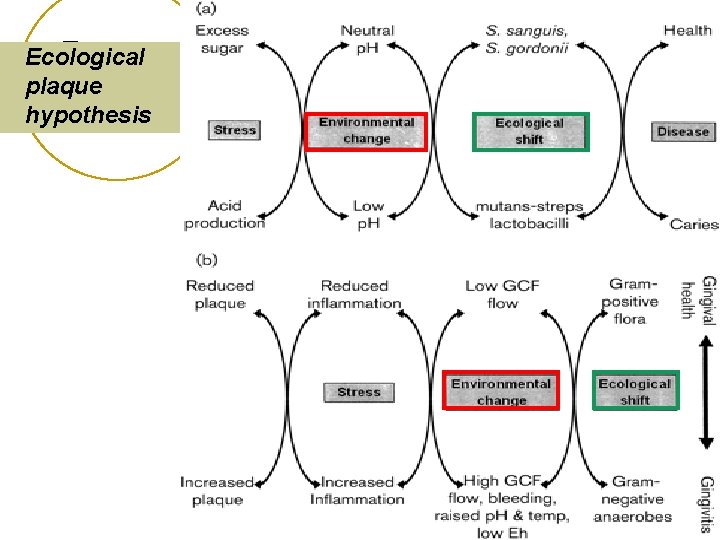
Ecological plaque hypothesis
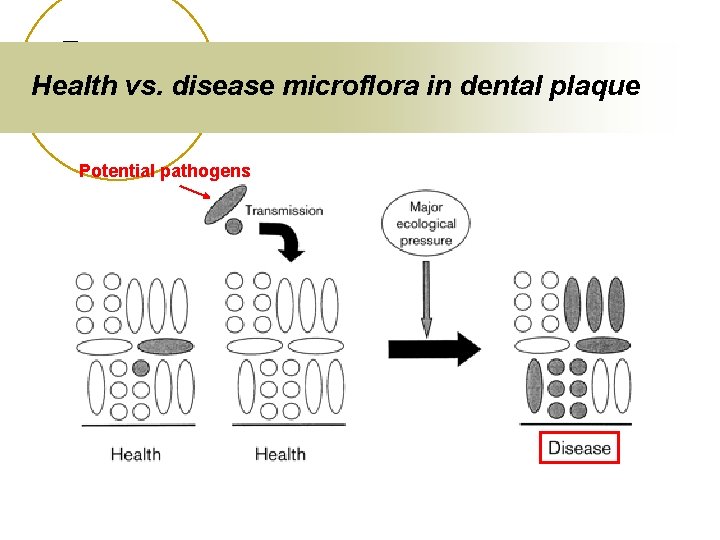
Health vs. disease microflora in dental plaque Potential pathogens
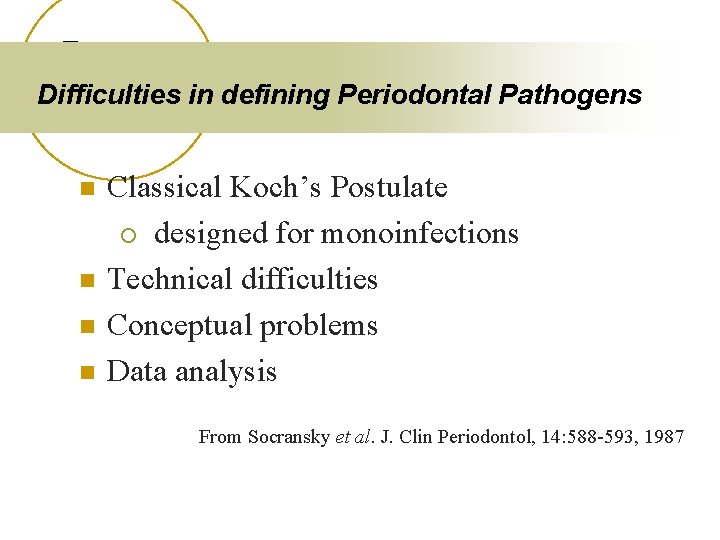
Difficulties in defining Periodontal Pathogens n n Classical Koch’s Postulate ¡ designed for monoinfections Technical difficulties Conceptual problems Data analysis From Socransky et al. J. Clin Periodontol, 14: 588 -593, 1987
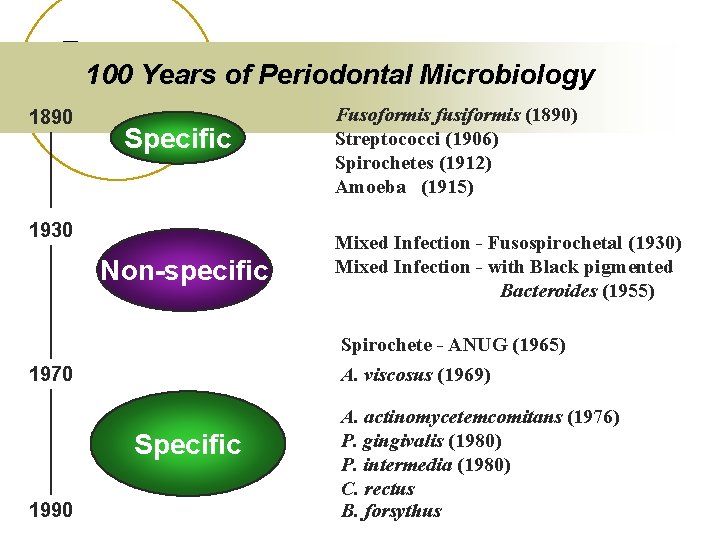
100 Years of Periodontal Microbiology 1890 Specific 1930 Non-specific Fusoformis fusiformis (1890) Streptococci (1906) Spirochetes (1912) Amoeba (1915) Mixed Infection - Fusospirochetal (1930) Mixed Infection - with Black pigmented Bacteroides (1955) 1970 Spirochete - ANUG (1965) A. viscosus (1969) 1990 A. actinomycetemcomitans (1976) P. gingivalis (1980) P. intermedia (1980) C. rectus B. forsythus Specific
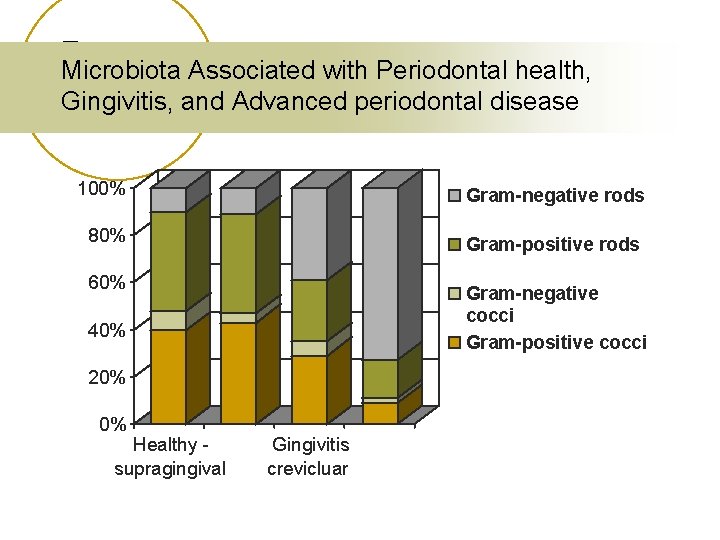
Microbiota Associated with Periodontal health, Gingivitis, and Advanced periodontal disease 100% Gram-negative rods 80% Gram-positive rods 60% Gram-negative cocci Gram-positive cocci 40% 20% 0% Healthy supragingival Gingivitis crevicluar
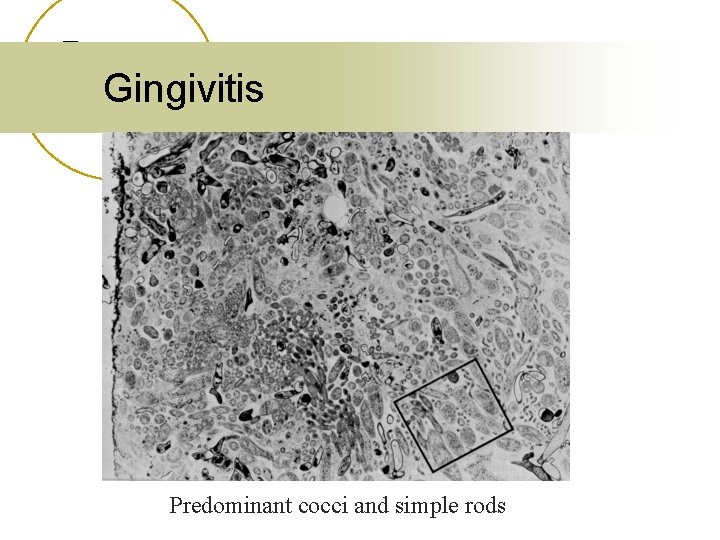
Gingivitis Predominant cocci and simple rods
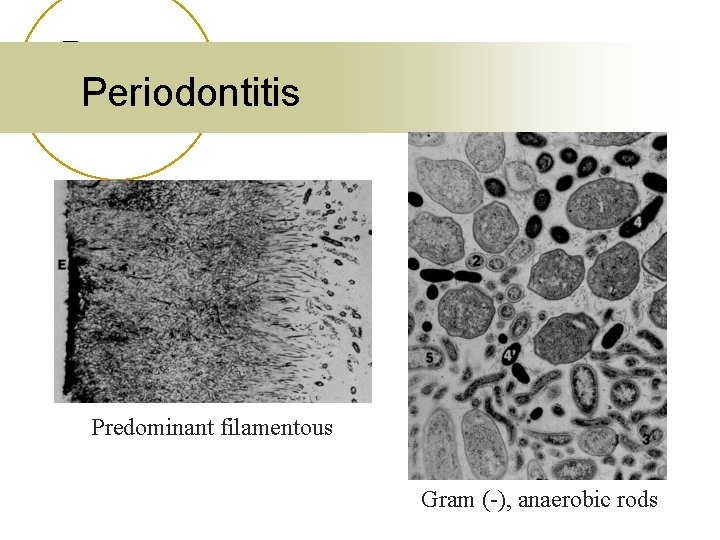
Periodontitis Predominant filamentous Gram (-), anaerobic rods
Microbial complexes in biofilms n n Not randomly exist, rather as specific associations among bacterial species Socransky et al. (1998) examined over 13, 000 subgingival plaque samples from 185 adults, and identified six specific microbial groups of bacterial species
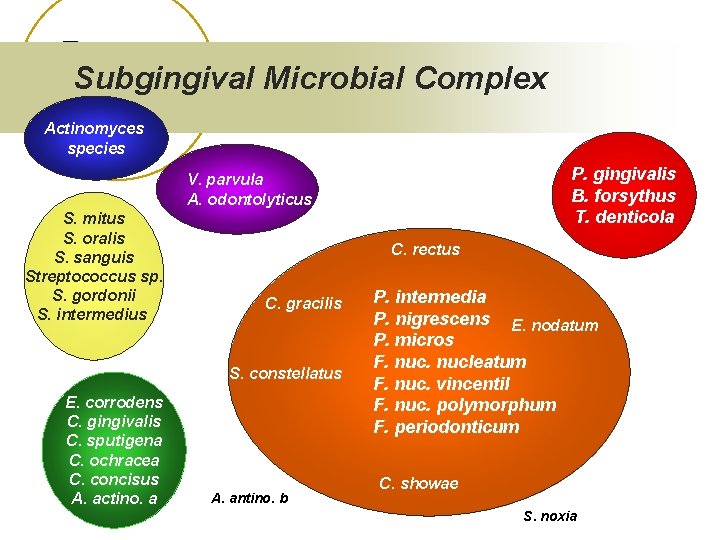
Subgingival Microbial Complex Actinomyces species P. gingivalis B. forsythus T. denticola V. parvula A. odontolyticus S. mitus S. oralis S. sanguis Streptococcus sp. S. gordonii S. intermedius C. rectus C. gracilis S. constellatus E. corrodens C. gingivalis C. sputigena C. ochracea C. concisus A. actino. a A. antino. b P. intermedia P. nigrescens E. nodatum P. micros F. nucleatum F. nuc. vincentil F. nuc. polymorphum F. periodonticum C. showae S. noxia
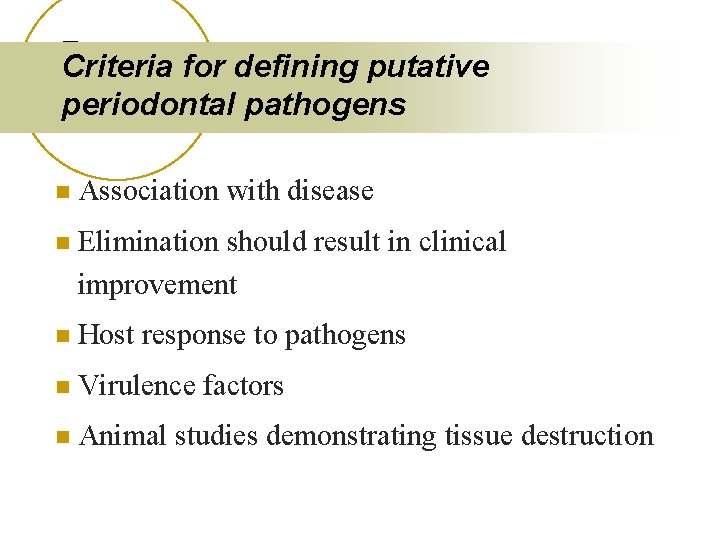
Criteria for defining putative periodontal pathogens n Association with disease n Elimination should result in clinical improvement n Host response to pathogens n Virulence factors n Animal studies demonstrating tissue destruction
Possible Etiologic Agents of Periodontal Disease Actinobacillus actinomycetemcomitans n Porphyromonas gingivalis n Tannerella forsythia (Bacteroides forsythus) n Prevotella intermedia n Spirochetes n Fusobacterium nucleatum n Eikenella corrodens n Campylobacter rectus (Wolinella recta) n Peptostreptococcus micros n Streptococcus intermedius n
Actinobacillus actinomycetemcomitans n n n n First recognized as a possible periodontal pathogen in LJP (Newman et al. , 1976) Majority of LJP patients have high Ab titers against Aa Successful therapy lead to elimination or significant decrease of the species Potential virulence factors; leukotoxin, cytolethal distending toxin, invasion, apoptosis Induce disease in experimental animals Eleveated in “active lesions”, compared with non-progressing sites Virulent clonal type of Aa ¡ ¡ LJP patients exhibit specific RFLP pattern, while healthy pts exhibit other patterns Increased leukotoxin production by Aa strains isolated from families of African origin, a 530 bp deletion in the promoter of the leukotoxin gene operon n n 22. 5 X more likely to convert to LJP than who had Aa strains with the full length leukotoxin promoter region Associated with refractory periodontitis in adult patients
Porphyromonas gingivalis n Gram (-), anaerobic, asaccharolytic, black-pigmented bacterium n Suspected periodontopathic microorganism ¡ Association n n Elevated in periodontal lesions, rare in health Elimination or suppression resulted in successful therapy ¡ Immunological n Elevated systemic and local antibody in periodontitis ¡ Animal n correlation pathogenicity Monkey, dog, and rodent models ¡ Putative virulent factors
Spirochetes n n G (-), anaerobic, spiral, highly motile ANUG Increased numbers in deep periodontal pockets Difficulty in distinguishing individual species ¡ ¡ n T. denticola ¡ n 15 subgingival spirochetes described Obscure classification - Small, medium, or large More common in diseased, subgingival site Uncultivated “pathogen-related oral spirochetes ¡ Detected by Ab cross-reactivity to T. pallidum antibody
Prevotella intermedia/Prevotella nigrescens n n n Strains of “P. intermedia” separated into two species, P. intermedia and P. nigrescins Hemagglutination activity Adherence activity Induce alveolar bone loss In certain forms of periodontitis Successful therapy leads to decrease in P. intermedia
Fusobacterium nucleatum n n n G(-), anaerobic, spindle-shaped rod Has been recognized as part of the subgingival microbiota for over 100 years The most common isolate found in cultural studies of subgingival plaque samples: 7 -10% of total isolates Prevalent in subjects with periodontitis and periodontal abscess Invasion of epithelial cell Apoptosis activity
Other species n Campylobacter rectus ¡ ¡ ¡ n n Eikenella corrodens Peptostreptococcus micros ¡ ¡ n G(+), anaerobic, small asaccharolytic Long been associated with mixed anaerobic infections Selemonas species ¡ n Produce leukotoxin Contains the S-layer Stimulate gingival fibroblast to produce IL-6 and IL-8 Curved shape, tumbling motility S. noxia found in deep pockets, conversion from healthy to disease site Eubacterium specues The “milleri” streptococci ¡ S. anginosus, S. constellatus, S. intermedius
Periodontal disease as an infectious disease n Events in all infectious disease: ¡ ¡ ¡ Encounter Entry Spread Multiplication Damage Outcome
Virulence factors n n Gene products that enhance a microorganism’s potential to cause disease Involved in all steps of pathogenicity ¡ Attach to or enter host tissue ¡ Evade host responses ¡ Proliferate ¡ Damage the host ¡ Transmit itself to new hosts Define “the pathogenic personality” Virulence genes
Expression of virulence factors n n Constitutive Under specific environmental signals ¡ Can be identified by mimicking environmental signals in the laboratory ¡ Many virulence-associated genes are coordinately regulated by environmental signals n Only in vivo ¡ Cannot be identified in the laboratory ¡ Anthrax toxin, cholera toxin
Identifying virulence factors n Microbiological and biochemical studies ¡ In vitro isolation and characterization ¡ In vivo systems n Genetic studies ¡ Study of genes involved in virulence ¡ Genetic transmission system ¡ Recombinant DNA technology n n Isogenic mutants Molecular form of Koch’s postulates (Falkow)
Virulence factors of A. actinomycemtemcomitans n Leukotoxin (RTX) ¡ n n n Cytolethal distending toxin (CDT) Chaperonin 60 LPS ¡ n n n Induce apoptosis Apoptosis, bone resorption, etc OMP, vesicles Fimbriae Actinobacillin Collagenase Immunosuppressive factor
Virulence factors of P. gingivalis n Involved in colonization and attachment ¡ Fimbriae, n hemagglutinins, OMPs, and vesicles Involved in evading (modulating) host responses ¡ Ig and complement proteases, LPS, capsule, other antiphagocytic products n Involved in multiplying ¡ Proteinases, n hemolysins Involved in damaging host tissues and spreading ¡ Proteinases (Arg-, Lys-gingipains), Collagenase, trypsin-like activity, fibrinolytic , keratinolytic, and other hydrolytic activities
An Example of Studying Microbial Pathogenesis Hypothesis S-layer of T. forsythia is a virulence factor

Tannerella forsythia n n n T. forsythia is a gram-negative, filament-shaped, nonmotile, non-pigmented oral bacterium. T. forsythia has been associated with advanced and recurrent periodontitis Implicated as one of three strong candidates for etiologic agents of periodontal disease ¡ Actinobacillus actinomycemtemcomitans ¡ Porphyromonas gingivalis ¡ Tannerella forsythia
Proving the S-layer as a virulence factor n Studying phenotype of the S-layer ¡ ¡ n Hemagglutination Adherence, invasion Studying the S-layer genes ¡ ¡ ¡ Cloning the S-layer genes Construction of the S-layer isogenic mutants Complementing the mutants with the S-layer genes
Proving association of genes with virulence n Molecular form of Koch's Postulates ¡ ¡ ¡ The phenotype under investigation should be associated significantly more often with pathogenic organism than with nonpathogenic member or strain. Specific inactivation of gene (or genes) associated with the suspected virulence trait should lead to a measurable decrease in virulence. Restoration of full pathogenicity should accompany replacement of the mutated gene with the wild type original.
- Slides: 31