
Dental Anatomy dr shabeel 1 Nomenclature Maxilla Mandible
Dental Anatomy dr shabeel 1

Nomenclature • Maxilla • Mandible dr shabeel 2

Deciduous Teeth • Primary Teeth • Post-natal development spans 2 -1/2 years • Usually 20 in number – 4 incisors – 2 canines – 4 molars per arch dr shabeel 3

Deciduous Teeth • In clinical practice they are designated by letters: A to T dr shabeel 4

Permanent Teeth • Development begins with the eruption of the first molars and exfoliation of the deciduous incisors • Process requires 20 years to complete • Usually 32 in number • In clinical practice they are designated by numbers: 1 to 32 dr shabeel 5

The Crown and Root • Crown- portion above the gingivae covered with enamel • Root- portion below covered with cementum • They are joined at the cemento-enamel junction (CEJ) dr shabeel 6
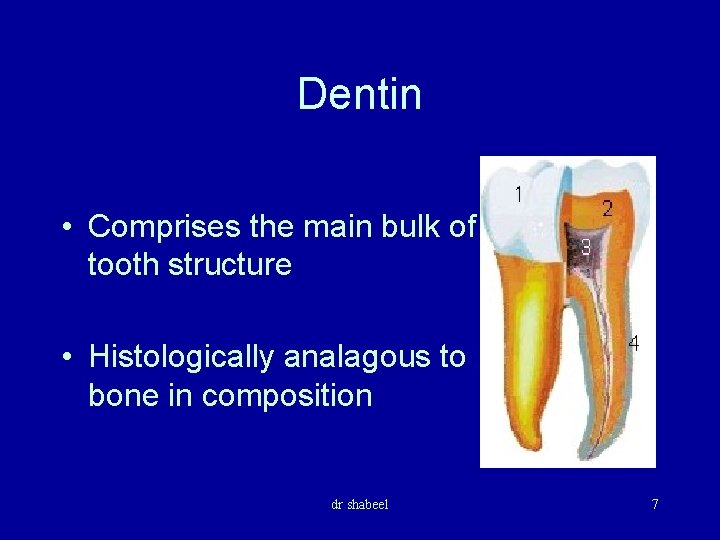
Dentin • Comprises the main bulk of tooth structure • Histologically analagous to bone in composition dr shabeel 7

Pulp Chamber and Canal • Contain the pulpal tissue – Nervous, arteriolar and venous tissue – fibrous tissue dr shabeel 8

The Crown • Incisors have an incisal edge • Canines have a single cusp • Premolars and Molars have 2 or more cusps • These are the cutting surfaces of the teeth dr shabeel 9

Incisor dr shabeel 10

Canine dr shabeel 11

Premolar dr shabeel 12

Molar dr shabeel 13

The Root • May be single or multiple • Firmly positioned in the boney process of the jaw called the alveolus • The alveolus together with the teeth forms the dental arch • The cervical area of the teeth are usually covered with a soft tissue, the gingivae dr shabeel 14
Surfaces and Ridges • Incisors and Canines- four surfaces and a ridge • Molars and Premolars- five surfaces dr shabeel 15

Surfaces- named according to positions and uses • Facial- toward the lips or cheeks • Lingual- toward the tongue dr shabeel 16
Surfaces • Occlusal- come in contact with those of the opposing jaw, molars and premolars only • Incisal- Those surfaces on the incisors and canines coming into contact with the opposing teeth dr shabeel 17

Proximal Surfaces • Surfaces coming into contact with the adjacent teeth • Mesial- toward the midline • Distal- away from the midline • Which teeth have the mesial surfaces touching each other? dr shabeel 18

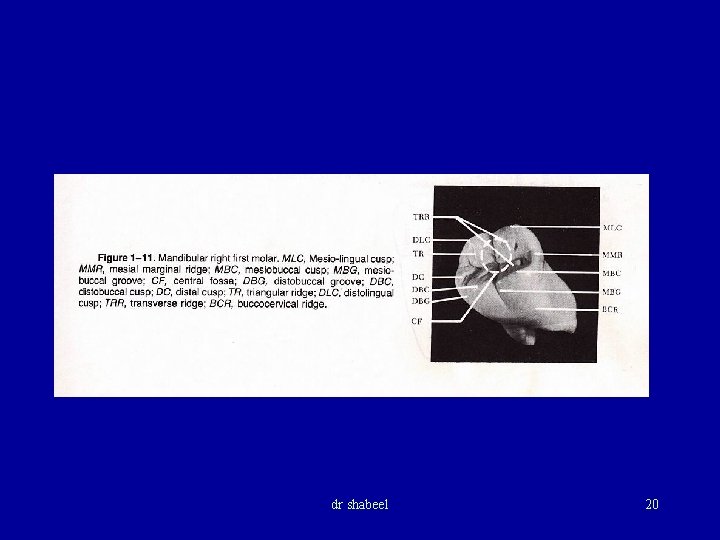
Cusp • an elevation or mound on the crown portion of a tooth making up a divisional part of the occlusal surface dr shabeel 19
dr shabeel 20

Tubercle • A smaller elevation on the same portion of the crown produced by an extra formation of enamel. Deviation from typical form. dr shabeel 21

Cingulum • The lingual lobe of an anterior tooth dr shabeel 22

dr shabeel 23

Ridge • Any linear elevation on the surface of a tooth and is named according to its location dr shabeel 24
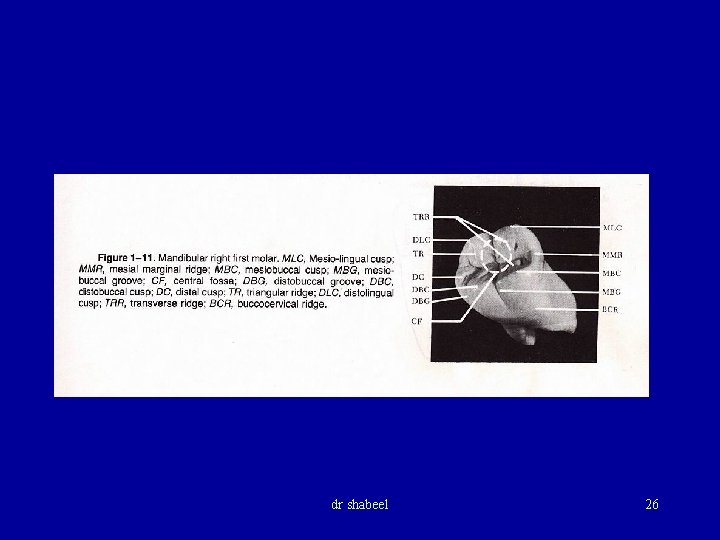
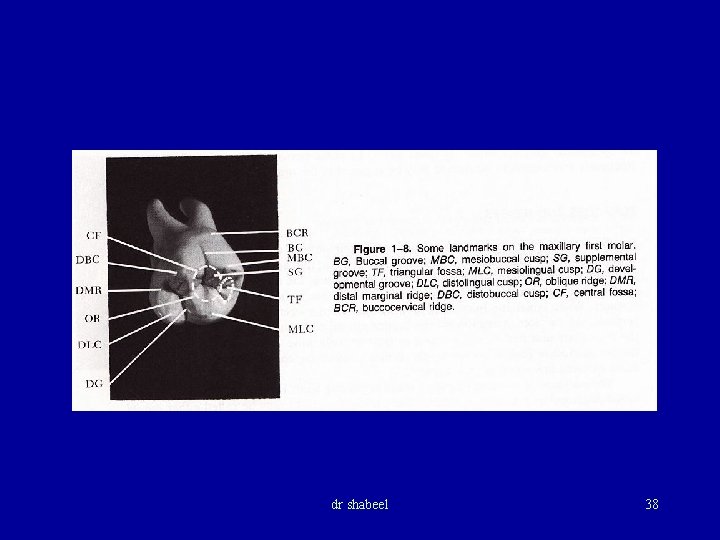
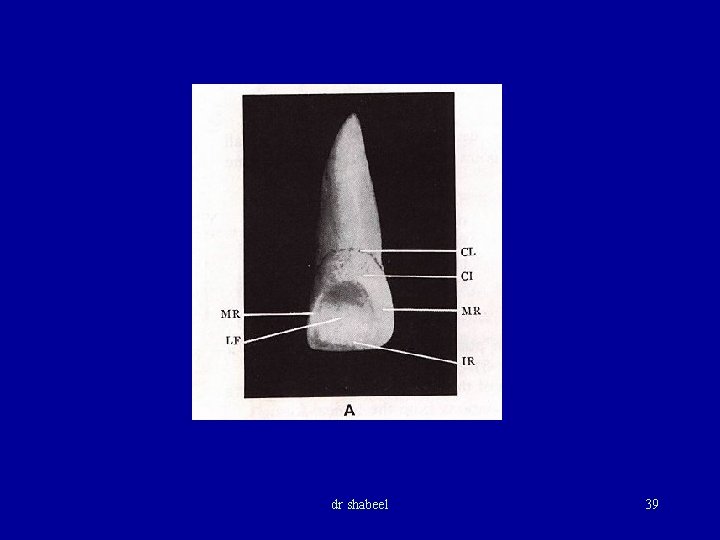
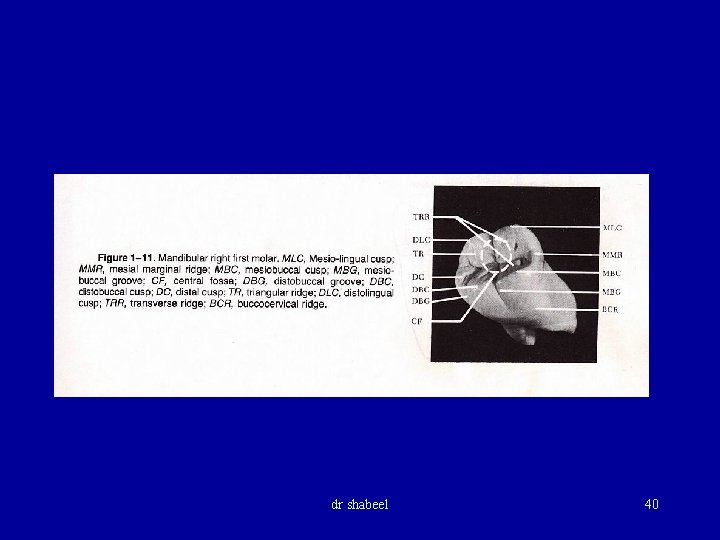
Marginal Ridge Those rounded borders of enamel that form the mesial and distal margins of the occlusal surfaces of premolars or molars, and the lingual surfaces of anterior teeth dr shabeel 25
dr shabeel 26

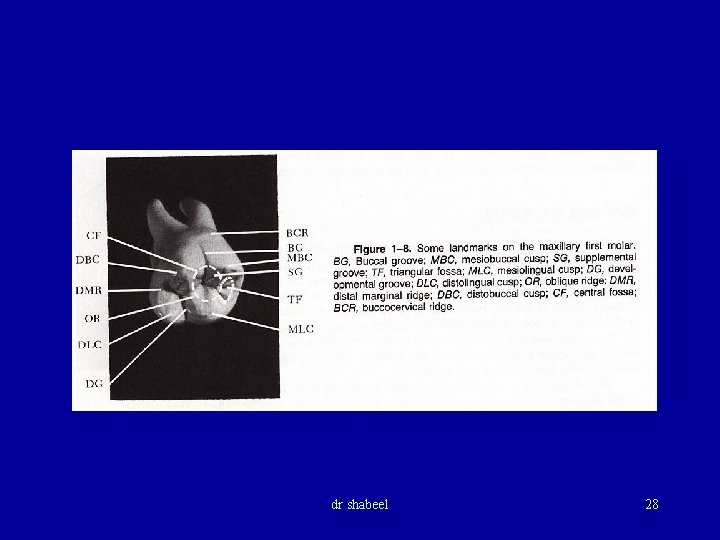
Triangular Ridges • descend from the cusp tips of molars and premolars toward the central part of the occlusal surface dr shabeel 27
dr shabeel 28

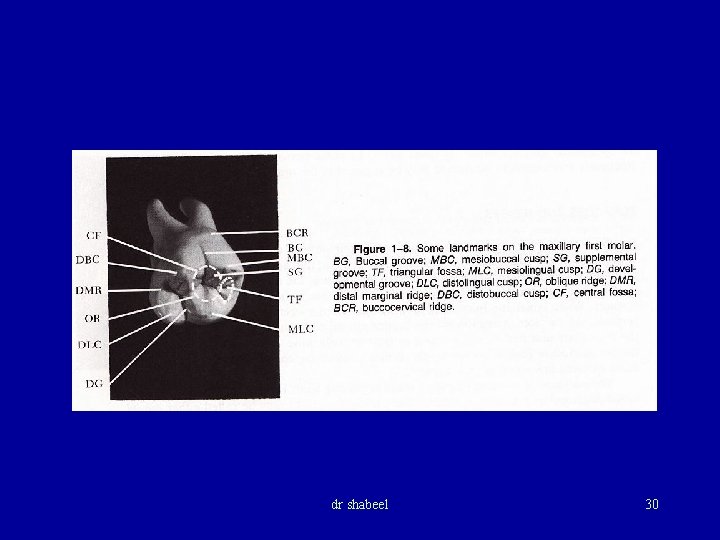
Oblique Ridge • Crosses the occlusal surface of maxillary molars in an oblique fashion dr shabeel 29
dr shabeel 30

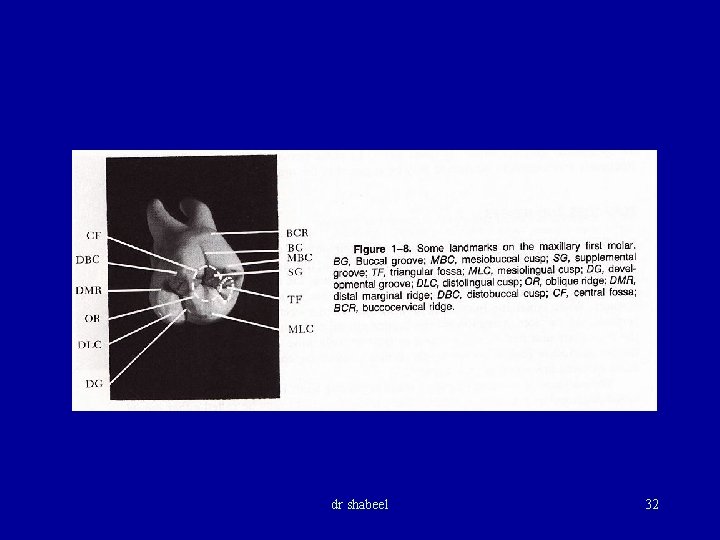
Fossa • An irregular depression or concavity dr shabeel 31
dr shabeel 32

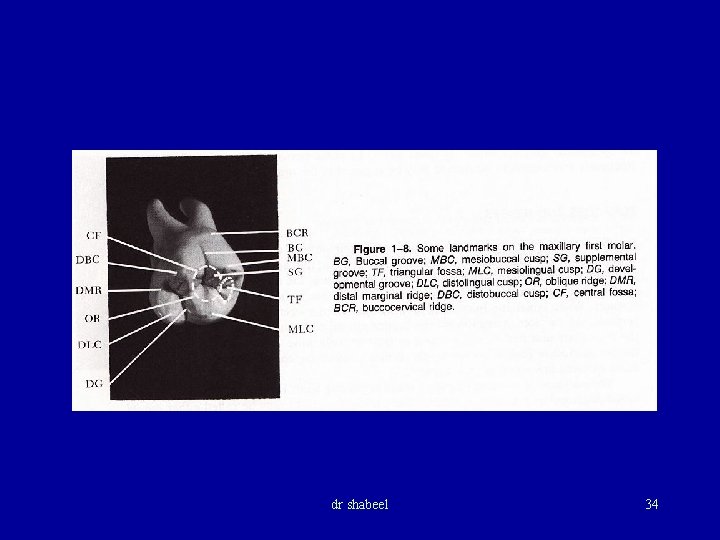
Sulcus • A long depression or valley in the surface of a tooth between ridges and cusps dr shabeel 33
dr shabeel 34
Developmental Groove • A shallow groove or line between the primary parts of the crown or root dr shabeel 35

dr shabeel 36

Pits • Small pinpoint depressions located at the junction of the developmental grooves dr shabeel 37
dr shabeel 38
dr shabeel 39
dr shabeel 40
- Slides: 40