
DensityBased Methods To discover clusters with arbitrary shape
Density-Based Methods • To discover clusters with arbitrary shape. • Regard clusters as dense regions of objects in the data space that are separated by regions of low density • DBSCAN grows clusters according to a density-based connectivity analysis. • OPTICS extends DBSCAN to produce a cluster ordering obtained from a wide range of parameter settings. • DENCLUE clusters objects based on a set of density distribution functions. Ajith G. S: poposir. orgfree. com
Density-Based Methods DBSCAN • Density Based Spatial Clustering of Applications with Noise • The algorithm grows regions with sufficiently high density into clusters and discovers clusters of arbitrary shape in spatial databases with noise. • It defines a cluster as a set of density-connected points. Ajith G. S: poposir. orgfree. com
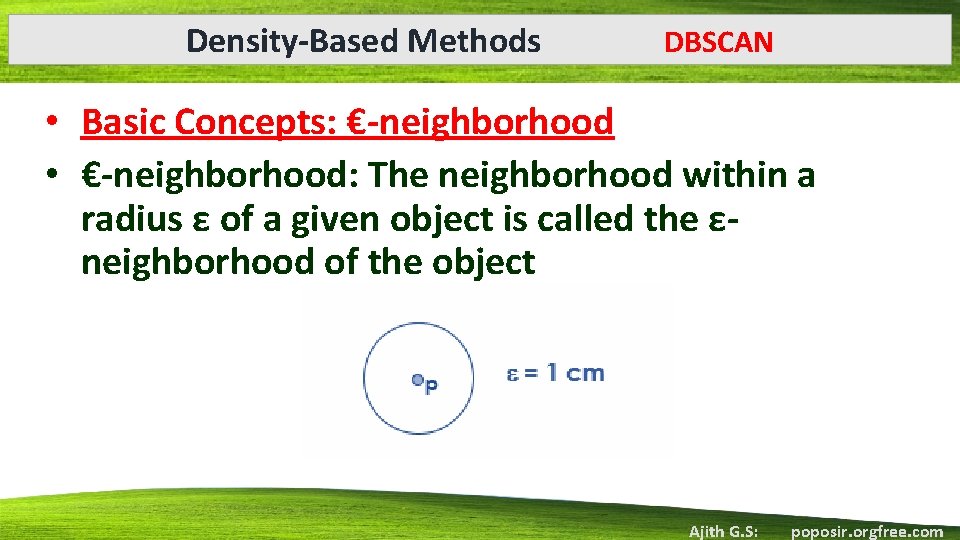
Density-Based Methods DBSCAN • Basic Concepts: €-neighborhood • €-neighborhood: The neighborhood within a radius ε of a given object is called the εneighborhood of the object Ajith G. S: poposir. orgfree. com
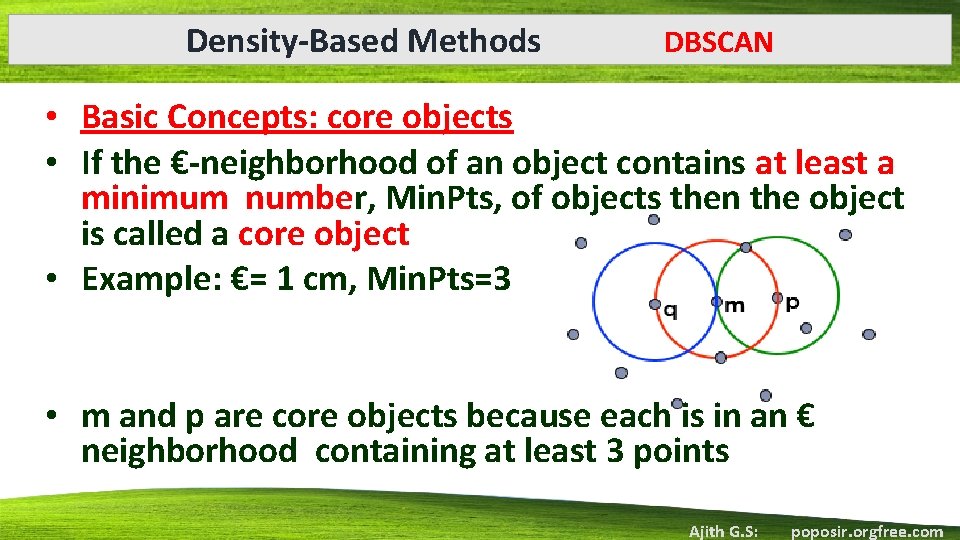
Density-Based Methods DBSCAN • Basic Concepts: core objects • If the €-neighborhood of an object contains at least a minimum number, Min. Pts, of objects then the object is called a core object • Example: €= 1 cm, Min. Pts=3 • m and p are core objects because each is in an € neighborhood containing at least 3 points Ajith G. S: poposir. orgfree. com
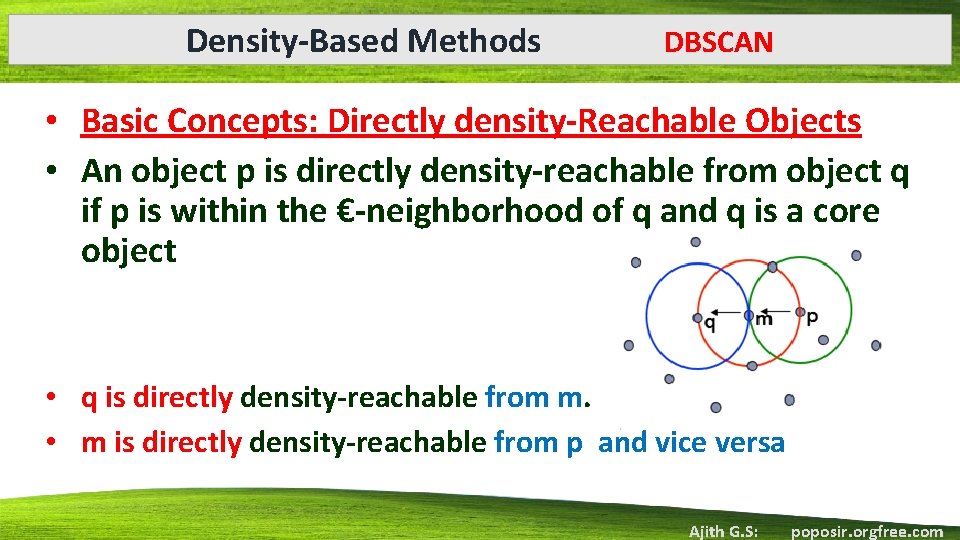
Density-Based Methods DBSCAN • Basic Concepts: Directly density-Reachable Objects • An object p is directly density-reachable from object q if p is within the €-neighborhood of q and q is a core object • q is directly density-reachable from m. • m is directly density-reachable from p and vice versa Ajith G. S: poposir. orgfree. com
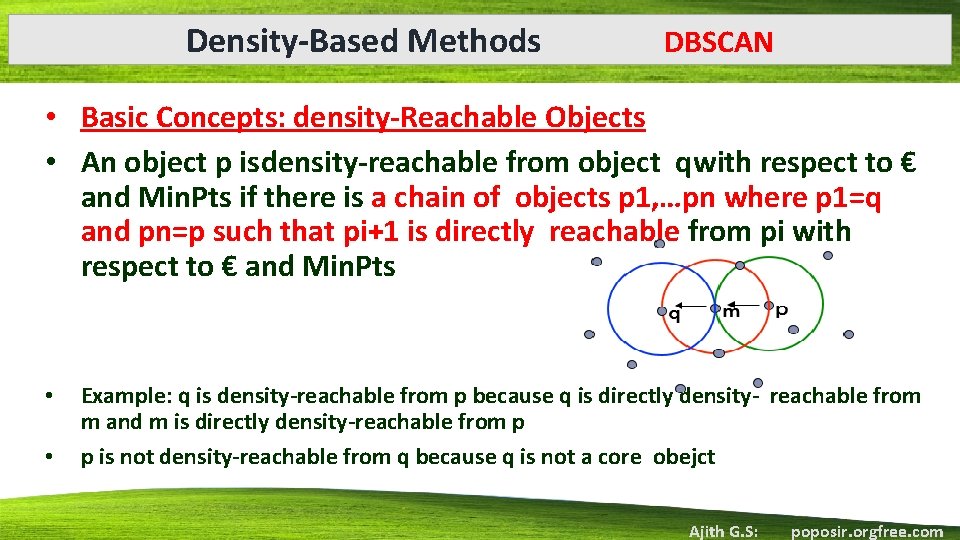
Density-Based Methods DBSCAN • Basic Concepts: density-Reachable Objects • An object p isdensity-reachable from object qwith respect to € and Min. Pts if there is a chain of objects p 1, …pn where p 1=q and pn=p such that pi+1 is directly reachable from pi with respect to € and Min. Pts • • Example: q is density-reachable from p because q is directly density- reachable from m and m is directly density-reachable from p p is not density-reachable from q because q is not a core obejct Ajith G. S: poposir. orgfree. com

Density-Based Methods DBSCAN • Basic Concepts: density-connected • An object p is density-connected to object qwith respect to € and Min. Pts if there is an object O such as both p and q are density reachable from O with respect to € and Min. Pts • Example: p, q and m are all density connected Ajith G. S: poposir. orgfree. com
Density-Based Methods DBSCAN Working • DBSCAN searches for clusters by checking the € neighborhood of each point in the database • If the € -neighborhood of a point p contains more than Min. Pts, a new cluster with p as a core object is created. • DBSCAN then iteratively collects directly densityreachable objects from these core objects, which may involve the merge of a few density-reachable clusters. • The process terminates when no new point can be added to any cluster. Ajith G. S: poposir. orgfree. com
Grid-Based Methods • The grid-based clustering approach uses a multiresolution grid data structure. • It quantizes the object space into a finite number of cells that form a grid structure on which all of the operations for clustering are performed. • The main advantage is its fast processing time, which depends only on the number of cells 1) STING: explores statistical information stored in the grid cells 2) Wave. Cluster: clusters objects using a wavelet transform method 3) CLIQUE: represents a grid-and density-based approach for clustering in high-dimensional data space Ajith G. S: poposir. orgfree. com
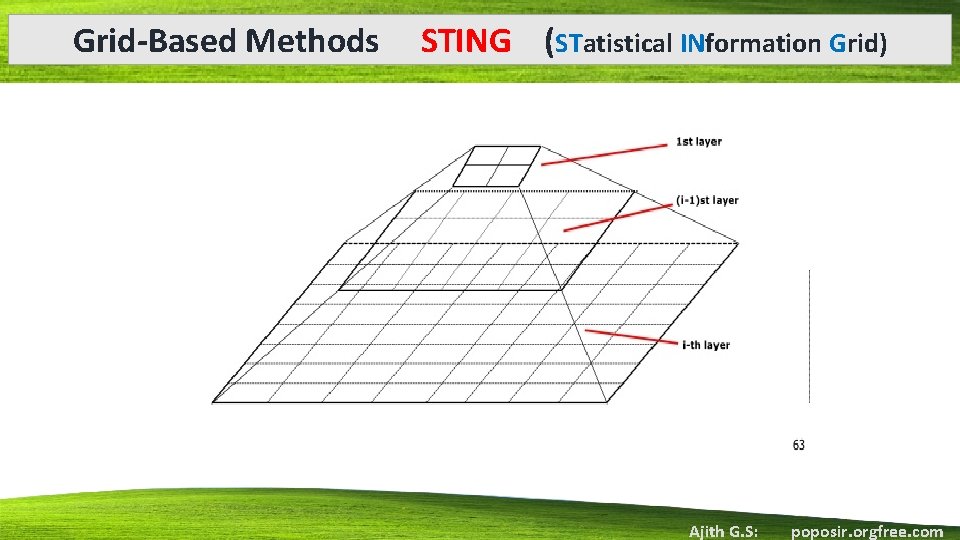
Grid-Based Methods STING (STatistical INformation Grid) • Spatial area is divided into rectangular cells. • There are usually several levels of such rectangular cells that forms a hierarchical structure • Each cell at a high level is partitioned to form a number of cells at the next lower level • Statistical information regarding the attributes in each grid cell (such as the mean, maximum, and minimum values) is pre-computed and stored. • These statistical parameters are useful for query processing Ajith G. S: poposir. orgfree. com
Grid-Based Methods STING (STatistical INformation Grid) • Statistical parameters of higher levels can easily be computed from parameters of the lower level cells. • The parameters for the bottom level cell can be computed directly from the data • The parameters of the higher levels can be computed from the corresponding lower level cells Ajith G. S: poposir. orgfree. com
Grid-Based Methods STING (STatistical INformation Grid) Ajith G. S: poposir. orgfree. com
Grid-Based Methods STING Query Processing • User top-down approach to answer spatial data queries • First, a layer within the hierarchical structure is determined from which the query-answering process is to start. • For each cell in the current layer, compute the confidence interval (or estimated range of probability) the cell’s relevancy to the given query. • The irrelevant cells are removed from further consideration. • Processing of the next lower level examines only the remaining relevant cells. • This process is repeated until the bottom layer is reached. Ajith G. S: poposir. orgfree. com
Grid-Based Methods STING Query Processing • At this time, if the query specification is met, the regions of relevant cells that satisfy the query are returned. • Otherwise, the data that fall into the relevant cells are retrieved and further processed until they meet the requirements of the query Ajith G. S: poposir. orgfree. com
Grid-Based Methods STING Advantages • Grid-based computation is query-independent: Each cell holds the summary information • The grid structure facilitates parallel processing and incremental updating • Time complexity of generating clusters is O(n), where n is the total number of objects. • The query processing time is O(g), where g is the total number of grid cells at the lowest level Ajith G. S: poposir. orgfree. com
Grid-Based Methods Wave. Cluster • Multiresolution clustering algorithm combines the grid and density based algorithm • It summarizes the data by imposing a multidimensional grid structure onto the data space represented in a n-dimensional feature space • It then uses a wavelet transformation to find the dense regions in the transformed space. • A wavelet transform is a signal processing technique that decomposes a signal into different frequency subbands. Ajith G. S: poposir. orgfree. com
Grid-Based Methods Wave. Cluster • In applying a wavelet transform, data are transformed so as to preserve the relative distance between objects at different levels of resolution • Clusters can then be identified by searching for dense regions in the new domain Ajith G. S: poposir. orgfree. com
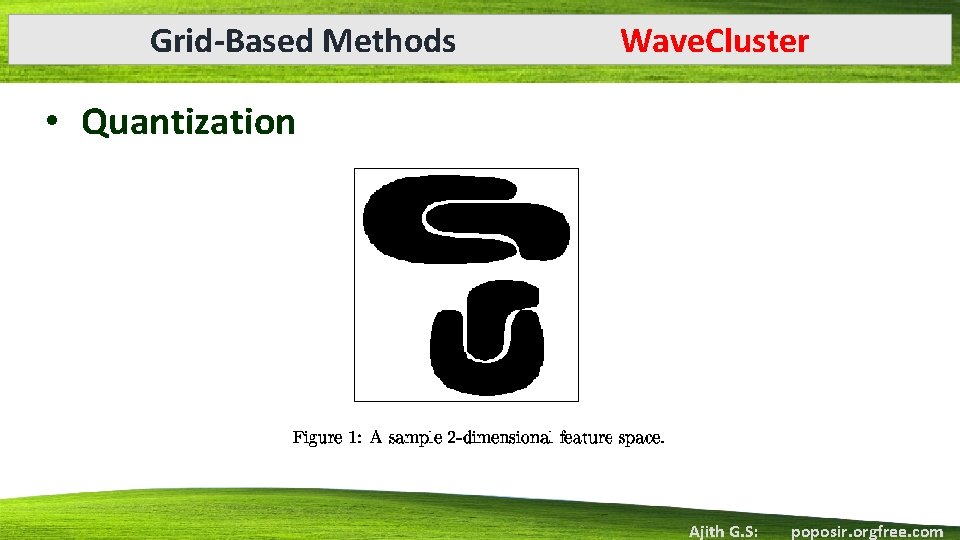
Grid-Based Methods Wave. Cluster • Quantization Ajith G. S: poposir. orgfree. com
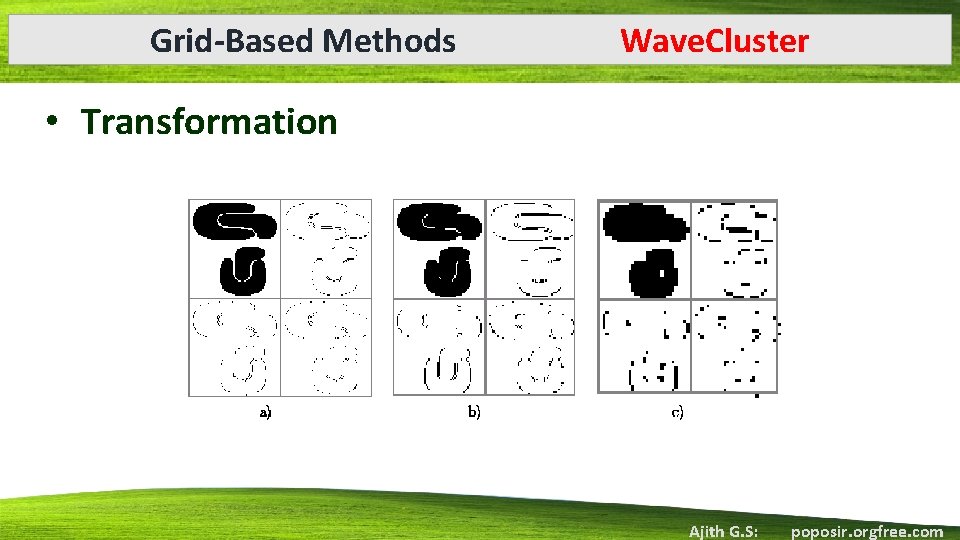
Grid-Based Methods Wave. Cluster • Transformation Ajith G. S: poposir. orgfree. com
Grid-Based Methods Wave. Cluster Advantages • It provides unsupervised clustering • Detects clusters at varying levels of accuracy • Wavelet-based clustering is very fast computational complexity of O(n), where n is the number of objects in the database • Handles large data sets efficiently • Able to discover clusters with arbitrary shape • Handles outliers • Insensitive to the order of input and does not require the specification of input parameters Ajith G. S: poposir. orgfree. com
Model-Based Clustering Methods • Attempt to optimize the fit between the data and some mathematical model • Assumption: Data are generated by a mixture of underlying probability distributions • 3 important methods are: 1) Expectation-Maximization 2) Conceptual Clustering 3) Neural Network Approach Ajith G. S: poposir. orgfree. com
Model-Based Clustering Methods Expectation-Maximization • Extension of the k-means partitioning algorithm • Each cluster can be represented mathematically by a parametric probability distribution. • The entire data is a mixture of these distributions • Each individual distribution component distribution. • Problem : to estimate the parameters of the probability distributions so as to best fit the data • The EM algorithm for finding the parameter estimates • EM assigns each object to a cluster according to a weight representing the probability of membership Ajith G. S: poposir. orgfree. com
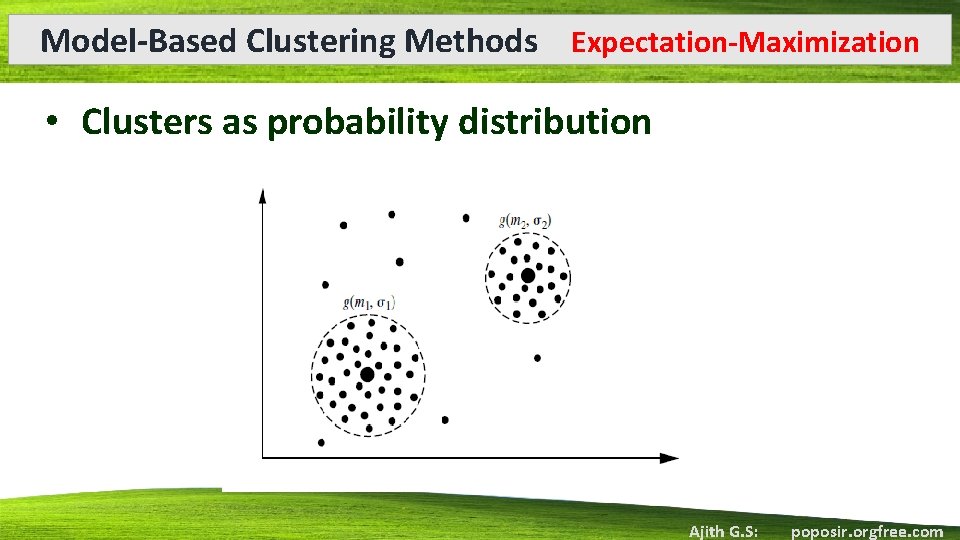
Model-Based Clustering Methods Expectation-Maximization • Clusters as probability distribution Ajith G. S: poposir. orgfree. com
Model-Based Clustering Methods Expectation-Maximization Working • Step 1: • Make an initial guess of the parameter vector • This involves randomly selecting k objects to represent the cluster means or centres (as in kmeans partitioning), as well as making guesses for the additional parameters. Ajith G. S: poposir. orgfree. com
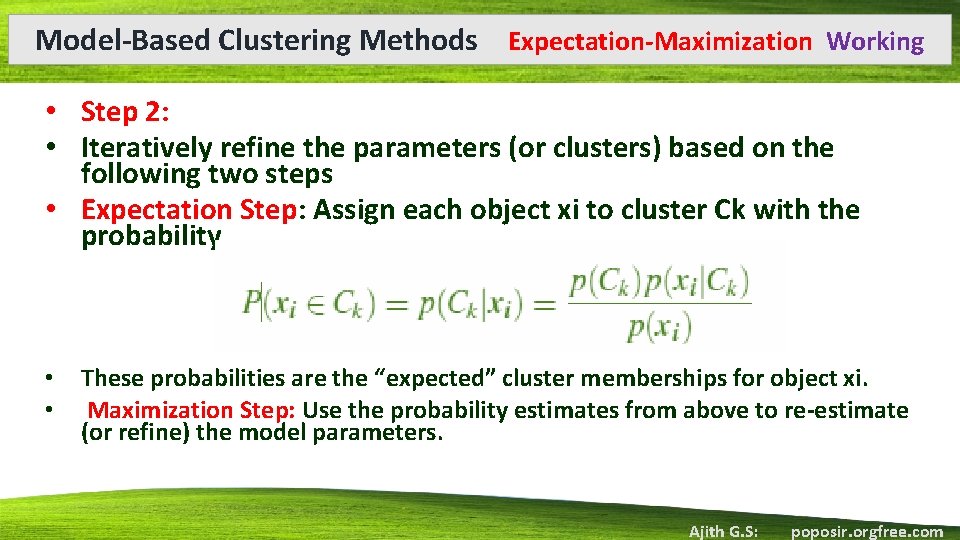
Model-Based Clustering Methods Expectation-Maximization Working • Step 2: • Iteratively refine the parameters (or clusters) based on the following two steps • Expectation Step: Assign each object xi to cluster Ck with the probability • • These probabilities are the “expected” cluster memberships for object xi. Maximization Step: Use the probability estimates from above to re-estimate (or refine) the model parameters. Ajith G. S: poposir. orgfree. com
Model-Based Clustering Methods Expectation-Maximization Advantage • Simple and easy to implement • The computational complexity is linear in d (the number of input features), n (the number of objects), and t (the number of iterations). • Note: Auto. Class is a popular Bayesian clustering method that uses a variant of the EM algorithm Ajith G. S: poposir. orgfree. com
Model-Based Clustering Methods Conceptual Clustering • A form of clustering in machine learning that, given a set of unlabelled objects, produces a classification scheme for objects. • It finds characteristic descriptions for each group • Hence it is a 2 step process • Clustering • Characterization • COBWEB is a popular and simple method of incremental conceptual clustering Ajith G. S: poposir. orgfree. com
Model-Based Clustering Methods Conceptual Clustering COBWEB • Creates a hierarchical clustering in the form of a classification tree. • Each node in a classification tree refers to a concept and contains a probabilistic description of that concept, which summarizes the objects classified under the node. • The probabilistic description includes the probability of the concept and conditional probabilities of the form P(Ai = vij/Ck), where Ai = vij is an attribute-value pair • The sibling nodes at a given level of a classification tree are said to form a partition. Ajith G. S: poposir. orgfree. com
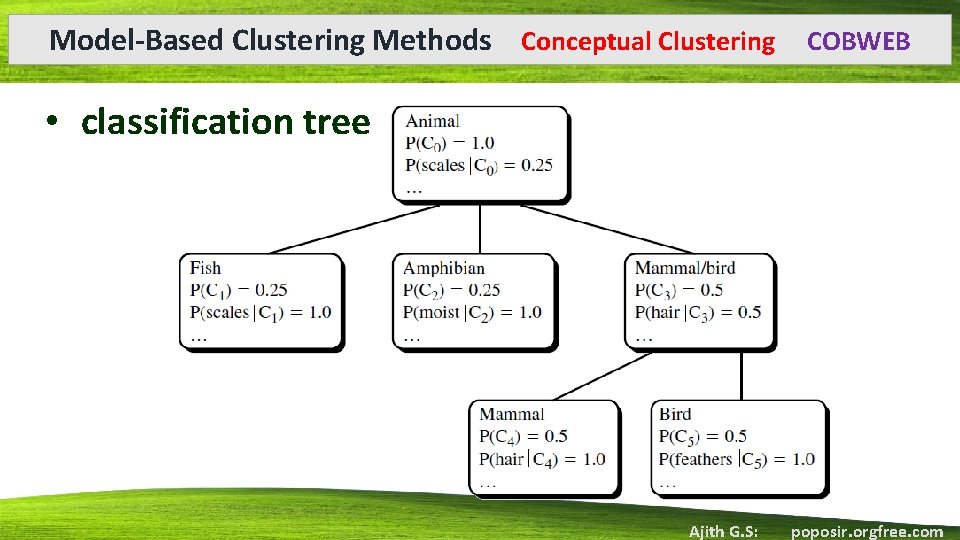
Model-Based Clustering Methods Conceptual Clustering COBWEB • classification tree Ajith G. S: poposir. orgfree. com
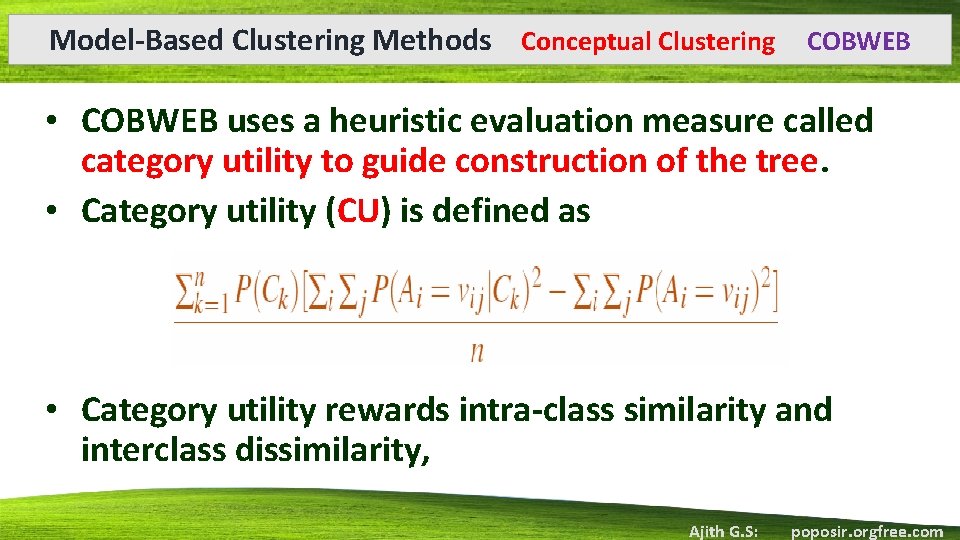
Model-Based Clustering Methods Conceptual Clustering COBWEB • COBWEB uses a heuristic evaluation measure called category utility to guide construction of the tree. • Category utility (CU) is defined as • Category utility rewards intra-class similarity and interclass dissimilarity, Ajith G. S: poposir. orgfree. com
Model-Based Clustering Methods Conceptual Clustering COBWEB Working • Given a new object, COBWEB searches the “best host” or node at which to classify the object • It temporarily place the object in each node and computes the category utility • The placement that results in the highest category utility should be a good host for the object. • If the object does not really belong to any of the concepts, it create a new node for the given object • It computes the category utility and compares it with the existing nodes Ajith G. S: poposir. orgfree. com
Model-Based Clustering Methods Conceptual Clustering COBWEB Working • The object is then placed in an existing class, or a new class is created for it, based on the partition with the highest category utility value • COBWEB has two additional operators that help make it less sensitive to input order. • These are merging and splitting Ajith G. S: poposir. orgfree. com
Model-Based Clustering Methods Neural Network Approach • A neural network is a set of connected input/output units, where each connection has a weight associated with it. • The neural network approach to clustering tends to represent each cluster as an exemplar. • An exemplar acts as a “prototype” of the cluster and does not necessarily have to correspond to a particular data example or object. • New objects can be distributed to the cluster whose exemplar is the most similar, based on some distance measure. • The attributes of an object assigned to a cluster can be predicted from the attributes of the cluster’s exemplar. Ajith G. S: poposir. orgfree. com
- Slides: 33