
Density Volume and Mass An introduction to physical
- Slides: 10
Density, Volume and Mass An introduction to physical properties
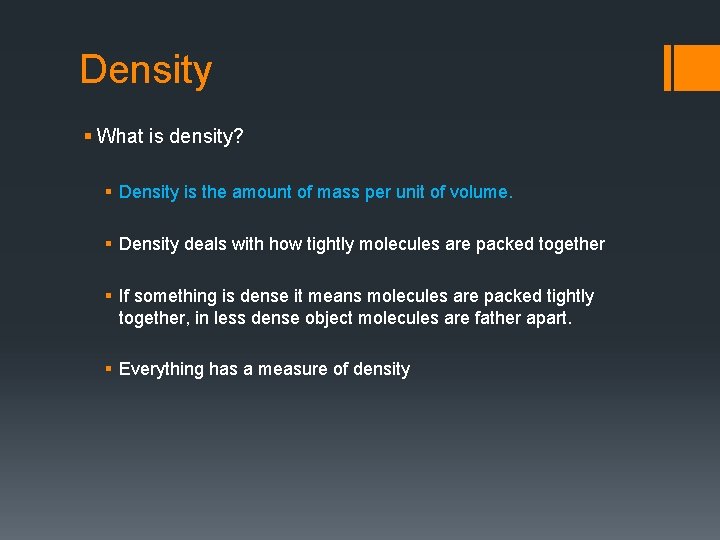
Density § What is density? § Density is the amount of mass per unit of volume. § Density deals with how tightly molecules are packed together § If something is dense it means molecules are packed tightly together, in less dense object molecules are father apart. § Everything has a measure of density
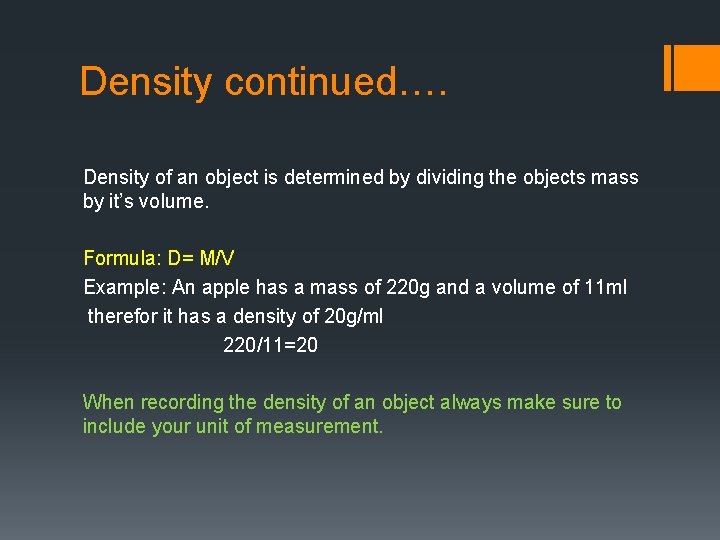
Density continued…. Density of an object is determined by dividing the objects mass by it’s volume. Formula: D= M/V Example: An apple has a mass of 220 g and a volume of 11 ml therefor it has a density of 20 g/ml 220/11=20 When recording the density of an object always make sure to include your unit of measurement.
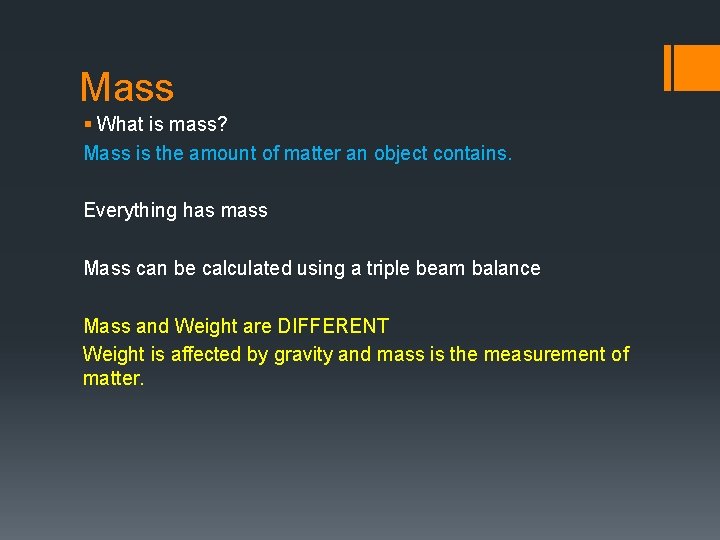
Mass § What is mass? Mass is the amount of matter an object contains. Everything has mass Mass can be calculated using a triple beam balance Mass and Weight are DIFFERENT Weight is affected by gravity and mass is the measurement of matter.
Mass continued… The base units of mass in the metric system in are kilograms and is represented by kg and grams represented by g. We will be a digital balance to find the mass of various objects.
Volume § What do you think volume is? § Volume is how much space an object takes up. § Volume can be measured in different ways § Objects that are not easily measured are called irregular (ex: an apple) § Objects that can be measured easily are called regular (ex: a box) § Anything that is made of matter has volume even gases like oxygen and nitrogen.
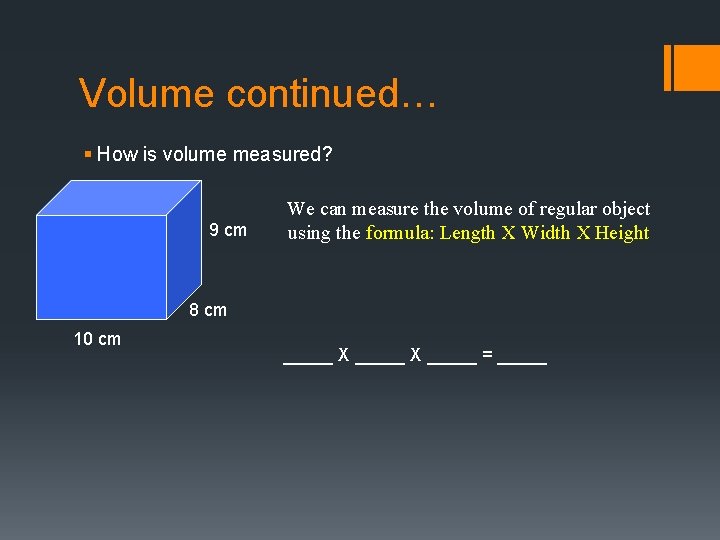
Volume continued… § How is volume measured? § _____ We can measure the volume of regular object 9 cm using the formula: Length X Width X Height 8 cm 10 cm _____ X _____ = _____
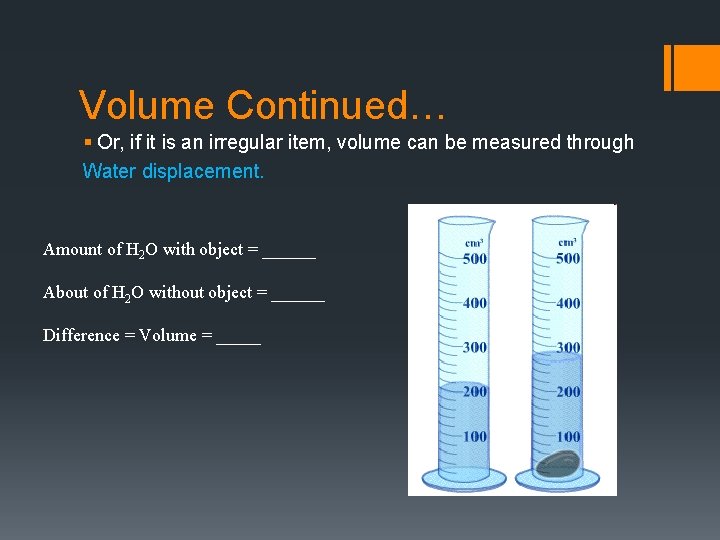
Volume Continued… § Or, if it is an irregular item, volume can be measured through Water displacement. Amount of H 2 O with object = ______ About of H 2 O without object = ______ Difference = Volume = _____
Other physical properties § There are numerous other physical properties. § Some of these physical properties of matter include: § Texture § Taste § Smell § Color § Shape § State of matter (solid, liquid, gas, plasma) These are all easily observable with the 5 senses, however some physical properties can be harder to determine.
Other physical properties § Some physical properties can be difficult to determine. Those properties include: § Brittleness- how easy it is to break the substance § Malleability- it is easy to bend or stretch without damage § Conductivity- how it transfers electricity § Boiling point- the temperature at which something boils § Freezing point- the temperature at which something freezes § Melting point- the temperature at which something melts § Ductility- When something can be stretched into wire § Elasticity- How easily something can be stretched and returned to its original shape.