
Density of States and Fermi Energy Concepts How
- Slides: 25
Density of States and Fermi Energy Concepts
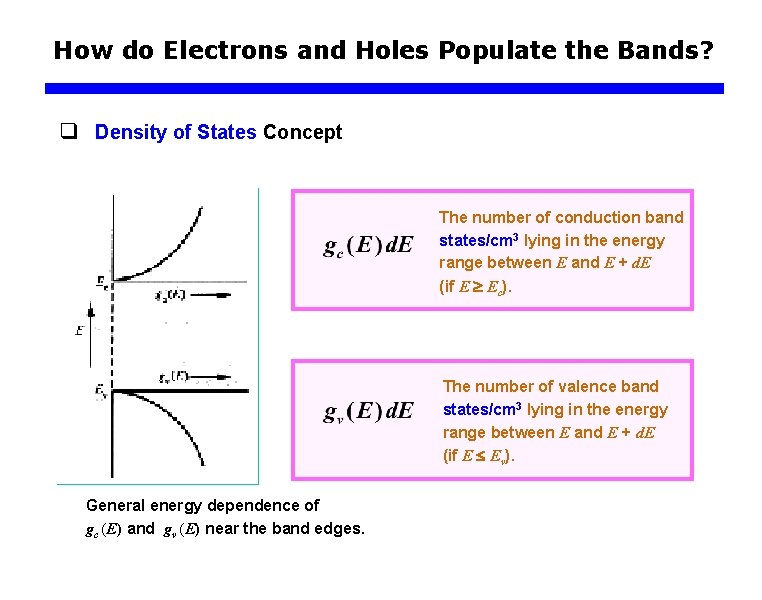
How do Electrons and Holes Populate the Bands? q Density of States Concept The number of conduction band states/cm 3 lying in the energy range between E and E + d. E (if E Ec). The number of valence band states/cm 3 lying in the energy range between E and E + d. E (if E Ev). General energy dependence of gc (E) and gv (E) near the band edges.
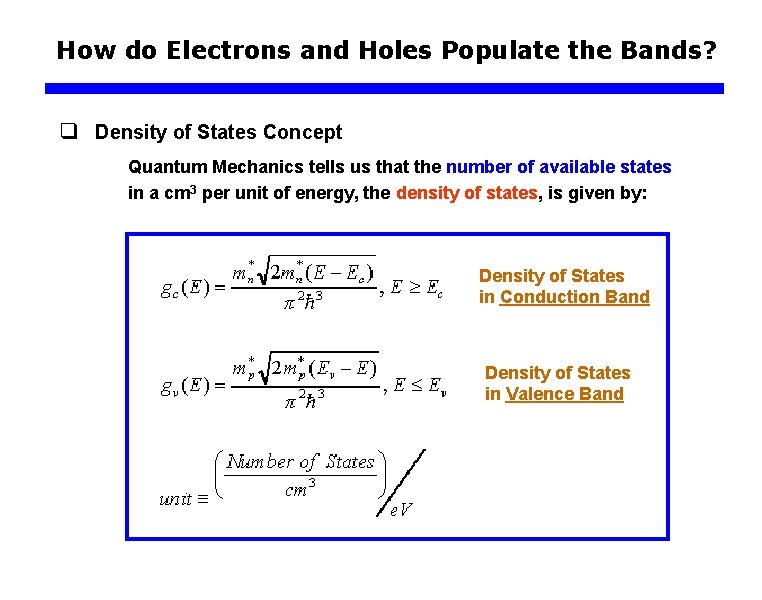
How do Electrons and Holes Populate the Bands? q Density of States Concept Quantum Mechanics tells us that the number of available states in a cm 3 per unit of energy, the density of states, is given by: Density of States in Conduction Band Density of States in Valence Band
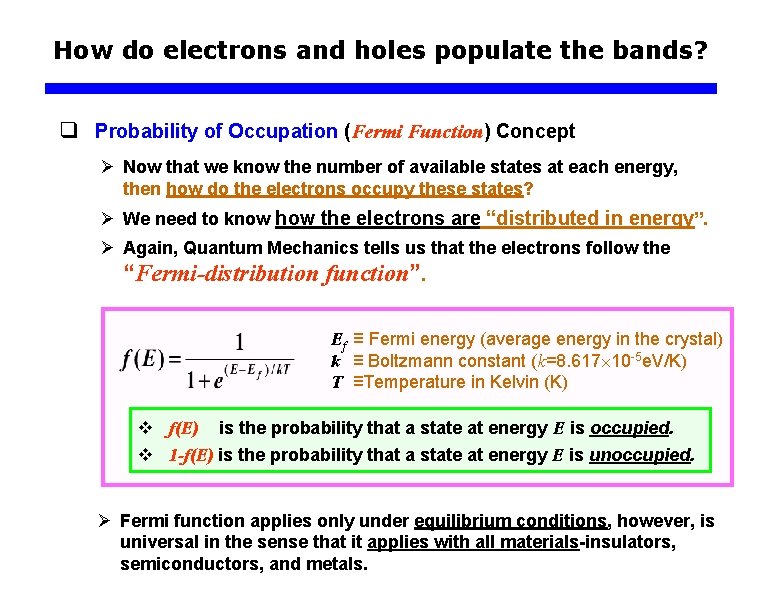
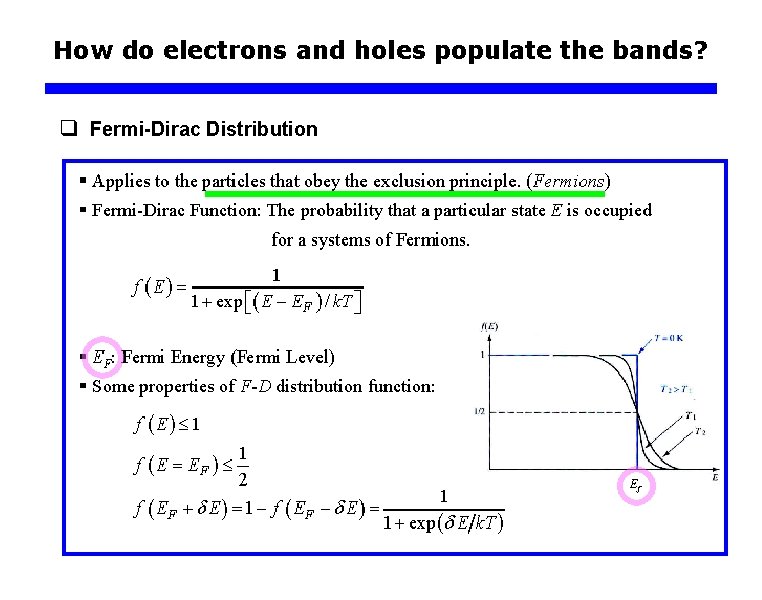
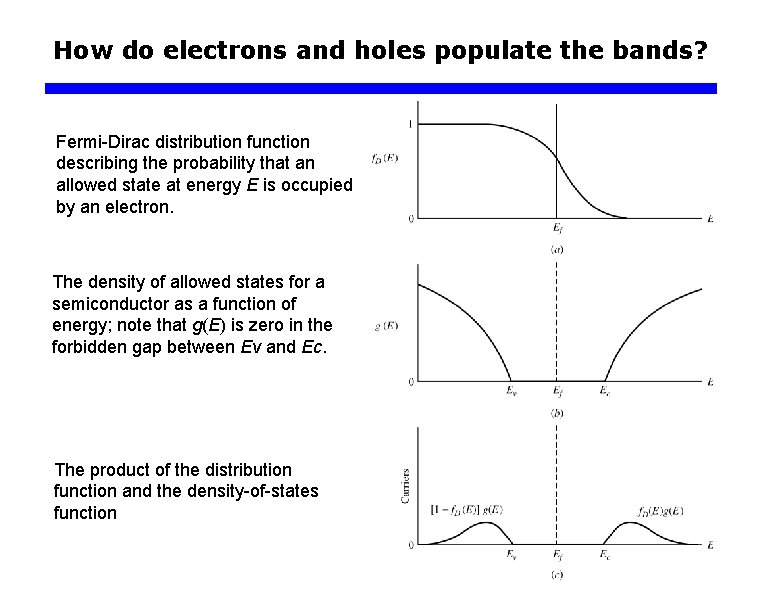
How do electrons and holes populate the bands? q Probability of Occupation (Fermi Function) Concept Ø Now that we know the number of available states at each energy, then how do the electrons occupy these states? Ø We need to know how the electrons are “distributed in energy”. Ø Again, Quantum Mechanics tells us that the electrons follow the “Fermi-distribution function”. Ef ≡ Fermi energy (average energy in the crystal) k ≡ Boltzmann constant (k=8. 617 10 -5 e. V/K) T ≡Temperature in Kelvin (K) v f(E) is the probability that a state at energy E is occupied. v 1 -f(E) is the probability that a state at energy E is unoccupied. Ø Fermi function applies only under equilibrium conditions, however, is universal in the sense that it applies with all materials-insulators, semiconductors, and metals.
How do electrons and holes populate the bands? q Fermi-Dirac Distribution Ef
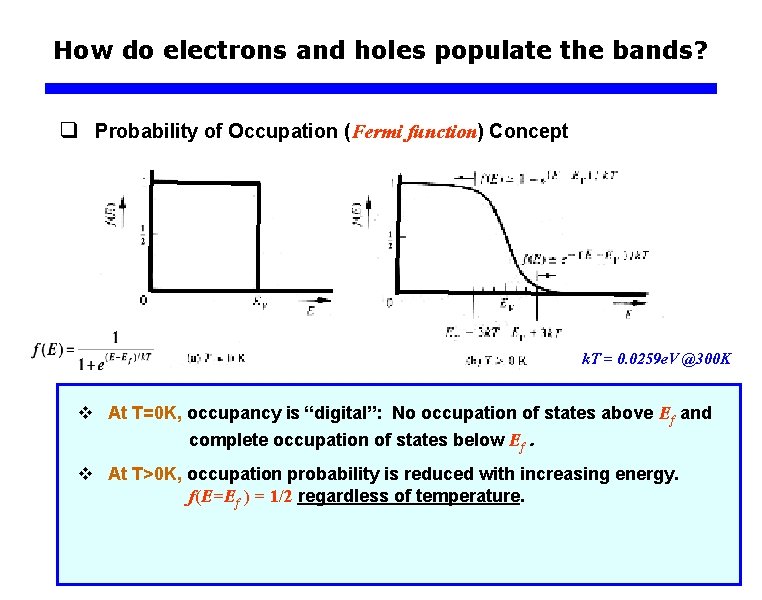
How do electrons and holes populate the bands? q Probability of Occupation (Fermi function) Concept k. T = 0. 0259 e. V @300 K v At T=0 K, occupancy is “digital”: No occupation of states above Ef and complete occupation of states below Ef. v At T>0 K, occupation probability is reduced with increasing energy. f(E=Ef ) = 1/2 regardless of temperature.
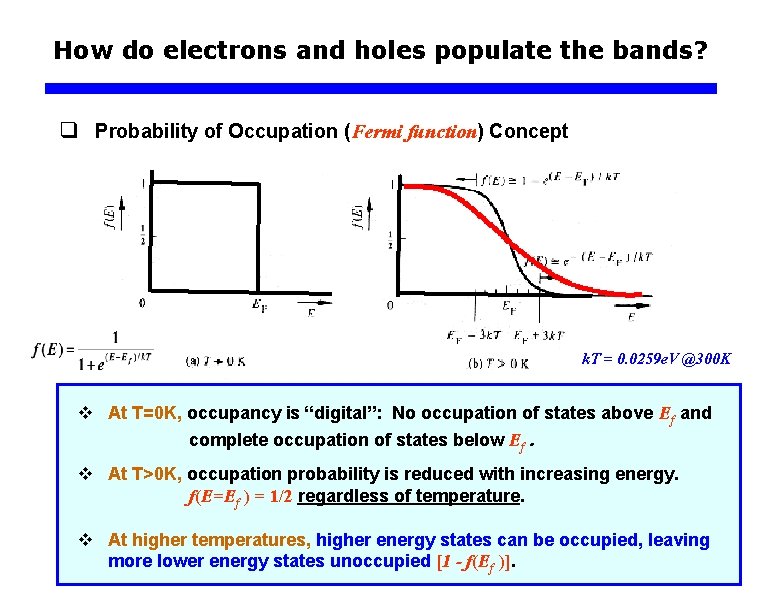
How do electrons and holes populate the bands? q Probability of Occupation (Fermi function) Concept k. T = 0. 0259 e. V @300 K v At T=0 K, occupancy is “digital”: No occupation of states above Ef and complete occupation of states below Ef. v At T>0 K, occupation probability is reduced with increasing energy. f(E=Ef ) = 1/2 regardless of temperature. v At higher temperatures, higher energy states can be occupied, leaving more lower energy states unoccupied [1 - f(Ef )].
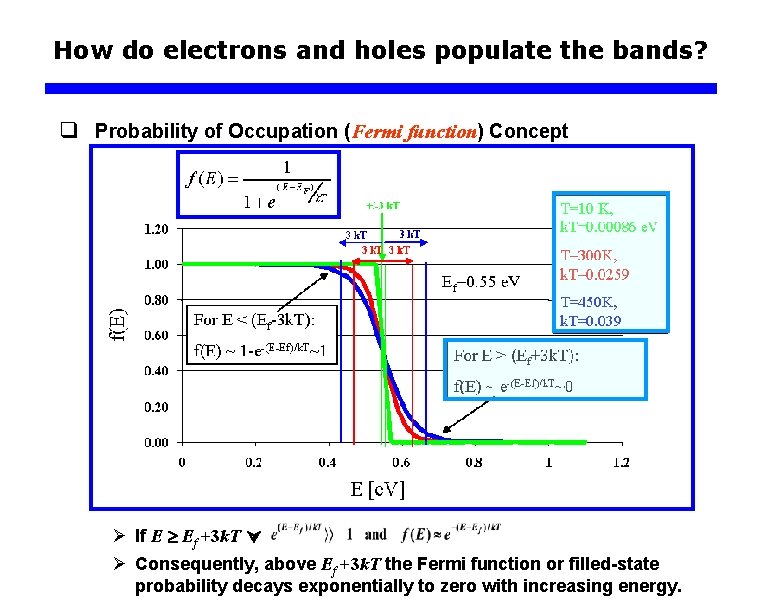
How do electrons and holes populate the bands? q Probability of Occupation (Fermi function) Concept Ø If E Ef +3 k. T Ø Consequently, above Ef +3 k. T the Fermi function or filled-state probability decays exponentially to zero with increasing energy.
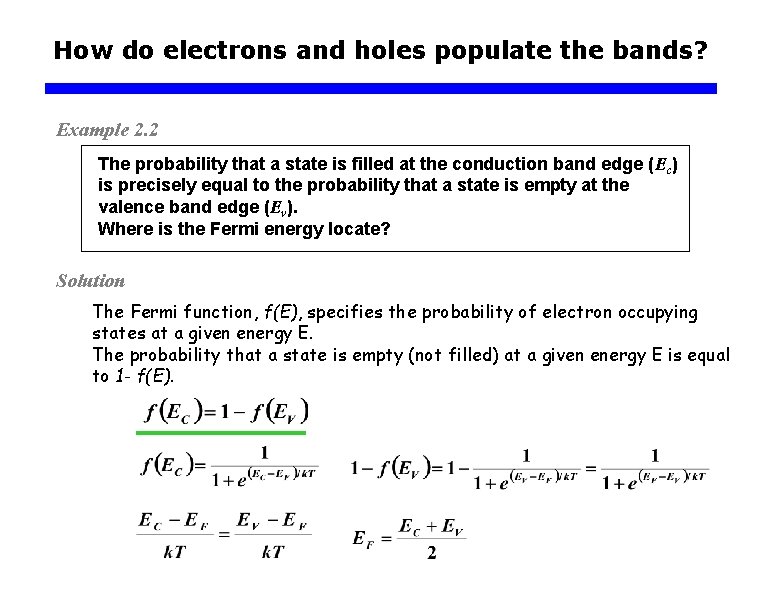
How do electrons and holes populate the bands? Example 2. 2 The probability that a state is filled at the conduction band edge (Ec) is precisely equal to the probability that a state is empty at the valence band edge (Ev). Where is the Fermi energy locate? Solution The Fermi function, f(E), specifies the probability of electron occupying states at a given energy E. The probability that a state is empty (not filled) at a given energy E is equal to 1 - f(E).
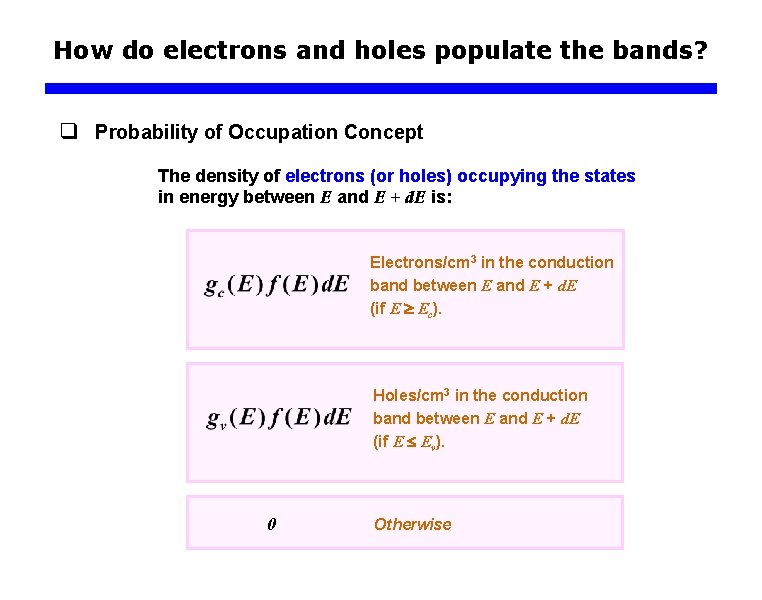
How do electrons and holes populate the bands? q Probability of Occupation Concept The density of electrons (or holes) occupying the states in energy between E and E + d. E is: Electrons/cm 3 in the conduction band between E and E + d. E (if E Ec). Holes/cm 3 in the conduction band between E and E + d. E (if E Ev). 0 Otherwise
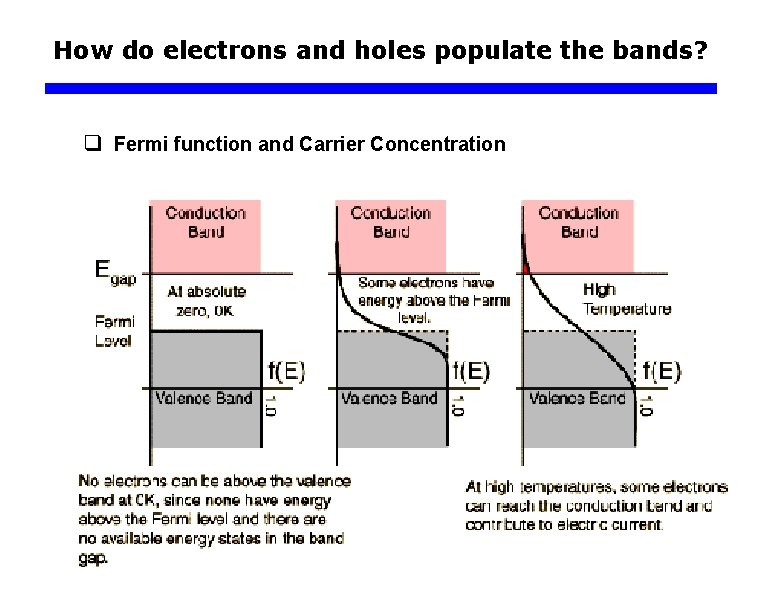
How do electrons and holes populate the bands? q Fermi function and Carrier Concentration
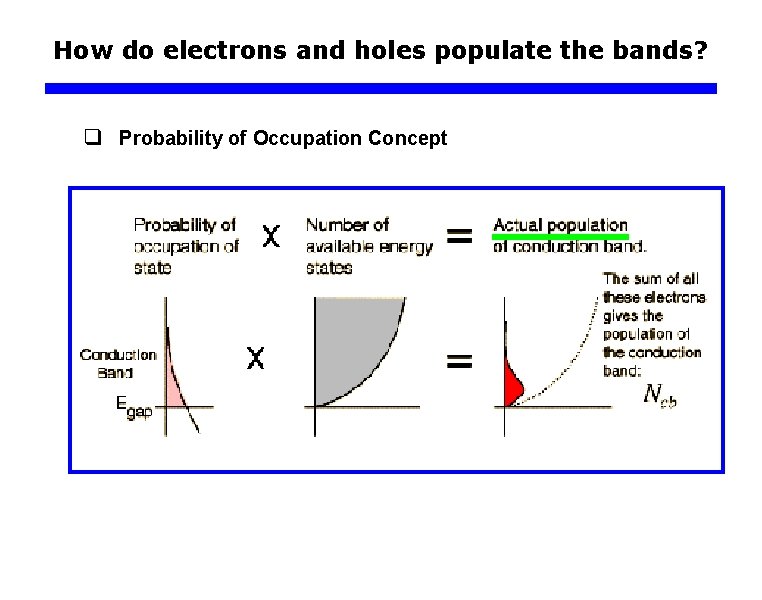
How do electrons and holes populate the bands? q Probability of Occupation Concept
How do electrons and holes populate the bands? Fermi-Dirac distribution function describing the probability that an allowed state at energy E is occupied by an electron. The density of allowed states for a semiconductor as a function of energy; note that g(E) is zero in the forbidden gap between Ev and Ec. The product of the distribution function and the density-of-states function
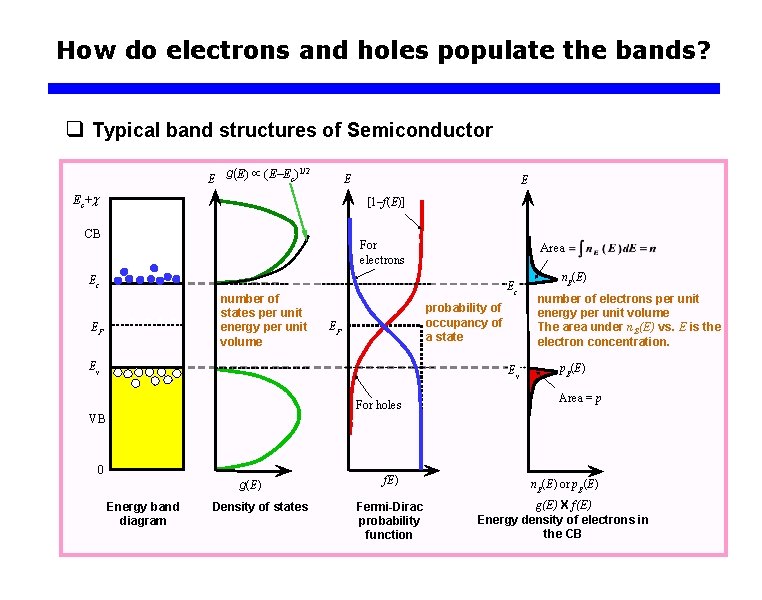
How do electrons and holes populate the bands? q Typical band structures of Semiconductor E g (E) µ (E–Ec)1/2 E Ec+c E [1–f(E)] CB For electrons Area Ec number of states per unit energy per unit volume EF Ec probability of occupancy of a state EF Ev Ev For holes n. E(E) number of electrons per unit energy per unit volume The area under n. E(E) vs. E is the electron concentration. p. E(E) Area = p VB 0 g(E) Energy band diagram Density of states f. E) n. E(E) or p. E(E) Fermi-Dirac probability function g(E) X f(E) Energy density of electrons in the CB
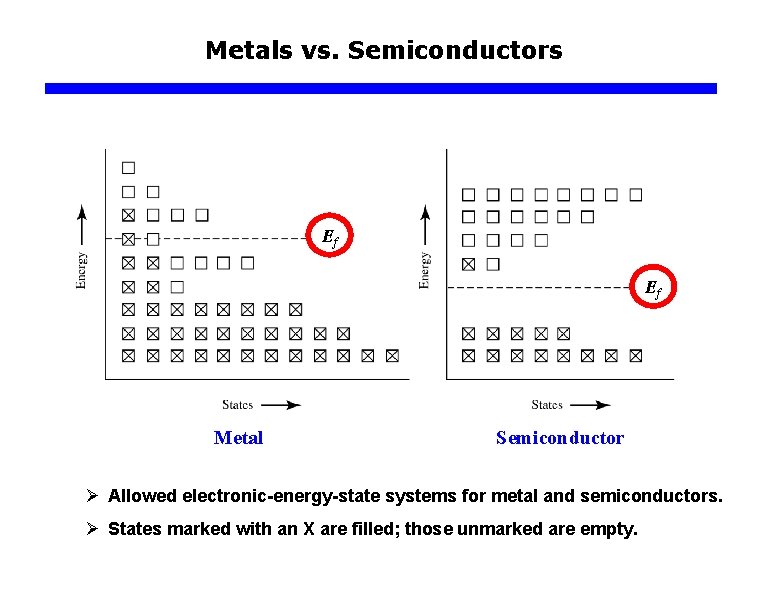
Metals vs. Semiconductors Ef Ef Metal Semiconductor Ø Allowed electronic-energy-state systems for metal and semiconductors. Ø States marked with an X are filled; those unmarked are empty.
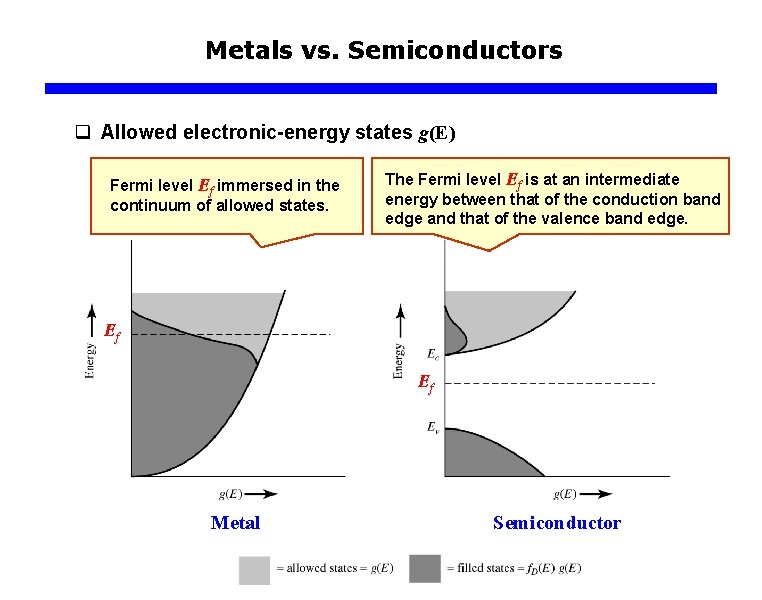
Metals vs. Semiconductors q Allowed electronic-energy states g(E) Fermi level Ef immersed in the continuum of allowed states. The Fermi level Ef is at an intermediate energy between that of the conduction band edge and that of the valence band edge. Ef Ef Metal Semiconductor
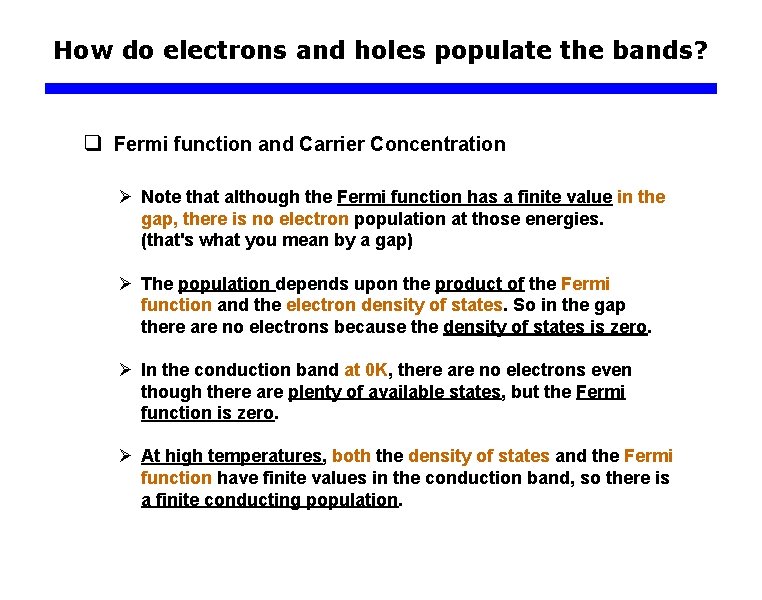
How do electrons and holes populate the bands? q Fermi function and Carrier Concentration Ø Note that although the Fermi function has a finite value in the gap, there is no electron population at those energies. (that's what you mean by a gap) Ø The population depends upon the product of the Fermi function and the electron density of states. So in the gap there are no electrons because the density of states is zero. Ø In the conduction band at 0 K, there are no electrons even though there are plenty of available states, but the Fermi function is zero. Ø At high temperatures, both the density of states and the Fermi function have finite values in the conduction band, so there is a finite conducting population.
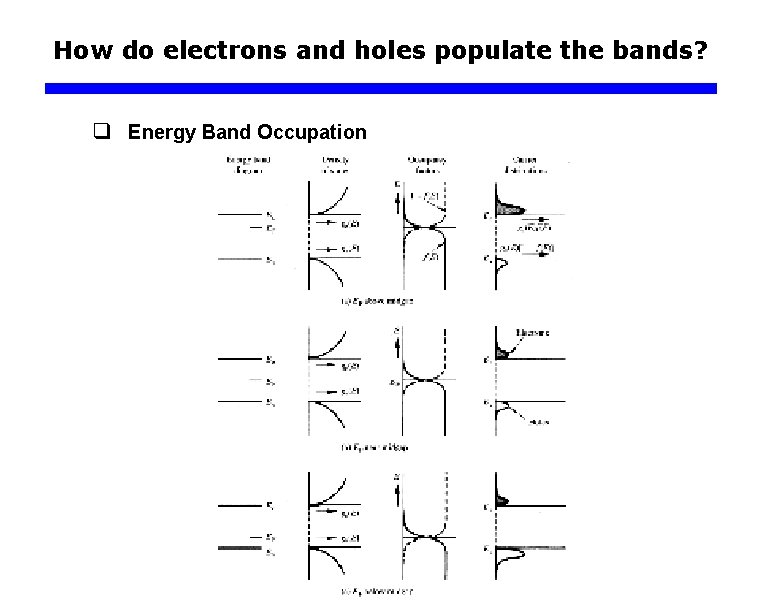
How do electrons and holes populate the bands? q Energy Band Occupation
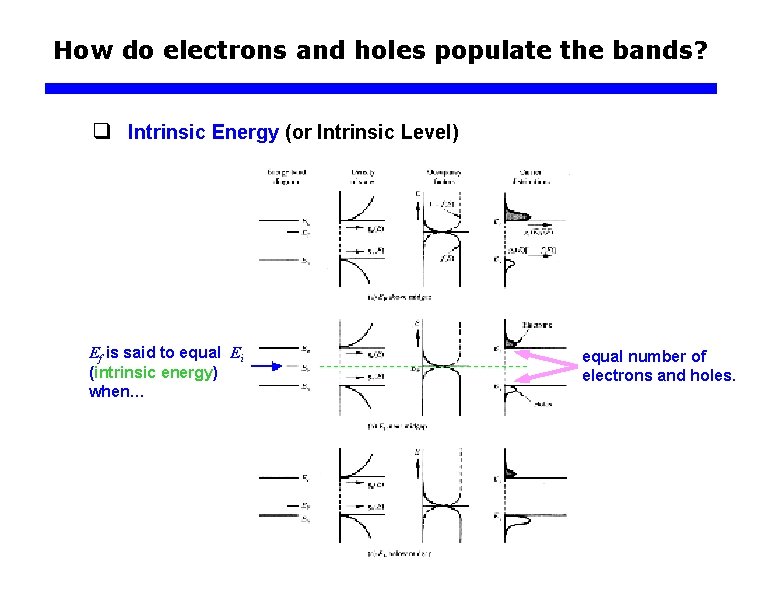
How do electrons and holes populate the bands? q Intrinsic Energy (or Intrinsic Level) Ef is said to equal Ei (intrinsic energy) when… equal number of electrons and holes.
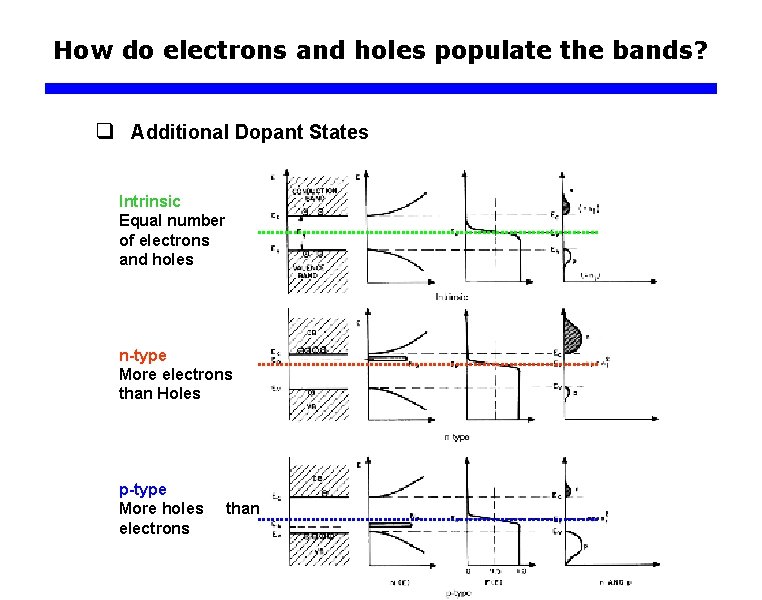
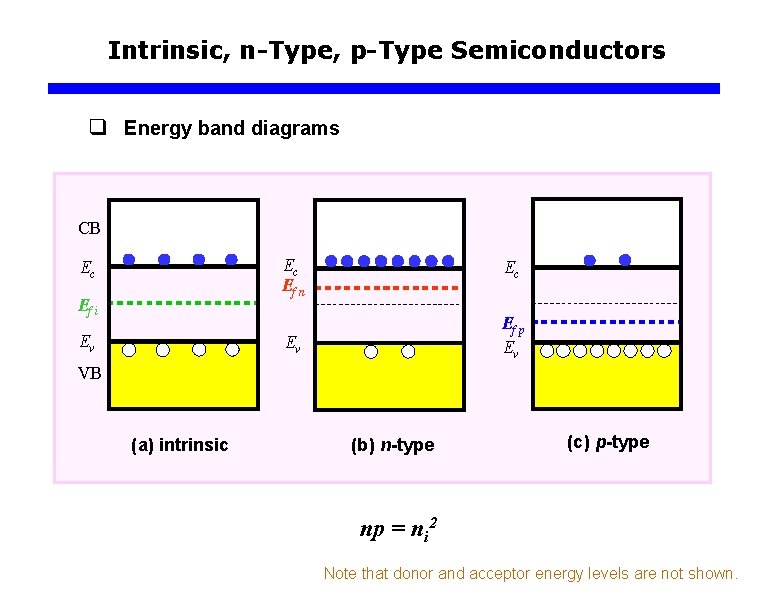
How do electrons and holes populate the bands? q Additional Dopant States Intrinsic Equal number of electrons and holes n-type More electrons than Holes p-type More holes electrons than
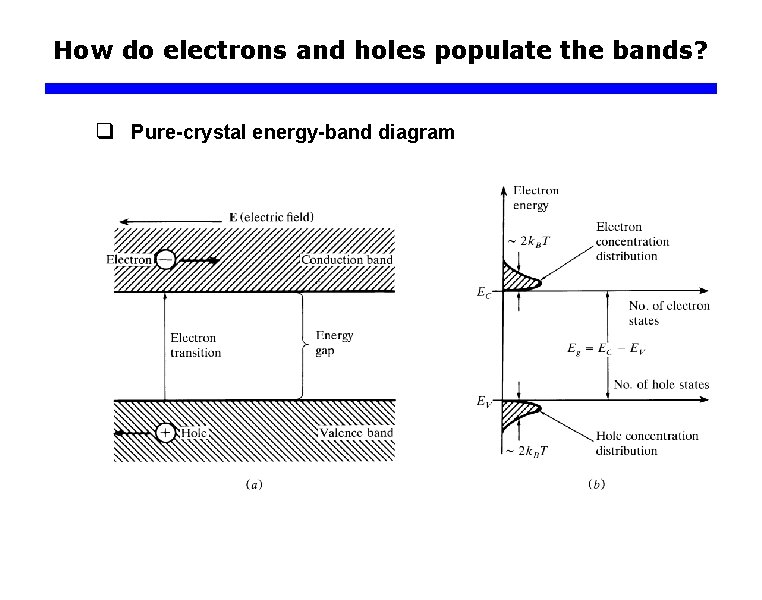
How do electrons and holes populate the bands? q Pure-crystal energy-band diagram
How do electrons and holes populate the bands? q n-type material
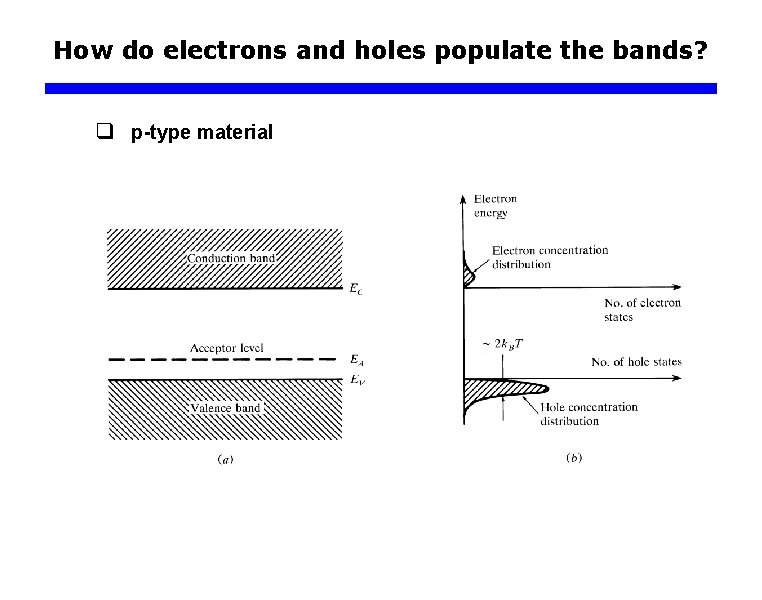
How do electrons and holes populate the bands? q p-type material
Intrinsic, n-Type, p-Type Semiconductors q Energy band diagrams CB Ec Ef i Ev Ec Ef n Ec Ev Ef p Ev VB (a) intrinsic (b) n-type (c) p-type np = ni 2 Note that donor and acceptor energy levels are not shown.
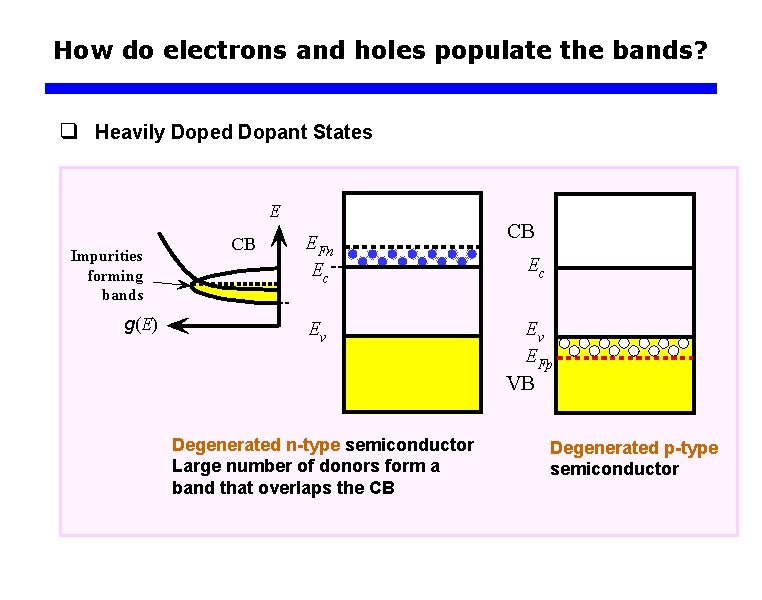
How do electrons and holes populate the bands? q Heavily Doped Dopant States E Impurities forming bands g(E) CB EFn Ec Ev CB Ec Ev EFp VB Degenerated n-type semiconductor Large number of donors form a band that overlaps the CB Degenerated p-type semiconductor