
Density Measurements of the Inner Shell Release 1
- Slides: 15
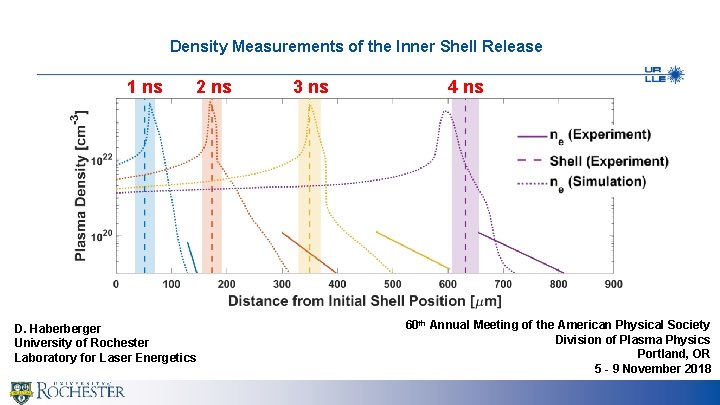
Density Measurements of the Inner Shell Release 1 ns 2 ns D. Haberberger University of Rochester Laboratory for Laser Energetics 3 ns 4 ns 60 th Annual Meeting of the American Physical Society Division of Plasma Physics Portland, OR 5 - 9 November 2018
Summary A platform was developed to study the time history of the low-density plasma release ahead of a driven shell • A 37 -µm-thick CH shell was driven with two UV (351 -nm) laser beams with a total of 6 k. J of energy in a 5 -ns pulse focused to a 750 -µm spot • The position of the driven shell was measured using streaked x-ray radiography from an aluminum backlighter • The position and density profile of the underdense plasma ahead of the shell was simultaneously measured by the 4ω probe using interferometry and angular filter refractometry • The results are compared to DRACO hydrodynamic simulations showing differences in position and scale length of the released plasma ahead of the shell
Collaborators A. Shvydky, J. P. Knauer, S. X. Hu, V. N. Goncharov, S. T. Ivancic, and D. H. Froula University of Rochester Laboratory for Laser Energetics
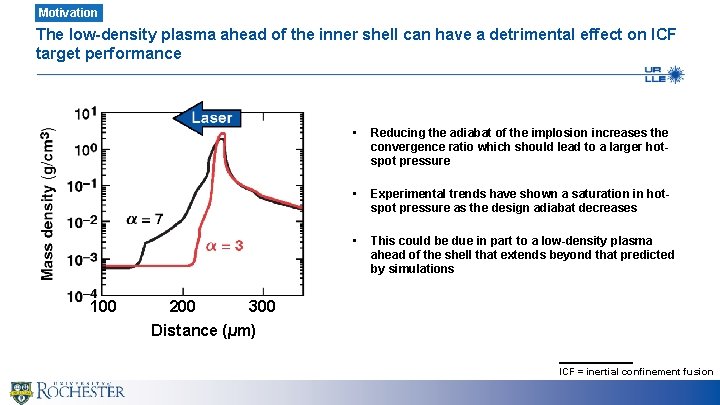
Motivation The low-density plasma ahead of the inner shell can have a detrimental effect on ICF target performance 100 • Reducing the adiabat of the implosion increases the convergence ratio which should lead to a larger hotspot pressure • Experimental trends have shown a saturation in hotspot pressure as the design adiabat decreases • This could be due in part to a low-density plasma ahead of the shell that extends beyond that predicted by simulations 200 300 Distance (µm) ICF = inertial confinement fusion
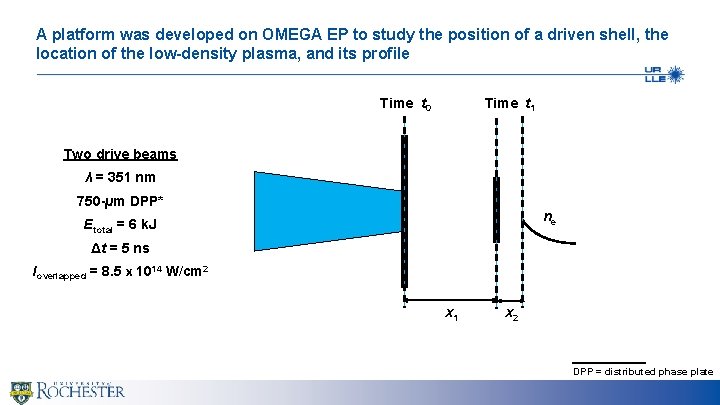
A platform was developed on OMEGA EP to study the position of a driven shell, the location of the low-density plasma, and its profile Time t 1 Time t 0 Two drive beams λ = 351 nm 750 -µm DPP* ne Etotal = 6 k. J Δt = 5 ns Ioverlapped = 8. 5 x 10¹⁴ W/cm 2 x 1 x 2 DPP = distributed phase plate
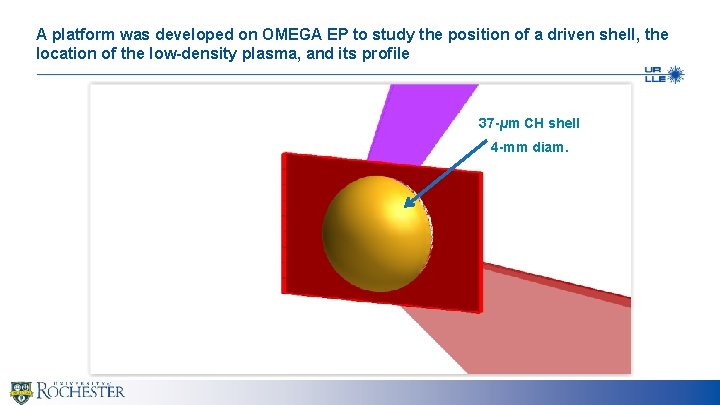
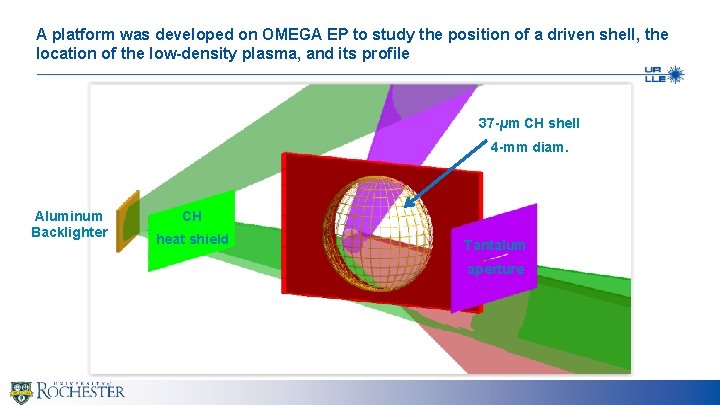
A platform was developed on OMEGA EP to study the position of a driven shell, the location of the low-density plasma, and its profile 37 -µm CH shell 4 -mm diam.
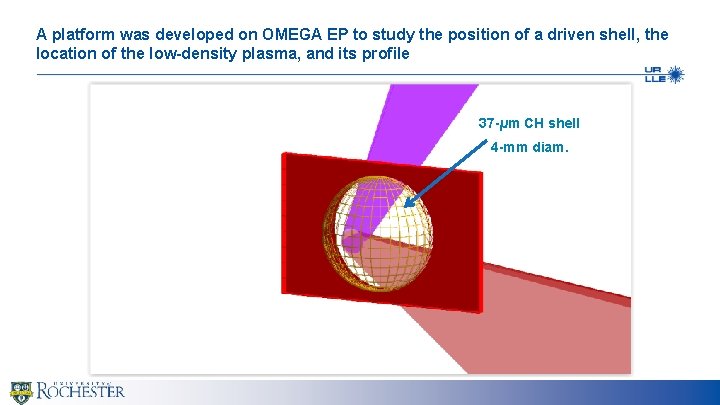
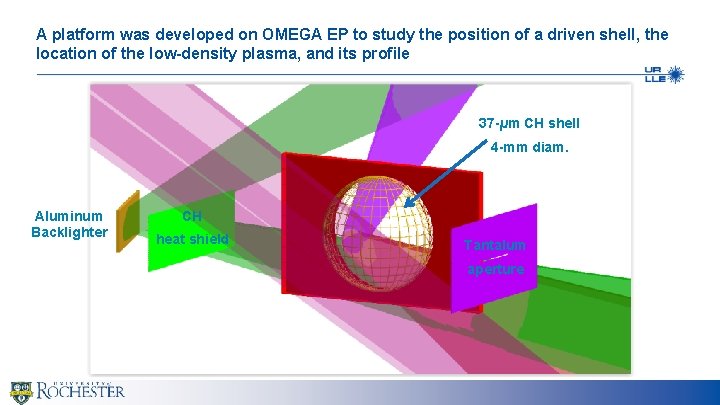
A platform was developed on OMEGA EP to study the position of a driven shell, the location of the low-density plasma, and its profile 37 -µm CH shell 4 -mm diam.
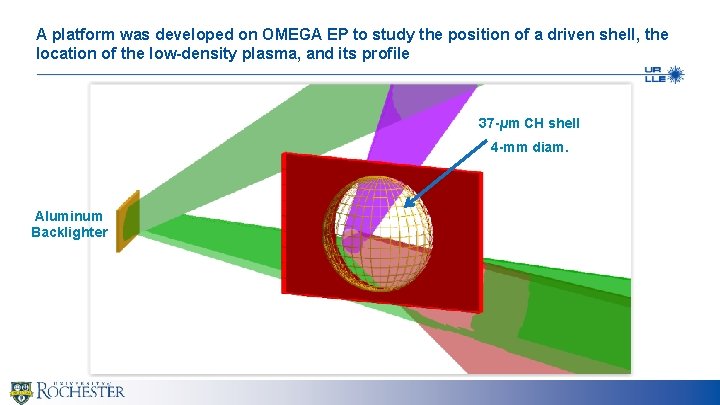
A platform was developed on OMEGA EP to study the position of a driven shell, the location of the low-density plasma, and its profile 37 -µm CH shell 4 -mm diam. Aluminum Backlighter
A platform was developed on OMEGA EP to study the position of a driven shell, the location of the low-density plasma, and its profile 37 -µm CH shell 4 -mm diam. Aluminum Backlighter CH heat shield Tantalum aperture
A platform was developed on OMEGA EP to study the position of a driven shell, the location of the low-density plasma, and its profile 37 -µm CH shell 4 -mm diam. Aluminum Backlighter CH heat shield Tantalum aperture
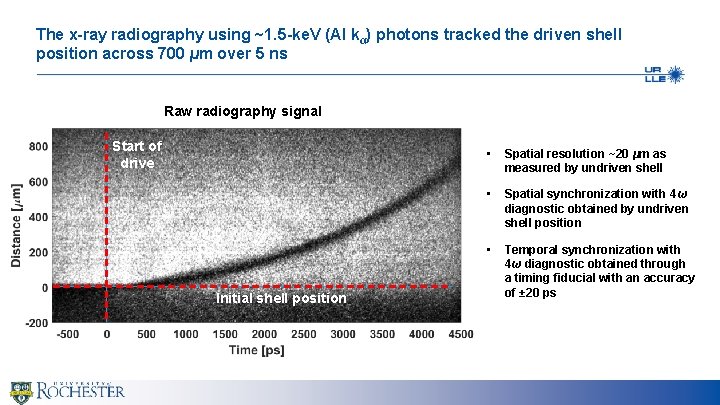
The x-ray radiography using ~1. 5 -ke. V (Al kα) photons tracked the driven shell position across 700 µm over 5 ns Raw radiography signal Start of drive Initial shell position • Spatial resolution ~20 µm as measured by undriven shell • Spatial synchronization with 4ω diagnostic obtained by undriven shell position • Temporal synchronization with 4ω diagnostic obtained through a timing fiducial with an accuracy of ± 20 ps
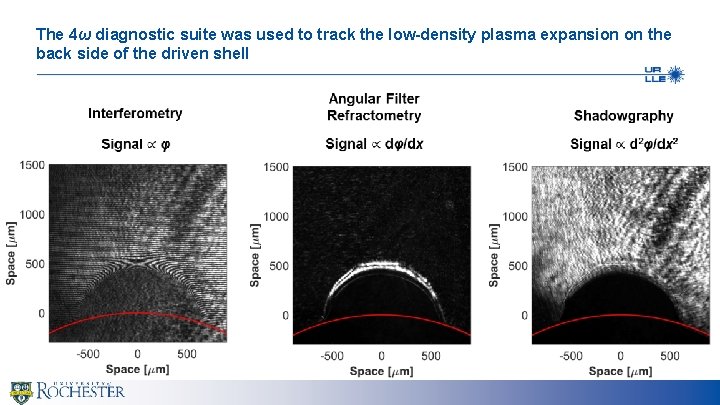
The 4ω diagnostic suite was used to track the low-density plasma expansion on the back side of the driven shell
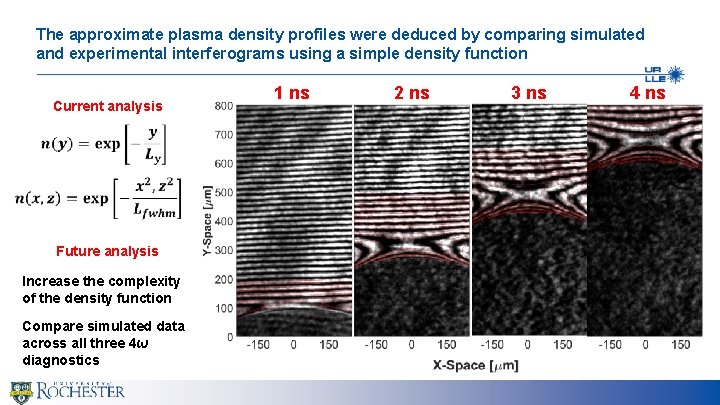
The approximate plasma density profiles were deduced by comparing simulated and experimental interferograms using a simple density function Current analysis Future analysis Increase the complexity of the density function Compare simulated data across all three 4ω diagnostics 1 ns 2 ns 3 ns 4 ns
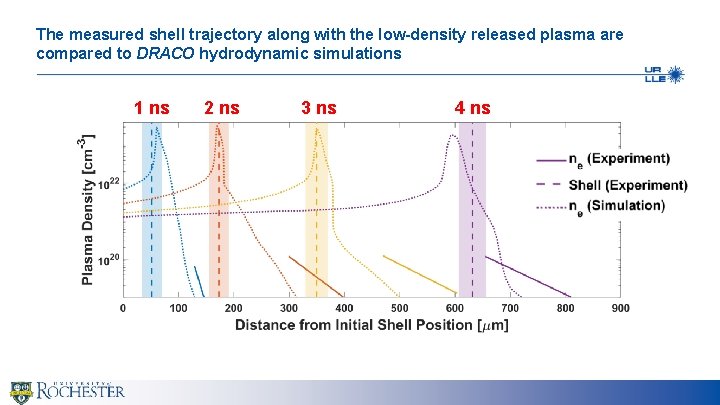
The measured shell trajectory along with the low-density released plasma are compared to DRACO hydrodynamic simulations 1 ns 2 ns 3 ns 4 ns
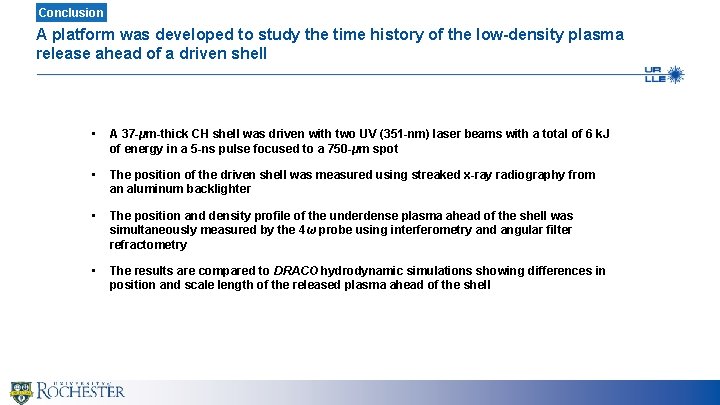
Conclusion A platform was developed to study the time history of the low-density plasma release ahead of a driven shell • A 37 -µm-thick CH shell was driven with two UV (351 -nm) laser beams with a total of 6 k. J of energy in a 5 -ns pulse focused to a 750 -µm spot • The position of the driven shell was measured using streaked x-ray radiography from an aluminum backlighter • The position and density profile of the underdense plasma ahead of the shell was simultaneously measured by the 4ω probe using interferometry and angular filter refractometry • The results are compared to DRACO hydrodynamic simulations showing differences in position and scale length of the released plasma ahead of the shell