
Density Mass Volume Foundation GCSE Questions These questions
- Slides: 11
Density, Mass & Volume – Foundation – GCSE Questions These questions are the same format as previous GCSE exams. COPY means they use the exact same numbers as the original GCSE question. Otherwise, they are clone questions using different numbers. The worksheets are provided in a variety of sizes.
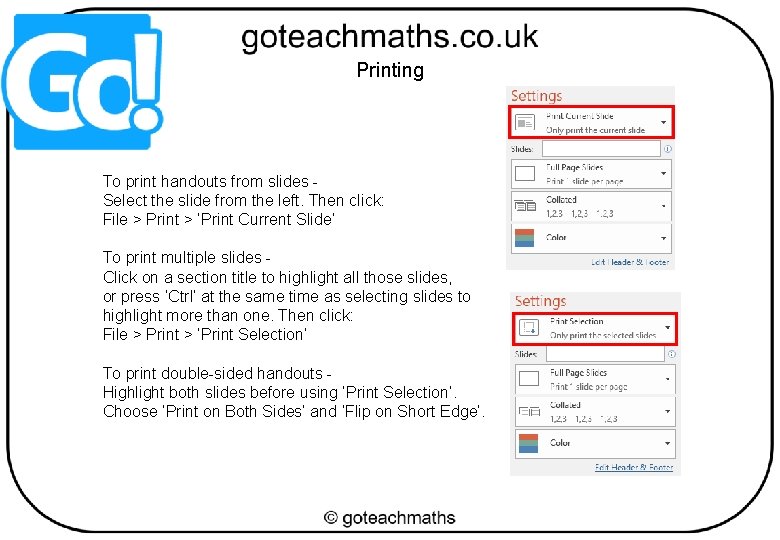
Printing To print handouts from slides Select the slide from the left. Then click: File > Print > ‘Print Current Slide’ To print multiple slides Click on a section title to highlight all those slides, or press ‘Ctrl’ at the same time as selecting slides to highlight more than one. Then click: File > Print > ‘Print Selection’ To print double-sided handouts Highlight both slides before using ‘Print Selection’. Choose ‘Print on Both Sides’ and ‘Flip on Short Edge’.
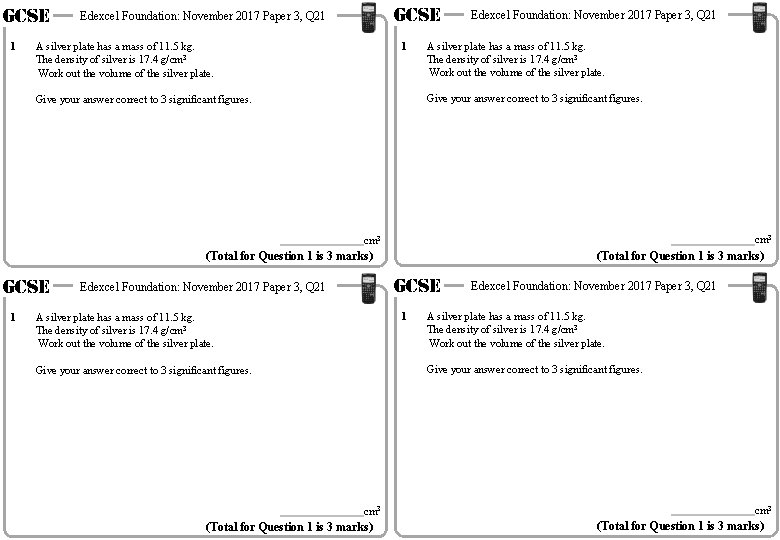
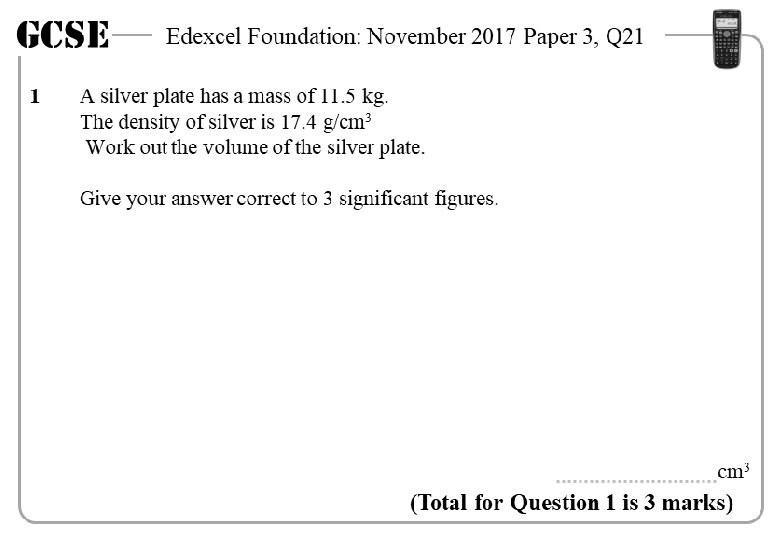
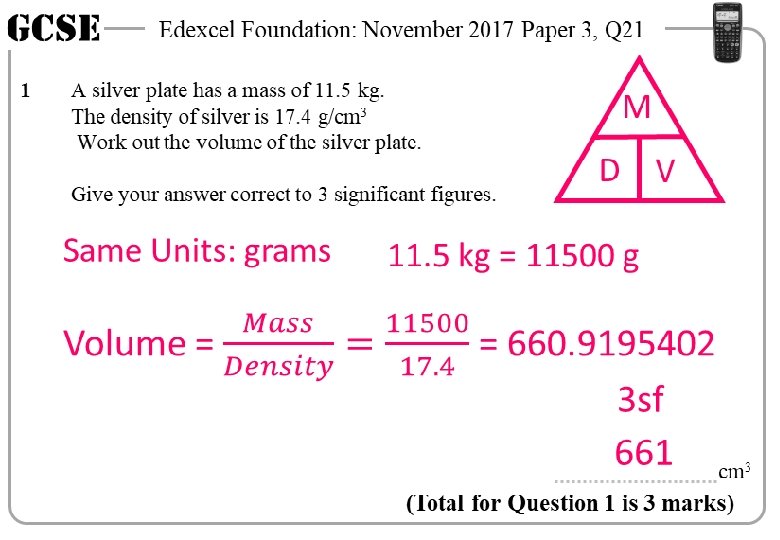
GCSE 1 GCSE Edexcel Foundation: November 2017 Paper 3, Q 21 1 A silver plate has a mass of 11. 5 kg. The density of silver is 17. 4 g/cm 3 Work out the volume of the silver plate. Edexcel Foundation: November 2017 Paper 3, Q 21 A silver plate has a mass of 11. 5 kg. The density of silver is 17. 4 g/cm 3 Work out the volume of the silver plate. Give your answer correct to 3 significant figures. cm 3 (Total for Question 1 is 3 marks)
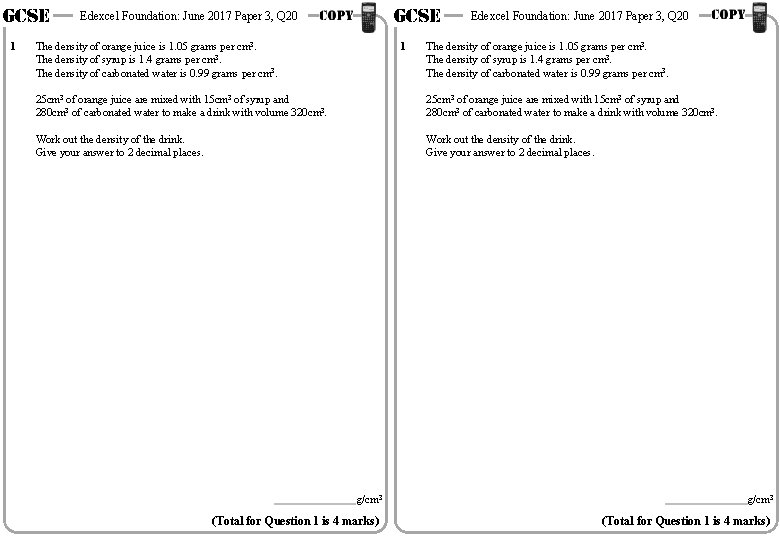
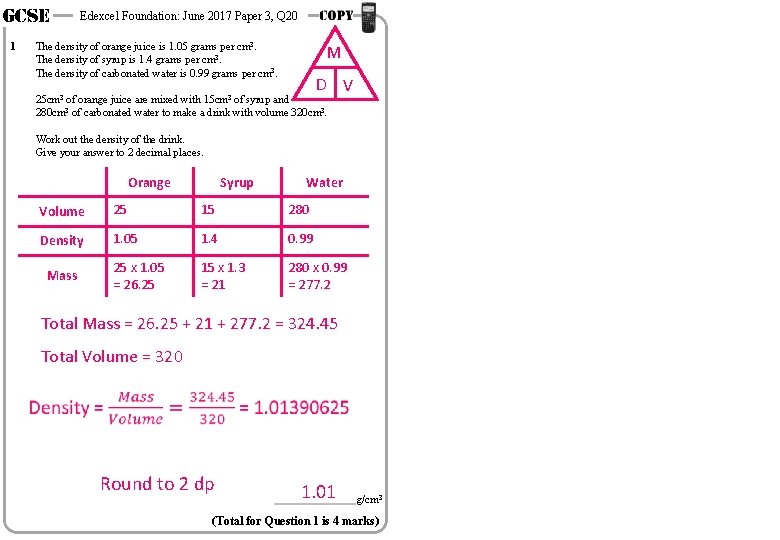
GCSE 1 GCSE Edexcel Foundation: June 2017 Paper 3, Q 20 The density of orange juice is 1. 05 grams per cm 3. The density of syrup is 1. 4 grams per cm 3. The density of carbonated water is 0. 99 grams per cm 3. 1 Edexcel Foundation: June 2017 Paper 3, Q 20 The density of orange juice is 1. 05 grams per cm 3. The density of syrup is 1. 4 grams per cm 3. The density of carbonated water is 0. 99 grams per cm 3. 25 cm 3 of orange juice are mixed with 15 cm 3 of syrup and 280 cm 3 of carbonated water to make a drink with volume 320 cm 3. Work out the density of the drink. Give your answer to 2 decimal places. g/cm 3 (Total for Question 1 is 4 marks)
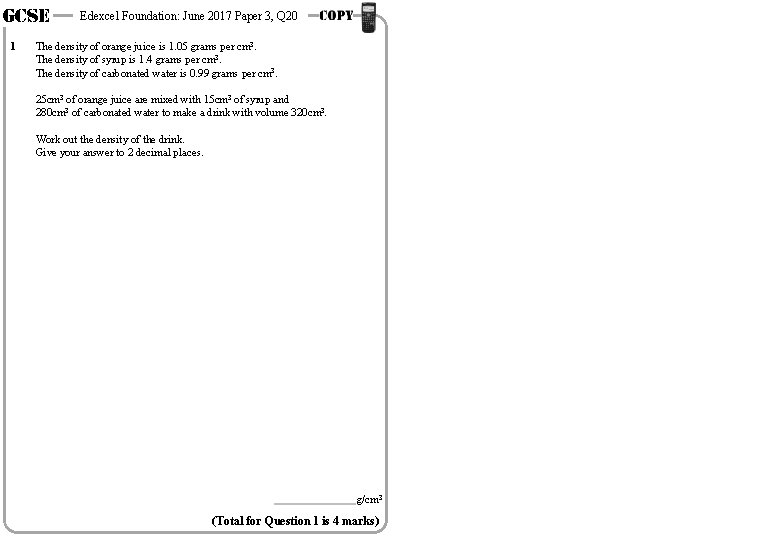
GCSE 1 Edexcel Foundation: June 2017 Paper 3, Q 20 The density of orange juice is 1. 05 grams per cm 3. The density of syrup is 1. 4 grams per cm 3. The density of carbonated water is 0. 99 grams per cm 3. 25 cm 3 of orange juice are mixed with 15 cm 3 of syrup and 280 cm 3 of carbonated water to make a drink with volume 320 cm 3. Work out the density of the drink. Give your answer to 2 decimal places. g/cm 3 (Total for Question 1 is 4 marks)
GCSE 1 Edexcel Foundation: November 2017 Paper 3, Q 21 A silver plate has a mass of 11. 5 kg. The density of silver is 17. 4 g/cm 3 Work out the volume of the silver plate. Give your answer correct to 3 significant figures. Same Units: grams M D V 11. 5 kg = 11500 g 3 sf 661 cm 3 (Total for Question 1 is 3 marks)
GCSE 1 Edexcel Foundation: June 2017 Paper 3, Q 20 The density of orange juice is 1. 05 grams per cm 3. The density of syrup is 1. 4 grams per cm 3. The density of carbonated water is 0. 99 grams per cm 3. M D V 25 cm 3 of orange juice are mixed with 15 cm 3 of syrup and 280 cm 3 of carbonated water to make a drink with volume 320 cm 3. Work out the density of the drink. Give your answer to 2 decimal places. Orange Syrup Water Volume 25 15 280 Density 1. 05 1. 4 0. 99 25 x 1. 05 = 26. 25 15 x 1. 3 = 21 280 x 0. 99 = 277. 2 Mass Total Mass = 26. 25 + 21 + 277. 2 = 324. 45 Total Volume = 320 Round to 2 dp 1. 01 g/cm 3 (Total for Question 1 is 4 marks)
Questions? Comments? Suggestions? …or have you found a mistake!? Any feedback would be appreciated . Please feel free to email: tom@goteachmaths. co. uk