
Density Functional Theory for Electrons in Materials Richard
- Slides: 17
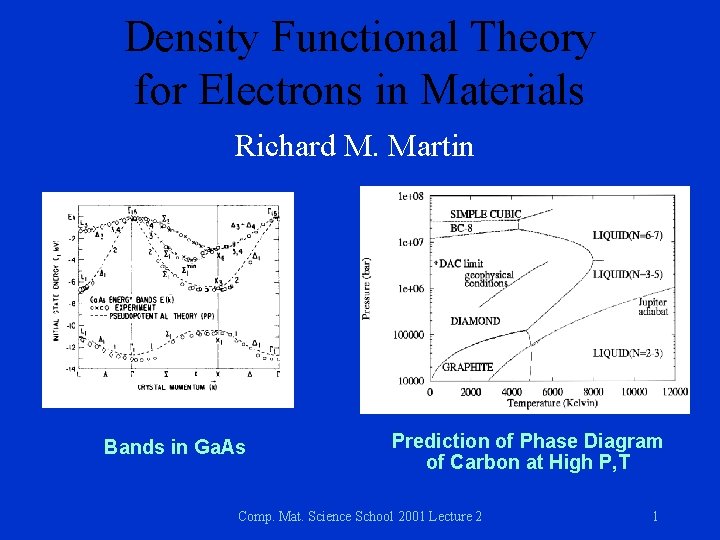
Density Functional Theory for Electrons in Materials Richard M. Martin Bands in Ga. As Prediction of Phase Diagram of Carbon at High P, T Comp. Mat. Science School 2001 Lecture 2 1
• Pseudopotentials Outline – Ab Initio -- Empirical • Bloch theorem and bands in crystals – Definition of the crystal structure and Brillouin zone in programs used in the lab (Friday) • Plane wave calculations • Iterative methods: – Krylov subspaces – Solution by energy minimization: Conjugate gradient methods – Solution by residual minimization (connnection to. VASP code that will be used by Tuttle) • Car-Parrinello ``ab initio’’ simulations • Examples Comp. Mat. Science School 2001 Lecture 2 2
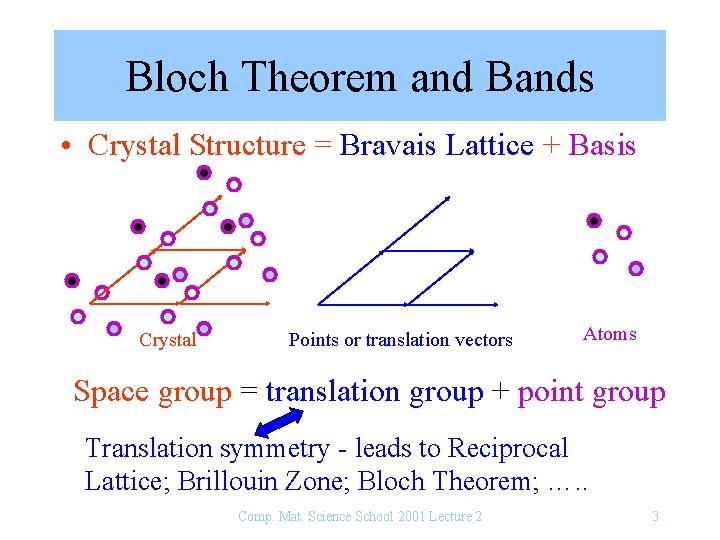
Bloch Theorem and Bands • Crystal Structure = Bravais Lattice + Basis Crystal Points or translation vectors Atoms Space group = translation group + point group Translation symmetry - leads to Reciprocal Lattice; Brillouin Zone; Bloch Theorem; …. . Comp. Mat. Science School 2001 Lecture 2 3
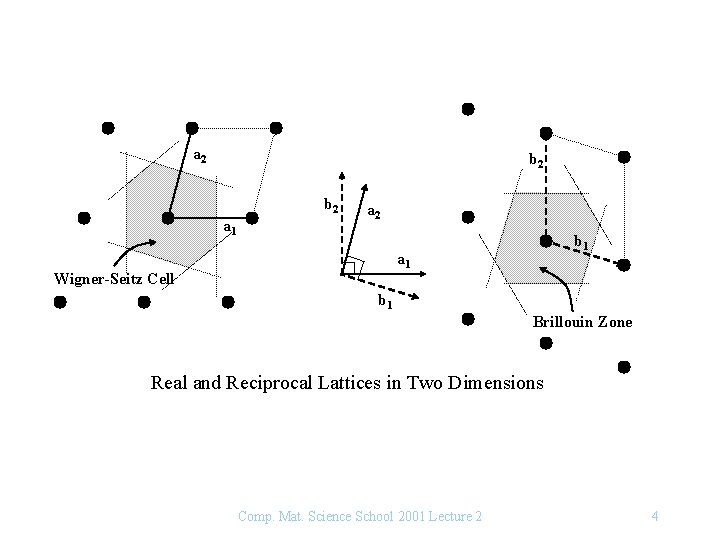
a 2 b 2 a 1 a 2 b 1 a 1 Wigner-Seitz Cell b 1 Brillouin Zone Real and Reciprocal Lattices in Two Dimensions Comp. Mat. Science School 2001 Lecture 2 4
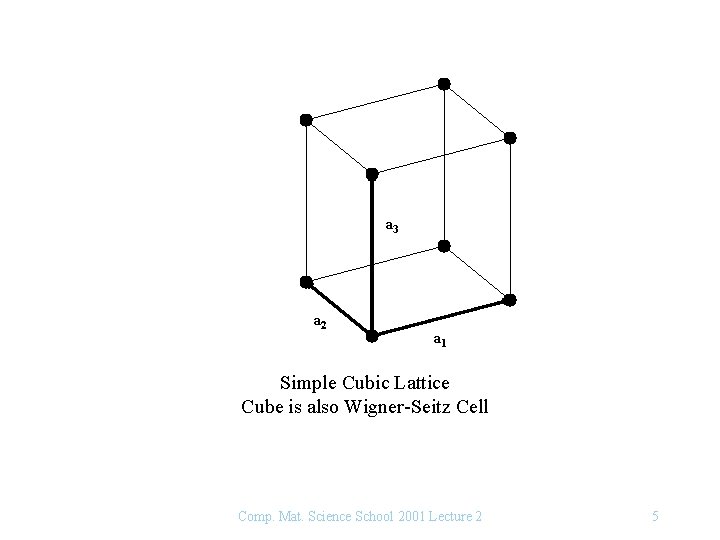
a 3 a 2 a 1 Simple Cubic Lattice Cube is also Wigner-Seitz Cell Comp. Mat. Science School 2001 Lecture 2 5
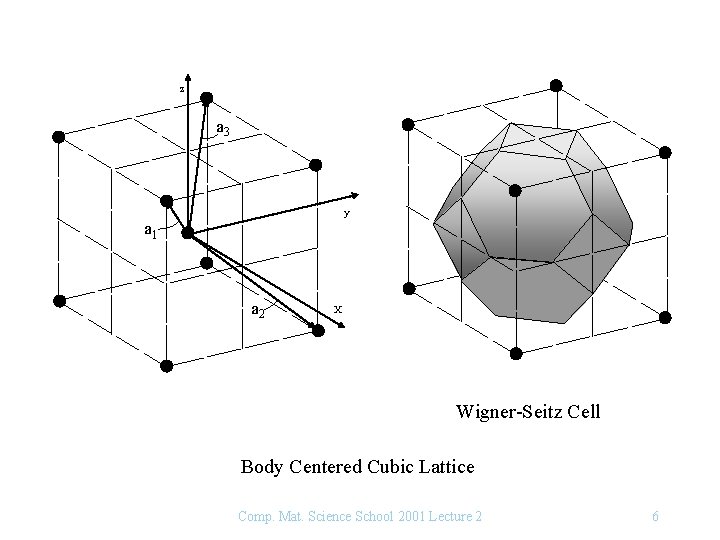
z a 3 y a 1 a 2 X Wigner-Seitz Cell Body Centered Cubic Lattice Comp. Mat. Science School 2001 Lecture 2 6
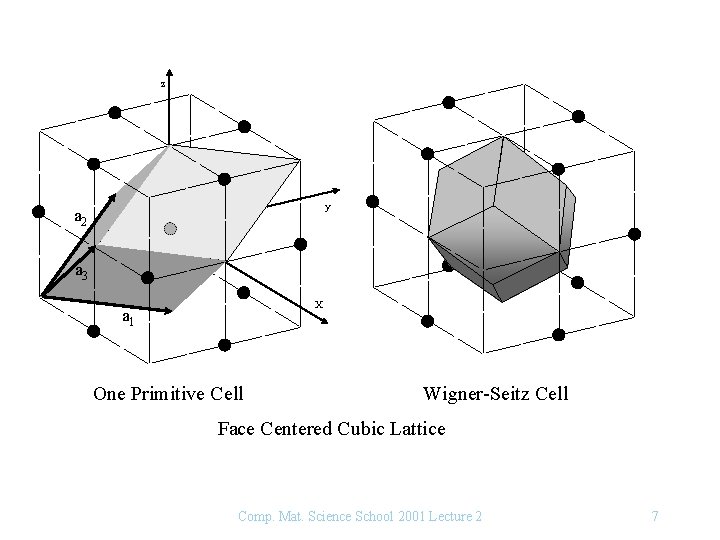
z y a 2 a 3 X a 1 One Primitive Cell Wigner-Seitz Cell Face Centered Cubic Lattice Comp. Mat. Science School 2001 Lecture 2 7
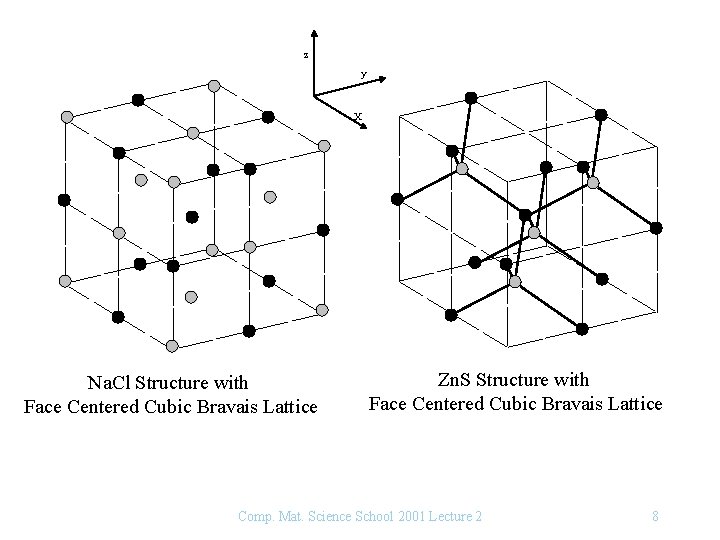
z y X Na. Cl Structure with Face Centered Cubic Bravais Lattice Zn. S Structure with Face Centered Cubic Bravais Lattice Comp. Mat. Science School 2001 Lecture 2 8
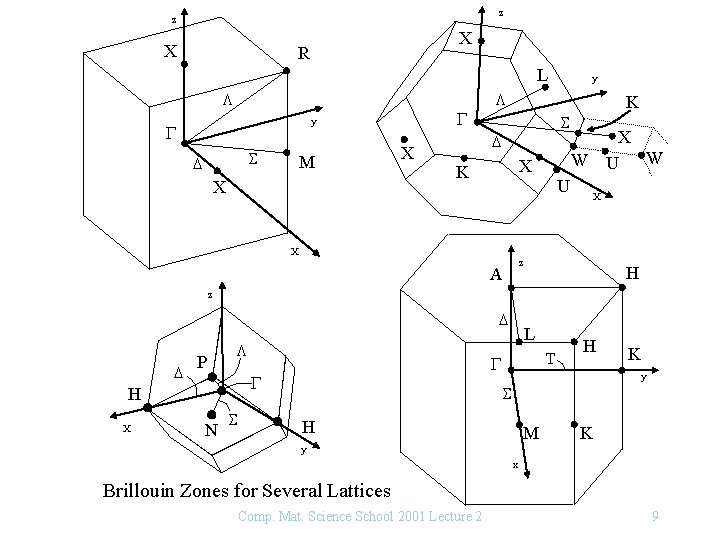
z z X X R L L G y G S D M X X y L K S D W X K U X X W U X z A H z D D P L X N S T G G H L H K y S H M K y x Brillouin Zones for Several Lattices Comp. Mat. Science School 2001 Lecture 2 9
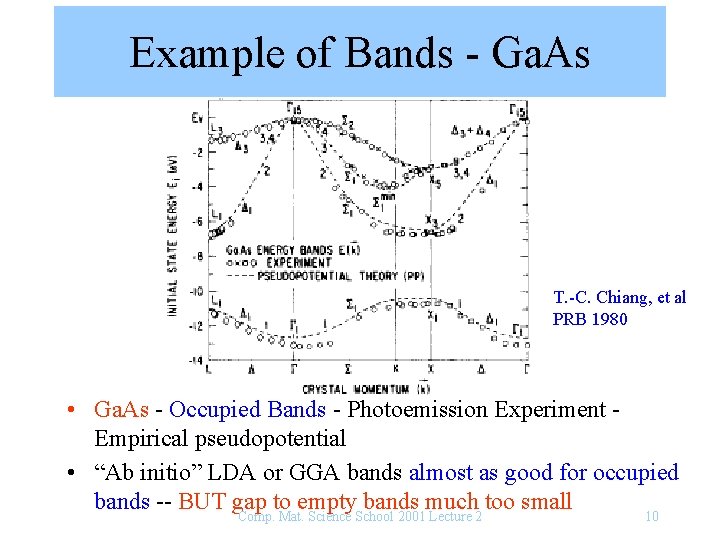
Example of Bands - Ga. As T. -C. Chiang, et al PRB 1980 • Ga. As - Occupied Bands - Photoemission Experiment Empirical pseudopotential • “Ab initio” LDA or GGA bands almost as good for occupied bands -- BUT gap to empty bands much too small Comp. Mat. Science School 2001 Lecture 2 10
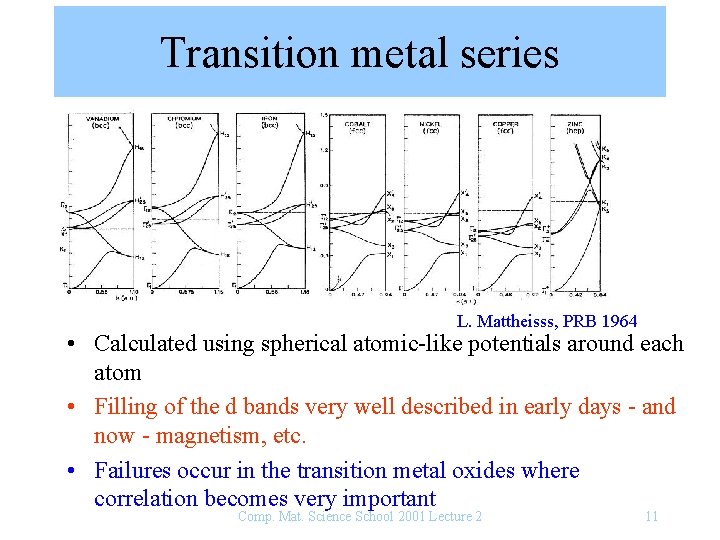
Transition metal series L. Mattheisss, PRB 1964 • Calculated using spherical atomic-like potentials around each atom • Filling of the d bands very well described in early days - and now - magnetism, etc. • Failures occur in the transition metal oxides where correlation becomes very important Comp. Mat. Science School 2001 Lecture 2 11
Standard method - Diagonalization • Kohn- Sham self Consistent Loop • Innner loop: solving equation for wavefunctions with a given Veff • Outer loop: iterating density to selfconsistency – Non-linear equations – Can be linearized near solution – Numerical methods - DIIS, Broyden, etc. (D. Johnson) See later - iterative methods Comp. Mat. Science School 2001 Lecture 2 12
Empirical pseudopotentials • Illustrate the computational intensive part of the problem – Innner loop: solving equation for wavefunctions with a given Veff – Greatly simplified program by avoiding the self -consistency • Useful for many problems • Description in technical notes and lab notes Comp. Mat. Science School 2001 Lecture 2 13
Iterative methods • Have made possible an entire new generation of simulations • Innner loop: This is where the main computation occurs – Many ideas - all with both numerical and a physical basis – Energy minimization - Conjugate gradients – Residual minimization - Davidson, DIIS, . . . – See lectures of E. de Sturler Comp. Mat. Science School 2001 Lecture 2 Used in Lab 14
Car-Parrinello Simulations • Elegant solution where the optimization of the electron wavefunctions and the ion motion are all combined in one unified algorithm Comp. Mat. Science School 2001 Lecture 2 15
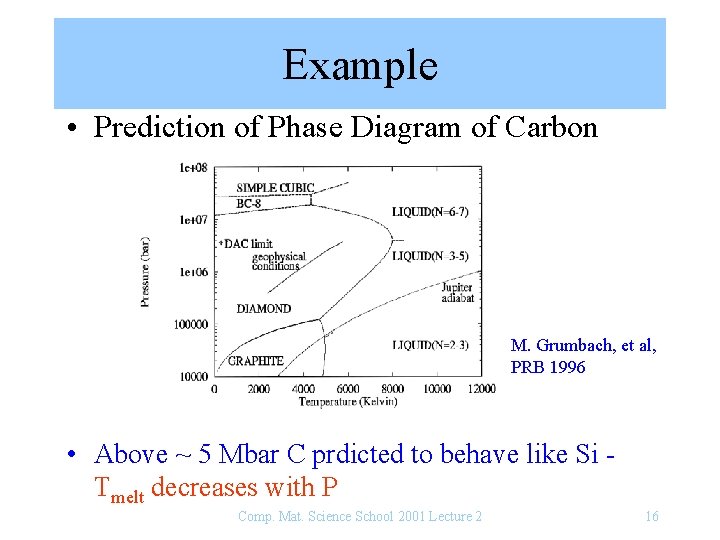
Example • Prediction of Phase Diagram of Carbon M. Grumbach, et al, PRB 1996 • Above ~ 5 Mbar C prdicted to behave like Si Tmelt decreases with P Comp. Mat. Science School 2001 Lecture 2 16
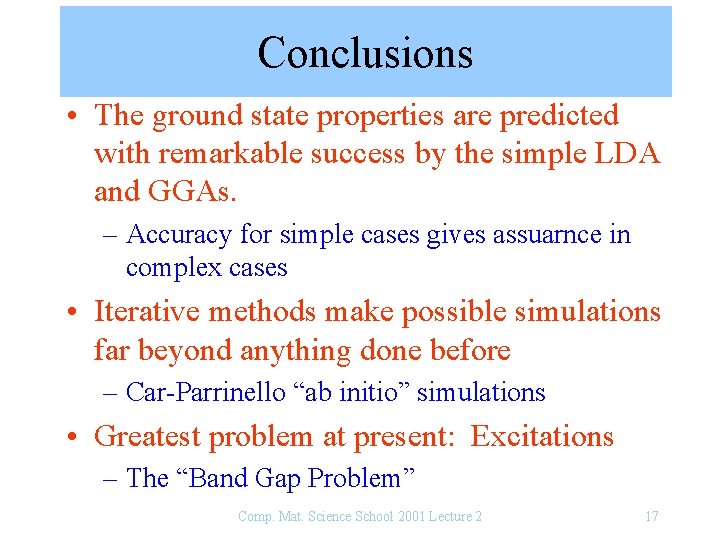
Conclusions • The ground state properties are predicted with remarkable success by the simple LDA and GGAs. – Accuracy for simple cases gives assuarnce in complex cases • Iterative methods make possible simulations far beyond anything done before – Car-Parrinello “ab initio” simulations • Greatest problem at present: Excitations – The “Band Gap Problem” Comp. Mat. Science School 2001 Lecture 2 17